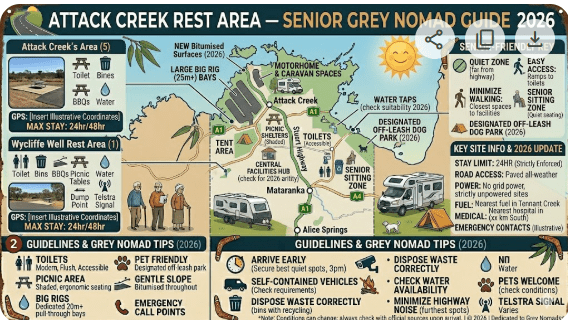
Attack Creek Rest Area – Senior Grey Nomad Guide 2026
GPS coordinates, road conditions, fuel stops, facilities, heat safety, wildlife, and everything a senior grey nomad needs to know before pulling off the Stuart Highway at this historic NT rest area.
📅 Last reviewed: January 2026 | Stuart Highway, Northern Territory 0862 | Free overnight stop — remote outback setting
📋 Table of Contents
- Why Grey Nomads Stop at Attack Creek
- Free Camping — Know the Rules for Seniors
- Quick Facts and Key Details 2026
- How to Get There + GPS Coordinates
- Road Conditions, Flooding and Sealed vs Unsealed
- Heat and Remoteness — Senior Safety
- Wildlife — Birds, Reptiles and What to Watch For
- What Other Websites Don’t Tell You
- Best Time to Visit — Month-by-Month Breakdown
- Free and Low-Cost Camping Alternatives Nearby
- Dump Points Near Attack Creek
- Free Water Sources Near Attack Creek
- Fuel Stops Along the Stuart Highway
- Caravan Parks — Paid Alternatives
- Full Facilities Comparison Table
- Rates — All Options Near Attack Creek 2026
- Senior Safety Checklist
- Things to Do Near Attack Creek
- Vanlife Savings Spots — GPS & Postcodes
- Phone Signal and Emergency Communications
- Campfires, Cooking and Food Purchases
- Pets at Attack Creek
- Accessibility for Seniors with Mobility Limitations
- Camping Permits, Fees, Etiquette and Waste Management
- Emergency Scenarios — What to Do
- Packing List for This Section of Highway
- 5 Rest Areas Near Attack Creek
- Reviews — What Grey Nomads Say
- Frequently Asked Questions
- Quick-Reference Card
- Disclaimer
Why Grey Nomads Stop at Attack Creek
Attack Creek Rest Area sits on the Stuart Highway approximately 375 kilometres north of Alice Springs and around 530 kilometres south of Tennant Creek — wait, let’s get this right. Attack Creek is located approximately 90 kilometres north of Tennant Creek and sits at roughly the halfway mark between Tennant Creek and Elliott on the long, remote northern stretch of the Stuart Highway in the Northern Territory.
For grey nomads completing the iconic Darwin to Alice Springs run — or travelling in the opposite direction — Attack Creek is one of those genuinely useful rest stops that breaks up a long and demanding section of outback highway. The area carries real historical significance: it was here in 1860 that explorer John McDouall Stuart was forced to turn back following a confrontation with Aboriginal warriors. A commemorative marker at the site tells this story, making it a rare rest area that combines practical utility with genuine outback history.
From a practical standpoint, senior travellers pulling long days on the Stuart Highway will appreciate the opportunity to rest, stretch, and regroup before continuing north toward Daly Waters or south toward Tennant Creek. It’s not a glamorous stop — no powered sites, no dump points, no kiosk — but for free overnight camping with shade trees and space for large rigs, it punches well above its weight in this part of the NT.
First-hand observation: Pulling in late one April afternoon, there were already three caravans set up under the scattered trees. The site has a genuinely peaceful, wide-open feel — the kind of quiet you only find hundreds of kilometres from the nearest city. The historical marker gave us a reason to stretch our legs and learn something while the billy boiled.
Free Camping — Know the Rules for Seniors
Attack Creek Rest Area is a Northern Territory Government managed rest area on the Stuart Highway. Overnight stays are permitted and free of charge. There are no booking systems, no fees, and no ranger check-ins required. You simply pull in, set up, and depart when ready.
There are no fees at Attack Creek. This is a genuine free overnight stop. Camping is permitted at the rest area itself — this is an NT highway rest area, not a national park. Refer to official NT Government highway rest areas information for the latest rules and any updates.
- ✅ Free to stay overnight
- ✅ No booking required
- ✅ Suitable for caravans, motorhomes, campervans
- ✅ Heavy vehicles and road trains use this area too — be aware
- ⚠️ No powered sites
- ⚠️ No dump point on-site
- ⚠️ No potable water on-site (confirm before relying on this)
- ⚠️ No phone signal (Telstra may have very limited coverage — do not rely on it)
Quick Facts and Key Details 2026
| Detail | Information |
|---|---|
| 📍 Location | Stuart Highway, NT — approx. 90 km north of Tennant Creek |
| 🌐 GPS Coordinates | -18.7383, 133.8947 (approx.) |
| 📮 Postcode | 0862 (Tennant Creek region) |
| 💰 Cost | Free — no fees |
| 🚐 Overnight Allowed? | Yes |
| 🚿 Toilets | Yes — basic pit/drop toilets on-site |
| 🚰 Potable Water | Not reliably available — carry your own |
| 🗑️ Dump Point | No — nearest at Tennant Creek or Elliott |
| ⚡ Power | No powered sites |
| 🐾 Pets | Permitted — on-lead recommended |
| 📶 Phone Signal | Very limited to none — Telstra only, unreliable |
| 🚛 Road Trains | Road trains use this rest area — park clear of their path |
| 🏛️ Historical Significance | John McDouall Stuart 1860 — explorer turned back here |
| 🌡️ Climate Zone | Semi-arid — extreme heat in wet season (Oct–Mar) |
| 🔥 Campfires | Ground fires generally not permitted at NT highway rest areas |
| 🌿 Shade | Some shade trees — not guaranteed availability |
🏛️ Historical Significance — John McDouall Stuart, 1860
In 1860, explorer John McDouall Stuart attempted to cross Australia from south to north. At Attack Creek, his party was confronted by a large group of Aboriginal warriors and was forced to retreat south. The site is named for this encounter. A commemorative marker at the rest area tells the story — it’s worth reading before you drive on. Stuart eventually succeeded in crossing the continent in 1862, and the Stuart Highway that carries you through this landscape today is named in his honour.
For senior travellers with an interest in Australian exploration history, this rest area is a genuine highlight of the Stuart Highway journey — not just a toilet stop.
How to Get There + GPS Coordinates
📍 GPS Coordinates — Attack Creek Rest Area
-18.7383, 133.8947
Coordinate source: Publicly available mapping data (OpenStreetMap / Google Maps cross-referenced). Verify on arrival — remote NT coordinates can vary slightly between mapping services.
🗺️ Open in Google Maps | 🍎 Open in Apple Maps
Postcode: 0862 | State: Northern Territory | Highway: Stuart Highway
Navigation Instructions
Attack Creek Rest Area is located directly on the Stuart Highway — there are no turnoffs, no unsealed access roads, and no hidden driveways. The rest area pull-in is clearly signed from both directions on the highway.
- Travelling North (from Tennant Creek toward Elliott/Darwin): After leaving Tennant Creek, travel approximately 90 kilometres north on the Stuart Highway. The rest area pull-in is on the left (west) side of the highway. Watch for the brown directional sign. Give yourself plenty of time to slow down — road trains behind you are a real consideration.
- Travelling South (from Elliott or Darwin toward Alice Springs): Travelling south from Elliott, Attack Creek is approximately 100 kilometres south. The entry is on the right (west) side of the road. Again, signage is present but watch your speed approaching the entry.
Using GPS, search for “Attack Creek Rest Area, NT” or enter the coordinates directly: -18.7383, 133.8947. Most major GPS apps including Google Maps, Hema Explorer, and CamperMate recognise this rest area. Hema Explorer is strongly recommended for this section of the Stuart Highway given the remoteness of the area.
Entry and Manoeuvring for Caravans and Motorhomes
The rest area is designed to accommodate heavy vehicles including road trains, which means the entry and internal layout are generally suitable for large caravans, fifth-wheelers, and motorhomes. The surface is sealed at the entry point and transitions to a compacted gravel or dirt surface within the rest area itself. In dry conditions, this presents no issues for most rigs. In wet conditions during the NT wet season, the surface can become soft — approach with care.
First-hand observation: Entering from the south in a 21-foot caravan, the pull-in was smooth and wide. We had no difficulty positioning the van under a shaded spot — though by mid-afternoon on our visit, the best shade positions were already taken by two trucks that had stopped for their mandatory rest. Plan to arrive before 3pm if shade is important to you.
Road Conditions, Flooding and Sealed vs Unsealed
Is the Stuart Highway Sealed?
Yes — the Stuart Highway is fully sealed for its entire length through the Northern Territory. Attack Creek Rest Area is accessed directly from this sealed highway. There are no unsealed sections required to reach or use this rest area. You do not need a 4WD to access Attack Creek Rest Area.
Does the Road Flood?
The Stuart Highway in this region can experience flooding across the road surface during significant wet season rainfall events. The surrounding landscape is flat and low-lying in sections, and water can sheet across the highway quickly. Specific creek crossings in the broader region have been known to flood.
- Always check road conditions before travelling during the wet season (October–April)
- Use the official NT Government Road Conditions website before departing
- The Bureau of Meteorology (BOM) NT forecast page provides rainfall warnings relevant to this region
- Tune in to local ABC radio on 783 AM (Alice Springs) for real-time road condition updates in the region
Rest Area Surface Conditions
The internal surface of Attack Creek Rest Area transitions from sealed highway entry to compacted gravel or dirt within the parking area. In dry conditions this is stable and firm. During or immediately after wet season rain, the surface can become soft, particularly around the edges. If you’re travelling during the wet season and have any concern about soft ground, consider parking closer to the sealed highway entry point rather than deeper in the rest area.
Heat and Remoteness — Senior Safety
This is not a rest area near a country town. Attack Creek sits in the heart of one of Australia’s most remote stretches of highway. The nearest town in either direction — Tennant Creek to the south or Elliott to the north — is approximately 90–100 kilometres away. In the event of a medical emergency, vehicle breakdown, or heat-related illness, help is not close.
Heat Safety Protocols for Seniors at Attack Creek
- Carry a minimum of 20 litres of drinking water per person when travelling this section of highway — more in summer
- Travel in the early morning (depart before 8am if possible during hot months) and rest during the hottest part of the day (11am–3pm)
- Ensure your vehicle’s air conditioning is fully functional before departing for this section of highway
- Know the signs of heat stroke: confusion, cessation of sweating, very high body temperature, loss of consciousness — these require emergency response
- Do not rely on phone signal to call for help — carry a PLB (Personal Locator Beacon) or satellite communicator (EPIRB, Garmin inReach, SPOT)
- Tell someone your intended travel plan, expected arrival time, and vehicle details before departing
- If your vehicle breaks down: stay with your vehicle, use shade, ration water, and activate your PLB
Wildlife — Birds, Reptiles and What to Watch For
Attack Creek sits in the semi-arid Northern Territory interior — an environment that supports a surprisingly rich range of wildlife despite its sparse appearance. For senior bird watchers and nature lovers, this region holds genuine rewards.
Birds You May See
- Budgerigars — large flocks move through this region seasonally and can number in the thousands
- Cockatiels — common in the mulga and spinifex scrub flanking the highway
- Wedge-tailed Eagles — frequently seen circling or feeding on roadkill along the Stuart Highway
- Australian Bustard (Plains Turkey) — occasionally spotted near the roadside at dawn and dusk
- Zebra Finches — particularly around any water source
- Kites and Ravens — common scavengers along the highway
Reptiles and Other Wildlife
- Goannas (Sand Monitor / Perentie) — may be seen near the rest area, particularly in cooler morning hours
- Bearded Dragons — frequently bask on warm bitumen near rest areas at dawn
- Brown Snakes and King Brown Snakes — present in this region; always check under and around your vehicle and never place hands or feet in unseen areas
- Feral Cattle and Camels — known to wander onto or across the Stuart Highway in this region, particularly at night
- Kangaroos and Wallabies — high collision risk at dawn, dusk, and night
What Other Websites Don’t Tell You
Most online resources list Attack Creek Rest Area as simply “toilets available, overnight OK.” Here is what the generic listings miss:
- Road trains park here too. This is a mandatory rest stop for heavy vehicle drivers. The rest area is sized for road trains — that’s actually good news for caravan access, but it does mean noise during the night. Earplugs are worth packing.
- The historical marker is genuinely worth reading. Most travellers drive straight past or use the toilets and leave. The story of John McDouall Stuart’s 1860 retreat from this location is a pivotal moment in Australian exploration history — take 10 minutes to read it.
- Shade positions fill fast. By mid-afternoon on any given day during the busy dry season (June–August), the limited shaded spots are typically taken. Arriving early — before 2pm — gives you the best chance of a comfortable, shaded overnight spot.
- The silence is remarkable. After the last road train passes in the early hours and before the dawn trucks begin again, the silence in this part of the outback is extraordinary. Senior travellers who appreciate stargazing and night silence will find this an unexpectedly special overnight experience.
- There is no phone signal for most carriers. Optus and Vodafone users will have no signal here. Telstra users may get a very weak signal — do not rely on it for navigation or emergency communication. A PLB is not optional on this section of highway.
- Fuel planning is critical. There is no fuel at Attack Creek. If you’re running low, the distances between fuel stops on this section of the Stuart Highway are serious — see the fuel section below.
Best Time to Visit — Month-by-Month Breakdown
| Month | Season | Conditions | Senior Suitability |
|---|---|---|---|
| January | Wet Season | Extreme heat (40–45°C), heavy rain, possible flooding | ❌ Not recommended |
| February | Wet Season | Extreme heat, high humidity, flood risk | ❌ Not recommended |
| March | Late Wet | Rain easing, still hot and humid, some flood risk | ⚠️ Borderline |
| April | Shoulder | Temperatures dropping, roads drying out | ✅ Good — improving daily |
| May | Dry Season | Pleasant 25–30°C days, cool nights, clear skies | ✅ Excellent |
| June | Dry Season | Peak season — ideal temperatures, busy highway | ✅ Excellent — most popular |
| July | Dry Season | Peak season — cool nights (can drop to 5–8°C) | ✅ Excellent — bring warm gear |
| August | Dry Season | Still excellent — nights warming slightly | ✅ Excellent |
| September | Late Dry | Warming quickly — days 35–38°C, dust increasing | ✅ Good but manage heat |
| October | Build-up | Very hot, oppressive humidity building, storm season begins | ⚠️ Challenging for seniors |
| November | Build-up / Early Wet | Extreme heat and humidity, afternoon storms | ❌ Not recommended |
| December | Wet Season | Extreme heat, heavy rain, flooding | ❌ Not recommended |
Free and Low-Cost Camping Alternatives Nearby
If Attack Creek is full, or you want a slightly different overnight experience, these are the closest alternatives along the Stuart Highway in both directions:
- Phillip Creek Rest Area — Approx. 30 km south of Attack Creek toward Tennant Creek. Basic facilities, highway rest area, free overnight.
- Tennant Creek Show Grounds / Caravan Park — Approximately 90 km south. Powered and unpowered sites available. Donation or paid basis.
- Elliott Rest Area / Town Area — Approximately 100 km north. Elliott has basic services including a pub and roadhouse. Some free roadside camping options in the region.
- Renner Springs Desert Rose Roadhouse — Approximately 90 km north. Paid caravan parking available adjacent to the roadhouse. Basic but has fuel and food.
- Newcastle Waters Historic Site — A short detour from the highway near Elliott. A historically significant droving site with basic facilities. Check current access conditions.
Dump Points Near Attack Creek
There is no dump point at Attack Creek Rest Area itself. The nearest confirmed dump point locations are:
| Location | Distance from Attack Creek | Direction | Notes |
|---|---|---|---|
| Tennant Creek — Caravan Park / Council Facility | ~90 km | South | Confirm with local council or use CamperMate app for current status |
| Elliott Roadhouse / Town | ~100 km | North | Basic facilities — confirm availability on arrival |
| Renner Springs Roadhouse | ~90 km | North | May have dump facilities — check on arrival or via CamperMate |
Free Water Sources Near Attack Creek
There is no reliable potable water supply at Attack Creek Rest Area. Do not assume water is available here — treat this stop as a dry camp and plan accordingly.
Water Sources in the Region
- Tennant Creek (south, ~90 km) — town water supply, supermarket, caravan parks all have water
- Elliott (north, ~100 km) — town water available at the roadhouse and town facilities
- Renner Springs Roadhouse (north, ~90 km) — water available for purchase/fill
Fuel Stops Along the Stuart Highway
Fuel planning is non-negotiable on this section of the Stuart Highway. Attack Creek has no fuel. Here are the distances between fuel stops in both directions:
| Fuel Stop | Direction from Attack Creek | Approximate Distance | Notes |
|---|---|---|---|
| Tennant Creek — Multiple Fuel Outlets | South | ~90 km | Diesel and unleaded available. BP, Outback Energy, independent stations. Best place to fill before heading north. |
| Renner Springs Desert Rose Roadhouse | North | ~90 km | Fuel available — prices typically higher than Tennant Creek. Check PetrolSpy before departing. |
| Elliott — Roadhouse | North | ~100 km | Fuel available at the main roadhouse. Elliott is a small town but has the basics. |
| Daly Waters — Daly Waters Pub & Roadhouse | North | ~180 km | Iconic outback pub with fuel. Worth a stop — legendary grey nomad social hub. |
| Three Ways Roadhouse | South (junction) | ~90 km (from Tennant Creek, at the Barkly Hwy junction) | Fuel and basic food available at the Barkly Highway / Stuart Highway junction |
Travelling North from Attack Creek — Fuel Distance Summary
- Attack Creek → Renner Springs Roadhouse: ~90 km
- Attack Creek → Elliott: ~100 km
- Attack Creek → Daly Waters: ~180 km
- Attack Creek → Katherine: ~370 km
- Attack Creek → Darwin: ~600 km
Travelling South from Attack Creek — Fuel Distance Summary
- Attack Creek → Tennant Creek: ~90 km
- Attack Creek → Three Ways (Barkly Hwy junction): ~100 km
- Attack Creek → Wauchope Roadhouse: ~230 km south
- Attack Creek → Alice Springs: ~465 km
Caravan Parks — Paid Alternatives
If you’re after powered sites, a proper dump point, hot showers, or simply want more security and comfort after a long day on the highway, these are the closest paid accommodation options:
| Option | Distance | Approx. Cost (2026) | Features |
|---|---|---|---|
| Tennant Creek — Outback Caravan Park | ~90 km south | $35–$50/night powered | Powered sites, dump point, showers, laundry, pool in some parks |
| Tennant Creek — Tourist Park | ~90 km south | $30–$45/night unpowered | Unpowered and powered options, amenities block |
| Renner Springs Desert Rose Roadhouse | ~90 km north | ~$25–$35/night basic | Basic powered and unpowered pull-through sites adjacent to roadhouse |
| Elliott Caravan Area | ~100 km north | Low cost / donation | Very basic — Elliott is a small community |
| Daly Waters Pub Caravan Park | ~180 km north | ~$30–$45/night | Iconic location, showers, dump point, legendary beef stew nights |
Free campsites and rest areas fill fast during peak dry season (June–August). If your preferred site is taken or the heat has become too much, search remaining accommodation options in Tennant Creek or along the Stuart Highway below.
Accommodation and flight search powered by Expedia. Booking through this search supports this website at no extra cost to you. As an affiliate, I earn from qualifying purchases at no extra cost to you.
Full Facilities Comparison Table
| Facility | Attack Creek RA | Tennant Creek CP | Renner Springs RH | Daly Waters Pub CP |
|---|---|---|---|---|
| Cost | Free | $35–$50 | $25–$35 | $30–$45 |
| Toilets | ✅ Basic pit | ✅ Full amenities | ✅ Roadhouse | ✅ Full amenities |
| Showers | ❌ | ✅ | ⚠️ Limited | ✅ |
| Power | ❌ | ✅ | ✅ Some sites | ✅ Some sites |
| Dump Point | ❌ | ✅ | ⚠️ Check on arrival | ✅ |
| Water | ❌ Not reliable | ✅ | ✅ | ✅ |
| Fuel Nearby | ❌ 90 km | ✅ In town | ✅ On-site | ✅ On-site |
| Phone Signal | ❌ Very poor | ✅ Telstra good | ⚠️ Weak | ⚠️ Weak |
| Historical Interest | ✅ Excellent | ⚠️ Nearby | ❌ | ✅ Iconic pub |
| Shade Trees | ✅ Some | ✅ Good | ⚠️ Limited | ✅ Good |
| Caravan Suitable | ✅ | ✅ | ✅ | ✅ |
| Road Train Traffic | ⚠️ High | ⚠️ Nearby | ⚠️ Nearby | ⚠️ Nearby |
Rates — All Options Near Attack Creek 2026
| Accommodation Option | Type | 2026 Rate (Approx.) | Booking Required? |
|---|---|---|---|
| Attack Creek Rest Area | Free overnight rest area | Free | No |
| Tennant Creek Caravan Park (powered) | Powered site | $35–$50/night | Recommended peak season |
| Tennant Creek Caravan Park (unpowered) | Unpowered site | $25–$35/night | Walk-in usually available |
| Renner Springs Roadhouse Camping | Basic powered/unpowered | $25–$35/night | No |
| Elliott Area Basic Camping | Unpowered / donation | Free–$15 | No |
| Daly Waters Pub Caravan Park | Powered and unpowered | $30–$45/night | Recommended — very popular |
| Newcastle Waters Historic Drovers Camp | Basic free camping area | Free–$5 | No |
Note: All rates are indicative for 2026 and subject to change. Verify current rates with individual operators before arrival. Peak season (June–August) may attract higher demand and limited availability at paid sites.
Senior Safety Checklist — Attack Creek & Stuart Highway
- Fuel tank full — topped up in last town (Tennant Creek or Elliott)
- Water carried — minimum 20 litres per person (40+ litres for a couple)
- Food for 2 extra days in case of breakdown or road closure
- PLB or satellite communicator charged and registered
- First aid kit stocked — including heat illness treatment supplies
- Medications packed with written medical summary in glove box
- Responsible person told of travel plan and expected arrival time
- Vehicle serviced — tyres, radiator, coolant, belts all checked
- Spare tyre in good condition and correctly inflated
- Air conditioning confirmed working before departure
- Hema Explorer or offline maps downloaded — do not rely on phone-based GPS with signal
- BOM weather forecast checked for the region
- NT road conditions checked online before departure
- Campfire restrictions noted — ground fires not generally permitted at NT highway rest areas
- Dump point emptied before leaving last town
- Grey or black water tanks capacity assessed — next dump point is 90+ km away
- Torch and batteries within reach (not packed away) for night emergencies
- Snake awareness — check under and around van before moving around at dawn or dusk
- Earplugs packed — road trains stop here through the night
- Warm layer packed — NT dry season nights can be very cold (5–10°C in June/July)
Things to Do Near Attack Creek — Senior Activity Guide
At Attack Creek Rest Area
- Read the John McDouall Stuart commemorative marker — a genuinely interesting piece of Australian exploration history
- Bird watching — particularly good at dawn and dusk. Budgerigars, cockatiels, raptors
- Stargazing — with zero light pollution, the night sky here is extraordinary. The Milky Way is clearly visible on clear nights
- Photography — the flat outback landscape, spinifex grasslands and big sky make for striking travel photography
Within 100 km — Tennant Creek (South ~90 km)
- Tennant Creek Battery Hill Mining Centre — outstanding gold rush history experience, senior-friendly facilities
- Barkly Homestead — nearby historic pastoral station country
- Karlu Karlu (Devils Marbles) Conservation Reserve — approximately 100 km south of Tennant Creek. One of the most iconic geological sites in Australia. Absolutely worth a detour. Senior-accessible walking paths. Day use area with toilets and picnic facilities.
- Tennant Creek Visitor Information Centre for local maps and touring advice
- Supermarket and services in Tennant Creek for restocking
Within 100 km — Elliott and North (North ~100 km)
- Newcastle Waters Historic Droving Site — near Elliott. A National Trust-listed historic droving junction with original buildings. Fascinating pastoral history.
- Daly Waters Pub (~180 km north) — a legendary outback icon. The famous barra and beef evening meal is an experience every grey nomad should have at least once on their Stuart Highway journey.
⭐ Don’t Miss: Karlu Karlu (Devils Marbles) — A Short Detour South
If you haven’t yet visited Karlu Karlu on your journey, it is located approximately 105 km south of Tennant Creek on the Stuart Highway — meaning it’s within realistic striking distance of Attack Creek. The massive granite boulders balanced in extraordinary formations are culturally significant to the Warumungu, Kaytetye, Alyawarr and Warlpiri people, and visually spectacular. Sunrise and sunset here are among the most photographed moments in outback Australia. There are basic camping facilities at the site managed by NT Parks and Wildlife — worth checking current availability and fees before you arrive.
🗺️ Vanlife Savings Spots — GPS Coordinates & Postcodes
The RetireToVanLife.com Vanlife Savings Spots map helps you find free camps, rest areas, and overnight stops along your route. Save every stop, plan your fuel and water strategy, and build your own personalised highway route — all in one place.
COPY PROMPT ➔ ASK AI ➔ SAVE TO FORM ➔ ADD SPOT PIN ➔ GET DIRECTIONS
📍 Interactive map — find free camps, rest areas and overnight stops. Enable location for best results.
Stuart Highway Key Stops — GPS Quick Reference
| Location | GPS (Approx.) | Postcode | Type | WiFi Nearby? |
|---|---|---|---|---|
| Attack Creek Rest Area | -18.7383, 133.8947 | 0862 | Free overnight rest area | No |
| Tennant Creek (town) | -19.6516, 134.1914 | 0860 | Town — full services | Yes — library, some cafes |
| Renner Springs Roadhouse | -18.3236, 133.7949 | 0862 | Roadhouse / basic camping | Very limited |
| Elliott (town) | -17.5556, 133.5321 | 0862 | Small town — basic services | Very limited |
| Karlu Karlu (Devils Marbles) | -20.5406, 134.2703 | 0860 | Conservation Reserve — basic camping | No |
| Daly Waters Pub & Caravan Park | -16.2636, 133.3763 | 0852 | Iconic pub / caravan park | Limited pub WiFi |
Phone Signal and Emergency Communications
Phone coverage at Attack Creek Rest Area is extremely limited to non-existent for all carriers. Telstra — Australia’s most extensive outback network — provides the best chance of a weak signal in this area but it cannot be relied upon for voice calls or data. Optus and Vodafone users will have no signal.
Emergency Communication Options — In Order of Reliability
- PLB (Personal Locator Beacon) — 406 MHz PLBs registered with AMSA are the gold standard for outback emergency communication. Free to register. Activates a rescue response 24/7 globally.
- Satellite Communicator — Garmin inReach, SPOT Gen4, or similar. Two-way messaging via satellite. More expensive to run than a PLB but allows non-emergency communication.
- HF Radio (27 MHz or SSB) — Used by some experienced outback travellers. RFDS (Royal Flying Doctor Service) frequencies provide an additional layer of safety.
- Telstra Mobile (Weak) — May provide limited 3G signal at this location. Try from higher ground near the highway. Do not rely on this alone.
- CB Radio (UHF 40-channel) — Channel 40 is the highway channel for truck drivers. If you break down, broadcasting on channel 40 may attract the attention of a passing road train driver who can alert emergency services at the next town.
Campfires, Cooking and Food Purchases
Campfire Rules at NT Highway Rest Areas
Ground fires are generally not permitted at NT highway rest areas including Attack Creek. The area is dry, fire risk is high, and the environment is fragile. Do not light a ground fire here. Check signage on arrival for current restrictions — fire bans may apply seasonally.
You may use a gas stove, portable LPG camp stove, or elevated firepot with a tray where embers cannot reach the ground — but always check current fire restriction signage on arrival and observe any Total Fire Bans that may be in effect. Current fire restrictions for the NT can be found via the NT Government Bushfire page.
Cooking and Food at Attack Creek
- There is no kiosk, no food outlet, and no vending machine at Attack Creek
- Bring all food from Tennant Creek (south) or Renner Springs / Elliott (north)
- Tennant Creek has a Coles supermarket and IGA for full grocery restocking
- Elliott has a basic community store — limited range, higher prices
- Daly Waters Pub serves meals and is well worth the northbound detour for a hot dinner
Pets at Attack Creek Rest Area
Pets are permitted at Attack Creek Rest Area. There are no restrictions specific to this highway rest area regarding pets. However, senior travellers should consider the following:
- Keep pets on a lead at all times — snake risk is very real in this region
- Carry significantly more water than you think you need for pets in outback heat
- Paw protection — hot bitumen and gravel can badly burn dog paws. Test the surface with your hand before letting a dog walk on it
- Be aware of snake activity at dawn and dusk — snakes are warm and active in outback regions
- Road trains and highway traffic pose a serious risk if a pet escapes near the highway
- Feral animals in the region — dingoes, feral cats — may pose a threat to small pets at night
Accessibility for Seniors with Mobility Limitations
Attack Creek Rest Area is a basic highway rest stop — it is not a purpose-built accessible tourism facility. However, it does offer a reasonable level of accessibility for seniors with moderate mobility limitations.
| Facility | Accessibility Notes |
|---|---|
| Parking Area Surface | Compacted gravel — generally firm in dry conditions. Uneven in wet. Not ideal for wheelchairs. |
| Toilet Facilities | Basic pit toilet — not a purpose-built accessible toilet. Limited accessibility for wheelchair users. Stable footing on approach in dry conditions. |
| Historical Marker | Ground-level signage — accessible for most mobility levels. No steps or barriers. |
| Shade Areas | Natural tree shade — ground is uneven but generally manageable with a walking stick or frame |
| Distance from Vehicle to Toilet | Short — can be managed by most seniors with mobility aids |
| Picnic Furniture | Basic table and seating may be present — not guaranteed to be fully accessible |
Camping Permits, Fees, Etiquette and Waste Management
Permits and Fees
No permit is required and there are no fees to use Attack Creek Rest Area. It is an NT Government highway rest area — open to all road users, free of charge, at all times.
Etiquette at Attack Creek
- This rest area is shared with road trains and heavy vehicles — respect their space and working conditions
- Do not park in the heavy vehicle lane or access area
- Keep noise to a minimum, particularly late evening and early morning
- Do not monopolise shaded areas with multiple vehicles if other travellers need shade
- Pick up your rubbish — there may or may not be a bin on-site. Carry a rubbish bag and take your waste to the next town
- Leave the rest area as you found it — or better
Waste Management
There may be basic waste bins at the rest area — but do not rely on them being present, emptied, or large enough for your waste. The practice of pack it in, pack it out is the safest approach on this section of the highway.
- Grey water — do not dump grey water at the rest area. Carry it to the next dump point
- Black water (cassette/pump-out) — nearest dump points are at Tennant Creek or Elliott (~90–100 km)
- Toilet paper and waste — use the on-site pit toilet and dispose responsibly
- Food scraps — bag and bin or take to next town; do not leave food waste on the ground (attracts wildlife and dingoes)
Emergency Scenarios — What to Do
Scenario 1: Vehicle Breakdown at Attack Creek
- Pull completely off the highway and set up warning triangles or lights
- Attempt to contact help via mobile (Telstra) — try from multiple positions including slightly elevated ground
- If no signal — use UHF CB Radio Channel 40 to contact passing truck drivers
- If still no contact — activate PLB if situation is life-threatening
- Stay with your vehicle — it is vastly easier to find than a person on foot in this terrain
- Ration water immediately and move to shade
- Flag down passing motorists — there is regular highway traffic on the Stuart Highway
- Nearest mechanical assistance: Tennant Creek (~90 km south) or Elliott (~100 km north)
- NRMA / RAA / other roadside assist — limited coverage in outback NT — know your policy limits before you depart
Scenario 2: Medical Emergency at Attack Creek
- Activate PLB immediately if the situation is life-threatening
- Call 000 — if any signal is available, emergency calls may connect even on weak networks
- The Royal Flying Doctor Service (RFDS) operates in this region — they can be dispatched to the highway in emergencies
- Keep the patient cool, in shade, and hydrated until help arrives
- Flag down a passing vehicle to carry word to the nearest town if no communication is possible
Scenario 3: Road Flooding — Highway Closed
- Never attempt to drive through floodwater — turn back
- Attack Creek Rest Area becomes a temporary shelter if the highway is closed in both directions
- Conserve water and food while waiting for the road to clear
- Monitor NT road conditions via any available signal
- NT road closures in this region typically clear within 24–72 hours after rain stops — but can be longer in severe events
Packing List for This Section of Highway
Water and Food
- 40+ litres drinking water per couple (more in summer)
- Water purification tablets as backup
- 2+ days of non-perishable food in emergency reserve
- Ice/cold storage for perishables
- Camp stove and sufficient gas canisters
Vehicle and Safety
- Full tank of fuel — topped up at last town
- Spare tyre (full-size preferred) in good condition
- Tyre repair kit / portable compressor
- Jump starter or jumper cables
- Basic vehicle tools
- PLB — charged and registered
- UHF CB Radio
- Hema Explorer (offline NT maps downloaded)
- Warning triangles or LED emergency markers
Health and Comfort
- Comprehensive first aid kit including heat illness treatment
- All prescribed medications — minimum 1 week extra supply
- Written medical summary in the glove box
- Sunscreen SPF50+, hat, UV-protective clothing
- Electrolyte sachets (essential in extreme heat)
- Insect repellent
- Earplugs (road trains stop here through the night)
- Warm layer for cold NT dry season nights
- Torch and spare batteries
- Fly net / mesh (flies can be relentless in outback NT)
Documents and Communication
- Vehicle registration papers
- Insurance documents (including roadside assist details)
- Emergency contact list in physical form (not just in the phone)
- Offline guide or printed map of the Stuart Highway as backup
5 Rest Areas Near Attack Creek — Stuart Highway
- Phillip Creek Rest Area — Approx. 30 km south on the Stuart Highway. Basic highway rest area. Toilets. Free overnight. Closer to Tennant Creek services.
- Three Ways Roadhouse Rest Area — Approx. 100 km south at the Barkly Highway / Stuart Highway junction. Fuel, food, basic facilities. Key junction for travellers heading east toward Queensland.
- Renner Springs Rest Area / Roadhouse Pullover — Approx. 90 km north. Roadhouse facilities, fuel, basic camping options adjacent to the highway.
- Elliott Town Rest Area / Roadhouse — Approx. 100 km north. Small town with a pub, roadhouse, basic community facilities. More services than a pure rest area.
- Newcastle Waters Historic Site Rest Area — Approx. 120 km north, short detour from highway. Historic droving station. Basic camping. National Trust listed site. A genuine outback history highlight.
Reviews — What Grey Nomads Say About Attack Creek
“We stopped here on our way north in June and were pleasantly surprised. The historical marker about Stuart’s 1860 retreat is genuinely interesting — we spent 20 minutes reading it and looking at the creek area. Shade was available though the better spots were taken by two trucks. Clean pit toilet. Very quiet after the trucks settled in. Brilliant stars at night. Would absolutely stop again.”
“Functional rather than beautiful. The facilities are bare bones — pit toilet, that’s about it. But for breaking up the long haul between Tennant Creek and Elliott, it does exactly what it needs to do. We pulled in at 4pm, had dinner, watched an incredible sunset, and were back on the road by 7am. No drama. Recommended for experienced outback travellers who know what to expect.”
“As someone who has done the Stuart Highway four times now, Attack Creek is always on my planned stops list when travelling north. The history alone makes it worth a pause. My only tip — arrive before 2pm if you want shade, and bring earplugs. Road trains come and go through the night. The sky here is absolutely stunning — best stargazing spot on the highway.”
Frequently Asked Questions
Is Attack Creek Rest Area free to stay at overnight?
Yes. Attack Creek Rest Area is a free Northern Territory Government highway rest area. No booking, no fees, and no permits are required. You can stay overnight at no cost.
Are there toilets at Attack Creek Rest Area?
Yes — basic pit/drop toilets are available at the rest area. These are not high-standard amenities, but they are functional. They are not wheelchair-accessible to a full standard.
Is there water at Attack Creek Rest Area?
No reliable potable water supply exists at Attack Creek Rest Area. Carry all your own water. A minimum of 10 litres per person per day is the recommended outback standard — carry more in summer.
Is there phone signal at Attack Creek?
Very limited to none. Telstra may provide a weak signal in some positions — do not rely on mobile phone communication here. Carry a registered PLB or satellite communicator for emergency use.
Can I take my caravan to Attack Creek Rest Area?
Yes. The rest area is accessed directly from the sealed Stuart Highway and is designed to accommodate road trains, so caravans, motorhomes and larger rigs can generally enter and park without difficulty. The internal surface is compacted gravel or dirt — suitable in dry conditions.
Is the Stuart Highway sealed near Attack Creek?
Yes. The Stuart Highway is fully sealed at and around Attack Creek Rest Area. No 4WD is required to reach or use this rest area.
Can the road flood near Attack Creek?
Yes — during the wet season (October–April), sections of the Stuart Highway in this region can flood following heavy rainfall. Always check NT road conditions before travel during this period.
What is the nearest fuel to Attack Creek Rest Area?
Tennant Creek (south, approximately 90 km) and Renner Springs Roadhouse (north, approximately 90 km) are the nearest fuel stops in either direction.
What is the historical significance of Attack Creek?
In 1860, explorer John McDouall Stuart and his party were forced to retreat from this location following a confrontation with Aboriginal warriors. This was a turning point in Stuart’s first attempt to cross the continent from south to north. A commemorative marker at the rest area tells this story. Stuart succeeded on his third attempt in 1862, and the Stuart Highway is named in his honour.
How far is Attack Creek Rest Area from Tennant Creek?
Approximately 90 kilometres north of Tennant Creek on the Stuart Highway.
Is RVLife available in Australia?
RV LIFE Trip Wizard is a USA-focused route planning tool designed for American RV travellers. It is not specifically designed for Australian roads, conditions, or the metric system. Australian travellers are better served by tools such as CamperMate, Hema Explorer, WikiCamps Australia, or the RetireToVanLife Vanlife Savings Spots map for Australian travel planning. RV LIFE may still be useful for US visitors reading this article planning an Australian trip alongside US travel.
Quick-Reference Card
⚡ Attack Creek Rest Area — Quick Reference 2026
| 📍 Location | Stuart Highway, NT — ~90 km north of Tennant Creek |
| 🌐 GPS | -18.7383, 133.8947 |
| 📮 Postcode | 0862 |
| 💰 Cost | Free — no booking required |
| 🚐 Overnight | Yes — permitted |
| 🚿 Toilets | Yes — basic pit toilet |
| 🚰 Water | No — carry your own |
| 🗑️ Dump Point | No — nearest Tennant Creek or Elliott |
| ⚡ Power | No |
| 🐾 Pets | Yes — on-lead |
| 📶 Signal | Very poor — Telstra only, unreliable |
| ⛽ Fuel North | Renner Springs ~90 km |
| ⛽ Fuel South | Tennant Creek ~90 km |
| 🔥 Campfires | Ground fires not permitted — gas only |
| 🌡️ Best Season | May–August (dry season) |
| 🏛️ Historic Interest | Yes — McDouall Stuart 1860 marker |
| 🚛 Road Trains | Yes — park clear of heavy vehicle lanes |
| 🆘 Emergency | PLB — no reliable phone signal |
| 🗺️ Road Type | Fully sealed — Stuart Highway |
🔒 Protect Your Van in Remote Locations
Exclusive Offer: Get 5% OFF all StarterStopper immobiliser products with promo code: RTV5
Visit StarterStopper.com to see our data-backed security solutions
As an affiliate, I earn from qualifying purchases at no extra cost to you.
RV LIFE Trip Wizard — For US Visitors
Planning an RV trip in the United States? RV LIFE Trip Wizard is a US-focused RV route planning tool. Note for Australian travellers: RV LIFE is designed for American roads and is not suitable for Australian outback trip planning. For Australia, use CamperMate, Hema Explorer, or the RetireToVanLife Vanlife Savings Spots map instead.

As an affiliate, I earn from qualifying purchases at no extra cost to you.
Northern Territory Rest Area Network
If you’re travelling through the Northern Territory, these rest areas form part of a reliable network of free and low-cost stops across major outback highways. From the Stuart Highway to the Barkly and Victoria Highway routes, these locations are popular with caravanners, road trippers, and long-haul drivers.
- Attack Creek Rest Area on the Stuart Highway
- 41 Mile Bore Rest Area along the Barkly Highway
- Bonney Well Rest Stop in the NT outback
- Newcastle Waters Rest Area free camping stop
- King Rest Area suitable for caravans and trucks
- Limestone Creek Rest Area overnight stop
- King West Rest Area highway break stop
- Noel Buntine Memorial Rest Area scenic stop
- Sullivan Campground Rest Area camping area
- East Baines Rest Area on the Victoria Highway
- Beef Road Monument Rest Area tourist stop
- Avon Downs Rest Area on the Barkly Tablelands
- Frewena Rest Stop on the Stuart Highway
- Wonarah Bore Rest Area free camp
- Soudan Bore Rest Area roadside camping
📚 Related Articles on RetireToVanLife
- Bulahdelah to Forster Free Camping — Complete Hub Guide
- Bulahdelah Rest Area — Free Camping & GPS Guide
- Wang Wauk Rest Area — Overnight Stop Guide
- Billabong Creek Rest Area Guide
- Singleton Rest Areas — Free Camping & GPS Guide (2026)
© 2026 RetireToVanLife.com — All rights reserved. Written for Senior Grey Nomads. Safe travels. 🚐