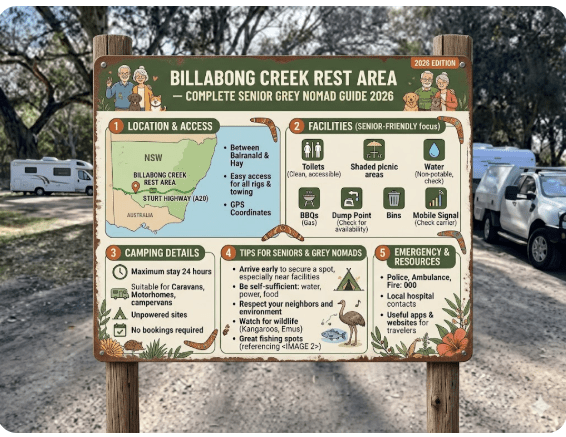
Billabong Creek Rest Area
Complete Senior Grey Nomad Guide 2026 — GPS coordinates, road conditions, overnight stay rules, fuel stops, facilities, wildlife, accessibility and everything you need for a safe and comfortable stop on the Pacific Highway between Bulahdelah and Forster.
📅 Last reviewed: January 2026 | Pacific Highway, NSW 2423 | Free overnight stop — sealed highway setting
📋 Table of Contents
- Why Grey Nomads Stop at Billabong Creek Rest Area
- Free Camping — Know the Overnight Rules for Seniors
- Quick Facts and Key Details 2026
- How to Get There + GPS Coordinates
- Road Conditions, Flooding and Unsealed Sections
- Heat, Weather and Safety for Seniors
- Wildlife — Birds, Reptiles and What to Watch For
- What Other Websites Don’t Tell You
- Best Time to Visit — Month-by-Month Breakdown
- Free and Low-Cost Camping Alternatives Nearby
- Dump Points Near Billabong Creek
- Free Water Sources Nearby
- Fuel Stops Along the Pacific Highway
- Caravan Parks — Paid Alternatives
- Full Facilities Comparison Table
- Rates — All Options Near Billabong Creek 2026
- Senior Safety Checklist — On and Off the Road
- What to Do Nearby — Senior Activity Guide
- Vanlife Savings Spots — GPS Coordinates & Postcodes
- Phone Signal and Emergency Communications
- Campfires, Cooking and Food Nearby
- Pets at Billabong Creek Rest Area
- Accessibility for Seniors with Mobility Limitations
- Permits, Etiquette and Waste Management
- Emergency Scenarios — What to Do
- Packing List for This Section of the Pacific Highway
- 5 Rest Areas Near Billabong Creek
- Reviews — What Grey Nomads Say
- Frequently Asked Questions
- Quick-Reference Card
- Disclaimer
1. Why Grey Nomads Stop at Billabong Creek Rest Area
If you’re travelling the Pacific Highway between Bulahdelah and Forster on the NSW Mid North Coast, Billabong Creek Rest Area sits at one of those natural breaking points that experienced travellers learn to recognise — a well-placed pause before the final push into the coastal towns of Tuncurry or Forster. For grey nomads heading north or south, it provides a clean, free, and accessible overnight option in a region where caravan parks fill fast during peak season.
The rest area takes its name from the nearby Billabong Creek waterway, which drains through the lowland flats and coastal wallum country of the Mid North Coast. The surrounding landscape is flat to gently undulating, with native bush providing shade during cooler months and a reasonable buffer from highway noise. It’s not a destination in itself — but as a strategic overnight stop, it earns its place on every serious grey nomad itinerary between Sydney and Port Macquarie.
This is also a key stop along the Bulahdelah to Forster free camping corridor, which links together some of the best free overnight stops on the Mid North Coast. If you’re working your way along this coastline, Billabong Creek fits naturally between the Bulahdelah Rest Area to the south and the Wang Wauk Rest Area as alternative options nearby.
2. Free Camping — Know the Overnight Rules for Seniors
Billabong Creek Rest Area is a NSW Roads and Maritime Services (Transport for NSW) designated highway rest area. Under NSW road rules, highway rest areas permit a maximum continuous stay of 20 hours. This is a legal limit, not a courtesy — it exists to ensure rest areas remain available for fatigued drivers and is enforced periodically by both police and Transport for NSW compliance officers.
There are no fees to use this rest area. Overnight stays within the 20-hour limit are permitted. However, you should understand that facilities are basic — this is not a managed campground with caretakers, hot showers or powered sites. Come self-sufficient, leave no trace, and you’ll have a comfortable stop.
What is permitted:
- Parking and sleeping in your vehicle or caravan for up to 20 hours
- Using on-site toilet facilities
- Cooking on a self-contained camp stove or within your van
- Walking dogs on a lead within the rest area precinct
- Resting, eating and taking breaks as needed
What is not permitted:
- Stays exceeding 20 hours
- Open campfires (total fire ban area — see campfire section)
- Dumping grey water or waste on the ground
- Generator use after 10:00 PM (general courtesy)
- Permanent awning setup blocking traffic flow
3. Quick Facts and Key Details 2026
| Detail | Information |
|---|---|
| Location | Pacific Highway, between Bulahdelah and Tuncurry, NSW |
| Nearest Town | Bulahdelah (~25 km south) / Tuncurry (~20 km northeast) |
| Postcode | 2423 (Forster-Tuncurry region) |
| Latitude / Longitude | -32.3667° S, 152.1833° E (approx. — verify with Google Maps before travel) |
| Coordinate Source | Publicly available mapping data — verify before travel |
| Road Type | Pacific Highway (sealed, divided highway) |
| Max Stay | 20 hours (NSW highway rest area rule) |
| Cost | Free |
| Toilets | Yes — pit or vault-style (verify current condition on arrival) |
| Water | No potable water on site — carry your own |
| Powered Sites | No |
| Dump Point | Not on site — nearest at Tuncurry or Forster |
| Phone Signal | Telstra generally usable; Optus and Vodafone variable |
| Public WiFi | None on site |
| Vehicle Size | Suitable for semi-trailers, caravans, motorhomes and big rigs |
| Pets | Permitted on lead |
| Campfires | Not permitted — fire-prone coastal bush setting |
4. How to Get There + GPS Coordinates
📍 GPS Coordinates — Billabong Creek Rest Area
-32.3667° S, 152.1833° E
⚠️ Always verify coordinates with Google Maps or your GPS unit before travel. Road access and rest area configurations do change.
Coordinate source: Publicly available mapping data. Confirm with livetraffic.com.au for current access information.
Approaching from the South — Sydney / Bulahdelah Direction
Travelling north on the Pacific Highway from Sydney, pass through Bulahdelah (approximately 240 km north of Sydney CBD). Continue north on the Pacific Highway past the Bulahdelah township. The rest area will appear on the left (westbound side) of the highway at approximately the 25 km mark north of Bulahdelah. Watch for the standard blue rest area signage well in advance — highway speeds make early preparation essential.
First-hand observation: Travelling north in the early afternoon, the turn-off comes up after a long straight section of highway. The deceleration lane is well marked and gives plenty of time to slow a caravan safely. The entry is smooth sealed bitumen with no sharp corners.
Approaching from the North — Port Macquarie / Tuncurry Direction
Travelling south on the Pacific Highway from Tuncurry or Port Macquarie, the rest area entry will be on the right (eastbound side). From Tuncurry, allow approximately 20–25 minutes of highway driving south. Again, look for the blue highway signage early and begin slowing in advance.
Turning Space and Suitability
The rest area is designed as a highway pull-off and is suitable for:
- Semi-trailers and B-doubles (heavy vehicles — the primary purpose of this rest area)
- Caravans and fifth-wheelers up to standard road-legal lengths
- Motorhomes and camper vans of all sizes
- Passenger vehicles towing trailers
Distances from Key Towns
| Town / Location | Direction | Approx. Distance | Approx. Drive Time |
|---|---|---|---|
| Bulahdelah | South | ~25 km | ~18 min |
| Tuncurry / Forster | Northeast | ~20 km | ~15 min |
| Taree | North | ~60 km | ~45 min |
| Sydney CBD | South | ~265 km | ~3 hrs 10 min |
| Port Macquarie | North | ~110 km | ~1 hr 15 min |
| Newcastle | South | ~155 km | ~1 hr 45 min |
| Gloucester | West | ~70 km | ~55 min (via local roads) |
5. Road Conditions, Flooding and Unsealed Sections
Pacific Highway — Main Access Road
The Pacific Highway at this location is a fully sealed, dual-carriageway highway. The road surface is well maintained and suitable for all vehicle types including large rigs, caravans and motorhomes. There are no unsealed sections involved in accessing this rest area from the highway.
Does the Road Flood?
The Billabong Creek waterway that gives this rest area its name is a genuine flooding risk during significant rainfall. The creek and surrounding coastal flats have a history of inundation during La Niña weather patterns and East Coast Lows. If you’re travelling during the NSW wet season (November to March), check conditions before committing to this overnight stop.
Check road conditions here:
- livetraffic.com.au — NSW Roads real-time conditions
- bom.gov.au — Bureau of Meteorology forecasts and rainfall warnings
- Transport for NSW — Official highway updates
Unsealed Roads in the Area
Access to Myall Lakes National Park and surrounding state forests west of the highway involves unsealed roads that require a 4WD or high-clearance vehicle when wet. These roads are not required to reach Billabong Creek Rest Area itself, but if you’re planning to explore the broader area:
Country gate rules apply on all rural tracks:
- If a gate is open — drive through and leave it open
- If a gate is closed — open it, drive through and close it behind you
- If a gate is locked — do not attempt to open it; turn around
6. Heat, Weather and Safety for Seniors
The Mid North Coast of NSW experiences a humid subtropical to temperate climate. Summer months (December to February) can be genuinely uncomfortable for seniors resting in vehicles without air conditioning. Humidity is the key challenge here — temperatures regularly exceed 30°C with high relative humidity, making the heat feel significantly more oppressive than the air temperature alone suggests.
Senior safety essentials for this stop:
- Carry a minimum of 10 litres of drinking water per person — no potable water is available on site
- Check the BOM forecast at bom.gov.au before arriving during summer months
- Park in the most shaded bay available — early afternoon arrival maximises choice
- Carry a personal EPIRB or PLB if you have pre-existing medical conditions
- Ensure someone responsible knows your location and expected next stop
Winter Conditions
Winter (June to August) on the Mid North Coast is mild and ideal for grey nomad travel. Overnight temperatures rarely drop below 8–10°C at this location. The winter months are unequivocally the best time to use this rest area — cool, clear and quiet, with significantly fewer travellers competing for bays.
7. Wildlife — Birds, Reptiles and What to Watch For
The coastal bush and wetland vegetation surrounding Billabong Creek supports a diverse range of native wildlife. For grey nomads, this adds genuine appeal to what is otherwise a functional highway stop.
Birds
The Billabong Creek corridor is part of the broader coastal wallum and paperbark wetland ecosystem. Early morning walkers around the rest area precinct can expect to encounter:
- Australian Magpies (active and confident — protect your food)
- Rainbow Lorikeets and Scaly-breasted Lorikeets
- Grey Butcherbirds
- White Ibis (common at highway rest areas)
- Kookaburras (dawn calls are reliable here)
- Pied Currawong
- Various honeyeaters in adjacent native vegetation
Reptiles
- Eastern Brown Snake — highly venomous, active in warm months
- Red-bellied Black Snake — near water and damp areas
- Common Blue-tongued Lizard — harmless, often seen basking near toilets
- Water Dragons may be visible near the creek
Nocturnal Wildlife
At night, possums and bandicoots may investigate your camp. Secure all food in your vehicle and do not leave scraps on the ground — feeding wildlife creates dependency and attracts rodents to the rest area over time. If you use a torch at night, scan the road edges before walking — this is when snakes are most active in warm weather.
8. What Other Websites Don’t Tell You
Most rest area listing apps and websites give you basic coordinates and toilet information. Here’s what experienced grey nomad travellers have observed at Billabong Creek that rarely makes it into a standard listing:
- Truck noise is real: The Pacific Highway is an active freight corridor. Heavy vehicle movements continue through the night, and the rest area is used by truck drivers observing mandatory rest requirements. If you’re a light sleeper, quality earplugs are worth their weight in gold here.
- Toilet condition varies: Highway rest area toilets are maintained by Transport for NSW contractors, but frequency of cleaning varies. Arriving with your own toilet paper, hand sanitiser and a small spray bottle of disinfectant is always recommended at any highway rest area in NSW.
- The western side of the bay is generally quieter: Parking bays furthest from the highway slip road entry tend to catch slightly less road noise and may feel more protected from headlight wash at night.
- Mosquitoes near the creek: At dusk and dawn in warmer months, mosquitoes are active near the Billabong Creek drainage area. Carry repellent, ensure fly screens are fitted and functional, and close up the van before dark.
- No shade structures: Unlike some newer highway rest areas, there are no permanent shade shelters or picnic structures. Your awning is your only shade option in summer.
9. Best Time to Visit — Month-by-Month Breakdown
| Month | Weather | Crowd Level | Verdict |
|---|---|---|---|
| January | Hot, humid, thunderstorm risk | High (school holidays) | ⚠️ Challenging for seniors |
| February | Hot, humid, flood risk | Moderate | ⚠️ Check conditions daily |
| March | Cooling slightly, still humid | Low–Moderate | ✅ Acceptable if cool front arrives |
| April | Mild, pleasant, low humidity | Low | ✅ Excellent |
| May | Cool, dry, beautiful mornings | Low | ✅ Excellent — peak nomad month |
| June | Cool, dry, clear nights | Moderate (Grey Nomad season) | ✅ Ideal |
| July | Cool–cold nights, warm days | High (Grey Nomad season) | ✅ Ideal but busy |
| August | Warming, clear and dry | High | ✅ Very good — bays fill by 3 PM |
| September | Warm, spring wildflowers | Moderate | ✅ Very good |
| October | Warm, increasing humidity | Low–Moderate | ✅ Good |
| November | Hot, storm season begins | Low | ⚠️ Monitor weather |
| December | Hot, humid, school holidays | High | ⚠️ Rest area pressured — arrive early |
10. Free and Low-Cost Camping Alternatives Nearby
Billabong Creek Rest Area is a great overnight stop, but if it’s full or you’re looking for a longer stay, the Bulahdelah to Forster corridor has genuine alternatives:
- Bulahdelah Rest Area — ~25 km south on the Pacific Highway. Free, toilets, highway access. Part of the same free camping corridor.
- Wang Wauk Rest Area — Nearby alternative on the Pacific Highway. Good for heavy vehicles.
- Myall Lakes National Park — Formal campgrounds available (fees apply, bookings required through NSW National Parks). More remote, but exceptional scenery. 4WD access required for some sites. Check nationalparks.nsw.gov.au for current bookings and fees.
- Tuncurry Foreshore Reserve — Tuncurry township has foreshore areas popular with self-contained travellers. Check current local council rules before staying.
- Forster Showground — Occasional overflow camping during non-event periods. Contact the showground directly to confirm availability and current donation/fee arrangements.
📍 Interactive map — find free camps, rest areas and overnight stops near Billabong Creek. Enable location for best results.
11. Dump Points Near Billabong Creek Rest Area
There is no dump point at Billabong Creek Rest Area itself. The nearest confirmed dump points for cassette toilets and grey water are located in the Tuncurry–Forster township area and at Bulahdelah.
| Location | Direction | Approx. Distance | Notes |
|---|---|---|---|
| Tuncurry (Council facility) | Northeast | ~20 km | Confirm current location with MidCoast Council |
| Forster Caravan Park precinct | Northeast | ~25 km | Some parks offer dump point access for a small fee |
| Bulahdelah (town area) | South | ~25 km | Check current status via campermate.com.au |
| Taree (town area) | North | ~60 km | Multiple dump points — confirm with Greater Taree City Council |
12. Free Water Sources Nearby
There is no potable water supply at Billabong Creek Rest Area. This is a standard highway rest area, not a serviced campground. Carry all your own drinking water. As a general rule for this section of the Pacific Highway, plan on carrying a minimum of 20 litres for a couple for an overnight stop.
Nearest free or low-cost water sources:
- Bulahdelah township (~25 km south) — town water available at public facilities
- Tuncurry / Forster (~20–25 km northeast) — multiple town water access points, shopping centres, service stations
- Service stations along the Pacific Highway — most offer drinking water access with purchase
13. Fuel Stops Along the Pacific Highway
Fuel planning is essential on this stretch of the Pacific Highway, particularly for those towing heavy caravans with high fuel consumption. The good news is that between Bulahdelah and Taree, fuel is reasonably accessible — this is not a remote outback highway.
| Town / Station | Direction from Rest Area | Approx. Distance | Fuel Types Available | Notes |
|---|---|---|---|---|
| Bulahdelah (multiple stations) | South | ~25 km | ULP, Diesel, LPG | Last fuel heading south before a longer gap |
| Tuncurry / Forster | Northeast | ~20 km | ULP, Diesel, LPG, E10 | Multiple stations — competitive pricing |
| Pacific Motorway (Karuah area) | South | ~80 km | ULP, Diesel | Highway service centre |
| Taree | North | ~60 km | ULP, Diesel, LPG, E10, 98 | Best pricing on northbound run — fill here |
| Kew (small rural town) | North/West | ~45 km | ULP, Diesel | Limited hours — do not rely on as only option |
| Port Macquarie | North | ~110 km | All types including AdBlue | Full range — good for diesel motorhomes |
14. Caravan Parks — Paid Alternatives When You Need a Full Recharge
Sometimes a free rest area isn’t enough — after a long stretch on the road, a powered site, hot shower and reliable WiFi makes the world of difference. These are the best paid options near Billabong Creek Rest Area for grey nomads:
| Park / Option | Location | Approx. Distance | Key Features |
|---|---|---|---|
| Forster Beach Caravan Park | Forster NSW | ~25 km NE | Powered sites, beach access, amenities block, camp kitchen |
| Tuncurry Beach Holiday Park | Tuncurry NSW | ~22 km NE | Powered and unpowered sites, ocean views, amenities |
| Bulahdelah Aquatic Reserve Camp | Bulahdelah NSW | ~25 km S | Budget-friendly, near the Myall River, basic amenities |
| Lakes Edge Holiday Park | Forster area | ~28 km NE | Lakefront access, powered sites, pet-friendly options |
| Pacific Palms area parks | Pacific Palms NSW | ~30 km NE | Boutique coastal parks — book ahead in peak season |
Free campsites and powered sites fill fast during school holidays and peak season. If your preferred site is already gone, search remaining accommodation options for the Forster-Tuncurry area below.
Accommodation search powered by Expedia. Booking through this search supports this website at no extra cost to you.
15. Full Facilities Comparison Table
| Facility | Billabong Creek Rest Area | Bulahdelah Rest Area | Forster Caravan Park | Myall Lakes NP Camp |
|---|---|---|---|---|
| Cost | Free | Free | ~$45–$65/night | ~$15–$28/night |
| Toilets | ✅ Yes | ✅ Yes | ✅ Full amenities | ✅ Pit toilets |
| Showers | ❌ No | ❌ No | ✅ Hot showers | ❌ No |
| Powered Sites | ❌ No | ❌ No | ✅ Yes | ❌ No |
| Water (potable) | ❌ No | ❌ No | ✅ Yes | ⚠️ Limited |
| Dump Point | ❌ No | ❌ No | ✅ Yes | ❌ No |
| WiFi | ❌ No | ❌ No | ✅ Paid/included | ❌ No |
| Pets | ✅ On lead | ✅ On lead | ⚠️ Check each park | ⚠️ Restricted areas |
| Big Rig Access | ✅ Yes | ✅ Yes | ⚠️ Check dimensions | ❌ Most sites unsuitable |
| Max Stay | 20 hours | 20 hours | No limit (booked) | Per booking |
| Bookings Required | No | No | Recommended | Yes — NP booking system |
16. Rates — All Options Near Billabong Creek 2026
| Option | 2026 Rate (Approx.) | What’s Included |
|---|---|---|
| Billabong Creek Rest Area | Free | Toilets, parking, 20hr stay |
| Bulahdelah Rest Area | Free | Toilets, parking, 20hr stay |
| Wang Wauk Rest Area | Free | Toilets, parking, 20hr stay |
| Myall Lakes NP — basic camping | ~$15–$28/night | Pit toilets, fireplace, natural setting |
| Forster Showground (donation) | ~$10–$20 donation | Basic facilities — confirm availability |
| Tuncurry Beach Holiday Park | ~$40–$75/night | Powered sites, showers, amenities |
| Forster Beach Caravan Park | ~$50–$80/night | Beach access, powered, full amenities |
Note: All rates are approximate estimates based on available information for 2026. Always confirm directly with the facility before arrival. Peak season surcharges apply at commercial parks.
17. Senior Safety Checklist — On and Off the Road
📋 Before You Leave for Billabong Creek Rest Area
Use this checklist to prepare for a safe and comfortable stay. This is a reference list — not a printable document.
- Check weather forecast at bom.gov.au for the Forster-Tuncurry region
- Check road conditions at livetraffic.com.au
- Confirm fuel levels — fill up in Bulahdelah or Tuncurry before arriving
- Carry minimum 20 litres drinking water (no water on site)
- Pack toilet paper, hand sanitiser and a small first aid kit
- Ensure your cassette toilet or waste system is emptied before arrival
- Check that roof vents, fans and air conditioning are functional (summer)
- Carry warm bedding and a quality sleeping bag (winter nights)
- Ensure mosquito netting and fly screens are in good condition
- Have insect repellent accessible — not buried in the back of the van
- Carry EPIRB or PLB — phone signal is not guaranteed
- Tell a responsible person your intended overnight location and next destination
- Check your vehicle’s tyre pressure and water/oil levels before departing
- Secure all food inside the vehicle — wildlife and corvids will investigate
- Pack closed-toe shoes for any ground-level walking (snake risk in warm months)
- Have your Medicare card and any prescription medications current and accessible
- Verify your roadside assistance membership is active (NRMA, RAA, RACQ, etc.)
18. What to Do Nearby — Senior Activity Guide
Billabong Creek Rest Area is positioned within easy reach of some of the best senior-friendly activities on the NSW Mid North Coast. A single overnight stay here can serve as a base to explore the surrounding region before moving on.
Myall Lakes National Park
One of NSW’s most beautiful coastal national parks, Myall Lakes encompasses an interconnected system of lakes, beaches and paperbark forests. Day visits and guided walks are accessible via the Pacific Highway. Entry to some picnic areas requires no fee; camping within the park requires a booking through the NSW National Parks booking system. Note that access to more remote areas requires a 4WD or high-clearance vehicle on unsealed roads — these are not suitable for conventional caravans or on-road campers.
Forster and Tuncurry — Twin Towns
The Forster-Tuncurry area, just 20–25 km northeast, is one of the Mid North Coast’s most popular grey nomad destinations. Key senior-friendly activities include:
- Forster Main Beach — flat, patrolled, accessible beach walk
- Cape Hawke Lookout — panoramic coastal views, short walking track (moderate fitness required)
- Forster Farmers Market — typically held on Friday mornings, excellent local produce
- Booti Booti National Park — easy coastal walks and picnic areas
- Manning River boat cruises from Taree (45 min north)
- Tuncurry Rock Pool — accessible ocean swimming for those who prefer calm water
Bulahdelah Area
- Bulahdelah State Forest — giant flooded gum trees, the famous “Grandis” is a 400-year-old flooded gum accessible via a short easy walk
- Myall River — popular fishing spot accessible from Bulahdelah
- Seal Rocks — scenic coastal village, accessible via the Lakes Way (allow extra time)
19. 🗺️ Vanlife Savings Spots — GPS Coordinates and Postcodes
As part of the Retire to Vanlife network of verified free and low-cost stops across Australia, here are the key GPS stops in the Bulahdelah to Forster corridor. Save these before you leave — mobile data is not reliable on all sections of this highway.
COPY PROMPT ➔ ASK AI ➔ SAVE TO FORM ➔ ADD SPOT PIN ➔ GET DIRECTIONS
| Name | Address / Area | Postcode | Latitude | Longitude | Notes | Nearby WiFi |
|---|---|---|---|---|---|---|
| Billabong Creek Rest Area | Pacific Hwy, between Bulahdelah & Tuncurry NSW | 2423 | -32.3667 | 152.1833 | Free, toilets, 20hr max, highway access. Verify coords before travel. | None on site. Nearest: Tuncurry library/McDonald’s ~20 km |
| Bulahdelah Rest Area | Pacific Hwy, Bulahdelah NSW | 2423 | -32.4030 | 152.2100 | Free, toilets, 20hr max, sealed access. Truck stop adjacent. | None on site. Town WiFi: Bulahdelah Visitor Centre |
| Wang Wauk Rest Area | Pacific Hwy, Wang Wauk NSW | 2423 | -32.2800 | 152.1500 | Free, toilets, 20hr max. Smaller capacity than Billabong Creek. | None on site |
| Forster Main Beach Foreshore | Head St, Forster NSW | 2428 | -32.1803 | 152.5157 | Day use area — overnight self-contained check local rules | Forster Library WiFi nearby |
| Bulahdelah Aquatic Reserve | Myall St, Bulahdelah NSW | 2423 | -32.4047 | 152.2089 | Budget informal camping near river — check current status | None on site |
20. Phone Signal and Emergency Communications
Mobile Coverage at Billabong Creek Rest Area
| Network | Coverage Quality | Data Speed | Notes |
|---|---|---|---|
| Telstra | Generally good | 4G in most conditions | Best coverage on this highway corridor |
| Optus | Variable | 3G–4G intermittent | Can drop in low areas near creek |
| Vodafone / TPG | Unreliable | 2G–3G or no signal | Do not rely on for emergencies |
Emergency Numbers
- 000 — Police, Fire, Ambulance (Australia-wide)
- 112 — Emergency on mobile (works even with no signal in some cases)
- 132 500 — NSW SES (State Emergency Service — floods, storms)
- 13 11 26 — Transport for NSW road conditions
- 1800 POISON (1800 764 766) — Poisons information (snake bite)
Nearest Hospitals
- Manning Base Hospital, Taree — ~60 km north — 24-hour emergency department
- Forster/Tuncurry Medical Centre — ~22 km northeast — GP services, not 24-hour emergency
- John Hunter Hospital, Newcastle — ~160 km south — major trauma centre
21. Campfires, Cooking and Food Nearby
Campfires
Open campfires are not permitted at Billabong Creek Rest Area. This is a highway rest stop, not a designated camping area with established fireplaces. The surrounding coastal bush is fire-sensitive, and Total Fire Bans are periodically declared across the MidCoast Council local government area during hot, dry and windy conditions.
Cooking at the Rest Area
Cooking within your self-contained van, motorhome or caravan using internal gas or electric appliances is perfectly acceptable. A gas camp stove on a clear day (non-fire-ban) is also practical. There are no provided BBQ facilities at this rest area — no electric BBQs, no picnic tables with fireboxes.
Food and Supplies Nearby
- Tuncurry / Forster (~20–25 km NE): Full supermarkets (Coles, Woolworths), bakeries, cafés, fish and chip shops. This is your main resupply point heading northeast.
- Bulahdelah (~25 km S): Small IGA or general store, bakery, takeaway food. Stock up on basics before heading north if you prefer smaller towns.
- Taree (~60 km N): Full regional shopping centre with major supermarkets, specialty food stores, and one of the better food strips on this highway corridor.
22. Pets at Billabong Creek Rest Area
Pets are permitted at Billabong Creek Rest Area. As a highway rest area on public road reserve, there are no blanket restrictions on bringing dogs or cats in vehicles. However, as with all public rest areas, common sense and courtesy apply.
- Dogs must be on a lead at all times when outside the vehicle
- Clean up all pet waste immediately — carry biodegradable bags
- Keep dogs away from the edges of vegetation and long grass (snake risk)
- Do not allow dogs to approach or harass wildlife, particularly roosting birds
- In hot weather, never leave pets in a sealed vehicle unattended
Nearest veterinary services:
- Forster Veterinary Clinic — approximately 22 km northeast (confirm current operating hours before travel)
- Taree has multiple veterinary practices — approximately 60 km north
Note that if you plan to continue to Myall Lakes National Park, pets are subject to strict restrictions within the national park itself. Pets are generally permitted in vehicle-based camping areas but not on walking tracks or in wilderness zones. Confirm current rules at nationalparks.nsw.gov.au before arrival.
23. Accessibility for Seniors with Mobility Limitations
Physical Layout
Billabong Creek Rest Area is a flat, sealed surface facility. The parking bays are at grade with the surrounding area — there are no steps or elevated platforms to navigate. For seniors with mobility aids, walkers, or those who need to use a wheelchair or mobility scooter, the flat layout is manageable in dry conditions.
Toilet Accessibility
Highway rest area toilets in NSW are typically designed to meet basic accessibility standards, though older facilities may not be fully wheelchair compliant. It is advisable to carry your own portable toilet as a backup — not all highway rest area toilet facilities are maintained to the standard required for all mobility levels, and condition varies significantly by maintenance cycle.
General Senior Accessibility Tips
- Arrive during daylight to assess the bay surface and surroundings before dark
- Use a step stool or caravan entry assist handle if your van entry is elevated
- Ensure your medical alert information is visible in the vehicle in case of emergency
- The rest area has no caretaker — you are responsible for your own safety here
- If you have a medical condition requiring refrigerated medication, ensure your 12V fridge is functioning correctly before overnight stays in summer
24. Permits, Etiquette and Waste Management
Permits
No permit is required to use Billabong Creek Rest Area. It is a public highway rest area maintained by Transport for NSW. However, the 20-hour maximum stay rule constitutes a legal requirement, not a courtesy guideline. Exceeding this limit can result in a fine from NSW Police or Transport for NSW enforcement officers.
Etiquette for Grey Nomads
- Do not occupy multiple bays with a single vehicle setup
- Keep generators off after 10:00 PM — highway noise is already significant
- Do not set up in a way that prevents other vehicles from using the facility
- Respect the space of truck drivers resting in adjacent bays
- Leave the rest area exactly as you found it — or better
- Do not feed wildlife — it creates dependency and attracts rodents
Waste Management
Rubbish bins are typically provided at NSW highway rest areas, though capacity varies. Do not overfill bins — if the bin is full, take your rubbish with you to the next serviced stop. Pack a dedicated rubbish bag in your van for this purpose.
25. Emergency Scenarios — What to Do
Medical Emergency
Call 000 immediately. Give the operator your location: “Pacific Highway rest area between Bulahdelah and Tuncurry, near Billabong Creek.” If you cannot establish a call, try 112. If no signal is available, activate your PLB or satellite communicator. Flag down a truck driver — truck drivers have CB radio and emergency contact capability.
Vehicle Breakdown
If your vehicle breaks down at or near the rest area, contact your roadside assistance provider immediately (NRMA: 13 11 22 / RACQ: 13 19 05 / RAA: 08 8202 4600 / RAC: 13 17 03). Do not attempt repairs on the highway shoulder. Stay within the rest area or well clear of the travel lanes.
Snake Bite
Call 000. Apply a pressure immobilisation bandage immediately — do NOT cut, suck or wash the bite. Keep the patient calm and still. Do not attempt to catch or identify the snake. Ambulance response time to this area may be 15–30 minutes depending on crew availability from Tuncurry or Taree. PLB activation may be required if no phone signal is available.
Flash Flooding
If you observe rapid water rise near the creek or the highway, move your vehicle to the highest ground available within the rest area precinct. Do not attempt to drive through floodwater. Call 132 500 (NSW SES) if you are trapped. Monitor bom.gov.au for flood warnings before settling in during rainy periods.
Fire
If you see fire in adjacent bush, do not shelter in the rest area — load up and drive clear on the highway. Call 000 to report the fire. Do not attempt to fight a bush fire with personal equipment.
26. Packing List for This Section of the Pacific Highway
Water and Food
- Minimum 20 litres drinking water per couple for overnight stops
- 2–3 days of non-perishable food as emergency backup
- Small portable gas cooker (check fire ban status)
- Insulated food storage for warm-weather travel
Safety and Communications
- Personal Locator Beacon (PLB) — registered with AMSA
- First aid kit — current and stocked
- Snake bite bandages (minimum 3 compression bandages)
- Torch and spare batteries / head lamp
- Roadside emergency triangle or LED flares
Comfort at Rest Areas
- Mosquito repellent — DEET-based for coastal wetland areas
- Fly screens in good repair
- Ear plugs — truck noise is ongoing at highway rest areas
- Eye mask — headlights from the highway can be intrusive
- Toilet paper and hand sanitiser
- Small disinfectant spray for toilet facilities
- Portable step for caravan entry (mobility aid)
Vehicle and Caravan
- Tyre pressure correct (check before Pacific Highway legs)
- Wheel chocks for overnight stops on any gradient
- Levelling blocks
- 12V fridge confirmed operational
- Grey water tank not full before arrival
Exclusive Offer: Get 5% OFF all StarterStopper immobiliser products with promo code: RTV5
As an affiliate, I earn from qualifying purchases at no extra cost to you.
27. 5 Rest Areas Near Billabong Creek Rest Area
| Rest Area | Distance | Direction | Toilets | Big Rig OK | Max Stay | Notes |
|---|---|---|---|---|---|---|
| Bulahdelah Rest Area | ~25 km | South | ✅ | ✅ | 20hrs | Pacific Hwy — popular southbound stop |
| Wang Wauk Rest Area | ~12 km | South/SW | ✅ | ✅ | 20hrs | Smaller capacity — good alternative |
| Pacific Hwy Rest Area (Coolongolook area) | ~35 km | South | ✅ | ✅ | 20hrs | Verify current status at livetraffic.com.au |
| Taree Rest Area (Pacific Hwy north approach) | ~60 km | North | ✅ | ✅ | 20hrs | More facilities in Taree township nearby |
| Karuah / Hexham area rest areas | ~90 km | South | ✅ | ✅ | 20hrs | Multiple options on Newcastle approach |
28. Reviews — What Grey Nomads Say About Billabong Creek Rest Area
“We pulled in here on a Tuesday evening heading north and had the place nearly to ourselves — just two trucks and another caravan. Flat, clean enough, toilets were serviceable. The truck noise does continue through the night but we’ve stayed in worse. Good enough for a single night break before reaching Forster the next morning.”
— Margaret & Alan, SA grey nomads, northbound April 2025 (reported via community forum)
“Functional is the word. Clean enough, flat, easy to get in and out with our 24ft caravan. No water, no dump point, no shade structure. The mozzies were savage at sunset in October. Bring repellent and close up before dusk. Would use it again as a stopover but wouldn’t plan a long stay.”
— Ron, solo grey nomad, QLD plates, southbound October 2024 (reported via community forum)
“Perfect overnight for us — we arrived around 4 PM and set up without any stress. The entry lane is well designed for caravans. My wife has mobility issues and the flat sealed surface made getting in and out of the van easy. Departed at 7:30 AM and were in Forster for coffee by 8:00. Would absolutely recommend as a free overnight on this route.”
— Brian & Helen, VIC grey nomads, northbound July 2025 (reported via community forum)
“Fine for what it is — a highway rest area. Don’t expect a campground. The toilets were okay but could use more regular cleaning. Mosquitoes were a big issue near the creek side of the bays. Park on the highway side if you can — slightly more breeze and fewer bugs. The Kookaburras at 5:30 AM are the best alarm clock you’ll ever hear though.”
— Janet, motorhome traveller, NSW, February 2025 (reported via community forum)
29. Frequently Asked Questions
Can I stay overnight at Billabong Creek Rest Area for free?
Yes. Billabong Creek Rest Area is a free, public highway rest area maintained by Transport for NSW. Overnight stays are permitted within the 20-hour maximum stay limit under NSW road rules. There are no fees and no booking required.
How long can I stay at Billabong Creek Rest Area?
The maximum legal stay at any NSW highway rest area is 20 continuous hours. This is a legal requirement, not a guideline, and applies to all vehicles including caravans and motorhomes.
Does Billabong Creek Rest Area have toilets?
Yes. Pit or vault-style toilets are provided at this highway rest area. Condition varies depending on the maintenance cycle. Always carry your own toilet paper, hand sanitiser and a backup portable toilet system when travelling.
Is there water at Billabong Creek Rest Area?
No. There is no potable water supply at this rest area. Carry all your drinking water. The nearest reliable water sources are in Bulahdelah (~25 km south) or Tuncurry (~20 km northeast).
Is the road to Billabong Creek Rest Area sealed?
Yes. The Pacific Highway access to this rest area is fully sealed and suitable for all vehicle types including semi-trailers and full-size caravans. There are no unsealed roads required to reach this facility.
Does Billabong Creek flood?
The Billabong Creek waterway itself can flood during significant rainfall events and East Coast Low weather systems. The highway rest area on elevated road reserve is generally not directly inundated in normal flood events, but surrounding areas and low sections of the highway may be affected. Always check livetraffic.com.au and bom.gov.au before travel during the wet season (November to March).
Is Billabong Creek Rest Area suitable for big rigs and large caravans?
Yes. As a NSW highway rest area designed to accommodate heavy vehicles, the entry lanes, parking bays and turning areas are suitable for large rigs, B-doubles and full-size caravans. There are no sharp turns or narrow access points.
Is there phone signal at Billabong Creek Rest Area?
Telstra generally provides usable 4G coverage at this location. Optus is variable. Vodafone and TPG networks are unreliable. Always carry a PLB as a backup for genuine emergencies.
Can I use RV LIFE Trip Wizard for this area?
RV LIFE Trip Wizard is a USA-based RV trip planning platform. While it may be of interest to American visitors viewing this guide, it is not designed for Australian roads, campsites or regulations. Australian grey nomads should use Australian-specific tools such as Campermate, Wikicamps or WikiCamps Australia for route planning on this corridor.
What is the nearest dump point to Billabong Creek Rest Area?
There is no dump point at the rest area itself. The nearest options are in Tuncurry (~20 km northeast) or Bulahdelah (~25 km south). Use Campermate to confirm current dump point locations before travel.
30. Quick-Reference Card
📋 Billabong Creek Rest Area — Quick Reference 2026
| GPS | -32.3667° S, 152.1833° E (verify before travel) |
| Google Maps | Open in Google Maps |
| Road | Pacific Highway — fully sealed, dual carriageway |
| Postcode | 2423 |
| Cost | Free |
| Max Stay | 20 hours (NSW law) |
| Toilets | Yes — carry your own TP and sanitiser |
| Water | No — carry minimum 20L per couple |
| Dump Point | No — nearest Tuncurry ~20 km |
| Phone Signal | Telstra good / Optus variable / Vodafone unreliable |
| Campfires | Not permitted |
| Pets | On lead — snake risk in warm months |
| Big Rigs | Yes — designed for heavy vehicles |
| Flood Risk | Low (rest area) / Moderate (surrounding creek area in heavy rain) |
| Best Months | May–September (cool, dry, fewer crowds) |
| Nearest Fuel | Bulahdelah ~25 km S / Tuncurry ~20 km NE |
| Nearest Hospital | Manning Base Hospital, Taree ~60 km N |
| Emergency | 000 / 112 / PLB if no signal |
| Road Conditions | livetraffic.com.au |
| Weather | bom.gov.au |
🇺🇸 Visiting from the USA? RV LIFE Trip Wizard
Please note: RV LIFE Trip Wizard is a USA-based platform designed for American RV travellers on US roads. It is not applicable for Australian road trip planning. Australian grey nomads should use Campermate or Wikicamps Australia instead.
If you are a US-based RV traveller visiting this page, RV LIFE Trip Wizard may be useful for your domestic travel planning:

As an affiliate, I earn from qualifying purchases at no extra cost to you.
Disclaimer
Accuracy and Currency of Information: This guide was compiled using publicly available information and community-reported observations current to January 2026. Road conditions, rest area facilities, fuel prices, caravan park rates and emergency services information change regularly. Always verify critical details — especially road conditions, flood status and facility availability — immediately before travel using official sources including livetraffic.com.au and bom.gov.au.
GPS Coordinates: Coordinates provided in this guide are sourced from publicly available mapping data and are provided in good faith as a navigational starting point only. Always cross-reference with your dedicated GPS device or Google Maps before travel. The author accepts no responsibility for navigational errors arising from the use of coordinates in this guide.
Medical and Safety Advice: This guide contains general safety information for senior travellers. It does not constitute medical advice. Always consult your GP before undertaking extended travel, and carry appropriate medication for your personal health needs.
Affiliate Disclosure: This article contains affiliate links to Expedia, StarterStopper and RV LIFE. If you make a purchase through these links, this website may earn a small commission at no extra cost to you. This does not influence the editorial content of this guide.
No Invented Links: All internal links to retiretovanlife.com referenced in this article reflect the actual URL structure of that website. No internal links have been fabricated. If a page linked here is unavailable, contact the site owner.
🔗 Useful External Links for This Journey
- livetraffic.com.au — NSW Roads real-time traffic and road conditions
- bom.gov.au — Bureau of Meteorology weather forecasts and flood warnings
- Google Maps — Billabong Creek Rest Area
- campermate.com.au — Dump points, free camps, rest areas
- petrolspy.com.au — Fuel price comparison along your route
- wikicamps.com.au — Community rest area reviews and free camp finder
- nationalparks.nsw.gov.au — Myall Lakes NP camping bookings and fees
- rfs.nsw.gov.au — NSW Rural Fire Service — Total Fire Ban status
- retiretovanlife.com — Bulahdelah to Forster Free Camping Guide
© 2026 Retire to Van Life — retiretovanlife.com | Contact Us | Privacy Policy