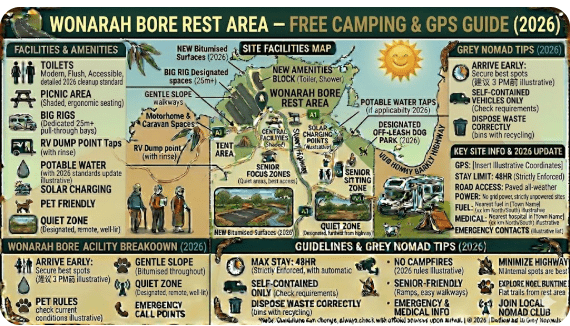
Wonarah Bore Rest Area
Senior Grey Nomad Guide 2026 — GPS coordinates, road conditions, Barkly Highway fuel stops, flooding risks, outback safety, facilities, wildlife and everything you need before you pull in for the night on one of Australia’s most remote highways.
📅 Last reviewed: January 2026 | Barkly Highway, NT 0862 | Free overnight stop — remote outback highway location
📋 Table of Contents
- Why Grey Nomads Stop at Wonarah Bore
- Free Camping — Know the Limits for Seniors
- Quick Facts and Key Details in 2026
- How to Get to Wonarah Bore Rest Area + GPS
- Road Conditions, Flooding and Unsealed Sections
- Heat and Remoteness — Senior Safety
- Wildlife — Birds, Reptiles and What to Watch For
- What Other Websites Don’t Tell You
- Best Time to Visit — Month-by-Month Breakdown
- Free and Low-Cost Camping Nearby
- Dump Points Near Wonarah Bore
- Free Water Sources in the Region
- Fuel Stops Along the Barkly Highway
- Caravan Parks — Paid Alternatives
- Full Facilities Comparison Table
- Rates — All Options Near Wonarah Bore 2026
- Senior Safety Checklist
- What to Do Near Wonarah Bore — Senior Activity Guide
- Vanlife Savings Spots — GPS Coordinates and Postcodes
- Phone Signal and Emergency Communications
- Campfires, Cooking and Food Purchases
- Pets at Wonarah Bore
- Accessibility for Seniors with Mobility Limitations
- Permits, Fees, Etiquette and Waste Management
- Emergency Scenarios — What to Do
- Packing List for This Section of the Barkly Highway
- 5 Rest Areas Near Wonarah Bore
- Reviews — What Grey Nomads Say
- Frequently Asked Questions
- Quick-Reference Card
- Disclaimer
Why Grey Nomads Stop at Wonarah Bore Rest Area
The Wonarah Bore Rest Area is a free, 24-hour roadside stop located along the Barkly Highway in the Northern Territory, situated approximately 43 km east of Barkly Homestead and 220 km west of Camooweal. It is best known for its massive, drive-through layout that provides ample space for large vehicles and multiple camping bays tucked into the surrounding bushland.
For senior travellers doing the Barkly crossing, this rest area is a practical and cost-effective overnight stop. Distances between towns on this highway can be punishing — particularly in summer heat — so knowing exactly where safe, free stops exist is essential for safe travel planning.
Free Camping — Know the Limits for Seniors
Wonarah Bore Rest Area is a free, government-maintained rest area on the Barkly Highway, managed under Northern Territory road authority guidelines. There is no fee to stop overnight, but it is designated as a rest area — not a campground — which means the expectation is a short rest stop rather than an extended multi-night stay.
In practical terms, most travellers stay one night (up to approximately 20–24 hours). There is no enforced time limit posted on-site as of 2026, but NT Transport guidelines recommend using rest areas as short-term stops to manage driver fatigue rather than as free camping destinations for extended stays.
Quick Facts and Key Details in 2026
| Detail | Information |
|---|---|
| Name | Wonarah Bore Rest Area |
| Highway | Barkly Highway (Tablelands Highway) |
| State / Territory | Northern Territory |
| Nearest Town West | Tennant Creek (~250 km) |
| Nearest Town East | Barkly Homestead (~110 km), then Mount Isa QLD (~390 km from TC) |
| GPS Coordinates | Approx. -19.905°S, 136.215°E (publicly sourced — verify on-site) |
| Postcode / Region | NT 0862 |
| Surface | Sealed highway access; gravel / compacted dirt rest area surface |
| Toilets | Pit toilet / drop toilet on-site (basic) |
| Shade | Minimal natural shade — flat open tablelands |
| Water | No potable water on-site — carry all water |
| Powered Sites | None |
| Cost | Free |
| Stay Limit | Short-term rest stop (one night practical maximum) |
| Dump Point | Not available on-site |
| Mobile Signal | Very limited — Telstra only in patchy coverage areas |
| Suitable For | Caravans, motorhomes, campervans, trucks, heavy vehicles |
How to Get to Wonarah Bore Rest Area + GPS
📍 GPS Coordinates — Wonarah Bore Rest Area
-19.905°S, 136.215°E (approximate — publicly sourced)
Enter into Google Maps: maps.google.com/?q=-19.905,136.215
Coordinate source: Public mapping databases and community travel reports. Always cross-reference with your GPS unit before travelling.
Approaching from the West (from Tennant Creek)
Head east on the Barkly Highway from Tennant Creek. The highway is sealed and generally well-maintained, though road trains share this route regularly. After approximately 245–255 km, you will find the Wonarah Bore Rest Area on your left (north) side of the highway. Watch for NT government highway rest area signage well before the turn — signs typically appear 1–2 km ahead at highway speed.
Approaching from the East (from Barkly Homestead / Mount Isa direction)
Travel west on the Barkly Highway from Barkly Homestead roadhouse. The rest area is approximately 108–115 km west of Barkly Homestead, on the right (south) side of the highway when heading west. Again, watch for official rest area signage.
Suitability by Vehicle Type
| Vehicle Type | Suitability | Notes |
|---|---|---|
| Caravan + Tow Vehicle | ✅ Suitable | Wide entry, flat gravel surface |
| Motorhome / Class A | ✅ Suitable | Enough turning room for large rigs |
| Campervan / Van Conversion | ✅ Suitable | No issues |
| Truck / Heavy Vehicle | ✅ Suitable | Rest area designed for HV use |
| 2WD Car + Tent | ✅ Suitable | Surface is accessible in dry conditions |
| 4WD Off-Road | ✅ Suitable | No off-road navigation required |
Road Conditions, Flooding and Unsealed Sections
The Barkly Highway between Tennant Creek and the Queensland border is sealed for the entire route. This is one of the key reasons the Barkly crossing is popular with grey nomads — there are no unsealed sections on the main highway that connect directly to Wonarah Bore Rest Area.
How to Check Road Conditions Before You Go
- NT Road Conditions: nt.gov.au — Road Conditions
- Bureau of Meteorology (Weather): bom.gov.au — check NT forecasts and rainfall warnings
- NT Emergency Services: Call 1800 246 199 for road closure updates
Dry Season Road Conditions (May to October)
During the dry season, the Barkly Highway is generally in good condition with a sealed surface. Corrugations can develop on unsealed shoulders and station tracks. The rest area surface itself can become dusty and rutted from heavy vehicle use. Road trains share this highway — expect them at any time of day or night. When passing, pull well left and slow down.
Wet Season Conditions (November to April)
Travel on the Barkly Highway during the wet season should be approached with significant caution. Even light rainfall can cause surface water across the highway. Heavy rain events can cause multi-day closures. If you are caught at Wonarah Bore Rest Area during unexpected flooding, you may need to shelter in place until roads reopen. Always carry enough water, food and fuel for extended delays — see the packing list section below.
Heat and Remoteness — Senior Safety
The Barkly Tablelands is one of the hottest and most remote regions in Australia. Summer temperatures routinely exceed 40°C and can spike significantly higher. Even in the “mild” dry season months, midday temperatures frequently reach 30–35°C. For senior travellers, heat management is not optional — it is a survival consideration.
Remoteness Reality Check
Wonarah Bore is approximately 250 km from Tennant Creek in one direction and 110 km from Barkly Homestead in the other. The nearest hospital is in Tennant Creek. Emergency response times in this region can be measured in hours, not minutes. Royal Flying Doctor Service (RFDS) covers this area, but response time depends on aircraft availability and weather.
- Tell someone your travel plan before departing — times, route and expected arrival
- Carry an EPIRB or satellite communicator (PLB or Garmin inReach) — these are not optional on the Barkly
- Carry at minimum 20 litres of drinking water per person above your normal travel supply
- If your vehicle breaks down, stay with your vehicle — do not walk for help in outback heat
Wildlife — Birds, Reptiles and What to Watch For
The Barkly Tablelands surrounding Wonarah Bore supports a surprising range of outback wildlife, particularly during the cooler months and at dawn and dusk.
Birds
The open grasslands attract raptors including wedge-tailed eagles, brown falcons and black kites. Budgerigars and cockatiels move through the area in large flocks, particularly near water sources. Emus are regularly sighted along the highway corridor and adjacent to rest areas — they can be unpredictable near vehicles.
Reptiles
Blue-tongue lizards, goannas and various skinks are active during daylight hours in the dry season. King brown snakes (mulga snakes) are present across the Barkly Tablelands — one of Australia’s most venomous and aggressive species. Do not reach under logs, rocks or vegetation, and always wear closed shoes when walking around the rest area at night or early morning.
Cattle and Livestock
Open range cattle country extends along the Barkly Highway. Cattle, donkeys and horses can wander onto the highway — particularly at night. This is a leading cause of serious accidents on the Barkly. Reduce speed after dark and use high beams where safe. If camping, check the perimeter of the rest area before walking around in the dark.
Kangaroos
Red kangaroos are common across the Barkly. They are most active at dawn and dusk and move unpredictably across roads. A bull red kangaroo can weigh 90 kg or more — a high-speed collision can total a vehicle. Fit a roo bar to your tow vehicle if travelling this route regularly.
What Other Websites Don’t Tell You
Most online listings for Wonarah Bore Rest Area stop at “toilets available, free overnight stop” — and that is the complete entry. Here is what the generic listings do not cover:
- Toilet quality varies significantly by season. In the dry season peak (June–August), the rest area sees the highest traffic from caravanners crossing the Barkly. Pit toilets can become unpleasant and may not be serviced as frequently as higher-traffic highway stops. Carry your own toilet paper and hand sanitiser — always.
- Wind is constant and fierce. The Barkly Tablelands is flat and exposed. Afternoon winds can be strong enough to make awning use uncomfortable or dangerous. Peg everything down or leave the awning packed.
- The bore itself is a historical relic. The name “Wonarah Bore” references the pastoral bores sunk across this landscape to support cattle drives. There is no operational water bore to fill tanks from — do not assume there is accessible water on-site.
- Road trains pass through the night. The Barkly Highway carries significant road train traffic 24 hours a day. If you are a light sleeper, earplugs are essential. The noise and vibration from 53-metre road trains passing at 100 km/h is substantial, even from a rest area set-back from the highway.
- No phone signal for most carriers. Optus and Vodafone have essentially no coverage on this section of the Barkly. Telstra has very patchy coverage — you may get a signal at the rest area or you may not. Do not rely on your phone for emergency communications here.
Best Time to Visit — Month-by-Month Breakdown
| Month | Season | Conditions | Recommended? |
|---|---|---|---|
| January | Wet | Extreme heat 38–42°C+, flooding risk, road closures possible | ❌ Avoid if possible |
| February | Wet | Cyclone season, high humidity, flooding | ❌ Avoid |
| March | Wet/Transition | Heat easing, flooding still possible | ⚠️ Caution |
| April | Transition | Rain tapering, roads improving, still warm | ⚠️ Caution — check roads |
| May | Dry begins | Excellent — 25–32°C days, cool nights | ✅ Recommended |
| June | Dry | Peak season — cool, clear, busy with caravanners | ✅ Best months |
| July | Dry | Peak season — ideal conditions | ✅ Best months |
| August | Dry | Excellent conditions, slightly warming toward end | ✅ Recommended |
| September | Late Dry | Warming up — 33–37°C, still pleasant for travel | ✅ Good |
| October | Pre-wet | Hot — 36–40°C+, dust and winds increasing | ⚠️ Experienced travellers only |
| November | Pre-wet/Wet | Severe heat, storm risk building | ❌ Not recommended |
| December | Wet | Wet season arrives — 40°C+, flooding risk | ❌ Avoid |
Free and Low-Cost Camping Nearby
Northern Territory Barkly Highway Rest Area Network
If you’re travelling through the Northern Territory on the Barkly Highway, these rest areas form part of a reliable network of free and low-cost stops across this remote outback crossing.
- Frewena Rest Stop — Barkly Highway, NT
- Soudan Bore Rest Area — roadside camping, Barkly Highway
- Avon Downs Rest Area — Barkly Tablelands
- 41 Mile Bore Rest Area — Barkly Highway
- Newcastle Waters Rest Area — free camping stop
- Barkly Homestead — paid roadhouse camping (~110 km east)
- Tennant Creek showground and caravan parks (~250 km west)
Dump Points Near Wonarah Bore
There is no dump point at Wonarah Bore Rest Area. The nearest dump points are at Tennant Creek to the west and at the Barkly Homestead roadhouse to the east.
| Dump Point Location | Direction | Approx Distance | Notes |
|---|---|---|---|
| Tennant Creek — Caravan Parks / Showground | West | ~250 km | Multiple options in town — verify hours on arrival |
| Barkly Homestead Roadhouse | East | ~110 km | Roadhouse may have dump point — confirm by phone before relying on this |
| Mount Isa (QLD) | Far East | ~390 km from Tennant Creek | Full facilities available in town |
Search current dump point listings at CamperMate — this free app has up-to-date dump point locations across the NT and QLD.
Free Water Sources in the Region
Water Planning for the Barkly Crossing
The standard recommendation from experienced outback travellers is to carry a minimum of 10 litres per person per day above your expected consumption, as an emergency reserve. For a crossing of 650+ km in summer heat, this means carrying substantial water reserves.
- Tennant Creek: Tap water available at caravan parks and service stations — fill all tanks before departing west
- Barkly Homestead Roadhouse: Water available for purchase — fill tanks before departing east
- Camooweal (QLD): Water available — first service point when continuing east after the NT/QLD border
Fuel Stops Along the Barkly Highway
Fuel planning on the Barkly Highway is not optional — it is a safety imperative. Distances between fuel stops are among the longest in Australia for a sealed highway route.
| Fuel Stop | Direction from Wonarah Bore | Approx Distance | Fuel Types | Notes |
|---|---|---|---|---|
| Tennant Creek | West | ~250 km | Petrol, Diesel, LPG | Multiple service stations — most competitive pricing |
| Barkly Homestead Roadhouse | East | ~110 km | Petrol, Diesel | Remote pricing — significantly more expensive |
| Camooweal (QLD) | Far East | ~330 km from Wonarah Bore | Petrol, Diesel | Small outback town — limited but reliable |
| Mount Isa (QLD) | Far East | ~500 km from Wonarah Bore | Full range | Major regional centre — competitive pricing |
| Elliott | Northwest | ~280 km via Stuart Hwy from TC | Petrol, Diesel | Via Tennant Creek — Stuart Highway stop |
Fuel Consumption Tip for Caravan Towers
Towing on the Barkly Highway typically increases fuel consumption by 30–50% compared to solo driving. If your vehicle normally uses 10L/100km, expect 13–15L/100km when towing in crosswinds. Barkly crosswinds can be fierce. Carry a jerry can of diesel or petrol as a backup — especially if your combined range when towing is under 600 km.
Caravan Parks — Paid Alternatives
| Park / Roadhouse | Location | Approx Cost (2026) | Facilities |
|---|---|---|---|
| Barkly Homestead Roadhouse | ~110 km east | ~$35–$55/night | Powered sites, restaurant, bar, showers, toilets, fuel |
| Tennant Creek Caravan Parks | ~250 km west | ~$35–$60/night | Full facilities — powered, camp kitchen, laundry, dump point |
| Camooweal Roadhouse (QLD) | ~330 km east | ~$25–$40/night | Basic powered sites, showers, toilets, fuel |
Free campsites and powered sites fill fast during school holidays and peak season. If your preferred site is already gone, search remaining accommodation options below to explore the region.
Accommodation and flight search powered by Expedia. Booking through this search supports this website at no extra cost to you. As an affiliate, I earn from qualifying purchases at no extra cost to you.
Full Facilities Comparison Table
| Facility | Wonarah Bore Rest Area | Barkly Homestead | Tennant Creek Parks |
|---|---|---|---|
| Cost | Free | ~$35–$55/night | ~$35–$60/night |
| Toilets | Pit toilet (basic) | Flush toilets | Flush toilets |
| Showers | None | Yes (coin or fee) | Yes |
| Water | None — BYO | Available | Available |
| Power | None | Yes (powered sites) | Yes |
| Dump Point | None | Check on arrival | Yes |
| Camp Kitchen | None | Limited | Yes |
| WiFi | None | Limited paid WiFi | Some parks offer WiFi |
| Fuel | None | Yes | Yes |
| Food / Shop | None | Yes (roadhouse) | Yes (supermarket in town) |
| Phone Signal | Very limited | Better coverage | Good coverage |
| Shade | Minimal | Some shade trees | Shaded sites available |
Rates — All Options Near Wonarah Bore 2026
| Option | Rate (2026 Estimate) | Notes |
|---|---|---|
| Wonarah Bore Rest Area | Free | No facilities beyond basic pit toilet |
| Barkly Homestead — unpowered | ~$25–$35/night | Includes use of showers, toilets |
| Barkly Homestead — powered | ~$45–$55/night | Peak season rates may be higher |
| Tennant Creek — unpowered | ~$25–$35/night | Multiple parks — prices vary |
| Tennant Creek — powered | ~$40–$60/night | Full facilities, dump point access |
| Camooweal Roadhouse | ~$25–$40/night | Basic but functional |
Senior Safety Checklist — On and Off the Road
- Full fuel tank — topped up at last service point
- Jerry can of additional fuel (minimum 20 litres) for caravans
- Minimum 20 litres drinking water per person above daily needs
- Food supplies for 3 extra days beyond planned trip
- PLB or satellite communicator (Garmin inReach or equivalent) — charged and registered
- EPIRB registered with AMSA (for extended remote travel)
- First aid kit — checked and restocked
- Medications — sufficient supply for trip plus 5 extra days
- Recovery gear: tyre repair kit, jumper cables, tow strap
- Torch and spare batteries (or rechargeable torch)
- Sunscreen SPF 50+ and wide-brim hat
- Someone at home knows your route, stops and expected arrival times
- NT road conditions checked within 24 hours of departure
- BOM weather forecast checked for the crossing days
- Roo bar or nudge bar fitted to tow vehicle
- Tyre pressure checked — including caravan tyres and spare
- Awning secured or retracted for travel through high-wind sections
- Snake precautions understood — closed footwear, torch at night
What to Do Near Wonarah Bore — Senior Activity Guide
Wonarah Bore is not a destination in itself — it is a strategic stop on one of Australia’s great outback drives. However, the Barkly region offers experiences that are genuinely remarkable for grey nomads who take the time to look.
The Barkly Tablelands Landscape
The flat, sweeping Mitchell grass plains that surround this section of the highway are unlike anywhere else in Australia. The scale of sky and land is extraordinary — and sunrises and sunsets on the Barkly are genuinely spectacular. Many caravanners report that this visual experience alone makes the crossing worthwhile.
Tennant Creek — 250 km West
- Nyinkka Nyunyu Art and Culture Centre — an exceptional First Nations cultural centre with art, tours and local knowledge. Highly recommended for senior visitors.
- Tennant Creek Telegraph Station Historical Reserve — a fascinating piece of Australian communication history with well-maintained walking paths suitable for seniors.
- Battery Hill Mining Centre — gold mining heritage with guided underground tours (check accessibility before booking).
- Supermarket, fuel, dump points, caravan parks and medical services all available in town.
Barkly Homestead — 110 km East
The Barkly Homestead Roadhouse is a genuine outback institution. Cold drinks, a meal, a cold beer and a conversation with fellow travellers make it a worthwhile stop even if you do not need fuel. The hospitality here is the kind that defines the outback traveller experience.
Three Ways Junction — Near Tennant Creek
The junction of the Stuart Highway and the Barkly Highway at Three Ways is a significant landmark for outback travellers — the point where north-south and east-west Australia intersects. The monument here is worth a stop and photograph.
🗺️ Vanlife Savings Spots — GPS Coordinates and Postcodes
Save every free stop, rest area and overnight spot along the Barkly Highway and the broader NT network. Use the interactive Vanlife Savings Spots map below to add Wonarah Bore to your route, find nearby stops, and plan the entire crossing before you leave.
COPY PROMPT ➔ ASK AI ➔ SAVE TO FORM ➔ ADD SPOT PIN ➔ GET DIRECTIONS
📍 Interactive map — find free camps, rest areas and overnight stops. Enable location for best results.
| Location | Postcode | Latitude | Longitude | Type | Nearby WiFi |
|---|---|---|---|---|---|
| Wonarah Bore Rest Area | 0862 | -19.905 | 136.215 | Free Rest Area | None |
| Frewena Rest Stop | 0862 | -19.380 | 135.900 | Free Rest Area | None |
| Soudan Bore Rest Area | 0862 | -19.960 | 136.500 | Free Rest Area | None |
| Avon Downs Rest Area | 0862 | -20.020 | 136.890 | Free Rest Area | None |
| 41 Mile Bore Rest Area | 0862 | -19.750 | 136.050 | Free Rest Area | None |
| Barkly Homestead | 0862 | -19.716 | 135.812 | Paid Roadhouse Camp | Limited paid |
| Tennant Creek | 0860 | -19.644 | 134.191 | Town — full services | Yes — library, some cafes |
Phone Signal and Emergency Communications
Emergency Communication Options
- Personal Locator Beacon (PLB): Mandatory recommendation for all travellers on the Barkly Highway. Register your PLB free of charge with the Australian Maritime Safety Authority (AMSA) at beacons.amsa.gov.au. In a life-threatening emergency, activate the beacon and emergency services will be dispatched.
- Satellite Communicator (Garmin inReach, SPOT): Two-way communication via satellite — you can send and receive messages, track your position, and trigger an SOS even with no phone signal. Highly recommended for regular outback travellers.
- HF Radio: Preferred communication method for remote station work in this region. RFDS network coverage is reliable via HF radio.
- Emergency Services: Call 000 in a life-threatening emergency — if you have any signal. If not, use your PLB.
- Royal Flying Doctor Service: Covers this region — RFDS Alice Springs Base — but response time depends on weather and aircraft availability. This is not a rapid-response service in the same way as urban ambulances.
Public WiFi Near Wonarah Bore
There is no public WiFi at or near Wonarah Bore Rest Area. The nearest public WiFi is available at the Tennant Creek Public Library (approximately 250 km west) and some cafes and roadhouses in Tennant Creek. The Barkly Homestead Roadhouse may offer limited paid satellite WiFi — confirm on arrival.
Campfires, Cooking and Food Purchases
Campfires
Campfires at road-side rest areas in the Northern Territory are generally not permitted or strongly discouraged. The Barkly Tablelands is dry grassland for most of the year — fire risk is extreme from May onwards and catastrophic in the pre-wet season (September–November). There are no fire rings or designated fire areas at Wonarah Bore Rest Area.
Cooking at Wonarah Bore
There are no BBQ facilities, tables or shelters at this rest area. Most experienced Barkly travellers cook from within their caravan or motorhome, or use a portable gas stove set up outside in calm conditions. In strong afternoon winds, cooking outdoors can be challenging. Prepare a hot meal before you reach the rest area if possible.
Food Purchases in the Region
- Barkly Homestead (~110 km east): Roadhouse meals, snacks, limited groceries — remote pricing
- Tennant Creek (~250 km west): Supermarket (Woolworths), bakery, cafes, takeaway — well stocked
- Camooweal (~330 km east): Limited supplies at roadhouse — stock up before this leg
Pets at Wonarah Bore Rest Area
Pets are permitted at this roadside rest area — there are no specific restrictions on domestic animals at NT highway rest stops. However, the outback environment presents real risks to pets, particularly dogs.
- Heat: Even in the dry season, temperatures at midday can be dangerous for dogs left outside or in vehicles. Never leave a dog in a vehicle in the NT outback — temperatures inside a vehicle can reach lethal levels within minutes.
- Snakes: King brown snakes are prevalent and a dog that disturbs one can be bitten quickly. Keep dogs on leads at all times and check the ground carefully before letting them roam.
- Cattle and dingoes: Dingoes are present in the Barkly region. Keep small dogs secured at night. Dingoes can approach camp areas, particularly after dark.
- Burrs and grass seeds: Mitchell grass seeds can become embedded in paws, ears and fur. Check your dog thoroughly after any grass walking.
Accessibility for Seniors with Mobility Limitations
Wonarah Bore Rest Area is a basic roadside facility and has very limited accessibility infrastructure. The following is an honest assessment for senior travellers with mobility considerations:
| Accessibility Factor | Assessment |
|---|---|
| Surface — parking area | Compacted gravel/dirt — can be uneven. Walking frame / rollator users may find this difficult in places. |
| Toilet access | Pit toilet — basic structure. Not wheelchair accessible. Step-up entry typical of outback pit toilets. |
| Lighting | No artificial lighting — bring a torch for night-time toilet visits |
| Shade / shelter | No shelter structures. Bring your own shade (awning, pop-up gazebo) |
| Distance from highway | Short walk from parking to toilet area — generally manageable for most mobility levels |
| Wheelchair | Not suitable for wheelchair users — surface and toilet are not accessible |
Permits, Fees, Etiquette and Waste Management
Permits and Fees
No permit is required and no fee is charged to use Wonarah Bore Rest Area. It is a public roadside rest area maintained by NT Government road authorities.
Etiquette for Rest Area Users
- One night maximum: Move on after your rest. Long-term parking prevents other travellers from using the space.
- Pack out all rubbish: There are typically no bins at remote NT rest areas — or if present, they may be overflowing. Carry a rubbish bag and take all waste to the next town.
- Noise: Road trains aside, keep noise to a minimum after 9 pm. Many travellers are in early to maximise cooler driving hours and wake before dawn.
- Generator use: If using a generator, limit use to reasonable hours (7 am–9 pm) and position it away from neighbouring rigs.
- Grey water: Do not dump grey water on the ground at rest areas. Use a grey water containment system and dispose at a proper dump point.
Waste Management
Carry all waste with you. The nearest waste disposal facilities are at Barkly Homestead (~110 km east) or Tennant Creek (~250 km west). Do not bury waste or leave human waste on the ground — use the on-site pit toilet for human waste only. Pack out all other rubbish including food scraps, which attract dingoes, crows and other wildlife that then become habituated to camp areas.
Emergency Scenarios — What to Do
Scenario 1: Vehicle Breakdown at Wonarah Bore
Stay with your vehicle. Do not attempt to walk for help — distances are too great and temperatures too extreme. Use your PLB or satellite communicator to call for assistance. Another traveller will likely stop within a few hours on this route. Ensure your vehicle is visible from the highway (hazard lights, reflective triangle).
Scenario 2: Medical Emergency
Activate your PLB immediately for life-threatening emergencies. Call 000 if you have any phone signal. The Royal Flying Doctor Service covers this area — RFDS Alice Springs. When activating an EPIRB or PLB, remain at your location and keep the beacon activated until rescuers arrive.
Scenario 3: Flash Flooding — Road Closed
Do not drive through floodwater. Even shallow water can conceal deep washouts and can sweep a vehicle off the road. If the highway is flooded in both directions and you are at the rest area, you may need to shelter in place. Ensure you have water, food and medication for 3+ extra days. Alert emergency services to your location via satellite communicator if flooding appears to be prolonged.
Scenario 4: Fire
Grass fires move fast across the Barkly Tablelands, particularly in the dry season. If you see smoke approaching, immediately prepare to evacuate along the highway in the direction away from the fire. Do not shelter in a caravan or tent. Keep windows closed and drive at highway speed through any smoke crossing. Monitor ABC Northern Territory Radio for fire warnings if you have any signal.
Packing List for This Section of the Barkly Highway
Water and Food
- Minimum 20 litres drinking water per person (above daily needs)
- 3–4 days of non-perishable food above planned needs
- Portable gas stove and spare gas canisters
- Insulated cooler bag for perishables
Fuel and Vehicle
- Full fuel tank — topped at last major service point
- Jerry can (20L minimum) of petrol or diesel
- Spare tyre (full-size recommended) — checked and inflated
- Tyre repair kit and inflator
- Jumper cables or jump starter pack
- Basic tool kit
- Roo bar — strongly recommended
Communication and Safety
- PLB — charged, registered, in accessible location
- Satellite communicator (Garmin inReach or equivalent)
- First aid kit — full outback kit
- Medications — 5 extra days supply
- Emergency contact plan left with someone at home
Comfort in Heat
- Sunscreen SPF 50+
- Wide-brim hat and long-sleeve UV shirt
- Fly net for hat (flies on the Barkly are persistent)
- Thermal blinds / reflective window covers for van
- Battery-powered fan for overnight if no 240V power
- Earplugs (road trains pass all night)
- Head torch with spare batteries
5 Rest Areas Near Wonarah Bore — Barkly Highway
| Rest Area | Direction | Approx Distance | Key Features |
|---|---|---|---|
| Soudan Bore Rest Area | East | ~40–60 km | Free, basic pit toilet, roadside stop |
| Avon Downs Rest Area | East | ~80–100 km | Free, flat tablelands setting, basic facilities |
| Frewena Rest Stop | West | ~70–90 km | Free roadside stop, minimal facilities |
| 41 Mile Bore Rest Area | West | ~50–70 km | Free, bore heritage site, basic pit toilet |
| Barkly Homestead Roadhouse | East | ~110 km | Paid — powered sites, showers, meals, fuel, bar |
- Attack Creek Rest Area on the Stuart Highway
- 41 Mile Bore Rest Area along the Barkly Highway
- Bonney Well Rest Stop in the NT outback
- Newcastle Waters Rest Area free camping stop
- King Rest Area suitable for caravans and trucks
- Limestone Creek Rest Area overnight stop
- King West Rest Area highway break stop
- Noel Buntine Memorial Rest Area scenic stop
- Sullivan Campground Rest Area camping area
- East Baines Rest Area on the Victoria Highway
- Beef Road Monument Rest Area tourist stop
- Frewena Rest Stop on the Barkly Highway
- Soudan Bore Rest Area roadside camping
Reviews — What Grey Nomads Say About Wonarah Bore
“Stopped here heading west toward Tennant Creek — perfect spot to break up the Barkly. Basic but exactly what you need. Pit toilet was clean when we arrived. Wind picked up overnight but settled by morning. Road trains do rumble through — get those earplugs in.”
“Don’t come expecting luxury. This is an outback rest stop — it does exactly what it promises. We had it to ourselves mid-week in May. The sunrise over the tablelands was stunning. Stock up on fuel and water before you get here because there is nothing for a long way in either direction.”
“We stopped here in August on the way to Mount Isa. Arrived at 4 pm and three other rigs were already set up. By dark there were seven of us — mix of caravans, trucks and a big motorhome. Everyone kept to themselves and it was peaceful. Telstra signal was non-existent. Make sure you have a PLB.”
Frequently Asked Questions
Is Wonarah Bore Rest Area free?
Yes. Wonarah Bore Rest Area is a free, government-maintained roadside rest area on the Barkly Highway in the Northern Territory. There is no fee to stop or stay overnight.
Is there water at Wonarah Bore Rest Area?
No. Despite the “bore” in the name, there is no accessible potable water on-site. Carry all drinking water before arriving — minimum 10 litres per person per day above daily needs as an emergency reserve.
Is the Barkly Highway sealed?
Yes, the Barkly Highway between Tennant Creek and the Queensland border is fully sealed. However, it can flood and close during the wet season (November–April).
How far is Wonarah Bore from Tennant Creek?
Approximately 245–255 km east of Tennant Creek along the Barkly Highway.
How far is Wonarah Bore from Barkly Homestead?
Approximately 108–115 km west of Barkly Homestead Roadhouse.
Is there mobile phone signal at Wonarah Bore?
Signal is extremely limited. Telstra customers may get intermittent coverage. Optus and Vodafone customers should expect no coverage. A satellite communicator or PLB is essential for this route.
Can caravans access Wonarah Bore Rest Area?
Yes. The rest area has a wide entry off the sealed highway, and the compacted gravel/dirt surface is accessible for caravans, motorhomes and heavy vehicles.
Are campfires allowed at Wonarah Bore?
No. Campfires are not permitted at NT highway rest areas. The fire risk across the Barkly Tablelands is extremely high. Use a gas camp stove.
Is there a dump point at Wonarah Bore?
No. The nearest dump points are at Barkly Homestead (~110 km east) or Tennant Creek (~250 km west). Verify availability at Barkly Homestead before relying on it.
What is the best time of year to visit?
May through September offers the best conditions — cooler temperatures, dry roads and manageable conditions for senior travellers. Avoid the wet season (November–April) if possible.
Quick-Reference Card
📋 Wonarah Bore Rest Area — Quick Reference 2026
| Location | Barkly Highway, NT — approx 250 km east of Tennant Creek |
| GPS | -19.905°S, 136.215°E (approx — verify on-site) |
| Cost | Free |
| Stay Limit | One night (practical maximum for rest areas) |
| Toilets | Pit toilet — basic |
| Water | None — BYO all water |
| Fuel (nearest west) | Tennant Creek ~250 km |
| Fuel (nearest east) | Barkly Homestead ~110 km |
| Dump Point | Not available on-site |
| Phone Signal | Very limited — Telstra only, patchy |
| Emergency | PLB essential — RFDS covers area |
| Road Surface | Sealed highway — gravel rest area |
| Flood Risk | Yes — wet season (Nov–Apr) |
| Best Months | May–September |
| Suitable For | Caravans, motorhomes, trucks, all vehicles |
| Road Conditions | nt.gov.au |
| Weather | bom.gov.au |
| Fuel Prices | petrolspy.com.au |
| Dump Points | campermate.com.au |
Exclusive Offer: Get 5% OFF all StarterStopper immobiliser products with promo code: RTV5
Visit StarterStopper.com to see our data-backed security solutions
As an affiliate, I earn from qualifying purchases at no extra cost to you.
Travelling from the USA? RV LIFE Trip Wizard is a USA-based RV trip planning tool
If you’re an American visitor planning an RV road trip back home, RV LIFE Trip Wizard is one of the best USA-specific route planners available for RV and motorhome travellers.

As an affiliate, I earn from qualifying purchases at no extra cost to you.
Disclaimer
Disclaimer: The information in this article was researched and compiled in January 2026 to the best of our knowledge using publicly available sources, community travel reports and mapping databases. GPS coordinates are approximate and sourced from public databases — always cross-reference with your own GPS unit and on-site signage before relying on them for navigation.
Road conditions, facility availability, fuel prices and rest area services can change without notice — particularly in the Northern Territory where remote area conditions vary significantly by season. Always check current NT road conditions at nt.gov.au and current weather at bom.gov.au before departure.
This article does not constitute emergency advice. Always carry a registered Personal Locator Beacon (PLB) when travelling remote areas of Australia. The author and RetireToVanLife.com accept no liability for decisions made based on this information.
© 2026 RetireToVanLife.com — All rights reserved. Written for Senior Grey Nomads. Safe travels. 🚐