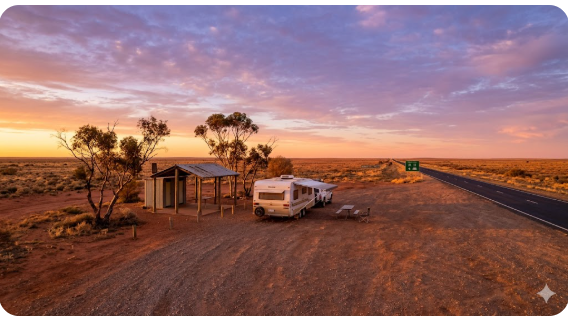
Outback NSW Rest Areas for Grey Nomads 2026 | Free Camping & Stopovers Guide
A complete guide to outback NSW overnight stops from Broken Hill to Bourke, including fuel distances, water planning, mobile coverage, heat management and safety advice for senior grey nomads travelling inland.
📅 Last reviewed: June 2026 | Outback NSW Regional Guide | Covers Broken Hill, Bourke, Wilcannia, Central West and Blue Mountains gateway routes
Outback NSW covers some of Australia’s most remote and rewarding grey nomad travel — from the mining history of Broken Hill to the vast plains around Bourke, the Darling River corridor and the central west plateau country beyond the Blue Mountains. Rest areas in this region are spread further apart than on the coast, fuel and water are not always available when you expect them, mobile coverage is patchy to non-existent in many areas, and summer heat can be genuinely dangerous for seniors managing health conditions. This guide breaks down the main outback NSW corridors, what rest areas exist along each route, what facilities you can count on, and how to plan safely for inland travel where the gaps between services matter more than anywhere else in the state.
- Region: Outback and far west NSW
- Main corridors: Broken Hill, Bourke, Wilcannia, Cobar, central west
- Rest areas: 15+ documented stops across the region
- Facilities: Basic — most have toilets, few have water, no dump points at rest areas
- Overnight stays: Generally permitted at signed rest areas — confirm on arrival
- Mobile coverage: Patchy Telstra only in most areas — Optus and Vodafone limited to towns
- Maximum fuel gap: Over 200km on some routes — plan ahead
- Summer risk: Extreme heat — temperatures inside stationary vans can exceed 50°C
- Best season: Autumn and winter — avoid December to February
- Medical distance: Can exceed 100km to nearest hospital — carry emergency contacts
- Best planning tool: Wikicamps, Fuel Map Australia, Telstra coverage map
Table of Contents
- Why Outback NSW Is Different From Coastal Travel
- Legal Overnight Rules for Outback NSW Rest Areas
- What Facilities to Expect at Outback Rest Areas
- Mobile Coverage and Wi-Fi in Outback NSW
- How to Plan an Outback NSW Route Safely
- Key Outback NSW Rest Areas by Corridor
- What to Expect When You Arrive at an Outback Rest Area
- Safety for Senior Grey Nomads in Outback NSW
- Medical Facilities and Emergency Planning
- Fuel, Water and Supplies — Outback Distance Planning
- Things to See and Do in Outback NSW
- Best Time of Year to Travel Outback NSW
- Outback Rest Area Etiquette
- Packing Checklist for Outback NSW Travel
- Frequently Asked Questions
- Final Verdict — Is Outback NSW Right for You?
Why Outback NSW Is Different From Coastal Travel
If your grey nomad experience so far has been along the NSW coast or the Hume Highway corridor, outback NSW will feel like a different country. The distances between towns are longer. The gaps between fuel stops can exceed 200 kilometres. Mobile coverage is limited to Telstra in most areas and disappears entirely in some stretches. Medical services are hours away, not minutes. Summer temperatures routinely exceed 40°C, and the heat inside a stationary campervan can become dangerous very quickly for seniors managing blood pressure, diabetes or other heat-sensitive conditions.
Rest areas in outback NSW are basic. Most have toilets — usually pit toilets rather than flushing facilities. Very few have potable water. None have dump points. Power is not available. The landscape is flat, open and often exposed, with little natural shade at many stops. Arrival times matter more here than on the coast — pulling in after dark without having confirmed the site in daylight is risky in remote areas where the next option might be 80 or 100 kilometres further on.
| Factor | Coastal NSW | Outback NSW |
|---|---|---|
| Distance between towns | 20–50km typically | 80–150km common, some gaps over 200km |
| Mobile coverage | Good across all carriers | Patchy Telstra only — Optus/Vodafone limited to towns |
| Rest area facilities | Toilets common, water sometimes available | Pit toilets common, water rare, no dump points |
| Medical services distance | Usually under 30km | Can exceed 100km to nearest hospital |
| Fuel availability | Service stations frequent | Gaps of 100–200km+ — planning essential |
| Summer temperatures | Moderated by coast — 25–35°C | Regularly 40–48°C — extreme heat risk for seniors |
The reward for these challenges is some of the most distinct and memorable landscape in Australia — wide open plains, huge skies, mining towns with deep history, Indigenous cultural significance at every turn, and the sense of genuine remoteness that many grey nomads travel seeking. Done well, with proper planning and an honest understanding of what the region demands, outback NSW is exceptional. Done poorly — improvising as you go, running fuel close, ignoring heat warnings — it can go wrong quickly.
Legal Overnight Rules for Outback NSW Rest Areas
Overnight stays at rest areas in outback NSW are generally permitted where rest areas are signed and managed by Transport for NSW or local councils. The same state-level rules that apply elsewhere in NSW apply here — up to 24 hours at most Transport for NSW rest areas unless signed otherwise. The practical difference is enforcement. In remote outback areas, ranger patrols are infrequent and you are unlikely to be moved on from a legal rest area even if you stay slightly beyond the time limit. That said, the rules still apply and signage on arrival is what counts legally.
Free camping on crown land and pastoral leases is less clearly defined in outback NSW than in some other states. Some areas permit it, others do not. Always check locally or use a verified source like Wikicamps before assuming an unmarked pull-off is legal for overnight use. Private property is everywhere in the outback — what looks like open bush is often part of a working pastoral lease, and camping without permission is trespass.
- Rest areas managed by Transport for NSW generally permit overnight stays of up to 24 hours — check signage on arrival for any shorter limits
- Council-managed rest areas and roadside stops vary — some permit overnight use, others are signed for short stops only
- Setting up a full camp with awnings, annexes and outdoor furniture is generally not permitted even where overnight vehicle stays are allowed
- National parks in outback NSW require camping to occur only in designated campsites with prior booking and payment
- On-site signage always takes legal precedence over any general advice — if the sign says no overnight stays, that overrides everything else
What Facilities to Expect at Outback Rest Areas
Facilities at outback NSW rest areas are basic and significantly more limited than what you will find on the coast or along major highway corridors closer to Sydney and regional centres. Manage your expectations before you arrive and plan your water, waste and power needs independently — do not rely on finding facilities at the rest area itself.
| Facility | Availability at Outback Rest Areas | What Seniors Should Know |
|---|---|---|
| Toilets | Most rest areas have pit toilets or composting toilets | Rarely flushing toilets — pit toilets can be unpleasant in hot weather. Carry your own toilet paper and hand sanitiser. |
| Potable water | Rare — assume no water unless verified in advance | Carry a minimum of 20 litres per person. Outback heat increases water needs significantly. Never assume water is available. |
| Dump point | Not available at rest areas — nearest in towns | Plan dump point stops at caravan parks or council facilities in Broken Hill, Bourke, Cobar or other major towns. Apps like Campermate show dump point locations. |
| Showers | Not available at rest areas | Use caravan parks or public pools in towns if shower access is needed between stops. |
| Rubbish bins | Some rest areas have bins — many do not | Carry all rubbish with you and dispose of it in the next town. Never leave rubbish at an overflowing bin or on the ground. |
| Power | Not available at any outback rest areas | CPAP users and those requiring powered medical equipment must carry battery systems, solar setups or plan overnight stops at powered caravan park sites. |
| Shade | Limited — most stops are open and exposed | Outback rest areas rarely have trees large enough for meaningful shade. Plan for full sun exposure and heat inside the van during the day. |
| Picnic tables | Some rest areas have tables and shelters | Metal tables in full sun become too hot to touch in summer. Shelters offer shade but not cooling. |
Mobile Coverage and Wi-Fi in Outback NSW
Mobile coverage in outback NSW is limited and unreliable. Telstra has the widest coverage across the region but even Telstra drops out completely in many stretches between towns. Optus and Vodafone coverage is largely limited to the towns themselves — Broken Hill, Bourke, Cobar and similar regional centres — with almost no coverage on the roads between them. If you rely on mobile data for navigation, communication or emergency contact, download offline maps before you leave and carry a satellite emergency device such as a Personal Locator Beacon (PLB) or satellite messenger.
Mobile Coverage by Corridor
- Broken Hill corridor (Barrier Highway): Telstra coverage is reasonable in and around Broken Hill and extends intermittently along the highway, but expect dead zones between towns. The Broken Hill Rest Area and Broken Hill South Rest Area both have Telstra signal when you are close to town.
- Wilcannia and far west (Barrier Highway west): Coverage drops significantly west of Cobar. The East of Wilcannia Rest Area has limited or no signal depending on your position within the site. Wilcannia township has Telstra coverage.
- Bourke region (Mitchell Highway): Telstra signal exists in Bourke and extends a short distance out of town, but the South of Bourke Rest Area and surrounding corridor have patchy or no coverage. The Attack Creek Rest Area and Belah Hill Rest Area are in low-coverage zones.
- Central west (Great Western Highway, Mitchell Highway): Coverage improves closer to Bathurst and the Blue Mountains but remains patchy in areas around Square Bush Rest Area and similar inland stops.
Public Wi-Fi
Public Wi-Fi does not exist at outback rest areas. Some libraries, visitor centres and cafes in towns offer free Wi-Fi, but speeds are often slow and access times may be limited. Do not rely on finding usable Wi-Fi outside of major regional centres like Broken Hill or Dubbo.
How to Plan an Outback NSW Route Safely
Planning an outback NSW route is fundamentally different from planning a coastal drive. The distances between services, the lack of mobile coverage, the scarcity of medical facilities and the extreme summer heat all demand a more deliberate and conservative approach. Improvising your route as you go — a strategy that works fine on the coast — can leave you stranded without fuel, water or help in outback NSW.
Route Planning Steps
- Map your fuel stops first: Identify every fuel station on your route and confirm current opening hours. Some outback fuel stops close early, close on weekends, or operate on reduced hours. Plan to refuel whenever you drop below half a tank — never run it close in remote areas.
- Identify overnight stops in advance: Choose your planned rest areas or caravan parks before you leave each morning, not at 4pm when you start looking. Have a primary stop and a backup in case the first is unsuitable or full.
- Note medical facilities: Mark the location of every hospital and medical centre along your route so you know how far you are from help at any point. In some stretches, the nearest hospital is over 100 kilometres away.
- Check road conditions: Outback roads can close after rain or during extreme heat events. Check the NSW Live Traffic website or call local councils before departure, especially after recent weather.
- Plan water and dump point stops: Identify where you will refill water tanks and dump waste. These stops are not frequent in outback NSW — plan them around towns with known facilities such as Broken Hill, Bourke, Cobar or Dubbo.
- Allow extra time: Do not plan tight daily distances. Outback roads are often single-lane each way, unsealed in sections, and slower than highway driving. Fatigue builds faster on long monotonous stretches. Plan shorter daily distances than you would on the coast.
Driving Notes for Seniors Towing Vans
- Many outback highways are single-lane each way with soft or non-existent shoulders — passing requires care and patience
- Road trains are common on outback routes — give them plenty of space and wait for safe, clear stretches to overtake or be overtaken
- Wildlife is active at dawn and dusk — kangaroos, emus and livestock can appear on the road with little warning
- Dust storms can reduce visibility to near zero in minutes — if you encounter a dust storm, pull over, turn off all lights, and wait it out
- Fatigue is a serious risk on long flat monotonous roads — take breaks every 90 minutes whether you feel tired or not
- Road surfaces can deteriorate rapidly in outback areas — watch for potholes, cracks and corrugations even on sealed roads
Key Outback NSW Rest Areas by Corridor
Outback NSW rest areas are spread across several main travel corridors. This section breaks down the key stops along each route, what to expect at each, and links to full individual guides where available. Use this as a planning reference before you depart so you know what exists along your chosen route.
Broken Hill Corridor (Barrier Highway)
The Barrier Highway runs east-west across outback NSW, connecting Sydney and Adelaide via Broken Hill. This is one of the busiest outback routes and has reasonable rest area coverage, though facilities remain basic.
| Rest Area | Approx Distance from Broken Hill | Facilities | Full Guide |
|---|---|---|---|
| Broken Hill Rest Area | In town | Toilets, bins, close to all services | View guide |
| Broken Hill South Rest Area | South of town on Barrier Hwy | Toilets, bins, no water | View guide |
| East of Wilcannia Rest Area | Approx 200km east of Broken Hill | Pit toilets, no water, exposed site | View guide |
| 41 Mile Bore Rest Area | Between Wilcannia and Broken Hill | Pit toilets, shelter, no water | View guide |
| Netallie Hill Rest Area | East of Wilcannia | Toilets, bins, limited shade | View guide |
| Marr Creek Rest Area | Between Cobar and Wilcannia | Basic facilities, remote | View guide |
Bourke and Northern Outback (Mitchell Highway, Kamilaroi Highway)
The route north to Bourke and beyond takes you into true far west NSW. Rest areas are less frequent and more remote than the Broken Hill corridor.
| Rest Area | Approx Location | Facilities | Full Guide |
|---|---|---|---|
| South of Bourke Rest Area | South of Bourke on Mitchell Hwy | Pit toilets, no water, open site | View guide |
| Attack Creek Rest Area | Bourke region | Toilets, bins, limited shade | View guide |
| Belah Hill Rest Area | Bourke corridor | Basic facilities, remote location | View guide |
Blue Mountains and Central West Gateway (Great Western Highway)
These rest areas mark the transition from Sydney’s urban fringe into the central west and eventually the outback. They are better serviced than the far west stops but still represent the start of more remote travel.
| Rest Area | Approx Location | Facilities | Full Guide |
|---|---|---|---|
| Sleepy Hollow Rest Area (Southbound) | Great Western Hwy, Blue Mountains | Toilets, bins, good access | View guide |
| Marrangaroo Tunnel Hill Rest Area | Blue Mountains descent | Toilets, scenic, limited parking for large rigs | View guide |
| Square Bush Rest Area | Central west between Bathurst and Parkes region | Toilets, bins, open site | View guide |
| Meadow Glen Rest Area | Central west corridor | Toilets, bins, reasonable shade | View guide |
Northern NSW and New England Routes
While not strictly outback, the northern inland routes through New England share some of the same characteristics — longer distances between towns, limited mobile coverage in sections, and more self-sufficient travel planning required.
| Rest Area | Approx Location | Facilities | Full Guide |
|---|---|---|---|
| Pine Brush Rest Area | Northern inland NSW | Toilets, bins, some shade | View guide |
| South Narrabri Stopping Bay | Newell Highway near Narrabri | Basic stopping bay, minimal facilities | View guide |
Points of Interest and Lookout Stops
Some rest areas in outback NSW double as scenic lookouts or cultural points of interest. These are worth planning into your route if time allows.
- Nancy Coulton Lookout Rest Area — named lookout with views over surrounding plains
What to Expect When You Arrive at an Outback Rest Area
Outback rest areas are not picturesque. They are functional stopping points designed to reduce driver fatigue on long monotonous roads. Most are flat, open, treeless clearings beside the highway with basic toilet facilities and little else. The appeal is not the amenity — it is the freedom to stop safely, rest overnight, and continue your journey without needing to book ahead or pay for a caravan park site.
What you will typically find on arrival:
- A pull-off area from the highway with space for several vehicles — sometimes marked bays, sometimes just a cleared area
- Pit toilets or composting toilets in a small shelter — these can be unpleasant in hot weather and are rarely cleaned daily
- Rubbish bins at some sites — often small and prone to overflowing during busy periods
- Picnic tables and shelters at better-maintained sites — metal tables in full sun are too hot to use during the day in summer
- Minimal or no shade — most outback rest areas are on open plains with few trees large enough to provide useful shade
- Other travellers during peak season (June to August), but often you will have the site to yourself outside those months
- Road noise if the rest area is immediately adjacent to the highway — this varies by site
Safety for Senior Grey Nomads in Outback NSW
Personal Safety
- Outback rest areas are generally safe — crime is rare and most travellers you encounter are fellow grey nomads or tourists
- Solo travellers should still lock doors and windows overnight and park in a position that allows easy exit if needed
- Let someone at home know your planned route and overnight stops each day, and check in the next morning — this simple habit is critical in remote areas
- Carry a Personal Locator Beacon (PLB) or satellite messenger for areas with no mobile coverage — register it with AMSA before you leave
- Trust your instincts on arrival. If a rest area feels unsafe or unsuitable for any reason, move on to the next option even if it adds time to your day
Trip Safety
- Never drive fatigued on outback roads — monotonous flat roads and long distances increase fatigue risk significantly
- Carry more water than you think you need — a minimum of 20 litres per person, and more in summer
- Check your vehicle before long remote stretches — tyre pressure, oil, coolant, and brake fluid all matter more when the nearest mechanic is 150 kilometres away
- Wildlife strikes are a serious risk at dawn and dusk — reduce speed during these periods and watch for movement at the roadside
- If your vehicle breaks down in a remote area, stay with the vehicle. It is easier for emergency services to find a stationary vehicle than a person walking in open country
- Dust storms and extreme heat can close roads or make travel dangerous — check conditions before departure and be prepared to delay travel if conditions are unsafe
Medical Facilities and Emergency Planning
Medical facilities in outback NSW are spread thin. The distance from your overnight rest area to the nearest hospital can easily exceed 100 kilometres. For seniors managing ongoing health conditions — diabetes, blood pressure, heart conditions — this distance is not hypothetical. It directly affects how you plan your route and what you carry with you.
| Service | Contact | Coverage in Outback NSW | When to Use |
|---|---|---|---|
| Emergency Services (Police, Ambulance, Fire) | 000 | Works from mobile in areas with signal — can work with very weak signal that appears unusable for normal calls | Any life-threatening emergency |
| Healthdirect (24/7 Nurse-on-Call) | 1800 022 222 | Requires phone coverage — works from Telstra in most towns | Health advice when unsure if emergency care is needed |
| Royal Flying Doctor Service | 1300 669 569 | Operates across all of outback NSW — critical service for remote medical emergencies | Serious medical events in areas more than 90 minutes from hospital |
| Poisons Information Centre | 13 11 26 | National service — works from any phone with coverage | Medication interactions, accidental ingestion, poisoning |
Major Hospitals in Outback NSW
- Broken Hill Base Hospital — Thomas Street, Broken Hill NSW 2880 — Full emergency department and medical services — Coordinates approximately -31.95, 141.45
- Bourke Multi-Purpose Service — Mitchell Street, Bourke NSW 2840 — Emergency and basic medical services — Coordinates approximately -30.09, 145.93
- Cobar District Hospital — Dalton Street, Cobar NSW 2835 — Emergency and general medical services — Coordinates approximately -31.50, 145.83
- Dubbo Base Hospital — Myall Street, Dubbo NSW 2830 — Full regional hospital with emergency department — Coordinates approximately -32.24, 148.60
Fuel, Water and Supplies — Outback Distance Planning
The single biggest planning challenge in outback NSW is the distance between services. Fuel stations, potable water, dump points, groceries and pharmacies are concentrated in towns, and the gaps between those towns can exceed 150 to 200 kilometres. Running out of fuel, water or essential supplies in a remote area is avoidable — but only if you plan conservatively and refill whenever you have the opportunity.
| Need | Best Option in Outback NSW | Planning Notes |
|---|---|---|
| Fuel | Service stations in Broken Hill, Bourke, Cobar, Wilcannia, Nyngan, Dubbo | Gaps between fuel stops can exceed 200km. Refuel at half a tank. Confirm station hours before relying on them — many close early or operate reduced weekend hours. |
| Potable water | Town water taps, caravan parks, some service stations | Carry minimum 20 litres per person. Refill at every opportunity. Never assume rest area water is potable unless clearly signed. |
| Dump point | Caravan parks and council facilities in major towns | Use apps like Campermate or WikiCamps to locate dump points. Plan dump stops around Broken Hill, Bourke, Cobar or Dubbo. No dump points exist at rest areas. |
| Groceries and fresh food | Supermarkets in Broken Hill, Bourke, Cobar, Dubbo, Nyngan | Smaller towns have general stores with limited range and higher prices. Stock up in larger towns before long remote stretches. |
| Pharmacy and medications | Pharmacies in Broken Hill, Bourke, Cobar, Dubbo | Smaller towns may have no pharmacy or operate limited hours. Carry sufficient medications for your entire trip plus a buffer. |
| Medical services (GP, hospital) | Broken Hill, Bourke, Cobar, Dubbo | Distances between hospitals can exceed 200km. Know where the nearest hospital is at every stage of your route. |
Fuel Planning Strategy
Use the Fuel Map Australia app or website to identify every service station along your route before you leave. Note their opening hours and days — many outback fuel stops close at 5pm or 6pm and some are closed Sundays. Plan to refuel whenever your tank drops to half — not quarter. Towing a caravan or driving a large motorhome increases fuel consumption significantly, and headwinds on open plains can reduce range further. Always carry more fuel capacity than your planned route requires.
Things to See and Do in Outback NSW
Outback NSW is not just about rest areas and transit — the region has significant cultural, historical and natural attractions that are worth building into your route if time allows. Many are senior-friendly and accessible without requiring strenuous activity.
| Activity / Attraction | Location | Why Seniors Like It |
|---|---|---|
| Pro Hart Gallery and Broken Hill art precinct | Broken Hill | World-class outback art in accessible galleries — fully accessible, air-conditioned, easy walking |
| Silverton historic town and Mad Max filming locations | 25km west of Broken Hill | Short drive, flat terrain, iconic outback scenery and film history — café and pub on site |
| Mutawintji National Park | 130km northeast of Broken Hill | Ancient rock art and Indigenous cultural tours — some walks are accessible, others require moderate fitness |
| Back O’ Bourke Exhibition Centre | Bourke | Excellent regional history and river culture displays — accessible, informative, air-conditioned |
| Darling River sunset viewing | Bourke, Wilcannia, Menindee | No walking required — park beside the river and watch the sunset over water and red gums |
Best Senior-Friendly Ideas in Outback NSW
- Take a guided Indigenous cultural tour at Mutawintji National Park — learn the deep history of the land from Traditional Owners
- Visit the Royal Flying Doctor Service Visitor Centre in Broken Hill — accessible, informative and air-conditioned
- Drive the Sculpture Symposium trail around Broken Hill — view large-scale sculptures in the landscape without leaving your vehicle
- Stop at historic pubs in Silverton, Menindee or Tilpa — these are genuine outback icons, not tourist reconstructions
- Photograph the sunset from the Darling River at Bourke or Wilcannia — some of the most vivid skies in Australia
Best Time of Year to Travel Outback NSW
Season matters enormously in outback NSW. Summer heat is genuinely dangerous for seniors and should be avoided unless you plan to stay only in air-conditioned caravan parks. Winter is the peak season for grey nomads heading west, but even winter nights can be very cold. Autumn and spring offer the best balance of comfortable temperatures and fewer crowds.
| Season | Conditions in Outback NSW | Senior Verdict |
|---|---|---|
| Summer (Dec–Feb) | Extreme heat — daytime temperatures regularly 40–48°C. Inside a stationary van can exceed 50°C. Dust storms common. Bushfire risk high. | Avoid unless staying in powered caravan parks with air conditioning. Heat is medically dangerous for seniors managing blood pressure, diabetes or cardiovascular conditions. |
| Autumn (Mar–May) | Temperatures moderate to 20–30°C. Dust settles. Crowds thin after Easter. Roads quieter. Wildflowers in some areas after rain. | One of the best times to travel outback NSW. Comfortable temperatures, fewer travellers, and lower fire risk. Nights can still be cool — bring warm bedding. |
| Winter (Jun–Aug) | Daytime temperatures 15–25°C. Nights can drop to near zero or below. Clear skies. Busy season for grey nomads — rest areas and caravan parks fill faster. | Popular season but can be crowded. Days are pleasant but nights are very cold. Heating or warm bedding essential. Plan to arrive at rest areas early during peak months. |
| Spring (Sep–Nov) | Warming temperatures 20–35°C. Wildflowers after winter rain. Less crowded than winter. Heat builds toward summer from October onward. | Good season for outback travel but watch the forecast — heat can arrive suddenly in November. Plan to complete outback legs before mid-November if possible. |
Outback Rest Area Etiquette
The same etiquette rules that apply at coastal rest areas apply in outback NSW — but they matter even more here because the number of legal overnight stops is smaller and losing access to any one of them reduces options for everyone. Outback rest areas survive as open access because most travellers use them responsibly. Misuse leads directly to closures.
- Leave no trace: Pack out all rubbish including food scraps, bottles, cans and packaging. If the bin is full, take your rubbish to the next town — never leave it on the ground or beside an overflowing bin
- No grey water dumping: Never drain grey water onto the ground, into roadside drains or near the rest area. Use a sealed tank and dispose of it properly at a dump point in the next town
- Respect time limits: If the rest area is signed for 24 hours or less, stick to it. Overstaying is one of the fastest ways to trigger new restrictions
- Keep noise to a minimum: Generators should not be run late at night or early morning. If you must use a generator, run it during daylight hours and only for essential charging
- No open fires: Fire bans are common in outback NSW from spring through summer. Even when fires are not banned, open fires at rest areas are generally prohibited. Use a gas cooker for meals
- Do not set up permanent camps: Rest areas are for overnight vehicle stays, not for setting up full camps with annexes, awnings, washing lines and outdoor kitchens. Keep your setup minimal and vehicle-based
Packing Checklist for Outback NSW Travel
Packing for outback NSW is different from packing for coastal travel. The remoteness, heat, distance between services and lack of mobile coverage all demand more self-sufficient preparation. This checklist is specific to the challenges of outback travel for senior grey nomads.
| Item | Why It Matters in Outback NSW | Packed |
|---|---|---|
| Minimum 20 litres fresh water per person | Rest areas rarely have water. Towns can be 150km apart. Heat increases water needs significantly. | ☐ |
| Personal Locator Beacon (PLB) registered with AMSA | Mobile coverage disappears entirely in many areas. PLB is your emergency lifeline when out of range. | ☐ |
| Written medical summary with medications and dosages | Nearest hospital can be 100km+ away. Emergency services need this information immediately if you cannot provide it. | ☐ |
| Offline maps downloaded (Wikicamps, Google Maps, Maps.me) | Mobile data drops out between towns. Offline maps are essential for navigation and finding rest areas. | ☐ |
| Extra fuel capacity or jerry cans | Fuel gaps can exceed 200km. Towing increases consumption. Headwinds reduce range further. | ☐ |
| Spare tyre in good condition and tools to change it | Outback roads are harder on tyres. Roadside assistance can take hours to reach you in remote areas. | ☐ |
| Insect repellent and fly nets | Flies are relentless in outback NSW during warmer months — they make outdoor activity unbearable without protection. | ☐ |
| Sun protection (hat, sunscreen, sunglasses) | UV levels are extreme in outback NSW. Shade is minimal at most rest areas. Sunburn happens quickly. | ☐ |
| Warm bedding (even in summer) | Outback nights can drop near freezing even after a 35°C day. Temperature swings are extreme. | ☐ |
| 12V fridge or insulated cooler for medications | Heat-sensitive medications like insulin can be destroyed by van temperatures exceeding 50°C in summer. | ☐ |
| Dust covers or tarps for vents and openings | Dust storms coat everything. Protecting vents and keeping dust out of the van interior matters for comfort and equipment. | ☐ |
| Portable toilet and grey water containment | Rest area toilets can be unpleasant or non-functional. Having your own removes uncertainty and improves hygiene. | ☐ |
COPY PROMPT ➔ ASK AI ➔ SAVE TO FORM ➔ ADD SPOT PIN ➔ GET DIRECTIONS
📍 Interactive map — find free camps, rest areas and overnight stops across outback NSW. Enable location for best results.
Frequently Asked Questions
Can you free camp anywhere in outback NSW?
No. Free camping in outback NSW is permitted only in designated rest areas, signed free camping zones or on crown land where it is specifically allowed. Much of what appears to be open bush is actually part of a working pastoral lease, and camping without permission is trespass. Always use designated rest areas, caravan parks or verified free camping spots listed on apps like Wikicamps. Never assume an unmarked pull-off is legal for overnight use.
How far apart are rest areas in outback NSW?
Rest area spacing varies significantly by route. On the Barrier Highway between Broken Hill and Cobar, rest areas are spaced roughly 80 to 120 kilometres apart. On less-travelled routes north toward Bourke or Wilcannia, gaps can exceed 150 kilometres. Always plan your overnight stops in advance and have a backup option — do not rely on finding a rest area when you need one.
Is it safe to travel alone in outback NSW as a senior?
Yes, thousands of solo senior grey nomads travel outback NSW safely every year. The key is preparation. Let someone at home know your route and check in daily. Carry a PLB for areas without mobile coverage. Refuel conservatively and carry extra water. Know the distance to the nearest hospital at every stage. The outback is not inherently dangerous, but it is unforgiving of poor planning.
What is the best route through outback NSW for first-timers?
The Barrier Highway from Dubbo to Broken Hill is the best first outback route. It is sealed the entire way, has reasonable rest area coverage, passes through several towns with full services, and is well-travelled year-round. From Broken Hill you can return via the same route or continue west into South Australia. Avoid attempting the Bourke to Wanaaring route or other remote northern tracks as a first outback experience — start with the Barrier Highway and build from there.
Do I need a 4WD to travel outback NSW?
No. All major outback NSW routes are sealed and accessible to 2WD vehicles, campervans, motorhomes and caravans. The Barrier Highway, Mitchell Highway, and Great Western Highway are all fully sealed. Some side tracks and national park access roads require 4WD, but these are not necessary for standard grey nomad outback travel. A well-maintained 2WD with good clearance is sufficient for the main routes.
How do I find fuel stations in outback NSW?
Use the Fuel Map Australia app or website before you leave to identify every service station along your route. Note their opening hours and phone numbers. Many outback fuel stops close by 6pm and some are closed Sundays. Confirm hours before you rely on a specific stop, and always refuel when your tank drops to half — never run it close in remote areas where the next station might be 150 kilometres away.
Can I use my mobile phone in outback NSW?
Mobile coverage in outback NSW is limited to Telstra in most areas, and even Telstra has significant dead zones between towns. Optus and Vodafone are largely limited to towns themselves. Download offline maps and travel information before you leave a town with coverage. Carry a PLB or satellite messenger for emergency communication in areas with no mobile signal. Do not rely on your mobile phone as your only means of contact in remote outback areas.
What should I do if I break down in outback NSW?
Stay with your vehicle. It is much easier for emergency services or roadside assistance to locate a stationary vehicle than a person walking in open country. Call for help if you have mobile coverage. If you have no signal, use your PLB if the situation is life-threatening. Set up shade and ration water while you wait. If another vehicle stops, ask them to call for help when they reach coverage. Most outback travellers will assist — it is part of the culture.
Are there crocodiles or dangerous wildlife in outback NSW?
No crocodiles exist in NSW — they are confined to northern Australia. The main wildlife risks in outback NSW are kangaroo strikes (especially at dawn and dusk), snakes during warmer months (watch where you walk and do not put hands or feet where you cannot see), and the occasional brown snake or red-bellied black snake near water sources. Spiders including redbacks can be present in toilet blocks. Use common sense — shake out shoes before putting them on, check toilet seats before sitting, and give snakes space if you encounter them.
Final Verdict — Is Outback NSW Right for You?
Outback NSW is not for every grey nomad — and that is perfectly fine. It demands more planning, more self-sufficiency, and a higher tolerance for heat, dust, isolation and basic facilities than coastal or highway travel. If you are looking for green scenery, daily coastal swims, frequent caravan parks with pools and easy access to cafes and shops, the outback will not meet those expectations. But if you want wide horizons, deep history, genuine remoteness, the freedom to travel at your own pace without crowds, and the satisfaction of navigating a genuinely challenging environment successfully, outback NSW delivers all of that and more.
The rest areas in this region are basic. Facilities are minimal. Medical services are distant. Fuel and water planning is non-negotiable. Summer heat is genuinely dangerous for seniors. But for grey nomads who plan conservatively, pack properly, travel in the right season, and approach the outback with respect rather than bravado, this region offers some of the most rewarding travel in Australia. You will see landscapes that exist nowhere else. You will drive for an hour without passing another vehicle. You will watch sunsets over plains that stretch to the horizon in every direction. And you will meet travellers who understand why the outback matters — people who choose challenge over convenience and find meaning in the space between towns.
- Broken Hill Rest Area — Full Guide
- Broken Hill South Rest Area — Full Guide
- East of Wilcannia Rest Area — Full Guide
- 41 Mile Bore Rest Area — Full Guide
- Netallie Hill Rest Area — Full Guide
- Marr Creek Rest Area — Full Guide
- South of Bourke Rest Area — Full Guide
- Attack Creek Rest Area — Full Guide
- Belah Hill Rest Area — Full Guide
- Sleepy Hollow Rest Area (Southbound) — Full Guide
- Marrangaroo Tunnel Hill Rest Area — Full Guide
- Square Bush Rest Area — Full Guide
- Meadow Glen Rest Area — Full Guide
- Pine Brush Rest Area — Full Guide
- Nancy Coulton Lookout Rest Area — Full Guide
Outback summer heat can be dangerous for seniors. If temperatures exceed 40°C or you need air conditioning for medical reasons, search powered caravan parks or motels below to stay safe and comfortable.
Accommodation and flight search powered by Expedia. Booking through this search supports this website at no extra cost to you. As an affiliate, I earn from qualifying purchases at no extra cost to you.

As an affiliate, I earn from qualifying purchases at no extra cost to you.
Exclusive Offer: Get 5% OFF all StarterStopper immobiliser products with promo code: RTV5
Visit StarterStopper.com to see our data-backed security solutions
As an affiliate, I earn from qualifying purchases at no extra cost to you.