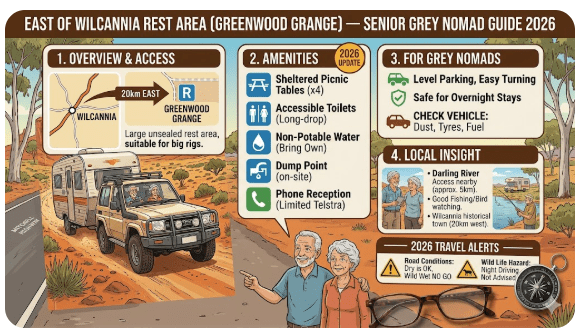
East Of Wilcannia Rest Area (Greenwood Grange)
Complete Senior Grey Nomad Guide 2026 — GPS coordinates, road conditions, flooding history, fuel distances, facilities, wildlife, phone signal, dump points and everything a senior traveller needs before pulling in on the Barrier Highway between Wilcannia and Cobar.
📅 Last reviewed: January 2026 | Barrier Highway, NSW 2836 | Free overnight rest area — remote outback highway setting
📋 Table of Contents
- Why Grey Nomads Stop at Greenwood Grange Rest Area
- Free Camping — Know the Limits for Seniors
- Quick Facts and Key Details 2026
- How to Get There + GPS Coordinates
- Road Conditions, Flooding and Unsealed Sections
- Heat and Remoteness — Senior Safety
- Wildlife — Birds, Reptiles and What to Watch For
- What Other Websites Don’t Tell You
- Best Time to Visit — Month-by-Month Breakdown
- Free and Low-Cost Camping Alternatives Nearby
- Dump Points Near Wilcannia
- Free Water Sources Near Wilcannia
- Fuel Stops Along the Barrier Highway
- Caravan Park and Paid Alternatives
- Full Facilities Comparison Table
- Rates — All Options Near the Area 2026
- Senior Safety Checklist — On and Off the Road
- What to Do Near Wilcannia — Senior Activity Guide
- Vanlife Savings Spots — GPS Coordinates and Postcodes
- Phone Signal and Emergency Communications
- Campfires, Cooking Restrictions and Food Near Wilcannia
- Pets at This Rest Area
- Accessibility for Seniors with Mobility Limitations
- Permits, Fees, Etiquette and Waste Management
- Emergency Scenarios — What to Do
- Packing List for This Section of the Barrier Highway
- 5 Rest Areas Near Wilcannia on the Barrier Highway
- Reviews — What Grey Nomads Say
- Frequently Asked Questions
- Quick-Reference Card
- Disclaimer
1. Why Grey Nomads Stop at Greenwood Grange Rest Area
The Greenwood Grange Rest Area — officially signposted as the East of Wilcannia Rest Area — sits on the Barrier Highway approximately 8 kilometres east of Wilcannia township in far-western New South Wales. It is one of the few formal, maintained rest areas between Wilcannia and Cobar on this long, largely featureless stretch of bitumen, making it a natural stopping point for grey nomads driving the iconic east–west outback corridor.
For senior travellers in caravans, motorhomes, campervans and fifth-wheelers, this rest area offers a level sealed pull-off with enough room to park a large rig comfortably. It breaks up the 465-kilometre Wilcannia-to-Cobar run — a drive that can feel relentless in summer heat — and provides a safe, free place to rest, brew a coffee, check your tyre pressure or catch a few hours of sleep before pushing on.
The surrounding landscape is classic far-western NSW: red-earth plains, scrubby mulga and bluebush, vast open sky, and the silence that draws so many retirees to outback travel in the first place. Sunsets from this rest area are genuinely spectacular, and the night sky — with almost zero light pollution — is among the darkest in eastern Australia.
This guide is written specifically for senior grey nomads and retirees aged 60 and over who are travelling independently. It covers every practical detail — road conditions, flooding risk, fuel planning, emergency preparedness, accessibility, phone signal — that experienced travel websites often skip over.
2. Free Camping — Know the Limits for Seniors
The East of Wilcannia Rest Area (Greenwood Grange) is a NSW Roads and Maritime Services managed rest area on a state highway. This means it operates under NSW road rules for rest areas, not under national park or council camping rules.
The 20-Hour Rule — NSW Rest Areas
Under NSW road regulations, travellers may stay at a highway rest area for a maximum of 20 consecutive hours. This is a fatigue management provision — rest areas exist for driver rest, not extended camping. Staying longer than 20 hours may attract attention from NSW Police highway patrols, who do enforce this on remote highways.
What Is Permitted at This Rest Area
- Stopping and resting in your vehicle or caravan — up to 20 hours
- Sleeping overnight in your self-contained rig
- Using a portable gas stove outside your vehicle (no total fire ban in force)
- Walking your dog on a lead around the perimeter
- Using your own toilet/cassette — grey water must be retained in your vehicle
What Is NOT Permitted
- Open campfires at any time — this is a highway rest area, not a campground
- Staying longer than 20 consecutive hours
- Dumping grey water, waste or rubbish (no facilities provided)
- Generators during quiet hours (common courtesy — typically 10pm–7am)
- Erecting tents or structures outside your vehicle
3. Quick Facts and Key Details 2026
| Detail | Information |
|---|---|
| Official Name | East of Wilcannia Rest Area (also known as Greenwood Grange Rest Area) |
| Highway | Barrier Highway (A32) |
| Location | Approx. 8 km east of Wilcannia, NSW |
| Postcode | 2836 (Wilcannia) |
| Coordinates | -31.555°S, 143.484°E (approx. — see GPS section) |
| Road Surface | Sealed highway — rest area access is sealed |
| Cost | Free — no booking required |
| Maximum Stay | 20 hours (NSW road rule) |
| Toilets | None on site |
| Water | None on site — carry your own |
| Shade | Limited natural shade (mulga scrub) |
| Power | No power — solar/battery rigs only |
| Dump Point | None on site — nearest in Wilcannia (8 km) |
| Suitable for Large Rigs | Yes — adequate turning space for caravans and motorhomes |
| Heavy Vehicles | Yes — trucks also use this rest area |
| Pets Allowed | Yes — on lead |
| Mobile Signal | Very limited — Telstra only, weak 3G/4G coverage |
| Emergency Contact | 000 (may need satellite communicator in this area) |
| Managed By | NSW Transport / Roads and Maritime Services |
4. How to Get There + GPS Coordinates
The Greenwood Grange Rest Area is located directly on the Barrier Highway (A32), which is the main sealed highway connecting Broken Hill (west) and Cobar (east), passing through Wilcannia. There is no turn-off or unsealed access required — you pull directly off the highway into the rest area.
Arriving from the East (from Cobar)
Travel west on the Barrier Highway from Cobar for approximately 457 kilometres. The rest area is on your right (north) side of the highway, approximately 8 km before you reach Wilcannia township. Watch for the standard blue rest area sign with the sleeping driver symbol.
Arriving from the West (from Broken Hill)
Travel east on the Barrier Highway from Broken Hill for approximately 190 kilometres through Wilcannia. After passing through Wilcannia, continue east for approximately 8 kilometres. The rest area will be on your left (north) side of the highway.
Arriving from the South (from Menindee Road)
From Menindee, take the Menindee Road north to Wilcannia — approximately 110 kilometres on a road that is largely unsealed (see Road Conditions section below). Once you reach Wilcannia, turn east onto the Barrier Highway and drive 8 km to the rest area.
📡 GPS Coordinates — Greenwood Grange Rest Area
-31.5550° S | 143.4840° E
Coordinate source: Publicly available mapping data (OpenStreetMap / Google Maps cross-referenced). These are approximate coordinates for navigation — always watch for highway signage.
Enter these coordinates directly into your GPS unit, Google Maps, Apple Maps, Hema Explorer or OziExplorer before you lose phone signal on the highway.
Distance Table — Key Locations from Greenwood Grange Rest Area
| Location | Direction | Distance | Approx. Drive Time | Road Type |
|---|---|---|---|---|
| Wilcannia Township | West | ~8 km | ~8 min | Sealed — Barrier Hwy |
| Broken Hill | West | ~198 km | ~2 hr 10 min | Sealed — Barrier Hwy |
| Cobar | East | ~457 km | ~4 hr 50 min | Sealed — Barrier Hwy |
| Nyngan | East | ~600 km | ~6 hr 30 min | Sealed — Barrier Hwy |
| Menindee | South (via road) | ~118 km | ~2 hr | Partly unsealed — see notes |
| White Cliffs | North | ~98 km | ~1 hr 30 min | Mostly unsealed — check conditions |
| Ivanhoe | East-SE | ~197 km | ~2 hr 10 min | Sealed — Barrier Hwy |
| Tibooburra | North | ~330 km | ~4 hr+ | Mostly unsealed — 4WD advised |
5. Road Conditions, Flooding and Unsealed Sections
The Barrier Highway — Sealed and Generally Reliable
The Barrier Highway (A32) between Broken Hill and Cobar is a fully sealed two-lane highway. The stretch passing the East of Wilcannia Rest Area is in reasonable condition for a remote outback road, though travellers should expect:
- Patchy surface repairs and occasional rough sections between Wilcannia and Ivanhoe
- Long flat straights with road train traffic — overtaking requires care and patience
- Animals on the road — particularly at dawn, dusk and overnight
- Limited passing bays — be aware of road train etiquette (pull left, slow down)
Does the Road Flood?
Yes — and this is critically important for senior travellers planning this route.
The Barrier Highway itself rarely floods between Wilcannia and Cobar as it runs along elevated ground for much of this section. However, Wilcannia sits on the Darling River, and during significant flood events (as experienced in 2022 and 2023), the entire Wilcannia area can be cut off by floodwaters. In major floods, the Barrier Highway has been closed west of Wilcannia and sections of the Menindee Road have been completely inundated.
The Menindee Road — Partially Unsealed
If you are approaching from Menindee to the south, the Menindee to Wilcannia road (approximately 110 km) is largely unsealed. Key facts:
- The first section south of Wilcannia (approximately 30 km) follows the Darling River floodplain and is prone to flooding and becoming impassable after rain
- The road is generally suitable for 2WD in dry conditions, but a high-clearance vehicle is recommended
- Caravans are discouraged — corrugations and soft shoulders can cause serious caravan damage and sway
- Always carry extra water — there is no fuel or service between Menindee and Wilcannia
- Check conditions at livetraffic.com before attempting this road
Road to White Cliffs — Mostly Unsealed
The road north from Wilcannia to White Cliffs (approximately 98 km) is mostly unsealed. It is passable by 2WD in dry conditions but becomes extremely slippery and dangerous after rain. A high-clearance vehicle is strongly recommended. Caravans are not recommended on this road.
🛣️ Road Condition Resources — Always Check Before You Travel
Live Traffic NSW: livetraffic.com — real-time road closures, incidents and conditions
Bureau of Meteorology: bom.gov.au — weather forecasts and flood warnings for far-western NSW
NSW Transport Road Conditions: roads-waterways.transport.nsw.gov.au
For remote unsealed roads in this region, also check with the Wilcannia Visitor Information or local roadhouses, who often have the most up-to-date local knowledge.
6. Heat and Remoteness — Senior Safety
Far-western NSW is one of Australia’s harshest environments for travellers, and senior grey nomads need to take heat and remoteness more seriously here than almost anywhere else on the grey nomad circuit. The Greenwood Grange Rest Area offers no shade structures, no water, no facilities and no mobile phone guarantee. In summer, this is a genuinely dangerous location if you are unprepared.
Temperature Extremes
| Season | Average Max Temp | Record Max | Risk Level for Seniors |
|---|---|---|---|
| Summer (Dec–Feb) | 38–42°C | 50°C+ | 🔴 Extreme — avoid daytime travel |
| Autumn (Mar–May) | 26–33°C | 40°C+ | 🟡 Moderate — travel early morning |
| Winter (Jun–Aug) | 16–20°C | 25°C | 🟢 Ideal — peak grey nomad season |
| Spring (Sep–Nov) | 28–38°C | 44°C+ | 🟡 Moderate to High — check forecast |
Remoteness and the “Tell Someone” Rule
You are in genuinely remote territory on the Barrier Highway east of Wilcannia. Before departing from either Broken Hill or Cobar, tell a responsible person — family, friend, or travel partner — your planned route, rest stops, and an expected arrival time. Ask them to contact NSW Police (not 000 unless emergency) if they have not heard from you by a specified time.
- NSW Police non-emergency line: 131 444
- If you have a satellite communicator (SPOT, Garmin inReach, Zoleo), activate it and test it before leaving the last town
- Carry a minimum of 10 litres of drinking water per person above your normal daily needs when travelling this section
7. Wildlife — Birds, Reptiles and What to Watch For
The far-western plains around Wilcannia support a remarkable range of outback wildlife, and the Greenwood Grange Rest Area — sitting within mulga and bluebush country — is an excellent spot for wildlife observation, particularly at dawn and dusk.
Birds You Are Likely to See
- Budgerigars — sometimes in flocks of thousands, flying in tight formations over the plains
- Galahs, Sulphur-crested Cockatoos and Little Corellas — common along the highway corridor
- Wedge-tailed Eagles — often seen feeding on roadkill along the Barrier Highway; give them time to clear the road
- Port Lincoln Parrots (Australian Ringnecks) — in mulga woodland patches
- Zebra Finches and Crimson Chats — particularly after rain, when grasses seed quickly
- Brolgas — occasional visitors near Darling River floodplains
- Barn Owls and Boobook Owls — active at night; often struck by vehicles on the highway
Reptiles and Mammals
- Red and Eastern Grey Kangaroos — extremely active at dawn, dusk and overnight. The Barrier Highway has a high kangaroo strike rate; fit a roo bar if possible
- Euros (Common Wallaroos) — rocky outcrops near Broken Hill end of the highway
- Feral Goats — common in large mobs on the roadside, can behave unpredictably
- Eastern Brown Snakes — one of the world’s most venomous snakes; common in mulga country. Watch your step when walking in scrub, particularly in warm months
- Goannas (Lace Monitors) — seen at rest areas, attracted to food scraps
- Bearded Dragons and Blue-tongue Lizards — often sunning on the warm bitumen
Dangerous Wildlife on the Highway
- Drive at reduced speed between dusk and dawn — kangaroo and wombat strikes at highway speed are fatal to animals and can seriously damage or destroy your vehicle
- Feral camels occasionally cross the Barrier Highway west of Wilcannia — at 600+ kg, a camel strike at speed is catastrophic
- Do not swerve for animals — brake firmly and hold your line. More accidents are caused by vehicles swerving off the road than by the animal strike itself
8. What Other Websites Don’t Tell You
Most camping apps and travel websites list the East of Wilcannia Rest Area with a one-line description: “rest area, no facilities.” Here is what they leave out.
The Truck Traffic
The Barrier Highway is a major freight route. Road trains — sometimes 53 metres long with three trailers — pass regularly, day and night. At this rest area, you will hear and feel these trucks passing in the night. If you are a light sleeper, earplugs are essential. The wind turbulence from road trains at close range can also rock smaller caravans.
The Corrugated Entry
Grey nomads report (2024–2025) that the entry and exit to this rest area can develop corrugations on the unsealed apron near the highway edge, particularly after dry periods with high truck traffic. Take the entry slowly to avoid jostling your caravan or motorhome contents.
Flies
Far-western NSW has some of Australia’s most persistent flies, particularly in spring and summer. Bring fly nets for your hat, fly repellent, and be prepared to eat and drink inside your sealed rig. This is not a pleasant rest area to sit outside in during peak fly season (October–January).
No Shade Structures
Some rest areas on this highway have basic shade shelters. Greenwood Grange does not. The mulga scrub provides minimal shade in summer. Deploy your awning immediately upon arrival if temperatures are high.
The Darling River Effect
After flood events on the Darling River (which runs through Wilcannia 8 km west), mosquito populations can be extreme in this area. Carry mosquito repellent, screen your van thoroughly, and be aware that Ross River Fever and Barmah Forest Virus are present in far-western NSW and transmitted by mosquitoes.
9. Best Time to Visit — Month-by-Month Breakdown
| Month | Temp Range | Conditions | Senior Suitability |
|---|---|---|---|
| January | 22–42°C | Extreme heat, flies, potential flooding | 🔴 Not recommended |
| February | 22–41°C | Extreme heat, thunderstorm risk | 🔴 Not recommended |
| March | 17–35°C | Easing heat, pleasant nights | 🟡 Marginal — travel early AM only |
| April | 11–27°C | Ideal weather begins, wildflowers possible | 🟢 Excellent |
| May | 7–22°C | Cool, clear, peak grey nomad season | 🟢 Excellent |
| June | 4–18°C | Cold nights (near 0°C), clear blue days | 🟢 Excellent — warm bedding essential |
| July | 3–17°C | Coldest month, stunning clear days | 🟢 Excellent — warmest gear required |
| August | 5–20°C | Warming slightly, very clear skies | 🟢 Excellent |
| September | 10–26°C | Spring wildflowers, warming fast | 🟢 Very good |
| October | 14–32°C | Hot afternoons returning, peak flies | 🟡 Travel early morning |
| November | 18–37°C | Heat building, flies intense | 🟡 Caution — early starts essential |
| December | 20–41°C | Extreme heat returns | 🔴 Not recommended |
10. Free and Low-Cost Camping Alternatives Nearby
If the rest area is crowded (unusual, but possible during peak season) or you need a longer stay, the following options are within reasonable range. Always verify current conditions before arrival — remote outback camping spots can change.
- Wilcannia Showground — 8 km west. Donations accepted. Showers, toilets, and space for large rigs. One of the better budget options in far-western NSW. Contact Wilcannia Shire Council to confirm availability.
- Netallie Hill Rest Area — east on Barrier Hwy toward Cobar. Basic highway rest area, no facilities. Free, 20-hour limit.
- Dolo Hill Rest Area — further east toward Cobar. Similar facilities (minimal). Free, 20-hour limit.
- Popiltah Lake Rest Area — west toward Broken Hill. Scenic location. Free overnight stay.
- Cawndilla Campground — near Menindee Lakes. Excellent lakeside camping, NPWS managed. Low cost, great birdwatching.
- Darling River Run free camps — several informal camping areas along the Darling River accessible from Wilcannia. 4WD or high clearance recommended depending on the site. Check current access conditions locally.
11. Dump Points Near Wilcannia
There is no dump point at the East of Wilcannia Rest Area. The nearest confirmed dump point is in Wilcannia township, approximately 8 km west.
| Location | Distance from Rest Area | Cost | Notes |
|---|---|---|---|
| Wilcannia — Council Caravan Park / Showground area | ~8 km west | Free (donation) | Confirm availability with local council — facilities in small outback towns can change |
| Broken Hill — Multiple points | ~198 km west | Free–$5 | Several options including at the showground and caravan parks. Reliable. |
| Cobar — Council dump point | ~457 km east | Free | Located near the Cobar Caravan Park. Reliable. |
| Menindee — Near Lake Menindee | ~118 km south | Free | See Menindee Showers & Facilities guide |
12. Free Water Sources Near Wilcannia
Water sources near Wilcannia:
- Wilcannia Township — potable water available from the council area. Confirm with locals whether tap water is safe to drink directly (Darling River water quality can vary). Most grey nomads filter or purchase drinking water.
- Wilcannia Service Station — water available for purchase
- Broken Hill — excellent tap water supply. Fill your tanks fully before leaving Broken Hill if travelling east, as this is your last reliable large-town water source for nearly 200 km.
- Cobar — reliable town water. Fill tanks here if travelling west.
13. Fuel Stops Along the Barrier Highway
Fuel planning is one of the most important safety considerations on the Barrier Highway. Distances between fuel stops are very long, and several remote service stations have reduced operating hours or have closed in recent years.
Fuel Stops — Travelling East from Greenwood Grange Rest Area (toward Cobar)
| Town/Stop | Distance East | Fuel Type | Notes |
|---|---|---|---|
| Wilcannia (west, behind you) | –8 km | Unleaded, Diesel | Last fuel behind you — fill before leaving if low |
| Ivanhoe | ~197 km | Unleaded, Diesel | Small town — limited hours. Confirm open before relying on this stop. |
| Cobar | ~457 km | All fuel types | Reliable large town. Multiple service stations. Fill here. |
| Nyngan | ~600 km | All fuel types | Reliable — good facilities |
Fuel Stops — Travelling West from Greenwood Grange Rest Area (toward Broken Hill)
| Town/Stop | Distance West | Fuel Type | Notes |
|---|---|---|---|
| Wilcannia | ~8 km | Unleaded, Diesel | Fill up here — it’s immediately ahead going west |
| Emmdale (Roadhouse) | ~100 km (approx) | Diesel, Unleaded | Remote roadhouse — verify operating status before travel. Hours can be limited. |
| Broken Hill | ~198 km | All fuel types | Major city — reliable. Competitive fuel prices. Fill completely here. |
14. Caravan Park and Paid Alternatives
When a free rest area overnight is not enough — because you need a powered site, a real shower, dump facilities, or simply a longer stay — the following paid options are closest to the East of Wilcannia Rest Area.
Wilcannia — Showground / Informal Caravan Area
Wilcannia does not have a formal commercial caravan park as of 2026, but the showground area has historically been available to travellers on a donation basis. Facilities are basic — toilets, and sometimes a cold shower — but it allows a longer stay than the rest area. Always confirm current availability by calling Wilcannia Shire Council or checking with locals on arrival, as remote outback town facilities change frequently.
Broken Hill Caravan Parks (~198 km west)
Broken Hill has several well-equipped caravan parks with powered sites, full amenities, dump points, WiFi, and camp kitchens. This is the recommended base for grey nomads wanting to explore the Silver City and surrounding region. See the Broken Hill Rest Area guide for more detail.
Cobar Caravan Park (~457 km east)
Cobar has a well-regarded caravan park on the eastern side of town. Excellent facilities, friendly management, and a great base for exploring the region. Recommended if you are arriving from the west on a multi-day crossing.
Free campsites fill fast during peak grey nomad season (June–August). If the rest area is too crowded, noisy, or you simply need a powered site and hot shower, search accommodation options for the Wilcannia and Broken Hill region below.
Accommodation search powered by Expedia. Booking through this search supports this website at no extra cost to you. As an affiliate, I earn from qualifying purchases at no extra cost to you.
15. Full Facilities Comparison Table
| Facility | East of Wilcannia Rest Area | Wilcannia Showground | Broken Hill Caravan Park | Cawndilla Campground |
|---|---|---|---|---|
| Cost | Free | Donation | ~$35–$55/night | ~$8–$15/night |
| Powered Sites | ❌ | ❌ | ✅ | ❌ |
| Toilets | ❌ | Basic ✅ | ✅ | Pit toilet ✅ |
| Showers | ❌ | Basic (cold) | ✅ Hot | ❌ |
| Fresh Water | ❌ | ✅ (limited) | ✅ | ❌ (carry own) |
| Dump Point | ❌ | Check locally | ✅ | ❌ |
| WiFi | ❌ | ❌ | ✅ (limited) | ❌ |
| Mobile Signal | Very weak | Weak | Good | Very weak |
| Max Stay | 20 hours | Check locally | Unlimited (paid) | Per NPWS rules |
| Large Rigs OK | ✅ | ✅ | ✅ | Some restrictions |
| Pets | ✅ (lead) | ✅ (lead) | Check park rules | ❌ (National Park) |
| Night Sky Quality | ⭐⭐⭐⭐⭐ | ⭐⭐⭐⭐ | ⭐⭐⭐ | ⭐⭐⭐⭐⭐ |
16. Rates — All Options Near the Area 2026
| Option | Type | 2026 Rate | Booking Required |
|---|---|---|---|
| East of Wilcannia Rest Area | Highway rest area | Free | No |
| Netallie Hill Rest Area | Highway rest area | Free | No |
| Dolo Hill Rest Area | Highway rest area | Free | No |
| Popiltah Lake Rest Area | Highway rest area | Free | No |
| Wilcannia Showground | Informal/donation | Gold coin donation suggested | No — confirm availability |
| Cawndilla Campground | NPWS campground | ~$8–$15 per night | Yes — book via NSW NPWS |
| Broken Hill Caravan Parks | Commercial caravan park | ~$35–$55/night powered | Recommended in peak season |
| Cobar Caravan Park | Commercial caravan park | ~$35–$50/night powered | Recommended in peak season |
Rates are indicative for 2026 and subject to change. Always confirm directly with the operator before arrival.
17. Senior Safety Checklist — On and Off the Road
- Fresh water tank is full — minimum 20 litres per person above daily needs
- Fuel tank is full — calculated range exceeds next fuel stop distance by 25%
- Emergency water container (20 L) is filled and accessible
- Satellite communicator is charged, tested and activated
- Someone knows your planned route, stops and expected arrival time
- Live Traffic NSW checked for road closures on your planned route
- Bureau of Meteorology forecast checked for flood or extreme heat warnings
- Offline maps downloaded for this section of highway
- Tyres checked — pressure correct for loaded rig, including spare
- Medications are accessible and not packed in an area you can’t reach easily
- First aid kit is stocked — including pressure immobilisation bandages for snakebite
- Fly repellent and fly nets packed and accessible
- Sunscreen SPF50+ and wide-brim hats accessible
- Awning can be deployed quickly — practised before needing it in an emergency
- Emergency contacts programmed into satellite communicator (not just phone)
- Food supply for 3 days beyond planned needs — in case of road closure
- Generator fuel, if applicable, in approved container
- Vehicle recovery gear if travelling to unsealed areas (tow rope, tyre deflator, pump)
- Cash — Wilcannia has very limited EFTPOS availability
- Dump tank is not full — plan to dump at Wilcannia or Broken Hill if needed
18. What to Do Near Wilcannia — Senior Activity Guide
Wilcannia is often treated as a fuel stop rather than a destination — and that is a genuine mistake. The town and its surrounds offer unique historical and natural experiences that most of the grey nomad circuit never stops long enough to appreciate.
Wilcannia Historic Precinct
Wilcannia was once known as the “Queen City of the West” — a prosperous river port in the 1880s when paddle steamers travelled the Darling River. The town has extraordinary sandstone buildings dating from this era, including the old courthouse, post office and wharf. Walk the heritage trail at your own pace — it takes about 1–1.5 hours and is flat and easy for most seniors.
The Darling River at Wilcannia
The old Wilcannia Bridge (now a walking bridge) over the Darling River is a beautiful spot, particularly in the early morning light. Birdwatching along the river is excellent — watch for herons, egrets, kingfishers and cormorants. Fishing in the Darling is permitted with a NSW fishing licence (available online at nsw.gov.au).
Sunset and Stargazing at the Rest Area
The East of Wilcannia Rest Area itself is an extraordinary spot for stargazing. With no light pollution for 100+ kilometres in most directions, the Milky Way is visible to the naked eye on clear nights. Bring a red-light torch (preserves night vision), a comfortable reclining chair, and a star chart or app. The months of May–August offer the best Milky Way viewing.
White Cliffs Opal Fields (98 km North)
White Cliffs is Australia’s first commercial opal mining town. The underground dugout homes (literally houses dug into the earth to escape the heat) are a unique experience. The drive north is mostly unsealed — suitable for high-clearance 2WD in dry conditions. Do not tow a large caravan on this road.
Menindee Lakes (118 km South)
The Menindee Lakes system is one of inland Australia’s great natural spectacles — particularly for birdwatching. The area supports enormous populations of waterbirds including pelicans, spoonbills and ibis. See the Cawndilla Campground guide and the Menindee Facilities guide for more detail.
19. 🗺️ Vanlife Savings Spots — GPS Coordinates and Postcodes
Use the interactive map below to find and save every free camp, rest area and overnight stop on the Barrier Highway and surrounding region. Pin your locations, get GPS directions, and build your own route before you lose phone signal in the outback.
COPY PROMPT ➔ ASK AI ➔ SAVE TO FORM ➔ ADD SPOT PIN ➔ GET DIRECTIONS
📍 Interactive map — find free camps, rest areas and overnight stops on the Barrier Highway. Enable location for best results.
GPS Coordinates and Postcodes — Key Stops on This Route
| Stop Name | Postcode | Latitude | Longitude | Notes |
|---|---|---|---|---|
| East of Wilcannia Rest Area (Greenwood Grange) | 2836 | -31.5550 | 143.4840 | Approx. — see GPS section above |
| Wilcannia Township | 2836 | -31.5600 | 143.3762 | Fuel, limited supplies, showground |
| Menindee Township | 2879 | -32.3946 | 142.4257 | Lakes, fuel, caravan parks |
| Broken Hill | 2880 | -31.9539 | 141.4677 | Major city — all facilities |
| Cobar | 2835 | -31.4992 | 145.8354 | Major town — all facilities |
| White Cliffs | 2836 | -30.8543 | 143.0804 | Opal fields — unsealed road from Wilcannia |
| Ivanhoe | 2878 | -32.9006 | 144.3062 | Small town — fuel, verify hours |
20. Phone Signal and Emergency Communications
Mobile Coverage at Greenwood Grange Rest Area
Mobile phone coverage at and around the East of Wilcannia Rest Area is extremely limited. Telstra provides the only viable coverage in this region, and even Telstra signal is intermittent to non-existent in sections of the Barrier Highway between Broken Hill and Cobar.
Public WiFi Near Wilcannia
There is no public WiFi at the rest area. In Wilcannia township, WiFi options are extremely limited. The local library (when open) may offer limited internet access. Do not plan to upload photos, stream content, or make video calls from Wilcannia or the surrounding area without a Starlink or similar satellite internet setup.
Recommended Communication Options for Remote Travel
- Satellite Communicator (highest priority): Garmin inReach Mini 2, Zoleo, or SPOT Gen4. These work anywhere with clear sky view and allow 2-way messaging and SOS activation. For senior travellers, an inReach is the single most important safety purchase for outback travel.
- Starlink (Roam): If you have Starlink on your rig, you will have satellite internet coverage in this area. Excellent for weather updates, navigation and staying in contact with family.
- HF Radio / RFDS Network: The Royal Flying Doctor Service has a network of HF radio repeaters in outback NSW. If you have an HF radio, this is a backup emergency communication option.
- UHF CB Radio (Channel 40): Standard for road train communication in outback Australia. All grey nomads on remote highways should monitor Channel 40. Not for emergency contact, but important for road safety around road trains.
Emergency Number — 000
Australia’s emergency number (000) may connect via any available network, including roaming on other carriers. However, in areas with no mobile coverage at all, 000 will not work on a mobile phone. This is why a satellite communicator is essential for outback travel.
Travelling Remote? Protect Your Rig with StarterStopper.
A vehicle immobiliser gives senior travellers peace of mind at remote rest areas — no one drives your home away while you sleep.
Exclusive Offer: Get 5% OFF all StarterStopper immobiliser products with promo code: RTV5
Visit StarterStopper.com — data-backed vehicle security solutions
As an affiliate, I earn from qualifying purchases at no extra cost to you.
21. Campfires, Cooking Restrictions and Food Near Wilcannia
Campfires at the Rest Area
Open campfires are not permitted at the East of Wilcannia Rest Area. This is a highway rest area, not a campground, and there are no designated fire pits or fire rings. Open fires on or near the highway verge are both illegal and dangerous in this dry environment.
Portable Gas Stoves
Portable gas stoves (LPG camp stoves, butane canister stoves) are permitted for cooking at rest areas when there is no Total Fire Ban (TFB) in force. During a TFB, even gas stoves must not be used outside — cooking must be done inside your vehicle using your internal stove.
Food and Supplies Near Wilcannia
Wilcannia has very limited food shopping options — a small general store and a service station with basic provisions. Do not plan to do a major food shop in Wilcannia. Stock up in either Broken Hill (west) or Cobar (east), which both have full supermarkets (Woolworths and/or IGA). Prices in Wilcannia will be significantly higher than in larger towns.
- Broken Hill — Woolworths, Coles, IGA, specialty food stores. Full range available.
- Cobar — Woolworths and IGA. Reasonable range for outback travel stock-up.
- Wilcannia — General store. Limited range, higher prices. Good for emergency top-ups only.
22. Pets at This Rest Area
Pets are permitted at the East of Wilcannia Rest Area. This is a highway rest area managed by NSW Transport, not a national park, so standard pet rules apply rather than the stricter national park restrictions.
- Dogs and cats must be kept on a lead at all times outside your vehicle
- Pick up all pet waste — bag it and take it with you (no waste facilities at the rest area)
- In extreme summer heat, never leave pets inside a closed vehicle — interior temperatures can reach lethal levels within minutes
- Ensure pets have access to fresh water at all times — carry extra water for pets in addition to your own supply
- Be aware of snake risk in the surrounding mulga — Eastern Brown Snakes are present and a dog sniffing in scrub is at real risk of a strike
- Keep pets away from road trains — the noise and wind turbulence can cause pets to panic and run onto the highway
23. Accessibility for Seniors with Mobility Limitations
The East of Wilcannia Rest Area is a basic highway pull-off. It is generally accessible for seniors with moderate mobility limitations but has significant gaps for those with serious mobility needs.
| Accessibility Feature | Status | Notes |
|---|---|---|
| Sealed/paved surface | Mostly ✅ | Rest area surface is gravel/compacted earth — not paved. Uneven in places. |
| Accessible toilets | ❌ | No toilets of any kind on site |
| Flat terrain | ✅ | The area is generally flat — good for walkers and wheelchairs on firm ground |
| Step-free vehicle access | Depends on your rig | No external steps or ramps provided — you bring your own |
| Shade shelter | ❌ | No shade structures — rely on your awning |
| Seating | ❌ | No picnic tables or seating — bring your own chairs |
| Even walking surface around area | 🟡 Partial | Immediate rest area surface is firm, but surrounding terrain is rough mulga scrub |
For seniors with significant mobility limitations, Broken Hill’s caravan parks offer far better accessibility, including accessible toilets, ramps, and level paved sites. If you rely on a mobility aid (walker, wheelchair), consider whether an overnight stay at a remote rest area with no facilities is appropriate for your needs, and plan accordingly.
24. Permits, Fees, Etiquette and Waste Management
Permits and Fees
No permit is required and there is no fee to use the East of Wilcannia Rest Area. It is a free NSW Transport highway rest area. You simply pull in, rest, and move on within 20 hours.
Rest Area Etiquette — The Grey Nomad Code
- Arrive quietly — if other travellers are already resting, do not slam doors, run generators, or make excessive noise on arrival
- Generator hours — by common courtesy, do not run generators after 10pm or before 7am
- Park considerately — leave space for other vehicles, including road trains, which may need to use the rest area too
- Leave no trace — take all rubbish with you. There are no bins at this rest area. Leaving rubbish creates a health hazard in remote areas.
- Noise and lights — in the outback at night, sound and light travel very far. Keep music at reasonable levels and turn off exterior lights by 10pm.
- Respect truck drivers — road train drivers are often operating on strict schedules and fatigue management rules. They have a legal right to use rest areas. Do not park in a way that prevents a large vehicle from accessing the area.
Waste Management
25. Emergency Scenarios — What to Do
Medical Emergency
The nearest hospital to the Greenwood Grange Rest Area is Wilcannia Health Service, approximately 8 km west. This is a small rural health service — for serious emergencies, you may need to be transferred to Broken Hill Base Hospital (~198 km) or airlifted by the Royal Flying Doctor Service.
- Call 000 immediately for any life-threatening emergency — ambulance will respond from Wilcannia
- If no phone signal, use your satellite communicator SOS function
- If driving west on your own in a medical situation, pull off the highway, activate hazard lights, and signal passing vehicles
- For the RFDS, call 1300 669 569 (Royal Flying Doctor Service eastern operations) if you can get through
Vehicle Breakdown
- Move your vehicle completely off the road surface before stopping — do not block the travel lane or shoulder
- Deploy hazard lights immediately
- Place warning triangles or flares at 50m and 100m behind your vehicle if you have them
- Do not attempt to walk for help — the next town is 8 km minimum. Stay with your vehicle, which is far more visible to rescue teams
- Contact NRMA (13 11 22 if signal available) or use satellite communicator to contact roadside assistance
- Road trains and other grey nomads will stop to assist if they see you — UHF Channel 40 is monitored by most outback drivers
Flash Flood or Road Cut-Off
- Never attempt to drive through floodwater — even 15cm of fast-moving water can sweep a large vehicle off a road in this region
- If the road is flooded, turn around and return to Wilcannia — do not try to find an alternative route in unfamiliar outback terrain
- Notify NSW Transport via Live Traffic (if signal allows) or wait for emergency services to assess the situation
- You may be waiting at a rest area or in Wilcannia for several days after major flood events — carry enough food and water for this scenario
Fire
- In the event of a grass fire approaching the highway, do not leave your vehicle — drive away from the fire if you can
- If you cannot escape, park in the most open area possible (away from dense vegetation), turn off the engine, cover yourself with wool blankets if available, and stay in the vehicle until the fire front passes
- Call 000 or activate satellite SOS immediately
26. Packing List for This Section of the Barrier Highway
🔴 Essential — Do Not Leave Without These
- Fresh water — minimum 10L per person above daily needs + 20L emergency reserve
- Fuel — full tank departing last major town; calculated range exceeds next stop by 25%
- Satellite communicator (charged and tested)
- First aid kit including pressure immobilisation bandages
- Fully inflated spare tyre (and the tools to change it)
- Food for 3 days beyond your planned travel time
- Medications — minimum 7 days supply above what you need
🟡 Strongly Recommended
- Hema Explorer app with offline outback maps downloaded
- UHF CB Radio (Channel 40 for road trains)
- Jumper cables or jump starter pack
- Tyre repair kit and 12V compressor
- Fly repellent and fly head nets
- SPF50+ sunscreen — multiple bottles
- Wide-brim hats — one per person
- Wool blankets (fire emergency / cold nights in winter)
- Portable power bank (phone charging)
- Solar panels or generator for extended off-grid stays
🟢 Useful Additions
- Binoculars for birdwatching and wildlife spotting
- Red-light torch for stargazing
- Star chart or SkySafari app for the night sky
- Camp chairs and a small table (no furniture at this rest area)
- Insect screens for all windows and vents
- Mosquito repellent (essential if arriving after Darling River flooding)
- Cash — Wilcannia has very limited EFTPOS facilities
27. 5 Rest Areas Near Wilcannia on the Barrier Highway
| Rest Area | Direction from Wilcannia | Distance | Facilities | Link |
|---|---|---|---|---|
| East of Wilcannia (Greenwood Grange) | East | ~8 km | Pull-off, no facilities | View Guide |
| Wilcannia–Menindee Road Rest Area | South | ~30 km | Basic pull-off, partly unsealed access | View Guide |
| Netallie Hill Rest Area | East toward Cobar | ~100 km+ | Basic highway rest area | View Guide |
| Dolo Hill Rest Area | East toward Cobar | ~130 km+ | Basic highway rest area | View Guide |
| Popiltah Lake Rest Area | West toward Broken Hill | ~80 km west of Wilcannia | Scenic location, basic | View Guide |
28. Reviews — What Grey Nomads Say About Greenwood Grange Rest Area
“We stopped here heading east after Wilcannia — a perfect spot for lunch and a rest before the long run to Cobar. Very flat, easy to park our 21-foot van and the truck. The night sky from here is absolutely phenomenal — we hadn’t planned to stay overnight but the stars convinced us. No facilities at all, but we’re self-contained. Recommend for any grey nomad.”
“Beware the flies in October. We stopped for 20 minutes and were eaten alive. The area itself is fine — flat, easy access, decent pull-off. In winter I’d give it 5 stars. In October? Fly nets are absolutely essential. Nothing wrong with the area itself, just the season.”
“We’ve done the Barrier Highway 4 times now as grey nomads based in Queensland. This rest area is our standard overnight stop before or after Wilcannia. Always quiet, always enough room for our big rig. Zero facilities — you genuinely need to be self-contained. But for a free overnight on a remote highway, it does what it says.”
“Truck noise through the night is significant. I’m a light sleeper and was woken repeatedly by road trains. If you’re a sound sleeper or have a well-insulated van, no problem. Otherwise, pack earplugs. The location itself is perfectly fine for a highway rest area.”
“After the 2022 floods receded, this area was surrounded by an explosion of wildflowers — absolutely stunning. We’ve been chasing outback wildflowers for 10 years and this was one of our top experiences. You have to be in the right season after decent rain, but when conditions are right, the mulga country around Wilcannia is magical.”
29. Frequently Asked Questions
Is the East of Wilcannia Rest Area the same as Greenwood Grange Rest Area?
Yes. The area is officially signposted on the highway as “East of Wilcannia Rest Area” — Greenwood Grange is the name used on some mapping platforms and camping apps to identify the same location. Both names refer to the same pull-off on the Barrier Highway approximately 8 km east of Wilcannia township.
Can I stay for more than one night?
No. NSW Transport highway rest areas have a maximum stay of 20 consecutive hours. After 20 hours, you are required to move on. If you need longer than one night in the area, the Wilcannia Showground (8 km west) is the closest alternative that may allow longer stays.
Are there toilets at this rest area?
No. There are no toilets of any kind at this location. Self-contained vehicles with onboard toilet facilities are strongly recommended. The nearest public toilets are in Wilcannia township, 8 km to the west.
Is the Barrier Highway safe to drive in a large caravan?
Yes — the Barrier Highway is a sealed two-lane highway suitable for caravans and large motorhomes. Be aware of road trains (up to 53 metres long) and give them space when they pass. Pull to the left and slow down when a road train is overtaking or approaching on a narrow section. Do not drive this highway at night unless absolutely necessary — animal strikes after dark are a serious risk.
How far is Broken Hill from the rest area?
Approximately 198 kilometres west via the Barrier Highway — roughly 2 hours and 10 minutes driving time at the speed limit with no stops.
Is there any phone signal at this rest area?
Possibly very weak Telstra signal — but it is intermittent and unreliable. Do not count on phone signal at this location. Download offline maps and carry a satellite communicator before arriving.
Can I light a campfire here?
No. Campfires are not permitted at highway rest areas in NSW. Portable gas stoves may be used outside when there is no Total Fire Ban in force. During a Total Fire Ban, all cooking must be done inside your vehicle on your internal stove.
What is the nearest fuel stop?
Wilcannia township, 8 km to the west, has a service station with unleaded and diesel. Heading east, the next reliable fuel is at Ivanhoe (~197 km) — verify hours before relying on this — or Cobar (~457 km).
Is this rest area suitable for large motorhomes and fifth-wheelers?
Yes. The rest area is large enough to accommodate big rigs, though you should enter and exit slowly as the apron may have corrugations. Road trains also use this rest area, so you may need to park alongside larger trucks.
What is the best time of year to travel this route as a senior?
April through September is ideal. Avoid December through February due to extreme heat. The window of May to August is peak grey nomad season — cool, clear, beautiful outback skies and pleasant driving conditions.
30. Quick-Reference Card
📋 Greenwood Grange Rest Area — Quick Reference 2026
| Official Name | East of Wilcannia Rest Area (Greenwood Grange) |
| Highway | Barrier Highway (A32) |
| Location | ~8 km east of Wilcannia, NSW 2836 |
| GPS | -31.5550°S, 143.4840°E |
| Cost | Free — no booking |
| Max Stay | 20 hours (NSW road rule) |
| Toilets | None |
| Water | None — carry your own |
| Power | None |
| Dump Point | None — nearest in Wilcannia 8 km west |
| Fuel (West) | Wilcannia 8 km | Broken Hill 198 km |
| Fuel (East) | Ivanhoe ~197 km (verify hours) | Cobar 457 km |
| Fires | No open fires — gas stove OK (check TFB) |
| Pets | Permitted on lead |
| Mobile Signal | Very weak Telstra only — carry satellite communicator |
| Emergency | 000 | RFDS 1300 669 569 | Wilcannia Health ~8 km |
| Best Season | April–September |
| Road Surface | Sealed highway — rest area apron is gravel |
| Flood Risk | Highway low risk — Wilcannia township high risk in major events |
| Road Conditions | livetraffic.com |
| Weather | bom.gov.au |
🗺️ Continue Your Barrier Highway Journey
Use these guides to plan every stop between Broken Hill and Cobar:
- Broken Hill Rest Area Guide
- Broken Hill South Rest Area
- Thackaringa Hills Rest Area
- West Broken Hill Rest Area (Eastbound)
- Popiltah Lake Rest Area
- East of Wilcannia Rest Area (This Guide)
- Netallie Hill Rest Area
- Dolo Hill Rest Area
- Wilcannia–Menindee Road Rest Area
- Cawndilla Campground — Menindee Lakes
- Menindee Showers & Facilities Guide
31. Disclaimer
Disclaimer: The information in this guide is provided in good faith based on publicly available sources, community reports and personal research as of January 2026. Road conditions, facility availability, operating hours, fuel prices and accommodation rates change frequently in remote outback areas — sometimes with little warning. Always verify current conditions with Live Traffic NSW, local councils, and service operators before travel. The author and retiretovanlife.com accept no liability for decisions made based on this information. Outback travel carries inherent risks — plan carefully, travel conservatively, and always prioritise safety over schedule.
GPS Coordinates: Coordinates provided in this guide are sourced from publicly available mapping platforms (OpenStreetMap, Google Maps) and are approximate. Always confirm your location using highway signage. Do not rely solely on GPS in remote areas.
Affiliate Disclosure: Some links in this article are affiliate links. If you make a purchase through these links, this website may earn a small commission at no extra cost to you. This helps support the ongoing creation of free travel resources for senior grey nomads.
© 2026 RetireToVanLife.com — All rights reserved. Written by a Senior Grey Nomad for Senior Grey Nomads. Safe travels. 🚐