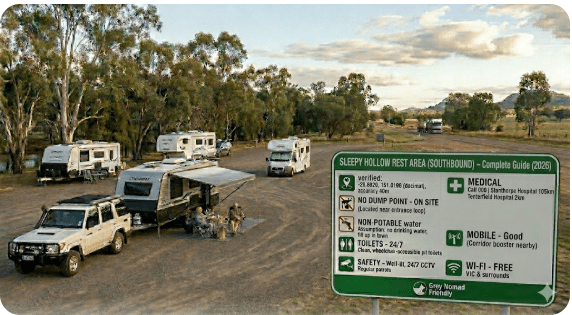
Sleepy Hollow Rest Area (Southbound) — 24hr Free Camping Guide 2026
A direction-specific roadside rest area on the Bruxner Highway corridor in northern NSW — this guide covers GPS, facilities, overnight rules, senior safety, medical contacts and honest arrival expectations for grey nomads aged 60 plus travelling southbound.
📅 Last reviewed: June 2026 | Bruxner Highway NSW | Southbound approach only — verify direction before entry
Sleepy Hollow Rest Area (Southbound) is a directional roadside rest area on the Bruxner Highway in northern New South Wales, designed primarily as a fatigue management stop for travellers heading south. This guide is written specifically for senior grey nomads aged 60 plus travelling by caravan, motorhome or campervan, many of whom travel solo and have health considerations including CPAP, blood pressure medication, diabetes or mobility concerns. It covers everything you need to plan a safe stop: GPS, overnight rules, real facilities, medical contacts, driving approach notes, and what to do if things do not go to plan.
- Name: Sleepy Hollow Rest Area (Southbound)
- State: NSW
- Use: Directional fatigue stop — southbound approach only
- Best for: Short fatigue breaks, tyre and hitch checks, meal stops; overnight if signage permits
- Toilets: May be present — verify on arrival; not guaranteed
- Dump point: No — nearest options in Tenterfield or Warialda
- Potable water: Not reliably available — arrive self-contained
- Power: No powered sites
- Phone signal: Patchy to poor — assume no reception on site
- Nearest town: Tenterfield NSW 2372 (approximately 25–35 km depending on exact location)
- Nearest major services: Tenterfield NSW 2372 or Warialda NSW 2402 (approximately 25–60 km)
Table of Contents
- Location, address and GPS
- Can you stay overnight at Sleepy Hollow Rest Area (Southbound)?
- Facilities: toilets, water, bins and dump point
- Nearby public Wi-Fi and mobile coverage
- How to get there
- What to expect on arrival
- Safety for senior grey nomads
- Medical and emergency contacts
- Dump points, water and supplies nearby
- Things to do for seniors in the area
- Best time of year to stop here
- Fires, generators and overnight etiquette
- Packing checklist for seniors
- GPS coordinates and postcodes: save every stop
- Frequently Asked Questions
- Quick verdict
Section 1 — Location, address and GPS
📍 GPS Coordinates — Sleepy Hollow Rest Area (Southbound)
Approximate: −29.05, 151.48 (verify on arrival — see warning below)
These are planning coordinates only. The exact entry point for the southbound carriageway should be confirmed using Google Maps or OpenStreetMap before departure. Drop a pin on the rest area entrance, copy the coordinates, and save them to your travel notes.
| Detail | Information | Notes for seniors |
|---|---|---|
| Name | Sleepy Hollow Rest Area (Southbound) | Directional — southbound approach carriageway only |
| Highway | Bruxner Highway, northern NSW | Freight corridor — expect heavy vehicle traffic |
| Nearest postcode | Approx. 2372 (Tenterfield) or 2402 (Warialda) | Verify against current signage and map pin |
| GPS (planning only) | −29.05, 151.48 | Confirm on arrival — coordinates are approximate |
| Coordinate source | Publicly available planning estimate | Cross-reference with Google Maps or OpenStreetMap |
| GPS accuracy note | Approximate — entry point varies by carriageway | Always confirm against signage on arrival |
| Nearby Wi-Fi | None on site — nearest in Tenterfield or Warialda | Download offline maps before departing any town |
For a full corridor plan including backup stops between Tenterfield and Warialda, visit the Vanlife Savings Spots guide to map your entire route with GPS pins saved.
Can you stay overnight at Sleepy Hollow Rest Area (Southbound)?
Possibly yes — but only if current signage at the site permits it. In NSW, rest areas are governed by individual signs erected by the relevant road authority or local council. There is no universal rule that allows overnight stays at all NSW rest areas. Some permit stays up to 20 hours, some restrict to 2–4 hours, and some are day-use fatigue stops only. Rules are subject to change without notice, and any signage present on arrival takes legal precedence over any website including this one.
The distinction matters: a rest area in NSW is primarily a fatigue management facility. A campground or free camping area is a designated overnight site. Sleepy Hollow Rest Area (Southbound) falls into the first category and should be treated accordingly unless signs explicitly state overnight use is permitted.
- Read every sign at the entrance before you park deep inside the bay area
- Look specifically for: maximum hours, “no camping”, “no generators after 10pm”, and “self-contained only” notices
- If overnight use is ambiguous, treat it as a short fatigue stop and plan a town caravan park for the night
- Being southbound-only means northbound travellers must not attempt to enter — plan your next stop before you reach this one if your direction does not match
Facilities: toilets, water, bins and dump point
| Facility | What is available | What seniors should know |
|---|---|---|
| Toilets | May be present — not guaranteed; pit or composting style if available | Arrive self-contained. Do not rely on toilet access, especially late at night or if maintenance has been delayed. Use a torch after dark. |
| Potable water | Not reliably available at this rest area | Carry a minimum 10 litres per person per day beyond your regular tank. Do not assume any tap on site is potable unless clearly signed as drinking water. |
| Dump point | No dump point at this location | Use Tenterfield or Warialda facilities. Never dump grey or black water at a rest area — doing so accelerates access restrictions for all travellers. |
| Showers | No showers | Plan for a caravan park stop every 2–3 days for hygiene and recovery. Showers also help manage circulation and fatigue in hot conditions. |
| Bins | May be present but not guaranteed to be emptied regularly | Always carry your own rubbish bags and be prepared to take waste with you if bins are full or absent. This is essential rest area etiquette. |
| Power | No powered sites | CPAP users: ensure your battery pack or inverter is fully charged before stopping here. This is not a suitable sole power source for medical equipment dependent travellers. |
Nearby public Wi-Fi and mobile coverage
Mobile coverage along the Bruxner Highway corridor between Tenterfield and Warialda is inconsistent. Expect gaps of 20–40 km with poor or no signal depending on your carrier and the terrain. At the rest area itself, assume no reception and plan accordingly.
- Tenterfield (approx. 25–35 km): Telstra and Optus coverage in town; library and visitor centre offer public Wi-Fi
- Warialda (approx. 50–60 km): Town centre coverage reasonable on Telstra; council library public Wi-Fi available during business hours
- Telstra: Best coverage option on this corridor — still patchy between towns
- Optus and Vodafone: Reduced reliability in rural sections — gaps likely
- Emergency calls: Triple Zero (000) may connect on any carrier tower even without active coverage — but do not rely on this; carry a PLB or satellite device
How to get there
From Brisbane (Queensland) heading south: Travel south via the New England Highway to Tenterfield NSW 2372. At Tenterfield, join the Bruxner Highway heading southwest toward Warialda. Sleepy Hollow Rest Area (Southbound) is located on the southbound carriageway of the Bruxner Highway. Watch for the rest area sign and begin slowing in advance — the entry can come up quickly on long straights. Total distance from Brisbane is approximately 250–280 km depending on your exact starting point.
From Warialda heading northeast toward Tenterfield: If you are northbound, this rest area is on the opposite carriageway and is not accessible to you without a legal turn. The northbound equivalent is a separate listing. Do not attempt to cross the highway.
Driving notes for seniors towing vans
- Signal your intent to exit at least 400 metres before the rest area turnoff — this is especially important on freight corridors where trucks will be travelling at speed behind you
- Begin braking gradually and early — caravans and motorhomes require significantly longer stopping distances than passenger vehicles, particularly on warm bitumen
- Check your mirrors and blind spots before moving left — trucks passing at 100 km/h in the adjacent lane are a genuine hazard if you signal late
- After entering the rest area, drive through the bay before choosing your final position — do not stop abruptly at the entrance where following vehicles may not expect it
- On exit, use the full length of the acceleration lane before merging — towing at loaded weight requires more distance to reach highway speed than most drivers expect
What to expect on arrival
Sleepy Hollow Rest Area (Southbound) is a functional roadside stop on a working freight corridor — not a scenic camping destination. Conditions are honest and unremarkable. The site exists to prevent fatigue-related crashes, and it does that job adequately. Do not arrive expecting a quiet bush retreat. Expect trucks, highway noise, variable shade, and basic or absent facilities depending on the time of day and how recently maintenance has occurred.
- Truck engines and refrigeration units may run continuously through the night, including from bays immediately adjacent to where you park
- The internal surface may be sealed bitumen, compacted gravel, or a mixture — edges can be soft and difficult for seniors with mobility concerns to navigate in the dark
- Lighting is minimal to non-existent at most times — carry a reliable torch and place it within reach before it gets dark
- Shade from established trees may or may not be present depending on the season and the specific bay position available when you arrive
- The site is visible and accessible to passing traffic — it is not private or secluded
Safety for senior grey nomads
Personal safety
- Lock your van or motorhome before sleeping, even for short naps — rest areas on freight corridors are accessible to anyone at any time, and opportunistic theft does occur at unlocked vehicles
- Do not leave valuables visible through windows — phones, laptops, wallets and cameras should be stored out of sight before you park
- Let a trusted contact know your planned stop before you lose mobile signal — a simple text with your GPS pin and expected next check-in time costs nothing and matters if something goes wrong
- Solo senior travellers should park in a visible central position rather than at the far edges of the rest area — proximity to other vehicles and potential witnesses is a practical safety benefit
- If you feel unsafe at any point — unfamiliar vehicles loitering, confrontational behaviour from other users — start your engine and move on without engaging
Trip safety
- Never drive past your comfortable fatigue limit to reach a better-known stop — pulling into a functional but unremarkable rest area is always safer than continuing when tired
- Check your tyre pressures, hitch pin, safety chains and lights at every rest area stop — not just at the start of each day
- Carry a basic vehicle emergency kit including reflective triangles, a torch, a first aid kit, and enough water and food to shelter in place for at least 24 hours if your vehicle becomes unserviceable in a remote section
- Read about caravan theft patterns and immobiliser options at our caravan security guide — knowing how theft happens is the best deterrent
Medical and emergency contacts
| Service | Address | GPS | Phone |
|---|---|---|---|
| Tenterfield District Hospital | Manners Street, Tenterfield NSW 2372 | −29.0488, 152.0186 | (02) 6736 1200 |
| Warialda Multi-Purpose Service | Hope Street, Warialda NSW 2402 | −29.5464, 150.5764 | (02) 6729 1000 |
| Emergency — Police, Fire, Ambulance | Australia-wide | N/A | 000 |
| Healthdirect — nurse on call 24/7 | Australia-wide telephone service | N/A | 1800 022 222 |
Dump points, water and supplies nearby
There is no dump point at Sleepy Hollow Rest Area (Southbound). This is standard for NSW roadside rest areas. Plan your dump stops in advance and arrive at this rest area with your tanks at a comfortable capacity that does not require urgent attention.
| Need | Best nearby option | Notes |
|---|---|---|
| Dump point | Tenterfield Showground or Tenterfield Caravan Park — Tenterfield NSW 2372 | Confirm access and availability before arrival — hours and access policies can change. Warialda also has a council dump point. |
| Fresh water | Tenterfield town taps, Tenterfield visitor centre, or Warialda town park | Always top up your water tank in town before driving this corridor. Do not assume the rest area tap is potable. |
| Groceries and fuel | Tenterfield NSW 2372 — supermarket, service stations and bakeries | Tenterfield is your best-stocked option on this corridor. Warialda has basics but a smaller range. |
| Major supplies | Glen Innes NSW 2370 (approx. 75 km south of Tenterfield) or Inverell NSW 2360 | For prescriptions, medical supplies, larger supermarket runs or hardware needs, plan a stop in Glen Innes or Inverell. |
| Alternative town stop | Warialda NSW 2402 | Smaller town but has a caravan park, fuel and basic supplies — a useful backup if Tenterfield is behind you. |
If you are uncertain whether your current tank capacity can safely carry you to the next dump point, err on the side of booking into a caravan park for a night — powered sites, showers and dump access in one stop make the cost very reasonable compared to managing a grey water overflow on a remote highway.
Things to do for seniors in the area
The Bruxner Highway corridor between Tenterfield and Warialda passes through some genuinely rewarding northern NSW countryside — granite belt landscapes, historic New England towns and accessible heritage attractions that suit senior travellers well.
| Activity | Location | Why seniors like it |
|---|---|---|
| Tenterfield Saddler Museum | High Street, Tenterfield NSW 2372 | Flat access, well-known historical site, air-conditioned in summer, central to town — easy walk from main street parking |
| Bald Rock National Park lookout | Approx. 29 km north of Tenterfield via Woodenbong Road | One of Australia’s largest exposed granite rocks — the walking track to the summit is graded but the base lookout is accessible; spectacular views with minimal effort |
| Warialda Heritage Museum | Hope Street, Warialda NSW 2402 | Small, quiet, locally run — suits a rest-day browse; excellent for learning about the New England region’s pastoral history |
| Sir Henry Parkes Memorial | Tenterfield Courthouse precinct, Tenterfield NSW 2372 | Flat paved access, outdoor monument and heritage building — the site where Parkes delivered his Federation speech in 1889; meaningful for history-interested travellers |
| Copeton Dam State Conservation Area | Approx. 40 km south of Inverell NSW 2360 | Large lake with excellent bird watching and fishing — sealed road access, day area suitable for motorhomes, picnic facilities, flat grassed areas |
Best senior-friendly ideas at Sleepy Hollow Rest Area (Southbound)
- Use this stop as your mid-morning break on a Tenterfield-to-Warialda day run — have a flask of tea, do a five-minute walk around the bays, and check your hitch before continuing
- If you are exploring the Bruxner Highway corridor, base yourself in Tenterfield for two nights and use day trips to Bald Rock and the heritage precinct rather than driving through in one push
- The New England Tableland in autumn (March to May) offers comfortable driving temperatures and beautiful colour — plan your southbound run in this window if you have flexibility
- Rest days matter more than distance covered — senior grey nomads who build in one recovery day per four driving days report significantly lower fatigue and fewer mechanical incidents
For more ideas on making the most of slow travel through regional NSW, visit the retirement van life living guide — it covers how to structure your days, manage health routines on the road, and enjoy the journey rather than just the destination.
Best time of year to stop here
| Season | What it is like | Senior verdict |
|---|---|---|
| Summer (Dec–Feb) | Hot days frequently above 30°C; afternoon thunderstorms common on the New England Tableland; road debris risk after heavy rain; peak traffic including families | Manageable with early starts — aim to be stopped and rested by 1pm. Carry extra water. Check BoM forecasts each morning. Not the most comfortable season but doable with planning. |
| Autumn (Mar–May) | Excellent conditions — temperatures between 15°C and 25°C, lower humidity, typically clear skies; reduced highway traffic after school holidays end | Best season for this corridor. Comfortable driving temperatures, manageable shade conditions, and lower truck traffic density in March and April. Highly recommended for senior travellers. |
| Winter (Jun–Aug) | Cold nights — temperatures can drop below 5°C and frosts are possible on the New England Tableland; clear crisp days with excellent visibility; minimal rain | Good for driving but cold overnight stays without power require a well-insulated setup. CPAP users should ensure their equipment handles cold temperatures. Day driving is pleasant and traffic is lighter. |
| Spring (Sep–Nov) | Variable — September can bring strong westerly winds affecting towing stability; October to November sees rising temperatures and the return of school holiday traffic in November | October is the sweet spot — warm days, low wind, good visibility. September requires caution with towing in gusty conditions. November becomes increasingly busy and warm. |
Fires, generators and overnight etiquette
Roadside rest areas on NSW state highways are subject to strict rules around fire, noise and generator use. These rules exist to protect all travellers and to maintain the community goodwill that keeps these stops accessible. Failure to follow them — individually or collectively — can result in restrictions being imposed for everyone.
- Open fires are not permitted at roadside rest areas in NSW — this applies even outside declared fire danger periods
- Gas cookers and portable stoves may be used but must be kept away from dry grass, tinder, and vehicle fuel sources; never leave cooking unattended
- Generators are subject to noise restrictions — many rest areas display specific quiet hours (commonly 10pm to 7am) and some prohibit generators entirely; check signage on arrival
- Keep interior lighting directed away from truck cab windows — bright LED lights pointed outward are one of the most common sources of conflict at overnight rest areas
- Observe posted time limits even if enforcement is not immediately visible — overstaying is the most common complaint that triggers council and RMS review of rest area access rules
- Respect truck drivers’ need for rest — they are managing mandatory fatigue hours; do not occupy truck-designated bays with passenger vehicles or caravans when truck bays are available
Packing checklist for seniors
| Item | Why it matters at this location | ☐ |
|---|---|---|
| Minimum 10L extra drinking water per person | No reliable potable water at this rest area; next town may be 30–60 km away | ☐ |
| CPAP battery pack or inverter fully charged | No power on site — medical sleep equipment requires independent power source | ☐ |
| Torch with fresh batteries + backup power bank | No lighting at rest area; internal surfaces may be uneven; critical for safe movement after dark | ☐ |
| Printed medication list, GP contact and Medicare number | Poor mobile signal means no reliable access to health apps; nearest hospital is 25–60 km away | ☐ |
| Offline maps downloaded for northern NSW region | No Wi-Fi on site; poor signal means live mapping apps will not load reliably | ☐ |
| Earplugs or noise-cancelling headphones | Freight vehicles with refrigeration units may run overnight in adjacent bays | ☐ |
| PLB or satellite communication device | Patchy to zero mobile coverage between towns; a PLB is the only reliable emergency signal in dead zones | ☐ |
| Cold-weather bedding (even in summer) | New England Tableland altitude means overnight temperatures can drop unexpectedly; do not underestimate the cold in shoulder seasons | ☐ |
| Tyre pressure gauge and hitch inspection gear | A rest area stop is the right time to check pressures, chains and lights before continuing the highway leg | ☐ |
| 24-hour supply of food independent of refrigeration | Generator restrictions and no power means fridge-dependent meal planning can fail; carry non-perishable options | ☐ |
COPY PROMPT ➔ ASK AI ➔ SAVE TO FORM ➔ ADD SPOT PIN ➔ GET DIRECTIONS
📍 Interactive map — find free camps, rest areas and overnight stops near Sleepy Hollow Rest Area (Southbound). Enable location for best results.
GPS coordinates and postcodes: save every stop
| Location | Address + Postcode | GPS | Notes |
|---|---|---|---|
| Sleepy Hollow Rest Area (Southbound) | Bruxner Highway, NSW (nearest postcode approx. 2372) | −29.05, 151.48 (planning estimate — confirm on arrival) | Southbound approach only; verify signage at entry; coordinates are approximate |
| Tenterfield (nearest town) | High Street, Tenterfield NSW 2372 | −29.0488, 152.0186 | Fuel, groceries, hospital, dump point, caravan park, visitor centre Wi-Fi |
| Tenterfield District Hospital | Manners Street, Tenterfield NSW 2372 | −29.0488, 152.0186 | Phone: (02) 6736 1200 — nearest emergency medical service |
| Warialda Multi-Purpose Service | Hope Street, Warialda NSW 2402 | −29.5464, 150.5764 | Phone: (02) 6729 1000 — second nearest hospital option |
| Glen Innes (major city reference) | Grey Street, Glen Innes NSW 2370 | −29.7308, 151.6954 | Larger service centre — supermarket, pharmacy, hospital; approx. 75 km south of Tenterfield via New England Highway |
Save all five of these locations to your travel notes or the Vanlife Savings Spots planner before you lose mobile signal. Having your hospital GPS pre-saved can save critical time in a genuine emergency on a remote highway corridor.
Frequently Asked Questions
Is Sleepy Hollow Rest Area (Southbound) free to camp at?
There is no fee charged to use this rest area. However, “free” does not mean “camping permitted”. Whether overnight stays are allowed depends entirely on the signage erected at the site by the relevant road authority. Rules can change without notice. Always read the signs at the entrance before settling in for the night. If no sign explicitly permits overnight use, treat this as a short fatigue stop only and plan your overnight accommodation in Tenterfield or Warialda.
Can caravans and motorhomes stay overnight?
Possibly yes, if current signage allows it. NSW rest areas vary significantly — some permit stays up to 20 hours, some cap at 4 hours, and some are restricted to fatigue breaks only with no overnight stays. Check the entrance signage on arrival. Bay widths at most Bruxner Highway rest areas accommodate standard caravans and motorhomes, but the number of suitable bays is limited and availability cannot be guaranteed, particularly on weekends and during school holiday periods.
What is the GPS for Sleepy Hollow Rest Area (Southbound)?
The approximate planning coordinates are −29.05, 151.48. These are general planning figures based on publicly available mapping data and should be treated as guidance only. The precise entry point for the southbound carriageway should be confirmed using Google Maps or OpenStreetMap before you depart your last town. Drop a pin on the rest area entrance, copy the coordinates, and save them to your travel notes. Always confirm against current signage on arrival — coordinates can place you near the rest area but cannot account for individual entry configuration.
Are there toilets at Sleepy Hollow Rest Area (Southbound)?
Toilets may be present at this rest area but they are not guaranteed. Maintenance schedules, vandalism and seasonal demand all affect whether toilets are operational at any given time. Arrive self-contained — carry a portable toilet or ensure your van toilet is functional and your cassette has capacity. Do not rely on finding a working toilet here, particularly late at night or early in the morning when maintenance attendance is lowest.
Is there a dump point at Sleepy Hollow Rest Area (Southbound)?
No. There is no dump point at this rest area. The nearest dump facilities are located in Tenterfield (approximately 25–35 km) and Warialda (approximately 50–60 km). Plan your dump schedule to match your tank capacity and ensure you use dump facilities in town before driving this corridor section. Never dump grey or black water at a rest area — it is illegal, unhygienic and the primary reason rest areas lose overnight access entitlements.
Can you get potable water at Sleepy Hollow Rest Area (Southbound)?
Not reliably. Even if a tap is present at the site, potable water is not guaranteed and signage confirming drinking water status may not be current. Always top up your water tank fully at Tenterfield or Warialda before driving this corridor section. Carry a minimum 10 litres per person per day beyond your regular tank capacity. For seniors managing diabetes, blood pressure medication or heat-related risk, reliable hydration is not optional — plan your water supply as carefully as your fuel.
Is Sleepy Hollow Rest Area (Southbound) safe for solo senior travellers?
It is reasonably safe when used with standard precautions. Park in a visible central position rather than at the edges. Lock your van or motorhome before sleeping. Let a trusted contact know your location and expected check-in time before you lose signal. Carry a PLB or satellite device for genuine emergencies. If you arrive and the stop feels uncomfortable — unfamiliar vehicles, unusual behaviour — trust your instincts and move on to the next stop or drive to a town. A paid caravan park site in Tenterfield is never far away and provides significantly more security and peace of mind for solo travellers.
What is the nearest hospital to Sleepy Hollow Rest Area (Southbound)?
The nearest hospital is Tenterfield District Hospital, located at Manners Street, Tenterfield NSW 2372, approximately 25–35 km from the rest area depending on your exact position on the highway. Phone: (02) 6736 1200. The second nearest option is Warialda Multi-Purpose Service, Hope Street, Warialda NSW 2402, phone (02) 6729 1000, approximately 50–60 km in the other direction. In a life-threatening emergency, call Triple Zero (000) first — ambulance services will advise on the nearest available emergency care and may coordinate helicopter assistance if road transport is not viable.
Why is this listed as “Southbound” when there seems to be another Sleepy Hollow Rest Area?
On divided highways, rest areas are often constructed as separate facilities on each carriageway — one for each direction of travel. The northbound and southbound entries serve different traffic streams and may be physically separate sites, sometimes several hundred metres apart. Travelling in the wrong direction does not allow safe access to the other carriageway’s rest area. Never attempt to cross the central median or perform an illegal U-turn. If you are northbound, locate the northbound-specific listing for this corridor instead. The directional label exists to prevent exactly this kind of dangerous confusion.
Quick verdict
Sleepy Hollow Rest Area (Southbound) is exactly what a freight highway rest area is supposed to be: functional, accessible to southbound traffic, and capable of serving its primary purpose as a fatigue break on a long rural corridor. For senior grey nomads using it correctly — as a planned mid-route stop for a rest, a vehicle check and a meal — it does the job adequately. The key strengths are that it is free, it is positioned on a well-spaced freight route, and it removes the dangerous temptation to push on when tired. On a corridor where the distances between towns can genuinely stretch your endurance, that matters.
The weaknesses are equally real. Facilities are uncertain — toilets may or may not be operational, water is unreliable, there is no power and no dump point. Truck noise on this freight corridor can make overnight stays genuinely difficult for light sleepers or anyone whose health depends on quality sleep. The directional nature of the site means it is easy to miss or navigate to incorrectly, and the consequences of a wrong turn on a fast highway are serious. For seniors with CPAP dependency, medical equipment needs, or mobility concerns that make an uneven gravel surface dangerous at night, a powered caravan park site in Tenterfield or Warialda will consistently deliver a better outcome. Use this stop as a tool, not a destination.
For full corridor planning including backup stops, connectivity notes and GPS-saved alternatives, visit the grey nomad routes guide and the Vanlife Savings Spots planner.
Free campsites and powered sites fill fast during school holidays and peak season. If your preferred site is already gone, search remaining accommodation options below to explore the region.
Accommodation and flight search powered by Expedia. Booking through this search supports this website at no extra cost to you. As an affiliate, I earn from qualifying purchases at no extra cost to you.

As an affiliate, I earn from qualifying purchases at no extra cost to you.
Exclusive Offer: Get 5% OFF all StarterStopper immobiliser products with promo code: RTV5
Visit StarterStopper.com to see our data-backed security solutions
As an affiliate, I earn from qualifying purchases at no extra cost to you.