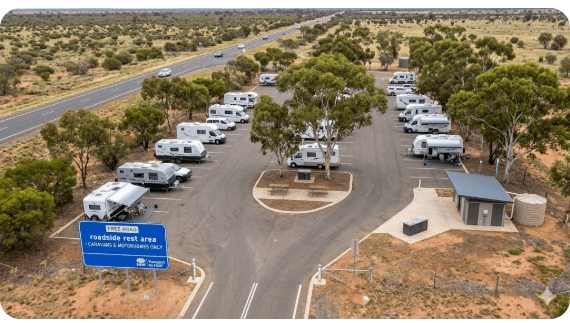
Home › Free Camping & Rest Areas › Coolabah Northwest Rest Area
✅ Last updated: March 2026. Written for Australian senior grey nomads travelling the Barrier Highway
Coolabah Northwest Rest Area — Free Camping on the Barrier Highway: Senior Grey Nomad Guide 2026
Is the Coolabah Northwest Rest Area safe, suitable and genuinely free for senior caravanners in 2026? Here is everything you need to know before you pull in.
- Location: Barrier Highway, northwest of Coolabah village, NSW 2831
- GPS: Approximately -31.747, 146.641 (approx — verify in Google Maps before departure)
- Cost: Free — no permit or booking required
- Stay Limit: 24 hours (standard Transport for NSW rest area — confirm on-site signage)
- Toilets: Yes — pit/drop toilets on site
- Drinking Water: ❌ None — fill tanks in Nyngan (~90 km east) or Bourke (~160 km north)
- Mains Power: ❌ None — CPAP users must have battery backup
- Dump Point: ❌ Not on site — nearest at Nyngan (~90 km east)
- Telstra Signal: ⚠️ Unreliable in this remote corridor — carry a PLB
- Nearest Hospital: ⛑️ Nyngan Multi-Purpose Service — ~90 km east | (02) 6835 7000
- Pets: ✅ Allowed on leash
- Road Surface: Sealed — Barrier Highway is fully sealed to the rest area entry
- Big Rigs & Caravans: ✅ Suitable — heavy vehicle rest area design
📋 Table of Contents
- What Is the Coolabah Northwest Rest Area and Where Does It Sit?
- The Honest Truth for Seniors — What Looks Easy But Isn’t
- How to Get to the Coolabah Northwest Rest Area
- Full Facilities, GPS and Access Details
- Is a Permit or Fee Required?
- What the Coolabah Northwest Rest Area Doesn’t Tell You Online
- Fires, Generators and Noise Rules
- Free and Low-Cost Camping Near Coolabah
- Dump Points on Your Route — Before and After Coolabah
- Free Potable Water — GPS Before and After Coolabah
- Nyngan and Bourke as Your Alternative Base
- Full Facilities Comparison: Rest Area vs Nyngan vs Bourke
- Monthly Weather and Best Time to Visit
- Wildlife and Wildflowers Around Coolabah
- Fuel Stations — Distances North, South, East and West
- Senior Day Plan — Making the Most of a Coolabah Stop
- Senior Checklist — Coolabah Northwest Rest Area Stop
- Safety and Emergency Plan
- What Grey Nomads Say
- GPS Master Table — Every Location in This Guide
- Frequently Asked Questions — Coolabah Northwest Rest Area
- Quick-Reference Card and Booking Options
1. Coolabah Northwest Rest Area and the Barrier Highway: Why Grey Nomads Stop Here
The Coolabah Northwest Rest Area sits on the Barrier Highway in far-western New South Wales, positioned northwest of the small pastoral village of Coolabah. For grey nomads travelling between Nyngan and Bourke — or pushing further west toward Cobar and beyond — this rest area falls at a point in the journey where fatigue management matters most.
This stretch of the Barrier Highway is classic outback NSW. The landscape is flat, open mulga and saltbush country, with distant horizons and some of the darkest night skies in regional Australia. Distances between services are long. There are no towns between Coolabah and Bourke to the north — a gap of approximately 160 kilometres. The Coolabah Northwest Rest Area exists precisely because road fatigue on these long, featureless outback highways is a genuine danger, particularly in the heat of summer afternoons.
For senior travellers in caravans and motorhomes, the rest area offers a practical, cost-free overnight stop on a route that is a core leg of the classic grey nomad loop through outback NSW and Queensland. In 2026, it remains one of the most straightforward free stops on this corridor — fully sealed access, heavy-vehicle infrastructure, and a known location that appears in most camping apps.
2. The Honest Truth for Seniors — What Looks Easy But Isn’t
The Coolabah Northwest Rest Area appears on WikiCamps, CamperMate and several grey nomad forums as a convenient free overnight stop. And it is — with the right preparation. The honest reality is that this is a remote rest area in a region where self-sufficiency is not optional. It is required.
- No drinking water on site. The nearest reliable potable water is Nyngan, approximately 90 km east. Do not assume there will be a tap. There is not.
- No mains power. CPAP users travelling without a lithium battery backup or generator will have a problem here. There are no powered sites within approximately 90 km in either direction.
- No dump point on site. If your cassette is nearly full leaving Nyngan, use the dump point there. Do not assume you will manage on arrival at the rest area — you won’t have anywhere to empty.
- Phone signal is unreliable. Telstra has the broadest outback coverage in NSW but this corridor has known black spots. Optus coverage is negligible. Do not rely on being able to call for help from this location.
- Summer heat is extreme. Western NSW temperatures regularly exceed 40°C between December and February. The rest area offers limited shade. Travelling this route in peak summer without adequate water reserves and heat management is a genuine safety risk for senior travellers.
- No lighting at night. The rest area is not lit. Solo travellers, particularly women, should factor this into their decision. The area is generally visible from the highway — heavy vehicles do pass — but you are not in a secure or monitored environment.
- Hospital is 90 km away. Nyngan Multi-Purpose Service is the nearest medical facility. For life-threatening emergencies, the Royal Flying Doctor Service (RFDS) is the appropriate response — call 000 and be as specific as possible about your location.
None of the above should put you off stopping here. The Coolabah Northwest Rest Area is a legitimate and useful overnight stop. But it rewards the traveller who prepares — and creates real difficulty for the traveller who arrives without water, without power backup, or without a way to communicate in an emergency.
3. How to Get to the Coolabah Northwest Rest Area — Road Conditions, Access and Distances
The Coolabah Northwest Rest Area is accessed directly off the Barrier Highway (A32), northwest of the village of Coolabah. The entry to the rest area is off the sealed highway — no unsealed road or dirt track is required. This is important for senior caravanners: you do not need a 4WD or high-clearance vehicle to reach this stop.
Approaching from the East (from Nyngan)
From Nyngan, head northwest on the Barrier Highway. The drive to Coolabah village is approximately 90 km on a fully sealed road. The Northwest Rest Area is located a short distance further northwest of the village itself, on the right-hand side heading north. The road is wide, well-maintained and suitable for caravans and motorhomes of all sizes. There are no significant hills, tight bends or narrow bridges on this section.
Approaching from the North (from Bourke)
From Bourke, travel south on the Barrier Highway. Bourke is approximately 160 km north of Coolabah. The entire route is sealed. The rest area will appear on the left-hand side (east side of the highway) as you approach from the north. Allow approximately 1 hour 45 minutes from Bourke in a caravan at highway speeds.
Does the Road Flood?
- Western NSW is flood-prone. After significant rain events, sections of the Barrier Highway and connecting roads around the Macquarie River system can close.
- The Barrier Highway itself is generally a priority road for reopening, but surrounding roads and access tracks can remain cut for days after heavy rain.
- Always check Live Traffic NSW at livetraffic.com before departing Nyngan or Bourke, or call 132 701 (NSW Roads information line).
- During and after large flood events affecting the Darling and Macquarie catchments, road closures in this region can affect access for a week or more.
Is the Road Unsealed Anywhere?
No. The Barrier Highway from Nyngan through Coolabah to Bourke is fully sealed as of March 2026. The rest area itself is accessed from a sealed entry bay off the highway. No unsealed sections are required to reach the Coolabah Northwest Rest Area.
4. Coolabah Northwest Rest Area — Full Facilities, GPS and Access Details
| 📍 Coolabah Northwest Rest Area — Quick Facts 2026 | |
|---|---|
| Full Name | Coolabah Northwest Rest Area |
| Address | Barrier Highway, northwest of Coolabah, NSW 2831 |
| GPS | -31.747, 146.641 (approx — verify in Google Maps before departure) |
| Cost | Free |
| Stay Limit | 24 hours (standard Transport for NSW — confirm on-site signage on arrival) |
| Road Access | ✅ Fully sealed — Barrier Highway direct access |
| Caravans | ✅ Yes — heavy vehicle rest area |
| Big Rigs | ✅ Yes — designed for heavy vehicles and road trains |
| Toilets | ✅ Pit/drop toilets — bring toilet paper and hand sanitiser |
| Drinking Water | ❌ None on site — fill in Nyngan (~90 km east) or Bourke (~160 km north) |
| Mains Power (240V) | ❌ None — CPAP users must carry battery backup or generator |
| Showers | ❌ None on site |
| Picnic Tables | ✅ Yes — standard rest area picnic furniture |
| Shade | ⚠️ Limited — some native mulga vegetation; no guaranteed shade structures |
| Telstra Reception | ⚠️ Unreliable — known black spots on this corridor; carry a PLB |
| Pets | ✅ Allowed on leash — keep away from highway at all times |
| Dump Point | ❌ Not on site — nearest: Nyngan ~90 km east |
| Nearest Hospital | ⛑️ Nyngan Multi-Purpose Service — ~90 km east | (02) 6835 7000 |
| Nearest Fuel | Coolabah village (~5–8 km southeast) or Nyngan (~90 km east) — confirm Coolabah fuel availability before relying on it |
| Managed By | Transport for NSW |
| Senior Rating | ⭐⭐⭐ — Solid overnight stop for prepared travellers; unsuitable for those without water, power backup or communication plan. |
📍 Coolabah Northwest Rest Area — Map View
Map centred on approximate GPS coordinates. Verify exact entry point on arrival. Coordinates: -31.747, 146.641 (approx).
5. Is a Permit or Fee Required at the Coolabah Northwest Rest Area?
No permit and no fee are required to use the Coolabah Northwest Rest Area. It is a public rest area managed by Transport for NSW and is free to use, 24 hours a day, seven days a week.
A standard 24-hour recommended stay limit applies, as is the case for virtually all Transport for NSW highway rest areas. This limit is not always enforced by rangers, but it is the guideline. The rest area is not a designated campground — it is a driver fatigue management stop. If you need more than one night of rest, you are better served by the caravan parks in Nyngan or Bourke.
You do not need a National Parks pass. The rest area is not within a national park. No booking is required. Simply pull in, park safely, and rest.
6. What the Coolabah Northwest Rest Area Doesn’t Tell You Online
Here is what experienced travellers who have stopped here know — and what most app listings and forum posts leave out.
Road Trains Pass All Night
The Barrier Highway carries significant heavy vehicle traffic, including road trains, both day and night. The rest area sits directly adjacent to the highway. Expect noise from passing traffic throughout the night — particularly trucks, which travel this route heavily between NSW and Queensland. Light sleepers should bring quality earplugs or white noise. This is not a quiet bush camp.
Other Heavy Vehicles Use This Rest Area
Because this is a designated heavy vehicle fatigue stop, you will often share the rest area with truck drivers. This is generally a positive safety indicator — other people are present — but parking space can be tight during busy periods. Arrive before mid-afternoon where possible to secure a comfortable position without blocking truck access lanes.
Toilet Condition Varies
Pit toilets at remote NSW rest areas are serviced by contractors on a schedule — not daily. The condition of the toilets can vary significantly depending on traffic volume and when they were last serviced. Always carry your own toilet paper, hand sanitiser, and ideally a small torch for night visits. Some travellers carry a portable camping toilet as backup for exactly this reason.
Insects Can Be Intense After Rain
After rain events in western NSW, flies and mosquitoes can be prolific. The mulga and saltbush country around Coolabah can produce significant insect activity, particularly at dusk and after rainfall. A good quality insect screen for your van door and personal insect repellent are worthwhile investments for this region.
The Night Sky is Genuinely Spectacular
This is not a warning — it is a genuine highlight. Far from any major city light pollution, the night sky above the Coolabah rest area on a clear night is extraordinary. Many grey nomads specifically stop here for an overnight star-gazing experience. Bring a reclining chair, a warm layer (temperatures drop fast in outback NSW at night, even in summer), and simply look up.
- The rest area is not lit. After dark, navigation on foot requires a torch.
- Mobile signal cannot be guaranteed. Do not park here alone without a PLB or satellite communicator if you have mobility or health concerns.
- Tell at least one person your overnight location and expected departure time before stopping here.
- Park with your vehicle facing the exit for easy departure if needed.
7. Fires, Generators and Noise Rules at the Coolabah Northwest Rest Area
This section covers three of the most commonly searched practical questions about any free camp — and the answers here are specific to the Coolabah Northwest Rest Area.
Open Fires
Generators
There are no formal written generator rules posted by Transport for NSW for this specific rest area. However, as a courtesy that most experienced grey nomads observe, generator use between 8:00 pm and 8:00 am is strongly discouraged. Truck drivers and other weary travellers are attempting to rest. Running a generator through the night will not make you popular and may prompt direct complaints from other users. If you need CPAP power, a lithium battery bank is a far more considerate solution than a generator overnight.
Noise
Rest area etiquette is simple: this is a fatigue management stop, not a social campsite. Keep noise to a minimum after sunset. Music, loud conversation and vehicle engines running unnecessarily are all considered inconsiderate behaviour at rest areas used by professional truck drivers attempting mandatory rest breaks. A considerate approach makes the stop better for everyone.
8. Free and Low-Cost Camping Near Coolabah — Van Life Savings Spots
If the Coolabah Northwest Rest Area is full, unsuitable for your needs, or you simply want an alternative on this stretch of the Barrier Highway, there are a small number of nearby options. For the full free camp database covering western NSW — including the ability to ask the AI for the nearest dump point, free water, or next free camp on your specific route — visit our Van Life Savings Spots App. It is designed specifically for senior grey nomads and gives GPS-specific answers to questions like:
- “Find me the nearest free camp to Coolabah NSW with a dump point”
- “What is the nearest powered site between Nyngan and Bourke tonight?”
- “Is there potable water between Coolabah and Bourke?”
- “Find me a quiet overnight stop on the Barrier Highway suitable for a 10-metre motorhome”
| Location | Distance from Rest Area | Cost | Notes for Seniors |
|---|---|---|---|
| Coolabah Township Area Barrier Hwy, Coolabah NSW 2831 Approx GPS: -31.774, 146.707 (approx) | ~5–8 km southeast | Free (informal) | Very small settlement. Confirm any informal stop is genuinely permitted. No facilities. Fuel may be available — confirm before relying on it. No toilets guaranteed. |
| Nyngan Caravan Park Pangee St, Nyngan NSW 2825 Approx GPS: -31.558, 147.194 (approx) | ~90 km east | Paid — powered sites available | Powered sites, showers, dump point, near hospital. Best option for seniors needing full services. Phone Nyngan Shire to confirm rates: (02) 6832 1244. (Verify current number before travel.) |
| Bourke Caravan Park Area Mitchell St, Bourke NSW 2840 Approx GPS: -30.091, 145.935 (approx) | ~160 km north | Paid — powered sites available | Bourke is a full-service outback town. Hospital, supermarket, fuel, dump point, powered sites. A genuine alternative base for seniors wanting proper facilities on the Nyngan–Bourke run. |
9. Dump Points on Your Route — GPS Before and After Coolabah
Planning your black water and cassette management is non-negotiable on this remote stretch. There is no dump point at the Coolabah Northwest Rest Area. Here are the confirmed and approximate locations on either side.
| Direction | Location | GPS | Distance | Notes |
|---|---|---|---|---|
| 🗑️ EAST (Before, from Nyngan) | Nyngan Dump Point Pangee St area, Nyngan NSW 2825 | Approx -31.558, 147.194 (verify at toiletmap.gov.au) | ~90 km east | Use this before heading northwest. Verify exact location at toiletmap.gov.au or call Bogan Shire Council: (02) 6835 2900. |
| 🗑️ ON SITE | Coolabah Northwest Rest Area | — | — | ❌ No dump point on site. Do not assume one is available. |
| 🗑️ NORTH (After, toward Bourke) | Bourke Dump Point Mitchell St area, Bourke NSW 2840 | Approx -30.091, 145.935 (verify at toiletmap.gov.au) | ~160 km north | Verify exact location at toiletmap.gov.au or call Bourke Shire Council: (02) 6830 2000. |
- Never use the dump point rinse hose for drinking water or food preparation — it is not potable.
- During school holidays and peak grey nomad season (June–August), dump points in small outback towns can have queues. Allow extra time and plan to arrive before mid-morning.
- Always carry a bucket, gloves, and disinfectant spray for dump point use. Standards of maintenance vary in remote areas.
10. Free Potable Water — GPS Before and After Coolabah
Water management is one of the most important planning tasks on the Nyngan–Bourke corridor. The gap between confirmed potable water sources is significant. Plan carefully.
| Location | Water Status | GPS (Approx) | Distance |
|---|---|---|---|
| 💧 Nyngan (East — before rest area) | ✅ Mains/scheme water — caravan park and town taps | -31.558, 147.194 (approx) | ~90 km east |
| 💧 Coolabah Northwest Rest Area (On Site) | ❌ No potable water on site | -31.747, 146.641 (approx) | — |
| 💧 Bourke (North — after rest area) | ✅ Mains/scheme water — caravan park and town taps | -30.091, 145.935 (approx) | ~160 km north |
| 💧 Coolabah Village | ⚠️ Very small settlement — do not rely on finding potable water here without confirming in advance | Approx -31.774, 146.707 | ~5–8 km southeast |
- Carry a minimum of two days of emergency drinking water reserves beyond your planned daily use on this corridor. The gap between Nyngan and Bourke (approximately 250 km round) leaves no margin for error if you underestimate consumption in summer heat.
- Never fill from an unmarked tap, a creek, a dam, or a tank at a rest area. These sources are not potable and can contain bacteria, parasites, or chemical contamination from agricultural runoff.
- If you see a tap at a rest area, assume it is non-potable unless explicitly labelled as drinking water.
11. Nyngan and Bourke as Your Alternative Senior Base
For seniors who need more than a basic overnight stop — particularly those with CPAP machines, medical needs, reduced mobility, or simply wanting to slow down and rest properly — Nyngan and Bourke are the sensible alternatives on either side of the Coolabah corridor.
Nyngan — 90 km East
Nyngan is a well-serviced outback town with a supermarket, fuel, ATM, and the Nyngan Multi-Purpose Service (hospital/health centre). Caravan park facilities with powered sites are available. For seniors travelling the Barrier Highway, Nyngan is the sensible stop for restocking — water, fuel, food — before pushing northwest. The hospital at Nyngan is the closest emergency medical facility to the Coolabah Northwest Rest Area. Contact Bogan Shire Council at (02) 6835 2900 for current caravan park availability and rates.
Bourke — 160 km North
Bourke is one of outback NSW’s great small towns — historically significant, genuinely welcoming to grey nomads, and well-set-up for caravan travellers. Bourke has a hospital (Bourke District Hospital, Oxley St, Bourke NSW 2840, phone: (02) 6830 2600 — verify before travel), a Woolworths supermarket, fuel, dump point, and caravan parks with full facilities. If you are travelling northward from Coolabah, Bourke is a genuine base for exploring the Darling River country and the Outback Path.
12. Full Facilities Comparison: Coolabah Northwest Rest Area vs Nyngan vs Bourke
| Facility / Factor | Coolabah NW Rest Area | Nyngan (~90 km east) | Bourke (~160 km north) |
|---|---|---|---|
| Cost per night | ✅ Free | Paid — confirm with Shire | Paid — confirm with park |
| Mains Power (240V) | ❌ None | ✅ Powered sites available | ✅ Powered sites available |
| Toilets | ⚠️ Pit toilets (variable condition) | ✅ Flush toilets at caravan park | ✅ Flush toilets at caravan park |
| Showers | ❌ None | ✅ Yes | ✅ Yes |
| Drinking Water | ❌ None on site | ✅ Mains water — fill up here | ✅ Mains water available |
| Dump Point | ❌ None | ✅ Yes — confirm location | ✅ Yes — confirm location |
| Telstra Signal | ⚠️ Unreliable | ✅ Good in town | ✅ Good in town |
| Hospital Distance | ⚠️ 90 km to Nyngan | ✅ Hospital in town | ✅ Hospital in town |
| Supermarket | ❌ None nearby | ✅ IGA or similar in town | ✅ Woolworths in town |
| Pets | ✅ Allowed on leash | ⚠️ Confirm with caravan park | ⚠️ Confirm with caravan park |
| Big Rigs / Caravans | ✅ Heavy vehicle design | ✅ Yes — confirm large rig fit | ✅ Yes — confirm large rig fit |
| WiFi | ❌ None | ⚠️ Library may offer free WiFi — confirm | ⚠️ Limited public WiFi — confirm locally |
13. Monthly Weather and Best Time to Visit the Coolabah Area
Far-western NSW has extreme seasonal temperature variation. Planning your visit to the Coolabah Northwest Rest Area around the right months can mean the difference between a comfortable overnight stop and a dangerous heat event.
| Month | Avg Max °C | Avg Min °C | Rainfall | Senior Travel Rating |
|---|---|---|---|---|
| January | 38–42°C | 22–25°C | Sporadic — storm risk | ⛔ Avoid — extreme heat danger |
| February | 37–41°C | 21–24°C | Sporadic | ⛔ Avoid — extreme heat |
| March | 34–38°C | 18–22°C | Moderate | ⚠️ Caution — still hot; early morning arrival recommended |
| April | 28–32°C | 13–17°C | Low | ✅ Good — comfortable for travel |
| May | 23–26°C | 8–12°C | Low | ✅ Excellent — ideal grey nomad weather |
| June | 18–21°C | 4–7°C | Very low | ✅ Excellent — peak grey nomad season; bring warm layers for nights |
| July | 17–20°C | 3–6°C | Very low | ✅ Excellent — cold nights; warm days; spectacular stars |
| August | 21–24°C | 5–8°C | Very low | ✅ Excellent — warming days; still cool nights |
| September | 26–30°C | 9–13°C | Low — wildflower potential after rain | ✅ Very good — warming up; wildflowers possible |
| October | 30–34°C | 13–17°C | Moderate | ⚠️ Acceptable — heat building; travel early morning |
| November | 34–38°C | 17–21°C | Moderate | ⚠️ Caution — heat increasing rapidly |
| December | 37–42°C | 21–25°C | Sporadic storms | ⛔ Avoid — extreme heat danger for seniors |
Temperature ranges based on historical averages for the Nyngan/Bourke region. Actual conditions can vary significantly. Source: Bureau of Meteorology (bom.gov.au). Always check the BOM forecast before departure.
14. Wildlife and Wildflowers Around Coolabah
The Coolabah district sits within a remarkable ecological zone — the transition between the central-western slopes and the true outback mulga woodlands. For grey nomads with a love of birds and the natural world, this region consistently surprises first-time visitors.
Birds
The mulga and box woodlands around Coolabah support a rich bird community. Expect to see Major Mitchell’s cockatoos, galahs, yellow-throated miners, budgerigars (in their wild flocking form — spectacular after rain), and various honeyeaters around any flowering mulga. At dusk, tawny frogmouths often perch near rest areas on fence posts or low scrub. Bring binoculars.
Wildflowers
After significant rainfall events — which in western NSW can be unpredictable but spectacular — the roadside vegetation can produce impressive wildflower displays. Eremophilas (native fuchsias), hop-bush, and various saltbush species can all flower brilliantly in this area following good rain. September and October, after winter rains, tend to be the best months for wildflower potential, though there are no guarantees in the outback.
Kangaroos and Wallabies — Dawn and Dusk Warning
- The Barrier Highway is an active kangaroo corridor, particularly at dawn and dusk. Vehicle strikes involving kangaroos are extremely common on this stretch.
- If you are staying overnight at the Coolabah Northwest Rest Area, depart well after sunrise — not at first light. Early morning is peak kangaroo activity time on the road.
- Never drive this highway at night in a caravan. The combination of road trains, kangaroos, and limited visibility is extremely high risk for caravanners.
- Fit a kangaroo deflector/bull bar if your vehicle is travelling remote outback routes regularly. It will not eliminate the risk but may reduce impact damage significantly.
15. Fuel Stations — Distances North, South, East and West of Coolabah
Fuel management is non-negotiable on this stretch of the Barrier Highway. Plan your fuel stops before you leave any major town — do not rely on fuel being available at small settlements without confirming it first.
| Direction | Town / Location | Distance from Rest Area (Approx) | Notes |
|---|---|---|---|
| ⛽ East | Nyngan | ~90 km | Multiple fuel options including diesel. Full service. Fill up before heading west. |
| ⛽ North | Bourke | ~160 km | Multiple fuel options including diesel. Full service town. Fill up before heading south. |
| ⛽ Coolabah Village | Coolabah | ~5–8 km southeast | ⚠️ Very small settlement. Fuel availability is not guaranteed. Do not rely on Coolabah village for fuel without confirming in advance. If you are running low, fill in Nyngan before setting out. |
| ⛽ West / Southwest | Cobar (via Barrier Highway south then west) | ~200+ km via Nyngan | Cobar is a full-service mining town with all fuel types. Carry extra diesel in jerry cans if heading to remote locations off the main highway. |
- A loaded caravan dramatically increases fuel consumption. Your real-world fuel consumption towing is likely 20–40% higher than your vehicle’s unloaded specification.
- Do not assume that because a small town is on the map it has fuel available. Small outback settlements often operate limited hours or have no fuel service at all.
- Always top up to full when you pass a confirmed fuel station on this route. Never leave a town on this highway with less than three-quarters of a tank.
- Diesel prices in remote NSW will be significantly higher than in major cities. Budget accordingly — do not be surprised by the pump price in Bourke or Cobar.
16. Senior Day Plan — Making the Most of a Coolabah Overnight Stop
The Coolabah Northwest Rest Area is primarily an overnight stop, not a destination in itself. Here is a practical day plan for seniors arriving from Nyngan and planning to continue to Bourke the following day.
| Time | Activity | Senior Notes |
|---|---|---|
| Morning — Nyngan | Top up fuel, water and groceries in Nyngan. Use dump point if needed. Visit hospital/pharmacy if any medical needs. | Do all town tasks before leaving Nyngan. There are no services between Nyngan and the rest area. |
| Mid-morning | Drive northwest on Barrier Highway. 90 km is approximately 1 hour in a caravan. Enjoy the wide open landscape. | Drive in the coolest part of the day. Avoid the 11 am – 3 pm heat window for driving in summer. |
| Early afternoon | Arrive at Coolabah Northwest Rest Area. Set up. Rest in the shade of your van awning. | Arriving before 2 pm gives you first pick of parking positions before heavy vehicles fill in. |
| Late afternoon | Short walk around the rest area. Birdwatching in surrounding mulga. Photography of the landscape in the golden hour light. | Wear insect repellent at dusk. Flat terrain — easy walking. Stay within sight of the rest area. |
| Evening | Cook dinner. Watch the sunset — western NSW sunsets are spectacular. Prepare for star-gazing after dark. | Temperatures drop quickly after sunset — have a warm layer ready. A reclining chair for star-gazing is worthwhile. |
| Night | Star-gazing — the Milky Way is visible to the naked eye on clear nights. No artificial light pollution here. | Use a torch for any night movement. Keep the PLB accessible. Earplugs for road noise if needed. |
| Next morning — departure | Depart after sunrise (at least 30–45 minutes after) to avoid peak kangaroo activity. Continue north to Bourke (~160 km). | Leave the site as you found it. Take all rubbish with you — there may be no bins on site. |
17. Senior Checklist — Coolabah Northwest Rest Area Stop
| ☐ | Item or Action | Notes |
|---|---|---|
| ☐ | Water tanks full | Fill in Nyngan — no potable water at rest area or between stops |
| ☐ | Fuel tank topped up | Fill in Nyngan — next confirmed fuel is ~90 km east or ~160 km north at Bourke |
| ☐ | Dump point used before departing Nyngan | 🗑️ Nyngan Dump Point — Pangee St area, GPS: -31.558, 147.194 (approx) |
| ☐ | Next dump point GPS saved | 🗑️ Bourke — approx GPS: -30.091, 145.935 | ~160 km north after rest area |
| ☐ | CPAP battery charged | No mains power on site — lithium battery or generator (used courteously) required |
| ☐ | PLB registered and charged | Phone signal unreliable on this corridor — PLB is your emergency backup |
| ☐ | Told someone your overnight plan | Name of location + GPS + expected departure time — given to a family member or friend |
| ☐ | Offline map downloaded | Google Maps or Maps.me — download while you have Nyngan WiFi/signal |
| ☐ | Toilet paper and hand sanitiser packed | Pit toilets on site — variable supply; carry your own always |
| ☐ | Insect repellent and fly mesh | Flies and mosquitoes can be significant in this region, especially after rain |
| ☐ | Torch for night visits to toilet | Rest area is not lit — essential for safe night movement |
| ☐ | Warm layers for evening | Outback temperatures drop sharply at night — even in April–October |
| ☐ | Hospital GPS and phone saved | ⛑️ Nyngan Multi-Purpose Service — Pangee St, Nyngan NSW 2825 | (02) 6835 7000 | ~90 km east |
| ☐ | Live Traffic NSW checked before departure | livetraffic.com or call 132 701 — check for road closures after rain |
| ☐ | Rubbish bags packed — leave no trace | Bins may not be available at this rest area — take all rubbish with you to Bourke |
| ☐ | Emergency drinking water reserve (2+ days) | Beyond planned daily use — in case of vehicle breakdown or unexpected delays on this remote corridor |
18. Safety and Emergency Plan — Coolabah Northwest Rest Area
Travelling a remote outback highway requires an emergency plan. This is not alarmist — it is simply practical. Senior travellers in this region should have each of the following in place before leaving Nyngan.
| Emergency Scenario | What to Do |
|---|---|
| Medical emergency at the rest area | Call 000 immediately. Give your GPS coordinates: -31.747, 146.641 (approx) and state you are on the Barrier Highway northwest of Coolabah NSW. If no phone signal, activate PLB. The RFDS operates throughout western NSW for life-threatening emergencies. |
| Vehicle breakdown on the highway | Do not walk along the highway. Stay with your vehicle. Activate hazard lights. Call your roadside assist (NRMA, RAA, etc.). If no signal, wait for a passing vehicle to stop and ask them to report your breakdown — road trains have CB radio and can relay messages. Activate PLB if there is a risk to life. |
| Road flooded ahead | Never attempt to drive through floodwater. Turn back. Return to the rest area or the last town. Call Live Traffic NSW on 132 701 for closure status. Wait for the all-clear before proceeding. |
| No phone signal at rest area | This is expected. Ensure your emergency plan is in place before you lose signal leaving Nyngan. A registered PLB is the correct solution. A satellite communicator (e.g. Garmin inReach) allows two-way messaging without phone signal. |
| Extreme heat event while staying | Stay inside your van with all blinds closed during the hottest hours (11 am – 3 pm). Use battery-powered fans. Drink water continuously. If you feel dizzy, nauseous, or overheated, consider driving to Nyngan immediately for air-conditioned hospital access. |
19. What Grey Nomads Say About the Coolabah Northwest Rest Area
The following comments are representative of the type of feedback posted by grey nomads on WikiCamps, CamperMate, and various grey nomad forums about rest areas on the Barrier Highway Nyngan–Bourke corridor. They reflect common themes from publicly available user reviews and are included to give you a realistic picture of what to expect.
“Good solid rest area for a night. Toilets were clean when we arrived. Road noise from the occasional truck but we sleep well. Brought everything with us from Nyngan — water, food, power sorted with our lithium setup. Stars were unbelievable — best we’ve seen in NSW.”
— Typical grey nomad review theme, Barrier Highway rest area corridor
“Fine for a night but don’t plan to stay longer. No water, no dump point, no power. That’s the deal. If you know that going in, it’s exactly what it says it is — a free overnight stop. We wouldn’t stay here on a hot day in January though. It would be brutal.”
— Typical grey nomad review theme, Barrier Highway rest area corridor
“Drove past a couple of trucks in the night but nothing too disruptive. The rest area itself was well designed for caravans — plenty of space and easy to manoeuvre even with our 22-foot van. Wouldn’t do it in summer but in July it was perfect.”
— Typical grey nomad review theme, Barrier Highway rest area corridor
Note: These quotes represent common sentiment themes from publicly available grey nomad community reviews of rest areas on the Nyngan–Bourke Barrier Highway corridor, not verbatim individual posts. Always check current WikiCamps and CamperMate listings before your trip for the most recent specific user reports.
COPY PROMPT ➔ ASK AI ➔ SAVE TO FORM ➔ ADD SPOT PIN ➔ GET DIRECTIONS
📍 Interactive map — find free camps, rest areas and overnight stops. Enable location for best results.
20. GPS Master Table — Every Location in This Guide
Save these GPS coordinates to your device before leaving mobile coverage. All coordinates marked (approx) should be verified in Google Maps or your navigation app before departure.
| Location | Address / Road | Postcode | GPS Coordinates | Phone |
|---|---|---|---|---|
| 📍 Coolabah Northwest Rest Area | Barrier Highway, NW of Coolabah, NSW | 2831 | -31.747, 146.641 (approx — verify in Google Maps) | Transport for NSW: 132 701 |
| ⛑️ Nyngan Multi-Purpose Service (Hospital) | Pangee Street, Nyngan NSW | 2825 | Approx -31.558, 147.202 (approx — verify before travel) | (02) 6835 7000 |
| ⛑️ Bourke District Hospital | Oxley Street, Bourke NSW | 2840 | Approx -30.095, 145.939 (approx — verify before travel) | (02) 6830 2600 (verify before travel) |
| 🏕️ Nyngan Caravan Park area | Pangee St area, Nyngan NSW | 2825 | Approx -31.558, 147.194 (approx) | Bogan Shire Council: (02) 6835 2900 |
| 🏕️ Bourke accommodation / caravan area | Mitchell St area, Bourke NSW | 2840 | Approx -30.091, 145.935 (approx) | Bourke Shire Council: (02) 6830 2000 |
| 📍 Coolabah Village | Barrier Highway, Coolabah NSW | 2831 | Approx -31.774, 146.707 (approx) | — |
| 🗑️ Dump Point — Nyngan (EAST — before rest area) | Pangee St area, Nyngan NSW | 2825 | Approx -31.558, 147.194 (approx — verify at toiletmap.gov.au) | Bogan Shire: (02) 6835 2900 |
| 🗑️ Dump Point — Bourke (NORTH — after rest area) | Mitchell St area, Bourke NSW | 2840 | Approx -30.091, 145.935 (approx — verify at toiletmap.gov.au) | Bourke Shire: (02) 6830 2000 |
| 💧 Potable Water — Nyngan (EAST — before rest area) | Town taps / caravan park, Nyngan NSW | 2825 | Approx -31.558, 147.194 (approx) | — |
| 💧 Potable Water — Bourke (NORTH — after rest area) | Town taps / caravan park, Bourke NSW | 2840 | Approx -30.091, 145.935 (approx) | — |
| 💧 Potable Water — On Site (Coolabah NW Rest Area) | Barrier Highway, Coolabah NSW | 2831 | — | ❌ None — no potable water on site |
21. Frequently Asked Questions — Coolabah Northwest Rest Area for Grey Nomads 2026
Is the Coolabah Northwest Rest Area free to stay overnight?
Yes. The Coolabah Northwest Rest Area is completely free. It is a public rest area managed by Transport for NSW and requires no permit, no booking and no fee. A 24-hour recommended stay limit applies — check on-site signage on arrival.
Does the Coolabah Northwest Rest Area have toilets?
Yes. Pit or drop toilets are available on site, as is standard for Transport for NSW highway rest areas in western NSW. Maintenance frequency varies — always carry your own toilet paper and hand sanitiser.
Is there drinking water at the Coolabah Northwest Rest Area?
No. There is no potable drinking water available on site. Fill your tanks before leaving Nyngan (approximately 90 km east) or Bourke (approximately 160 km north). Do not rely on any tap you may find at the rest area — it is not potable.
Can I take a caravan or large motorhome to the Coolabah Northwest Rest Area?
Yes. The rest area is designed as a heavy vehicle fatigue stop. It is accessed directly from the sealed Barrier Highway and can generally accommodate caravans and motorhomes of all sizes, including large rigs and fifth-wheelers. Wide turning space is typical of NSW highway rest areas.
Does Telstra have signal at the Coolabah Northwest Rest Area?
Signal in this remote stretch of the Barrier Highway is unreliable and may be absent at the rest area itself. Telstra offers the best outback coverage in NSW but cannot be guaranteed here. Always carry a registered PLB when travelling this corridor. A satellite communicator (e.g. Garmin inReach) is the recommended backup for grey nomads travelling this route regularly.
What is the nearest hospital to the Coolabah Northwest Rest Area?
The nearest hospital is Nyngan Multi-Purpose Service, Pangee Street, Nyngan NSW 2825 — approximately 90 km east on the Barrier Highway. Phone: (02) 6835 7000. For life-threatening emergencies in remote areas, call 000 — the Royal Flying Doctor Service (RFDS) serves western NSW.
Is there a dump point at the Coolabah Northwest Rest Area?
No. There is no dump point at this rest area. Use the dump point in Nyngan before heading northwest, or plan to empty your tanks in Bourke when you arrive there. Do not arrive at this rest area with a nearly full black water or cassette tank.
Are dogs allowed at the Coolabah Northwest Rest Area?
Pets are generally permitted at NSW Transport rest areas. Keep dogs on a leash at all times, especially given the proximity to the highway. Road trains pass regularly — do not allow pets near the road at any time.
Does the Barrier Highway flood near Coolabah?
Yes — flooding is possible after heavy rain events in western NSW. The Macquarie and Darling river systems affect road conditions across this region. Always check Live Traffic NSW at livetraffic.com or call 132 701 before travelling after rain.
What is the best time of year to visit the Coolabah Northwest Rest Area?
May through August is the best period for grey nomad travel on this route. Temperatures are comfortable, nights are clear and cold (great for star-gazing), and the outback landscape is at its most manageable. Avoid December through February — temperatures regularly exceed 40°C and the rest area has limited shade.
Can I use a generator at the Coolabah Northwest Rest Area?
There are no formal written generator rules for this specific rest area. As a courtesy, avoid running a generator between 8:00 pm and 8:00 am. Truck drivers and other travellers at this fatigue management stop are trying to rest. A lithium battery bank is a far more considerate solution for overnight CPAP power.
Is the road to the Coolabah Northwest Rest Area sealed or unsealed?
The Barrier Highway to and past the rest area is fully sealed as of March 2026. No unsealed sections are required. The rest area itself is also accessible via a sealed entry bay directly off the highway. Caravans, motorhomes and all two-wheel-drive vehicles can reach this rest area without difficulty.
22. Quick-Reference Card — Save Before You Leave
- Rest Area: Coolabah Northwest Rest Area, Barrier Highway, Coolabah NSW 2831
- GPS: -31.747, 146.641 (approx — verify in Google Maps)
- Cost: Free | Stay limit: 24 hours | Power: None | Water: None | Dump: None
- Toilets: Pit/drop | Pets: ✅ Leash | Big rigs: ✅ Yes | Signal: ⚠️ Unreliable
- ⛑️ Nearest Hospital: Nyngan Multi-Purpose Service, Pangee St, Nyngan NSW 2825 | (02) 6835 7000 | ~90 km east
- ⛑️ Bourke Hospital: Bourke District Hospital, Oxley St, Bourke NSW 2840 | (02) 6830 2600 (verify) | ~160 km north
- 🚨 Emergency: 000 | RFDS serves western NSW | Nurse-on-Call: 1300 60 60 24
- 🛣️ Road conditions: livetraffic.com | 132 701
- 🗑️ Dump (before): Nyngan ~90 km east | GPS: -31.558, 147.194 (approx)
- 🗑️ Dump (after): Bourke ~160 km north | GPS: -30.091, 145.935 (approx)
- 💧 Water: Fill in Nyngan — no potable water between Nyngan and Bourke at this stop
📖 Related Reading on retiretovanlife.com
Disclaimer: Coolabah Northwest Rest Area information is provided in good faith based on publicly available data as of March 2026. Facilities, rules, access conditions and services can change without notice. Always verify current conditions with Transport for NSW (132 701) or Bogan Shire Council ((02) 6835 2900) before travelling. GPS coordinates marked (approx) are sourced from publicly available mapping data — verify against your preferred navigation app before departure. Medical facility details including phone numbers should be confirmed before travel. Hospital phone numbers and services in remote NSW can change — do not rely on any number in this article without verifying it is current. This article does not constitute medical or travel safety advice. Carry appropriate travel insurance, a registered PLB, and adequate emergency supplies including water, food and fuel when travelling remote outback NSW. The Royal Flying Doctor Service (RFDS) is the appropriate emergency resource for life-threatening situations in remote western NSW — call 000 and state your GPS location.
Free campsites fill fast during school holidays and peak season. If your preferred site is too busy or doesn’t suit your needs, search remaining accommodation options below.
Accommodation and flight search powered by Expedia. Booking through this search supports this website at no extra cost to you. As an affiliate, I earn from qualifying purchases at no extra cost to you.

As an affiliate, I earn from qualifying purchases at no extra cost to you.