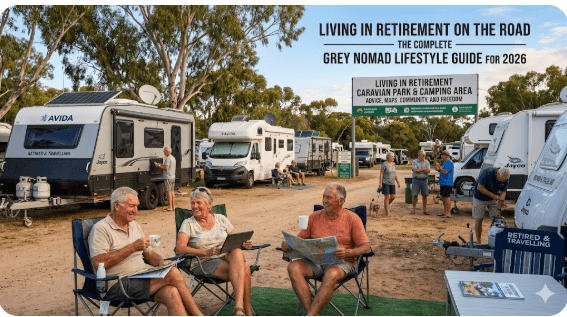
Living in Retirement on the Road – The Complete Grey Nomad Lifestyle Guide for 2026
Everything you actually need to know about retiring into full-time van life in Australia — money, health, safety, relationships, legal basics and what nobody warns you about before you sell the house and buy the rig.
📅 Last reviewed: June 2026 | Australia-wide | Relevant to all states and territories
Retiring to the road in Australia is one of the most significant lifestyle decisions a person can make — and one of the least honestly documented. The brochure version is sunsets, freedom and community. The real version includes those things, but also includes insurance complications, medical planning, relationship strain, vehicle maintenance costs that arrive without warning, and the quiet difficulty of being far from family when something goes wrong. This guide covers both versions honestly, because the grey nomads who thrive on the road are the ones who went in with clear eyes rather than glossy expectations.
- Who this guide is for: Australians aged 60+ considering or already living full-time van life in retirement
- Vehicle types covered: Motorhomes, campervans, caravans (towed), fifth-wheelers, converted vans
- Average daily cost: $35–$80 per day depending on van type, fuel use and overnight stop choices
- Best season to begin: April–May — avoid summer heat and wet season for your first months on the road
- Key legal requirements: Vehicle registration, roadworthy certification, adequate insurance, mail address
- Health planning: GP letter, medication list, 14-day medication buffer, PLB registration
- Biggest underestimated cost: Vehicle maintenance and unexpected repairs
- Most common regret: Rushing the first year — not allowing enough time to adjust
- Best resource for stops: Vanlife Savings Spots directory
Table of Contents
- What Living on the Road in Retirement Actually Looks Like
- Is Full-Time Van Life Right for You? Honest Questions to Ask First
- Choosing Your Rig: Motorhome, Caravan or Campervan
- The Real Cost of Living on the Road in Retirement
- Legal Essentials: Registration, Insurance and Your Permanent Address
- Health and Medical Planning for Senior Grey Nomads
- Safety on the Road: Personal, Vehicle and Campsite
- Medical Services and Emergency Contacts Across Australia
- Free Camping, Rest Areas and Where to Stay Each Night
- Staying Connected: Family, Friends and Mental Wellbeing
- The Best Seasons and Routes for Retirement Road Life
- Van Life Etiquette: Rules Every Grey Nomad Needs to Know
- Essential Packing and Preparation Checklist
- Key GPS Coordinates and Postcodes for Planning Your Route
- Frequently Asked Questions
- Final Verdict: Is Retiring to the Road Worth It?
1. What Living on the Road in Retirement Actually Looks Like
The reality of full-time grey nomad life in Australia sits somewhere between the Instagram version — golden light, empty beaches, total freedom — and the version nobody posts — the grey water tank that needs emptying in a caravan park at 7am, the generator that dies in 38-degree heat, or the moment you realise you are 600 kilometres from the nearest person who knows your name.
Most grey nomads who make it work describe a rhythm that took at least six months to find. The first weeks are typically exhilarating. Months two and three bring practical friction — things that break, routes that do not work as planned, sites that are full. By month six, most people have settled into a pace that suits them: moving every few days rather than every day, building loose circuits rather than relentless forward progress, choosing community over solitude more deliberately.
What a Typical Week on the Road Looks Like
| Day Pattern | What Many Grey Nomads Actually Do | What Surprises Beginners |
|---|---|---|
| Travel days (2–3 per week) | Drive 200–350km, arrive by 2pm to secure a site | Arriving late means no level ground left |
| Rest days (3–4 per week) | Explore locally, do laundry, resupply, socialise | Rest days are as important as travel days |
| Admin days (1 per week) | Bank access, medical appointments, vehicle checks | Admin takes longer from the road than from home |
| Morning routine | Pack down, safety checks, departure by 9am | Pack-down takes 30–45 minutes minimum |
| Evening routine | Level the van, set up awning, connect water | Setup takes 20–30 minutes at an unfamiliar site |
- Almost everyone moves too fast in the first three months — slow down earlier than you think you need to
- The grey nomad community is genuinely welcoming — do not be isolated if you are struggling to adjust
- Having a loose plan is better than no plan and better than a rigid plan — build in flexibility
- The emotional adjustment is real — leaving a fixed home changes your sense of identity in ways that take time to process
- Most people who quit do so in the first six months — if you can get through that period, retention rates are very high
2. Is Full-Time Van Life Right for You? Honest Questions to Ask First
Before buying a rig or selling a house, there are questions worth sitting with genuinely rather than answering with the version of yourself you hope to be.
Questions About Yourself
- Are you comfortable with uncertainty? Sites fill. Plans change. Roads close. Things break. If unpredictability causes you significant anxiety, full-time van life will amplify that rather than relieve it.
- How do you handle being alone? Even travelling as a couple, there are long stretches of outback driving and quiet evenings at isolated rest areas. Solo travellers face this more acutely — be honest about whether solitude energises or depletes you.
- What is your health situation honestly? Chronic conditions are manageable on the road with planning. Conditions that require frequent specialist appointments, regular hospital access or complex medication regimes are genuinely harder to manage from a moving base.
- What does your partner think — really? One of the most common van life breakdowns is one partner enthusiastic and one partner reluctant. A trial period of two to three months on the road before making permanent decisions is strongly recommended.
Questions About Your Finances
- Can you fund van life from your superannuation, pension or investment income without drawing down capital unsustainably?
- Do you have an emergency fund of at least $15,000–$20,000 for vehicle repairs, medical costs or unexpected accommodation needs?
- Have you factored in the cost of eventually coming off the road — buying or renting a fixed home again is expensive and competitive?
- If you sell your house to fund van life, what is your plan if you want to return to fixed housing in five years?
3. Choosing Your Rig: Motorhome, Caravan or Campervan
The vehicle you choose shapes your entire experience on the road. There is no universally correct answer — the right rig depends on your health, your budget, your driving confidence and whether you are travelling solo or as a couple.
| Rig Type | Typical Cost (used) | Senior Advantages | Senior Disadvantages | Best For |
|---|---|---|---|---|
| Motorhome (A-class or B-class) | $80,000–$350,000+ | Everything in one vehicle; no towing stress; easier to set up | Expensive; difficult to park in towns; repairs costly | Couples wanting maximum comfort |
| Caravan (towed) | $30,000–$120,000 | Detach and drive tow vehicle freely; wide range of sizes | Towing skill required; reversing difficult; coupling daily | Couples with towing experience |
| Campervan (converted or factory) | $25,000–$90,000 | Easier to drive; easier to park; lower running costs | Less living space; less storage; fewer amenities | Solo travellers or minimalist couples |
| Fifth-wheeler | $60,000–$180,000 | Very stable tow; spacious; good amenities | Requires specific tow vehicle; expensive combination | Experienced towers wanting maximum space |
| Pop-top caravan | $20,000–$60,000 | Lower wind resistance; lower height for some sites | Less insulation; some mobility issues with pop-top mechanism | Budget-conscious travellers in mild climates |
- Buy secondhand for your first rig — you will learn what you actually need after six months on the road, and your priorities will change
- Consider step height seriously — climbing in and out of a high motorhome cab dozens of times per day is tiring on ageing joints
- Check bed access before buying — island beds (accessible from both sides) are significantly more practical for older travellers than beds against a wall
- Bathroom size matters more than it seems — a bathroom large enough to dress in comfortably is a quality-of-life issue on long trips
- Solar and battery capacity matters enormously if you use CPAP — verify actual usable amp-hour capacity, not marketing figures
4. The Real Cost of Living on the Road in Retirement
The most common financial mistake grey nomads make is underestimating their total costs by focusing on the overnight stop savings while ignoring fuel, maintenance and the irregular large expenses that arrive without warning. Here is an honest breakdown.
| Cost Category | Estimated Monthly Cost | Notes for Senior Travellers |
|---|---|---|
| Fuel | $600–$1,400 | Depends heavily on distance travelled and rig fuel efficiency; diesel motorhomes average 18–25L/100km towing |
| Overnight stops (mix of free and paid) | $0–$800 | Full free camping costs nothing; mix of free and caravan parks averages $200–$400/month for most grey nomads |
| Food and groceries | $600–$1,000 | Outback food costs are higher; planning bulk buys in major towns saves significantly |
| Vehicle maintenance and repairs | $200–$600 average (but irregular) | Budget $3,000–$6,000 per year for tyres, servicing and unexpected repairs — it will be needed |
| Insurance (vehicle and contents) | $150–$400 | Full-time van life changes your insurance classification — confirm with your insurer before departure |
| Medical and health | $100–$400 | Prescription costs, GP visits, specialist appointments and any gap fees |
| Communications (phone, data) | $80–$200 | Telstra plans with adequate data for navigation, streaming and family contact cost more than city plans |
| Activities and dining out | $200–$600 | Varies enormously by lifestyle — museum entry, national park fees, occasional restaurant meals |
| Laundry and personal care | $50–$150 | Laundromat costs add up; many grey nomads use caravan park laundry facilities strategically |
| Total estimated monthly | $1,980–$5,550 | Most grey nomads report $2,500–$3,500/month as a realistic average for comfortable travel |
For more strategies on reducing your overnight costs without sacrificing safety or comfort, see our complete vanlife savings spots guide which covers free camping, low-cost stops and council camping areas across Australia.
5. Legal Essentials: Registration, Insurance and Your Permanent Address
Full-time van life creates several legal complications that most beginners do not anticipate. These are not insurmountable but they need to be resolved before you depart, not discovered when something goes wrong.
Vehicle Registration
- Your vehicle must be registered in an Australian state or territory and maintained current — there is no special registration category for full-time travellers
- Registration renewal notices are sent to your registered address — ensure you have a reliable mail-forwarding arrangement or a permanent address for registration purposes
- Annual roadworthy or safety inspection requirements vary by state — know your state’s requirements and plan inspections around your travel route
- Towing a caravan adds complexity — combined length and mass limits apply and vary by state; ensure your tow vehicle is rated for your van’s loaded weight
Insurance — Critical Points for Full-Time Van Life
Your Permanent Address
- You are legally required to have a residential address in Australia for electoral roll, Medicare, taxation and banking purposes
- Options include: a family member’s address, a mail forwarding service, or a registered address service
- Your Medicare card, centrelink payments, tax returns and superannuation fund all need a current address — keep this updated
- Some grey nomads use a postal address service such as Australia Post’s Mail Holding service or a private mail forwarding company for ongoing correspondence
Centrelink and Age Pension Considerations
- If you receive the Age Pension, notify Centrelink that you are travelling — your assets and income assessment does not change but your address must remain current
- The Age Pension is not affected by van life itself, but selling your family home and holding the proceeds as cash or investments will affect your assets test — get financial advice before selling
- Report any significant change in assets or financial circumstances to Centrelink promptly
6. Health and Medical Planning for Senior Grey Nomads
Health planning is the single most important preparation task for senior grey nomads and the one most commonly left until the last minute. The distance between where you are and where you need to be when something goes wrong can be very large in outback Australia. Planning reduces that risk — it does not eliminate it.
Before You Leave — Non-Negotiable Medical Preparation
- Schedule a comprehensive GP review specifically for travel — discuss your planned routes, remoteness of travel and any conditions that may require monitoring
- Obtain a signed letter from your GP summarising your conditions, current medications (generic and brand names, doses and schedule), known allergies and emergency contacts — keep a copy in the van and a digital copy accessible to a trusted contact
- Carry a minimum 14-day medication buffer beyond your planned travel period — pharmacy access in remote areas is limited and mail-order medications can be delayed
- Review your dental health before departure — dental emergencies in remote areas are extremely difficult to manage
- Ensure your vaccinations are current — tetanus in particular is relevant for outback travel
- Register a PLB (Personal Locator Beacon) with AMSA before any outback travel — this is a genuine lifesaving device, not an optional extra
| Health Condition | Specific Planning Required | Resource or Contact |
|---|---|---|
| CPAP users | Battery or solar backup essential — rest areas have no power; confirm battery capacity meets your nightly usage | Your CPAP supplier — ask specifically about 12V travel options |
| Insulin-dependent diabetes | Insulin storage at correct temperature is critical — outback heat destroys insulin rapidly without a powered fridge | Diabetes Australia: diabetesaustralia.com.au |
| Cardiac conditions | Map cardiologist locations along your intended route; carry defibrillator knowledge; ensure companion knows CPR | Heart Foundation: heartfoundation.org.au |
| Blood pressure medications | Heat and dehydration interact with BP medications — monitor closely in summer; stay hydrated | Your GP — discuss heat management plan |
| Mobility limitations | Check site accessibility before committing; many rest areas have uneven ground; walking aids need dedicated storage | Research sites individually using WikiCamps notes |
| Mental health conditions | Isolation can exacerbate depression and anxiety — plan regular social contact and maintain mental health support relationships | Beyond Blue: 1300 22 4636 |
7. Safety on the Road: Personal, Vehicle and Campsite
Personal Safety
- Register your travel intentions with a trusted contact before any remote or outback stage — share your planned route, intended overnight stops and expected check-in schedule
- Park near other grey nomads at rest areas where possible — community presence is the most practical deterrent to opportunistic theft and the fastest response to a medical event
- Do not leave valuables visible through van windows — medications, electronics, cash and documents should be stored out of sight in locked compartments
- Trust your instincts about specific sites — if a location feels unsafe on arrival, leave without apologising for the decision
- Solo travellers should avoid advertising that they are travelling alone — gender-neutral conversation about travel companions is a reasonable precaution
- Read our full guide on how caravan theft happens in Australia — understanding the methods used makes prevention much more practical
Vehicle Safety
- Conduct a daily walk-around inspection of your rig before departure — check tyres, coupling security, lights, awning stowage and any changes since arriving
- Know your vehicle’s limitations — maximum towing weight, maximum height for bridges and tree cover, minimum turning radius for tight camp entrances
- Carry a tyre repair kit, a portable compressor and a full-size spare — tyre failures on outback roads are common and roadside assistance response times can be several hours
- Service your vehicle on schedule and do not defer maintenance to save money — deferred maintenance is the primary cause of serious mechanical failures in the field
- Carry an emergency breakdown kit: jumper cables or jump pack, tow rope, warning triangles, torch and basic tools
8. Medical Services and Emergency Contacts Across Australia
The hospitals and services below represent key medical resources along Australia’s main grey nomad routes. Always identify the nearest hospital to your planned route before departing each stage. This list is a planning starting point — verify current contact details before travel as these change.
| Service / Hospital | Address | GPS (approx) | Phone |
|---|---|---|---|
| Royal Brisbane and Women’s Hospital | Butterfield St, Herston QLD 4029 | -27.4468, 153.0269 | (07) 3646 8111 |
| Royal Adelaide Hospital | Port Rd, Adelaide SA 5000 | -34.9210, 138.5876 | (08) 7074 0000 |
| Royal Melbourne Hospital | 300 Grattan St, Parkville VIC 3050 | -37.7993, 144.9558 | (03) 9342 7000 |
| Fiona Stanley Hospital (Perth) | 11 Robin Warren Dr, Murdoch WA 6150 | -32.0648, 115.8373 | (08) 6152 2222 |
| Alice Springs Hospital | Gap Rd, Alice Springs NT 0870 | -23.7025, 133.8807 | (08) 8951 7777 |
| Royal Hobart Hospital | 48 Liverpool St, Hobart TAS 7000 | -42.8826, 147.3277 | (03) 6166 8308 |
| Royal Flying Doctor Service | Australia-wide emergency aeromedical | — | 1300 669 569 |
| Emergency (all states) | — | — | 000 |
| Healthdirect (nurse on call) | — | — | 1800 022 222 |
9. Free Camping, Rest Areas and Where to Stay Each Night
The overnight stop strategy you develop is one of the most important practical skills of grey nomad life. It takes most travellers two to three months to develop a reliable approach. The basics are consistent across all states.
The Three-Tier Overnight Strategy
- Tier 1 — Free camps and rest areas: No cost or minimal donation. TMR rest areas, council free camps, national park designated sites. Plan your primary stop here and aim to arrive by 2pm during peak season.
- Tier 2 — Budget caravan parks: $25–$45 per night. Use these for dump point access, water top-up, laundry and the occasional powered site for CPAP battery recharging or hot weather relief.
- Tier 3 — Full-service caravan parks: $45–$80 per night. Use strategically — after a long outback run, before a medical appointment, or when you need a genuine rest from van management.
Understanding the rules around how long you can stay at different site types is essential — our guide to how long you can stay at caravan parks and overnight stops in Australia covers the legal limits state by state.
10. Staying Connected: Family, Friends and Mental Wellbeing
Social connection is the aspect of grey nomad life that receives the least practical attention in most guides and causes the most quiet difficulty for the most people. Distance from family is manageable. Distance from yourself — your sense of purpose, identity and community — is harder.
Staying Connected with Family
- Establish a regular check-in schedule with family before departure — weekly video calls are more sustaining than irregular messages
- Share your location in real time using apps like Life360, Find My Friends or a simple WhatsApp location share — this gives family peace of mind and removes the anxiety of wondering where you are
- Plan route circuits that bring you within reasonable distance of family every few months — the road is more sustainable when you can see grandchildren regularly
- Be honest with family about your contact capacity in remote areas — managing their expectations about response times prevents unnecessary worry
Building Community on the Road
- The grey nomad community is one of the genuinely great things about this lifestyle — engage with it actively rather than staying in your van
- Morning tea at popular rest areas and free camps is a well-established grey nomad tradition — it is both social and practical (information sharing about road conditions, sites ahead, tips)
- Consider joining the CMCA (Campervan and Motorhome Club of Australia) — it provides community, advocacy and practical resources
- Online grey nomad forums and Facebook groups provide connection during remote stages when physical community is not available
Mental Wellbeing on the Road
For deeper exploration of what full-time retirement van life involves practically and emotionally, see our companion guide to living in a camper full-time in retirement.
11. The Best Seasons and Routes for Retirement Road Life
| Season | What It Is Like Nationally | Senior Verdict |
|---|---|---|
| Summer (Dec–Feb) | Extreme heat in inland areas; cyclone risk in northern QLD and NT; flooding on outback roads; southern states more manageable | ⛔ Stay south — Victoria, Tasmania and southern NSW are viable; avoid Queensland north and NT entirely |
| Autumn (Mar–May) | Temperatures easing across most of Australia; roads drying after wet season in north; shoulder season pricing at caravan parks | ✅ Excellent — begin your northern migration in April; May is ideal for Queensland outback |
| Winter (Jun–Aug) | Dry and clear across Queensland, NT and WA; cold nights in southern states and outback; peak grey nomad season | ✅✅ Best overall — the entire northern half of Australia is accessible and comfortable |
| Spring (Sep–Nov) | Wildflowers in WA; warming temperatures; humidity beginning to build in Queensland from October; southern states excellent | ✅ Good — September and October ideal; November begin moving south from Queensland |
12. Van Life Etiquette: Rules Every Grey Nomad Needs to Know
The access grey nomads enjoy to free camps, council sites and rest areas exists because enough travellers before you behaved well enough to preserve it. That access is fragile. Councils revoke permissions. TMR installs barriers. Sites close. Every grey nomad carries some responsibility for protecting the commons.
- Observe maximum stay limits at every site — overstaying is the most common cause of site closures and enforcement action
- Never dump grey water or black water on the ground — this is illegal in all states, carries substantial fines and has caused multiple site closures
- Carry your rubbish out if there are no bins — do not leave rubbish bags beside full bins expecting someone else to manage them
- Respect quiet hours — 10pm to 7am is the standard expectation at most free camps and rest areas; generator noise past 9pm is antisocial regardless of rules
- Do not occupy more than one site with a single rig — at crowded sites, taking extra space for chairs, annexes or bikes across a neighbouring pitch is a genuine imposition
- Leave the site better than you found it — a five-minute cleanup before departure costs nothing and builds the goodwill that keeps sites open
13. Essential Packing and Preparation Checklist
| Item | Why It Matters for Retirement Van Life | ☐ |
|---|---|---|
| PLB (Personal Locator Beacon) — registered with AMSA | Only reliable emergency contact in areas with no mobile coverage | ☐ |
| GP medical letter with medication list | Essential for hospital admissions away from your regular GP | ☐ |
| 14-day medication buffer | Pharmacy access limited in remote areas; delays happen | ☐ |
| CPAP with 12V adapter and battery bank | Rest areas have no power; battery backup is non-negotiable for CPAP users | ☐ |
| Insulin cooler or 12V medical fridge (diabetic travellers) | Heat destroys insulin — proper storage is a medical requirement | ☐ |
| 20-litre minimum water storage | Outback water sources unreliable; bore water unsafe for drinking | ☐ |
| Tyre repair kit and portable compressor | Outback tyre damage is common; roadside assistance is slow | ☐ |
| Offline maps (Hema Explorer or similar) | No data coverage in remote areas; live navigation unreliable | ☐ |
| Vehicle emergency breakdown kit | Jump pack, tow rope, warning triangles, torch, basic tools | ☐ |
| Caravan or van security lock | Popular sites have opportunistic theft risk during peak season | ☐ |
| First aid kit (senior-specific) | Include wound care, pain relief, electrolyte sachets, BP monitor | ☐ |
| Travel insurance (if venturing to remote areas) | Standard Medicare does not cover aeromedical evacuation costs in full | ☐ |
COPY PROMPT ➔ ASK AI ➔ SAVE TO FORM ➔ ADD SPOT PIN ➔ GET DIRECTIONS
📍 Interactive map — find free camps, rest areas and overnight stops across Australia for your retirement road trip. Enable location for best results.
14. Key GPS Coordinates and Postcodes for Planning Your Route
The locations below represent key reference points for grey nomads planning an Australian circuit. Save these to your offline maps before departing. These coordinates are provided as planning guidance — verify against current signage on arrival.
| Location | Address / Postcode | GPS (approx) | Notes |
|---|---|---|---|
| Cardwell Foreshore Free Camp (QLD) | Victoria St, Cardwell QLD 4849 | -18.2614, 146.0296 | 48hr limit; toilets; water; popular grey nomad stop |
| Charleville Showgrounds (QLD) | King St, Charleville QLD 4470 | -26.4040, 146.2450 | Council camp; powered sites; outback gateway |
| Longreach Rest Area (QLD) | Landsborough Hwy, Longreach QLD 4730 | -23.4425, 144.2560 | Outback QLD; verify water availability |
| Alice Springs (NT reference point) | Alice Springs NT 0870 | -23.6980, 133.8807 | Central Australia hub; hospital; major services |
| Royal Adelaide Hospital (SA) | Port Rd, Adelaide SA 5000 | -34.9210, 138.5876 | Major hospital — southern circuit reference |
| Kalgoorlie (WA reference point) | Kalgoorlie WA 6430 | -30.7489, 121.4658 | WA outback hub; hospital; fuel; services |
For a comprehensive Australia-wide directory of free camps, rest areas and low-cost overnight stops, see our vanlife savings spots guide.
15. Frequently Asked Questions
How much money do you need to retire to van life in Australia?
Most grey nomads report comfortable van life travel on $2,500–$3,500 per month including all costs. A realistic minimum budget for a couple is around $2,000 per month if you maximise free camping and minimise paid activities. Solo travellers can manage on slightly less. You will also need an emergency fund of at least $15,000–$20,000 for vehicle repairs and unexpected medical costs that are genuinely likely to arise over a multi-year trip. Budget honestly before you go rather than discovering the shortfall in month three.
Can you receive the Age Pension while travelling full-time?
Yes — the Age Pension is payable to Australian residents regardless of where they travel within Australia. You are required to maintain a current address with Centrelink and notify them of significant changes to your assets or circumstances. Selling your family home and holding the proceeds will affect your assets test — get financial advice from a licensed adviser before making that decision. Living in a van does not disqualify you from pension entitlements but it does require you to stay on top of your Centrelink obligations.
Is van life safe for senior solo travellers?
Yes, with honest preparation. Australia’s grey nomad routes are generally safe and the community of fellow travellers provides a practical safety network. The real risks are practical rather than criminal: medical emergencies in remote areas, vehicle breakdowns, road fatigue and extreme weather. Carry a PLB for outback travel, register your route with a trusted contact, park near other grey nomads at rest areas, and trust your instincts about specific sites. Solo van life is genuinely achievable for most seniors with reasonable planning and appropriate equipment.
What is the best vehicle for a senior grey nomad?
There is no single best vehicle — it depends on your health, driving confidence, budget and travel style. Motorhomes offer the most comfort and simplest operation but cost more. Caravans offer flexibility but require daily towing. Campervans are easiest to drive and park but offer less living space. For most seniors, a mid-size motorhome or a manageable caravan behind a reliable 4WD tow vehicle provides the best balance. Always buy secondhand for your first rig and upgrade once you know what you actually need after six months on the road.
How do CPAP users manage overnight power?
CPAP power management is one of the most common practical concerns for senior grey nomads. Options include: a 12V DC adapter connecting directly to your vehicle battery (suitable for short use), a dedicated lithium battery bank sized to your machine’s actual amp-hour draw (most practical solution), a solar panel system with battery storage, or strategic use of powered caravan park sites every few nights to recharge. Never rely on a powered site being available — always have a battery backup. Discuss your specific machine’s power requirements with your CPAP supplier before departure.
How do you handle mail and banking while living on the road?
Most grey nomads use a combination of: a trusted family member’s address for important mail, Australia Post Mail Holding or a private mail forwarding service for ongoing correspondence, and fully online banking with a bank that has no-fee ATM access and good app functionality. Ensure your bank knows you will be travelling — some banks flag interstate transactions as suspicious. Set up Centrelink, Medicare and ATO access through myGov before departure so you can manage government obligations online from anywhere.
What happens if you need urgent medical attention in a remote area?
For life-threatening emergencies in any location, call 000. In areas without mobile coverage, a registered PLB activates a satellite emergency signal that coordinates AMSA and the relevant state rescue authority. The Royal Flying Doctor Service provides aeromedical retrieval across remote Australia — they are activated through the 000 system. For non-emergency medical issues, Healthdirect (1800 022 222) provides nurse-on-call advice 24 hours a day. Planning the location of the nearest hospital to each stage of your route before departing is strongly recommended.
How do you manage relationships on the road — especially as a couple?
Couples living full-time in a small space face genuine relationship pressure that most guides understate. The practical advice from experienced grey nomads is consistent: maintain individual interests and activities alongside shared ones, establish ground rules about personal space and alone time before departure rather than during a disagreement, and do not use the road as a way to fix a relationship that was already struggling. The grey nomad community provides a valuable social outlet that reduces the pressure of being each other’s sole social contact. Build community deliberately rather than relying entirely on each other for all social needs.
How long does it take to adjust to full-time van life?
Most grey nomads describe a genuine adjustment period of three to six months. The first weeks are typically exciting. Months two and three bring the friction of reality — things that do not work as expected, routes that are harder than anticipated, the emotional weight of having left behind familiar routines and places. By month six, most people who are going to make van life work have found their rhythm. The most common piece of advice from long-term grey nomads is to commit to at least six months before deciding the lifestyle does not suit you — most difficulties that feel insurmountable at month two are resolved naturally by month five.
16. Final Verdict: Is Retiring to the Road Worth It?
For the right person with honest preparation, retiring to the road in Australia is one of the most genuinely rewarding ways to spend a retirement. The combination of freedom, community, natural beauty and the sustained sense of purpose that comes from managing your own mobile home competently is not available anywhere else at any price. The grey nomad community is real and warm. The landscapes are extraordinary. The cost savings over fixed housing — when managed well — are meaningful and sustainable. People who approach van life as a considered lifestyle choice, planned carefully and entered with realistic expectations, report high satisfaction rates that persist across many years of travel.
The honest qualification is equally important. Van life is not an escape and it is not for everyone. It requires physical and cognitive capability to manage a vehicle, a campsite and the daily logistics of mobile living. It creates genuine distance from family, specialist medical care and familiar support networks. It places demands on relationships that comfortable fixed housing conceals. Vehicles break, sites fill, heat is dangerous and isolation is real. None of these are reasons not to go — but they are reasons to go prepared rather than optimistic. The grey nomads who struggle are almost always the ones who underestimated the practical demands. The ones who thrive are almost always the ones who did their homework, built their emergency reserves, sorted their medical planning and then had the courage to go anyway.
- Complete Free Camping and Vanlife Savings Spots Directory — Australia-wide
- Best Routes to Drive Around Australia for Grey Nomads
- Living in a Camper Full-Time in Retirement — Complete Guide
- How Long Can You Stay at a Caravan Park in Australia?
- How Caravan Theft Happens in Australia — Grey Nomad Security Guide
- Free Camping Queensland — The Complete Grey Nomad Hub Guide
- Free Camping NSW — The Complete Grey Nomad Hub Guide
Free campsites and powered sites fill fast during peak season. If your preferred stop is already taken, search remaining accommodation options below to keep your trip on track.
Accommodation and flight search powered by Expedia. Booking through this search supports this website at no extra cost to you. As an affiliate, I earn from qualifying purchases at no extra cost to you.

As an affiliate, I earn from qualifying purchases at no extra cost to you.
Exclusive Offer: Get 5% OFF all StarterStopper immobiliser products with promo code: RTV5
Visit StarterStopper.com to see our data-backed security solutions
As an affiliate, I earn from qualifying purchases at no extra cost to you.