Free Camping Western Australia 2026 — Complete Senior Grey Nomad Guide
The complete GPS-verified guide to free camping across Western Australia for senior grey nomads — rest areas, overnight stops, self-contained rules and safety across every major WA highway.
📅 Last reviewed: May 2026 | Western Australia | Free and low-cost overnight stops for senior grey nomads
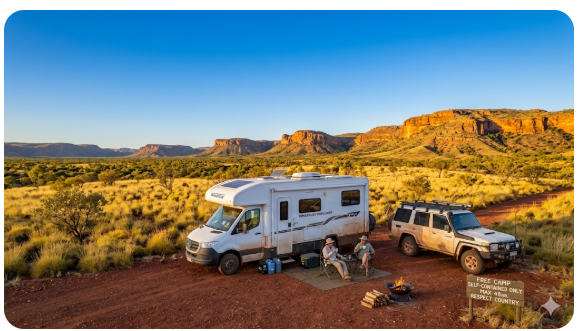
There is a moment — somewhere on the Great Northern Highway, maybe three hundred kilometres north of Meekatharra with nothing but red earth and a burnt-sky horizon in every direction — when free camping Western Australia stops being a travel decision and becomes something closer to a revelation. The sun is dropping fast, you’ve found a flat wide roadside bay, the dust is still settling behind your van, and the silence that follows is the kind you don’t encounter anywhere else on earth.
Free camping in Western Australia is unlike anything else this country offers, and for grey nomads with the time, the rig and the spirit for it, it is the journey of a lifetime. At 2.6 million square kilometres, WA is larger than Western Europe. Its coastline runs for more than 12,500 kilometres. Its free camps range from windswept bays on the South Coast to ancient gorge camps in the Kimberley, from scrubby Nullarbor highway stops to wildflower-carpeted Wheatbelt pullouts in September. There is no single guide that could cover all of it — but this one gets you as close as any guide can.
📋 At a Glance — Free Camping Western Australia 2026
- Self-contained requirements: Vary by location and local government area — many remote camps strongly recommend or require a self-contained vehicle with toilet, grey water containment and fresh water storage.
- Best apps: WikiCamps Australia and Campermate are the most reliable for WA — download maps offline before leaving mobile coverage zones.
- Heat warning: Northern WA (Kimberley, Pilbara) regularly exceeds 45°C in summer. Do not travel these regions between November and March without full air conditioning and reliable power.
- Remote medical access: The Royal Flying Doctor Service (RFDS) covers all of WA — but response times in remote areas can be lengthy. Carry a PLB or satellite communicator and sufficient medication for 14 days minimum.
- Telstra coverage: Telstra has the best regional coverage in WA by a significant margin. Optus and Vodafone coverage drops away rapidly outside Perth and major regional centres.
- Fire bans: Total Fire Ban periods vary by region. Always check the DFES Emergency WA app or website and local radio before lighting any fire. Penalties are severe.
- Best season: April to October — comfortable temperatures across most of the state, wildflowers in spring, whale watching in autumn, clear skies throughout.
- Stay limit: Most roadside rest areas allow 24 hours; some allow up to 48 hours. Rules change — always read the signage on arrival, which takes legal precedence over any app or website.
What You Will Find in This Guide
- Free Camping Rules in Western Australia
- Self-Contained Vehicle Requirements WA
- Free Camping by Region
- Top 10 Free Camps in WA for Grey Nomads
- Kimberley Free Camping
- South Coast Free Camping
- Mid-West and Coral Coast Free Camping
- Nullarbor and Eyre Highway Stops
- Safety for Senior Free Campers in WA
- Medical and Emergency Access in Remote WA
- Heat Management for Seniors in WA
- Best Apps for Free Camping in WA
- Packing Checklist for WA Free Camping
- Fire Ban Seasons in WA
- Frequently Asked Questions
- Our Honest Verdict on WA Free Camping
Free Camping Rules in Western Australia
Western Australia does not operate under a single unified free camping law. Rules are set by a combination of Main Roads WA (for roadside rest areas), the Department of Biodiversity, Conservation and Attractions (for national parks and reserves), local government authorities (for town-adjacent stops) and pastoral lease holders (for private land). Understanding which authority governs your chosen site is the first step to camping legally and without stress.
Roadside Rest Areas
Main Roads WA manages designated rest areas along state highways including the Great Northern Highway, the North West Coastal Highway, the Eyre Highway and the South Coast Highway. These rest areas are generally provided for driver fatigue management and most permit overnight stays of up to 24 hours. Some rest areas — particularly along the Nullarbor stretch of the Eyre Highway — allow up to 48 hours. Signs at the entrance will always state the permitted stay. If no sign is present, 24 hours is the standard assumption, though you should verify locally.
Crown Land
Camping on unallocated Crown Land is legal in many parts of WA but it is your responsibility to confirm the land is not part of a pastoral lease, nature reserve or other restricted category. The Department of Planning, Lands and Heritage administers Crown Land in WA. In practice, many grey nomads camp on Crown Land roadside areas that are neither signed rest areas nor formally designated camps — this is generally tolerated provided you leave no trace, do not disturb livestock or gates, and do not outstay a reasonable period (typically one night).
National Parks
Free camping is generally not permitted inside WA national parks. Most national park camping requires a fee and must be booked in advance through the Parks and Wildlife Service online booking system. There are exceptions — some national parks have free or low-cost bush camping zones that require booking but not payment. Always check the specific park rules before arrival, particularly for popular parks like Cape Le Grand, Kalbarri, Karijini and the Kimberley parks which book out months in advance.
Local Government Areas
Some WA shires actively encourage grey nomad camping and provide free or low-cost camps within their boundaries. Others prohibit overnight parking in town areas entirely. Rules change regularly — a shire that permitted free camping in the town oval two years ago may have installed a fee-based system or prohibited overnight stays entirely. Always check with the local shire council or use a current app review before relying on historical information.
For a broader look at how overnight parking differs from free camping across Australia, see our guide on Free Camping vs Overnight Parking Australia — understanding that distinction matters more in WA than almost anywhere else in the country.
Self-Contained Vehicle Requirements WA
The term “self-contained” gets used loosely in Australian grey nomad circles, but in Western Australia it has a specific and increasingly important legal meaning — particularly as more shires and remote camp managers introduce self-contained requirements to protect fragile environments and limited water resources.
What Self-Contained Means in WA
A genuinely self-contained vehicle must have all three of the following on board: a fixed flush or composting toilet (not a portable bucket-style toilet in many interpretations), a grey water containment system that captures all waste water from sinks and showers, and a fresh water storage capacity sufficient for the occupants’ needs for the duration of the stay. The vehicle must be capable of operating entirely independently of external water, sewer or power connections for the stated period.
Certification
In New Zealand, a formal self-containment certificate (NZMCA) is standard. In Australia, no equivalent national scheme exists as of May 2026. Some WA shires and camp managers may ask you to demonstrate your vehicle’s self-contained capability — in practice this usually means showing that your grey water tank is plumbed and functional, your toilet is onboard and operational, and you can demonstrate fresh water storage. Carry your vehicle’s manual, a photograph of the grey water tank plumbing and your toilet documentation as proof if requested. The situation is evolving — check for updated shire requirements before travelling.
Grey Water Management
Dumping grey water on the ground is prohibited at self-contained required sites and is actively frowned upon at all WA free camps — particularly in national parks and near waterways. Always carry a grey water containment bladder or ensure your van’s grey tank is functional before departing. Dump points are available at most roadhouses, caravan parks and many shire-managed camps across WA.
If you’re still working out what van setup suits long-term travel, our guide on Living in a Camper covers practical setup considerations for extended grey nomad travel.
Free Camping by Region
Western Australia divides naturally into distinct travel regions, each with its own character, climate, road conditions and free camping opportunities. What works on the South Coast — sealed roads, accessible camps, mild temperatures — is a completely different experience from the Kimberley, where corrugated dirt roads, remote gorge camps and extreme heat demand a different level of preparation. Use this regional overview to plan your route, then follow the links to our dedicated guides for each area before you travel each stretch.
Kimberley
The Kimberley is WA’s crown jewel and its most demanding region. Free camping ranges from rest areas at Fitzroy Crossing and Halls Creek to remote gorge camps accessible only by high-clearance 4WD. The Gibb River Road opens up extraordinary free camp country for well-prepared travellers. This is not a region for first-time WA visitors in a standard caravan — but for those ready for it, it is unforgettable.
South Coast
Albany, Esperance, Ravensthorpe and the Cape Le Grand area offer some of the most accessible and scenic free camping in the state. Sealed roads, reliable facilities and stunning coastal scenery make this the ideal starting region for grey nomads new to WA free camping. Spring wildflower season from August to October adds extraordinary colour to the journey.
Mid-West and Coral Coast
From Geraldton north to Carnarvon and Shark Bay, the Coral Coast along the North West Coastal Highway offers warm winter temperatures, whale watching from July to November and dolphin feeding at Monkey Mia. Kalbarri National Park provides spectacular gorge scenery within reach of good facilities. This region is WA’s sweet spot for grey nomads seeking warmth, wildlife and manageable road conditions.
Wheatbelt
Often overlooked by travellers racing north or east, the Wheatbelt offers quiet roadside camps, the extraordinary granite outcrop of Baladjie Rock Free Camping WA and a genuine sense of off-the-beaten-track WA. Wildflower season transforms the Wheatbelt from August to October. Most camps are simple roadside pullouts with basic facilities but they are rarely crowded.
Nullarbor and Eyre Highway
The Nullarbor crossing is one of Australia’s great road journeys — honest, vast and humbling. Rest areas along the Eyre Highway provide overnight stops with basic facilities. Distances between roadhouses are extreme. This is a drive that demands fuel discipline, water discipline and a respect for the absolute remoteness of the landscape.
Top 10 Free Camps in WA for Grey Nomads
The following ten locations represent some of the most consistently well-regarded free camps in Western Australia for senior grey nomads — chosen for accessibility, facilities, safety and the overall experience they offer. GPS coordinates are provided as navigation guidance only and are accurate to within 50 metres of the stated location. Always confirm position on arrival and read current signage, which takes legal precedence over any coordinates or guide.
| Location | Region | GPS (approx. ±50m) | Facilities | Big Rig Friendly | Senior Rating |
|---|---|---|---|---|---|
| Dongara Rest Area | Coral Coast | -29.2441, 114.9342 | Toilets, picnic tables, shade | Yes | ⭐⭐⭐⭐⭐ |
| Carnarvon Fascine Foreshore | Gascoyne | -24.8762, 113.6594 | Toilets, dump point nearby, town access | Yes | ⭐⭐⭐⭐⭐ |
| Norseman Rest Area | Goldfields | -32.1979, 121.7791 | Toilets, shade, sealed parking | Yes | ⭐⭐⭐⭐ |
| Balladonia Roadhouse Rest Area | Nullarbor / Eyre Highway | -32.4513, 123.6244 | Toilets, roadhouse fuel and meals adjacent | Yes | ⭐⭐⭐⭐ |
| Fitzroy Crossing Rest Area | Kimberley | -18.1768, 125.5893 | Toilets, shade shelters, town access | Yes | ⭐⭐⭐⭐ |
| Halls Creek Rest Area | Kimberley | -18.2310, 127.6673 | Toilets, sealed area, town adjacent | Yes | ⭐⭐⭐⭐ |
| Baladjie Rock | Wheatbelt | -30.5312, 119.2847 | Pit toilets, firepit areas, nature setting | Mostly — some tight access | ⭐⭐⭐⭐ |
| Geraldton Foreshore Rest Area | Mid-West | -28.7747, 114.6148 | Toilets, town access, flat sealed parking | Yes | ⭐⭐⭐⭐⭐ |
| Esperance Bay Foreshore | South Coast | -33.8570, 121.8891 | Toilets, showers nearby, foreshore walk | Yes — check current bay rules | ⭐⭐⭐⭐⭐ |
| Shark Bay (Denham) Foreshore | Gascoyne / Shark Bay | -25.9294, 113.5328 | Toilets, town access, stunning bay views | Yes | ⭐⭐⭐⭐⭐ |
Kimberley Free Camping
The Kimberley is not for the faint-hearted — and that is precisely what makes it so extraordinary. This is ancient country: sandstone gorges carved over millions of years, rivers that run red with ochre after rain, and skies so vast and so dark at night that the Milky Way appears close enough to reach up and touch. For senior grey nomads who are properly prepared and honest about their rig’s capability, the Kimberley offers a free camping experience that has no equal in Australia.
The key word is prepared. The Kimberley demands more from you and your vehicle than any other region in WA. The Gibb River Road — the legendary dirt track connecting Derby to Kununurra — is corrugated, remote and requires a high-clearance 4WD or capable AWD vehicle. Standard caravans are not recommended on the Gibb. However, the sealed Great Northern Highway that runs through Fitzroy Crossing and Halls Creek gives grey nomads in standard caravans and motorhomes genuine access to some of the Kimberley’s most remarkable landscapes, including Geikie Gorge, Wolf Creek Crater and the extraordinary ochre country around Halls Creek.
Key Stops — Kimberley Free Camping
The Fitzroy Crossing Rest Area on the Great Northern Highway is a practical overnight stop for travellers heading east or west through the Kimberley. Sealed parking, basic toilet facilities and proximity to the Fitzroy Crossing townsite make it a reliable base. From here, a short drive accesses Geikie Gorge National Park — one of the most accessible and spectacular gorge landscapes in the Kimberley, bookable through Parks and Wildlife in advance.
Further east, Halls Creek Rest Areas provide a logical overnight stop in the heart of the Kimberley. The town has fuel, a supermarket and medical facilities — essential reassurances in such a remote region. Wolf Creek Meteorite Crater is within reach as a day trip.
For those with the right rig, El Questro Kimberley is an extraordinary destination — a private station the size of a small European country that offers camping from basic bush sites to station campgrounds. Some sites are free or very low cost; others are fee-based. Booking well in advance is essential during the April to September peak season.
For broader safety planning for remote travel, our Grey Nomad Safety Tips guide covers the key principles that apply particularly well to Kimberley travel.
South Coast Free Camping
If the Kimberley is WA at its most demanding, the South Coast is WA at its most welcoming. From Albany west along the South Coast Highway to Esperance and beyond to Cape Arid, this is a region that rewards senior grey nomads with spectacular coastal scenery, accessible sealed roads, reliable facilities and a pace of travel that feels exactly right for unhurried exploration.
Albany anchors the western end of the South Coast route — a historic port city with excellent facilities, a superb maritime museum and some of the most dramatic coastal scenery in southern WA. Torndirrup National Park, The Gap and Natural Bridge are all within easy reach and fully accessible. Free Camping Albany WA 2026 gives you the full detail on where to stay near Albany without paying caravan park prices.
Heading east along the South Coast Highway, Ravensthorpe sits at the junction of the highway and the Hopetoun road — a small town with a big heart during the wildflower season. Ravensthorpe Free Camping details the options in and around this underrated stopover.
Esperance is the jewel of the South Coast — turquoise waters, white sand beaches and the extraordinary Cape Le Grand National Park with its granite peaks and Lucky Bay (where kangaroos famously share the beach with swimmers). The foreshore at Esperance has historically offered overnight stays, though rules around specific areas change — check Esperance Free Camping for the current situation before you arrive.
Best Season — South Coast
The South Coast is at its finest from August to November. Spring wildflowers transform the roadsides and reserves from late August, whale watching peaks at Albany from June to October, and the summer heat is moderate compared to the north. Winters are mild but can be wet and windy — not unpleasant for van life but worth factoring into your planning.
Also worth reading before your South Coast trip: our guide on Sleeping in a Campervan in Australia — particularly relevant for those new to overnight stops away from powered caravan parks.
Mid-West and Coral Coast Free Camping
The stretch of WA coast from Geraldton north to Carnarvon and across to Shark Bay is the region that converts most grey nomads into committed WA devotees. Winter temperatures are genuinely pleasant — overnight lows rarely below 10°C, daytime highs in the comfortable 22–26°C range from May to August — and the combination of wildlife encounters, coastal scenery and accessible free camps along the North West Coastal Highway makes this WA’s most rewarding region for senior travellers who want comfort alongside adventure.
Geraldton and Surrounds
Geraldton is the Mid-West’s largest city and a practical hub for grey nomads travelling north. Fuel, supplies, medical facilities and dump points are all available. Geraldton Free Camping covers the options in and around the city — including the popular foreshore area that has been a favourite of grey nomads for many years.
Just south of Geraldton, Dongara Rest Areas offer some of the best-presented roadside overnight stops in regional WA — shaded, clean, and well-used by the grey nomad community heading north in the autumn months.
Shark Bay
Shark Bay — a UNESCO World Heritage Area — is one of WA’s true natural wonders. Monkey Mia, where wild bottlenose dolphins have been interacting with humans on the beach for decades, is one of the most accessible and genuinely moving wildlife experiences in Australia for senior travellers. The dolphin feeding at Monkey Mia is managed by the Parks and Wildlife Service and is a short, flat walk from the car park. Free Camping in Shark Bay Western Australia covers the overnight options in the area, including the Denham foreshore and the broader Shark Bay region.
Carnarvon
Carnarvon — famous for its tropical fruits and prawns — sits at the mouth of the Gascoyne River and is a key stop on the North West Coastal Highway. The town has excellent facilities and the foreshore area has historically been a popular overnight stop for grey nomads. Carnarvon Free Camping has current details on the best spots in the area.
Fortescue Roadhouse — North West Coastal Highway
The essential fuel, food and facilities stop between Karratha and Port Hedland — with free camping 1km away at Fortescue River Rest Area.
Kalbarri
Kalbarri National Park offers some of the most spectacular gorge scenery in WA — the Z-Bend and Nature’s Window lookouts are among the most photographed landscapes in the state. While camping within the national park requires booking and a fee, the town of Kalbarri and surrounding area has options for grey nomads. See Kalbarri National Park Free Camping for the full current picture.
Nullarbor and Eyre Highway Stops
There is nothing quite like driving the Nullarbor. For many grey nomads, crossing the Nullarbor Plain on the Eyre Highway is a rite of passage — a journey across one of the flattest, most featureless and most quietly mesmerising landscapes on earth. The name means “no trees” in Latin and the plain largely lives up to it. The Bunda Cliffs — where the Nullarbor meets the Southern Ocean in a series of vertical limestone drops — are among the most extraordinary natural features you will drive past anywhere in Australia.
The Nullarbor is not a journey to rush or to take lightly. The longest straight stretch of road in Australia runs for 146.6 kilometres without a bend. Fuel stops are far apart — sometimes exceeding 200 kilometres — and the roadhouses, while basic, are genuine lifelines. At each roadhouse, fuel up completely regardless of how much fuel you have. Do not assume the next one will be open or have the fuel type you need.
Key Stops — Eyre Highway
The Balladonia Roadhouse Rest Area is one of the most popular overnight stops on the Nullarbor for grey nomads heading east from Perth. The roadhouse has fuel, food and basic facilities. The rest area adjacent allows overnight stays and is a reliable, well-used stopping point. Norseman Free Camping at the western gateway to the Nullarbor is the last major town before the crossing and the best place to stock up, dump grey water and prepare your rig for the crossing ahead.
For a full guide to every stop between Norseman and the South Australian border, see our Nullarbor Rest Areas Grey Nomad Guide — this covers GPS coordinates, stay limits, facilities and honest assessments of every rest area and roadhouse along the Eyre Highway.
The Nullarbor crossing is best done in autumn (March to May) or spring (September to November) to avoid both the extreme summer heat and the winter storms that can make the crossing genuinely unpleasant. Allow at least three to four days for a comfortable crossing with time to stop at the cliffs and explore the roadhouses without feeling rushed.
Safety for Senior Free Campers in WA
Western Australia is the most remote state in Australia and free camping here — particularly outside the major coastal routes — requires a level of self-sufficiency and safety awareness that goes beyond what most grey nomads need in more densely settled states. The following safety principles apply across all WA free camping but are most critical in remote areas.
Personal Safety
- Always park where you can clearly see who is approaching your vehicle — avoid spots obscured by dense scrub or with limited exit options.
- Lock your van or caravan at night, including overhead hatches and skylight vents. In remote areas this is less about theft and more about keeping wildlife out.
- Be aware of your surroundings when arriving at a new camp at dusk — other travellers, wildlife activity and the lay of the ground are much easier to assess in daylight.
- Carry a whistle, personal alarm and torch within easy reach of your sleeping area — practical in any emergency from a medical event to a disorientation incident in the dark.
- Trust your instincts — if a campsite does not feel right for any reason, move on. There is always another stop further down the road.
Trip Safety
- File a detailed trip plan with a trusted person at home — include every stop, the route between them and an agreed check-in schedule. If you miss a check-in, they should know exactly who to call.
- Carry a PLB (Personal Locator Beacon) — registered with the Australian Maritime Safety Authority (AMSA) — on every remote trip. A PLB is not optional in the Kimberley, Pilbara or Nullarbor.
- A satellite communicator (Garmin inReach, Spot or similar) allows two-way messaging from areas with zero mobile coverage — invaluable for daily check-ins and non-emergency communication.
- Know the location of the nearest hospital, RFDS base and fuel stop for every leg of your trip before you depart each morning.
- Do not drive more than 400 kilometres per day in remote WA — fatigue on long, featureless roads is a genuine risk and the consequences of a single-vehicle accident in a remote area are severe.
Vehicle Safety
- Service your vehicle comprehensively before entering remote WA — tyres, brakes, cooling system and battery are the four most common failure points in remote conditions.
- Carry at least two full-size spare tyres on any trip involving unsealed roads — a single flat in the Kimberley is manageable; two flats without a second spare is a serious emergency.
- Check tyre pressures daily in extreme heat — heat causes tyre pressure to increase significantly and under-inflated tyres compound the risk on corrugated surfaces.
- Know your vehicle’s ground clearance before attempting any unsealed track — if you are unsure, ask locally before committing to a track you cannot reverse out of.
For more on staying safe on the road, see our Grey Nomad Road Safety Checklist and our guide on How Caravan Theft Happens in Australia — understanding vehicle security matters even in remote WA. Also see our guide on Can You Park a Campervan Anywhere in Western Australia for clarity on where overnight parking is and is not permitted.
Medical and Emergency Access in Remote WA
One of the most important aspects of planning a WA free camping trip as a senior grey nomad is understanding the medical landscape — specifically, how far you may be from help when you need it, and how to access emergency services from a remote location with no mobile coverage.
Royal Flying Doctor Service (RFDS)
The RFDS covers all of Western Australia and is the primary emergency medical response for people in remote areas. If you activate a PLB or call for emergency assistance via satellite communicator, emergency services will coordinate with the RFDS as appropriate. The RFDS can reach most parts of WA within hours — but “hours” in a cardiac event or stroke is a critical variable. Senior travellers with known cardiac conditions, stroke history, diabetes or respiratory conditions should discuss their travel plans with their GP before departing and carry an action plan for medical emergencies specific to their conditions.
Major Hospitals by Region
| Region | Nearest Major Hospital | Approx. Distance from Remote Camps | Emergency Phone |
|---|---|---|---|
| Perth Metro / South Coast | Royal Perth Hospital / Albany Health Campus | Albany: within 50km of south coast camps | 000 |
| Mid-West / Coral Coast | Geraldton Hospital (Geraldton Regional) | Up to 200km from Coral Coast camps | 000 |
| Gascoyne / Shark Bay | Carnarvon Hospital | Up to 130km from Shark Bay camps | 000 |
| Goldfields / Nullarbor | Kalgoorlie Health Campus | Up to 300km+ from Nullarbor rest areas | 000 |
| Pilbara | Karratha Health Campus / Port Hedland Regional | Up to 300km from remote Pilbara camps | 000 |
| Kimberley | Broome Health Campus / Kununurra District Hospital | Up to 400km+ from remote Kimberley camps | 000 |
In an emergency with no mobile coverage: activate your PLB immediately. Do not wait. In a non-emergency situation requiring medical advice, the RFDS operates a medical advice line — details are available through the RFDS website and should be noted before you lose mobile coverage.
Heat Management for Seniors in WA
Heat is the most underestimated risk for senior grey nomads in Western Australia. In the Kimberley and Pilbara, summer temperatures regularly exceed 45°C. Even on the South Coast, summer days in January and February can push past 38°C inland. For senior travellers, the risk from heat is not simply discomfort — it is a genuine medical emergency risk. Older bodies are less efficient at regulating temperature, sweat less effectively, and often mask early warning signs of heat stress under the effects of common medications including diuretics, beta blockers and antihistamines.
Practical Heat Management for Seniors in a Van or Caravan
- Install and maintain a quality rooftop air conditioner before entering any northern WA region — a unit that works reliably in 45°C heat is not a luxury in the Kimberley, it is a survival tool.
- Park under shade wherever possible — a van parked in direct sun in 40°C heat reaches lethal internal temperatures within 30 minutes. Even with good insulation, direct sun is your enemy.
- Carry and use reflective window covers — external reflective shades on windscreens and windows significantly reduce the heat load inside a stationary vehicle.
- Drink water consistently throughout the day — do not wait until you feel thirsty. Senior travellers are often already mildly dehydrated before the thirst mechanism activates. Aim for 2.5 to 3 litres per day in hot conditions.
- Know the warning signs of heat exhaustion — heavy sweating, cold or pale skin, nausea, weakness, dizziness, headache. If these occur, move immediately to the coolest available space, drink water and apply cool wet cloths to the neck and wrists. If symptoms do not improve rapidly, activate emergency assistance.
- Plan your driving for the cooler parts of the day — depart early (before 8am), rest during midday heat (11am to 3pm) and resume in the late afternoon. This is not laziness — it is sound safety practice in remote WA.
- Check your vehicle’s cooling system before entering northern WA — an overheating engine in 45°C heat on a remote highway is an extremely dangerous situation for a senior traveller.
- Carry a battery-powered fan as backup to your air conditioner — if your 240V power fails overnight, a 12V fan can make the difference between a comfortable night and a dangerous one.
Best Apps for Free Camping in WA
Having the right apps loaded, updated and saved offline before you leave mobile coverage is one of the single most practical things you can do to improve your WA free camping experience. These are the five apps that matter most for senior grey nomads travelling Western Australia.
WikiCamps Australia
WikiCamps is the most comprehensive free camping database in Australia and is particularly strong for WA. It covers free camps, rest areas, caravan parks, dump points and drinking water locations. User reviews are current and honest — grey nomads actively update facility conditions, stay limits and access changes. The offline map download for your planned region is essential before leaving mobile coverage. WikiCamps has a small one-off purchase cost and is worth every cent.
Campermate
Campermate is free and similarly comprehensive. Some grey nomads prefer it for its interface; others prefer WikiCamps. Most experienced WA travellers carry both — the community review bases are slightly different and cross-referencing both apps gives the most current picture of any given site. Campermate also shows fuel prices, which is genuinely useful in regional WA where fuel costs vary significantly between towns.
GasBuddy
GasBuddy tracks real-time fuel prices at roadhouses and service stations across Australia. In WA, where the difference between fuel prices in regional towns can be 30 to 50 cents per litre, knowing which roadhouse ahead has the best price can save meaningful money over a long trip. Note that coverage in very remote areas is limited — cross-reference with WikiCamps fuel price data.
Hema Explorer
Hema Explorer is the definitive offline mapping tool for remote Australian travel. It covers 4WD tracks, station roads, national park access tracks and remote areas that standard GPS navigation apps do not include. Essential for anyone venturing off the sealed highway in WA — and worth having even if you plan to stay sealed, as it provides the most comprehensive remote area road data available. Download the WA map set before leaving mobile coverage.
Emergency Plus
Emergency Plus is the Australian emergency services app that displays your current GPS coordinates when you dial 000 — invaluable in remote areas where you cannot describe your location to an emergency operator. When you call 000 with Emergency Plus open, the operator can see your exact coordinates. Download it, keep it on your home screen and make sure every person in your travel party knows how to use it.
Packing Checklist for WA Free Camping
This checklist is built specifically for senior grey nomads planning free camping in Western Australia — with a particular emphasis on remote area safety, heat management and self-sufficiency. Use it alongside our full Grey Nomad Packing Checklist for a complete pre-departure review.
| Item | Why It Matters in WA | ☐ |
|---|---|---|
| PLB (Personal Locator Beacon) | Essential in remote WA — activates emergency rescue from areas with zero mobile coverage. Register with AMSA before departure. | ☐ |
| Satellite Communicator (Garmin inReach or similar) | Allows two-way messaging and daily check-ins from remote areas — critical for travellers with medical conditions. | ☐ |
| Extra Drinking Water — minimum 20L above tank capacity | Water sources in remote WA can be unreliable, closed or contaminated. In 45°C heat, 20L extra is a minimum safety buffer. | ☐ |
| Extra Fuel — minimum 20L in approved containers | Distances between fuel stops on the Nullarbor and in the Kimberley can exceed 200km. Do not rely on every roadhouse being open or stocked. | ☐ |
| Two Full-Size Spare Tyres | One flat on an unsealed road is manageable. Two flats without a second spare is an emergency on remote WA tracks. | ☐ |
| Offline Maps (Hema Explorer, WikiCamps, Campermate) | Mobile data disappears rapidly in remote WA. Download maps for every planned region before leaving mobile coverage. | ☐ |
| Grey Water Containment System | Required at self-contained sites and essential for responsible free camping. Ensure your tank is functional and your dump point list is loaded on WikiCamps. | ☐ |
| Snake Bite Bandages (Pressure Immobilisation Bandages) | WA has some of the most venomous snakes in the world. Carry at least four compression bandages and know how to use them. Keep footwear on at all times in scrubby areas. | ☐ |
| Battery-Powered Cooling Fan (12V) | Backup to air conditioning — essential if 240V power fails overnight in summer heat. | ☐ |
| Reflective Window Covers | External reflective shades significantly reduce heat load inside a stationary vehicle. Non-negotiable in northern WA. | ☐ |
| 14+ Days of Medications | Remote areas of WA may be days from a pharmacy. Carry a buffer beyond your planned trip length. Include a written medication list in your glovebox. | ☐ |
| Jumper Cables / Jump Starter Pack | A flat battery in a remote location with no passing traffic is a serious inconvenience that a jump pack resolves independently. | ☐ |
| Emergency Plus App (downloaded and tested) | Displays GPS coordinates when dialling 000 — tells emergency services exactly where you are even when you cannot describe it. | ☐ |
| Written Trip Itinerary (left with trusted contact) | Include every planned stop, your route, your check-in schedule and who to call if you miss a check-in. Update it when plans change. | ☐ |
| Basic Tool Kit and Tyre Repair Kit | Tyre plugs, a portable compressor, basic spanners and cable ties resolve a significant proportion of minor roadside issues without external help. | ☐ |
COPY PROMPT ➔ ASK AI ➔ SAVE TO FORM ➔ ADD SPOT PIN ➔ GET DIRECTIONS
📍 Interactive map — find free camps, rest areas and overnight stops. Enable location for best results.
Fire Ban Seasons in WA
Fire management in Western Australia is administered by the Department of Fire and Emergency Services (DFES) and local government authorities. The rules are taken seriously — and the penalties for breaching a Total Fire Ban are substantial. For grey nomads who enjoy an evening campfire, understanding WA’s fire ban system before you travel could save you a significant fine and potentially a great deal worse.
Total Fire Bans — How They Work
A Total Fire Ban (TFB) can be declared for any district in WA on any day that conditions present an unacceptable risk of fire spread. A TFB prohibits the lighting, maintaining or using of any fire in the open air — including campfires, gas barbecues and solid fuel cookers — within the affected district. TFBs are declared on a district-by-district basis, so a ban may apply to one region while the neighbouring region remains unaffected. Always check the DFES website or the Emergency WA app for current TFB declarations before lighting any fire.
Regional Fire Season Differences
The fire season varies significantly across WA’s regions. In the south-west (including the South Coast Highway region), the declared fire danger season typically runs from approximately November to April — with Total Fire Ban days most likely in December through February during heatwave conditions. In the Kimberley, the dry season fire risk peaks from August to October as the landscape becomes tinder-dry before the wet season. In the Goldfields and Nullarbor regions, fire risk can be elevated at any time of year during hot, dry, windy conditions. The Mid-West and Coral Coast have their own seasonal patterns — conditions after a wet season can produce fuel loads that make summer fire risk elevated even in areas that traditionally see less fire activity.
What Grey Nomads Must Do
- Download the Emergency WA app before leaving Perth — it provides real-time Total Fire Ban declarations, fire warnings and emergency alerts for every WA district.
- Check the DFES website (dfes.wa.gov.au) or tune to local ABC radio each morning for the current day’s fire danger rating and any TFB declarations for the districts you will be travelling through.
- Even when a TFB is not in force, always check campsite rules — many designated camping areas in WA prohibit open fires entirely, or permit them only in established fire rings during restricted periods.
- Never leave a campfire unattended. Never light a fire in windy conditions. Extinguish completely with water — not dirt — before leaving the site or going to sleep.
- Consider a portable gas campfire as an alternative to open wood fires — these are permitted during some restricted burning periods (check DFES regulations) and are a practical middle ground for grey nomads who enjoy the ritual of an evening fire.
Frequently Asked Questions
Is free camping legal in Western Australia?
Yes — free camping is legal in many parts of Western Australia, but it is not universally permitted everywhere. Legal free camping in WA occurs in designated roadside rest areas managed by Main Roads WA, on unallocated Crown Land where no restrictions apply, and in some shire-managed areas that permit overnight stays. It is not legal in national parks without a paid and booked permit, on private property without the landowner’s permission, or in areas where local government signage explicitly prohibits overnight parking. The key is always to read the signage at each specific location on arrival — that sign is the legal authority, regardless of what an app or guide says.
Do I need a self-contained certificate to free camp in WA?
As of May 2026, there is no single national self-contained certification scheme in Australia equivalent to New Zealand’s NZMCA system. Some WA local government areas and private camp managers have introduced self-contained requirements, particularly in the Kimberley and Mid-West regions. In practice, you may be asked to demonstrate that your vehicle has a functional toilet, grey water containment and fresh water storage rather than produce a formal certificate. The requirements are evolving — always check the specific requirements of your planned camps before departing, and ensure your systems are genuinely functional rather than theoretical.
What is the best free camping in Western Australia for grey nomads?
The “best” free camping in WA depends entirely on what you are looking for. For coastal beauty and ease of access, the South Coast between Albany and Esperance is outstanding. For warm winters and wildlife encounters, the Coral Coast from Geraldton to Carnarvon and Shark Bay is hard to beat. For the ultimate remote adventure, the Kimberley is incomparable — but requires thorough preparation and the right rig. The Nullarbor is a bucket-list drive with practical roadside stops. For solitude and wildflowers, the Wheatbelt offers a quieter WA experience that most travellers miss entirely. Senior grey nomads making their first WA trip are best served starting on the South Coast and working north as their confidence and familiarity with WA conditions builds.
Is the Kimberley safe for senior grey nomads?
The Kimberley can be safe for senior grey nomads who are properly prepared — but it is not a region for underestimating. The key variables are: your vehicle’s capability for the tracks you intend to drive (the Gibb River Road requires high clearance and is not suitable for standard caravans), your level of self-sufficiency (the Kimberley will test grey water systems, water tanks, solar and battery setups in ways other regions do not), your medical preparedness (carry medication for 14 days minimum, carry a PLB, have an emergency plan), and your timing (do not enter the Kimberley between November and March — the heat and the wet season flooding make it genuinely dangerous for senior travellers). Travel the sealed Great Northern Highway through Fitzroy Crossing, Halls Creek and Kununurra if you are uncertain about your rig’s off-road capability — this gives you the Kimberley experience without the Gibb River Road.
What is the best time of year to free camp in WA?
April to October is the best overall window for free camping in Western Australia. May to August offers the most comfortable conditions across the broadest range of the state — the north is warm and dry, the south is mild, and the Coral Coast is at its best with whale watching and good camping weather. September and October add the extraordinary wildflower season across the south-west, Wheatbelt and Goldfields — one of the most spectacular natural events in Australia. Avoid November to March in northern WA (extreme heat and wet season) and be aware that July and August in the far south (South Coast, Esperance) can be cold and windy, though rarely unpleasant for a well-equipped van.
How do I find free camps in remote WA?
WikiCamps Australia and Campermate are the two most reliable apps for finding free camps in remote WA. Both allow offline map downloads — essential before you lose mobile data. Hema Explorer covers remote tracks and station roads that the other apps miss. The Main Roads WA website lists all designated roadside rest areas with basic facility information. Local visitor centres are an underrated resource — shire visitor centres in Meekatharra, Marble Bar, Halls Creek and Fitzroy Crossing often know about unofficial but tolerated camp spots that do not appear in any app. The grey nomad community itself is an excellent source of current information — travelling in loose convoy with other nomads for remote sections is a practical safety strategy as well as a social one.
Is there mobile coverage in remote Western Australia?
Mobile coverage in remote WA is limited — even on Telstra, which has the best regional network coverage in the country. Along the Great Northern Highway, North West Coastal Highway and South Coast Highway, Telstra coverage is reasonable in and near towns but drops out between population centres. On the Nullarbor, Telstra coverage exists at the roadhouses but disappears for long stretches between them. The Gibb River Road has minimal to no Telstra coverage for most of its length. The Pilbara is patchy outside the major towns. If mobile coverage is a requirement for your medical monitoring equipment or personal safety plan, factor this in carefully — a satellite communicator removes the dependency on mobile networks entirely and is the recommended solution for remote WA travel.
What should I do in a medical emergency in remote WA?
In a life-threatening emergency in remote WA with no mobile coverage: activate your PLB immediately — do not wait for symptoms to worsen. A PLB sends a distress signal via satellite to the Australian Maritime Safety Authority (AMSA), which coordinates emergency response including RFDS dispatch. If you have a satellite communicator (Garmin inReach or similar), you can send an SOS message with your medical details before emergency services arrive. If you have patchy mobile coverage, the Emergency Plus app displays your GPS coordinates when you dial 000, allowing emergency operators to locate you even when you cannot describe your position. Stay with your vehicle, conserve water, create shade, and signal to passing vehicles with your hazard lights or a reflective signal mirror. Do not attempt to walk for help in remote WA.
Can I free camp in WA national parks?
Generally, no — free camping is not permitted inside WA national parks. Most national park camping in WA requires a booking and a nightly fee paid through the Parks and Wildlife Service online booking system (exploreparks.dbca.wa.gov.au). Some parks have limited bush camping areas that require booking but are low-cost or no-cost — check the specific park’s details before assuming. Popular national parks including Cape Le Grand, Karijini, Kalbarri, Fitzgerald River and the Kimberley parks book out months in advance during peak season (April to October). Book well before your travel dates and have your Parks and Wildlife booking confirmation accessible for inspection at the camp entrance.
Our Honest Verdict on WA Free Camping
Western Australia is, without question, the ultimate grey nomad destination in Australia — and free camping is the way to truly experience it. Nowhere else in this country do you get the combination of scale, remoteness, natural spectacle and sheer variety that WA offers. In a single trip you can watch dolphins approach you on a pristine beach at Monkey Mia, camp under stars so thick and bright they cast shadows in the Kimberley, drive the longest straight road on earth across the Nullarbor, and watch wildflowers carpet the roadsides of the south-west in colours that feel almost too vivid to be real. The free camps that punctuate this journey — from well-presented Coral Coast rest areas to raw remote pullouts in the red heart of the Kimberley — are not just places to sleep. They are the experience itself.
The honest warning that must accompany that enthusiasm is this: WA demands more from senior grey nomads than any other Australian state. The distances are real — 500 kilometres between towns is not unusual in the north. The heat is real — 45°C in the Kimberley is not abstract and it is genuinely dangerous for older bodies. The remoteness is real — a breakdown or medical event far from mobile coverage is a serious emergency that requires preparation, not optimism. The grey nomads who have the best WA experiences are the ones who did the preparation: serviced their vehicles, packed the PLB, downloaded the offline maps, left a detailed itinerary with someone at home, carried the extra water and extra fuel, and built a travel plan that matched their rig’s capability and their body’s needs. That preparation does not diminish the freedom of WA free camping — it is what makes the freedom possible.
Ready to plan the full circuit? See our guide to The Best Routes to Drive Around Australia for Grey Nomads — WA fits into the bigger picture of the classic grey nomad lap, and planning it as part of a full circuit often makes more sense than treating it as a standalone destination. And for practical tips on saving money along the way, our Vanlife Savings Spots guide is full of strategies that apply particularly well to long WA trips.
📍 Verify GPS and Save This Stop to Your Route Planner
Use the free Vanlife Savings Spots map tool to get accurate GPS and save this stop to your personal route — step by step:
- Open Vanlife Savings Spots and tap the green 🤖 Ask AI button — ChatGPT opens in a new browser window
- Copy and paste this exact prompt into ChatGPT — add your destination at the end then press Enter:“Find free camps, rest areas, or parks where overnight stays are allowed. Return name, address, postcode, latitude/longitude, coordinate source, notes, and nearby public WiFi options. Only use publicly available coordinates. (Add Your Location or Destination)”
- ChatGPT returns the verified name, address, postcode and GPS coordinates
- Go back to Vanlife Savings Spots — fill in Spot name, Type, Location (postcode), GPS Coordinates exactly as returned by ChatGPT, and any Notes
- Click ➕ Add Spot — your stop is saved and a pin drops on the map at your verified GPS location
- Click Get Directions — the tool uses your current device location and navigates you directly to your saved stop
More Western Australia Free Camping Stops
The following stops are GPS-verified rest areas and free camping locations across Western Australia — each with a full senior grey nomad guide covering facilities, overnight rules and what to expect on arrival.
Lake Yealering Caravan Park WA
Lakeside camping in the Wheatbelt 221km south-east of Perth — powered sites, black swans and a country pub next door.
Roebuck Free 2WD Campground — Broome
One of the few genuine free camps near Broome accessible to 2WD rigs — GPS, rules and honest senior review.
Kalbarri Anchorage Caravan Park
On the Murchison River where it meets the Indian Ocean — full senior grey nomad guide to Kalbarri free camping options.
Ajana Rest Area
North Midlands Highway stop between Northampton and Kalbarri junction — GPS, facilities and senior overnight guide 2026.
Cockburn Rest Area
Great Northern Highway stop near Lake Argyle — GPS, overnight rules and full senior grey nomad guide 2026.
Coral Coast & Mid-West — Brand & North West Coastal Highway
Travelling north from Perth on the Brand Highway or up the North West Coastal Highway, these stops cover the stretch from Cataby through to the Overlander Roadhouse — the gateway to Shark Bay and the Gascoyne.
Cataby Rest Area
Free overnight stop on the Brand Highway north of Perth — GPS, facilities and senior grey nomad guide 2026.
Eneabba Rest Area
Free and low-cost overnight stop on the Brand Highway — GPS, toilets, shade and overnight rules 2026.
Cliff Head Campground
Ocean-view campground on WA’s Coral Coast — access, rates, rig suitability and senior grey nomad guide 2026.
Northampton Rest Area
Free camp stop on the North West Coastal Highway near historic Northampton — GPS, facilities and overnight rules 2026.
Galena Bridge Rest Area
Free camping on the Murchison River — one of WA’s most scenic roadside stops with river views and overnight rules 2026.
Minilya River Rest Area
Free camping rest area on the North West Coastal Highway — GPS, overnight rules and senior grey nomad guide 2026.
Overlander Roadhouse
Gateway to Shark Bay on the North West Coastal Highway — free camping, fuel, senior essentials and grey nomad guide 2026.
Nerren Nerren Rest Area
One of WA’s most-used overnight rest areas on the North West Coastal Highway — GPS, toilets and grey nomad guide 2026.
Gascoyne & Exmouth — Shark Bay, Carnarvon and Ningaloo
The Gascoyne region offers some of WA’s most rewarding stops — from Denham on World Heritage Shark Bay to Exmouth beside Ningaloo Reef. Gibson Soak sits on the inland return route between Carnarvon and Meekatharra.
Denham Free Camping — Shark Bay
Low-cost stays in World Heritage Shark Bay — Denham foreshore options, self-containment rules and grey nomad guide 2026.
Exmouth Ningaloo Caravan Park
Senior grey nomad guide to Exmouth’s Ningaloo Caravan Park — powered sites, facilities and Ningaloo Reef access 2026.
Gibson Soak Hotel
Free camping and overnight stop at the Gibson Soak Hotel on the inland WA highway — fuel, facilities and grey nomad guide 2026.
Pilbara — Port Hedland, Karratha and Inland Routes
The Pilbara stretch connects Exmouth to Port Hedland and the Kimberley border. Distances are long and fuel stops are critical in this region — plan carefully before leaving each town.
Newman Road Rest Area
Pilbara rest area stop on the route to Newman — GPS, overnight rules and senior grey nomad guide 2026.
Whim Creek Hotel
Iconic outback pub on the North West Coastal Highway — camping, fuel, cold beer and grey nomad guide 2026.
Whim Creek Rest Area
Free roadside rest area near Whim Creek on the North West Coastal Highway — GPS, facilities and overnight guide 2026.
De Grey River Rest Area
Free camping on the De Grey River between Port Hedland and Broome — GPS, flood risk, facilities and guide 2026.
Pardoo Roadhouse Rest Area
Free overnight parking at Pardoo Roadhouse on the Great Northern Highway — fuel, facilities and grey nomad guide 2026.
Kimberley — Gibb River Road, Station Stays and Remote Camps
These additional Kimberley stops cover the Gibb River Road gorge camps, station stays and highway rest areas between Willare Bridge and Kununurra. Check road conditions before entering the Gibb — it is unsealed and seasonal.
Willare Bridge Roadhouse Rest Area
Free camping and roadhouse stop at the Fitzroy River crossing — your first Kimberley stop heading north 2026.
Mary Pool Rest Area
Free camping on the Great Northern Highway east of Fitzroy Crossing — GPS, facilities and senior grey nomad guide 2026.
Ngumban Cliff Rest Area
Kimberley’s best sunset free camp near Mimbi Caves — GPS, overnight rules and complete senior grey nomad guide 2026.
Spring Creek Rest Area
Free roadside stop on the Great Northern Highway near the Bungle Bungles — GPS, overnight rules and guide 2026.
Lennard River Gorge
Gibb River Road gorge camp in the Kimberley — road access, rig suitability and grey nomad camping guide 2026.
Manning Gorge Campground
Gibb River Road gem — Manning Gorge campground GPS, fees, access and full grey nomad guide 2026.
Barn Hill Station Stay
2WD access guide to Barn Hill Station Stay between Broome and Port Hedland — rates, facilities and grey nomad guide 2026.
Mundrabilla Roadhouse Rest Area
One of the most isolated stops on the Nullarbor — meteorite history, GPS, fuel gaps and grey nomad guide 2026.
Eucla Rest Area
Last WA stop before the SA border — telegraph station ruins, time zone change and grey nomad guide 2026.
Perth Surrounds & South-West — North, South and Inland
WA’s South-West is often overlooked by northbound grey nomads but offers some of the state’s most beautiful and accessible free camps — river dams, jarrah forest stops and coastal parks within a few hours of Perth.
Rest Areas North of Perth
Complete guide to free camping rest areas north of Perth on all major highways — GPS and grey nomad guide 2026.
Rest Areas South of Perth
Complete free camping guide to rest areas south of Perth heading toward Bunbury and the South-West — grey nomad guide 2026.
Stake Hill Rest Area
Free overnight stop on the Perth–Mandurah corridor — GPS, overnight rules and senior grey nomad guide 2026.
Balingup Transit Park
Powered caravan sites in the WA South-West town of Balingup — pet-friendly, rates and senior grey nomad guide 2026.
Collie Tourist Park
Tourist park in the coal town of Collie — facilities, powered sites and grey nomad guide for WA’s South-West 2026.
Glen Mervyn Dam
Free waterfront camping at Glen Mervyn Dam in WA’s Collie region — facilities, access and senior grey nomad guide 2026.
Greenbushes Pool Campground
Underrated free camp in WA’s South-West jarrah country — GPS, facilities and senior grey nomad guide 2026.
Lake Brockman Glamping
Adults-only glamping at Logue Brook Dam — everything the official website doesn’t tell you, grey nomad guide 2026.
Coalmine Beach Holiday Park
Waterfront camping at Walpole — Coalmine Beach Holiday Park facilities, rates and senior grey nomad guide 2026.
Cape Riche Campground
Beach camping on WA’s Southern Coast — access, rig suitability and senior grey nomad guide for Cape Riche 2026.
Woodanilling Pool
Free camp stop at Woodanilling Pool in WA’s Great Southern — GPS, facilities and grey nomad overnight guide 2026.
Madura Roadhouse Rest Area
Nullarbor stop at the top of the spectacular Madura Pass escarpment — GPS, fuel distances and grey nomad guide 2026.
Dongara Cluster — Port Denison and Dongara Town
Dongara and Port Denison are a popular two-night grey nomad stop on the Brand Highway. Two additional stay options beyond the main rest area already listed above.
Dongara Tourist Park — Hardstand Sites
Hardstand powered caravan sites for senior grey nomads at Dongara Tourist Park, Port Denison — full review and guide 2026.
Dongara Town Oval RV Overnight Stay
Affordable low-cost overnight stop at Dongara Town Oval — not free camping but a solid budget option for grey nomads 2026.
Caiguna Roadhouse Rest Area
Nullarbor overnight stop at the start of the 90 Mile Straight — GPS, fuel distances, facilities and grey nomad guide 2026.
🏨 Park full? Search Local Accommodation Below When Van Life Becomes Exhausting.
Free campsites and powered sites fill fast during school holidays and peak season. If your preferred site is already gone, search remaining accommodation options below to explore the region.
Accommodation and flight search powered by Expedia. Booking through this search supports this website at no extra cost to you. As an affiliate, I earn from qualifying purchases at no extra cost to you.

As an affiliate, I earn from qualifying purchases at no extra cost to you.
Exclusive Offer: Get 5% OFF all StarterStopper immobiliser products with promo code: RTV5
Visit StarterStopper.com to see our data-backed security solutions
As an affiliate, I earn from qualifying purchases at no extra cost to you.