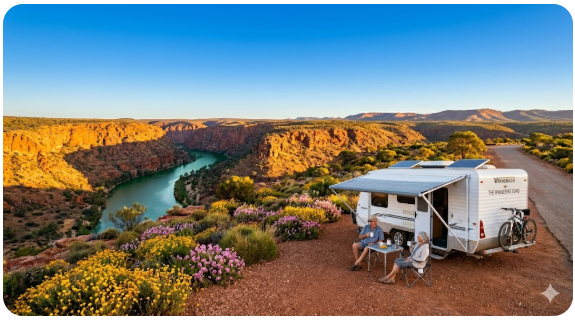
Kalbarri National Park Free Camping — Very Popular WA Stop For Senior Grey Nomads
GPS-verified guide to Kalbarri National Park free camping on the North West Coastal Highway — gorges, wildflowers, overnight rules, facilities, fees and safety for senior grey nomads travelling coastal and inland WA in 2026.
📅 Last reviewed: May 2026 | Kalbarri WA 6536 | National Park — fees apply, passes accepted, camping permit required
The gorges hit you before you expect them. You are driving through flat scrubland on the North West Coastal Highway, the Murchison River somewhere ahead, and then the earth simply opens — red sandstone walls dropping hundreds of metres to a ribbon of green water far below. Kalbarri National Park free camping sits within one of Western Australia’s most spectacular and accessible national parks, a place where senior grey nomads return year after year not just for the scenery but for the quality of the camping experience itself. With over 186,000 hectares of gorge country and coastline, Kalbarri rewards those who slow down, and a well-chosen campsite here can anchor a week of gentle exploration without ever feeling like you have run out of things to see.
- Kalbarri National Park is managed by DBCA (Department of Biodiversity, Conservation and Attractions) — a valid WA Parks Pass or per-visit fee is required for entry and camping.
- The term “free camping” is commonly used by grey nomads to describe bush camping within the park — it is low-cost camping, not zero-cost. A WA Parks Pass (annual) offers excellent value for nomads spending extended time in WA parks.
- The main camping area used by grey nomads is at Meanarra Hill and along the gorge loop road — facilities are basic and sites are unsealed.
- The town of Kalbarri (6 km from the park entrance) provides full services — supermarket, fuel, pharmacy, medical centre, dump point and caravan parks with powered sites.
- Mobile coverage in the town of Kalbarri is reasonable on Telstra — coverage drops significantly inside the park gorge areas.
- The park is most popular between May and October — book or arrive early as sites fill quickly, especially long weekends and school holidays.
- The Skywalk — a spectacular cantilevered viewing platform over the gorge — is accessible to most mobility levels and is one of the best senior-friendly experiences in WA.
What You Will Find in This Guide
- Location, Address and GPS
- Can You Stay Overnight?
- Facilities — Toilets, Water and Dump Point
- Mobile Coverage and Wi-Fi
- How to Get There
- What to Expect on Arrival
- Safety for Senior Grey Nomads
- Medical and Emergency Contacts
- Dump Points, Water and Supplies Nearby
- Things to Do for Seniors
- Best Time of Year to Stop Here
- Fires, Generators and Overnight Etiquette
- Packing Checklist for Seniors
- GPS Coordinates and Postcodes
- Frequently Asked Questions
- Quick Verdict
1. Location, Address and GPS
Kalbarri National Park straddles both the Murchison River gorge system and a dramatic section of Indian Ocean coastline, located approximately 590 km north of Perth and 66 km west of Ajana on the North West Coastal Highway. The park entrance is accessed via Kalbarri Road from Ajana, or directly through the town of Kalbarri itself. The gorge section — where the main camping areas used by grey nomads are located — is accessed via the Kalbarri gorge loop roads off Ajana–Kalbarri Road.
📍 GPS — Kalbarri National Park Main Gorge Area (Z-Bend / Ross Graham)
-27.6895, 114.5372
Kalbarri National Park, Ajana–Kalbarri Road, Kalbarri WA 6536
These coordinates place you within 50 metres of the Ross Graham Lookout and gorge access area — one of the primary stopping points used by grey nomads in the gorge section. Always confirm exact camping zone boundaries against DBCA signage on arrival.
| Detail | Information |
|---|---|
| Park Name | Kalbarri National Park |
| Managing Authority | DBCA — Department of Biodiversity, Conservation and Attractions WA |
| Nearest Town | Kalbarri WA 6536 (approx. 6 km from gorge entrance) |
| State | Western Australia |
| Postcode | 6536 |
| Primary Access Road | Ajana–Kalbarri Road off North West Coastal Highway |
| Distance from Perth | Approximately 590 km north via North West Coastal Highway |
| Distance from Geraldton | Approximately 155 km north |
| GPS — Gorge Area (Ross Graham) | -27.6895, 114.5372 |
| GPS — Kalbarri Skywalk | -27.6469, 114.5108 |
2. Can You Stay Overnight?
Yes — overnight camping is permitted in designated areas within Kalbarri National Park, but it is not free in the traditional grey nomad sense. A valid WA Parks Pass or a per-visit entry and camping fee is required. DBCA manages camping in the park and you must comply with all permit conditions. Camping without a valid permit is an offence under WA parks legislation and rangers do patrol the area.
- A WA Parks Pass (annual holiday pass) covers entry fees for all WA national parks for 12 months and is outstanding value for grey nomads spending more than a few days in WA parks — check the DBCA Parks and Wildlife Service website for current pricing before your trip.
- Bush camping in the gorge section is available at designated sites — these are basic, unsealed and self-sufficient. No powered sites exist within the park itself.
- The Meanarra Hill campsite is one of the primary bush camping areas used by grey nomads in the gorge section — basic pit toilets may be available but facilities are minimal.
- Camping is not permitted in random locations throughout the park — you must use designated camping areas only. DBCA rangers enforce this actively during peak season.
- Stay limits vary by site — confirm current maximum night limits with DBCA or via the Parks and Wildlife booking system before arrival. Some sites require advance online booking during peak periods.
- Powered sites, dump points and full-facility camping are available in the town of Kalbarri at commercial caravan parks — these are the best option for travellers who need power or dump access.
For a broader understanding of camping rules and overnight stays across Australia, see our guide to free camping vs overnight parking in Australia.
3. Facilities — Toilets, Water and Dump Point
Facilities inside Kalbarri National Park at the gorge camping areas are deliberately basic — this is bush camping, managed for conservation. The full-service facilities available in the town of Kalbarri (6 km away) make up for what the park itself lacks, but you need to plan around the gap between the two.
| Facility | What Is Available | What Seniors Should Know |
|---|---|---|
| Toilets | Pit toilets or composting toilets at designated camping areas — flush toilets not available in the bush camping zones | Toilet availability varies by site and season — self-contained vehicles with their own toilet have the most flexibility. Confirm at the ranger station. |
| Potable Water | Not reliably available at gorge camping areas — carry all drinking water from town | Do not assume any water source in the park is potable. Fill all tanks in Kalbarri town before entering the gorge camping areas. |
| Dump Point | Not available inside the national park | Nearest dump point is in Kalbarri town — use it before entering the park and manage your tanks carefully during your stay |
| Showers | Not available at park camping areas | Showers available at commercial caravan parks in Kalbarri town for a small fee — plan accordingly for multi-night stays |
| Bins | Limited — pack-in pack-out policy applies at most bush camping sites | Carry your own rubbish bags and take all waste to town bins. Leaving rubbish at bush sites attracts wildlife and damages the park environment. |
| Power | Not available anywhere in the park camping areas | Solar, battery and generator power only — ensure your system is adequate for your stay length. No powered sites exist within the national park boundary. |
- Site suitable for: campervans, motorhomes and smaller caravans — very large rigs may have difficulty on some internal park roads; check road conditions with the ranger station before entering
- Road access: sealed to park entrance, then unsealed gravel on internal gorge loop roads — suitable for 2WD with care; some areas require 4WD
- Site surface: gravel and compacted earth — uneven in places; use levelling blocks
- Camping permitted: Yes — designated areas only, permit required
- Maximum overnight stays: varies by site — typically 14 nights maximum; confirm with DBCA
- Boat ramp: No (river access exists but no formal ramp at camping areas)
- Picnic tables: Yes at some sites and lookouts — not guaranteed at all camping areas
- Potable water: No — carry all drinking water from Kalbarri town
- Mobile phone coverage: Reasonable Telstra in Kalbarri town; drops to patchy or nil in gorge areas
- TV reception: Unreliable in gorge terrain
- Rubbish bins: Pack-in pack-out at most bush camping sites
- Open fires: Subject to DBCA rules and total fire bans — check on arrival; campfire rings provided at some sites only
- Generator use: Permitted with consideration — quiet hours apply; check DBCA rules for specific sites
- Number of sites available: Limited — peak season sites fill quickly; online booking may be required
4. Mobile Coverage and Wi-Fi
Mobile coverage at Kalbarri is a tale of two experiences. In the town of Kalbarri itself, Telstra provides reasonable coverage and you can make calls, send messages and access data without too much difficulty. The moment you head into the gorge country of the national park, that coverage becomes patchy and then disappears entirely in the deeper gorge sections. Plan your communications accordingly before leaving town.
- Telstra: Best provider for Kalbarri. Reasonable voice and data coverage in the town of Kalbarri. Coverage becomes intermittent on the gorge loop roads and unreliable at most bush camping areas within the park. At some elevated lookout points (including near the Skywalk) a weak Telstra signal may be accessible.
- Optus: Coverage limited to the town of Kalbarri and main roads approaching the town. Expect no coverage in the gorge camping areas.
- Vodafone / TPG: Coverage limited to Kalbarri town at best. Do not rely on Vodafone for any park-interior communications.
- Wi-Fi: Available at some Kalbarri town cafes, the visitor centre and commercial caravan parks. No Wi-Fi inside the national park.
- Satellite / Starlink: Works well from any open-sky camping location inside the park — a Starlink terminal or satellite phone is the most reliable communication tool for multi-night stays in the gorge areas.
For broader route planning along the North West Coastal Highway and beyond, see our guide to the best routes to drive around Australia for grey nomads.
5. How to Get There
Kalbarri National Park is well signposted from the North West Coastal Highway and is a straightforward drive from both Perth to the south and Carnarvon to the north. The roads to the park are sealed with the exception of the internal gorge loop roads, which are unsealed gravel.
From Perth (Heading North)
Take the Brand Highway or Indian Ocean Drive north from Perth to Geraldton — approximately 424 km. From Geraldton, continue north on the North West Coastal Highway to Ajana (approximately 150 km), then turn left onto the Ajana–Kalbarri Road and drive approximately 66 km west to Kalbarri town. Total from Perth: approximately 590 km. Allow 6 to 7 hours without stops — a comfortable two-day drive with an overnight in Geraldton recommended for senior travellers.
From Carnarvon (Heading South)
From Carnarvon, drive south on the North West Coastal Highway approximately 360 km to the Ajana turnoff. Turn right onto Ajana–Kalbarri Road and drive 66 km west to Kalbarri. Total from Carnarvon: approximately 430 km — a manageable single day’s drive with rest stops, but allow a full day and do not rush the last section as kangaroos are active near Kalbarri at dawn and dusk.
Driving Notes for Seniors Towing Vans
- The Ajana–Kalbarri Road is 66 km of sealed two-lane highway with no overtaking lanes — this road carries a mix of tourist traffic, local farm vehicles and occasional road trains. Patience and wide margins are required when larger vehicles pass.
- Kangaroos and emus are extremely active on the Ajana–Kalbarri Road at dawn and dusk — avoid driving this section in the hour before and after sunrise and sunset. If you cannot avoid it, slow to 80 km/h and use high beam where safe.
- Internal park roads in the gorge section are unsealed gravel — suitable for most 2WD tow vehicles with care, but lower clearance vans and wide caravans should check road conditions with the Kalbarri ranger station before entering. Some roads have sharp gravel that increases tyre puncture risk.
- Turning circles matter — if you are towing a large caravan, check the turning radius requirements at your intended campsite before committing. Some gorge camping areas have limited turnaround space.
- The wind can be significant on the approach to Kalbarri — the coastal position of the town means strong westerly winds are common, particularly in winter and spring. Van sway management and appropriate towing speed are important on exposed sections of the Ajana–Kalbarri Road.
- Fuel up in Kalbarri town before entering the park — there is no fuel available inside the national park and some internal roads extend 50+ km from town.
6. What to Expect on Arrival
Pulling into Kalbarri National Park for the first time tends to produce one of two reactions: awe at the gorge scenery, or mild confusion about where exactly you are allowed to camp. Here is an honest picture of what actually greets you.
- The gorge roads are narrow and winding by caravan standards — what looks manageable on a map can feel tight when you are towing a 20-foot van on a gravel road with a sheer drop nearby. Drive slowly, and if you have any doubt about a section, reverse out and use a different access point.
- Camping areas are informal and basic — do not arrive expecting level, numbered sites with picnic tables at every pitch. The bush camping experience here is genuinely remote. Bring levelling blocks, patience and self-sufficiency.
- The park can be busy during peak season (May to September) — arrive before midday to find the best spots. Latecomers may find popular sites taken and have to choose a less ideal position or return to a Kalbarri town caravan park.
- Rangers do patrol and check permits — have your WA Parks Pass displayed or your booking confirmation accessible. Rangers are generally helpful and happy to point grey nomads to the best available sites.
- The gorge scenery begins immediately — even from the access roads, the views into the Murchison River gorge are extraordinary. Allow time to stop at the lookouts as you drive in rather than rushing to set up camp first.
7. Safety for Senior Grey Nomads
Personal Safety
- The gorge edges at Kalbarri are unfenced in many areas — senior travellers with any balance, mobility or vision concerns should stay well back from cliff edges at all lookouts and never approach the edge for a photograph. The drops are sheer and fatal.
- Walking tracks in the gorge section vary from easy boardwalked paths to demanding rocky scrambles — always read the difficulty rating at the trailhead and choose tracks rated easy or moderate for your fitness level. Do not attempt difficult tracks alone.
- Snake awareness is important in this region — eastern brown snakes and dugites are present in the Kalbarri area. Wear closed shoes at all times when walking in scrub or around campsites, and watch where you put your hands and feet.
- The coastal section of the park has strong surf, exposed headlands and rock ledges that can be dangerously slippery when wet — stay behind safety barriers and never walk on wave-washed rocks.
- Travelling solo at Kalbarri is manageable and common, but solo senior travellers should tell someone their campsite location, check in daily when coverage allows, and carry a PLB as standard equipment.
Trip Safety
- Heat safety is a genuine concern from October through April — plan all walking and outdoor activity before 9:00 am and after 4:00 pm during warm months. Carry at least 2 litres of water per person for any walk longer than 30 minutes.
- The Murchison River can flood rapidly after inland rainfall — check local conditions with rangers before camping in or near the gorge floor. Flash flooding can occur with no warning at the campsite even when the sky above you is clear.
- Review your vehicle and caravan setup before heading onto the unsealed park roads — tyre pressures, clearance and tow coupling security all matter more on rough gravel than on sealed highway.
- Read the grey nomad road safety checklist before entering any national park on unsealed roads with limited coverage.
For advice on caravan security at national park camps, see our guide to how caravan theft happens in Australia.
8. Medical and Emergency Contacts
Medical planning for Kalbarri is more manageable than for truly remote outback locations, but the gorge camping areas still sit several kilometres from the nearest medical facility and have limited mobile coverage. Know your contacts before you lose signal.
| Service | Address | GPS (approx.) | Phone |
|---|---|---|---|
| Emergency Services | Australia-wide | N/A | 000 |
| Healthdirect (24hr nurse line) | Australia-wide (telephone) | N/A | 1800 022 222 |
| Kalbarri Medical Centre | 84 Grey Street, Kalbarri WA 6536 | -27.7124, 114.1658 | (08) 9937 1009 |
| Geraldton Hospital (Midwest) | Shenton Street, Geraldton WA 6530 | -28.7774, 114.6099 | (08) 9956 2222 |
| Royal Flying Doctor Service (WA) | Jandakot Airport, Perth (base) | N/A — dispatch via 000 | 000 (emergency) / (08) 9417 6300 (admin) |
9. Dump Points, Water and Supplies
Kalbarri town functions as the supply base for the national park. Everything you need is available in town — you simply need to use it before entering the park rather than after running short inside it.
| Need | Best Nearby Option | Notes |
|---|---|---|
| Dump Point | Kalbarri town — check current location with visitor centre or local council | Use the dump point in town before entering the park. No dump facility exists inside the national park boundary. |
| Fresh Water | Kalbarri town — fill all tanks before entering the park | No reliable potable water inside the gorge camping areas. Plan for your full stay duration plus a buffer. 10L per person per day minimum in warm weather. |
| Groceries | Kalbarri IGA — Grey Street, Kalbarri town | Well-stocked IGA for a regional town — stock up fully before entering the park for multi-night stays |
| Fuel | Kalbarri town service stations | Fill up before entering the park — no fuel inside the national park. Geraldton has cheaper fuel if you are price-sensitive and passing through. |
| Pharmacy / Medications | Kalbarri Pharmacy — Kalbarri town | Small community pharmacy — limited stock of specialist medications. Stock up on prescriptions in Geraldton or Perth before arriving. |
10. Things to Do for Seniors
Kalbarri National Park is one of the richest destinations for senior grey nomads in all of Western Australia — not because it demands physical effort, but because it rewards stillness, observation and gentle exploration. The combination of gorge scenery, coastal cliffs, wildflowers and the Skywalk makes it extraordinary value for older travellers who prefer experiences over kilometres covered.
| Activity | Location | Why Seniors Like It |
|---|---|---|
| Kalbarri Skywalk | Kalbarri National Park gorge section — sealed road access, boardwalk to platforms | Fully sealed and boardwalked access to two cantilevered platforms extending over the gorge — no scrambling required. The views are among the best in WA. Allow 1 to 1.5 hours. Wheelchair-friendly to the main platform. |
| Nature’s Window Walk | Gorge loop road, Kalbarri National Park | The iconic natural rock arch framing the Murchison River — the walk to Nature’s Window is approximately 1 km return on a well-defined track with some rocky sections. Moderate difficulty; most fit seniors manage it comfortably. Go early morning for the best light. |
| Ross Graham Lookout and River Walk | Gorge section, Kalbarri National Park | Easy riverside walking on relatively flat ground — excellent for birdwatching and quiet time by the Murchison River. Suitable for most senior mobility levels on the flatter sections. |
| Coastal Cliffs Drive and Lookouts | Kalbarri coastal section — Red Bluff, Eagle Gorge, Natural Bridge | Drive between dramatic coastal lookouts with short, flat walks from the car park to cliff-edge viewpoints. The Indian Ocean scenery is spectacular. Suitable for all mobility levels at the lookout areas. |
| Wildflower Viewing (July–October) | Throughout Kalbarri National Park and surrounding scrublands | Western Australia’s wildflower season transforms the Kalbarri region — everlastings, banksias and hundreds of other species bloom prolifically. No walking required — flowers are visible from roadside and camp areas. A genuine bucket-list experience for grey nomads. |
Best Senior-Friendly Ideas Near Kalbarri
- Attend the free sunset viewing at Red Bluff on the coastal section — the colour of the red cliffs against the Indian Ocean at dusk is extraordinary and requires no walking beyond the car park.
- Visit the Kalbarri Visitor Centre in town for excellent interpretive displays about the park’s geology, flora and fauna — free entry, air-conditioned and well worth an hour.
- Book a river cruise on the Murchison River — tour operators in Kalbarri town offer seated gorge cruises that provide the full gorge experience without any walking. Excellent for seniors with limited mobility.
- Spend a morning at the Kalbarri foreshore — the town beach, jetty and foreshore walk are flat, scenic and safe for senior travellers of all fitness levels.
- Join one of the ranger-guided walks offered by DBCA during peak season — check the rangers station for current program details. These walks are tailored for general visitors including older travellers.
11. Best Time of Year to Stop Here
Kalbarri is a genuinely seasonal destination — the difference between a May visit and a January visit is the difference between one of the best experiences of your grey nomad trip and something you will spend most of in your air-conditioned van waiting for the temperature to drop. Choose your timing carefully.
| Season | What It Is Like at Kalbarri | Senior Verdict |
|---|---|---|
| Autumn (March–May) | Temperatures cooling from summer heat — March can still be hot (30°C+), April and May are ideal at 22–28°C by day, cooler evenings. The park is accessible, crowds are thinning and conditions are comfortable for most activities. | ✅ Excellent — April and May are among the best months. Comfortable temperatures, manageable crowds, good light for photography. |
| Winter (June–August) | Mild and pleasant — daytime temperatures 16–22°C, nights can drop to 8–12°C. Occasional coastal rain and strong westerly winds. Wildflowers begin appearing from July. This is the most popular period for grey nomads. | ✅ Very good — pack for cold nights and wind. July and August see the park at peak busyness — arrive early or book ahead. The wildflowers make this period special. |
| Spring (September–November) | Wildflower season peaks in September and October — the region is spectacular. Temperatures warm through October and November. The park is very busy September–October with wildflower tourists and grey nomads. | ✅ Excellent in September–October for wildflowers. November begins to warm — comfortable but getting towards the upper limit for extended outdoor activity. |
| Summer (December–February) | Hot to extremely hot — temperatures regularly 35–42°C, occasionally higher. Very limited outdoor activity possible during the middle of the day. Strong flies. Coastal sea breezes provide some relief in the afternoon but the gorge areas are exposed and hot. | ❌ Not recommended for extended camping — senior grey nomads should avoid the gorge camping areas in summer. If you must pass through, stop briefly, use the Skywalk early morning and move on. Stay in powered, air-conditioned accommodation in town. |
12. Fires, Generators and Overnight Etiquette
Kalbarri National Park is a conservation area and camping etiquette here is not just about courtesy to other travellers — it is about protecting a landscape that tens of thousands of people visit every year. The rules are enforced by DBCA rangers and the consequences of breaching them can include fines and exclusion from the park.
- Campfires are subject to DBCA rules — campfire rings are provided at some sites and fires may be permitted in designated areas during cooler months. During total fire ban periods, no fire of any kind is permitted. Always check fire conditions with the ranger station before lighting anything.
- During total fire ban periods, gas stoves in enclosed situations are generally still permitted — but confirm this with rangers for the specific conditions in force during your visit.
- Generators should be used with consideration — quiet hours in national parks are typically 8:00 pm to 8:00 am. Run your generator in the afternoon for battery charging, not overnight. The sound carries significantly in gorge terrain.
- Pack-in pack-out applies at most bush camping sites — take all rubbish to town bins. Leaving rubbish at a campsite in a national park is a fineable offence under WA parks legislation.
- Stay in designated camping areas only — camping outside your designated zone is not permitted. This protects sensitive vegetation and wildlife habitat around the gorge edges and river margins.
- Respect wildlife — do not feed any animals including birds, kangaroos or emus. Feeding wildlife in national parks is illegal and damages the animals. Store all food securely and do not leave anything edible outside overnight.
13. Packing Checklist for Seniors — Kalbarri National Park
This checklist is written specifically for a bush camping stay in Kalbarri National Park — not a generic van life list. Every item addresses something real and specific about this gorge environment, its remoteness from full services, its wildlife and its weather.
| Item | Why It Matters at Kalbarri | Packed ☐ |
|---|---|---|
| WA Parks Pass or cash for entry/camping fees | Entry and camping fees are mandatory — rangers check and issue fines for non-compliance. Annual pass is best value for grey nomads visiting multiple WA parks. | ☐ |
| Minimum 40 litres of drinking water | No potable water in gorge camping areas — fill completely in Kalbarri town before entering the park for any stay longer than one night | ☐ |
| Levelling blocks and spirit level | Gorge camping areas are on natural ground — uneven surfaces are common. Sleeping and living in an unlevel van is uncomfortable and affects appliances | ☐ |
| Closed-toe shoes and long socks for all walks | Snake species including dugites and eastern browns are present in the Kalbarri region — foot and ankle protection is essential for any walk in scrub or rocky terrain | ☐ |
| PLB (Personal Locator Beacon) — registered | Mobile coverage is unreliable to non-existent in the gorge camping areas — a PLB is your primary emergency link to rescue services from inside the park | ☐ |
| Binoculars | Birdwatching at Kalbarri is exceptional — red-tailed black cockatoos, ospreys, wedge-tailed eagles and dozens of honeyeater species are regular sightings. Binoculars also help with wildlife spotting from gorge lookouts. | ☐ |
| Sun protection — SPF 50+, hat, long sleeves | The Kalbarri gorge lookouts and coastal cliffs are fully exposed with no shade. UV levels in this latitude are extreme. Senior skin burns faster than younger travellers realise. | ☐ |
| Offline maps of the entire park downloaded | Internal park roads are confusing without a map and mobile data is unavailable in gorge areas. Pre-download both Google Maps and Maps.me offline before leaving Kalbarri town. | ☐ |
| Rubbish bags for pack-in pack-out | Most bush camping sites in Kalbarri have no bins — all rubbish must be taken to town. Carry enough bags for your full stay and a little extra. | ☐ |
| Wind-rated awning setup or awning ties | Coastal winds at Kalbarri can be strong and arrive quickly — an awning left unrolled in a wind gust can be destroyed or can damage your van. Always retract or tie down in gusty conditions. | ☐ |
For the complete senior grey nomad pre-departure list, see our full grey nomad packing checklist.
COPY PROMPT ➔ ASK AI ➔ SAVE TO FORM ➔ ADD SPOT PIN ➔ GET DIRECTIONS
📍 Interactive map — find free camps, rest areas and overnight stops. Enable location for best results.
14. GPS Coordinates and Postcodes
All GPS coordinates below are within 50 metres of the stated location and are provided as navigation guidance only. Always confirm your position against DBCA signage on arrival. Coordinates are in decimal degrees (DD) format compatible with Google Maps, Apple Maps and most GPS devices.
| Location | Address and Postcode | GPS (Decimal Degrees) | Notes |
|---|---|---|---|
| Kalbarri National Park — Ross Graham / Gorge Area | Kalbarri National Park, WA 6536 | -27.6895, 114.5372 | Primary gorge camping and lookout area — within 50m, confirm on arrival against DBCA signage |
| Kalbarri Skywalk | Kalbarri National Park, WA 6536 | -27.6469, 114.5108 | Sealed road access to Skywalk car park — within 50m of car park entry |
| Kalbarri Town Centre | Grey Street, Kalbarri WA 6536 | -27.7124, 114.1658 | Town centre with IGA, pharmacy, visitor centre, fuel and medical centre — approximately 6 km from gorge park entrance |
| Geraldton Hospital (nearest major hospital) | Shenton Street, Geraldton WA 6530 | -28.7774, 114.6099 | Approximately 155 km south of Kalbarri — nearest full emergency department |
| Perth CBD (nearest capital city) | GPO, Perth WA 6000 | -31.9505, 115.8605 | Approximately 590 km south — Royal Perth Hospital and major tertiary medical services |
15. Frequently Asked Questions
Is Kalbarri National Park free to camp at?
Not exactly — and this is one of the most common misunderstandings among grey nomads planning a Kalbarri stop. The term “free camping” is widely used in grey nomad communities to describe the bush camping available within Kalbarri National Park, but entry and camping fees apply. A WA Parks Pass (annual) or a per-visit fee must be paid to camp legally within the park. DBCA rangers patrol and issue fines for unpermitted camping. That said, the per-night cost is very low compared to commercial caravan parks, and the WA Parks Pass is outstanding value for any grey nomad spending more than a few days in WA national parks. Think of it as low-cost bush camping rather than genuinely free camping.
Can caravans and motorhomes stay overnight at Kalbarri National Park?
Yes — caravans and motorhomes can stay overnight at designated camping areas within Kalbarri National Park, subject to having a valid permit and paying the applicable fees. However, not all internal park roads are suitable for large rigs — the unsealed gorge loop roads can be challenging for very wide or very long caravans, and turning space at some camping areas is limited. Contact the Kalbarri ranger station before entering with a large van to confirm current road conditions and campsite suitability. Motorhomes and campervans generally have fewer issues than large fifth-wheelers or caravans over 8 metres. Powered sites are not available inside the park — these are available at commercial caravan parks in Kalbarri town.
What is the GPS for Kalbarri National Park camping areas?
The GPS coordinates for the Ross Graham and gorge camping area in Kalbarri National Park are approximately -27.6895, 114.5372 (decimal degrees). For the Kalbarri Skywalk car park, use -27.6469, 114.5108. Both sets of coordinates are within 50 metres of the stated locations and are suitable for navigation purposes. Save these to your offline maps before leaving Kalbarri town as mobile data coverage is unreliable inside the park gorge areas. Always confirm your specific campsite position against DBCA signage on arrival — internal park roads and camping zones can shift seasonally.
Are there toilets at Kalbarri National Park camping areas?
Pit toilets or composting toilets are available at some designated camping areas within Kalbarri National Park — the gorge section camping areas have basic toilet facilities but these are not flush toilets and may vary in availability between sites and seasons. The Skywalk has modern toilet facilities in the car park area, which is a sealed, accessible facility. For multi-night bush camping stays, self-contained vehicles with their own cassette or composting toilet have the greatest flexibility. Confirm toilet availability at your specific campsite with the DBCA ranger station when you pay your camping fee.
Is there a dump point at Kalbarri National Park?
There is no dump point inside Kalbarri National Park. The nearest dump point is in Kalbarri town — confirm the current location with the visitor centre or local council as these can relocate. Grey nomads planning a multi-night stay in the park should use the town dump point before entering and manage their black tank and cassette carefully throughout their stay. Plan your tank capacity for your intended length of stay plus a buffer day — if you fill unexpectedly quickly, the drive back to town and return adds time and fuel cost to your trip.
Can you get potable water at Kalbarri National Park?
Potable water is not reliably available at the gorge camping areas inside Kalbarri National Park. The Murchison River water is not suitable for drinking without treatment. All drinking water should be filled from the town of Kalbarri before entering any camping area in the park. As a minimum, carry 10 litres per person per day for your planned stay, plus a one-day emergency buffer. The Skywalk facility may have a water tap but potability should be confirmed with rangers. Do not arrive at the gorge camping areas expecting to find a tap with safe drinking water.
Is Kalbarri National Park safe for solo senior travellers?
Yes — Kalbarri National Park is generally safe for solo senior grey nomads and is a popular destination for solo travellers. The park is well-managed by DBCA rangers who patrol regularly during peak season, and other campers are almost always present at the main camping areas. The primary safety considerations for solo seniors at Kalbarri are: unreliable mobile coverage in gorge areas (carry a PLB), gorge edge hazards (stay well back from unfenced cliff edges), snake awareness (wear closed shoes in scrub), and heat management (plan all activity before 9:00 am in warm weather). Solo travellers should also tell someone their campsite location, check in with family when coverage allows in town, and have a clear emergency plan before entering the park.
What is the nearest hospital to Kalbarri National Park?
The Kalbarri Medical Centre at 84 Grey Street, Kalbarri WA 6536, phone (08) 9937 1009, provides GP-level medical services in the town. However, it is not a hospital emergency department. For serious medical emergencies — cardiac events, stroke, major trauma — the nearest full emergency department is Geraldton Hospital at Shenton Street, Geraldton WA 6530, phone (08) 9956 2222, approximately 155 km south of Kalbarri. In a life-threatening emergency, call 000 — the Royal Flying Doctor Service provides emergency medical evacuation for the region. Always carry all medications, Medicare details and a written medical summary when staying in the gorge camping areas where mobile coverage is limited.
What is the best campsite in Kalbarri National Park for grey nomads with a caravan?
The Ross Graham camping area in the gorge section is the most commonly used site by grey nomad caravanners — it offers the most accessible unsealed road approach and reasonable flat ground for van setup. The road to Ross Graham is generally suitable for standard 2WD tow vehicles. Meanarra Hill is another popular option with better views but a slightly rougher approach road. Before arriving, always call the Kalbarri ranger station to check current road conditions, confirm campsite availability and get advice on suitability for your specific van and tow vehicle combination. Peak season (August to October) sees these sites fill quickly — aim to arrive before midday for the best choice of position.
16. Quick Verdict
Kalbarri National Park deserves every bit of its reputation as one of the must-do stops on any west coast grey nomad route. The combination of gorge scenery, coastal cliffs, wildflowers and the remarkable accessibility of the Skywalk makes it genuinely exceptional for older travellers — this is not a park that demands youth or athleticism. You can spend a week here moving slowly between lookouts, sitting by the Murchison River at dawn, watching cockatoos wheel above the red cliffs at sunset and feeling like you have found somewhere that rewards the kind of slow travel that grey nomads do better than anyone. The camping is affordable, the rangers are helpful and the landscape is one of the most striking in Western Australia.
The weaknesses are real but manageable with preparation. The “free camping” label is misleading — fees apply, and grey nomads who arrive expecting zero-cost camping may be disappointed. The gorge camping areas are genuinely basic: no power, no potable water, limited or no mobile coverage, pack-in pack-out rubbish and unsealed roads that challenge larger vans. The distances to proper medical care — 155 km to Geraldton — require that you enter the park genuinely self-sufficient in medications, equipment and emergency communications. None of these are reasons to avoid Kalbarri. They are simply reasons to prepare properly before you leave town, which is exactly what senior grey nomads travelling well already do.
Free campsites and powered sites fill fast during school holidays and peak season. If your preferred site is already gone, search remaining accommodation options below to explore the region.
Accommodation and flight search powered by Expedia. Booking through this search supports this website at no extra cost to you. As an affiliate, I earn from qualifying purchases at no extra cost to you.

As an affiliate, I earn from qualifying purchases at no extra cost to you.
Exclusive Offer: Get 5% OFF all StarterStopper immobiliser products with promo code: RTV5
Visit StarterStopper.com to see our data-backed security solutions
As an affiliate, I earn from qualifying purchases at no extra cost to you.