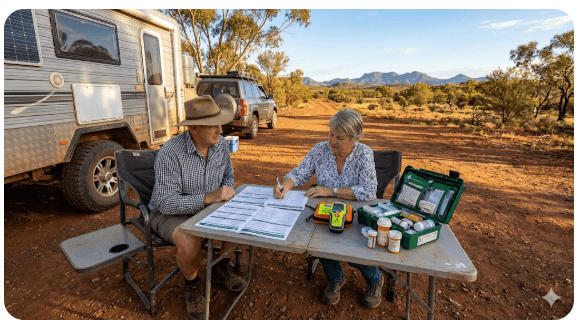
Grey Nomad Safety Tips
A comprehensive, honest safety guide for senior grey nomads travelling Australia by caravan, motorhome or campervan — covering personal security, medical planning, road safety, remote travel, solo travel and emergency preparedness for travellers aged 60 and over.
📅 Last reviewed: June 2026 | Australia-wide | Applies to all states and territories — individual road rules and emergency contacts vary by state
Grey nomad safety is not about fear — it is about preparation. Every year, thousands of Australians aged 60 and over take to the road in caravans, motorhomes and campervans, and the vast majority travel safely and without incident. But the small number of serious incidents that do occur — medical emergencies in remote areas, vehicle theft, heat illness, falls, and communication failures — are almost always preventable with the right planning. This guide covers every major safety category relevant to senior travellers in plain language, without sensationalism, and without glossing over the realities that matter most.
- Who this is for: Senior grey nomads aged 60+ travelling Australia by caravan, motorhome or campervan
- Key risk areas: Medical emergencies, remote breakdown, heat illness, theft, falls, communication failure
- Most important device: Personal Locator Beacon (PLB) — registered with AMSA, carried at all times in remote areas
- Emergency number: 000 (police, fire, ambulance) — 112 also works on mobile networks with no signal bars
- Medical helpline: Healthdirect 1800 022 222 — free 24-hour nurse advice line
- Medication rule: Always carry a minimum three-day extra supply of all prescription medications
- Solo travel: Safe with preparation — share your itinerary with a contact before every remote leg
- Caravan security: Use wheel clamps, hitch locks and a vehicle immobiliser as standard practice
- Heat safety: Never remain in an unventilated van when temperatures exceed 35°C
- Trip planning: Download offline maps before entering areas with no mobile coverage
Table of Contents
- Before you leave — pre-departure safety checklist
- Medical safety and health planning for senior travellers
- Personal Locator Beacons and emergency communication devices
- Road safety — driving and towing safely at 60+
- Heat, cold and weather safety for grey nomads
- Remote area travel safety
- Solo grey nomad safety
- Caravan and vehicle security
- Water safety and hydration
- Falls, mobility and physical safety at camp
- Wildlife and natural hazard awareness
- Financial and document safety on the road
- Emergency contacts and planning by state
- Safety packing checklist for senior grey nomads
- Frequently Asked Questions
- Final verdict — the honest truth about grey nomad safety
- Related guides — safety, security and free camping resources
Section 1 — Before You Leave: Pre-Departure Safety Checklist
The majority of grey nomad safety problems that occur on the road are rooted in inadequate pre-departure planning. A thorough departure routine takes less than an hour and can prevent days of difficulty — or worse. Treat this as a non-negotiable part of every trip, not a suggestion.
Share your itinerary
Before leaving for any leg of your journey — especially one involving remote areas, unsealed roads or regions with limited mobile coverage — share your full itinerary with at least one trusted person who is not travelling with you. Include your planned route, overnight stop locations, expected arrival dates, and a clear check-in schedule. Agree on a specific time each day or every two days when you will make contact, and agree on what action your contact should take if they do not hear from you by a specified hour.
- Share full itinerary with a trusted contact — include GPS stops and check-in schedule
- Confirm all prescription medications are filled and carry a minimum three-day extra supply
- Service your tow vehicle and caravan before any major trip — tyres, brakes, wheel bearings, lights
- Register your PLB with the Australian Maritime Safety Authority (AMSA) — free at beaconregistration.gov.au
- Download offline maps for your full route before leaving phone coverage
- Carry your Medicare card, any concession cards, travel insurance documents and a list of current medications and doses
- Check the Bureau of Meteorology forecast for every region you plan to travel through
- Ensure your vehicle and caravan insurance is current and that it covers your specific usage
- Test all safety devices — smoke alarm, CO detector, fire extinguisher, PLB battery status
- Carry enough cash for two to three days of expenses in areas without ATM access
Vehicle and van pre-departure checks
- Tyre pressure on all vehicle and caravan tyres — including the spare — checked cold before departure
- Wheel nuts torqued correctly — particularly important after any recent tyre change or service
- Brake controller calibration — test trailer brakes at low speed before joining a highway
- All lights operational — indicators, brake lights, reversing lights, caravan running lights
- Gas system checked — no leaks, all connections tight, regulator within service date
- Fresh water tank filled — do not assume you will find water at your first stop
- Fire extinguisher accessible and within service date
- Smoke and carbon monoxide alarms tested and batteries replaced if needed
Section 2 — Medical Safety and Health Planning for Senior Travellers
Medical preparedness is the single most important safety category for senior grey nomads. The good news is that most medical risks on the road are manageable with the right planning. The bad news is that many travellers underestimate how quickly a manageable situation becomes a crisis when you are two hours from the nearest hospital with no mobile signal and inadequate medication supplies.
Before you travel — see your GP
- Have a full medication review with your GP before departing — particularly if you are managing multiple conditions. Confirm that all medications are appropriate for extended travel in heat, humidity and variable conditions.
- Ask your GP to provide a written summary of your current conditions, medications, doses and any known allergies. Keep this document accessible — not packed in a locked compartment.
- Confirm that your travel insurance covers pre-existing conditions. Many standard travel insurance policies exclude pre-existing conditions unless specifically declared and covered.
- Discuss with your GP whether any of your conditions require proximity to specialist services — some conditions are not appropriate for extended remote travel without specific planning.
- Arrange repeat prescriptions or an authority prescription for extended supply before you leave. Some medications cannot be dispensed in quantities greater than one month without specific arrangements.
Medication management on the road
- Always carry a minimum three-day extra supply of every prescription medication — ideally one week extra for remote legs of your journey.
- Store medications correctly — many medications, including insulin and some cardiac drugs, must be kept below specific temperatures. In summer, van interiors can exceed 50°C. Use an insulated medication bag or 12V cooler for temperature-sensitive medications.
- Know the generic name of every medication you take — not just the brand name. In a remote town, a pharmacist may be able to supply a generic equivalent if a brand is not stocked.
- Carry a MedicAlert bracelet or equivalent if you have a condition that may affect your treatment in an emergency — particularly if you take blood thinners, have a pacemaker, or are prone to anaphylaxis.
| Medical Situation | Recommended Action | Key Contact |
|---|---|---|
| Chest pain or heart attack symptoms | Call 000 immediately. Do not drive yourself. Chew 300mg aspirin if not allergic and not contraindicated. | 000 |
| Stroke symptoms (FAST — Face, Arms, Speech, Time) | Call 000 immediately. Time is critical — do not wait to see if symptoms improve. | 000 |
| Medication query or health concern (non-emergency) | Call Healthdirect for free 24-hour nurse advice before deciding whether to travel to hospital. | 1800 022 222 |
| Medication supply emergency | Contact nearest pharmacy — they can often arrange emergency supply with your medication list. In remote areas, call the Royal Flying Doctor Service. | RFDS: 1300 669 569 |
| Mental health concern (yours or travel companion) | Call Lifeline for immediate support. Do not dismiss mental health symptoms on extended solo trips. | 13 11 14 |
| Dental emergency | Contact nearest hospital emergency department for pain management referral. Dental emergencies in remote areas are managed through local health services. | 000 or local hospital |
Section 3 — Personal Locator Beacons and Emergency Communication Devices
A Personal Locator Beacon (PLB) is the single most important safety device for any grey nomad travelling in areas with limited or no mobile phone coverage. It is not optional for remote travel. If you travel in rural or remote Australia without a PLB and something goes wrong, you may have no way to call for help.
What is a PLB?
A PLB is a compact, battery-powered emergency device that transmits a distress signal via satellite to the Australian Maritime Safety Authority (AMSA) Rescue Coordination Centre when activated. Registration is free. When activated, your registered details — including your name, medical conditions, emergency contacts and vehicle description — are immediately available to search and rescue services. Response times vary but the signal is received globally regardless of mobile coverage.
PLB versus EPIRB versus Satellite Messenger
| Device | How It Works | Two-Way Communication | Cost | Best For |
|---|---|---|---|---|
| PLB (Personal Locator Beacon) | One-way distress signal via satellite to AMSA. No subscription required. | No | $200–$400 purchase, free registration | All remote travel — minimum standard for grey nomads |
| EPIRB (Emergency Position Indicating Radio Beacon) | Marine-focused distress beacon. Similar function to PLB but designed for vessels. | No | $300–$600 | Grey nomads travelling coastal or river areas by boat |
| Satellite Messenger (e.g. Garmin inReach) | Two-way satellite messaging, GPS tracking, SOS function. Subscription required. | Yes | $400–$700 + $25–$65/month subscription | Extended remote travel where two-way communication is preferred |
| Sat Phone | Full voice calls via satellite. Works anywhere with sky view. | Yes (voice) | $800–$1,500 + call costs or plan | Extended outback travel, couples or groups who want full voice contact |
Section 4 — Road Safety: Driving and Towing Safely at 60+
Road safety for grey nomads is a multi-layered topic that includes driver fitness, vehicle condition, towing technique, fatigue management and route planning. Each element matters, and weakness in any one area increases risk significantly.
Driver fitness and licence considerations
- In most Australian states, drivers aged 75 and over are required to undergo periodic medical assessments to retain their licence. Check the requirements in your state of residence and in states you plan to travel through — rules vary.
- Vision changes are among the most common age-related driving risks. Have an annual eye test and ensure your prescription is current before any extended trip.
- Some medications commonly taken by seniors — including sedatives, antihistamines, some blood pressure medications and pain relief — can impair driving. Discuss this with your GP before departure.
- If you have had a recent cardiac event, stroke or major surgery, confirm with your treating specialist that you are cleared to drive before hitting the road. Do not assume clearance.
Fatigue management
- The standard advice of stopping every two hours applies more critically to senior drivers, who are at higher risk from fatigue-related cognitive impairment than younger drivers.
- Drive between 7am and 4pm where possible — avoid dusk and dawn driving when wildlife activity peaks and visibility is most compromised.
- Never drive more than 400km in a single day when towing. The physical and cognitive demands of towing a heavy caravan over long distances are significant — tiredness accumulates faster than most drivers realise.
- If you feel drowsy at the wheel, stop immediately at the next safe location. A 20-minute power nap is far safer than persisting.
- Do not drive the day after a very poor night’s sleep — particularly in remote areas where a single error has more serious consequences.
Towing safety
- Know your legal towing capacity and do not exceed it. Overloading your caravan is one of the most common causes of sway, loss of control and accident on Australian highways.
- Weigh your loaded caravan before departure — not just estimate it. Many grey nomads are surprised to find their loaded van significantly exceeds the unloaded figure they assumed was safe.
- Fit a weight distribution hitch and sway control device if your van is over 2,000kg GTM — these devices save lives.
- Practice reversing in an empty car park before attempting tight camp entries. Poor reversing technique is responsible for a disproportionate number of caravan damage incidents.
Section 5 — Heat, Cold and Weather Safety for Grey Nomads
Australia’s climate presents genuine physical risks to senior travellers at both temperature extremes. Heat illness and cold exposure are both preventable — but only if you take the conditions seriously and plan accordingly.
Heat safety
- Never remain in a closed, unventilated caravan or motorhome when outside temperatures exceed 35°C. Internal van temperatures can exceed 60°C within minutes of direct sun exposure — this is a life-threatening environment for anyone, particularly seniors.
- Drink a minimum of two to three litres of water per day in hot weather — more if you are physically active. Do not wait until you feel thirsty. Thirst is a late indicator of dehydration in older adults.
- Heat stroke symptoms in seniors include confusion, cessation of sweating, rapid pulse and hot dry skin. This is a medical emergency — call 000, move to the coolest available environment and apply wet cloths to skin immediately.
- Plan hot-weather travel for early morning departures — leave by 7am and be stopped and set up in shade before 11am.
- Know the location of the nearest air-conditioned public building — library, shopping centre, RSL club — in every town you pass through during summer.
Cold and winter safety
- Hypothermia risk in seniors begins at temperatures below 10°C — well above what most people consider “cold enough to be dangerous.” Older adults lose body heat more rapidly and have a reduced ability to shiver effectively.
- Ensure your van heating system — diesel heater, reverse cycle or gas heater — is serviced and operational before winter travel. A failed heating system overnight in the Australian Alps or Tablelands is a serious situation.
- Carbon monoxide poisoning from poorly ventilated gas heaters is a documented cause of death in caravans. Ensure adequate ventilation when using any gas appliance and fit a carbon monoxide detector.
- Black ice on alpine roads and high-country passes can form at temperatures above zero — particularly in shaded sections. If travelling through alpine areas in winter or early spring, carry traction aids and check road conditions before departure each morning.
Section 6 — Remote Area Travel Safety
Remote area travel is where grey nomad safety risks are most concentrated and where preparation matters most. The distances involved, the absence of mobile coverage, the limited availability of services and the physical demands of unsealed road travel all combine to create an environment where small problems can become large ones quickly.
Before entering a remote area
- Tell someone exactly where you are going, which route you are taking, and when you expect to arrive. This is not optional — it is the most important thing you can do before entering remote Australia.
- Carry enough water for a minimum of five days for all people in your party. In desert conditions, water consumption can double — plan conservatively.
- Carry enough fuel to complete your planned route plus a 20% reserve. Fuel availability in remote Australia is unreliable — stations close, run out or have restricted hours without notice.
- Check road conditions via the relevant state road authority or local council before departing. Remote roads can become impassable after rain — sometimes for days or weeks.
- Ensure your PLB is registered, charged and accessible — not packed away in a hard-to-reach compartment.
While in a remote area
- If you break down in a remote area, stay with your vehicle. A vehicle is far easier for search and rescue to locate than a person on foot. Do not attempt to walk for help in remote or desert conditions.
- Activate your PLB immediately if you are in a life-threatening situation or if you have not been able to make contact with the outside world within your agreed timeframe and you are not able to self-rescue.
- Carry a basic vehicle recovery kit — tyre repair equipment, jump leads, tow rope, shovel and traction boards if travelling on sand or outback tracks.
- Take unsealed roads slowly — corrugations, sharp rocks and soft edges are responsible for most remote-area tyre failures and rollover incidents involving caravans.
Section 7 — Solo Grey Nomad Safety
Solo travel is a growing and thoroughly valid choice for senior grey nomads — particularly for those who have lost a partner or who simply prefer the freedom of independent travel. Solo travel requires a higher baseline of preparation than paired travel, but it is not inherently more dangerous than travelling as a couple if the right systems are in place.
Personal safety for solo travellers
- Establish a daily or every-two-day check-in routine with a trusted contact. Use a simple text message or WhatsApp message when you have signal — agree in advance what action your contact takes if they do not hear from you by a set time.
- Use a satellite messenger device (such as a Garmin inReach) if you travel solo regularly in areas with limited mobile coverage — the two-way messaging and tracking capability adds a significant layer of safety that a PLB alone does not provide.
- Trust your instincts about camp locations. If a rest area or bush camp feels wrong — for any reason — move on without guilt. You are under no obligation to stay anywhere that makes you uncomfortable.
- Park in visible, well-lit locations when possible — highway rest areas and town-adjacent stops are generally safer for solo travellers than isolated bush camps.
- Join grey nomad social groups and Facebook communities before departure — knowing that other travellers are aware of your general route provides an informal safety net and can lead to convoy arrangements on remote legs.
Home security while travelling solo
- Arrange mail redirection and ask a trusted neighbour to keep an eye on your home property.
- Use automatic light timers and inform your home insurer that the property will be unoccupied for an extended period — some policies have exclusions for extended vacancy.
- Do not announce extended travel plans or departure dates on public social media. This information is useful to opportunistic thieves.
Section 8 — Caravan and Vehicle Security
Caravan and vehicle theft is a real and growing risk for grey nomads across Australia. Opportunistic theft at rest areas, camp sites and tourist attractions is the most common scenario — but organised caravan theft also occurs, particularly targeting high-value vans left unattended for extended periods. Good security practice significantly reduces your risk without adding significant cost or inconvenience.
Physical security devices
- Wheel clamps: A visible wheel clamp is one of the most effective theft deterrents for unattended caravans. It creates a significant physical barrier and signals to opportunistic thieves that this van is a difficult target.
- Hitch lock: A quality hitch lock prevents your van from being hitched to another vehicle and driven away. Use one every time your caravan is unattended — even for short periods.
- Vehicle immobiliser: A hidden or secondary immobiliser (beyond the factory-fitted system) makes your tow vehicle significantly harder to steal. StarterStopper immobilisers are specifically designed for caravan tow vehicles and grey nomad use — see the affiliate offer below for details.
- Deadbolt locks on van doors: Factory caravan door locks are typically low-security. Fit a quality deadbolt or secondary lock to your main caravan door as a minimum upgrade.
- Window and vent security: Secure roof vents and windows before leaving your van unattended — these are common entry points for opportunistic theft.
Reducing your target profile
- Do not leave obviously valuable items visible through van windows — laptops, cameras, tablets and cash should be stored out of sight when you leave the van.
- Remove or conceal external accessories (e.g. solar panels, bike racks with bikes, satellite dishes) when leaving your van unattended in insecure locations.
- At rest areas, park with other vans where possible rather than in isolated bays — visibility and community presence deters theft.
For a comprehensive guide to understanding how caravan theft happens and how to prevent it, read our dedicated guide: How Caravan Theft Happens in Australia — Grey Nomad Security Guide.
Section 9 — Water Safety and Hydration
Water is a safety issue for grey nomads — not just a comfort issue. Dehydration in seniors develops faster, presents with fewer obvious warning signs, and carries more serious health consequences than in younger adults. Water source quality in rural and remote Australia is also highly variable and should never be assumed safe without testing or treatment.
Carrying enough water
- Carry a minimum of 40 litres of potable water per person for any leg of travel that includes remote areas or locations without confirmed water access.
- In hot weather and during physical activity, water consumption requirements increase significantly — plan for 3–4 litres per person per day in summer rather than the standard 2 litres.
- Fill your fresh water tank at every confirmed potable source in towns — do not wait until you are running low before seeking a refill.
- Keep a small emergency water supply (5–10 litres per person) separate from your main tank in case of tank contamination or failure.
Water source safety
- Creek, river and dam water in agricultural and pastoral areas of Australia should be treated as potentially contaminated by fertilisers, pesticides, livestock waste and blue-green algae. Do not drink it untreated.
- Bore water quality varies enormously — some bores are potable, many are not. Do not drink bore water without testing or confirmed local knowledge of its safety.
- Blue-green algae (cyanobacteria) blooms occur in many Australian waterways, particularly in warm weather. Avoid all contact with water showing green, blue or brown surface scum — this water is toxic and cannot be made safe by boiling.
- If you need to treat natural water, a quality two-stage filter followed by chemical treatment (iodine or chlorine tablets) provides reasonable protection — but is not a substitute for carrying your own supply.
Section 10 — Falls, Mobility and Physical Safety at Camp
Falls are the leading cause of injury-related hospitalisation for Australians over 65. The camp environment — uneven ground, van steps, wet surfaces, night-time movement in unfamiliar spaces — creates specific fall risks that are often underestimated by grey nomads who are otherwise physically active and capable.
Common fall risks at camp
- Van entry and exit steps: Caravan and motorhome steps are steep, narrow and often poorly lit. Most van falls occur on steps — particularly in the dark or in wet conditions. Fit non-slip step covers and ensure your step lighting is functional.
- Uneven ground: Free camping areas and bush stops frequently have uneven, sloped or soft ground. Always walk the campsite in daylight before moving around it in the dark. Use a quality torch or headlamp for any night movement.
- Awning and annexe guy ropes: Guy ropes at ankle height in low light are a consistent trip hazard. Mark them with high-visibility flags or reflective tape as a standard setup practice.
- Wet surfaces: Morning dew and rain make caravan steps and any plastic or fibreglass surfaces extremely slippery. Never rush on wet surfaces, particularly when carrying items.
- Getting up at night: Night-time trips to the toilet in an unfamiliar space are a high-risk fall scenario. Keep a torch at the bedside, ensure the path to the toilet is clear of obstacles, and consider a bedside light or motion-activated night light inside the van.
Mobility aids at camp
- If you use a walking stick, walker or other mobility aid, carry a second one in your van — if your primary aid is damaged or inaccessible, a backup prevents a dependent situation.
- A grab handle fitted next to the van entry steps is one of the highest-value safety additions any grey nomad can make — particularly for solo travellers who have no one to assist during entry and exit.
- Consider a set of portable camp steps with a handrail — these are widely available and provide a significant stability improvement over standard van steps for travellers with mobility concerns.
Section 11 — Wildlife and Natural Hazard Awareness
Australia’s wildlife and natural environment present specific hazards for grey nomads that deserve honest discussion without either alarmism or dismissal. Most wildlife encounters in the camp environment are manageable with basic awareness — but a small number carry genuine risk if handled incorrectly.
Animal hazards on the road
- Kangaroos and large animals: The single greatest wildlife-related road risk for grey nomads. Kangaroos are most active at dusk, dawn and night — avoid driving in these periods wherever possible, particularly in rural and regional areas. If a collision with a large animal is unavoidable, do not swerve violently — hold your line, brake firmly and signal other traffic. A violent swerve to avoid an animal causes far more accidents than the animal itself.
- Wombats and livestock: Wombats are low to the ground and difficult to see at night — a collision can cause serious vehicle damage. Cattle and sheep on unfenced outback roads are a significant collision risk, particularly at night. Slow down dramatically on open range roads after dark.
- Birds: Emus and large birds on outback roads can cause serious vehicle damage. They are unpredictable in traffic — slow down when emus are near the road.
Snakes, spiders and insects at camp
- Check under your van, around camp chairs, inside shoes and in any items left on the ground overnight before handling them. Snakes seek warmth and shelter — van undersides, storage compartments and low shade are common resting spots.
- If you encounter a snake at camp, do not attempt to move or kill it. Back away slowly, give it space and it will move on. Call a snake catcher if it takes refuge inside your van — do not attempt to remove it yourself.
- Funnel web spiders (eastern Australia) and redback spiders (continent-wide) are the two spiders of genuine concern at camp. Both are more common in warm weather and shelter in shoes, clothing and low outdoor furniture. Call the Poisons Information Centre on 13 11 26 in the event of any suspected venomous bite.
- Carry a broad-spectrum insect repellent and use it in the evening — mosquito-borne diseases including Ross River Fever and Barmah Forest Virus are common in many parts of Australia, particularly near water.
Section 12 — Financial and Document Safety on the Road
Financial and document security is a less dramatic but genuinely important safety category for extended grey nomad travel. Identity theft, card fraud and document loss can turn a pleasant trip into a stressful and expensive ordeal.
Document management
- Carry certified copies of your most important documents — Medicare card, driver’s licence, vehicle registration, insurance policies, passport and birth certificate — stored separately from the originals.
- Store scanned digital copies of all key documents in a secure cloud storage service that you can access from any device. Email copies to a trusted person who can help if originals are lost or stolen.
- Keep your vehicle registration papers accessible in the vehicle — you are legally required to produce them if requested by police, and not having them can create unnecessary complications in remote areas.
Financial security
- Carry two bank cards from two different accounts — never keep both in the same location. If one card is compromised or lost, the second provides immediate backup without requiring bank assistance.
- Carry a moderate cash float — enough for two to three days of expenses — in areas where ATM access is limited. Many remote towns have no ATM or have an ATM that is frequently out of service or out of cash.
- Notify your bank before extended travel — particularly if you plan to make purchases in states you do not usually use your card in. Some banks flag unusual geographic card use as fraud and freeze accounts.
- Be aware of card skimming at remote fuel stops — use contactless payment where available and cover the keypad when entering PINs. Report any suspicious card reader modifications immediately.
Section 13 — Emergency Contacts and Planning by State
Emergency services, health services and road assistance contacts vary by state and territory. Save the relevant contacts for every state you plan to travel through before you leave, not when you need them.
| Service | Contact | Notes |
|---|---|---|
| Emergency (Police, Fire, Ambulance) | 000 | Works on all networks. 112 also works on mobile networks even without signal bars. |
| Healthdirect (nurse helpline) | 1800 022 222 | Free 24-hour health advice. Not for emergencies — call 000 for emergencies. |
| Poisons Information Centre | 13 11 26 | 24-hour advice for snake bite, spider bite, chemical exposure and medication overdose. |
| Royal Flying Doctor Service | 1300 669 569 | Medical advice and emergency retrieval for remote areas. Not a replacement for 000. |
| Lifeline (mental health crisis) | 13 11 14 | 24-hour crisis support. Available to anyone experiencing distress — including travel-related isolation. |
| NRMA Roadside Assistance (NSW/ACT) | 13 11 22 | 24-hour roadside assistance. Coverage varies in remote areas. |
| RACQ Roadside Assistance (QLD) | 13 11 11 | 24-hour roadside assistance across Queensland. |
| RAA Roadside Assistance (SA) | 13 11 11 | 24-hour roadside assistance across South Australia. |
| RAC Roadside Assistance (WA) | 13 17 03 | 24-hour roadside assistance across Western Australia. |
| RACT Roadside Assistance (TAS) | 13 27 22 | 24-hour roadside assistance across Tasmania. |
| RACV Roadside Assistance (VIC) | 13 11 11 | 24-hour roadside assistance across Victoria. |
| AMSA Beacon Registration | beaconregistration.gov.au | Free PLB and EPIRB registration. Update every two years. |
Section 14 — Safety Packing Checklist for Senior Grey Nomads
This checklist covers the safety-specific items that every senior grey nomad should carry. It is not a full camping packing list — it is a safety-focused layer that sits on top of your standard camping kit.
| Item | Why It Matters | ☐ |
|---|---|---|
| Registered PLB | Your primary emergency signal device in areas with no mobile coverage. Must be registered with AMSA before departure. | ☐ |
| Satellite messenger (optional but recommended for solo travellers) | Provides two-way communication and GPS tracking — significantly enhances solo safety on remote legs. | ☐ |
| Minimum 3-day extra prescription medication supply | Pharmacy access is unreliable in remote areas. Running out of critical medication in a remote location is a medical emergency. | ☐ |
| Written medication and medical history document | Enables treating clinicians to make fast, informed decisions in an emergency. Keep accessible at all times. | ☐ |
| Comprehensive first aid kit | Must include: wound care, compression bandages, triangle bandages, SAM splint, CPR face shield, thermal blanket, tweezers, antiseptic, pain relief. | ☐ |
| Fire extinguisher (dry powder or CO2) | Caravan and motorhome fires can escalate within 90 seconds. An accessible extinguisher is a life-safety device — not an optional accessory. | ☐ |
| Smoke alarm and CO detector | Both required. Carbon monoxide poisoning from gas appliances in poorly ventilated vans is a documented cause of death. | ☐ |
| Quality headlamp and backup torch | Night movement at camp sites is a primary fall risk. Reliable lighting is essential. | ☐ |
| 40+ litres potable water reserve per person | For remote areas with no confirmed water access. Dehydration in seniors develops faster and has more serious consequences than in younger adults. | ☐ |
| Vehicle wheel clamp and hitch lock | Most effective physical deterrents against caravan theft. Use every time the van is unattended. | ☐ |
| Non-slip step covers for van entry | Van entry steps are the most common location for falls. Non-slip covers significantly reduce wet-weather fall risk. | ☐ |
| Grab handle at van entry | Provides stable support for entry and exit, particularly for those with balance or mobility concerns. | ☐ |
COPY PROMPT ➔ ASK AI ➔ SAVE TO FORM ➔ ADD SPOT PIN ➔ GET DIRECTIONS
📍 Interactive map — find safe free camps, rest areas and overnight stops near your location. Enable location for best results.
Section 15 — Frequently Asked Questions
What is the most important safety item for a grey nomad?
A registered Personal Locator Beacon (PLB) is the single most important safety device for any grey nomad travelling in remote or rural Australia. It works without mobile coverage, costs nothing to register, and when activated, sends your exact location and personal details to the Australian Maritime Safety Authority’s search and rescue coordination centre. No other device offers this combination of reliability, coverage and zero ongoing cost. Register yours at beaconregistration.gov.au before your next trip.
Is solo grey nomad travel safe for seniors?
Yes — with appropriate preparation. Solo grey nomad travel is undertaken safely by thousands of Australian seniors every year. The key safety additions for solo travellers are: a PLB (or satellite messenger for two-way communication), a reliable daily check-in routine with a trusted contact, a clear agreement about what that contact does if they do not hear from you, and sound judgement about which camp locations to choose. Solo travel carries higher consequence for any single incident — which means the preparation threshold should be slightly higher, not that solo travel should be avoided.
How do I stay safe from caravan theft?
The most effective combination is a visible wheel clamp, a quality hitch lock, and a vehicle immobiliser on your tow vehicle. These three devices together create a sufficiently difficult target that most opportunistic thieves will move on. Reducing your target profile — parking with other vans, not leaving valuables visible, securing windows and vents — provides additional protection. For a full breakdown of how caravan theft occurs and how to prevent it, read our caravan theft prevention guide.
What should I do in a medical emergency in a remote area?
Call 000 first — even in areas with no mobile signal, the emergency call system may still connect. If 000 does not connect, try 112. If neither works, activate your PLB immediately — do not wait. Stay with your vehicle. Apply any first aid within your training. Keep your written medication and medical history document accessible for first responders. If you have a satellite messenger, use the SOS function and follow up with a message to your check-in contact. The Royal Flying Doctor Service operates across remote Australia and can respond to PLB activations in areas beyond road ambulance reach.
How do I avoid heat illness on the road?
Never remain in an unventilated caravan or motorhome when temperatures exceed 35°C. Drive early and stop by mid-morning during heat events. Drink a minimum of three litres of water per day in hot weather. Know the location of the nearest air-conditioned public building in every town you pass through. Be aware that many common senior medications significantly increase heat sensitivity — discuss this with your GP before summer travel. Heat stroke in seniors can develop rapidly and with few obvious warning signs — if confusion, cessation of sweating or hot dry skin develops, call 000 immediately.
What is the emergency number if my mobile has no signal?
Call 000 — Australia’s primary emergency number. Even with no signal bars showing, your phone may still connect to the emergency network using any available tower, including towers from providers other than your own. Also try 112, which works on GSM networks even without a SIM card in some circumstances. If neither connects, your only option is your PLB or satellite device. This is why carrying a PLB in remote areas is not optional — it is your failsafe when the phone network fails.
How many days of medication should I carry?
A minimum of three extra days supply for any trip. For remote legs of your journey — outback routes, cape tracks, unpopulated coastal areas — carry a minimum of seven extra days supply. Pharmacies in small remote towns may not stock your specific medication, and weather events, road closures or breakdown can delay your planned timeline by several days without warning. Arrange extended supply prescriptions with your GP before departure. The inconvenience of carrying a few extra tablets is trivial compared to running out of a critical medication two days from the nearest pharmacy.
Is it safe to drink water from creeks and rivers when camping?
Generally no — not without appropriate treatment. Water from Australian waterways in agricultural and pastoral areas is frequently contaminated by fertilisers, pesticides, livestock waste and naturally occurring bacteria. In warm weather, blue-green algae blooms can render water toxic regardless of treatment. Carry your own potable water supply from town taps, top up at every confirmed source, and treat natural water with a quality two-stage filter plus chemical treatment if you must use it. When in doubt, do not drink it.
What should my emergency contact know before I leave?
Your emergency contact should know: your full planned route including specific camp stops and GPS coordinates; your expected travel dates and arrival times at each major stop; the make, model, colour and registration number of your vehicle and caravan; your PLB registration number; a list of your current medications and medical conditions; the number to call (000) if they cannot reach you by the agreed check-in time; and the name and number of your travel insurer. Write all of this on a single document and give them a copy before you leave. Update it whenever your plans change.
Section 16 — Final Verdict: The Honest Truth About Grey Nomad Safety
The honest truth about grey nomad safety in Australia is this: the risks are real, they are manageable, and they are almost never the dramatic headline events that people imagine when they think about “dangers of outback travel.” The most common serious outcomes for senior grey nomads — medical emergencies, falls, heat illness, vehicle incidents and communication failure — are all significantly preventable with planning that costs very little money and a modest investment of time. A PLB registration costs nothing. A daily check-in text message costs nothing. Carrying a written medication list costs nothing. Fitting non-slip step covers costs twenty dollars. The safety gap between a well-prepared grey nomad and an under-prepared one is not measured in courage or physical fitness — it is measured in preparation.
Where grey nomad safety genuinely fails, it almost always fails in the same way: someone assumed that what worked for younger travel would work here, or assumed that the area they were entering was “not really remote,” or assumed that a phone would work where a PLB was actually needed. This guide exists to close those assumption gaps with honest, specific, actionable information. Travel widely. Travel boldly. But travel prepared. The road is safer than most people imagine — and riskier than the least-prepared imagine. The sweet spot is honest planning, appropriate equipment, and the wisdom to know that most problems are predictable and preventable before they happen. For free camping locations and overnight spots across Australia, see our Vanlife Savings Spots guide, and for full route planning advice, see our grey nomad Australia routes guide.
- How Caravan Theft Happens in Australia — Grey Nomad Security Guide
- Vanlife Savings Spots — Free Camping Across Australia
- Best Routes to Drive Around Australia — Grey Nomad Planning Guide
- How Long Can You Stay in a Caravan Park in Australia?
- Living in a Camper Full-Time — What Senior Grey Nomads Need to Know
17. Related Guides — Safety, Security and Free Camping Resources
Every link below is a GPS-verified guide or practical resource on this site directly relevant to grey nomad safety on the road. Use these alongside this guide to cover every angle before you leave.
Grey Nomad Road Safety Checklist
The complete senior driver checklist for 2026 — pre-departure, towing, fatigue and emergency planning all covered.
Full Checklist →Grey Nomad Packing Checklist
Everything senior van life travellers actually need in 2026 — medications, safety gear, CPAP, water and more.
Full Checklist →How Caravan Theft Happens in Australia
The real grey nomad guide to caravan and vehicle security — how theft happens and exactly how to stop it.
Read Guide →When It’s Safer Not to Stay in Your Van
Knowing when to leave a site is a safety skill — this guide covers the warning signs and what to do.
Read Guide →Australia’s Most Dangerous Snakes
What grey nomads don’t get told — identification, camp safety and first response for senior travellers.
Read Guide →Australia’s Most Dangerous Spiders
What grey nomads need to know at camp — identification and safety for senior travellers 2026.
Read Guide →Camping Near Crocodiles in Queensland
What no one tells seniors about staying safe at night near water in north Queensland.
Read Guide →Is Vanlife Safe in Australia?
Real risks and safety tips — an honest assessment for senior grey nomads considering van life.
Read Guide →Van Safety Upgrades That Actually Work
Practical van security upgrades for grey nomads — what works, what doesn’t and what to prioritise first.
Read Guide →Free Camping Near Hospitals Rockhampton
Medical safety planning for grey nomads — free camping close to hospital access in Rockhampton QLD.
Read Guide →Free campsites fill fast during school holidays and peak season. If you need a comfortable base with powered sites and full amenities, search accommodation options below.
Accommodation search powered by Expedia. Booking through this search supports this website at no extra cost to you. As an affiliate, I earn from qualifying purchases at no extra cost to you.

As an affiliate, I earn from qualifying purchases at no extra cost to you.
Exclusive Offer: Get 5% OFF all StarterStopper immobiliser products with promo code: RTV5
Visit StarterStopper.com to see our data-backed security solutions
As an affiliate, I earn from qualifying purchases at no extra cost to you.