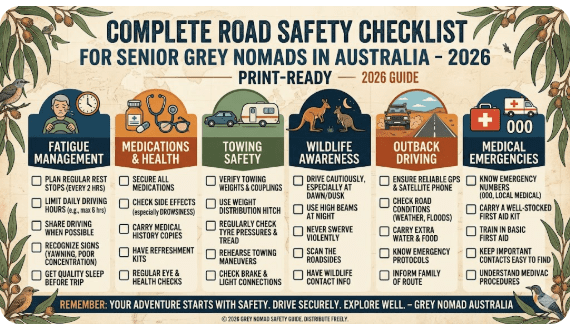
Grey Nomad Road Safety Checklist – The Complete Senior Driver Guide for 2026
The most honest road safety checklist for senior grey nomads driving across Australia — covering vehicle checks, fatigue management, wildlife hazards, outback driving, towing safety, medical emergencies and the risks most guides understate until something goes wrong.
📅 Last reviewed: June 2026 | Australia-wide | Relevant to all states and territories
Road safety for grey nomads is not the same conversation as road safety for younger drivers. Senior travellers face a specific set of compounding risks — longer reaction times, medications that affect alertness, chronic conditions that can deteriorate suddenly, unfamiliar roads in remote areas, and the particular danger of underestimating fatigue because retirement means there is no deadline forcing a rest stop. Australian road fatigue research consistently identifies retirees as a high-risk group not because they are bad drivers but because they drive further than their bodies can sustain, more often than is wise, in conditions that punish mistakes severely. This checklist is designed to change that pattern with practical, honest guidance rather than generic safety slogans.
- Who this is for: Senior grey nomads aged 60+ driving motorhomes, caravans and campervans across Australia
- Single biggest risk: Driver fatigue — responsible for more grey nomad serious accidents than any other factor
- Safe daily driving distance: 250–350km maximum; less if towing or on unsealed roads
- Wildlife hazard window: One hour before and after sunrise and sunset — avoid driving in this window
- Most dangerous season: Summer — heat, fatigue and remote road conditions combine dangerously
- Most important safety item: PLB registered with AMSA — the only reliable emergency contact in no-coverage areas
- Emergency number: 000 | Healthdirect: 1800 022 222 | RFDS: 1300 669 569
- Best route planning resource: Grey nomad routes guide
Table of Contents
- Before You Drive: The Pre-Departure Vehicle Safety Check
- Fatigue Management: The Number One Grey Nomad Road Risk
- Medications and Driving: What Senior Travellers Must Know
- Towing Safety for Senior Grey Nomads
- Outback and Remote Road Driving Safety
- Wildlife Hazards on Australian Roads
- Weather and Road Condition Safety
- Medical Emergency Planning on the Road
- Campsite Arrival and Departure Safety
- Solo Senior Driver Safety
- Night Driving Safety for Senior Grey Nomads
- Van and Caravan Security on the Road
- Daily Road Safety Checklist — Print and Laminate
- Key Emergency Contacts and GPS Reference Points
- Frequently Asked Questions
- Final Verdict: Road Safety is Not Optional — It is the Foundation
1. Before You Drive: The Pre-Departure Vehicle Safety Check
Every road safety conversation for grey nomads starts with the vehicle. A mechanically sound rig driven by a fatigued or medicated driver is dangerous. A well-rested alert driver in a mechanically compromised rig is equally dangerous. Both factors must be managed together — and vehicle safety starts before the engine turns over.
Daily Pre-Drive Vehicle Check
- Tyre pressure checked — including spare; pressure drops overnight in cold conditions and rises in heat
- Tyre condition visual check — no obvious bulges, cuts or foreign objects embedded in tread
- All lights working — brake lights, indicators, reversing lights, headlights; use a wall or ask a companion to confirm
- Mirrors adjusted correctly — both door mirrors and interior mirror set before moving; do not adjust while driving
- Windscreen clear — no frost, condensation or dirt obscuring vision; wiper fluid reservoir adequate
- Fuel level confirmed — never start a remote stage with less than three-quarters of a tank
- Engine oil and coolant levels — check weekly or after any long remote stage
- Coupling secure if towing — hitch lock engaged, safety chains attached, breakaway cable connected
- Caravan lights working — walk to rear of rig and confirm brake lights and indicators operating
- Awning retracted and locked — most common cause of on-road damage to vans
- All external compartments locked — loose compartment doors at highway speed cause serious damage
- Jockey wheel fully raised — driving with jockey wheel down is both illegal and damaging
Weekly Vehicle Safety Check
- Tyre pressure measured with gauge — not estimated visually; carry a reliable digital gauge
- Engine oil level checked and topped up if required
- Coolant level checked
- Battery terminals inspected for corrosion
- Brake fluid level confirmed
- Wheel nuts checked for tightness — particularly on caravans after unsealed road sections
- Caravan coupling and safety chains inspected for wear
- Tow ball torque checked if your setup specifies a torque requirement
2. Fatigue Management: The Number One Grey Nomad Road Risk
Fatigue is responsible for more serious grey nomad road accidents than any other single factor. It is also the risk most consistently underestimated by older drivers, because fatigue at 65 does not feel the same as fatigue at 35. The warning signs are subtler. The onset is faster. The recovery time after a fatigued driving episode is longer. And the consequences of driving fatigued with a caravan in tow at highway speed are severe.
Why Fatigue Hits Senior Drivers Harder
- Sleep quality typically declines with age — many grey nomads are travelling on less restorative sleep than they realise
- Many common senior medications — antihistamines, blood pressure medications, some pain relief — affect alertness and reaction time
- Unfamiliar driving environments require more cognitive effort than familiar routes, accelerating mental fatigue
- The excitement of travel can mask the early signs of fatigue, causing drivers to push through warning signals they would notice at home
- Heat increases fatigue onset significantly — driving in a warm van cab on a hot day is fatiguing at a rate most drivers underestimate
The Fatigue Rules That Actually Work
- Maximum 250–350km per driving day — less if towing, on unsealed roads or in hot conditions
- Stop every 90–120 minutes regardless of how you feel — do not wait for fatigue signals
- Use Queensland and NSW rest areas for their intended purpose — they exist because fatigue is killing people
- Never drive in the two hours after a large meal — post-meal drowsiness is physiologically real and driving-relevant
- Never drive between midnight and 6am — the body’s circadian rhythm produces genuine impairment in this window regardless of sleep
- If you yawn three times in five minutes, pull over — yawning is a reliable early fatigue signal that most drivers ignore
- If you cannot remember the last few kilometres of road, pull over immediately — this is microsleep, not fatigue warning
- Coffee and energy drinks delay fatigue for approximately 20–30 minutes — they do not eliminate it; use them to get to the next rest area, not to extend your driving day
3. Medications and Driving: What Senior Travellers Must Know
This is the section that receives the least attention in most grey nomad guides and the most urgent attention after a medication-related driving incident. Many common medications prescribed to senior Australians affect driving ability — some significantly. The legal and safety responsibility for understanding this rests with the driver, not with the prescribing doctor or the pharmacist, though both should be consulted.
| Medication Type | Common Examples | Driving Risk | What to Do |
|---|---|---|---|
| Antihistamines (older generation) | Phenergan, Polaramine | High — significant sedation | Do not drive within 8 hours of taking; switch to non-sedating type |
| Benzodiazepines | Diazepam, Temazepam, Oxazepam | Very high — impairs reaction time and judgement | Do not drive while taking; discuss alternatives with GP before travel |
| Opioid pain relief | Codeine, Tramadol, Oxycodone | Very high — sedation and impaired judgement | Do not drive while taking; plan alternatives for pain management |
| Blood pressure medications (some) | Beta-blockers, some calcium channel blockers | Low to medium — dizziness risk particularly on standing | Monitor for dizziness; avoid driving immediately after dose change |
| Diabetes medications | Insulin, some oral hypoglycaemics | Medium to high — hypoglycaemia impairs driving severely | Check blood glucose before driving; carry fast glucose in cab; do not drive if below 5.0 mmol/L |
| Sleeping tablets | Zopiclone, Zolpidem, Temazepam | Very high — next-morning impairment common | Do not drive within 8–12 hours of taking; timing is critical |
| Some antidepressants | Tricyclics, some SSRIs at initiation | Low to medium — particularly at initiation or dose change | Discuss driving impact with prescribing GP; avoid driving when starting new antidepressant |
4. Towing Safety for Senior Grey Nomads
Towing a caravan is one of the most skill-dependent driving tasks most grey nomads undertake and one of the least formally trained for. Many grey nomads begin their first extended trip having never reversed a caravan at a campsite, never experienced trailer sway at highway speed, and never needed to brake hard with a loaded van behind them. All three of these situations will arise. Being prepared for them significantly reduces the risk they create.
Towing Fundamentals
- Tow vehicle is rated for the caravan’s loaded ATM — not estimated, confirmed with the vehicle manufacturer’s towing capacity documentation
- Ball weight is within the tow vehicle’s specified limit — typically 10% of ATM; check your vehicle handbook
- Weight distribution hitch fitted and adjusted if your van exceeds approximately 2,000kg ATM
- Electric brake controller fitted, calibrated and tested before each trip
- Caravan loaded with heavy items low and forward of the axle — incorrect loading causes sway
- Tow mirrors fitted and adjusted — standard vehicle mirrors do not provide adequate rearward vision when towing
- Combined length within your state’s legal limit — varies by state but generally 19m for standard rigs
- Speed limit when towing observed — in most states 100km/h is the maximum when towing regardless of posted limit
Managing Trailer Sway
Reversing a Caravan
- Practise reversing in an empty car park before attempting campsite reversing — this skill requires practice, not optimism
- Use a spotter where possible — a companion on the ground with clear hand signals reduces reversing incidents dramatically
- Make small steering inputs — caravan steering response is counterintuitive; small inputs, not large ones
- If in doubt, pull forward and restart — there is no shame in multiple attempts; there is significant cost in reversing into a tree, post or neighbouring van
- Know your rig’s turning circle and tail swing before arriving at any campsite
5. Outback and Remote Road Driving Safety
Outback road driving is categorically different from highway driving. The distances between services, the road surface conditions, the wildlife density, the heat, the absence of mobile coverage and the response time for any emergency all combine to create a risk environment that requires specific preparation and specific driving habits.
Before Any Outback Stage
- Full fuel tank — never start an outback stage with less than a full tank; carry a jerry can of minimum 10 litres as reserve
- Distances between fuel stops confirmed — do not rely on online information alone; call ahead to roadhouses to confirm they are open
- Road conditions checked — qld.gov.au/transport/conditions for Queensland; relevant state authority for other states
- PLB confirmed accessible in cab — not packed in rear storage
- Satellite communicator charged and active if carrying one
- Travel plan shared with trusted contact — including planned route, overnight stops and check-in schedule
- Water supply confirmed — minimum 20 litres drinking water carried separately from main tank
- Next hospital location known — not guessed; specifically identified and phone number saved offline
Outback Driving Rules
- Reduce speed on unsealed roads — gravel and dirt roads require 60–80km/h maximum for safe control
- Slow down for corrugations — speed over corrugated roads causes rapid tyre wear, loosens fittings and dramatically increases blowout risk
- Give road trains maximum space — road trains can be up to 53.5m long; pass only when completely clear; never cut back in front of a road train
- Do not drive at dawn, dusk or night in outback areas — kangaroo and cattle density on outback roads at these times is extremely high
- If you break down, stay with your vehicle — a stationary vehicle is vastly easier to find than a walking person in outback terrain
- Do not drive through flooded crossings — water depth is impossible to judge visually; if in doubt, wait for it to recede or turn around
- Check tyre pressures after each unsealed road section — pressures change on rough surfaces and require adjustment
6. Wildlife Hazards on Australian Roads
Wildlife collisions are the second most common cause of serious grey nomad vehicle incidents after fatigue. Kangaroos, wombats, cattle, camels, emus and wallabies all pose genuine collision risks on Australian roads, and a collision with a large kangaroo or a cow at highway speed is a potentially fatal event for the vehicle occupants as well as the animal.
| Animal | Peak Risk Time | Peak Risk Region | Collision Impact | Senior Advice |
|---|---|---|---|---|
| Kangaroos and wallabies | Dawn, dusk, overnight | All states; highest density in QLD, NSW, SA outback | Severe — large males can weigh 85kg | Stop driving one hour before sunset; do not resume until one hour after sunrise |
| Cattle (open range) | Any time; worse at night | NT, outback QLD, WA, SA | Catastrophic — cattle are black at night and invisible until impact | Never drive outback roads at night; treat open range roads as active cattle zones |
| Camels | Any time; worse at night | NT, outback SA, WA | Catastrophic — camels are extremely tall; vehicle goes under the body | Extreme caution on outback NT and SA roads; camel warning signs are serious |
| Wombats | Dawn, dusk, overnight | NSW, VIC, SA, TAS | Severe — extremely solid; causes significant undercarriage damage | Reduce speed at dusk and dawn in wombat habitat areas; they do not move away from vehicles |
| Emus | Daytime | Outback QLD, NSW, SA, WA | Medium — significant windscreen and body damage | Brake, do not swerve; emus are unpredictable and may run toward the vehicle |
| Horses (brumbies) | Any time | Alpine areas NSW, VIC; outback QLD | Severe — similar to cattle collision | Reduce speed in known brumby areas; treat like cattle on open range roads |
7. Weather and Road Condition Safety
Australian weather creates road conditions that change faster and more dramatically than most grey nomads from coastal cities are accustomed to. A dry outback road can become impassable within thirty minutes of a remote storm — even a storm you cannot see from where you are driving.
Heat Safety on the Road
- Check forecast maximum temperature before each driving day — above 38°C warrants serious consideration of whether to drive at all
- Ensure vehicle air conditioning is working before any hot-weather driving stage — a failed aircon in outback summer is a medical emergency for senior travellers
- Carry minimum 5 litres of drinking water accessible in the cab — not in the van, in the cab
- Wear light, breathable clothing when driving in heat — even with aircon, heat stress accumulates during long drives
- Know the symptoms of heat stroke — confusion, hot dry skin, rapid pulse, loss of consciousness; treat as a medical emergency
- Plan driving for early morning in summer — 6am to 11am is the safest summer driving window in outback areas
Flood and Wet Road Safety
- Check road conditions before every outback stage — flash flooding can close roads that were clear when you left
- Never drive through floodwater — the rule is simple: if it is flooded, forget it
- Do not assume a crossing is safe because another vehicle crossed it — water depth and current can change within minutes
- If caught by rising water, move to higher ground immediately and activate PLB if required
- Wet outback roads — even light rain on clay outback roads creates surfaces with near-zero traction; reduce speed dramatically and consider stopping until conditions improve
8. Medical Emergency Planning on the Road
Medical emergencies happen to grey nomads. Cardiac events, strokes, diabetic emergencies, falls and severe allergic reactions all occur in the van life context. The difference between a manageable medical event and a fatal one is often the quality of the preparation made before it happened.
Emergency Contacts — Save These Offline Before You Lose Signal
| Service | Address / Coverage | GPS (approx) | Phone |
|---|---|---|---|
| Emergency (all states) | Australia-wide | — | 000 |
| Healthdirect — nurse on call | Australia-wide, 24 hours | — | 1800 022 222 |
| Royal Flying Doctor Service | Remote Australia aeromedical | — | 1300 669 569 |
| Poisons Information Centre | Australia-wide | — | 13 11 26 |
| Royal Brisbane and Women’s Hospital | Butterfield St, Herston QLD 4029 | -27.4468, 153.0269 | (07) 3646 8111 |
| Townsville University Hospital | 100 Angus Smith Dr, Douglas QLD 4814 | -19.3109, 146.7428 | (07) 4433 1111 |
| Alice Springs Hospital | Gap Rd, Alice Springs NT 0870 | -23.7025, 133.8807 | (08) 8951 7777 |
| Royal Adelaide Hospital | Port Rd, Adelaide SA 5000 | -34.9210, 138.5876 | (08) 7074 0000 |
If a Medical Emergency Happens While Driving
- If you feel unwell while driving — pull over immediately; do not try to reach the next town
- Hazard lights on as soon as you are stopping — alert other road users immediately
- Call 000 — provide your location using your GPS coordinates if you have them; describe the nearest landmark or road sign visible
- If no signal — activate PLB; this is exactly the scenario it exists for
- If travelling with a companion — the companion should know how to call for help, provide your medical information and perform basic first aid
- Do not minimise symptoms to avoid inconveniencing anyone — chest pain, stroke symptoms, severe breathlessness and loss of consciousness are all 000 calls regardless of location
9. Campsite Arrival and Departure Safety
A disproportionate number of grey nomad injuries occur not on the open road but at campsites — during arrival manoeuvring, campsite setup and morning departure. These are the moments of distraction, fatigue and unfamiliar terrain that create slip, trip and fall injuries and vehicle damage incidents.
Arrival Safety
- Arrive by 2pm during peak season — tired, rushed arrivals in fading light cause more incidents than any other campsite timing factor
- Walk the site before driving in — check overhead clearance, surface levelness, turning radius and any obstacles not visible from the entry point
- Use a spotter for reversing — never reverse a caravan or large motorhome into an unfamiliar site without a ground guide
- Chock wheels before unhitching — always; never assume level ground is level enough to hold a stationary van
- Check ground surface before placing levelling blocks — soft ground in recently wet sites can shift under vehicle weight overnight
- Set up awning only after confirming wind forecast — an awning in unexpected wind causes expensive damage and injury risk
Campsite Hazards for Senior Travellers
- Uneven ground — torch and careful footing required for any campsite movement after dark
- Guy ropes and tent pegs from neighbouring campers — a consistent trip hazard at busy sites; identify them on arrival
- Van entry steps — wet or dusty steps are slippery; treat them as a fall risk every time, not just when they look wet
- Fire pits — hot coals remain dangerous for hours after a fire appears extinguished; keep distance and use a torch at night
- Insects and snakes — check shoes before putting them on each morning; shake out any clothing left outside
10. Solo Senior Driver Safety
Solo grey nomad travel is common, genuinely rewarding and entirely manageable with the right preparation. It does, however, require more deliberate safety planning than couple travel because every safety function that a travelling companion provides must be replaced by a system, a device or a protocol.
What a Companion Provides That You Must Replace When Solo
- Fatigue monitoring: A companion notices when you are driving poorly before you do. Solo — build mandatory rest stops into your route regardless of how you feel.
- Emergency response: A companion can call for help if you are incapacitated. Solo — your PLB, your UHF radio and your check-in protocol with a trusted contact replace this function.
- Campsite safety: A companion is a second set of eyes for reversing, setup and campsite hazards. Solo — slow down every campsite procedure; there is no rushing required and no audience to perform for.
- Medical awareness: A companion notices if you seem unwell before you acknowledge it. Solo — weekly video check-ins with a trusted person who knows what to look for replaces this partially.
- Security: Two people in a van is a deterrent to opportunistic approaches. Solo — park near other occupied vans; community presence provides a similar deterrent effect.
For comprehensive solo travel guidance including security, campsite selection and community building strategies, see our complete guide to living in retirement on the road and our caravan security guide.
11. Night Driving Safety for Senior Grey Nomads
The recommendation for grey nomads is straightforward: do not drive at night on rural or outback roads. This is not an arbitrary suggestion — it reflects the convergence of three genuine risks that are each serious individually and catastrophic in combination.
- Wildlife density at night: Kangaroos, wombats, cattle, camels and other animals are most active between dusk and dawn. Collision risk at night is dramatically higher than during daylight hours.
- Reduced vision with age: Night vision deteriorates significantly with age. Many 65-year-old drivers have night vision equivalent to a much younger driver with significant visual impairment. Glare recovery from oncoming headlights also slows considerably.
- Fatigue at night: The body’s circadian rhythm produces genuine physiological drowsiness between midnight and 6am regardless of how much sleep you had the previous night. This cannot be overcome by willpower or caffeine.
12. Van and Caravan Security on the Road
Road safety includes the security of your vehicle and its contents when you are not driving. Popular rest areas and free camps during peak season carry a genuine opportunistic theft risk — not organised crime, but thieves who move along popular grey nomad routes targeting unsecured or visibly valuable items.
- Lock all vehicle doors whenever you leave the van — including during a ten-minute walk to the toilet block
- Lock all external compartments — storage bay locks are the first point of opportunistic access
- Keep valuables out of sight — electronics, bags, cameras visible through windows invite smash-and-grab
- Lock bikes to the bike rack with a quality chain lock — bikes are the most commonly stolen item from grey nomad rigs
- Chain generators to a fixed point on the van — portable generators left unsecured are a consistent theft target
- Use a steering wheel lock — visual deterrent effective against opportunistic thieves
- Park near other occupied vans at rest areas — community presence is your best deterrent
- Do not advertise that you are travelling solo — gender-neutral conversation about travel companions is reasonable
For the full breakdown of how grey nomad van theft actually happens and the specific countermeasures that work, read our dedicated guide to how caravan theft happens in Australia.
13. Daily Road Safety Checklist — Print and Laminate
This is the checklist to print, laminate and keep in your cab. Run through it every morning before starting your engine. Every item is on this list because its absence has caused a real incident for a real grey nomad.
| Check | What to Verify | ☐ |
|---|---|---|
| Fatigue assessment | Did you sleep adequately? Do you feel alert? If no — do not drive yet | ☐ |
| Medications reviewed | Have you taken morning medications? Do any affect driving? If yes — wait the required period | ☐ |
| Blood glucose (diabetic travellers) | Above 5.0 mmol/L before driving; fast glucose in cab within reach | ☐ |
| Tyre visual check | No obvious flats, bulges or damage on all tyres including caravan | ☐ |
| Fuel level | Adequate for planned stage plus 20% reserve; jerry can carried on remote stages | ☐ |
| Coupling and chains (towers) | Hitch locked; chains attached; breakaway cable connected; jockey wheel up | ☐ |
| Lights working | All van and caravan lights confirmed; use a wall reflection or ask companion | ☐ |
| Awning retracted | Fully closed and locked; most common cause of on-road van damage | ☐ |
| External compartments locked | Full perimeter walk; every latch confirmed closed and locked | ☐ |
| Road conditions checked | State transport authority road conditions checked for planned route | ☐ |
| Weather forecast reviewed | Temperature, rain, wind; adjust plans if extreme weather forecast | ☐ |
| Wildlife risk window noted | Plan to be stopped one hour before sunset; do not start driving before one hour after sunrise in rural areas | ☐ |
| PLB accessible in cab | Not in rear storage; immediately accessible to driver | ☐ |
| Water in cab | Minimum 2 litres drinking water accessible in cab; not in van | ☐ |
| Overnight stop identified | Primary stop and backup stop known; arrival time estimated; trusted contact notified if remote stage | ☐ |
| Next hospital location known | Nearest hospital to planned route identified; phone number saved offline | ☐ |
COPY PROMPT ➔ ASK AI ➔ SAVE TO FORM ➔ ADD SPOT PIN ➔ GET DIRECTIONS
📍 Interactive map — find safe overnight stops, rest areas and free camps along your planned route across Australia. Enable location for best results.
14. Key Emergency Contacts and GPS Reference Points
Save these contacts and coordinates to your phone before you lose mobile coverage. These are provided as planning guidance — verify current contact details before each major stage of travel.
| Service or Location | Address / Postcode | GPS (approx) | Phone |
|---|---|---|---|
| Emergency — all states | Australia-wide | — | 000 |
| Healthdirect — 24hr nurse | Australia-wide | — | 1800 022 222 |
| Royal Flying Doctor Service | Remote Australia | — | 1300 669 569 |
| Poisons Information Centre | Australia-wide | — | 13 11 26 |
| Cairns Hospital | 165 The Esplanade, Cairns QLD 4870 | -16.9233, 145.7760 | (07) 4226 0000 |
| Mount Isa Hospital | 30 Camooweal St, Mount Isa QLD 4825 | -20.7253, 139.4979 | (07) 4744 4444 |
| Alice Springs Hospital | Gap Rd, Alice Springs NT 0870 | -23.7025, 133.8807 | (08) 8951 7777 |
| Kalgoorlie Health Campus | Piccadilly St, Kalgoorlie WA 6430 | -30.7453, 121.4686 | (08) 9080 5888 |
For comprehensive route planning and overnight stop information across Australia, see our guide to the best routes around Australia for grey nomads and our vanlife savings spots directory.
15. Frequently Asked Questions
How far should a grey nomad drive in a single day?
The practical maximum for senior grey nomads is 250–350 kilometres per day under good conditions. Less if you are towing, driving on unsealed roads, in hot weather, or if you are not sleeping well. This is not a conservative estimate — it reflects the genuine fatigue onset rate for older drivers on Australian roads. Many experienced grey nomads target 200–250 kilometres as their comfortable daily distance and report significantly less fatigue and more enjoyment than when they drove further. The kilometres you save by stopping earlier cost you nothing and may save your life.
Can I drive while taking my prescribed medications?
It depends entirely on the specific medication. Many medications commonly prescribed to senior Australians — benzodiazepines, opioid pain relief, older antihistamines, sleeping tablets and some diabetes medications — significantly impair driving ability. Before your trip, take your complete medication list to your GP and ask explicitly which medications may affect your driving, what the safe driving window is after taking each one, and whether any alternatives are available. Get this in writing. Under Australian road law, driving while impaired by any substance including prescribed medications is a criminal offence.
What should I do if my caravan starts to sway at highway speed?
Do not brake hard — this is the most common and most dangerous response to caravan sway and makes it significantly worse. Hold the steering wheel firmly and straight. Ease off the accelerator gently to reduce speed. Do not countersteer. If sway continues, apply the caravan brake controller manually. Move to the left side of the road and reduce speed progressively until the van stabilises. Stop safely when it is safe to do so and identify the cause — speed, load distribution, tyre condition or crosswind — before continuing. Practice the correct response so it is automatic; discovering the correct procedure during an active sway event is not the time to be reading the manual.
Is it safe to drive at night as a grey nomad?
No — not on rural or outback roads. Night driving for senior grey nomads on rural Australian roads combines three compounding risks: dramatically elevated wildlife collision risk, age-related night vision deterioration and circadian fatigue between midnight and 6am. The recommendation is unambiguous: stop one hour before sunset and do not resume driving until one hour after sunrise on any rural or outback road. On well-lit urban roads this rule is less critical, but the wildlife and fatigue risks remain.
What is the most important safety item a grey nomad should carry?
A PLB — Personal Locator Beacon — registered with AMSA before departure. Not because other safety items are unimportant but because the PLB covers the scenario where everything else has failed simultaneously: no phone signal, no satellite communicator, a medical emergency or breakdown in a remote location. A registered PLB activation triggers a coordinated emergency response via satellite that reaches you from almost anywhere in Australia. Register yours at beacons.amsa.gov.au. Keep it accessible in the cab, not in rear storage.
How do I manage driving fatigue on a long trip?
Stop every 90–120 minutes regardless of how you feel. Limit daily driving to 250–350 kilometres. Never drive between midnight and 6am. Plan your driving for the cool morning hours in summer. If you yawn three times in five minutes, pull over — do not push to the next rest area. Recognise that coffee buys you 20–30 minutes of delayed fatigue, not eliminated fatigue. On a long trip, build in complete rest days every three to four days of driving. The grey nomad lifestyle has no mandatory schedule — there is no reason to push through fatigue when there is always another stop available.
What do I do if I break down in outback Australia?
Stay with your vehicle. It is vastly easier to find than a walking person and provides shade and shelter. Activate your PLB if the situation is life-threatening and you cannot reach emergency services. Use your UHF CB radio on channel 40 to alert passing traffic. Place warning triangles or flares visible from both directions. Call your roadside assistance provider if you have phone coverage. Do not attempt to walk to assistance — the distances in outback Australia make walking in heat conditions genuinely fatal. Signal passing aircraft if possible. Wait. Help will come.
How do I know if I am too old to keep driving long distances?
The honest answer is that age alone is not the determining factor — health, medication profile, reaction times and cognitive function matter more than the number on your birthday. Most Australian states require older drivers to have regular medical assessments from their GP. If your GP has concerns about your driving, take them seriously rather than dismissing them. An occupational therapist can provide a formal on-road driving assessment that gives an objective answer to this question. There is no shame in modifying your travel style as you age — shorter daily distances, more rest stops, avoiding night and dawn driving, and planning routes near services rather than through remote areas are all adaptations that extend the safe driving period significantly.
What is the biggest mistake first-time grey nomads make on the road?
Moving too fast and driving too far. First-time grey nomads almost universally try to cover too much distance in the first weeks — driven by excitement, the desire to reach specific destinations, and the habits of holiday driving where you push hard to get there. The grey nomad lifestyle is not holiday driving. It is a different pace entirely. The most experienced and most satisfied grey nomads drive shorter days, stop more often, stay longer in places they enjoy, and arrive at overnight stops with energy remaining rather than exhausted. Speed is the enemy of the grey nomad experience in every sense — on the road and in the broader lifestyle.
16. Final Verdict: Road Safety is Not Optional — It is the Foundation
Every other aspect of grey nomad travel — the free camping, the community, the extraordinary landscapes, the freedom — depends entirely on arriving safely at each destination. Road safety is not a constraint on the grey nomad lifestyle. It is the foundation that makes the lifestyle possible. The senior travellers who enjoy decades of rewarding grey nomad travel are not the ones who are lucky — they are the ones who took fatigue seriously, prepared their vehicles honestly, planned their routes with medical access in mind, and understood that the extra hour of rest before a long driving day is an investment in everything that follows.
The risks in this guide are real. Fatigue, medication impairment, trailer sway, wildlife collisions, outback breakdowns and remote medical emergencies all happen to grey nomads every year in Australia. None of them are inevitable. All of them are significantly reduced by the habits, protocols and equipment described in this guide. The goal is not to eliminate all risk — that is impossible in any life worth living. The goal is to reduce the avoidable risks to a level that allows you to be genuinely present for the extraordinary parts of the journey rather than managing consequences that honest preparation would have prevented.
- Complete Free Camping and Vanlife Savings Spots Directory — Australia-wide
- Best Routes to Drive Around Australia for Grey Nomads
- Living in Retirement on the Road — Complete Grey Nomad Lifestyle Guide
- Grey Nomad Packing Checklist — Everything Senior Van Life Travellers Need
- How Caravan Theft Happens in Australia — Grey Nomad Security Guide
- How Long Can You Stay at a Caravan Park in Australia?
- Living in a Camper Full-Time in Retirement — Complete Guide
- Free Camping Queensland — The Complete Grey Nomad Hub Guide
Free campsites and powered sites fill fast during peak season. If your preferred stop is already taken, search remaining accommodation options below to keep your trip moving.
Accommodation and flight search powered by Expedia. Booking through this search supports this website at no extra cost to you. As an affiliate, I earn from qualifying purchases at no extra cost to you.

As an affiliate, I earn from qualifying purchases at no extra cost to you.
Exclusive Offer: Get 5% OFF all StarterStopper immobiliser products with promo code: RTV5
Visit StarterStopper.com to see our data-backed security solutions
As an affiliate, I earn from qualifying purchases at no extra cost to you.