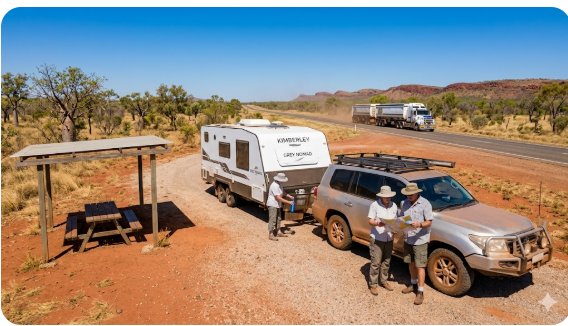
Fitzroy Crossing Rest Area — Major NT/WA Kimberley Grey Nomad Stop
Fitzroy Crossing sits at the midpoint of the Great Northern Highway between Broome and Kununurra — a genuine grey nomad staging town with verified GPS details, honest rest area and overnight options, fuel and supplies information, medical access data and real-world conditions for senior travellers crossing the Kimberley in 2026.
📅 Last reviewed: May 2026 | Fitzroy Crossing WA 6765 | Mix of free rest areas, paid caravan parks and roadside stops — rules apply at each. Confirm on arrival.
The Great Northern Highway between Broome and Kununurra is one of the longest and most demanding stretches of sealed outback road that a grey nomad will tackle in a Kimberley crossing — and right in its middle, where the ancient Fitzroy River cuts its broad, sandy floodplain through the range country, sits Fitzroy Crossing. For eastbound travellers who left Broome that morning, this is where the body starts asking for a break. For those coming west from Kununurra or the Northern Territory border, it is the last proper town before the final run to the coast. Either way, the Fitzroy Crossing rest area and town facilities are not just a convenience — on a 250-kilometre open highway with almost nothing in between, they are a serious grey nomad lifeline.
- Fitzroy Crossing sits on the Great Northern Highway (Highway 1) approximately 260 km east of Broome and 400 km west of Kununurra — it is the only significant town stop between these two centres.
- A free 24-hour rest area is located on the Great Northern Highway on the western approach to Fitzroy Crossing — basic facilities, suitable for a break or short overnight stop.
- Fitzroy Crossing Caravan Park offers powered and unpowered sites for those wanting a full overnight stay with facilities — fees apply.
- Geikie Gorge National Park is 18 km north of town — one of the most accessible and spectacular gorge experiences in the Kimberley, with a sealed road and flat walking tracks suitable for most senior travellers.
- Fuel is available in Fitzroy Crossing — always fill up here regardless of your gauge reading. The next reliable fuel stops are Broome (260 km west) or Halls Creek (290 km east).
- Mobile coverage is limited — Telstra provides the best signal in the Fitzroy Crossing town area but coverage drops quickly outside town on the highway.
- The nearest hospital is Fitzroy Crossing Hospital (also known as Fitzroy Valley District Hospital) located within the town — a significant asset for such a remote community.
What You Will Find in This Guide
- Location, Address and GPS
- Can You Stay Overnight?
- Facilities — Toilets, Water and Dump Point
- Mobile Coverage and Wi-Fi
- How to Get There
- What to Expect on Arrival
- Safety for Senior Grey Nomads
- Medical and Emergency Contacts
- Dump Points, Water and Supplies Nearby
- Things to Do for Seniors
- Best Time of Year to Stop Here
- Fires, Generators and Overnight Etiquette
- Packing Checklist for Seniors
- GPS Coordinates and Postcodes
- Frequently Asked Questions
- Quick Verdict
1. Location, Address and GPS
Fitzroy Crossing is a small Kimberley town positioned directly on the Great Northern Highway where the highway crosses the Fitzroy River. The town serves as the primary service centre for the Fitzroy Valley region and is a critical refuelling and rest point for all highway travellers crossing the Kimberley. There are two distinct stopping points grey nomads use here: the roadside rest area on the highway’s western approach, and the town itself with its caravan park, fuel, shops and hospital.
📍 GPS — Fitzroy Crossing Rest Area (Western Approach, Great Northern Highway)
-18.1720° S, 125.5580° E
Great Northern Highway, Western Approach, Fitzroy Crossing WA 6765
These coordinates place you within 50 metres of the main highway rest area on the western side of Fitzroy Crossing. Always confirm on arrival against current signage. Coordinates are provided as navigation guidance only and must be verified against conditions on the day.
Find more verified stop locations at Vanlife Savings Spots →
| Detail | Information |
|---|---|
| Town name | Fitzroy Crossing |
| State | Western Australia |
| Postcode | 6765 |
| Region | Kimberley, Western Australia |
| Highway | Great Northern Highway (National Highway 1) |
| Distance from Broome | Approximately 260 km east |
| Distance from Kununurra | Approximately 400 km west |
| Distance from Halls Creek | Approximately 290 km east |
| Local government | Shire of Fitzroy Valley |
2. Can You Stay Overnight?
Yes — overnight stopping is permitted at the designated rest area on the Great Northern Highway at Fitzroy Crossing, and paid overnight accommodation is available at the Fitzroy Crossing Caravan Park within town. Grey nomads have two realistic options here: a free or low-cost rest area stop on the highway itself, or a paid caravan park stay with fuller facilities. The choice depends on your needs, your rig’s self-sufficiency and how long you plan to rest.
In Western Australia, highway rest areas managed by Main Roads WA are generally open to overnight use for the purpose of fatigue management — typically for a period of 24 hours. These rest areas are not designated free camps in the traditional sense, and they are not intended as multi-night base camps. The Fitzroy Crossing rest area is a fatigue stop first and a free camp second. Treat it accordingly.
- The highway rest area on the western approach to Fitzroy Crossing is suitable for a single overnight stop in a self-contained van, caravan or motorhome.
- The standard rest area stay period under WA Main Roads guidelines is 24 hours — do not treat this as a free camp for extended stays.
- Fitzroy Crossing Caravan Park offers powered and unpowered sites for travellers wanting a longer stay, access to showers, dump point and other facilities — fees apply and it is advisable to confirm availability before arrival, particularly during peak dry season.
- Self-contained rigs are best suited to the rest area stop — the facilities are basic and not adequate for travellers who cannot manage independently overnight.
- Respect quiet hours at the rest area — this is a shared space used by highway truckies, tourists and local travellers alike. It is not a social campground.
3. Facilities — Toilets, Water and Dump Point
Fitzroy Crossing’s highway rest area provides basic facilities appropriate to a remote outback fatigue stop. The town itself, a short drive from the rest area, has significantly more complete services. Senior grey nomads who need more than a toilet and a parking bay should drive the short distance into town and use the caravan park or town facilities instead.
| Facility | What Is Available | What Seniors Should Know |
|---|---|---|
| Toilets | Pit or composting toilets at the highway rest area. Flushing toilets available at the caravan park and town facilities. | Rest area toilets in remote WA are serviceable but basic. Cleanliness varies with use and maintenance frequency — carry your own toilet paper and hand sanitiser at all times. |
| Potable water | No guaranteed potable water at the highway rest area. Potable water available at the Fitzroy Crossing Caravan Park and town facilities. | Do not rely on the highway rest area for drinking water. Fill your tanks in Broome or at the Fitzroy Crossing Caravan Park. Always carry an emergency water reserve. |
| Dump point | No dump point at the highway rest area. A dump point is available at the Fitzroy Crossing Caravan Park — confirm current availability on arrival. | Dump in Broome before leaving if heading east. The caravan park dump point is the most reliable option in Fitzroy Crossing — a small fee may apply for non-guests. |
| Showers | No showers at the highway rest area. Showers available at the Fitzroy Crossing Caravan Park. | If a shower is required, drive into the caravan park — they typically offer day use shower access for a small fee. |
| Bins | Bins generally available at the highway rest area — confirm on arrival as bin provision at remote rest areas can change. | Carry your own bin bags. If bins are full or absent, do not leave rubbish at the rest area — take it to the town bins or caravan park. |
| Power | No mains power at the highway rest area. Powered sites available at the Fitzroy Crossing Caravan Park — fees apply. | The rest area is a dry camp — solar panels, batteries or a generator (within reasonable hours) are your only power options overnight. |
- Site suitable for: all vehicles including caravans and motorhomes — sealed pull-off area at rest area; caravan park suits all standard rigs
- Road access: sealed Great Northern Highway — all-weather access to town and rest area
- Site surface: bitumen or compacted gravel at highway rest area; gravel sites at caravan park
- Camping permitted: Yes at rest area (24-hour fatigue stop); Yes at caravan park (paid)
- Maximum overnight stays: 24 hours at highway rest area; caravan park subject to booking
- Boat ramp: No at rest area — the Fitzroy River is accessible near town but crocodile presence makes recreational use inadvisable
- Picnic tables: Yes at rest area — shade shelters may be present; confirm on arrival
- Potable water: Not at rest area — available at caravan park and town
- Mobile phone coverage: Telstra — limited but present in town area. Coverage drops on highway outside town. Optus and Vodafone — minimal to none.
- TV reception: Limited — satellite only reliable option in this region
- Rubbish bins: Present at rest area — condition variable. Town bins available in centre.
- Open fires: Subject to local fire restrictions — confirm before lighting any fire. Fire danger is extreme in dry season.
- Generator use: Considerate use only at rest area — be mindful of other travellers and truckies resting. Caravan park generator hours apply — confirm at check-in.
- Number of sites: Highway rest area — multiple pull-off spaces for caravans and trucks. Caravan park — confirm current site numbers and availability at time of booking.
4. Mobile Coverage and Wi-Fi
Fitzroy Crossing is one of the most significant communication checkpoints on the entire Great Northern Highway crossing of the Kimberley. If you have been driving west from Kununurra or the NT border, Fitzroy Crossing may be your first reliable signal in several hours. If you are heading east from Broome, it will be one of the last. Use your time here to make calls, send messages, download maps and check conditions ahead — do not drive out of town without doing this.
- Telstra: The most reliable coverage in Fitzroy Crossing. Signal is available in the town centre and caravan park area. Coverage diminishes quickly on the highway east and west of town. If you are on a Telstra plan, you will get a usable signal here — make the most of it.
- Optus: Limited to minimal coverage in Fitzroy Crossing town area. Do not rely on Optus for reliable communication at this location or on the surrounding highway.
- Vodafone / TPG: No reliable coverage at Fitzroy Crossing. Vodafone’s network does not extend meaningfully into the Kimberley beyond major centres.
- Wi-Fi: Wi-Fi may be available at the Fitzroy Crossing Caravan Park for guests — confirm at check-in. Do not rely on this for high-bandwidth use. Town businesses may offer limited Wi-Fi access.
- Satellite communicators: A PLB or satellite communicator such as a Garmin inReach is strongly recommended for all grey nomads travelling the Great Northern Highway between Broome and Kununurra. The distances between towns and the limited mobile coverage make self-rescue extremely difficult in an emergency.
5. How to Get There
Fitzroy Crossing is straightforward to reach — it sits directly on the Great Northern Highway (National Highway 1) and there are no turn-offs, unsealed sections or navigational challenges involved in getting there. The difficulty is not finding the town; it is managing the distance and fatigue on the long approach drives from either direction.
From Broome (Westbound to Eastbound — most common grey nomad direction)
Head east from Broome on the Great Northern Highway. The highway is sealed and well-maintained for the full 260 km to Fitzroy Crossing. Pass through the landscape of the Broome Peninsula, cross the flat red country of the central Kimberley and watch for the dramatic range country that signals the approach to the Fitzroy Valley. The Fitzroy Crossing rest area appears on your left (north side of the highway) on the western approach before the main town entry. The town itself is a short distance further east. Allow 2.5 to 3 hours from Broome depending on your vehicle and road conditions. Do not attempt this drive in one push after an already long day.
From Halls Creek or Kununurra (Eastbound to Westbound)
From Halls Creek, head west on the Great Northern Highway for approximately 290 km to Fitzroy Crossing. From Kununurra, the total distance west is approximately 400 km — a full day’s drive that most grey nomad travellers break with a stop at Halls Creek or Turkey Creek (Warmun). The highway is sealed throughout. Fitzroy Crossing appears after the descent from the range country into the Fitzroy River floodplain — the river crossing bridge is an unmistakable landmark. The rest area is on the eastern approach to town on this route.
From the Northern Territory (via the Great Northern Highway)
Travellers crossing from the NT via the Victoria Highway through Kununurra will follow the Great Northern Highway west. Fitzroy Crossing is approximately 650 km from the NT border at Timber Creek — a journey typically broken into two or three days. The full route from Darwin to Fitzroy Crossing is approximately 1,100 km.
Driving Notes for Seniors Towing Vans
- The Great Northern Highway between Broome and Fitzroy Crossing is a genuine fatigue highway — long, straight, flat sections with minimal landmarks and sparse traffic create the ideal conditions for microsleep. Stick to the two-hour driving rule and stop before you feel tired, not after.
- Road trains operate on this highway — some reaching up to 53.5 metres in length. Give road trains maximum space when passing and never attempt an overtake unless you have a very long, clear straight with sufficient acceleration capability. When a road train approaches from the front, move as far left as safely possible and reduce speed.
- The Fitzroy River bridge narrows the highway significantly — approach at reduced speed, maintain your lane and do not attempt to pass another vehicle on or immediately adjacent to the bridge.
- Speed zones through Fitzroy Crossing reduce to 60 km/h and lower through town — honour these zones. Roadworks and pedestrian activity can occur without warning in this community.
- Animals on the road — particularly cattle, kangaroos and donkeys — are a significant night-driving hazard on the Great Northern Highway. Never drive this section after dark when towing a van. The collision impact of a large animal at highway speeds is severe.
- Dust from road shoulders and passing vehicles can dramatically reduce visibility — ensure your van’s windows and cab seals are in good order before this section.
6. What to Expect on Arrival
Fitzroy Crossing does not look like much from the highway and that is part of the honest picture you need going in. This is a small, remote Kimberley community that serves a huge geographic catchment area. It is functional, it has what you need, and it is genuinely important to the grey nomad experience of crossing the Kimberley — but it is not a polished tourist town. Arrive with realistic expectations and you will find it more than adequate.
- The highway rest area on the western approach is a basic pull-off — sealed bays, a toilet block and shaded picnic tables in most cases. It is clean when well-maintained but can show the wear of heavy use during peak season. Do not expect manicured lawns or resort-style facilities — expect a functional outback rest stop that does exactly what it needs to do.
- Fitzroy Crossing township is small — a fuel station, a supermarket-style store, a roadhouse, a hotel, the hospital and the caravan park cover the essential services. This is not a place to browse boutique shops or visit a café strip. It is a working community and a highway service town.
- The Fitzroy River, visible from the bridge and accessible near town, is an extraordinary landscape feature — particularly in the dry season when its broad sandy bed contrasts with the vivid red escarpments of the surrounding ranges. Take time to walk to the river’s edge from a safe, cleared viewpoint and appreciate the scale of the country you are crossing.
- The fly population at Fitzroy Crossing is considerable during the dry season — this is consistent with all Kimberley locations. A fly net and long-sleeved clothing make outdoor time significantly more comfortable.
- Fuel pricing in Fitzroy Crossing is higher than coastal centres — this is standard across remote WA and should be factored into your budget. Fill up regardless of your gauge reading, because the next reliable fuel is a very long way in either direction.
7. Safety for Senior Grey Nomads
Personal Safety
- Keep your van locked at all times when you are not in immediate attendance — this applies equally at the rest area and at any town stop in Fitzroy Crossing.
- Do not approach or enter the Fitzroy River at any point — saltwater crocodiles are recorded in the Fitzroy River system and the risk is genuine. The river looks benign and sandy in the dry season but it is active crocodile habitat. View from a safe distance and from cleared, elevated viewpoints only.
- Travel with a registered PLB or satellite communicator and ensure it is charged and accessible. Between Fitzroy Crossing and the next town in either direction, you are in a genuine remote area with very limited communication options.
- Secure all valuables inside your locked van at the rest area overnight — do not leave portable items such as chairs, bikes, generators or solar panels unsecured outside your rig after dark.
- If you feel uncomfortable at the rest area at any point during the night, you have options — the caravan park, the roadhouse or simply moving on at first light. Trust your instincts and act on them.
Trip Safety
- Use the Fitzroy Crossing stop as a genuine vehicle check point — check your tyre pressures, tow ball connection, brake lights, water and oil before getting back on the highway. The next mechanic is a very long way away.
- Never depart Fitzroy Crossing with less than a full tank of fuel. Fuel availability east and west of town cannot be relied upon at unexpected hours or during incidents.
- Share your itinerary with family or friends not travelling with you — let them know you are at Fitzroy Crossing, your next planned stop and your expected arrival time there.
- The two-hour driving rule is non-negotiable on the Great Northern Highway — set a timer if necessary. Fatigue on this highway is responsible for a disproportionate number of serious incidents.
- Check the Grey Nomad Road Safety Checklist and Grey Nomad Safety Tips before departing each morning — both are directly relevant to Great Northern Highway travel.
For specific advice on protecting your rig and belongings while travelling remote Australia, see How Caravan Theft Happens in Australia.
8. Medical and Emergency Contacts
One of Fitzroy Crossing’s most important assets for grey nomad travellers — and one that most people do not know about before they arrive — is that it has a hospital. The Fitzroy Valley District Hospital serves the enormous Fitzroy Valley catchment and provides a level of medical care that is genuinely unusual for a community of this size and remoteness. This does not make Fitzroy Crossing a medical destination, but it does mean that if something goes wrong in the vicinity of town, you are significantly better placed than you would be anywhere else on this 660-kilometre highway stretch.
| Service | Address | GPS (approx.) | Phone |
|---|---|---|---|
| Fitzroy Valley District Hospital | Flynn Drive, Fitzroy Crossing WA 6765 | -18.1788° S, 125.5823° E | (08) 9164 0200 |
| Broome Health Campus (nearest major hospital) | Robinson Street, Broome WA 6725 | -17.9597° S, 122.2364° E | (08) 9194 2222 |
| Emergency (Police, Fire, Ambulance) | Call Triple Zero from any network — use PLB if no mobile signal | — | 000 |
| Healthdirect (24-hour nurse advice line) | Telephone service — national | — | 1800 022 222 |
| Royal Flying Doctor Service (RFDS) | Derby RFDS Base serves the Kimberley region — contact via 000 or PLB activation | — | 000 (emergency) or (08) 9191 1211 (Derby base) |
9. Dump Points, Water and Supplies Nearby
Fitzroy Crossing is the most significant resupply point between Broome and Kununurra — and that status demands that you take it seriously as a provisioning stop. Grey nomads who treat Fitzroy Crossing as a quick fuel stop and drive straight through often regret it when they discover what the next 290 kilometres to Halls Creek actually offers in comparison.
| Need | Best Nearby Option | Notes |
|---|---|---|
| Dump point | Fitzroy Crossing Caravan Park — confirm current availability on arrival. A fee may apply for non-guests. | Dump thoroughly at the caravan park before continuing east or west. Do not count on a dump point at Halls Creek or on the highway between here and Broome. |
| Fresh water | Fitzroy Crossing Caravan Park — potable water for guests and typically available for a fee to non-guests. Town public facilities may also have water access. | Fill all tanks here. Carry an additional 20-litre emergency reserve. Do not rely on rest area water between here and the next major town. |
| Groceries | Fitzroy Crossing — a IGA or similar community store is located in town. Stock is variable and prices reflect the remote location. The roadhouse also stocks basic provisions. | Do a full pantry check and restock here. Fresh produce may be limited — take what is available. Prices will be higher than coastal supermarkets. |
| Fuel | Fitzroy Crossing — fuel available at the roadhouse/service station. Both diesel and unleaded available. Confirm LPG availability if required. | Fill to capacity regardless of gauge. Next reliable fuel east is Halls Creek (approximately 290 km). Next reliable fuel west is Broome (approximately 260 km). Prices are higher than coastal centres. |
| LPG | Confirm LPG bottle swap availability at the Fitzroy Crossing roadhouse before relying on it — remote roadhouses have variable LPG stock. | If LPG is unavailable, your next confirmed options are in Broome or Halls Creek. Check your bottle levels before arriving and plan accordingly. |
| Medications and pharmacy | Fitzroy Valley District Hospital pharmacy for urgent medication needs. No general pharmacy retail store in town. | Fill all prescriptions in Broome before heading east, or in Kununurra before heading west. Do not rely on Fitzroy Crossing for routine prescription fulfilment. |
10. Things to Do for Seniors
Fitzroy Crossing is not a destination in the way that El Questro or Broome is — but it sits on the doorstep of one of the most accessible and genuinely extraordinary gorge experiences in the entire Kimberley. Geikie Gorge National Park is 18 kilometres north of town on a sealed road and is frequently described by senior travellers as one of the highlights of the entire Kimberley crossing. Do not drive through Fitzroy Crossing without visiting it.
| Activity | Location | Why Seniors Love It |
|---|---|---|
| Geikie Gorge National Park | 18 km north of Fitzroy Crossing on Geikie Gorge Road (sealed) | Flat, accessible walking tracks along the gorge base. The ancient reef walls — once an underwater coral reef 350 million years ago — tower above the river in extraordinary banded colours. Boat tours available seasonally. One of the most rewarding gorge experiences in the Kimberley for senior travellers with limited mobility. |
| Fitzroy River lookout and bridge view | Great Northern Highway bridge, Fitzroy Crossing | The view from the Fitzroy River bridge — or from cleared bank areas near the bridge — gives a genuine sense of the scale of the river system and the surrounding range country. Best in the late afternoon light. No walking required beyond leaving the vehicle safely. |
| Danggu Geikie Gorge boat tour | Geikie Gorge National Park — 18 km north of town | Ranger-guided boat tours on the Fitzroy River through the gorge are offered seasonally (dry season) and provide a spectacular, effortless way to experience the gorge from the water. The tours include commentary on the Aboriginal history and ecology of the gorge. Highly recommended for senior travellers who want the gorge experience without the walking. |
| Fitzroy Crossing community arts | Fitzroy Crossing town area | The Kimberley is one of Australia’s most significant living Indigenous art regions. Fitzroy Crossing has connections to important community arts organisations — ask at the town’s visitor information point for current access to local art and cultural experiences. |
| Sunrise at the rest area | Highway rest area, western approach, Fitzroy Crossing | If you stay overnight at the rest area, the Kimberley dawn light on the range country surrounding the Fitzroy Valley is an experience worth waking up for. No walking, no cost, no planning — just a camp chair and the right direction. |
Best Senior-Friendly Ideas Near Fitzroy Crossing
- Take the Danggu Geikie Gorge boat tour — this is genuinely one of the most accessible and rewarding experiences in the Kimberley and it requires nothing more than the ability to board a flat-bottomed boat. Book ahead during peak dry season as tours fill quickly.
- Walk the Geikie Gorge flat loop track — the track runs along the western bank of the Fitzroy River through the gorge and is mostly flat and compact. It is one of the most senior-friendly gorge walks in the Kimberley.
- Photograph the Fitzroy River from the bridge at golden hour — the wide sandy river bed, the ancient range walls and the warm Kimberley light combine for extraordinary photographs without any physical demand.
- Rest deliberately — Fitzroy Crossing is positioned at roughly the midpoint of the Kimberley crossing and is the ideal place to take a genuine rest day. A night at the caravan park, a morning at Geikie Gorge and an afternoon reading in the shade is a genuinely restorative use of this stop.
- Check your rig — use the time at the caravan park or roadhouse to inspect your van’s tyres, wheel bearings, brake connections and hitch. The corrugated Kimberley roads and long highway stretches take a toll on equipment. A quiet afternoon inspection now prevents a roadside crisis tomorrow.
11. Best Time of Year to Stop Here
Like all Kimberley destinations, Fitzroy Crossing operates on a firmly seasonal calendar. The Fitzroy River is one of Australia’s great flood rivers — in the wet season it can rise many metres and inundate vast areas of the surrounding floodplain. Planning your crossing around the dry season is not optional — it is essential.
| Season | What It Is Like | Senior Verdict |
|---|---|---|
| Dry Season (May–August) | Warm to hot days (28–38°C), cool nights (12–18°C), very low humidity, no rain. The Great Northern Highway is open and reliable. Geikie Gorge and the Fitzroy River are at their most beautiful with good water levels from wet season flows. | ✅ Ideal — the only practical window for a comfortable grey nomad crossing. June and July are the busiest months. May and August offer similar conditions with fewer travellers. |
| Late Dry / Transitional (September–October) | Temperatures rising rapidly — September can reach 40°C, October regularly exceeds 42°C. The build-up begins. Humidity increases. Dust storms possible. Geikie Gorge boat tours may have finished their season by late September. | ⚠️ Marginal — early September is manageable for fit, prepared travellers with good air conditioning. October is genuinely uncomfortable and carries heat risk for seniors. |
| Wet Season (November–April) | Extreme heat (38–46°C), high humidity, monsoonal rainfall, potential flooding of the Fitzroy River and highway approaches. The town may be accessible but surrounding areas and national parks may close. The highway west of Fitzroy Crossing can flood at creek crossings. | ❌ Not recommended — while the highway itself is generally sealed and maintained, wet season travel through the Kimberley is unpredictable and uncomfortable. Geikie Gorge may flood completely. Not suitable for most grey nomad travellers. |
| Early Dry / Opening (April–May) | The wet season recedes, temperatures moderate, and the Kimberley begins its annual reopening. The Fitzroy River may still be running strongly in April — which is actually spectacular at Geikie Gorge. The highway is generally passable but check current conditions. | ✅ Good — May is an excellent time to cross the Kimberley. The crowds have not yet peaked, conditions are comfortable, and the landscape is at its most lush from wet season moisture. |
12. Fires, Generators and Overnight Etiquette
The Fitzroy Crossing highway rest area is a shared space used simultaneously by grey nomad travellers, long-haul truck drivers on mandatory rest breaks, highway workers, local community members and passing tourists. The etiquette here is not about campfire circles and sunset drinks — it is about being a considerate, aware and respectful co-user of a functional public facility.
- Open fires are not permitted at highway rest areas in Western Australia — the rest area is a sealed or gravel pull-off area without designated fire rings. In any case, fire risk in the Kimberley during the dry season is extreme. Do not attempt to light any fire at or adjacent to the rest area.
- Generator use at the rest area should be kept to reasonable hours — truckies are using this area for mandatory rest breaks and excess noise at night is both inconsiderate and counterproductive to the rest area’s primary fatigue management purpose. If you need overnight power, the caravan park is a more appropriate option.
- Keep the rest area clean — bin your rubbish, do not pour grey water onto the ground or into the car park area, and leave the toilet facilities as you would want to find them. In remote communities, rest area cleanliness is a genuine quality of life issue for local residents who use these facilities too.
- Respect the privacy and space of other users — the rest area is not a campground and interactions with fellow users should be brief and courteous rather than extended social visits that may disturb those trying to sleep.
- Lighting — keep your van’s exterior lighting low after dark. A blazing floodlight on a tired truckie’s cab window is not neighbourly. Use internal lighting where possible after 9pm.
- Departure — try to depart the rest area before 7am if possible, as arriving travellers from overnight drives will be seeking the same spaces you are vacating and early departures create a positive flow through the facility.
13. Packing Checklist for Fitzroy Crossing
This checklist is tailored specifically to what you need for the Fitzroy Crossing stop and the Great Northern Highway crossing of the Kimberley — not a generic van life list. Cross-reference with the Grey Nomad Packing Checklist and Sleeping in a Campervan in Australia for complete preparation.
| Item | Why It Matters at Fitzroy Crossing | Packed |
|---|---|---|
| Registered PLB or satellite communicator | No mobile coverage for hundreds of kilometres on either side of town. Your only reliable emergency link in a breakdown or medical crisis on the highway. | ☐ |
| Full fuel jerry can (diesel or petrol as applicable) | Fuel is available in town but next reliable options are 260–290 km away. A jerry can adds safety margin for any unexpected delays or diversions. | ☐ |
| 20-litre emergency water reserve | No potable water at the highway rest area. Long distances between reliable water sources on either side of Fitzroy Crossing. | ☐ |
| Fly head net and long-sleeve shirt | Fitzroy Crossing fly pressure during the dry season is considerable — a head net transforms outdoor time from an exercise in frustration to a genuine pleasure. | ☐ |
| Offline maps for Great Northern Highway | Download the full route between Broome and Kununurra while you have Telstra signal in town. No reliable data coverage on the open highway in either direction. | ☐ |
| Written medical summary and medication list | Fitzroy Valley District Hospital is available in a genuine emergency but staff need your medical history quickly. Keep this document in a labelled folder accessible to your travel companion. | ☐ |
| Comprehensive first aid kit | Between towns on the Great Northern Highway, first aid is self-provided until emergency services can reach you. Distances make response times long. | ☐ |
| Road train awareness — mirrors checked and adjusted | Road trains dominate this highway. Ensure your tow mirrors provide full rearward visibility and that you can confidently judge road train passing distances before departure. | ☐ |
| Geikie Gorge booking confirmation (if applicable) | Danggu boat tours can fill during peak season — if you have pre-booked, have your confirmation ready. If you haven’t booked, check availability at the gorge on arrival. | ☐ |
| Prescription medication — minimum 7-day supply beyond planned stay | No pharmacy retail in Fitzroy Crossing. Fill all prescriptions in Broome before heading east or in Kununurra before heading west. Running out of critical medication here is a serious problem. | ☐ |
COPY PROMPT ➔ ASK AI ➔ SAVE TO FORM ➔ ADD SPOT PIN ➔ GET DIRECTIONS
📍 Interactive map — find free camps, rest areas and overnight stops. Enable location for best results.
14. GPS Coordinates and Postcodes
All GPS coordinates below are within 50 metres of the stated location and are provided as navigation guidance only. Always confirm your position on arrival against current signage and road conditions. For additional verified stop locations across the Kimberley and Great Northern Highway corridor, see Vanlife Savings Spots.
| Location | Address and Postcode | GPS (approx. within 50m) | Notes |
|---|---|---|---|
| Fitzroy Crossing Highway Rest Area (Western Approach) | Great Northern Highway, Fitzroy Crossing WA 6765 | -18.1720° S, 125.5580° E | Main highway rest area west of town. Basic facilities. 24-hour fatigue stop. Confirm on arrival against current signage. |
| Fitzroy Crossing Town Centre | Fitzroy Crossing WA 6765 | -18.1802° S, 125.5860° E | Fuel, store, roadhouse, caravan park, hospital. All services located within a small area in town. |
| Fitzroy Valley District Hospital | Flynn Drive, Fitzroy Crossing WA 6765 | -18.1788° S, 125.5823° E | Nearest hospital to rest area — within town. Phone: (08) 9164 0200. |
| Broome Health Campus | Robinson Street, Broome WA 6725 | -17.9597° S, 122.2364° E | Nearest major hospital — approximately 260 km west. Phone: (08) 9194 2222. |
| Geikie Gorge National Park Entry | Geikie Gorge Road, Fitzroy Crossing WA 6765 | -18.0847° S, 125.6139° E | 18 km north of town on sealed Geikie Gorge Road. Park entry fees apply. Confirm current hours and tour availability on arrival. |
15. Frequently Asked Questions
Is the Fitzroy Crossing rest area free to camp at?
The highway rest area on the Great Northern Highway at Fitzroy Crossing is a free stopping point managed by Main Roads WA as a fatigue management facility. There is no fee to use the rest area for a break or an overnight stop. However, this is not a designated free camp in the traditional grey nomad sense — it is a highway rest area intended for fatigue management stops of up to 24 hours. There are no powered sites, no showers and no dump point at the rest area itself. If you need paid facilities with full amenities, the Fitzroy Crossing Caravan Park in town is the appropriate option and fees will apply there.
Can caravans and motorhomes stay overnight at the Fitzroy Crossing rest area?
Yes — the highway rest area at Fitzroy Crossing is suitable for caravans and motorhomes overnight. The pull-off area is on sealed or compacted gravel and is designed to accommodate large vehicles including B-doubles and road trains, meaning there is adequate space for caravans of standard lengths. Motorhomes and self-contained vans are the most comfortable option for a rest area overnight stay given the absence of showers and dump point facilities. If your van is not self-contained or if you need powered sites, the Fitzroy Crossing Caravan Park within town is the better choice. Always read current signage at the rest area on arrival — rules can change.
What is the GPS for the Fitzroy Crossing rest area?
The GPS coordinates for the Fitzroy Crossing highway rest area on the western approach to town are approximately -18.1720° S, 125.5580° E. These coordinates are within 50 metres of the location and are provided as navigation guidance only — always confirm on arrival against current signage. Your navigation device should guide you to the pull-off area on the highway before the main town entry. Note that the Fitzroy Crossing Caravan Park and town centre are located a short distance further east on the highway at approximately -18.1802° S, 125.5860° E.
Are there toilets at the Fitzroy Crossing rest area?
Yes — toilet facilities are present at the Fitzroy Crossing highway rest area. These are typically pit or composting style toilets as is standard at remote WA highway rest areas. Cleanliness and maintenance standards vary with use levels and servicing frequency — during peak dry season when traffic through the Kimberley is at its highest, rest area toilets can experience heavy use. Always carry your own toilet paper and hand sanitiser when travelling the Great Northern Highway. If you require flushing toilet facilities, the Fitzroy Crossing Caravan Park and town public facilities within town are the better option.
Is there a dump point at the Fitzroy Crossing rest area?
No — there is no dump point at the highway rest area itself. The most reliable dump point option in Fitzroy Crossing is at the Fitzroy Crossing Caravan Park in town, where a fee may apply for non-guests. Always confirm availability with the caravan park on arrival as remote facilities can be temporarily out of service. As a general rule, dump your tanks thoroughly in Broome before heading east — and use the Fitzroy Crossing Caravan Park dump point as your next opportunity before continuing toward Halls Creek or Kununurra.
Can you get potable water at the Fitzroy Crossing rest area?
No — there is no guaranteed potable water supply at the highway rest area. Drinking water is available at the Fitzroy Crossing Caravan Park for guests and typically for a small fee to non-guests. The town itself has public water access points — confirm locations with the caravan park or roadhouse on arrival. Never drink water from the Fitzroy River or any surrounding waterways without treatment. Always carry a minimum of 20 litres of emergency potable water beyond your van’s tank capacity when travelling the Great Northern Highway. Water treatment tablets are a worthwhile addition to your supplies.
Is the Fitzroy Crossing rest area safe for solo senior travellers?
Yes — with appropriate awareness and preparation, the Fitzroy Crossing rest area is used regularly by solo senior grey nomad travellers and the vast majority report entirely uneventful experiences. The rest area is on the main highway and is visible to passing traffic, which provides a degree of natural security. As with any remote rest area, keep your van locked overnight, do not leave valuables visible, and trust your instincts if anything feels uncomfortable. The caravan park in town offers a more enclosed and structured environment if you prefer that for a solo overnight stay. Read our full guide on Grey Nomad Safety Tips for detailed solo travel advice specific to remote WA.
What is the nearest hospital to the Fitzroy Crossing rest area?
The nearest hospital is Fitzroy Valley District Hospital, located on Flynn Drive within Fitzroy Crossing township — just a short drive from the highway rest area. The hospital phone number is (08) 9164 0200. This is a significant advantage of the Fitzroy Crossing stop compared with other points on the Great Northern Highway between Broome and Kununurra, where no hospital facilities exist for hundreds of kilometres. For major emergencies requiring specialist care, Broome Health Campus at Robinson Street, Broome — phone (08) 9194 2222 — is approximately 260 km west. The RFDS can be activated via 000 or PLB for medical emergencies that require urgent aerial transport.
Is Geikie Gorge worth visiting if I am only stopping at Fitzroy Crossing for one night?
Absolutely yes — Geikie Gorge National Park is 18 km north of Fitzroy Crossing on a sealed road and a return visit takes two to three hours including the walk or boat tour. Many experienced Kimberley travellers rate Geikie Gorge as one of the most underrated gorge experiences in the entire region — the ancient fossil reef walls, the river wildlife (including freshwater crocodiles visible from the safe walking track distance), the bird life and the sheer quiet beauty of the gorge make it genuinely memorable. If you arrive in Fitzroy Crossing with an afternoon spare, drive to Geikie Gorge, walk the flat western bank track and watch the light change on the gorge walls before returning to town for the night. It is one of those side trips that costs almost nothing and delivers an experience most people remember for years.
16. Quick Verdict
Fitzroy Crossing is not a glamorous destination and it does not pretend to be — but for grey nomads crossing the Kimberley on the Great Northern Highway, it is one of the most important stops on the entire journey. The combination of fuel, supplies, a hospital, a caravan park, a functional rest area and the nearby miracle of Geikie Gorge makes Fitzroy Crossing punch significantly above its weight. Travellers who stop properly here — refuel, restock, visit the gorge, rest well and check their rig — arrive at their next destination in far better shape than those who treat it as a drive-through. The rest area itself is basic but functional, the highway approach is straightforward for all vehicles, and the town’s services are adequate for everything a prepared grey nomad needs in the middle of a long Kimberley crossing.
The honest weaknesses are worth knowing: the rest area facilities are basic and not suitable for travellers who are not self-contained, the town’s retail options are limited and prices reflect the remote location, mobile coverage is thin and drops off rapidly outside town, and the social environment of a remote Kimberley community can feel unfamiliar to travellers accustomed to more conventional tourist stops. The heat in the shoulder months and wet season makes the town uncomfortable to the point of impractical for most senior travellers. And the distances to the nearest major hospitals — Broome to the west — mean that medical planning must be taken seriously before this section of the journey. None of these realities diminish the importance of Fitzroy Crossing as a stop; they simply demand that you arrive prepared.
Free campsites and powered sites fill fast during school holidays and peak season. If your preferred site is already gone, search remaining accommodation options below to explore the region.
Accommodation and flight search powered by Expedia. Booking through this search supports this website at no extra cost to you. As an affiliate, I earn from qualifying purchases at no extra cost to you.

As an affiliate, I earn from qualifying purchases at no extra cost to you.
Exclusive Offer: Get 5% OFF all StarterStopper immobiliser products with promo code: RTV5
Visit StarterStopper.com to see our data-backed security solutions
As an affiliate, I earn from qualifying purchases at no extra cost to you.