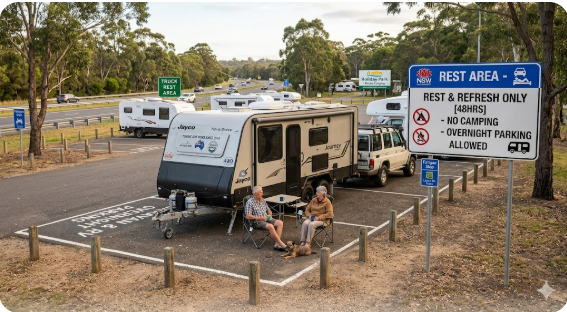
Free Camping vs Overnight Parking Australia: What Every Senior Grey Nomad Needs to Know
The rules are not the same — and confusing the two can cost you a fine. This plain-English guide explains exactly what free camping and overnight parking mean legally in Australia, how the rules differ state by state, and how to stay legal, safe and comfortable on the road.
📅 Last reviewed: May 2026 | Applies Australia-wide | Rules subject to change — always verify locally
Most grey nomads use the words “free camping” and “overnight parking” as if they mean the same thing. They do not. In Australia, these are two legally distinct activities governed by different authorities, different legislation, and very different consequences if you get them wrong. Whether you are pulling up at a highway rest area for the night, tucking into a national park campsite without paying, or sleeping in a suburban street in your motorhome, the rules that apply — and the penalties for breaking them — are completely different. This guide cuts through the confusion so you can travel with confidence.
- Free camping: Staying overnight on designated or permitted public land at no cost — usually in nature reserves, state forests or dedicated free camp areas
- Overnight parking: Sleeping in your vehicle while it remains parked — on roadsides, rest areas, car parks or streets — governed by parking and local government laws
- Self-containment: Required for many free camps and increasingly enforced; means your vehicle manages its own waste, water and power
- Time limits: Most rest areas allow 20–24 hours; some allow 48 hours; free camp areas vary by state and land manager
- Who enforces: Rangers, local council rangers, police and RMS/VicRoads officers all have different powers in different zones
- Fines: Can range from a warning to $300+ depending on the offence and state
- Best resource: Our free camping savings guide lists legal, verified overnight spots across Australia
Table of Contents
- What does free camping actually mean in Australian law?
- What is overnight parking and where is it allowed?
- Key differences: rules, time limits and self-containment
- State by state overview of rules
- Who enforces the rules and what rangers look for
- Self-containment requirements explained
- How to find legal free camping and overnight parking spots
- Common mistakes grey nomads make — and how to avoid them
- Stealth camping: what it is and why seniors should think carefully
- How long can you legally stay for free?
- Safety considerations for senior grey nomads
- Saving money legally: the real numbers
- Quick reference comparison table
- Frequently asked questions
- Final verdict: which is better for grey nomads?
1. What Does Free Camping Actually Mean in Australian Law?
The term “free camping” has no single legal definition that applies across all of Australia. What it means in practice depends entirely on the land you are camped on and who manages that land. Broadly speaking, free camping refers to staying overnight on public land at no cost, in a location where that activity is either explicitly permitted or not explicitly prohibited.
In Australia, land management is split between multiple authorities — the federal government (national parks and territories), state governments (state forests, crown land, state parks), and local governments (reserves, rest areas and road corridors). Each operates under different legislation and each has different rules about what is and is not permitted.
The three main categories of free camping land in Australia
- Crown land (state managed): In most states, camping on crown land is permitted unless signs prohibit it. Rules vary significantly between NSW, Queensland, Victoria, South Australia, Western Australia and the Northern Territory.
- State forests: Generally permit free camping with some restrictions. Campfire rules, vehicle access restrictions and maximum stay periods apply.
- Designated free camp areas: Specifically gazetted by local councils or state governments as permitted free camping zones. These often have time limits, self-containment requirements and sometimes booking systems.
For a detailed breakdown of what free camping means and which types of seniors benefit most from it, read our guide: What is free camping in Australia — a seniors guide.
2. What Is Overnight Parking and Where Is It Allowed?
Overnight parking is legally distinct from camping. It refers to leaving your vehicle stationary in a location for an extended period — including sleeping in it — without setting up camp equipment. In legal terms, you are a parked vehicle, not a camper. This distinction matters enormously because the laws that govern parking are different from the laws that govern camping.
Overnight parking is generally regulated by:
- Local council parking bylaws
- State road rules (e.g. the Australian Road Rules as adopted by each state)
- RMS or equivalent road authority signage on highways and rest areas
- National park entry conditions where applicable
Where overnight parking is commonly permitted
- Highway rest areas: The most commonly used overnight parking option for grey nomads. Most are managed by state road authorities and permit stays of 24 to 48 hours for fatigue management purposes.
- Roadside stops: Wide shoulders and designated stopping bays on rural highways often permit overnight stays, but the rules differ by state and signage.
- Council-approved town car parks: Some regional councils actively welcome grey nomads and permit overnight parking in designated areas — often signed with a caravan icon and time limit.
- Private property with permission: Staying overnight on private property with the owner’s explicit consent is legal and falls outside camping and parking regulations.
For a thorough look at where overnight parking is and is not permitted across Australia, including specific state rules, read: Overnight parking Australia — the complete guide.
3. Key Differences: Rules, Time Limits and Self-Containment
Understanding the practical differences between free camping and overnight parking can save you from fines, arguments with rangers, and genuinely uncomfortable situations. The table below summarises the core distinctions.
| Factor | Free Camping | Overnight Parking |
|---|---|---|
| Legal basis | Land management legislation (state/federal) | Road rules and local council parking bylaws |
| Who enforces | Park rangers, land management officers | Council rangers, police, RMS officers |
| Time limits | Varies — 1 night to 14 nights depending on area | Usually 24–48 hours at rest areas; shorter in towns |
| Self-containment required | Often required — especially in designated areas | Not usually required — but recommended |
| Camp setup permitted | Usually yes — within site rules | Usually no — you are a parked vehicle |
| Campfires | Sometimes — subject to fire restrictions | Almost never permitted |
| Booking required | Sometimes — increasing in popular areas | No — first come first served |
| Typical fine for breach | $100–$500+ depending on state and offence | $100–$300 depending on council/state |
| Toilet facilities | Sometimes — pit toilets or composting toilets | Sometimes — at rest areas |
| Dump points nearby | Rarely on site — usually in nearby towns | Rarely — must plan ahead |
4. State by State Overview of Rules
Australia has no single national law governing free camping or overnight parking. Each state and territory operates its own framework. What is perfectly legal in Queensland’s state forests may be prohibited in the same type of land in Victoria. The overview below covers the key rules in each jurisdiction as of 2026 — but always verify locally as rules change.
New South Wales
NSW has relatively restrictive free camping rules compared to Queensland. Camping on crown land requires a permit in most managed areas. State forests permit free camping in many locations but check with Forestry Corporation NSW before arriving. Highway rest areas on NSW roads permit overnight stays of up to 24 hours. Many regional councils have designated free or low-cost camp areas, particularly along the Princes Highway and inland routes.
Queensland
Queensland is generally considered the most free-camping-friendly state for grey nomads. Crown land camping is widely permitted across much of the state. Many local councils actively encourage grey nomad tourism by providing free or very low cost camp areas in town parks and reserves. Queensland state forests and timber reserves permit camping in most areas unless signage prohibits it. Most highway rest areas allow 24–48 hour stays.
Victoria
Victoria has strict rules around free camping. Camping in state forests is permitted in many areas but vehicle-based camping on crown land requires a permit in most managed areas. Parks Victoria manages national parks and overnight stays almost always require a paid booking. Rest areas on Victorian highways typically permit 24-hour stays. Some regional councils have designated rest areas for grey nomads — Henty, Nhill and Ouyen are known examples.
South Australia
SA permits camping on some crown land but the rules vary by region and land type. The Outback regions are generally more permissive. The Flinders Ranges and coastal areas require permits or paid bookings. Many SA towns have embraced grey nomad tourism and operate free or low-cost camps. Rest areas on SA highways generally permit overnight stays.
Western Australia
WA is a vast state with enormous diversity in land management. State forests and crown land often permit camping. DBCA (Department of Biodiversity, Conservation and Attractions) manages most national parks and requires paid bookings. Many remote pastoral stations offer free or very low cost camping with permission. The northwest and Kimberley regions have specific rules around camping on pastoral land — always ask the station owner directly.
Northern Territory
The NT is generally permissive about roadside and crown land camping, particularly in outback areas. However, Aboriginal land is strictly controlled — you require a permit to enter many areas, let alone camp. The Northern Land Council and Central Land Council issue permits. Darwin and Alice Springs have designated rest areas. Rest stops on the Stuart Highway typically permit overnight stays.
Tasmania
Tasmania has a mix of paid and free camping options. State forests permit vehicle-based camping in many areas. Some national park areas require paid passes (the Parks Pass). Roadside camping in designated areas is generally permitted but Tasmania’s climate and terrain add complications — not all roadside stops are accessible to large rigs.
Australian Capital Territory
The ACT is the most restrictive jurisdiction for free camping in Australia. Camping outside of designated paid campgrounds is generally not permitted. Overnight parking in urban areas is subject to normal parking rules. If you are travelling through the ACT, plan a paid camp or push through to the NSW border.
| State / Territory | Crown Land Camping | State Forest Camping | Rest Area Overnight | Grey Nomad Friendliness |
|---|---|---|---|---|
| Queensland | Generally permitted | Generally permitted | 24–48 hours | ★★★★★ |
| NSW | Permit often required | Permitted in most areas | 24 hours | ★★★☆☆ |
| Western Australia | Variable by region | Permitted in many areas | 24–48 hours | ★★★★☆ |
| South Australia | Variable by region | Variable | 24 hours | ★★★☆☆ |
| Northern Territory | Generally permitted (non-Aboriginal land) | Generally permitted | 24–48 hours | ★★★★☆ |
| Victoria | Permit often required | Permitted in many areas | 24 hours | ★★☆☆☆ |
| Tasmania | Variable | Permitted in some areas | 24 hours | ★★★☆☆ |
| ACT | Generally not permitted | Limited | Standard parking rules | ★☆☆☆☆ |
5. Who Enforces the Rules and What Rangers Look For
One of the most common questions grey nomads ask is: “Who is actually going to check on me?” The answer depends entirely on where you are parked and what authority manages that land. Understanding this helps you understand both the risk and the reality of enforcement.
Types of enforcement officers
- National and state park rangers: Have broad powers on park land including the power to issue fines, require you to move, and in serious cases arrange removal of your vehicle.
- Forestry officers: Similar powers to park rangers but on state forest land. Generally less numerous and patrols less frequent in remote areas.
- Local council rangers: Enforce council bylaws in town parks, reserves, car parks and designated rest areas within council boundaries. Common in coastal and tourist towns.
- Police: Can enforce road rules, noise complaints, and in some jurisdictions have the power to move on vehicles where a nuisance is being caused.
- RMS / road authority officers: Less commonly enforce overnight parking rules directly, but highway rest area signage is backed by state road rules.
What rangers and council officers actually look for
- Vehicles that have clearly been stationary for longer than the posted time limit
- Camp setups visible from the road — awnings out, chairs and tables deployed, external cooking equipment in use
- Grey or black water discharge onto the ground
- Campfires where fires are prohibited
- Generators running after quiet hours (typically 10pm)
- Vehicles parked on vegetation or in sensitive areas
- No self-containment certification where it is required
For a detailed look at exactly what rangers check and what they can and cannot do, read: What rangers look for at overnight van parking spots in Australia.
6. Self-Containment Requirements Explained
Self-containment is increasingly the dividing line between who can legally camp in many designated areas and who cannot. In New Zealand, self-containment certification (the NZMCA Freedom Camping certification) is well established. In Australia, the system is less formalised but the concept is spreading rapidly, particularly in Queensland, NSW and Victoria.
What self-containment means in practice
A self-contained vehicle is one that can manage its own waste, water and basic living needs without requiring external services. The key requirements are:
- Grey water tank: All sink and shower water contained on board — no discharge onto the ground
- Black water tank or cassette toilet: All toilet waste contained and disposed of at a dump point
- Potable water supply: Sufficient fresh water carried on board for the planned stay
- No campfire dependency: Cooking and warmth managed without open fires
Where self-containment is currently required in Australia
- Many designated free camp areas in Queensland explicitly require self-containment
- Some NSW council areas require it at designated overnight stops
- An increasing number of Victoria’s designated rest areas and free camp zones require it
- Freedom camping areas in the ACT (very limited) require it
7. How to Find Legal Free Camping and Overnight Parking Spots
Finding genuinely legal overnight spots across Australia requires more than a quick Google search. The most reliable sources combine official land management databases with community-verified reports from other grey nomads who have stayed there recently.
Official sources
- State forest websites: Forestry Corporation NSW, VicForests, Forestry Tasmania, DPIRD WA, and SA Forestry all publish camping information online
- Council websites: Many regional councils list designated grey nomad rest areas on their tourism pages
- State national parks booking systems: Parks Victoria, NSW National Parks, Queensland National Parks all have online booking portals
- WikiCamps Australia: Community-verified database of camps across Australia — not always up to date but useful for cross-referencing
- Campermate: Similar community-based app with map interface
- GasBuddy and Hema Explorer: Useful for planning fuel stops alongside camp locations
How to verify a spot before you commit
- Check the listing date on any app entry — entries older than 12 months may be outdated
- Read the comments section, not just the listing — other travellers often note when rules have changed
- Call the relevant council or land manager if in doubt — a two-minute phone call can save hours of uncertainty
- When you arrive, look for signage before setting up — if signage contradicts what the app told you, the signage is what matters legally
Our most comprehensive resource for verified free camping locations and savings strategies is: Van life savings spots — free and low-cost camps across Australia.
8. Common Mistakes Grey Nomads Make — and How to Avoid Them
After years of collecting stories from senior travellers, a clear pattern of recurring mistakes emerges. Most of them are honest misunderstandings about where the legal lines are. Here are the most common ones and how to sidestep them.
Mistake 1: Assuming rest areas are free camps
Rest areas exist to reduce driver fatigue. They permit overnight stays for that purpose. They are not campgrounds. Setting up an extended camp — with full outdoor furniture, cooking equipment and an awning deployed for days — will attract attention and in many states will result in a move-on notice or a fine.
Mistake 2: Staying too long
The single most common reason grey nomads receive fines or move-on notices at rest areas and designated overnight spots is overstaying the permitted time. Most rest areas are signed 24 hours. Some are 48 hours. A small number have no time limit stated. When no time limit is stated, do not assume unlimited stay — the general Australian road rule position is that you must not park for longer than reasonably necessary.
Mistake 3: Setting up camp outside the vehicle at a parking-only location
This is the most important distinction to understand. At an overnight parking location, you are a parked vehicle. The moment you deploy an awning and place furniture outside, you become a camper — and camping may not be permitted at that location. Keep your camp compact and primarily contained within or immediately adjacent to your vehicle.
Mistake 4: Assuming black and grey water disposal is safe anywhere
Discharging grey water onto the ground is illegal in virtually every managed area in Australia. Even at remote rest areas, grey water must be contained. Disposing of black water anywhere other than a designated dump point is a serious offence in all states and territories.
Mistake 5: Not checking for permit requirements before entering
Some popular free camping areas now require online booking or a camping permit obtained in advance. Walking in (or driving in) without one puts you in the same position as camping without permission. Always check before you leave, not after you arrive.
9. Stealth Camping: What It Is and Why Seniors Should Think Carefully
Stealth camping means deliberately positioning your vehicle and concealing your overnight presence to avoid detection — typically in urban areas, suburban streets, car parks or locations where overnight stays are technically not permitted. It is popular with younger van lifers who can move quickly and pack up before dawn. For senior grey nomads, the picture is more complicated.
Stealth camping is not illegal in itself — parking in a legal parking space is always legal, and sleeping in your parked vehicle is not an offence in most Australian states unless a local bylaw specifically prohibits it. The issues arise when:
- You park in a timed zone and stay beyond the time limit
- A local bylaw prohibits sleeping in vehicles in that area
- You are perceived as creating a nuisance and police are called
- You set up anything outside the vehicle
The honest recommendation for senior grey nomads is to treat stealth camping as a last resort rather than a primary strategy. The mental load of finding a safe, discreet location, monitoring for council rangers, and packing up before dawn is tiring and stressful in a way that quickly offsets the money saved. Legal free camping at a proper designated spot — even one that is slightly further from your destination — is nearly always the better choice for senior travellers.
10. How Long Can You Legally Stay for Free?
This is the question every grey nomad asks and the answer is genuinely complicated because it depends on exactly where you are, who manages the land, and what the current signage says. Here is an honest breakdown by location type.
| Location Type | Typical Maximum Stay | Who Sets the Rule | Consequence of Overstay |
|---|---|---|---|
| Highway rest area | 24–48 hours | State road authority | Move-on notice, possible fine |
| Council designated free camp | 2–7 nights typically | Local council | Fine and move-on |
| State forest free camp | 14 nights in most states | State forestry authority | Move-on notice |
| Crown land (unpermitted) | No formal limit in many areas | State land management | Uncertain — depends on local rules |
| National park campsite (paid) | As per booking — typically 2–14 nights | National park authority | Cancelled booking, removed |
| Town car park (overnight) | As per parking sign — often 12 hours | Local council | Parking fine |
For a detailed state-by-state breakdown of stay limits and how they affect your travel budget, read: Free camping for retirees — how long can you stay and how much can you save?
11. Safety Considerations for Senior Grey Nomads
Safety at free camps and overnight parking locations is not just about crime — it is about medical readiness, vehicle security, communication capability and terrain suitability. Senior travellers have specific needs that younger campers do not always plan for.
Personal safety
- Tell someone your plan: Always let a trusted person know your intended overnight location before you stop. If you change plans, update them. This is the single most important safety habit for solo senior travellers.
- Check mobile coverage before you commit to a remote site: Being overnight in a location with no mobile signal is manageable if you are prepared; it becomes dangerous if you have a medical event and no way to call for help.
- Park facing the exit: Always position your vehicle so you can drive out without reversing in a hurry. This is basic safety and also reduces your anxiety at unfamiliar sites.
- Trust your instincts: If a location feels wrong when you arrive — unfamiliar people nearby, poor sightlines, signs of previous anti-social activity — move on. No free camp is worth a night of genuine fear.
- Lock up properly: Even at quiet rest areas, lock all doors before sleeping. Vehicle security is not paranoia — it is basic preparation.
Medical and health safety
- Carry a minimum 48-hour supply of all prescription medications beyond what you expect to need
- Know the location of the nearest hospital to any area you plan to stay in — look it up before you leave mobile coverage
- If you use a CPAP machine, plan your power source (solar, battery bank or inverter) before you commit to an unpowered site
- In hot weather, plan shade before you plan the camp — heat stress in an enclosed van or caravan is a genuine medical risk for older travellers
- Carry an emergency Personal Locator Beacon (PLB) if you are travelling into remote areas with patchy mobile coverage — they are available for around $300 and can be life-saving
12. Saving Money Legally: The Real Numbers
The financial case for free camping and legitimate overnight parking is compelling — but only when it is done legally and sustainably. Here is an honest look at what the savings actually amount to over a typical grey nomad journey.
| Accommodation Type | Typical Nightly Cost | Cost Over 180 Nights | Compared to Free Camping |
|---|---|---|---|
| Caravan park — unpowered | $25–$40 | $4,500–$7,200 | Costs more |
| Caravan park — powered | $35–$60 | $6,300–$10,800 | Costs significantly more |
| Holiday park — peak | $50–$100+ | $9,000–$18,000+ | Costs dramatically more |
| Free camp — legal | $0 | $0 | Baseline |
| Low-cost council camp | $5–$15 | $900–$2,700 | Still much less than caravan parks |
A grey nomad who uses free camps and low-cost overnight stops for even 60% of their nights on the road can save $3,000–$6,000 over a six-month trip compared to exclusively using powered caravan parks. Over a full year on the road, those savings fund several weeks of extra travel.
13. Quick Reference Comparison Table
Use this table as a quick reference when you are trying to decide whether a specific location qualifies as a legitimate free camp, a legal overnight parking spot, or neither.
| Question to Ask | Free Camping | Overnight Parking | Neither — Move On |
|---|---|---|---|
| Is there a sign permitting camping? | Yes | N/A | No sign — uncertain |
| Is there a sign permitting overnight parking? | N/A | Yes or no prohibition sign | Prohibition sign present |
| Is it a managed rest area with toilet? | No — this is overnight parking only | Yes — if no camping signs | If camping signs and no permit |
| Is it a state forest? | Likely yes — check forestry website | N/A | If “no camping” signs present |
| Is it a national park? | Only in designated paid campsites | Only in designated car parks | Anywhere else in the park |
| Is it a town car park? | No | If no time restriction or within time | If time restriction exceeded |
| Is there a no camping / no overnight sign? | No | No | Yes — do not stay |
14. Frequently Asked Questions
Is free camping legal in Australia?
Yes — in many locations and under many conditions. Free camping is legal in most state forests, on much of Australia’s crown land (particularly in Queensland, Western Australia and the Northern Territory), and in specifically designated free camp areas operated by local councils. It is not universally legal everywhere — national parks, private land, and many urban areas do not permit free camping. The legality depends entirely on the specific location and the land management rules that apply to it.
What is the difference between free camping and overnight parking?
Free camping means setting up an overnight camp on designated or permitted land at no cost — you may be entitled to set up camp equipment, cook outside, and stay for multiple nights. Overnight parking means sleeping in your vehicle while it is parked — you are legally a parked vehicle, not a camper. Camping equipment deployed outside the vehicle typically converts your legal status from “parked” to “camping,” which may not be permitted at overnight parking locations such as highway rest areas.
Can grey nomads sleep in their van at a highway rest area?
Yes — in most Australian states, sleeping in a vehicle at a designated highway rest area is permitted and even encouraged for fatigue management. The typical stay limit is 24 hours, though some rest areas allow 48 hours. What is not permitted at most rest areas is setting up a full camp outside the vehicle. Keep your setup contained, stay within the time limit, and you will generally be within the law.
Do I need a self-contained vehicle to free camp in Australia?
It depends on the specific location. Self-containment is increasingly required at designated free camp areas, particularly in Queensland and NSW. At informal bush camping locations, rest areas and roadside stops, self-containment is often not formally required — but it is always best practice. A self-contained setup means you can stay at a wider range of locations as requirements tighten, and it reduces your environmental impact regardless of the rules.
How long can you stay at a free camp in Australia?
This varies significantly by location type. Highway rest areas typically permit 24–48 hours. Designated council free camps typically allow 2–7 nights. State forests usually permit up to 14 consecutive nights. Some remote crown land locations have no formally posted limit, but staying indefinitely in one spot will eventually attract attention from land managers. Always follow the posted time limit. Where no limit is posted, treat 48 hours as a reasonable guide. For a full breakdown, read: How long can you legally stay for free in Australia?
What happens if a ranger asks me to move on?
Cooperate immediately and move without argument. Rangers in Australia have the legal authority to direct you to leave land they manage. Arguing, delaying or refusing to move escalates the situation and can result in a formal fine or, in extreme cases, having your vehicle towed. If you believe you were asked to move incorrectly, note the details — officer name, time, location — and raise a formal complaint with the relevant authority afterwards. Never argue with a ranger at the scene.
Is overnight parking in a suburban street legal in Australia?
Parking a vehicle in a legal parking space is always legal, and sleeping in your vehicle while parked there is not specifically prohibited in most Australian states. However, if a local council bylaw prohibits sleeping in vehicles in that area, or if you overstay a timed zone, you can be fined. Some councils — particularly in coastal tourist areas — have introduced specific bylaws prohibiting sleeping in vehicles in residential streets. Check local council rules before relying on street parking as an overnight option in any town.
What do rangers actually check when they approach a van at a rest area?
Rangers generally check whether you are within the time limit, whether you have set up camp outside the vehicle (which may not be permitted), whether there is evidence of grey or black water discharge, and whether you have any required permits. They are not routinely checking vehicle registration or running licence checks — unless there is a specific reason to do so. Being polite, having your vehicle self-contained, and being within the time limit means a ranger visit is usually brief and uneventful. Read the full detail: What rangers look for at overnight van parking stops.
Is stealth camping safe for senior solo travellers?
Stealth camping — deliberately concealing your overnight presence in locations where camping or parking may not be ideal — carries risks that are more significant for older solo travellers than for younger groups. Security, medical access, and the stress of monitoring for enforcement all add up. For most senior grey nomads, using legitimate free camps and legal overnight stops is a far better strategy. Read our honest assessment: Stealth camping in Australia — is it worth the risk?
15. Final Verdict: Which Is Better for Grey Nomads?
The honest answer is that “free camping” and “overnight parking” are not in competition — they are tools in a toolkit, and experienced grey nomads use both strategically. Free camping in designated state forest or council free camp areas gives you more flexibility, longer stays, and in many cases a more comfortable and scenic experience than a highway rest area. But it requires more planning, often requires self-containment, and is not always available on a given night’s route. Overnight parking at highway rest areas is available almost everywhere on the national highway network, requires almost no planning, and gives you a safe, legal stop when a free camp is not accessible.
The grey nomads who travel most successfully over long periods are the ones who understand both options, know where the legal lines are, and refuse to take risks that are not worth taking. A fine, a confrontation with a ranger, or a night in an unsafe location all carry costs — financial, emotional and physical — that outweigh any saving from pushing into legally uncertain territory. Use verified free camps and overnight spots, respect time limits, keep your camp self-contained, and you will travel legally, comfortably and for far less money than you ever imagined possible.
- What is free camping in Australia — the complete seniors guide
- Overnight parking Australia — rules, locations and what to expect
- What rangers look for at overnight van parking spots in Australia
- Free camping for retirees — how long can you stay and how much can you save?
- Stealth camping Australia — honest guide for senior travellers
- Van life savings spots — verified free and low-cost camps across Australia
- Free camping NSW — where seniors can legally stop for free
- Queensland free camping guide — the best spots for grey nomads
- Grey nomad safety tips — staying safe on the road after 60
- Sydney to Victoria via the Princes Highway — overnight stop guide
Free campsites and rest areas fill fast during school holidays and peak season. If your preferred spot is already taken, search remaining accommodation options below to keep your trip moving.
Accommodation and flight search powered by Expedia. Booking through this search supports this website at no extra cost to you. As an affiliate, I earn from qualifying purchases at no extra cost to you.

As an affiliate, I earn from qualifying purchases at no extra cost to you.
Exclusive Offer: Get 5% OFF all StarterStopper immobiliser products with promo code: RTV5
Visit StarterStopper.com to see our data-backed security solutions
As an affiliate, I earn from qualifying purchases at no extra cost to you.