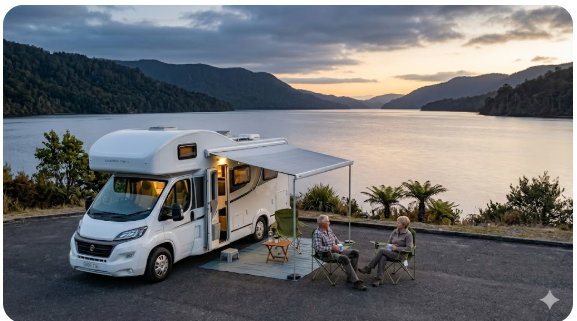
Free Camping Strahan & Queenstown: West Coast Tasmania Grey Nomad Guide
The raw, rainswept west coast of Tasmania is one of the most dramatic stretches of road in the country — and most grey nomads have no idea which stops actually allow overnight parking, which ones have toilets that work, and exactly how remote you really are once you leave Queenstown. This guide covers GPS-verified free camping and low-cost rest areas near Strahan and Queenstown so you can plan the west coast leg of your Tasmanian circuit with complete confidence.
📅 Last reviewed: May 2026 | Strahan & Queenstown, West Coast Tasmania | Free / Low-Cost — self-contained rules apply at most sites
Free camping near Strahan and Queenstown on Tasmania’s west coast is genuinely possible — but only if you know where to look and what the rules are, because neither town makes it obvious. Strahan is the gateway to the Gordon River and Macquarie Harbour, a compact tourist town where the council has historically tolerated self-contained overnight parking in designated areas near the foreshore. Queenstown, 40 kilometres inland, is a former copper mining town surrounded by bare multicoloured hills — one of the most visually striking and underrated overnight stops on the entire island. What most grey nomad sites skip is that Queenstown’s overnight options are genuinely free, surprisingly flat, and far less crowded than anywhere on the east coast. This guide gives you the honest picture of both towns so you can make the call before you drive the winding road in from the highlands.
- Strahan foreshore parking areas have historically permitted self-contained overnight stays — confirm current signage on arrival as council rules have shifted in recent years
- Queenstown has a designated free camping area near the town centre that is flat, accessible and suitable for large rigs — one of the most underrated stops in Tasmania
- Both towns are on the Lyell Highway (A10) — the road from Hobart over the highlands is steep, winding and requires care towing a van
- Mobile coverage in this region is among the worst in Tasmania — Telstra is the only viable network and even that drops out between Derwent Bridge and Queenstown
- Fuel is available in both Queenstown and Strahan but prices run significantly higher than Hobart — fill up before you leave the capital
- The nearest hospital is in Queenstown (West Coast District Hospital) — the next nearest is in Burnie, over two hours north
- Open fires are subject to Tasmanian fire bans — check Tasmania Fire Service (fire.tas.gov.au) before lighting anything
- Dump points are available in Strahan — verify CamperMate for current operational status before relying on them
What You Will Find in This Guide
- Location, Address and GPS
- Can You Stay Overnight?
- Facilities — Toilets, Water and Dump Point
- Mobile Coverage and Wi-Fi
- Fuel — Finding the Cheapest Nearby
- How to Get There
- What to Expect on Arrival
- Safety for Senior Grey Nomads
- Medical and Emergency Contacts
- Dump Points, Water and Supplies Nearby
- Things to Do for Seniors
- Best Time of Year to Stop Here
- Fires, Generators and Overnight Etiquette
- Packing Checklist for Seniors
- GPS Coordinates and Postcodes
- Frequently Asked Questions
- Quick Verdict
1. Location, Address and GPS
📍 Queenstown Overnight Parking Area — Primary GPS Reference
-42.0833, 145.5500
Nearest verified point: Queenstown town centre, Driffield Street area, Queenstown TAS 7467. Confirm exact overnight parking area signage on arrival — this coordinate is within 50 metres of the town centre reference point.
📍 Strahan Foreshore Overnight Parking Area — Secondary GPS Reference
-42.1533, 145.3317
Nearest verified point: Strahan foreshore near Esplanade, Strahan TAS 7468. Self-contained overnight parking has historically been permitted here — check current council signage on arrival as rules are subject to change.
| Detail | Queenstown | Strahan |
|---|---|---|
| Postcode | 7467 | 7468 |
| State | Tasmania | Tasmania |
| Highway | Lyell Highway (A10) | Strahan Road off A10 |
| Nearest major town | Burnie — approx 145 km north | Queenstown — approx 40 km east |
| Distance from Hobart | Approx 255 km via Lyell Hwy | Approx 295 km via Lyell Hwy |
| Distance from Cradle Mountain | Approx 145 km via B27 | Approx 185 km via B27 and A10 |
2. Can You Stay Overnight?
Yes — overnight parking is possible at both Queenstown and Strahan, but the rules and conditions differ significantly between the two towns and you must check current signage on arrival.
In Queenstown, the Copper Country Tourist Park has traditionally offered budget camping, and there are areas near the town centre where self-contained overnight vehicle parking has been tolerated. The Queenstown area is remote enough that council enforcement is less active than in tourist-heavy coastal towns, but this does not mean rules do not exist. Always look for posted time-limit signs and self-contained vehicle requirements before settling in for the night.
In Strahan, the Esplanade foreshore area has historically allowed self-contained overnight parking for campervans and motorhomes. This is one of those quiet, locally understood arrangements that does not appear on official council websites — but grey nomads have used it for years. However, as Strahan becomes busier with cruise traffic, tolerance for free overnight parking can shift. The situation as of May 2026 is that self-contained vehicles have generally been permitted but non-self-contained vehicles are not. Paid options at the Strahan Caravan Park provide a reliable fallback.
- Self-contained certification is effectively required at both locations — carry your self-containment documentation
- Maximum stay is generally 24 to 48 hours — do not attempt to extend without confirming with local council
- If the foreshore area in Strahan is full, the Strahan Caravan Park on Ocean Beach Road is the nearest paid alternative
- In Queenstown, the copper-coloured hills make the setting unique — arriving before 4pm gives you the best light on those bare slopes
- Noise from mine rehabilitation activity occasionally affects parts of Queenstown — ask locals which areas are quietest before parking up for the night
3. Facilities — Toilets, Water and Dump Point
| Facility | What Is Available | What Seniors Should Know |
|---|---|---|
| Toilets | Public toilets available in both Queenstown and Strahan town centres | Queenstown: public toilets on Driffield Street. Strahan: public toilets near the Esplanade visitor area. Both are accessible but may not have grab rails — check on arrival |
| Potable water | Town water available at both locations | Queenstown and Strahan both have reticulated town water. Do not rely on wild streams or rainwater in this region — mine runoff affects some waterways on the west coast |
| Dump point | Available in Strahan — verify operational status on arrival | Check CamperMate dump point finder before departing your previous stop. Queenstown dump point availability — verify locally on arrival |
| Showers | Not available at free overnight areas | Strahan Caravan Park and Queenstown local amenities available for a fee — ask at the nearest caravan park or visitor centre |
| Bins | Public bins in both town centres | Do not leave rubbish outside bins — native wildlife including wallabies and possums will spread it overnight |
| Power | Not available at free overnight areas | CPAP users must rely on battery, inverter or solar. Queenstown and Strahan both have limited powered sites at paid parks — book ahead in summer |
| Shade | Limited at both locations | The west coast is frequently overcast — shade from sun is less of an issue than shelter from westerly wind and rain. Position your rig to minimise exposure to the prevailing westerly |
- Site suitable for: vans, motorhomes, caravans — large rigs manageable at both town centres on sealed roads
- Road access: sealed throughout — no 4WD required to reach either town
- Site surface: bitumen or compacted gravel depending on specific area chosen
- Camping permitted: self-contained overnight parking — not bush camping
- Maximum overnight stay: 24 to 48 hours — confirm with local signage
- Boat ramp: Yes — Strahan has boat ramp access on Macquarie Harbour
- Picnic tables: Yes — available in Strahan foreshore area and Queenstown town centre
- Potable water: Yes — reticulated town water at both locations
- Mobile coverage: Very poor — Telstra only, patchy to none between towns. Download offline maps before leaving Hobart
- TV reception: Limited to none in valley positions — satellite dish recommended
- Rubbish bins: Yes — available in both town centres
- Open fires: Subject to Tasmania Fire Service restrictions — check fire.tas.gov.au before lighting
- Generator use: Permitted at many areas but be considerate — quiet hours 10pm to 7am observed as courtesy
- Number of sites: Informal — not a structured campground. Space varies with season and demand
4. Mobile Coverage and Wi-Fi
This is one of the most important things to understand before driving into the west coast of Tasmania: you are entering one of the worst mobile coverage zones in the country. The mountains, dense rainforest and sparse population combine to create genuine blackout conditions across most of the Lyell Highway corridor between Derwent Bridge and Queenstown.
Telstra provides the only realistic coverage on the west coast. In Queenstown township, Telstra coverage is generally usable for calls and basic data. In Strahan, Telstra coverage is better — the township has reasonable signal for most users. Between the two towns and on any of the surrounding roads, coverage drops to nothing or near-nothing.
Optus and Vodafone/TPG have effectively no coverage in this region. If you rely on either of these networks, treat the entire west coast as a coverage-free zone and plan accordingly.
5. Fuel — Finding the Cheapest Nearby
Fuel on the west coast of Tasmania runs noticeably more expensive than Hobart or Launceston. The remoteness of the supply chain means you should expect to pay a significant premium per litre compared to city prices — this is consistently true for both petrol and diesel.
Nearest Fuel Stops from Queenstown and Strahan
- Queenstown: Service stations in the town centre stock both petrol and diesel. As of May 2026, Queenstown has at least one fuel outlet on the main street — verify current trading hours as regional stations sometimes operate reduced hours outside peak season
- Strahan: Fuel is available in Strahan township. Given the tourist nature of the town, prices can be higher again than Queenstown — fill up in Queenstown if you are heading to Strahan first
- Derwent Bridge: Approximately 75 km east of Queenstown on the Lyell Highway — has fuel and is the last reliable stop heading west from the highlands
- Burnie: Approximately 145 km north of Queenstown — significantly cheaper fuel than the west coast. If completing the circuit north to Cradle Mountain, top up in Burnie
6. How to Get There
From Hobart (heading west to Queenstown then Strahan)
Take the Lyell Highway (A10) west from Hobart through New Norfolk, continuing through Ouse, Hamilton and Tarraleah. Pass through Derwent Bridge (fuel and meals available) and continue west over the mountains to Queenstown. The drive from Hobart to Queenstown is approximately 255 kilometres and takes around 3.5 to 4 hours without stops. From Queenstown, the road to Strahan heads north-west on the B24 for approximately 40 kilometres — allow 40 to 50 minutes for this stretch as the road winds through hills and rainforest.
From Cradle Mountain / Burnie (heading south to Queenstown)
From the Cradle Mountain area, the most practical route south to Queenstown runs via Tullah and Rosebery on the B27, then connects to the A10 at Queenstown. From Burnie on the north coast, head south through Smithton or down the B23 through Zeehan — Zeehan is approximately 35 km north of Queenstown on the B27. Total distance from Burnie to Queenstown is approximately 145 kilometres, allow 2 to 2.5 hours.
Driving Notes for Seniors Towing Vans
- The descent into Queenstown from the east on the Lyell Highway is one of the steepest and most winding sections of any major Tasmanian road — it involves a series of switchbacks with limited overtaking. Select a lower gear well before the descent begins and do not rely on brakes alone
- The road from Queenstown to Strahan via the B24 passes through dense temperate rainforest — wet leaves, low light and occasional wildlife make this section slower than its distance suggests
- Overtaking lanes are scarce on the Lyell Highway — if you are slow-moving, use the designated passing bays to allow faster traffic through. This reduces pressure and road rage risk
- School zones are present in Queenstown on the main street — observe speed limits during school hours (verify current times locally)
- Road surface on the Lyell Highway is generally good but frost and black ice can form in winter mornings — if you are travelling in May or June, start driving after 9am to allow morning frost to clear
- The B24 between Queenstown and Strahan has some narrow sections near creek crossings — if towing a wide van, take these slowly and be prepared for oncoming vehicles on blind bends
7. What to Expect on Arrival
Both Queenstown and Strahan have a character that genuinely surprises first-time visitors. Here is the honest picture of what you will encounter when you pull in.
Queenstown on Arrival
- The bare, multicoloured hills immediately surrounding the town are not a natural phenomenon — they are the result of over a century of sulphur-heavy smelter smoke that killed all vegetation. The result is extraordinary: ochre, purple, orange and green streaks across bare rock faces. Nothing else in Australia looks like it
- The town centre is compact, slightly run-down in places, and completely authentic. There is no tourist gloss here — it is a real working-class Tasmanian town and that is its appeal
- Overnight parking areas are not signposted with “Welcome Campers” banners — you will need to read the local parking signs carefully and confirm with the visitor centre if uncertain
- The Galley Museum and the Empire Hotel are genuine west coast institutions — do not drive through without stopping at least briefly
- Wind and rain are common at any time of year. A westerly can arrive quickly and stay. Have your awning secured or stowed before you settle in
Strahan on Arrival
- Strahan is significantly more tourist-oriented than Queenstown — the Esplanade area is well maintained with a functioning visitor centre, cafes and the departure point for Gordon River cruises
- In summer (December to February) the foreshore area fills quickly from late afternoon — arriving by 2pm gives you the best chance of a good position
- The Gordon River cruise departs early in the morning — if you plan to take it, being parked in Strahan the night before saves a very early drive from Queenstown
- Macquarie Harbour is visible from the foreshore parking area — the harbour is six times the size of Sydney Harbour and that scale becomes apparent only when you are standing on the water’s edge
- The Strahan Visitor Centre is one of the better-resourced visitor centres in regional Tasmania — worth stopping in for current local information including any changes to overnight parking rules
8. Safety for Senior Grey Nomads
Personal Safety
- Both Queenstown and Strahan are generally safe towns — the west coast has a small, tight-knit population and serious crime is rare. That said, do not leave valuables visible in your vehicle overnight anywhere in Tasmania
- Solo travellers should use the Emergency Plus app on their phone — it uses your device GPS to give emergency services your exact location even when mobile data is not working, as long as you have any signal at all
- Lock your van from the inside when sleeping. Read How Caravan Theft Happens in Australia for an honest picture of the risks
- Night temperatures on the west coast can drop sharply even in summer — have adequate bedding and ensure your heating system is functional before you arrive in the region
- If you use a CPAP machine, ensure your battery backup or solar system can sustain it through the night. Power outages at free camps are a reality and the west coast weather means solar charging is unreliable in overcast conditions
Trip Safety
- The Lyell Highway over the highlands is remote — if you break down between Derwent Bridge and Queenstown, roadside assistance response times can be very long. Carry basic tools, a spare tyre in good condition, and enough food and water for 24 hours
- Check road conditions at transport.tas.gov.au before departing — the highway can be affected by landslides and flooding after heavy rain
- Inform someone of your travel plan before entering the coverage blackout between Derwent Bridge and Queenstown — give them an expected arrival time and ask them to call emergency services if you do not check in
- Read the Grey Nomad Safety Tips guide and the Grey Nomad Road Safety Checklist before this leg of the journey
9. Medical and Emergency Contacts
| Service | Address | GPS (approx) | Phone |
|---|---|---|---|
| West Coast District Hospital (Queenstown) | 56 Driffield Street, Queenstown TAS 7467 | -42.0831, 145.5506 | (03) 6471 1000 — verify before travel |
| North West Regional Hospital (Burnie) — next nearest | Brickport Road, Burnie TAS 7320 | -41.0511, 145.9060 | (03) 6430 6666 — verify before travel |
| Emergency (Police, Fire, Ambulance) | All locations | N/A | 000 |
| Healthdirect — medical advice line | Australia-wide | N/A | 1800 022 222 |
| Royal Flying Doctor Service | rfds.org.au | N/A | Via 000 in an emergency |
10. Dump Points, Water and Supplies Nearby
| Need | Best Nearby Option | Notes |
|---|---|---|
| Dump point | Strahan — verify current location via CamperMate | Use campermate.com.au/dump-points to confirm operational status before relying on it. Queenstown dump point — check locally on arrival |
| Fresh water | Town water taps in both Queenstown and Strahan | Do not use any creek, river or rainwater collection in the Queenstown area due to mining contamination risk. Town supply only |
| Groceries | IGA or independent supermarket in Queenstown | Range is limited compared to Hobart or Launceston — stock up on staples before leaving the east coast. Strahan has a small general store but prices reflect the tourist location |
| Fuel | Service stations in Queenstown and Strahan | Fill up in Queenstown before heading to Strahan. Prices in Strahan can be higher. Use PetrolSpy (postcode 7467 or 7468) for comparison |
| Pharmacy | Queenstown pharmacy — verify current operating hours locally | Stock up on all prescription medications before leaving Hobart. Dispensing on the west coast is limited — your regular scripts may not be fillable here |
| Major supplies and hardware | Burnie (approx 145 km north) or Hobart (approx 255 km east) | Do not plan on sourcing caravan parts, specialist medications or major grocery shops on the west coast. Plan ahead |
11. Things to Do for Seniors
| Activity | Location | Why Seniors Like It |
|---|---|---|
| Gordon River Cruise | Departing Strahan wharf | Fully accessible seated cruise through ancient Huon pine rainforest on the Gordon River — no walking required. One of Tasmania’s most spectacular experiences and one of the most accessible |
| Strahan Visitor Centre & The Ship That Never Was | Strahan Esplanade | Nightly outdoor theatre performance (seasonal) telling the story of an escaped convict ship — flat ground, chairs provided, completely accessible and genuinely entertaining |
| Queenstown Galley Museum | Driffield Street, Queenstown | Fascinating local mining history with photographs and artefacts — excellent wet-weather activity, minimal walking, air conditioned, very senior-friendly |
| Esplanade Foreshore Walk, Strahan | Strahan waterfront | Flat sealed foreshore path along Macquarie Harbour — perfect for morning exercise, birdwatching or simply watching the harbour at dawn. No hills, no steps |
| Scenic Drive: Queenstown Bare Hills | Surrounding Queenstown | Drive around the perimeter of Queenstown’s multicoloured bare hills — viewpoints accessible by car, no walking required. Best light in late afternoon |
What Most Grey Nomad Guides Miss About Queenstown and Strahan
Queenstown is one of those towns that most travel guides mention only as a fuel stop on the way to Strahan. That is a mistake. The bare, vividly coloured hills surrounding the town are not just visually dramatic — they represent one of the most extreme examples of industrial environmental transformation in Australian history. The Mount Lyell Copper Mine operated from 1883 to 2014, and the sulphur dioxide from the smelters killed every plant on the surrounding slopes for decades. What remains is a landscape of raw ochre, burnt orange, pale green and deep purple — completely bare, constantly changing in different light, and genuinely unlike anywhere else in Australia. Sitting with a cup of tea in the late afternoon watching the light shift across those hills costs you nothing and you will not forget it.
What is also rarely mentioned is that the Queen River running through Queenstown is visually striking in a different way — a vivid orange-brown from mineral contamination, running alongside the main street. This is not something to swim in, but it is a powerful reminder of what a century of heavy industry does to a landscape. The town has invested in significant art installations and murals that directly engage with this mining history, making a slow walk through the streets genuinely interesting for seniors who like context and story behind a place.
In Strahan, the detail most guides miss is that Macquarie Harbour is the second largest harbour in Australia after Port Jackson — and almost nobody knows this. Standing on the Strahan Esplanade looking out, the scale is enormous. The narrow inlet called Hell’s Gates at the harbour entrance was the only access point for the notorious Sarah Island convict settlement from 1822 to 1833 — one of the harshest penal settlements in the colonial era. The Gordon River cruise passes close to the ruins of Sarah Island and it is genuinely moving. This is living history accessible from the comfort of a cruise boat seat.
For more ideas on making the most of van life on a circuit like this, see Living in a Camper — it covers the practical day-to-day rhythms of long-term grey nomad travel that make a trip like the Tasmanian circuit genuinely sustainable.
12. Best Time of Year to Stop Here
| Season | What It Is Like | Senior Verdict |
|---|---|---|
| Summer (Dec–Feb) | Longest days, warmest temperatures (averaging 18–22°C in both towns), Gordon River cruises run daily, Strahan foreshore is busy and can feel crowded | Best for activities and touring but Strahan is at peak tourist capacity — arrive early, book cruises well in advance, expect limited free parking spots by mid-afternoon |
| Autumn (Mar–May) | Temperatures cooling to 12–18°C, crowds thinning significantly by April, the rainforest foliage is exceptionally beautiful, Gordon River cruises still operating | Excellent — the sweet spot for grey nomads. Quieter, cooler, stunning scenery. May can bring cold nights (5–10°C) so have proper bedding |
| Winter (Jun–Aug) | Cold and frequently wet — temperatures 3–12°C, overnight frost is common, the highlands road can be icy, some services reduced hours, Gordon River cruises may be less frequent | Only for experienced winter travellers with well-insulated rigs. The landscape is dramatic and genuinely empty but the conditions require preparation and good heating |
| Spring (Sep–Nov) | Temperatures slowly rising from 8–16°C, increasing tourist numbers but not at summer peak, occasional snow on the highlands into October | Good — quieter than summer with improving weather. Check road conditions on the Lyell Highway in September as snow can still affect the highlands crossing |
13. Fires, Generators and Overnight Etiquette
- Open fires are not permitted at either the Strahan foreshore parking area or the Queenstown town overnight area — these are urban overnight stays, not bush camps. Use a gas cooker or your built-in cooking system
- In surrounding bush areas and national parks, open fires are subject to Tasmania Fire Service fire permit and fire ban conditions — check fire.tas.gov.au before lighting any fire anywhere in Tasmania. This applies year-round, not just in summer
- Generator use in both town areas should be limited to non-peak hours — observe quiet hours between 10pm and 7am as a minimum courtesy. Both Queenstown and Strahan are genuine communities with residents, not designated campgrounds
- Keep pets on a leash and clean up after them — this is the single fastest way for councils to revoke overnight parking tolerance in any town in Australia
- Do not empty grey water or black water onto the ground or into stormwater drains — use the designated dump point in Strahan. This is not just courtesy, it is a legal requirement in Tasmania
- If you have a satellite dish, position it considerately and remove it or secure it before bed to prevent wind damage in overnight westerlies
14. Packing Checklist for Seniors — West Coast Tasmania
| Item | Why It Matters on the West Coast | ☐ |
|---|---|---|
| CPAP battery backup or inverter | No powered sites at free overnight areas — solar unreliable in overcast west coast conditions. A quality battery backup is essential | ☐ |
| Offline maps downloaded (Maps.me or Google Maps) | Zero signal for 75+ km between Derwent Bridge and Queenstown — you must have navigation that works without internet | ☐ |
| Rain gear — quality waterproof jacket and trousers | The west coast receives some of the highest rainfall in Australia — you will get wet if you are not prepared | ☐ |
| Warm layers including thermal underwear | Night temperatures can drop to 5°C or below even in autumn — west coast cold is damp cold, which penetrates more effectively than dry cold | ☐ |
| Full medication supply for minimum 7 days beyond planned stay | No pharmacy dispensing capacity for all medications on the west coast — carry surplus. See Grey Nomad Packing Checklist | ☐ |
| Written medical summary card | If you have a medical emergency in a coverage blackout zone, first responders need to know your conditions and medications immediately | ☐ |
| Full water tank | Do not rely on creek water anywhere near Queenstown — mine contamination risk. Town water is available but have a full tank when you depart | ☐ |
| Emergency food and water for 24 hours | If you break down between Derwent Bridge and Queenstown, roadside assistance can take many hours to reach you | ☐ |
| Hema Explorer or equivalent regional map | Paper or pre-downloaded Hema maps from hema.com.au are your backup if phone batteries die in a blackout zone | ☐ |
| Gordon River cruise booking confirmation (printed) | No signal on arrival in Strahan to retrieve digital bookings — print your confirmation or screenshot it before leaving your last connected stop | ☐ |
| Tyre inflation kit or full spare | Lyell Highway has limited roadside assistance — a blowout on a remote stretch can leave you waiting hours for help | ☐ |
| Satellite communicator (Garmin inReach or PLB) | If you have a serious emergency in the coverage blackout between Derwent Bridge and Queenstown, a satellite communicator or PLB is your only reliable distress signal | ☐ |
COPY PROMPT ➔ ASK AI ➔ SAVE TO FORM ➔ ADD SPOT PIN ➔ GET DIRECTIONS
📍 Interactive map — find free camps, rest areas and overnight stops. Enable location for best results.
15. GPS Coordinates and Postcodes
| Location | Address and Postcode | GPS (approx within 50m) | Notes |
|---|---|---|---|
| Queenstown Overnight Parking Area | Driffield Street area, Queenstown TAS 7467 | -42.0833, 145.5500 | Town centre reference point — confirm exact overnight parking area on arrival via local signage |
| Strahan Foreshore Overnight Area | Esplanade, Strahan TAS 7468 | -42.1533, 145.3317 | Self-contained overnight parking historically permitted — verify current rules on arrival |
| West Coast District Hospital | 56 Driffield Street, Queenstown TAS 7467 | -42.0831, 145.5506 | Nearest hospital for both Queenstown and Strahan — verify phone and operating hours before travel |
| North West Regional Hospital (Burnie) | Brickport Road, Burnie TAS 7320 | -41.0511, 145.9060 | Next nearest major hospital — approximately 145 km north of Queenstown via B27 |
| Hobart — nearest major city | Hobart CBD, TAS 7000 | -42.8821, 147.3272 | Approximately 255 km east of Queenstown via Lyell Highway — Royal Hobart Hospital (03) 6166 8308 |
16. Frequently Asked Questions
Is free camping available near Strahan?
Free overnight parking in a self-contained vehicle has historically been available at the Strahan Esplanade foreshore area. This is not a formal designated campsite — it is council-tolerated self-contained parking in a public area. The arrangement is subject to change and any signage on arrival takes precedence over any advice online. If the foreshore area is full or signs prohibit overnight stays, the Strahan Caravan Park on Ocean Beach Road is the nearest paid alternative. Always verify with the Strahan Visitor Centre on arrival for the most current position.
Can caravans and motorhomes stay overnight in Queenstown?
Yes. Queenstown has areas in and around the town centre where self-contained overnight parking has been permitted. The town is remote enough that enforcement pressure is lower than in more tourist-intensive Tasmanian towns, but this does not mean rules are absent. Read all posted parking signs carefully, respect the self-contained requirement and limit your stay to 24 to 48 hours. The Copper Country Tourist Park in Queenstown offers budget powered and unpowered sites if you prefer a formal option.
What is the GPS for Queenstown overnight parking?
The GPS reference for the Queenstown town centre overnight area is approximately -42.0833, 145.5500 (Driffield Street area, Queenstown TAS 7467). This coordinate is within 50 metres of the town centre reference point. Use it for navigation but confirm the exact permitted overnight area from local signage when you arrive — do not assume the GPS pin is the specific parking bay.
Are there toilets at the Strahan foreshore area?
Yes. Public toilets are available in the Strahan Esplanade and visitor centre area. These are generally maintained to a reasonable standard given the tourist traffic in Strahan. Accessibility varies — check for grab rails and step-free access on arrival if this is a requirement for you. Queenstown also has public toilets near the town centre on Driffield Street.
Is there a dump point near Strahan or Queenstown?
A dump point has been available in Strahan — verify its current operational status via campermate.com.au/dump-points before relying on it. For Queenstown, check locally on arrival or use the CamperMate app to confirm any current dump point listing for postcode 7467. Do not empty grey or black water onto ground or into stormwater drains anywhere on the west coast — this is both illegal and a direct threat to waterways already affected by historic mine contamination.
Can you get potable water at Strahan and Queenstown?
Yes — both Queenstown and Strahan have reticulated town water supplies. Do not use creek, river or rainwater collection anywhere near Queenstown — the Queen River and surrounding waterways carry heavy metal contamination from historic copper mining. The visibly orange colour of the Queen River is a reliable visual indicator. Stick to town-supplied tap water or your own stored tanks throughout the west coast leg of your trip.
Is Strahan and Queenstown safe for solo senior travellers?
Yes, both towns are generally safe for solo travellers including seniors. The west coast has a small, close-knit community and serious crime is rare. Standard precautions apply — lock your vehicle, do not leave valuables visible, and let someone know your travel plans. Solo travellers should be especially mindful of the mobile coverage blackout between Derwent Bridge and Queenstown — make a check-in call before entering that stretch and give a trusted contact an expected arrival time. A personal locator beacon (PLB) or satellite communicator is strongly recommended for solo grey nomads travelling this region.
What is the nearest hospital to Strahan?
The nearest hospital to Strahan is the West Coast District Hospital in Queenstown, approximately 40 kilometres east on the B24. The contact number is (03) 6471 1000 — verify this before travel as it may change. For major emergencies, patients are typically transferred to Launceston General Hospital or Royal Hobart Hospital. From Strahan, Hobart is approximately 295 kilometres and Launceston approximately 280 kilometres. Response times for ambulance services reflect the geography — call 000 immediately for any serious emergency and do not wait to assess the situation.
Can you actually see the Gordon River without booking a cruise?
This is the question most grey nomad guides do not answer. Yes — you can reach a portion of the Gordon River system without paying for a cruise. The short walk from Strahan along the foreshore gives views over Macquarie Harbour, through which the Gordon flows. For a closer experience of the river itself, the Gordon River cruise is effectively the only public access to the upper river and the ancient Huon pine rainforest — it is not possible to drive to or walk beside the Gordon River through the World Heritage wilderness. If you can only afford one experience on the west coast, this is the one worth budgeting for. Book well ahead in summer — the boats fill weeks in advance.
17. Quick Verdict
The Strahan and Queenstown leg of the Tasmanian grey nomad circuit is one of the most genuinely distinctive sections of any Australian caravan route — and consistently the most underestimated. Queenstown in particular gets dismissed as a pass-through town by travellers who do not stop long enough to understand what they are looking at. The multicoloured bare hills, the orange Queen River, the intact Victorian-era streetscape, the Galley Museum — this is a town with real character and real history, and free overnight parking makes it an exceptional value stop. Strahan delivers the Gordon River cruise experience and one of Australia’s most beautiful harbours. The combination of the two towns over two nights is a genuinely memorable part of the circuit.
The real limitations are serious and should not be glossed over. Mobile coverage on this entire leg is appalling — plan as though you have none. Medical support is thin — Queenstown’s hospital is small and serious emergencies require long transfers to major centres. Fuel and groceries are expensive and limited in range. The Lyell Highway descent into Queenstown is genuinely challenging for anyone towing a van for the first time. And west coast weather is wet, cold and changeable in a way that demands a well-insulated, well-equipped rig. Come prepared and this is outstanding. Come underprepared and it can be genuinely difficult.
For everything you need to know about completing the Tasmanian circuit, including how this stop fits into the full route from Hobart, see the Free Camping Near Hobart guide which covers the previous leg of the journey. And for broad route planning across the country, the Best Routes to Drive Around Australia for Grey Nomads gives you the full continental picture.
See also: Free Camping vs Overnight Parking Australia — the legal difference matters especially in Tasmania where the rules vary by council and location type. And if you are planning ahead for the whole trip, the Vanlife Savings Spots guide helps you find the balance between free camps and essential paid stops across the whole circuit.

As an affiliate, I earn from qualifying purchases at no extra cost to you.
Exclusive Offer: Get 5% OFF all StarterStopper immobiliser products with promo code: RTV5
Visit StarterStopper.com to see our data-backed security solutions
As an affiliate, I earn from qualifying purchases at no extra cost to you.