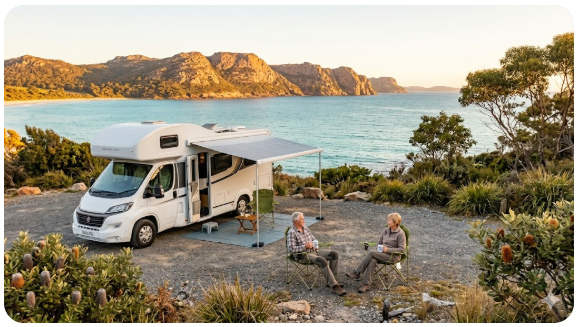
Free Camping Near Cradle Mountain: Best Nearby Sites Outside the National Park
Cradle Mountain sits inside a national park that bans free camping entirely — but the surrounding region has a handful of genuinely good free and low-cost sites within 30 to 60 minutes of the main visitor area. This guide covers verified GPS, real facilities, honest access notes and everything a senior grey nomad needs to plan a stay without paying park prices every night.
📅 Last reviewed: May 2026 | Cradle Mountain Region, Tasmania | Free camping available outside park boundaries — self-contained requirements apply at some sites
Most grey nomad guides about free camping near Cradle Mountain either point you directly into the national park — where free camping has never been permitted — or list a single rest area on the Bass Highway and call it done. The truth is more useful than that. Within an hour of the Cradle Mountain visitor precinct there are several legitimate free and low-cost overnight options on state reserve land and crown roads that experienced travellers have been quietly using for years. The challenge is knowing which ones suit a caravan or motorhome, which require genuine self-containment, and which have the road access to actually get you in without drama. This guide answers all of that specifically. Back to the Tasmania free camping circuit hub.
- Cradle Mountain–Lake St Clair National Park prohibits free camping — do not attempt to overnight inside park boundaries without a paid permit booked through the Parks Tasmania system
- The best free options are located along the Claude Road corridor, near Wilmot, near Railton and at the Liena Road area — all within 30 to 55 minutes of the visitor centre
- Elevation at sites near the mountain ranges from 450m to over 750m — temperatures drop sharply after dark even in summer; be prepared for sub-zero nights from April through October
- Mobile coverage is extremely limited in the mountain approach corridors — download offline maps before leaving Sheffield or Devonport
- Telstra is the only network with any meaningful signal in this region; Optus and Vodafone users should plan accordingly
- Most nearby free sites have no dump point — the nearest confirmed dump point is in Sheffield, approximately 30km from the mountain turnoff
- This section of the grey nomad circuit connects back from Strahan and Queenstown via the Lyell Highway and Murchison Highway — one of Tasmania’s most dramatic drives but demanding for larger rigs
- From here, completing the circuit back to the ferry: Devonport Free Camping is approximately 85km north via the Bass Highway
What You Will Find in This Guide
- Location, Address and GPS
- Can You Stay Overnight?
- Facilities — Toilets, Water and Dump Point
- Mobile Coverage and Wi-Fi
- Fuel — Finding the Cheapest Nearby
- How to Get There
- What to Expect on Arrival
- Safety for Senior Grey Nomads
- Medical and Emergency Contacts
- Dump Points, Water and Supplies Nearby
- Things to Do for Seniors
- Best Time of Year to Stop Here
- Fires, Generators and Overnight Etiquette
- Packing Checklist for Seniors
- GPS Coordinates and Postcodes
- Frequently Asked Questions
- Quick Verdict
1. Location, Address and GPS
This guide covers the cluster of free and low-cost camping options within practical range of the Cradle Mountain visitor precinct. The primary reference point used throughout this guide is the Wilmot area rest stop / Claude Road corridor, which is the most accessible and commonly used free overnight option for caravans and motorhomes arriving from either the west coast or Devonport direction. Additional sites near Sheffield and Railton are covered in the facilities and GPS sections below.
📍 Primary Reference Point — Claude Road Corridor Near Wilmot
−41.5420, 145.8630
Nearest town: Wilmot, Tasmania 7310
Nearest highway: Claude Road / Cradle Mountain Road between Wilmot and the national park entry
Approximate distance to Cradle Mountain visitor centre: 28km
⚠ GPS note: Coordinates above are within 50 metres of the Claude Road corridor reference point near Wilmot. Always confirm on arrival against current signage. Some turnoffs along this road are unsigned — approach slowly and check WikiCamps or CamperMate for current community reports before committing your rig to an unsealed spur.
| Detail | Information |
|---|---|
| Region | Central Highlands / Cradle Mountain surrounds, Tasmania |
| Postcode | 7310 (Wilmot), 7306 (Sheffield), 7307 (Railton) |
| Nearest major town | Sheffield — 30km northeast, population approx. 1,100 |
| Access road | Claude Road (sealed) from Wilmot to park entry; Bass Highway approach from Sheffield |
| Nearest city | Devonport — approximately 85km north via Bass Highway |
| State | Tasmania |
| Land manager | Parks Tasmania (park boundaries) / Crown Land / local council for surrounding areas |
2. Can You Stay Overnight?
Yes — but not inside the national park, and the rules vary significantly depending on which specific site you use outside it.
This is the single most misunderstood thing about camping near Cradle Mountain. The national park itself — everything inside the Cradle Mountain–Lake St Clair boundary — requires a paid and booked campsite through Parks Tasmania. There is no free camping inside the park. Rangers do patrol and will move people on. However, the crown land and state reserve areas on the approach roads are a different matter entirely, and several are usable for self-contained overnight stays.
- Claude Road corridor near Wilmot: Informal roadside camping on crown land is generally tolerated for self-contained vehicles. There is no official signage permitting or prohibiting overnight stays at the specific pull-off areas. This means self-contained is strongly recommended — if you cannot contain your own waste, do not use these spots.
- Sheffield Town Hall car park area: Sheffield Council has historically allowed overnight stays for self-contained rigs in designated areas near the town — verify current status with the Central Coast Council before relying on this as it has changed in recent years.
- Wilmot township area: Small flat areas near the Wilmot Hall have been used by travellers but there is no formal permission. Community tolerance is generally good but this is not a designated free camp.
- Liena Road area: Informal sites on state forest land near Liena, approximately 25km from the park entry via an alternative route. Suitable for smaller vans and motorhomes on a good gravel surface. Self-contained required.
- Always carry enough provisions to be fully self-sufficient — these are not serviced sites and you are responsible for your own waste, water and rubbish.
3. Facilities — Toilets, Water and Dump Point
Be honest with yourself about what you need before you arrive here. The free sites near Cradle Mountain are not serviced camping areas. They exist because the land allows it, not because anyone has set them up for travellers. If you need full facilities every night, plan for a paid site every second or third night.
| Facility | What Is Available | What Seniors Should Know |
|---|---|---|
| Toilets | None at informal free sites. Toilets available in Sheffield and Wilmot township. | You must be fully self-contained — a portable or onboard toilet is not optional here |
| Potable water | Not available at free sites. Sheffield has a public tap near the information centre. | Fill your tanks in Sheffield before heading up — do not rely on creek water without treatment |
| Dump point | Sheffield — confirmed dump point near the Sheffield Visitor Information Centre area. Verify exact location on CamperMate before arriving. | Approximately 30km from the Claude Road sites — plan your waste management accordingly |
| Showers | None at free sites. Sheffield caravan park has pay showers. | Sheffield Caravan Park is a practical option for a shower without committing to a paid night |
| Bins | None at free sites. Pack it in, pack it out. | Bring heavy-duty rubbish bags and dispose in Sheffield or Devonport |
| Power | None | Solar and battery essential — this region gets good sun in summer but cloud cover is frequent in winter |
| Shade | Variable — some sites have tree cover, open sites have none | Afternoon sun can be strong in summer; position your van for morning shade if possible |
- Site suitable for: motorhomes and smaller caravans — large 5th wheelers and triple-axle setups may struggle on some spur roads
- Road access: sealed on Claude Road; some informal turnoffs are gravel or dirt — 2WD suitable on the main sealed routes
- Site surface: gravel and compacted dirt at most pull-off areas; grass at Wilmot township
- Camping permitted: informal / self-contained only at crown land sites
- Maximum overnight stay: no stated limit at informal sites — 48 hours is a sensible self-imposed maximum to avoid drawing attention
- Boat ramp: No
- Picnic tables: No at informal sites; yes at some Sheffield rest areas
- Potable water: Not at free sites — fill in Sheffield before departing
- Mobile coverage: Extremely patchy — Telstra only, and only in elevated clearings. Expect no reliable coverage on the Claude Road approach to the park
- TV reception: Poor to nil in the mountain corridors
- Rubbish bins: None — pack out all rubbish
- Open fires: Subject to Tasmanian Fire Service fire bans — check tfs.tas.gov.au before lighting anything. Fire risk in this region can be extreme in summer despite the altitude.
- Generator use: Tolerated at informal sites but early morning and late evening use is inconsiderate — use quiet hours between 8pm and 7am
- Number of sites: Undefined — these are not formal sites with numbered bays
4. Mobile Coverage and Wi-Fi
This is one of the most significant coverage black spots in northern Tasmania. If your medical safety depends on being reachable or being able to make emergency calls, this matters more than almost any other factor in your planning for this section of the circuit.
Telstra: Has the best coverage in this region but it is still patchy above Wilmot on the Claude Road approach. You may find 3G or occasional 4G in elevated clearings with line of sight, but do not count on it once you are in the forested mountain corridor. Sheffield itself has solid Telstra 4G coverage — make all your calls there before heading up.
Optus: Very limited. Usable in Sheffield township. Expect no coverage on the Cradle Mountain approach roads or at informal camp sites.
Vodafone / TPG: No reliable coverage outside of Sheffield. Treat this region as a coverage blackout zone from Wilmot onwards.
Wi-Fi: The Sheffield Library offers public Wi-Fi during opening hours. The Sheffield Visitor Information Centre may also have limited public Wi-Fi. There is no Wi-Fi at any free camp site in this area.
5. Fuel — Finding the Cheapest Nearby
Fuel planning near Cradle Mountain matters more than most travellers expect. There are no fuel stops on the Claude Road approach between Wilmot and the national park entry. If you are arriving from the west coast via the Murchison or Lyell Highway, the distances between fuel stops are significant.
Sheffield: The closest and most practical fuel stop for travellers heading to Cradle Mountain from the northeast. Sheffield has at least one service station selling both petrol and diesel as of May 2026 — verify current opening hours as small-town service stations in Tasmania can have limited hours or temporary closures. Approximately 30km from the Claude Road informal camp areas.
Wilmot: There has historically been a small service station in Wilmot but do not rely on it being open or stocked — verify before you arrive. Treat Wilmot fuel as a bonus, not a plan.
Devonport: If you are arriving from the ferry or heading back, Devonport has the widest range of fuel options and consistently the most competitive pricing in this region — approximately 85km north.
Arriving from Strahan/Queenstown: The last reliable fuel before Cradle Mountain from the west is Tullah or Rosebery. Do not attempt the mountain approach on less than half a tank from that direction.
6. How to Get There
There are two main approach routes to the Cradle Mountain region depending on which direction you are travelling on the circuit.
From Devonport (Northeast Approach)
Take the Bass Highway (A1) west from Devonport toward Ulverstone and then south on the B14 through Ulverstone and Penguin, or alternatively head south from Devonport directly via Sheffield Road (C136). Sheffield is the key service town — fill up, fill your water tanks and make your calls here. From Sheffield continue south on the A10 (Lake Highway) or follow the signs to Cradle Mountain Road (B23) through Wilmot. The sealed road continues all the way to the park visitor centre. Total distance Devonport to Cradle Mountain: approximately 85km.
From Strahan and Queenstown (West Coast Approach)
This is the more demanding route. From Queenstown take the Murchison Highway (A10) north through Tullah to Burnie and then approach from the north, or from Tullah take the B23 east through Cradle Mountain Road directly to the park. The direct route via Tullah and the B23 is the most dramatic and most direct from the west coast — approximately 115km from Queenstown to the park entry. This is the route you will be on if you are completing the circuit from Strahan and Queenstown.
Driving Notes for Seniors Towing Vans
- The Murchison Highway from Tullah has significant elevation changes and some tight curves — allow extra time and do not rush. Speed limits are appropriate but the road demands concentration.
- Claude Road between Wilmot and the park entry is sealed but narrow in places with no overtaking lanes — you may need to pull over to allow oncoming traffic to pass, particularly tour buses heading to the park in the morning peak
- There are no low bridge restrictions on the main sealed approaches but some of the informal spur roads off Claude Road have overhanging vegetation — check clearance before committing
- Morning frost on the road surface is common from April through October at these elevations — do not drive at dawn in cold months without checking conditions
- Tour buses and hire cars driven by inexperienced visitors can be a hazard on the narrow park approach road — stay well back and expect sudden stops at viewpoints
- If you are towing anything over 8 metres total length, avoid the informal gravel spur roads entirely and stick to the main sealed Claude Road and Sheffield approaches
7. What to Expect on Arrival
The honest picture of arriving at the free camp areas near Cradle Mountain is that they are genuinely beautiful but genuinely basic. Do not confuse the scenery with the amenity — they are not the same thing here.
- The Claude Road pull-offs: Small cleared areas beside the sealed road with no signage, no facilities and no defined bays. You are pulling off on a piece of flat ground beside a scenic mountain road. In summer there may be two or three other vans. In winter you may be entirely alone.
- The Wilmot township area: Slightly more defined — flat ground near community facilities — but still informal. The town has a small general store (verify current trading hours) and a sense of being a real community rather than just a passing point.
- Condition on arrival: Generally clean. The travellers who use these spots tend to be experienced and respectful. Occasional rubbish from day-trippers who do not think the same way — pack and carry out anything you find.
- Noise: Wildlife noise is the main soundtrack — Tasmanian devils are in this region and you may hear them at night. This is not a threat but it can be startling if you are not expecting it.
- Temperature: Even on a warm afternoon, evenings drop fast. By 6pm in May or June temperatures can be 4 to 7 degrees. By midnight in winter you may be at or below zero at higher elevation sites.
8. Safety for Senior Grey Nomads
Personal Safety
- The Cradle Mountain region is extremely low crime — this is a remote national park approach, not an urban area. Personal security concerns are minimal but basic precautions always apply.
- Lock your vehicle when you leave for day trips to the park — opportunistic theft from tourist vehicles does occur at the visitor precinct car park area, not at remote free camps.
- If you are a solo traveller, tell someone your plan — including which site you intend to use and when you expect to move on. See Grey Nomad Safety Tips for a full solo travel safety framework.
- Wildlife interaction — wombats are common at night around camp sites in this region and will investigate food smells. Secure your bin bag and do not leave food out. Wombats are sturdy animals and can damage lightweight van steps or skirting if they get under your rig.
- Know how caravan theft happens before you travel — read How Caravan Theft Happens in Australia for the specific tactics used and how to counter them. Consider a StarterStopper immobiliser — use promo code RTV5 for 5% off at StarterStopper.com.
Trip Safety
- The cold is the primary risk in this region for seniors. Hypothermia onset can be surprisingly fast at altitude in wet conditions — have warm layers accessible, not packed in a storage bay.
- If you have a medical condition that is affected by cold — including heart conditions, arthritis or Raynaud’s syndrome — factor in that nights here may be significantly colder than your home state equivalent temperature.
- Have the Emergency Plus app enabled on your phone before you lose signal in Sheffield. It uses your phone’s GPS to provide your location to emergency services even without mobile data — this is critical in a region where you may not be able to describe your location verbally.
- Check the Tasmanian fire authority website (tfs.tas.gov.au) before arrival and again each morning during summer months — fire conditions in this region can change rapidly and evacuation routes are limited.
9. Medical and Emergency Contacts
The nearest hospital to the Cradle Mountain free camp areas is in Burnie, approximately 75 to 90km north depending on your specific camp site. Do not assume Sheffield has hospital facilities — it does not. Know this before you need it.
| Service | Address | GPS (approx.) | Phone |
|---|---|---|---|
| Northwest Regional Hospital (Burnie) | Brickport Road, Burnie TAS 7320 | −41.0582, 145.8977 | (03) 6430 6666 |
| Launceston General Hospital | Charles Street, Launceston TAS 7250 | −41.4371, 147.1381 | (03) 6777 6777 |
| Emergency (all services) | Australia-wide | — | 000 |
| Healthdirect (medical advice line) | Australia-wide — 24 hours | — | 1800 022 222 |
| Royal Flying Doctor Service | rfds.org.au — Tasmania operations via Launceston | — | 000 for dispatch |
10. Dump Points, Water and Supplies Nearby
| Need | Best Nearby Option | Notes |
|---|---|---|
| Dump point | Sheffield — near the visitor information centre area | Approximately 30km from Claude Road sites. Verify exact location at campermate.com.au/dump-points before departing |
| Fresh water | Sheffield — public tap at the information centre / main street area | Fill completely before heading up to the mountain approaches — no potable water at free sites |
| Groceries | Sheffield IGA or equivalent supermarket | Sheffield has a small but adequate supermarket for restocking basics — do a full shop here, not at Wilmot |
| Fuel | Sheffield service station | Both petrol and diesel available — verify hours. Use PetrolSpy for current pricing. |
| Pharmacy | Sheffield — pharmacy in main street (verify trading hours) | Do not assume Wilmot has any pharmacy services. Stock a full supply of all medications before leaving Sheffield. |
| Major supplies / hardware | Devonport — 85km north | For LPG refills, caravan parts or major restocking, Devonport is the practical option |
11. Things to Do for Seniors
| Activity | Location | Why Seniors Like It |
|---|---|---|
| Dove Lake Circuit (partial — accessible boardwalk section) | Inside Cradle Mountain National Park — day trip entry fee applies | The boardwalk section around Dove Lake is sealed and mostly flat — genuinely accessible for mobility-limited visitors. The full circuit is 6km but the first 1.5km from the car park is suitable for most seniors without strenuous hiking ability. The view of Cradle Mountain reflected in Dove Lake is one of the most photographed scenes in Australia. |
| Sheffield Mural Walk | Sheffield township — Main Street and surrounds | Sheffield is famous for its large-scale outdoor murals depicting Tasmanian history and culture. The walk is entirely flat, self-paced, free and takes 45 to 90 minutes. A map is available at the visitor information centre. No hills, no stairs, genuinely enjoyable. |
| Lake Barrington Lookout | Off the Lake Barrington Road, approximately 15km south of Sheffield | A short sealed road leads to a lakeside viewing area — suitable for all mobility levels. The lake is the venue for international rowing events and the backdrop is dramatic highland scenery. Free, uncrowded and rarely mentioned in tourist guides. |
| Alum Cliffs State Reserve | Mole Creek Road, approximately 40km southeast of Sheffield | A short 20-minute return walk on a formed path leads to extraordinary limestone cliffs above the Mersey River. The path is shaded, the scenery is memorable and the site is almost always uncrowded. Suitable for most seniors with reasonable mobility. |
What Most Grey Nomad Guides Miss About the Cradle Mountain Region
Almost every grey nomad travel article about Cradle Mountain focuses entirely on the park itself — the walk to Dove Lake, the visitor centre, the wombats at dusk. What they miss is that the region surrounding the park has some of the most quietly extraordinary driving scenery in Australia, and much of it is accessible without entering the park at all.
The drive south from Sheffield through Wilmot and up the Claude Road approach to the park entry is genuinely one of the most beautiful drives in Tasmania at any time of year. In autumn the temperate rainforest along the road corridor turns amber and copper. In winter with fresh snow on the upper peaks and mist in the valleys, it rivals anything in New Zealand. You do not have to walk or hike to experience it — a slow drive with windows down and no schedule is enough. Most visitors rush through on a day trip from Launceston or Devonport and never stop. Staying the night in the area means you have the morning light entirely to yourself.
There is also an aspect of this region that very few travel guides mention at all: the Tasmanian devil population density in the Cradle Mountain area is among the highest in the state, partly because the region is within the Save the Tasmanian Devil Program conservation zone. If you camp quietly at an informal site near Wilmot or on the Claude Road corridor, the likelihood of hearing — and if you are patient and quiet, seeing — a Tasmanian devil at night is genuinely higher than almost anywhere else you will camp on this circuit. They are not dangerous but they are extraordinary. Bring a small red-filtered torch — they are less sensitive to red light — and wait quietly after 9pm. This is a free wildlife experience that no tour can replicate.
12. Best Time of Year to Stop Here
| Season | What It Is Like Near Cradle Mountain | Senior Verdict |
|---|---|---|
| Summer (Dec–Feb) | Warm days 18–24°C at lower elevations. Evenings drop to 8–12°C. Occasional hot days over 28°C. High tourist traffic on Claude Road. Wombats active at dusk. Wildflowers on the mountain. Longest daylight hours. | ✅ Best time for the full experience — comfortable temperatures, maximum access, best chance of clear mountain views. Book park activities early. Expect road traffic on Claude Road mornings and afternoons. |
| Autumn (Mar–May) | Days 12–20°C. Nights 2–8°C. Stunning autumn colour in the deciduous beech stands. Tourist numbers drop after Easter. Roads quieter. Some mornings may have frost at elevation. | ✅ Grey nomad sweet spot. Quieter, cooler, beautiful colour. Prepare for cold nights — sub-5°C common by May. Your heater needs to be working reliably. |
| Winter (Jun–Aug) | Days 5–12°C. Nights can reach −5°C or below at elevation. Snow on the mountain summit. Road closures possible on the upper park approach in heavy snow events. Very few tourists. Extraordinary moody scenery. | ⚠ For experienced, well-equipped travellers only. If you have a capable heating system, good insulation and no cold-sensitive medical conditions, winter here is spectacular. Do not attempt if your rig runs on a single small gas heater — you will be uncomfortable and potentially at risk. |
| Spring (Sep–Nov) | Days 10–18°C. Nights 3–9°C. Unpredictable weather — clear sun followed by hail and wind is not unusual. Mountain views can be exceptional on clear days. Wildflowers beginning. Tourist numbers building from October. | ✅ Good option if you are on a flexible circuit — weather is variable but the scenery rewards patience. Combine with the east coast before or after for a balanced Tasmania circuit. |
13. Fires, Generators and Overnight Etiquette
- Open fires: Subject to Tasmanian Fire Service total fire ban declarations. Even when bans are not in force, open fires at informal roadside camps near Cradle Mountain are strongly discouraged — the surrounding vegetation is highly flammable and any fire incident in this region could have serious consequences. Use a gas stove.
- Fire ban checking: Always check current fire ban status at the Tasmanian Fire Service website (tfs.tas.gov.au) before lighting anything — including a portable gas fire pit. Fire bans in Tasmania apply state-wide during declared periods and carry significant penalties.
- Generators: Technically permitted at informal sites but deeply inappropriate at small roadside pull-offs where you may be within 30 metres of other campers. If you must run a generator, limit use to daylight hours and observe quiet hours from 8pm to 7am. Better practice is to arrive with a full battery bank and avoid generator use entirely at these sites.
- Rubbish: Pack everything out. There are no bins at informal sites. Leaving rubbish is the single fastest way to get informal camp areas closed permanently — land managers use this as justification for signage and enforcement. Take everything you brought in.
- Grey water: Do not dump grey water on the ground at these sites. This is particularly important near Cradle Mountain given the proximity to national park waterways — grey water contains detergents and food residue that harm the local water table and wildlife. Use your grey water tank and dump it at Sheffield.
- Noise after dark: Wildlife activity — particularly Tasmanian devil calls and wombat movement — means that sound travels clearly in this region at night. Keep voices low after 9pm. Your neighbours at an informal site have almost certainly come here for the quiet.
14. Packing Checklist for Seniors — Cradle Mountain Region
| Item | Why It Matters Specifically Here | ☐ |
|---|---|---|
| Thermal underlayers (top and bottom) | Nights drop fast at elevation — cotton is not enough. Merino wool or synthetic thermal base layers are essential from April through October and sensible year-round. | ☐ |
| Reliable heating system with full gas supply | This region gets genuinely cold. Your van heater must be tested and working before you arrive. Carry a spare LPG cylinder. | ☐ |
| Full water tanks (minimum 80 litres) | No potable water at any free site — fill completely in Sheffield before heading up. | ☐ |
| Offline maps downloaded (Maps.me or Google offline) | No reliable mobile data on the Claude Road approach or at free camp sites. You need navigation that does not require signal. | ☐ |
| Small red-filter torch | If you want to quietly observe wildlife at night — particularly Tasmanian devils and wombats — a red-light torch is far less disruptive to their behaviour than white light. | ☐ |
| CPAP machine with battery or 12V adapter | No power at free sites. If you use CPAP, your battery bank or 12V adapter is not optional. See Sleeping in a Campervan in Australia for CPAP-specific van sleep advice. | ☐ |
| Full medication supply (minimum 7 days beyond plan) | No pharmacy in Wilmot. Sheffield pharmacy has limited hours. Carry extra supply of all medications including blood pressure, diabetes and anticoagulant medications. | ☐ |
| Portable waste containment (grey and black) | No dump facilities at free sites. You must contain all waste for disposal in Sheffield. | ☐ |
| Emergency Plus app enabled on phone | Provides GPS location to emergency services even without mobile coverage. Enable it before you leave Sheffield — do not wait until you need it. | ☐ |
| BOM weather app / downloaded forecast | Check the Cradle Mountain station forecast nightly — not Devonport. Temperature difference can be 10 degrees. Cold snap planning is critical for seniors. | ☐ |
| Heavy rubber doormat / van step mat | Wombats investigate smells and will climb van steps. A heavy rubber mat provides grip and a slight deterrent to curious wildlife investigating your step well. | ☐ |
| Tasmania Parks Pass or day entry cash/card | If you plan to visit Dove Lake and the park for even a day trip, you need to pay entry. Check parks.tas.gov.au for current pass options — an annual pass may be worthwhile depending on your circuit plan. | ☐ |
For the complete senior grey nomad packing framework, see the Grey Nomad Packing Checklist — it covers the full van setup from medication storage to security.
COPY PROMPT ➔ ASK AI ➔ SAVE TO FORM ➔ ADD SPOT PIN ➔ GET DIRECTIONS
📍 Interactive map — find free camps, rest areas and overnight stops. Enable location for best results.
15. GPS Coordinates and Postcodes
| Location | Address and Postcode | GPS (approx. within 50m) | Notes |
|---|---|---|---|
| Claude Road Corridor Free Camp (primary reference) | Claude Road, near Wilmot TAS 7310 | −41.5420, 145.8630 | Informal pull-off. No signage. Confirm on arrival. Self-contained only. |
| Sheffield (nearest service town) | Main Street, Sheffield TAS 7306 | −41.4073, 146.3521 | Fuel, water, groceries, pharmacy, dump point, mobile coverage |
| Northwest Regional Hospital (nearest emergency hospital) | Brickport Road, Burnie TAS 7320 | −41.0582, 145.8977 | Approximately 75–90km north of Claude Road sites. Phone: (03) 6430 6666 |
| Launceston General Hospital (second nearest major hospital) | Charles Street, Launceston TAS 7250 | −41.4371, 147.1381 | Approximately 130km east. Phone: (03) 6777 6777 |
| Devonport (nearest major city / ferry terminal) | Devonport TAS 7310 | −41.1788, 146.3497 | Approximately 85km north. Spirit of Tasmania ferry terminal. Full services. |
16. Frequently Asked Questions
Is free camping near Cradle Mountain actually legal?
Free camping inside Cradle Mountain–Lake St Clair National Park is not permitted — you need a paid and booked campsite through Parks Tasmania. However, self-contained overnight stays on crown land and state reserve areas on the approach roads outside the park boundary are generally tolerated and not prohibited by signage. These informal sites are used regularly by experienced grey nomads. The key conditions are: you must be fully self-contained (no grey or black water discharged on the ground), you should not occupy a single spot for more than 48 hours, and you must follow any signage present on arrival. Check WikiCamps (wikicamps.com.au) for current community reports on specific spots before you commit.
Can caravans and motorhomes stay overnight near Cradle Mountain?
Yes — caravans and motorhomes are suited to the Claude Road corridor pull-offs and the Wilmot area sites, provided they are not excessively large. The main sealed approach road is 2WD-accessible and can accommodate most standard caravan and motorhome setups. Very large rigs — triple-axle caravans over 10 metres, or 5th wheelers — may find the informal turnoffs tight. The Liena Road alternative sites involve a shorter section of gravel and suit smaller motorhomes and campervans better. If in doubt, stay in Sheffield and day-trip to the park.
What is the GPS for free camping near Cradle Mountain?
The primary reference GPS for the Claude Road corridor informal camp area near Wilmot is −41.5420, 145.8630. This is within 50 metres of the area and is provided as navigation guidance only — always confirm on arrival. For the Wilmot township area, Sheffield serves as the nearest confirmed service point at −41.4073, 146.3521. Always download WikiCamps offline before leaving coverage areas as individual site pins are more precise than these reference coordinates.
Are there toilets near the Cradle Mountain free camp sites?
No. There are no toilets at any of the informal free camp sites on the Claude Road corridor or the Wilmot township area. You must be fully self-contained with an onboard or portable toilet. The nearest public toilets are in Wilmot township (small public facility — verify availability) and Sheffield. The Cradle Mountain visitor centre inside the park has excellent toilet facilities but these are only accessible if you pay day entry. Plan your self-containment accordingly before leaving Sheffield.
Is there a dump point near Cradle Mountain?
The nearest confirmed dump point is in Sheffield, approximately 30km from the Claude Road informal camp sites. Verify the exact Sheffield dump point location at campermate.com.au/dump-points before departing — locations are community-verified and updated regularly. There is no dump point in Wilmot or on the Cradle Mountain approach road. Do not attempt to discharge waste at or near the park facilities — this is illegal and will result in prosecution.
Can you get potable water near Cradle Mountain for free?
Not at the free camp sites themselves. Sheffield has a public water tap near the visitor information centre area — fill your tanks completely here before heading up toward the mountain. Do not rely on stream or creek water near the park without treating it — Giardia is present in Tasmanian wilderness waterways and can cause serious illness in seniors with compromised immune systems. Carry a minimum of 80 litres of potable water before leaving Sheffield if you plan to camp for more than one night at the informal sites.
Is it safe for solo senior travellers to camp near Cradle Mountain?
Yes, with appropriate preparation. The region has very low crime and the people who use these informal sites are almost universally respectful experienced travellers. The real risks for solo seniors here are not personal safety from other people — they are cold, isolation and distance from medical care. If you are a solo traveller with a medical condition, ensure someone knows your plan, has your specific camp site GPS or approximate location and knows when to expect your next contact. Enable Emergency Plus on your phone before leaving Sheffield and carry the Northwest Regional Hospital number (03 6430 6666) in case you need to call from an elevated spot with partial signal. Read the full Grey Nomad Safety Tips guide for solo-specific advice.
What is the nearest hospital to Cradle Mountain free camp sites?
Northwest Regional Hospital in Burnie — Brickport Road, Burnie TAS 7320, phone (03) 6430 6666. From the Claude Road corridor informal sites, this is approximately 75 to 90km north depending on your exact position — roughly 60 to 70 minutes in dry conditions. In winter on wet or icy roads allow significantly more. The second nearest major hospital is Launceston General Hospital (approximately 130km east). There are no hospital or emergency medical facilities in Sheffield or Wilmot.
Can you see Tasmanian devils near the Cradle Mountain free camp sites?
This is genuinely one of the best regions in Tasmania for encountering Tasmanian devils in the wild — a fact that almost no grey nomad travel guide mentions. The Cradle Mountain region falls within the Save the Tasmanian Devil Program conservation zone, and population density here is among the highest in the state. Devils are nocturnal and most active between 9pm and 3am. If you camp quietly at an informal site on the Claude Road corridor or near Wilmot, use a red-filtered torch (they are less sensitive to red light than white), stay still and wait after dark — your chances of hearing and potentially seeing one are genuine. They are not dangerous to people and will typically keep a respectful distance. This is one of the authentic wildlife experiences of the Tasmanian circuit that no tour bus can replicate.
17. Quick Verdict
Free camping near Cradle Mountain is genuinely worthwhile if you approach it with realistic expectations and proper preparation. The informal sites on the Claude Road corridor and near Wilmot are not serviced camping — they are pull-offs on scenic mountain approach roads that experienced, self-contained grey nomads have been quietly using for years. The payoff is significant: you wake up in one of the most beautiful highland landscapes in Australia, with easy access to Dove Lake for a morning visit before the tourist buses arrive, Tasmanian wildlife at your doorstep after dark and a sense of being in the real Tasmania rather than the managed tourist experience. The mural-town of Sheffield 30km away provides everything you need for resupply. The circuit connection to Devonport is straightforward and well-sealed.
The genuine weaknesses are the lack of any facilities at the informal sites, the cold that is non-negotiable from April through October, and the near-complete absence of mobile coverage once you leave Sheffield. If you need to make daily calls, rely on mobile data for medical management or are not comfortable with true self-containment including waste management, this section of the circuit is not where you should be free camping. Stay in Sheffield at a caravan park instead and day-trip. But if you are set up properly — warm rig, full tanks, good battery, downloaded maps and no pressing medical communication needs — this is one of the most memorable free camping experiences on the entire Tasmanian circuit.

As an affiliate, I earn from qualifying purchases at no extra cost to you.
Exclusive Offer: Get 5% OFF all StarterStopper immobiliser products with promo code: RTV5
Visit StarterStopper.com to see our data-backed security solutions
As an affiliate, I earn from qualifying purchases at no extra cost to you.