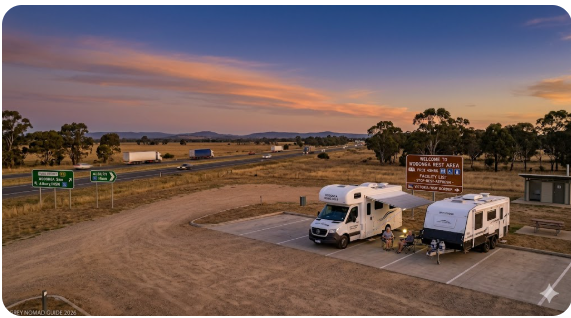
Wodonga Rest Areas — Last Stop Before NSW VIC 2026
An honest senior traveller’s guide to the rest areas at Wodonga on the Hume Highway — the last serviced stops in Victoria before crossing into New South Wales. What’s here, what isn’t, and what grey nomads genuinely need to know before pulling over.
📅 Last reviewed: May 2026 | Wodonga VIC 3690 | Accessible directly from the Hume Highway — pull-off bays suitable for caravans and motorhomes when dry.
Entry Cost
Unpowered Only
Verify on Arrival
From Melbourne CBD
Approx 3 km North
Wodonga sits at the southern end of the Murray River crossing on the Hume Highway — one of Australia’s busiest freight and touring corridors. For senior grey nomads driving north from Melbourne or south from Sydney, the rest areas here — if you are heading south, check our Benalla Rest Area guide for your next stop — represent a genuine opportunity to rest, reset and check your vehicle before or after crossing the state border. This guide covers what the stops genuinely offer, what is missing, how overnight rules apply, and why health-critical travellers should plan carefully before relying on this location for anything beyond a daytime break.
- Name: Wodonga Highway Rest Areas (multiple bays along Hume Highway approaches)
- State: Victoria
- Use: Short-term rest and fatigue stopping — highway corridor
- Best for: Daytime breaks, driver fatigue management, toilet stops between Melbourne and Sydney
- Toilets: Present at major bays — condition varies; verify on arrival as maintenance schedules differ
- Dump point: No dump point at rest area bays — nearest verified option in Wodonga town centre
- Potable water: Not reliably available at highway bays — carry your own supply
- Power: No powered sites — CPAP users must have battery or solar solution
- Phone signal: Generally good Telstra coverage in the Wodonga township corridor — may reduce at some highway bays
- Nearest town: Wodonga VIC 3690
- Nearest major services: Wodonga CBD VIC 3690 (approximately 2–5 km depending on bay)
Table of Contents
- Location, GPS Coordinates and How to Find It
- Overnight Stays — What the Rules Actually Say
- Facilities — Toilets, Water and What to Expect
- Mobile Signal and Wi-Fi Coverage
- Road Access and Driving Notes for Caravans
- Realistic Arrival Conditions — What Others Don’t Tell You
- Safety — Personal and Trip Planning
- Medical Services and Emergency Planning
- Dump Points, Supplies and Resupply Planning
- Activities and Things to Do Nearby
- Seasonal Conditions and Best Time to Visit
- Rest Area Etiquette and Access Restrictions
- Pre-Departure Checklist for Senior Travellers
- GPS Master Reference Table
- Frequently Asked Questions
- Honest Verdict — Is It Worth Stopping?
1. Location, GPS Coordinates and How to Find It
The Wodonga rest areas are located along the Hume Highway (M31) corridor as it passes through the twin border cities of Albury–Wodonga — heading south on the Hume you will also want to check Benalla Rest Areas. Wodonga itself sits on the Victorian side of the Murray River, with the New South Wales border running through the river channel just north of the town centre. The highway rest bays in this zone serve both northbound and southbound travellers and are positioned at intervals to break up the long run between Melbourne and Sydney — a total distance of approximately 875 kilometres.
The primary rest areas most relevant to grey nomads are situated on the Hume Freeway approaches to the Wodonga bypass. These are purpose-built highway fatigue stops with sealed pull-off areas, basic amenity blocks and shaded seating in some locations. They are not campgrounds and are not managed as overnight facilities. The surrounding landscape is flat to gently rolling open country, with the broader Wodonga urban fringe visible in the distance. The Murray River floodplain gives the area a wide-sky feel, particularly heading north.
The Wodonga township itself — with its full complement of supermarkets, medical centres, fuel stations and hardware — is within a short drive of the highway bays, making this one of the better-serviced rest stop zones on the entire Hume corridor. That proximity to town is genuinely useful for senior travellers who need to restock, refuel or seek non-urgent medical attention.
📍 GPS Coordinates — Wodonga Rest Area (Southbound Hume Freeway Reference)
−36.1218° S, 146.8882° E
Enter into Google Maps: [-36.1218, 146.8882]
Or search: Wodonga Rest Area, Hume Freeway, Wodonga VIC 3690
Nearest reference point: Hume Freeway approaching Wodonga bypass — check posted highway signs for active bay locations
Approaching from Melbourne (southbound to northbound), you will travel the Hume Freeway north-west through Wangaratta and then through the Wodonga bypass before reaching the Murray River crossing. From Sydney, you enter Victoria from the Albury side (NSW 2640) before the road transitions to Victorian jurisdiction at the river. Total drive time from Melbourne is approximately 3 hours 20 minutes in good conditions — longer if you have made the recommended rest stops at the previous stop at Wangaratta, or further south at Euroa, Seymour or Broadford heading south towards Melbourne.
2. Overnight Stays — What the Rules Actually Say
The Wodonga rest area bays on the Hume Freeway are managed under Victorian fatigue stop provisions. VicRoads designates these bays primarily as driver rest facilities intended for short-term stops — typically understood as up to a few hours rather than full overnight camping. However, unlike many rest areas in other states, overnight stopping in a self-contained vehicle on Hume Freeway highway rest bays is not universally prohibited under a blanket rule. The position is nuanced and depends on posted signage at the individual bay, which can change.
Wodonga City Council manages some rest facilities within the urban fringe, where different rules may apply. Travellers should not assume a blanket overnight permission exists. If no signage prohibits it and your vehicle is self-contained, a single overnight stop may be tolerated in practice — but this is not a confirmed entitlement. For health-critical travellers who need power, reliable water or guaranteed security, a paid powered site in Wodonga is the far more sensible choice and adds only modest cost to your journey.
- These are designated highway fatigue stops — short-term rest is the primary intended use
- No signs explicitly prohibiting overnight stops have been consistently reported at major Hume Freeway bays in this zone — but this can change without notice
- Self-contained vehicles only — grey water, sewage and rubbish disposal on-site is illegal
- Do not set up awnings, outdoor furniture or cooking setups — this draws ranger attention and breaches rest area use conditions
- Maximum recommended stay is one overnight — move on by morning
- Wodonga City Council can issue notices and fines under local government laws if rest area conditions are breached
- Highway patrol and transport compliance officers are active on the Hume corridor — be aware of your vehicle’s roadworthiness and load compliance
- For full rules on overnight parking across Australia, read our overnight parking Australia guide
Senior travellers managing CPAP machines, insulin storage, blood pressure medication schedules or mobility challenges will find a powered caravan park site in Wodonga a significantly better choice than an overnight highway bay. The peace of mind from reliable power and a secure, known environment is worth far more than the saving at this particular stop.
3. Facilities — Toilets, Water and What to Expect
The facilities at Wodonga’s highway rest bays are consistent with what VicRoads provides along the Hume Freeway — basic, functional and maintained on a schedule rather than daily. Expect clean-enough toilets during weekdays and varying standards on weekends when traffic volumes increase significantly. These are not resort facilities and should not be treated as your primary amenity stop if you have health considerations that depend on clean, reliable infrastructure.
| Facility | Available? | Senior Travel Notes |
|---|---|---|
| Toilets | Yes — at major highway bays; condition varies | Accessible toilets reported at some bays — verify on arrival; surfaces are generally level but may be unlit at night |
| Potable water | Not reliably available — do not depend on it | Carry a minimum of 15 litres per person from your last town; dehydration is a serious health risk for seniors managing blood pressure or diabetes |
| Powered sites | No | CPAP users must bring a fully charged battery pack or solar solution — there is no power at any highway bay in this zone |
| Dump point | No | Do not discharge grey water or waste at this location — nearest dump point is in Wodonga township; see Section 9 |
| Shade and seating | Partial — picnic tables at some bays | Shade varies by bay and time of day — in summer, exposed bays can become very hot by mid-morning; park facing away from western sun where possible |
| Rubbish bins | Yes at most major bays | Do not leave rubbish beside full bins — carry it with you to the next town if bins are overflowing |
| Overnight lighting | Minimal to none at most bays | Carry a reliable head torch — moving around an unlit rest area at night on uneven ground is a fall risk for senior travellers |
| Dog access | Generally permitted on lead | Keep dogs restrained at all times — highway traffic is close and fast; some bays have no fencing between the rest area and the road shoulder |
4. Mobile Signal and Wi-Fi Coverage
Mobile signal in the Wodonga urban corridor is generally reliable on the Telstra network, which has strong infrastructure along the Hume Freeway in this region. The township itself offers full 4G coverage. However, signal can be inconsistent at specific highway bay locations depending on which side of the bypass you are on, surrounding vegetation and the exact terrain of each bay. Do not assume full coverage at every pull-off point — test your signal on arrival before settling for the night.
- Telstra: Generally strong in the Wodonga township corridor — 4G coverage broadly available; some minor signal variation at specific highway bays outside the town boundary
- Optus: Reasonable coverage in the Wodonga urban area — may weaken at more remote highway bays north or south of town on the Freeway
- Vodafone / TPG: Coverage less predictable at highway bay locations — acceptable in the township itself but not guaranteed at all pull-off points
- Wi-Fi: No Wi-Fi available at highway rest bays — free Wi-Fi available at Wodonga Library (business hours) and some fast food and cafe locations in the Wodonga CBD
- Satellite devices: Strongly recommended for all senior solo travellers on this corridor — a registered PLB or satellite communicator ensures emergency contact capability regardless of mobile network availability
5. Road Access and Driving Notes for Caravans
Approaching Wodonga Rest Areas from key directions
- From Melbourne (south) via Hume Freeway M31: The freeway runs directly into the Wodonga bypass — rest bays are signed from approximately 10 km south of Wodonga town centre. Allow 3 hours 20 minutes minimum from Melbourne CBD in good conditions. If travelling south from Wodonga, the previous major rest stops heading south towards Melbourne are at Wangaratta (approximately 67 km) and then further south at Euroa, Seymour and Broadford as you head south towards Melbourne.
- From Sydney (north) via Hume Highway A31: Cross the Murray River at Albury–Wodonga on the Gateway Bridge — the road transitions from NSW to VIC jurisdiction at the river. Rest bays on the Victorian side are signed from the southern approaches to the bridge. Allow approximately 6 hours from Sydney CBD without stops.
- From Bright or Alpine areas (west): Access Wodonga via the Kiewa Valley Highway from Falls Creek or Mount Beauty direction — this route is scenic but involves some narrow sections not recommended for long rigs. Join the Hume Freeway at Wodonga for the final approach.
Specific road cautions for caravan and motorhome drivers
- The Hume Freeway bypass around Wodonga is a high-speed multi-lane road — rest bay entrances have merge lanes that are shorter than you may expect when towing; signal early and reduce speed well before the bay entrance
- Heavy freight traffic is constant on this corridor at all hours — allow extra distance when exiting a rest bay and merging back onto the freeway
- Some Hume Freeway rest bays in this zone have gravel or compacted dirt surfaces rather than sealed parking — check your van’s jockey wheel and stabilisers after parking on these surfaces
- The Murray River bridge at Albury–Wodonga (Gateway Bridge) is rated for all normal road vehicles including caravans — no height or weight restrictions apply under standard conditions, but verify with VicRoads for any current works: vicroads.vic.gov.au
- Wind exposure increases on the open floodplain approaches to Wodonga — high-sided motorhomes and vans with roof systems should anticipate crosswinds, particularly in spring and summer afternoons
- Fuel at highway service centres on the Hume corridor typically attracts a premium — fill your tank in Wodonga township proper using PetrolSpy to find the best local price before you depart
6. Realistic Arrival Conditions — What Others Don’t Tell You
Arriving at a Wodonga highway rest bay is a different experience from pulling into a quiet free camp. The Hume Freeway is one of the most trafficked roads in Australia — heavy trucks run through this corridor 24 hours a day, and the noise level at rest bays adjacent to the freeway is significant, particularly at night. If you are a light sleeper or sensitive to diesel engine noise and air brakes, be prepared for an interrupted night. The sound does not stop at midnight on this highway.
The bays themselves are not hidden or discreet. Your vehicle is visible from the freeway and, in some cases, from service roads. This is actually a safety positive in terms of not being isolated — but it also means you have no privacy screen and there will be other travellers arriving and departing at irregular hours. The lights from passing trucks and service vehicles can be intrusive if your sleeping area faces the road. Park with your cab facing the road and your sleeping area facing away where possible.
- Truck noise and air brakes are constant at night — bring quality earplugs or plan to use a white noise app if you are a sensitive sleeper
- Lighting from passing vehicles will enter your van even with blinds drawn — blackout curtains make a genuine difference at highway bays
- In summer, morning temperatures inside a dark-coloured van parked on a sealed surface can rise sharply from 6am — plan your ventilation before you go to sleep
- Weekend evenings can see higher visitor numbers including non-travellers using the bay as a meeting point — assess the environment when you arrive rather than assuming it will be quiet
- If the bay feels unsuitable on arrival — too noisy, too crowded, poorly lit or with people behaving erratically — do not stay; drive the short distance into Wodonga town and use a caravan park instead
7. Safety — Personal and Trip Planning
Personal safety at this location
- Vehicle visibility and positioning: Park with your cab end facing traffic flow where possible — this gives you a clear sightline to your surroundings and makes your vehicle look like a resting driver rather than an unoccupied van, which is a deterrent to opportunistic theft
- Door and window security: Lock all doors before sleeping — even in a low-risk environment like a busy highway bay, open windows or unlocked doors create unnecessary exposure. Use a security bar or steering lock if travelling solo
- Valuables and appearance: Keep items of value out of sight in the cab area — smash-and-grab events at highway rest stops, while uncommon, do occur on major freight corridors like the Hume
- Night movement: If you need to use the toilet block at night, take your head torch, your phone and your keys — do not leave the vehicle unlocked while you walk across an unlit bay; assess the surface before walking to avoid trip hazards
- Trusting your instincts: If the bay feels wrong on arrival — unfamiliar vehicles, people loitering or an atmosphere that makes you uncomfortable — leave immediately without engaging with anyone; you owe no explanation and your safety is not worth the cost of stubbornness
Trip safety planning before you leave home
- Notify a trusted contact of your planned itinerary including which rest bays you intend to stop at — update them when you arrive and when you depart, particularly when crossing the state border at Albury–Wodonga
- Keep your phone above 50% charge before stopping for the night — carry a power bank rated at minimum 20,000mAh that can recharge your phone without the vehicle running
- Register your PLB or EPIRB at beacons.amsa.gov.au — a registered beacon is your most reliable emergency tool if your phone fails on a highway corridor at 3am
- Carry a minimum 7-day buffer of all prescription medications in a clearly labelled, temperature-appropriate bag — do not rely on being able to access a pharmacist in the next town if you are unwell or the hours don’t suit
- Check VicRoads and the NSW equivalent for road conditions before departing — the Hume Freeway can be affected by flooding, accident closures and planned works that create unexpected delays affecting medication timing, food access and driving fatigue
For a full caravan security checklist and safe parking habits for grey nomad travellers, read our guide to grey nomad safety tips — staying safe on the road after 60.
8. Medical Services and Emergency Planning
Wodonga is one of the better-serviced locations on the entire Melbourne–Sydney corridor in terms of medical infrastructure. The Border Medical services at Albury–Wodonga represent a significant regional hospital cluster straddling both states. That said, senior travellers should not mistake proximity to a regional city for the same level of specialist care available in Melbourne or Sydney — and should plan their health management accordingly before reaching this point on the journey.
| Service | Location | Distance from Wodonga Rest Areas | Notes |
|---|---|---|---|
| Albury Wodonga Health — Wodonga Hospital | Wodonga VIC 3690 | Approximately 4–6 km from major highway bays | Public hospital with emergency department — part of the Albury Wodonga Health network; 24-hour ED; general surgery, cardiology and medical wards available at regional level |
| Albury Base Hospital | Albury NSW 2640 | Approximately 5–8 km north (cross the Murray River bridge) | Larger public hospital with 24-hour emergency department on the NSW side — more extensive specialist services including ICU; note that your Medicare card is valid in both states but ambulance cover may differ across the border — check your policy |
| GP and Medical Centres — Wodonga | Wodonga VIC 3690 | Approximately 3–5 km | Multiple GP practices in Wodonga CBD — business hours only; useful for prescription repeats, non-urgent queries and referrals; some bulk-billing available — call ahead to confirm |
| Emergency — 000 | Australia-wide | N/A | Call 000 for ambulance, fire or police — ambulance response times to highway bay locations in this zone are generally reasonable given the urban proximity, but advise your exact bay location clearly when calling |
| Healthdirect — 1800 022 222 | Phone service — Australia-wide | N/A | Free 24-hour nurse-on-call line — useful for assessing whether a symptom requires emergency care or can wait until morning when a local GP becomes available; uses your mobile signal so confirm coverage before settling for the night |
9. Dump Points, Supplies and Resupply Planning
There is no dump point at the Wodonga Hume Freeway rest area bays. Discharging grey water, black water or any vehicle waste at a highway rest stop or roadside location is illegal under Victorian Environment Protection Authority regulations and can attract substantial fines — do not be tempted regardless of how full your tank is.
| Supply Need | Nearest Option | Approximate Distance |
|---|---|---|
| Dump point | Wodonga township — verify current location via WikiCamps or Camps Australia Wide before travelling as positions can change | Approximately 3–6 km from highway bays into the township area |
| Drinking water | Wodonga township — supermarkets, service stations and caravan parks | Approximately 3–6 km — fill before stopping at a highway bay |
| LPG refill | Wodonga — service stations and camping suppliers in the CBD area — call ahead to confirm cylinder compatibility and stock | Approximately 4–7 km from highway bays |
| Groceries and fresh food | Wodonga CBD — Woolworths and Aldi both present in Wodonga VIC 3690 — full range | Approximately 4–6 km from highway bays |
| Fuel | Wodonga township — multiple service stations; use PetrolSpy to compare prices before filling; highway service centre fuel typically costs more per litre | Approximately 3–5 km — always fill in town rather than at highway service centres where possible |
For help planning a longer grey nomad circuit with reliable resupply stops built in, visit our vanlife savings spots directory.
10. Activities and Things to Do Nearby
Best senior-friendly ideas at Wodonga Rest Areas
| Activity | Distance from Wodonga Rest Areas | Senior Accessibility Notes |
|---|---|---|
| Wodonga Wetlands and Sumsion Gardens walk | Approximately 5 km into town | Flat sealed paths through wetlands — excellent for mobility aid users and those managing joint pain; shaded seating available throughout; no significant elevation change |
| Murray River waterfront at Gateway Island | Approximately 6–8 km | Flat grassed area with river views — sealed paths and picnic facilities; the river setting is calming; some uneven grass between sealed paths so watch your footing |
| Wodonga CBD cafes and markets | Approximately 4–6 km | Flat CBD streetscape with accessible cafes — good option for a morning coffee and resupply; weekend markets are popular and flat; parking for larger vehicles requires planning |
| QEII Square and Wodonga library | Approximately 5 km | Fully accessible — level ground, seating, public toilets; library offers free Wi-Fi; a practical stop for checking email, loading maps or making phone calls in a comfortable, air-conditioned environment |
| Noreuil Park, Albury (cross the bridge to NSW) | Approximately 7–9 km north | Murray River foreshore park with accessible paths, BBQ facilities, flat lawns and river views — excellent senior-friendly stop; public toilets available; parking for caravans possible in nearby streets during off-peak times |
| Hume Weir and Lake Hume | Approximately 15 km east of Wodonga | Scenic lake with picnic areas — some areas flat and accessible, others more uneven; water levels vary significantly with drought — check current lake level before making the trip as low water levels substantially reduce the scenic value |
For verified free and low-cost stops across Australia that suit senior grey nomads, visit our vanlife savings spots directory.
11. Seasonal Conditions and Best Time to Visit
| Season | Typical Conditions | Senior Travel Rating |
|---|---|---|
| Summer (Dec–Feb) | Hot to very hot — Wodonga regularly reaches 38–42°C during heatwave events; highway bays on exposed bitumen become extremely hot; minimal shade at some bays; northerly winds can be harsh | ⚠️ Caution — highway rest bays in full sun are unsafe for overnight stays in extreme heat; blood pressure and diabetes management become significantly harder above 35°C; a powered air-conditioned van or caravan park is strongly recommended during summer heatwaves |
| Autumn (Mar–May) | Moderate and pleasant — temperatures 18–26°C during the day, cooler overnight; reduced tourist pressure; stable road conditions; a genuinely good time to pass through this region | ✅ Excellent — the best window for senior grey nomads; comfortable temperatures for travel and overnight stops; lower traffic volumes after the Easter peak |
| Winter (Jun–Aug) | Cold overnight — temperatures can drop to 1–4°C overnight at highway bays; frost is possible; fog on the Hume Freeway in this region is a serious driving hazard; increased rainfall | ⚠️ Manageable with preparation — ensure adequate insulation, heating and warm layers; hypothermia risk is real for seniors with poor circulation; morning fog on the Hume requires reduced speed and extra following distance |
| Spring (Sep–Nov) | Variable — warm days with cold snaps possible through September and October; occasional afternoon thunderstorms; wildflowers visible along the Murray corridor; traffic increases toward November school holidays | ✅ Good overall — spring is a popular time for the Hume corridor; book caravan parks ahead during October–November as sites fill quickly; weather is generally manageable for senior travellers with layered clothing |
12. Rest Area Etiquette and Access Restrictions
The Hume Freeway rest bays between Melbourne and Sydney are among the most-used highway rest facilities in the country. How grey nomads use these bays — and how visible that use is — directly affects whether authorities maintain them as free overnight-tolerated stops or introduce formal prohibitions. Poor behaviour by a small number of travellers has already led to restrictions at rest areas in other states, and the same risk exists here. Every grey nomad who uses these bays well protects access for the next one.
- Arrive after dusk and depart before 9am — do not occupy a bay during peak daytime hours when fatigued drivers genuinely need the space for a mandatory rest break
- No generators after 9pm or before 7am — highway bays are not powered sites and generator noise is intrusive to other resting travellers and nearby residents; if power is critical, book a powered site
- No awnings, camp chairs, outdoor tables or cooking setups — these signal camping rather than resting and attract compliance attention; keep everything inside your vehicle
- Remove all rubbish when you leave — do not leave bags beside full bins; carry your rubbish to the next town if bins are at capacity
- Do not cut grass, collect firewood, light fires or damage any vegetation — highway bays are not campsites and open fires are prohibited
- Respect the time limit — highway fatigue stops are designed for one night maximum; travellers who stay multiple nights effectively privatise a public rest bay and trigger enforcement responses from both transport authorities and council officers
13. Pre-Departure Checklist for Senior Travellers
| Item | Action Required | Why It Matters at This Location |
|---|---|---|
| Water supply — minimum 15 litres per person | Fill before leaving Wodonga township or your last town | No potable water at highway bays — and the heat in summer makes dehydration a rapid health risk |
| Medication supply — minimum 7-day buffer | Check quantities and expiry dates before departing | Wodonga has pharmacies but they close in the evening — do not arrive here having run short of critical medication |
| CPAP battery or solar solution | Confirm fully charged and functional before departing last town | No power at any Hume Freeway highway bay in this zone — CPAP users without battery backup will not be able to use their machine overnight |
| Fuel — above half tank before arriving | Fill at Wodonga township service stations using PetrolSpy | Highway service centre fuel is consistently more expensive — fill in town before stopping at a bay |
| Emergency contact notified of itinerary | Send message with exact bay location before sleeping | Mobile signal is generally available but cannot be guaranteed at every bay — send your location while you have full signal |
| EPIRB or PLB registered and charged | Confirm registration at beacons.amsa.gov.au | A registered beacon is your emergency backup if phone signal fails overnight at a highway bay on the Hume corridor |
| Backup overnight plan confirmed | Have a Wodonga caravan park contact and approximate cost ready before arrival | If the bay is unsuitable, overcrowded or restricted, you need a plan you can execute without searching in the dark on an unfamiliar road |
| Road conditions checked | Check VicRoads at vicroads.vic.gov.au before departure | The Hume Freeway can be affected by accident closures, works zones and flooding on the floodplain approaches — know your alternate route before you leave |
| Warm layers accessible — not packed deep | Keep a jacket, thermal layer and socks within arm’s reach inside the vehicle | Overnight temperatures at highway bays can drop 15 degrees or more below the daytime high — rummaging through external storage in the dark on a freeway verge is dangerous |
| Head torch and spare batteries | Confirm working before departure | Lighting at highway bays is minimal or absent — a head torch is essential for safe movement to toilet blocks and back in the dark |
📍 Interactive Map — Wodonga Rest Areas, Hume Freeway VIC 3690
COPY PROMPT ➔ ASK AI ➔ SAVE TO FORM ➔ ADD SPOT PIN ➔ GET DIRECTIONS
📍 Interactive map — find free camps, rest areas and overnight stops. Enable location for best results.
14. GPS Master Reference Table
| Location | GPS Coordinates | Notes |
|---|---|---|
| Wodonga Hume Freeway Rest Area (southbound reference) | −36.1218° S, 146.8882° E | Planning coordinates only — verify exact stopping position on arrival using posted highway signage; multiple bays exist in this zone |
| Albury Wodonga Health — Wodonga Hospital | −36.1267° S, 146.8812° E | Approximately 4–6 km from highway bays — nearest 24-hour ED on the Victorian side; public hospital |
| Albury Base Hospital | −36.0808° S, 146.9108° E | Approximately 5–8 km north across the Murray River — larger ED on the NSW side; check ambulance cover cross-border with your insurer |
| Wodonga CBD township centre | −36.1215° S, 146.8876° E | Full services — supermarkets, pharmacies, fuel, dump point access, GP clinics, library Wi-Fi |
| Gateway Island / Murray River foreshore | −36.0960° S, 146.9080° E | Flat accessible river foreshore — approximately 7 km north of Wodonga CBD; good senior-friendly day stop with river views and picnic facilities |
For a broader list of verified free and low-cost stops, visit our vanlife savings spots directory.
15. Frequently Asked Questions
Can I stay overnight at the Wodonga Hume Freeway rest areas?
Overnight stays in self-contained vehicles are not explicitly prohibited at major Hume Freeway rest bays in the Wodonga zone under current arrangements — but they are not formally approved camping either. These are highway fatigue stops, and overnight tolerance is not the same as a legal entitlement. Always check signage on arrival, keep your stay to one night maximum, and do not set up any outdoor equipment. If signage has changed since this guide was reviewed, comply immediately — the rules can change without public announcement.
Are there toilets at the Wodonga highway rest areas?
Toilets are present at major Hume Freeway rest bays in the Wodonga zone. Condition varies depending on maintenance schedules and traffic volume — weekend and public holiday periods see the heaviest use and the most variable cleanliness. Accessible toilets are reported at some bays but not all. Carry your own toilet paper and hand sanitiser as a precaution. For senior travellers who require very reliable or clean toilet facilities, the Wodonga CBD public toilets (approximately 5 km) are a better guaranteed option.
How far are the Wodonga rest areas from Melbourne and Sydney?
From Melbourne CBD, the Wodonga highway corridor is approximately 320 kilometres — roughly 3 hours and 20 minutes in good conditions, longer with rest stops. From Sydney CBD, Wodonga is approximately 570 kilometres — roughly 5 hours 45 minutes to 6 hours depending on traffic around the capital cities and rest stop time. The NSW–Victoria border runs through the Murray River at Albury–Wodonga, so the Wodonga bays are the last Victorian stops before you cross into New South Wales heading north.
Is it safe for a solo senior to stop overnight at Wodonga highway rest areas?
The high visibility of the Hume Freeway — with constant truck and vehicle traffic — means these bays are not isolated, which is a genuine safety positive. However, they are not supervised, and the unpredictable mix of travellers stopping at a 24-hour highway rest point means solo seniors, particularly solo women, should carefully assess the environment on arrival before committing. If the bay is empty or feels calm, the risk is low. If there are unfamiliar people behaving oddly or the bay feels uncomfortable, leave without hesitation and use a Wodonga caravan park instead.
Is there a dump point at the Wodonga rest areas?
No. There is no dump point at any Hume Freeway highway rest bay in the Wodonga zone. The nearest dump point access is in Wodonga township — verify the current location using WikiCamps or Camps Australia Wide before travelling, as council dump point locations can change. Discharging waste at a rest area is illegal under Victorian EPA regulations and can attract significant fines. Plan your dump point stop in Wodonga township before or after using the rest area.
What is the mobile phone signal like at the Wodonga rest areas?
Telstra coverage is generally reliable in the Wodonga urban corridor — most major bays have usable 4G signal on the Telstra network. Optus coverage is adequate in town but variable at specific highway bays. Vodafone and TPG are less predictable at rest bay locations. Test your signal on arrival before settling. If you have fewer than two bars, drive the short distance into Wodonga township where full coverage is consistently available. Always keep a satellite communicator or registered PLB as a backup regardless of phone signal.
When is the best time of year to stop at the Wodonga rest areas?
Autumn (March to May) is the most comfortable window for senior grey nomads at Wodonga — temperatures are moderate, traffic pressure is lower after Easter, and the Murray River landscape is at its most attractive. Spring (September to October) is also pleasant but traffic volumes increase toward the November school holiday period and caravan parks fill quickly. Avoid mid-summer if you are in a vehicle without reliable air conditioning — Wodonga can reach 40°C-plus during heatwave events and exposed highway bays become genuinely dangerous for overnight stays in that heat.
Can I use my CPAP machine at the Wodonga highway rest areas?
Not from mains power — there are no powered sites at any highway rest bay in this zone. CPAP users must arrive with a fully charged external battery pack (lithium battery systems or deep-cycle battery setups are most common), a solar charging setup, or a vehicle-power solution already tested and confirmed functional. If your CPAP battery does not provide a full night’s runtime, the only reliable option is a powered site at a Wodonga caravan park. Do not skip your CPAP use on the assumption that one night without it is fine — for travellers with moderate to severe sleep apnoea, even one interrupted night can affect driving alertness significantly the following day.
Can I bring my dog to the Wodonga rest areas?
Dogs are generally permitted at Hume Freeway rest bays on a lead. However, the immediate proximity to high-speed freeway traffic makes this a genuinely risky environment for dogs — especially if they are reactive or likely to pull toward the road. Keep your dog on a short lead at all times and do not let them roam unattended. Pick up after your dog and dispose of waste in the bins. Some bays have no physical barrier between the rest area and the road shoulder — be especially careful at these locations, particularly after dark.
16. Honest Verdict — Is It Worth Stopping?
The Wodonga highway rest areas serve a clear and legitimate purpose — they are well-positioned fatigue stops on one of Australia’s longest and most demanding highway runs. As a daytime break, a leg-stretch, a toilet stop or a short driver rest, they are genuinely useful. The proximity to Wodonga township means supplies, fuel, medical care and dump point access are all within easy reach — which makes this a far better-supported rest zone than many others on the Hume corridor. If you are stopping for two hours in the middle of a long drive, this is one of the better places to do it between Melbourne and Sydney.
For overnight stays, the picture is more nuanced. The noise level from truck traffic is the dominant reality — it does not quiet down at night on the Hume Freeway, and senior travellers who are light sleepers or sensitive to diesel noise may find a full night’s rest difficult regardless of safety or rule compliance. For health-critical travellers — those on CPAP, managing cardiac conditions, insulin-dependent diabetes or blood pressure medication that requires stable temperature — the honest recommendation is to use a powered caravan park site in Wodonga town rather than a highway bay. The cost is modest, the peace of mind is real, and the medical proximity remains the same.
Daytime rest stop: ✅ Recommended — well-positioned, basic facilities present, close to full town services
Overnight stay: ⚠️ Possible in self-contained vehicles — but truck noise is significant and rules can change; assess on arrival
Senior health suitability: ⚠️ Use with planning — no power, no guaranteed water, no supervised environment; health-critical travellers should use a powered caravan park site in Wodonga
Best for: Daytime driver fatigue breaks, toilet stops, leg stretches and resupply staging between Melbourne and Sydney
For verified overnight stops with facilities, see our vanlife savings spots directory.
- Free Camping Victoria 2026 — the complete guide for grey nomads
- Rest Areas Victoria 2026 — where to stop safely on Victorian highways
- What is free camping in Australia — the complete seniors guide
- Overnight parking Australia — rules, locations and what to expect
- What rangers look for at overnight van parking spots in Australia
- Free camping for retirees — how long can you stay and how much can you save?
- Stealth camping Australia — honest guide for senior travellers
- Van life savings spots — verified free and low-cost camps across Australia
- Free camping NSW — where seniors can legally stop for free
- Queensland free camping guide — the best spots for grey nomads
- Grey nomad safety tips — staying safe on the road after 60
Free campsites and powered sites fill fast during school holidays and peak season. If your preferred site is already gone, search remaining accommodation options below to explore the Albury–Wodonga region.
Accommodation and flight search powered by Expedia. Booking through this search supports this website at no extra cost to you. As an affiliate, I earn from qualifying purchases at no extra cost to you.
Plan your Hume Highway route with confidence. RV LIFE Trip Wizard is built for caravans and motorhomes — enter your rig size and it routes around low bridges, narrow roads and unsuitable terrain.
 As an affiliate, I earn from qualifying purchases at no extra cost to you.
Protect your van or motorhome on the Hume corridor. StarterStopper immobilisers are used by grey nomads across Australia — easy to fit, hard to beat.
Exclusive Offer: Get 5% OFF with promo code: RTV5
Visit StarterStopper.com.au to see data-backed caravan security solutions
As an affiliate, I earn from qualifying purchases at no extra cost to you.