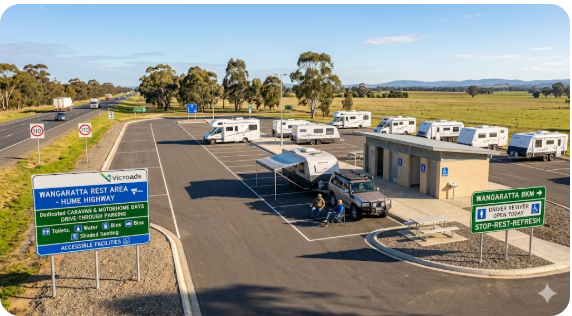
Wangaratta Rest Areas — Hume Highway VIC 2026
An honest, detailed guide to the Hume Highway rest areas at Wangaratta, Victoria — written specifically for senior grey nomads, caravan travellers and solo motorhome drivers aged 60 and over who need reliable, realistic information before they stop.
📅 Last reviewed: May 2026 | Wangaratta VIC 3677 | Rest areas are located directly on the Hume Highway and accessed via dedicated on and off ramps — not suitable for U-turns or reversing large rigs.
Cost to Stop
From Melbourne
Facility Present
Unpowered Only
Overnight Rules Apply
The Hume Highway rest areas near Wangaratta sit roughly 270 kilometres northeast of Melbourne on one of Australia’s busiest freight and holiday corridors. They are purpose-built stopping points managed under VicRoads guidelines, designed primarily for driver fatigue breaks rather than extended overnight camps. For senior grey nomads travelling between Melbourne and Albury-Wodonga, these rest areas offer a legitimate and legal place to pause, stretch, use the toilet and assess your condition before continuing. This guide gives you the honest picture — facilities, overnight rules, safety, medical access and what to plan before you arrive.
- Name: Wangaratta Rest Areas — Hume Highway (northbound and southbound)
- State: Victoria
- Use: Driver fatigue rest stop — short-term vehicle stop on the Hume Highway
- Best for: Daytime rest breaks, toilet stops, fatigue management on long highway drives
- Toilets: Yes — standard highway rest area toilet blocks present on both northbound and southbound sides; cleanliness and accessibility vary
- Dump point: No dump point at these rest areas
- Potable water: Not reliably available — carry your own supply
- Power: No powered sites — no 240V hookups of any kind
- Phone signal: Generally reasonable Telstra coverage on the Hume Highway corridor near Wangaratta — confirm on arrival
- Nearest town: Wangaratta VIC 3677
- Nearest major services: Wangaratta VIC 3677 (approximately 5 to 10 km depending on which rest area you use)
Table of Contents
- Location, GPS Coordinates and How to Find It
- Overnight Stays — What the Rules Actually Say
- Facilities — Toilets, Water and What to Expect
- Mobile Signal and Wi-Fi Coverage
- Road Access and Driving Notes for Caravans
- Realistic Arrival Conditions — What Others Don’t Tell You
- Safety — Personal and Trip Planning
- Medical Services and Emergency Planning
- Dump Points, Supplies and Resupply Planning
- Activities and Things to Do Nearby
- Seasonal Conditions and Best Time to Visit
- Rest Area Etiquette and Access Restrictions
- Pre-Departure Checklist for Senior Travellers
- GPS Master Reference Table
- Frequently Asked Questions
- Honest Verdict — Is It Worth Stopping?
1. Location, GPS Coordinates and How to Find It
The Wangaratta rest areas sit on the Hume Highway (M31) on either side of the divided carriageway, positioned north and south of Wangaratta township. The northbound rest area is located on the left-hand side when travelling from Melbourne toward Albury, and the southbound rest area mirrors this on the opposite carriageway. Both are accessible directly from the highway via dedicated deceleration lanes and are not accessible by U-turn — once you pass them you cannot loop back without exiting at a highway interchange.
Wangaratta itself sits in the Upper Murray region of northeast Victoria, surrounded by flat agricultural land with the King River and Ovens River running nearby. The landscape here is open and exposed — minimal tree cover at the rest areas themselves, which means good daytime visibility but wind exposure at night and in winter. The rest areas are clearly signed from the highway with standard blue rest area signage.
There are two separate rest area locations associated with the Wangaratta stretch of the Hume Highway. The coordinates below refer to the primary northbound rest area. If you are travelling southbound, your access point will be on the opposite carriageway. Check your GPS device for the southbound version before committing to an exit.
📍 GPS Coordinates — Wangaratta Rest Area (Northbound, Hume Highway)
−36.3480° S, 146.3120° E
Enter into Google Maps: [-36.3480, 146.3120]
Or search: Wangaratta Rest Area, Hume Highway VIC 3677
Nearest reference point: Hume Highway M31, approximately 5 km north of the Wangaratta township centre
Approaching from Melbourne, Wangaratta is reached via the Hume Highway (M31) through Seymour, Euroa and Benalla. The drive from Melbourne CBD to the Wangaratta rest areas is approximately 2 hours 40 minutes to 3 hours depending on traffic and road conditions. From Albury-Wodonga, the rest areas are roughly 80 kilometres south — approximately 50 to 55 minutes on the Hume. If you are travelling the full Melbourne-to-Sydney corridor, Wangaratta sits at roughly the halfway point between Melbourne and Albury.
2. Overnight Stays — What the Rules Actually Say
Wangaratta rest areas on the Hume Highway are classified as VicRoads highway rest areas — meaning they are managed as fatigue management stops under Victorian road safety legislation rather than as free camping reserves or overnight caravan parks. The primary legal purpose of these areas is to allow drivers to take a break from driving to manage fatigue. Overnight stays are technically not prohibited in all circumstances, but they exist in a grey zone that is distinct from designated free camping areas.
VicRoads rest area signage typically does not post explicit time limits at all locations, but the intent is clear: these are short-term rest stops, not camping locations. Rural City of Wangaratta council does not manage these areas directly — responsibility falls under VicRoads. If you are a senior grey nomad with a health condition that means you genuinely need to stop overnight for safety reasons (fatigue, medical need), a single night stop is unlikely to attract enforcement, but this cannot be guaranteed and conditions can change. The nearest full overnight options with facilities are in Wangaratta township itself.
- These are VicRoads highway rest areas — not designated free camping reserves
- No explicit overnight camping permit is available or required, but extended stays are not the intended use
- No time limit signs were present at the time of review — verify posted signage on arrival as these can be updated
- Do not set up tables, chairs, awnings or outdoor cooking equipment — this signals an extended camp and may attract ranger or police attention
- Noise and generators are inappropriate at any hour at a highway rest area — truck drivers and other travellers are also resting here
- If you feel unsafe to drive and need to stop overnight for genuine fatigue or health reasons, a single night is a reasonable and defensible decision
- For a full explanation of how overnight parking rules work across Australia and what rangers actually enforce, read our overnight parking Australia guide
- The best alternative for a powered, managed overnight stay in Wangaratta is a local caravan park in the township — several options exist within 5 to 10 kilometres
For senior travellers managing CPAP machines, insulin that requires refrigeration, or heart or respiratory conditions, the honest recommendation is to plan for a powered site in Wangaratta township rather than relying on this rest area for overnight stays. The rest area has no power, no dump point and no reliable water — and a single night without CPAP or medication refrigeration carries real health risk that no free stop is worth.
3. Facilities — Toilets, Water and What to Expect
The Wangaratta Hume Highway rest areas are highway standard — functional rather than comfortable. Expect a toilet block, a paved pull-off area suitable for trucks and caravans, some picnic infrastructure, and very little else. Do not arrive expecting camp kitchen facilities, powered sites, running hot water or showers. This is a rest stop in the genuine sense — a place to stop your engine, use the toilet, stretch your legs and reassess whether you are fit to continue driving.
| Facility | Available? | Senior Travel Notes |
|---|---|---|
| Toilets | Yes — basic highway toilet block | Present on both northbound and southbound sides; accessibility varies — not all highway blocks meet full DDA standards; check for grab rails before assuming accessible |
| Potable water | Not reliably available | Do not count on tap water being present or safe to drink — carry a minimum of 15 litres per person from your last town stop |
| Powered sites | No | No 240V power of any kind — CPAP users must have battery backup or solar; do not plan an overnight stay here without independent power |
| Dump point | No | Nearest dump point is in Wangaratta township — plan cassette or tank capacity accordingly before stopping here |
| Shade and seating | Limited — some picnic tables and shelter | Exposure to sun and wind is significant — bring a hat and sun protection; seating is basic and may be unsuitable for those with back or hip conditions |
| Rubbish bins | Generally present | Bin emptying frequency varies — if bins are full, carry your rubbish out; do not leave waste at the site |
| Overnight lighting | Minimal or none | Limited lighting after dark — essential to have a head torch for safe movement; ground may be uneven |
| Dog access | Yes — on lead | Dogs permitted on lead; ground surface is sealed or gravel — suitable for short walks but no formal dog area; clean up waste and carry bags |
4. Mobile Signal and Wi-Fi Coverage
The Hume Highway corridor through Wangaratta is one of the better-covered stretches of regional Victoria for mobile signal, primarily because it is a major freight and transport route with long-term investment in network infrastructure. That said, signal quality at the specific rest area pulloffs can differ from signal quality at 100 km/h on the highway itself — particularly for Optus and Vodafone users. Do not assume strong highway signal means strong parked signal.
- Telstra: Generally reliable 4G coverage in and around Wangaratta along the Hume Highway corridor — best performing network at this location for most senior travellers
- Optus: Coverage present in Wangaratta township and along much of the highway corridor; signal at the specific rest area pulloffs may be reduced — test on arrival before relying on it for medical alerts or emergency contact
- Vodafone / TPG: Coverage in the Wangaratta area but less consistent than Telstra on the highway fringe locations — verify on arrival; do not rely on this network for sole emergency communication
- Wi-Fi: No public Wi-Fi at these highway rest areas — nearest free Wi-Fi is likely at Wangaratta town library or local cafes in the township
- Satellite devices: Strongly recommended for any grey nomad travelling regional Victoria regardless of highway signal — a registered PLB or satellite communicator (such as a Garmin inReach) provides emergency contact capability independent of mobile towers; register at beacons.amsa.gov.au
5. Road Access and Driving Notes for Caravans
Approaching Wangaratta Rest Areas from key directions
- From Melbourne (southbound origin, travelling north): Follow the Hume Highway M31 through Seymour, Euroa and Benalla. The rest area is on the left-hand side approximately 5 km north of the Wangaratta interchange. Watch for blue rest area signs with sufficient advance notice to safely decelerate with a caravan or motorhome — approximately 2 hours 40 minutes from Melbourne in normal conditions.
- From Albury-Wodonga (northbound origin, travelling south): Follow the Hume Highway M31 south from Wodonga. The southbound rest area is on your left approximately 75 to 80 km south of Wodonga — allow approximately 50 to 55 minutes. Watch for blue signs and begin decelerating early given caravan braking distances.
- From Wangaratta township: If you are already in Wangaratta and want to access the rest areas from local roads, use the Wangaratta Highway interchange to re-enter the Hume Highway in the correct direction. Do not attempt to cross the median or access the highway from local side roads — this is illegal and extremely dangerous for vehicles towing caravans.
Specific road cautions for caravan and motorhome drivers
- The Hume Highway at this point is a divided dual carriageway — rest areas are only accessible from the correct direction of travel; there is no crossing point and no U-turn facility
- Deceleration lanes exist at highway rest areas but may be shorter than ideal for heavy rigs — begin slowing earlier than you think necessary, particularly when towing a van over 2,000 kg
- Truck and semi-trailer traffic is heavy on the Hume Highway at all hours including overnight — be aware of large vehicle movements when parking and walking within the rest area
- The rest area surface is sealed but may have edging kerbs or drainage lips that can catch low-slung caravans — walk the site before reversing or positioning your rig
- Wind exposure is significant in this open flat landscape — strong crosswinds can affect caravan handling on the approach; check conditions via the Bureau of Meteorology before departing your previous stop
- Fuel — do not count on finding roadside fuel at the rest area itself; fill at Wangaratta township before continuing; check prices at petrolspy.com.au before you leave town
6. Realistic Arrival Conditions — What Others Don’t Tell You
Arriving at a Hume Highway rest area near Wangaratta is a different experience from pulling into a quiet bush camp or a managed caravan park. The Hume is Australia’s busiest inland highway — truck and freight traffic runs 24 hours a day, seven days a week. When you pull into the rest area, you are parking beside semi-trailers, refrigerated transport rigs and highway travellers who are also using the stop for a legal fatigue break. Noise from idling diesel engines, reversing trucks and highway traffic is constant. If you are a light sleeper or have a health condition that is aggravated by interrupted sleep, this environment will affect your rest quality in a way that a quiet caravan park simply would not.
The rest area environment is open, exposed and functional. There is no natural screening from highway traffic, no ambient calm and no quiet hours enforced by a camp host. You will be visible to all other users of the rest area — trucks, cars and other travellers. For a solo senior traveller this is worth considering carefully. On the positive side, the constant through-traffic means you are never entirely alone, which some travellers consider a safety factor rather than a drawback.
- Expect diesel engine noise throughout the night — heavy vehicles often idle their refrigeration units for hours at a time
- Rest area lighting may be minimal after midnight — bring a head torch and place it within arm’s reach before sleeping
- The area is visible and open — your vehicle is not concealed from road view, which is reassuring from a safety standpoint but means no real privacy
- In peak holiday periods (Christmas, Easter, long weekends) the rest area may reach capacity — arrival after 9 pm in these periods carries the risk of having no space for a full-size motorhome or caravan
- Always have a backup plan — know the address and phone number of at least one Wangaratta caravan park before you arrive at the rest area, so if conditions are unsuitable you can move immediately rather than searching in the dark
7. Safety — Personal and Trip Planning
Personal safety at this location
- Vehicle visibility and positioning: Park in a well-lit section of the rest area if possible, facing the exit. This allows you to drive away quickly without reversing if you feel uncomfortable — important for solo senior travellers.
- Constant through-traffic as a safety factor: Unlike isolated bush camps, the Hume Highway rest area has constant vehicle movement — other trucks and travellers are always present, which reduces the risk of isolated confrontation; however, it also means unknown individuals pass through at all hours
- Lock doors and secure windows before sleeping: Standard practice for any overnight vehicle stop — use internal van locks; do not rely solely on external door locks that can be defeated; keep valuables inside the vehicle rather than in external storage compartments
- Ground surface and fall risk after dark: The rest area surface is sealed or compacted gravel — suitable in daylight, but the combination of darkness, unfamiliar terrain and overnight temperature drop creates a genuine fall risk for seniors who need to use the toilet block overnight; use a head torch every time you exit the vehicle after dark
- Fatigue monitoring for solo travellers: The entire purpose of this rest area is fatigue management — if you have stopped here because you felt tired while driving, do not underestimate how seriously fatigue impairs senior drivers; give yourself a minimum of 30 minutes rest before reassessing whether you should continue or stop for the night
Trip safety planning before you leave home
- Notify a trusted person of your full itinerary including planned stops — update them when you depart each location and confirm when you arrive at the next
- Keep your phone charged at all times; carry a portable power bank with sufficient capacity for at least one full phone charge; at an unpowered rest area your vehicle power is your only charging source overnight
- Register your EPIRB or PLB at beacons.amsa.gov.au — even on a major highway, mobile signal failure combined with a medical emergency can leave you without any other reliable way to call for help
- Carry at least a 7-day buffer of all prescription medications — the nearest pharmacy in Wangaratta can fill standard prescriptions during business hours but specialist medications may need to be sourced before you leave your home base
- Check VicRoads road conditions before departure at vicroads.vic.gov.au — highway works, incidents or detours on the Hume can significantly affect your stopping options and timing
For a full caravan security checklist and safe parking habits for grey nomad travellers, read our guide to grey nomad safety tips — staying safe on the road after 60.
8. Medical Services and Emergency Planning
Wangaratta is one of the better-serviced regional centres on the Hume Highway corridor for medical infrastructure, which is an important factor when planning a stop in this area. The Northeast Health Wangaratta hospital is a genuine regional hospital with emergency department services — not a small community clinic. This makes the Wangaratta stretch of the Hume significantly safer from a medical planning perspective than many rural rest areas further along the corridor. However, response times from a highway rest area to the hospital still require a vehicle journey — ambulance dispatch from the Wangaratta area is your primary option in a genuine emergency.
| Service | Location | Distance from Rest Area | Notes |
|---|---|---|---|
| Northeast Health Wangaratta — Emergency Department | Green Street, Wangaratta VIC 3677 | Approximately 6 to 9 km south depending on which rest area you are at | Full regional hospital with 24-hour emergency department — public hospital with ED, surgical and medical wards; this is the primary emergency facility for the Wangaratta region |
| Albury Wodonga Health — Albury Hospital | Borella Road, Albury NSW 2640 | Approximately 80 km northeast | Major regional referral hospital with full emergency department — relevant if you are closer to the Wodonga end of the route or if specialist services are needed beyond Northeast Health Wangaratta capacity |
| GP and Medical Centres — Wangaratta | Wangaratta VIC 3677 | Approximately 5 to 10 km | Multiple GP practices in Wangaratta township — business hours only; useful for prescription repeats, non-urgent assessments and travel health advice; not a substitute for the emergency department |
| Emergency — 000 | Australia-wide | N/A | Call 000 for ambulance, fire or police — ambulance coverage in the Wangaratta region is reasonable by regional standards but response times to a highway rest area may still be 10 to 20 minutes depending on crew availability and workload |
| Healthdirect — 1800 022 222 | Phone service — Australia-wide | N/A | Free 24-hour nurse-on-call line — call this number when you are unsure whether a symptom requires an emergency department visit or can safely wait until morning; particularly valuable for solo senior travellers overnight at an unpowered stop |
9. Dump Points, Supplies and Resupply Planning
There is no dump point at the Wangaratta Hume Highway rest areas. Disposing of grey water, black water or cassette waste at a highway rest area is illegal under Victorian environmental protection legislation and carries significant on-the-spot fines — do not use rest area drainage, car park edges or adjacent vegetation as a waste disposal point under any circumstances.
| Supply Need | Nearest Option | Approximate Distance |
|---|---|---|
| Dump point | Wangaratta township — confirm exact location via the Camps Australia Wide app or WikiCamps before arriving; the Wangaratta Caravan Park and some council facilities in town have dump points | Approximately 5 to 10 km from the rest area |
| Drinking water | Wangaratta township — fill at a caravan park, service station or council tap point in town before stopping at the rest area | Approximately 5 to 10 km |
| LPG refill | Wangaratta — service stations and hardware outlets in town; call ahead to confirm Motorhome-size LPG cylinder compatibility before making the trip | Approximately 5 to 10 km |
| Groceries and fresh food | Wangaratta township — Woolworths, Coles and IGA are all present in Wangaratta; full resupply is straightforward before or after your rest stop | Approximately 5 to 10 km |
| Fuel | Wangaratta township — multiple service stations available; fill before leaving town rather than relying on finding roadside fuel at the rest area; check prices at petrolspy.com.au before you commit to a particular outlet | Approximately 5 to 10 km |
For help planning a longer grey nomad circuit with reliable resupply stops built in, visit our vanlife savings spots directory. Also see our complete free camping Victoria guide for stops with better facilities along this corridor.
10. Activities and Things to Do Nearby
Best senior-friendly ideas at Wangaratta Rest Areas
| Activity | Distance from Rest Area | Senior Accessibility Notes |
|---|---|---|
| Wangaratta Town Centre — cafes, shops and galleries | Approximately 5 to 10 km | Flat sealed footpaths through most of town centre; parking available for motorhomes and caravans at designated areas; excellent for a relaxed morning before or after a highway stop |
| Wangaratta Visitor Information Centre | Approximately 8 km | Fully accessible visitor centre with seating, local maps and trip planning advice — useful for finding current dump points, powered overnight options and local events |
| King River Walk — Wangaratta riverside trail | Approximately 8 to 10 km | Flat paved riverside walking path through town — suitable for seniors with mobility aids on the main sealed sections; rest benches available; short sections are possible if a full walk is too much |
| Milawa Gourmet Region — wineries and cheese | Approximately 18 km from Wangaratta township | Milawa is flat and accessible; tasting rooms generally have seating; road to Milawa is sealed two-lane — suitable for caravans but check turning space before committing a large rig to a winery driveway |
| Wangaratta Jazz and Blues Festival (annual — November) | In Wangaratta township | Australia’s premier jazz festival — fully accessible main stages; some outdoor seating; crowds can be large so arrive early for parking; check current festival dates via Wangaratta council as scheduling can vary |
| Mount Buffalo National Park | Approximately 60 km east of Wangaratta | Significant alpine destination — scenic drive is accessible by car but road sections are steep and winding; not suitable for large caravans on the upper mountain road; check Parks Victoria access conditions before towing; best as a day trip without the van |
For verified free and low-cost stops across Australia that suit senior grey nomads, visit our vanlife savings spots directory.
11. Seasonal Conditions and Best Time to Visit
| Season | Typical Conditions | Senior Travel Rating |
|---|---|---|
| Summer (Dec–Feb) | Hot to very hot — Wangaratta regularly exceeds 35°C in January and February; open exposed rest area has minimal shade; extreme heat events occur in this region; northerly winds can be strong and very dry | ⚠️ Caution — heat stress and dehydration risk is significant for seniors; do not stay at an unpowered stop overnight in extreme heat without air conditioning capability; early morning or late afternoon stops only in peak summer |
| Autumn (Mar–May) | Mild and pleasant — temperatures typically 18°C to 26°C; low humidity; generally calm winds; this is the most comfortable season for highway travel in northeast Victoria; minimal rain | ✅ Best season — comfortable temperature range for senior travellers; ideal for unhurried travel; Milawa wine region harvest season adds a regional bonus |
| Winter (Jun–Aug) | Cool to cold — overnight temperatures regularly drop to 2°C to 5°C; frost is common on the flat surrounding paddocks; wind chill on the exposed rest area can make even a mild day feel significantly colder; heavy rain periods occur | ⚠️ Manageable with preparation — cold nights at an unpowered stop require quality insulation and warm bedding; seniors on blood pressure medication should be aware that cold weather can elevate BP; hypothermia risk is real for anyone who sleeps cold at this location |
| Spring (Sep–Nov) | Warming and variable — temperatures rising from 14°C to 25°C through the season; some strong winds and occasional thunderstorms; the landscape greens considerably; generally very pleasant for travel | ✅ Excellent — spring is the second-best season for this corridor; wildflower season in the High Country nearby adds interest; temperatures suit senior travellers well; wind can be an issue on the exposed highway rest area but is manageable |
12. Rest Area Etiquette and Access Restrictions
The long-term availability of highway rest areas as overnight or extended stops for grey nomads depends directly on how those areas are used by travellers. VicRoads reviews the use patterns of rest areas regularly, and if an area attracts complaints — from truck drivers who cannot access fatigue stop bays, from local residents near highway access roads, or from other travellers encountering waste or mess — the response is typically increased signage, time limits or physical modifications to make extended stays impractical. Every grey nomad who uses a rest area respectfully helps preserve access for the next traveller.
- Arrive at a reasonable hour — pulling into a rest area late at night with lights blazing and engine idling for extended periods disrupts other users who are already resting there
- No generators overnight — ever; generator noise is completely inappropriate at a shared highway rest area where truck drivers and other travellers are trying to rest; this is the single most common complaint that leads to access restrictions at popular rest stops
- Do not set up awnings, outdoor furniture, camp kitchens or clothes lines — this signals an extended camp and occupies space that may be needed for other vehicles; at a rest area, you are a vehicle stop, not a campsite
- Remove all rubbish when you leave — if bins are full, pack your waste and dispose of it in Wangaratta township; leaving rubbish at a rest area is both illegal and one of the fastest ways to trigger council or VicRoads enforcement action
- Do not damage or remove vegetation — the limited grass and plant material at the rest area is important for preventing erosion and dust; do not park on grassed areas or allow pets to dig
- Respect time limits — if signs are posted indicating a maximum stay (24 hours, 20 hours or similar), move on when required; do not assume your situation is an exception to posted rules
13. Pre-Departure Checklist for Senior Travellers
| Item | Action Required | Why It Matters at This Location |
|---|---|---|
| Water supply — minimum 15 litres per person | Fill before leaving Wangaratta township or your last overnight stop | No potable water is reliably available at this rest area — dehydration risk is elevated in warm weather for seniors on medications |
| Medication supply — minimum 7-day buffer | Check quantities, expiry dates and refrigeration needs before departure | The nearest pharmacy is in Wangaratta township approximately 5 to 10 km away — adequate for standard repeats but specialist medications may need to be sourced before leaving your home base |
| CPAP battery or solar solution | Confirm charged and functional before stopping overnight | No power at this rest area — CPAP users must have an independent battery solution; a single night without CPAP carries genuine health risk for those with diagnosed sleep apnoea |
| Fuel — above half tank before arriving | Fill at Wangaratta township service stations before accessing the rest area | No fuel at the rest area itself; if you need to drive to Wangaratta for any reason overnight, having adequate fuel avoids an additional stress point |
| Emergency contact notified of itinerary | Send a message before leaving your previous stop | Mobile signal at this rest area is generally reasonable on Telstra but cannot be guaranteed — notify someone of your location before you lose confidence in your signal |
| EPIRB or PLB registered and charged | Confirm registration at beacons.amsa.gov.au | On a major highway with reasonable signal this may feel unnecessary — but a medical emergency combined with mobile network congestion or failure can leave you with no other option; always carry and register your device |
| Backup overnight plan confirmed | Have the name, address and phone number of at least one Wangaratta caravan park saved before arrival | If the rest area is full, unsuitable, noisy or restricted, you need an immediate alternative — do not search for accommodation from the highway in the dark |
| Road conditions checked | Check VicRoads at vicroads.vic.gov.au before departure | Highway works, incidents or lane closures on the Hume between your departure point and Wangaratta can affect timing and access significantly for slow-moving caravan combinations |
| Warm layers accessible — not packed in external storage | Keep a jacket, beanie and extra blanket within the vehicle cab or sleeping area | Winter overnight temperatures near Wangaratta can drop to near zero — rummaging through external storage compartments in the dark on cold sealed ground is a genuine fall risk for seniors |
| Head torch and spare batteries | Confirm working before departure; place within arm’s reach before sleeping | Rest area lighting is minimal to nil after midnight; the toilet block is a walk from your vehicle across an uneven or dimly lit surface — a head torch is essential for every night-time exit from the vehicle |
📍 Interactive Map — Wangaratta Rest Areas, Hume Highway VIC 3677
COPY PROMPT ➔ ASK AI ➔ SAVE TO FORM ➔ ADD SPOT PIN ➔ GET DIRECTIONS
📍 Interactive map — find free camps, rest areas and overnight stops near Wangaratta on the Hume Highway. Enable location for best results.
14. GPS Master Reference Table
| Location | GPS Coordinates | Notes |
|---|---|---|
| Wangaratta Rest Area — Hume Highway Northbound | −36.3480° S, 146.3120° E | Planning coordinates only — verify exact stopping position on arrival using posted VicRoads signage; northbound carriageway only |
| Northeast Health Wangaratta — Emergency Department | −36.3594° S, 146.3118° E | Approximately 6 to 9 km south of rest area — 24-hour emergency department; primary hospital for the Wangaratta region |
| Albury Hospital — Albury Wodonga Health | −36.0785° S, 146.9135° E | Approximately 80 km northeast — major regional referral hospital with full ED; relevant for specialist care or if travelling closer to the Wodonga end |
| Wangaratta Town Centre | −36.3587° S, 146.3131° E | Approximately 5 to 10 km — full services including Woolworths, Coles, IGA, pharmacies, fuel, dump point and caravan parks |
| Milawa Gourmet Region | −36.4416° S, 146.4277° E | Approximately 18 km from Wangaratta township — wineries, cheese factory and local produce; sealed road suitable for caravans on the main route; check individual winery access for large rigs |
For a broader list of verified free and low-cost stops across Victoria and the Hume Highway corridor, visit our vanlife savings spots directory.
15. Frequently Asked Questions
Can you stay overnight at the Wangaratta rest areas on the Hume Highway?
Overnight stays are not explicitly prohibited at Wangaratta Hume Highway rest areas in the way that a clearly signed “no camping” area would be. These are VicRoads fatigue management stops — the legal intent is for short rest breaks, not extended overnight camps. A single overnight stop for genuine fatigue or safety reasons is unlikely to attract enforcement, but cannot be guaranteed. Always check posted signage on arrival as rules can be updated without notice. For a planned overnight stop, a powered caravan park in Wangaratta township is a significantly better option for senior travellers.
Are there toilets at the Wangaratta Hume Highway rest areas?
Yes — basic toilet blocks are present on both the northbound and southbound sides of the rest area. These are standard highway rest area facilities — functional but not always well maintained. Accessibility for seniors with mobility requirements is variable — not all highway toilet blocks meet full accessible design standards. Verify grab rail and door width adequacy on arrival before relying on them overnight. Carry your own toilet paper as supplies in highway rest area blocks are not always reliably restocked.
How far is the Wangaratta rest area from Melbourne?
The Wangaratta rest areas are approximately 270 kilometres northeast of Melbourne CBD via the Hume Highway M31. In normal traffic conditions this is approximately 2 hours 40 minutes to 3 hours of driving. For senior travellers, factoring in a comfort break at Seymour (approximately 100 km) or Euroa (approximately 160 km) before reaching Wangaratta is a sensible fatigue management strategy — both have rest facilities along the highway. See our guide to the Euroa Rest Area for what to expect at that stop.
Is the Wangaratta rest area safe for a solo senior traveller overnight?
The Wangaratta Hume Highway rest area is a busy, well-trafficked location — the constant presence of truck and highway traffic means you are not isolated, which is a positive safety factor compared with remote bush camps. However, it is not a managed, staffed facility and has no ranger presence. Standard safety practices apply: lock your vehicle, park facing the exit, keep your phone charged, notify someone of your location before settling for the night, and have a backup plan ready. Solo senior travellers — particularly women — should assess their comfort level with the rest area environment on arrival rather than committing to it before seeing the actual conditions.
Is there a dump point at the Wangaratta Hume Highway rest areas?
No. There is no dump point at the highway rest areas. Do not discharge any waste — grey water, black water or cassette waste — at this location. The nearest dump point is in Wangaratta township, approximately 5 to 10 kilometres from the rest area. Verify the exact location and operating hours via a current camping app such as Camps Australia Wide or WikiCamps before you arrive. Illegal waste disposal carries significant fines under Victorian environmental legislation.
What is the mobile signal like at Wangaratta rest areas on the Hume Highway?
The Hume Highway corridor near Wangaratta generally has reasonable Telstra 4G coverage — it is one of the better-serviced stretches of the highway given its importance as a freight and transport route. Optus and Vodafone coverage is present but less consistent at specific rest area pull-offs compared with signal at highway speed. Test your signal on arrival before assuming connectivity for emergency contact or medical monitoring. If you rely on mobile connectivity for health-related devices or emergency alerts, carry a satellite communication device as a backup regardless of the expected coverage quality.
What are the best months to stop at the Wangaratta rest areas?
Autumn (March to May) and spring (September to November) are the most comfortable seasons for stopping at this location. Temperatures are mild, winds are generally manageable and the highway traffic, while constant, is less congested than peak summer holiday periods. Avoid summer (December to February) for overnight stays at unpowered stops — the exposed location and potential for extreme heat make it unsuitable for seniors without adequate van cooling. Winter overnight stays are possible for well-equipped travellers but require proper insulation against near-zero temperatures.
Can CPAP users stay overnight at the Wangaratta rest areas?
Not without independent power. There are no powered sites or 240V electricity hookups at the Wangaratta Hume Highway rest areas. CPAP users who require mains power for their machine must either carry a fully charged CPAP battery (such as a ResMed or Medistrom travel battery), have a solar charging setup with sufficient overnight capacity, or book a powered site at a Wangaratta caravan park. A single night without CPAP treatment for someone with diagnosed sleep apnoea is a genuine health risk — it is not a decision to make lightly to save the cost of one night at a powered site.
Are dogs allowed at the Wangaratta Hume Highway rest areas?
Dogs are generally permitted at highway rest areas and are welcome at these locations provided they are kept on lead at all times. The rest area surface is sealed or compacted gravel — suitable for short leg-stretch walks. There is no formal dog exercise area. Clean up after your dog and dispose of waste in provided bins or carry it out if bins are full. In hot weather, the exposed surface of the rest area heats quickly — check the ground temperature before walking your dog in summer conditions, as sealed surfaces can burn paws at temperatures above 35°C.
16. Honest Verdict — Is It Worth Stopping?
As a daytime rest stop on a long Hume Highway drive, the Wangaratta rest areas do exactly what they are designed to do. They give you a safe, legal, off-highway place to stop your engine, use the toilet, eat a sandwich, walk the dog and genuinely assess whether you are fit to continue driving. For senior grey nomads on the Melbourne-to-Albury corridor, this is a valuable and well-positioned stop — Wangaratta sits at a natural mid-point in the journey and the township nearby gives you genuine backup options if your plans change. The proximity to Northeast Health Wangaratta also provides meaningful reassurance for travellers with health conditions compared with more isolated highway rest areas further north or south.
For overnight stays, the honest verdict is more nuanced. The rest area is legally usable for a fatigue-management overnight stop and is unlikely to attract enforcement for a single quiet night. But it is not a comfortable, quiet or well-facilitated overnight destination — it is a truck rest area on a 24-hour freight highway, and that environment is exactly what it sounds like. Senior travellers managing health conditions requiring power, refrigeration, stable sleep or medical proximity should book a powered site in Wangaratta township rather than treating this rest area as an overnight camp. The town has good caravan park options within 10 kilometres and a full-service regional hospital. Use those resources — they exist specifically to support travellers like you.
Daytime rest stop: ✅ Recommended — well-positioned, legal and functional for a fatigue break on the Hume Highway corridor
Overnight stay: ⚠️ Possible but not ideal — highway noise, truck traffic and no power or water make this a last-resort overnight option rather than a planned stop
Senior health suitability: ⚠️ Limited — no power for CPAP, no water, no dump point; proximity to Northeast Health Wangaratta is a positive factor but a powered caravan park in town is the better choice for any senior with active health management needs
Best for: Daytime fatigue breaks, toilet stops, leg stretches and reassessment of driving condition on the Melbourne-to-Albury run
For verified overnight stops with facilities along the Hume Highway corridor and across Victoria, see our vanlife savings spots directory and the complete rest areas Victoria guide.
- Euroa Rest Area — Hume Highway VIC guide for senior grey nomads
- Seymour Rest Area — Hume Highway VIC guide for senior grey nomads
- Broadford Rest Area — Hume Highway VIC guide for senior grey nomads
- Free Camping Victoria — the complete grey nomad guide 2026
- Rest Areas Victoria — every major stop on the Hume and beyond
- What is free camping in Australia — the complete seniors guide
- Overnight parking Australia — rules, locations and what to expect
- What rangers look for at overnight van parking spots in Australia
- Free camping for retirees — how long can you stay and how much can you save?
- Stealth camping Australia — honest guide for senior travellers
- Van life savings spots — verified free and low-cost camps across Australia
- Free camping NSW — where seniors can legally stop for free
- Queensland free camping guide — the best spots for grey nomads
- Grey nomad safety tips — staying safe on the road after 60
Free campsites and powered sites fill fast during school holidays and peak season. If your preferred site is already taken, search remaining accommodation options below to explore the Wangaratta region.
Accommodation and flight search powered by Expedia. Booking through this search supports this website at no extra cost to you. As an affiliate, I earn from qualifying purchases at no extra cost to you.
Plan your Hume Highway route with confidence — RV LIFE Trip Wizard helps senior grey nomads map rest areas, dump points and overnight stops before you leave home.
Plan Your Route with RV LIFE Trip Wizard
Travelling the Hume Highway solo? Protect your van and your peace of mind with StarterStopper — Australia’s trusted vehicle immobilizer system.
Visit StarterStopper.com.au — Use Code RTV5 for 5% OffPromo code: RTV5
As an affiliate, I earn from qualifying purchases at no extra cost to you.