Rest Areas Victoria 2026 — GPS-Verified Guide
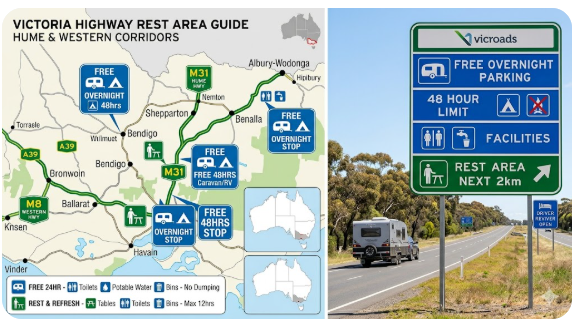
A practical, honest guide to Victoria’s key highway rest areas for senior grey nomads — covering GPS coordinates, overnight rules, facilities, medical access and realistic arrival conditions across the Hume, Princes and Goulburn Valley corridors.
📅 Last reviewed: May 2026 | Victoria, Australia | Accessible by sealed highway from all major Victorian entry points — confirm individual rest area conditions before arrival.
GPS-Verified Stops
No Booking Required
At Most Sites
Highways Covered
Senior Health Priority
Victoria’s highway rest areas serve a practical purpose — they exist to reduce driver fatigue, not to provide the facilities of a powered campsite. For senior grey nomads driving the Hume, Princes or Goulburn Valley corridors in 2026, knowing exactly what each stop offers before you arrive can mean the difference between a safe, comfortable break and an uncomfortable or risky overnight. This guide covers eight verified Victorian rest area locations with honest facility details, GPS coordinates, overnight rules and health-specific planning information written for travellers aged 60 and above.
- Coverage: Eight verified Victorian rest areas across three major highway corridors
- Highways covered: Hume Highway, Princes Highway, Goulburn Valley Highway
- Cost: Free at all locations — no booking required
- Overnight rules: Varies by location and council jurisdiction — check each individual guide
- Toilets: Present at most but not all locations — confirm at each stop
- Dump points: Not available at rest area level — plan dump stops in advance
- Potable water: Not reliably available — carry minimum 15 litres per person
- Power: Not available at any of the locations in this guide
- Phone signal: Varies significantly — Telstra performs best across regional Victoria
- Nearest major services: Varies by location — each individual guide lists distances
- Best for: Daytime fatigue breaks, short overnight stops for self-contained travellers
- Not suitable for: CPAP-dependent travellers without battery backup, insulin storage without cooling solution, travellers without a self-contained waste system
Table of Contents
- Location Overview — Where These Rest Areas Sit in Victoria
- Overnight Stays — What the Rules Actually Say Across Victoria
- Facilities — Toilets, Water and What to Expect
- Mobile Signal and Wi-Fi Coverage Across These Corridors
- Road Access and Driving Notes for Caravans
- Realistic Arrival Conditions — What Others Don’t Tell You
- Safety — Personal and Trip Planning
- Medical Services and Emergency Planning
- Dump Points, Supplies and Resupply Planning
- Activities and Things to Do Near These Rest Areas
- Seasonal Conditions and Best Time to Visit
- Rest Area Etiquette and Access Restrictions
- Pre-Departure Checklist for Senior Travellers
- GPS Master Reference Table — All Eight Locations
- Frequently Asked Questions
- Honest Verdict — Are Victorian Rest Areas Worth Using?
1. Location Overview — Where These Rest Areas Sit in Victoria
The eight Victorian rest areas covered in this guide are spread across three of the state’s busiest highway corridors. The Hume Highway corridor runs northeast from Melbourne toward Wodonga and the New South Wales border, passing through Broadford, Seymour and Euroa. The Princes Highway corridor heads east from Melbourne through Gippsland toward the New South Wales border at Cann River. The Goulburn Valley corridor heads north through Shepparton and Cobram toward the Murray River. Each of these routes carries significant freight and tourist traffic, and rest areas along these roads serve a genuine road safety function — they are designed to interrupt long drives, not to replace caravan parks.
Matthew Flinders Park Rest Area sits outside the main highway corridors and serves a different purpose — it is a council-managed recreational reserve near Frankston in the Mornington Peninsula region, and its character is different from a highway fatigue stop. Understanding which type of rest area you are approaching matters significantly for senior travellers making planning decisions about overnight stops, medical access and supply buffers.
Each location listed below has a dedicated individual guide with full GPS coordinates, facility details and specific overnight rules. This hub page gives you the overview you need to plan your Victorian route and select the stops most appropriate for your health needs and travel style.
📍 GPS Reference — Victorian Rest Area Corridor Overview
Hume Highway Corridor: NE of Melbourne toward Wodonga
Broadford Rest Area: See individual guide — approximately 73 km north of Melbourne CBD
Seymour Rest Area: See individual guide — approximately 98 km north of Melbourne CBD
Euroa Rest Area: See individual guide — approximately 155 km north of Melbourne CBD
Shepparton Rest Areas: See individual guide — approximately 185 km north of Melbourne CBD
Cobram Rest Area: See individual guide — approximately 255 km north of Melbourne CBD
Cann River Rest Area: See individual guide — approximately 415 km east of Melbourne CBD
Matthew Flinders Park Rest Area: See individual guide — approximately 47 km southeast of Melbourne CBD
For travellers entering Victoria from New South Wales on the Hume Highway, Broadford is your first realistic stop after Albury-Wodonga. For those entering via the Princes Highway from the east, Cann River is the first major Victorian stop. Travellers heading to the Riverina or Murray regions will find Shepparton and Cobram the most relevant stops. Plan your route using the individual guides below before you leave — not on your phone while driving.
Individual Location Guides — Click Through for Full Detail
- Broadford Rest Area — GPS-Verified Senior Guide
- Seymour Rest Area — GPS-Verified Senior Guide
- Euroa Rest Area — GPS-Verified Senior Guide
- Shepparton Rest Areas — GPS-Verified Senior Guide
- Cobram Rest Area — GPS-Verified Senior Guide
- Cann River Rest Area — GPS-Verified Senior Guide
- Matthew Flinders Park Rest Area — GPS-Verified Senior Guide
- Sydney to Victoria via the Princes Highway — Grey Nomad Route Guide
2. Overnight Stays — What the Rules Actually Say Across Victoria
Victorian highway rest areas operate under a patchwork of rules. Some are managed by VicRoads as road reserve infrastructure, which generally permits short-duration overnight stops for driver fatigue management. Others sit within council jurisdiction, where overnight vehicle accommodation rules vary significantly between municipalities and are subject to local by-laws that can change without wide public notice. The key principle under Victoria’s Road Management Act is that rest areas exist for driver rest — not for extended camping. What constitutes an acceptable stay duration is not always clearly posted, and enforcement patterns differ between regional and metropolitan areas.
As a general position across the eight locations in this guide: a single overnight stop of one night is typically tolerated at highway rest areas on the Hume and Princes corridors. Stays beyond 24 hours are not appropriate and may attract enforcement. Matthew Flinders Park operates under different council rules and has different expectations — see its individual guide for current details. The Shepparton rest areas operate within a regional city context where council visibility is higher than on remote highway stretches.
- Highway rest areas on the Hume and Princes corridors generally permit one overnight stop for driver fatigue — this is not a free camping entitlement
- Extended stays beyond one night are not appropriate at any of the locations in this guide
- No campfires at any Victorian rest area — this is an enforced restriction, not a suggestion
- Self-contained vehicles only for overnight use — grey water and black water must be retained on board
- No erection of tents or annexes — vehicles must remain road-ready in configuration
- Council-managed locations such as Matthew Flinders Park have specific local rules — check that individual guide before assuming highway rest area conditions apply
- Conditions change — always check posted signage on arrival and move on if new restrictions have been posted since this guide was reviewed. See our full overnight parking Australia guide for broader context on your legal position
For senior travellers managing health conditions that require overnight power — CPAP machines, insulin refrigeration, medication stability — a highway rest area in Victoria is not a reliable solution unless you have independent battery, solar or generator capacity sufficient for your full overnight needs. The honest recommendation for health-critical seniors is to use powered caravan park sites as your primary overnight option and treat rest areas as daytime fatigue breaks or single-night emergency stops only.
3. Facilities — Toilets, Water and What to Expect
Victorian highway rest areas vary considerably in facility standard. The difference between a well-maintained VicRoads rest area on the Hume Highway and a basic roadside pull-off on a secondary route can be significant. The table below reflects the general facility position across the eight locations in this guide — individual guides provide location-specific detail. Do not assume all facilities listed as present are in working order on arrival; maintenance schedules vary and vandalism affects some sites.
| Facility | Available Across These Sites? | Senior Travel Notes |
|---|---|---|
| Toilets | Present at most locations — not all | Verify at each individual guide; condition varies; not always accessible-standard; check for step-free entry before committing to overnight |
| Potable water | Not reliably available at any location | Carry minimum 15 litres per person; diabetes and blood pressure medication management depends on consistent hydration — do not rely on rest area water |
| Powered sites | Not available at any location in this guide | CPAP users must have battery backup, solar or generator capacity confirmed before arriving; no exceptions |
| Dump point | Not available at any location in this guide | Plan dump stops in advance using verified locations in nearby towns — see Section 9 |
| Shade and seating | Varies — some sites have shelters, most have limited shade | Afternoon summer heat at exposed highway stops can be significant; arrive before midday or after 4pm in summer |
| Rubbish bins | Present at most highway locations | Carry out principle applies when bins are full — do not leave rubbish beside overflowing bins; this contributes to site closures |
| Overnight lighting | Limited — most sites have minimal or no overnight lighting | Head torch is essential; movement around the vehicle after dark on uneven ground is a fall risk for seniors |
| Dog access | Generally permitted on lead — verify posted signage at each site | Keep dogs on lead at all times; some sites have vehicle movement at night from other travellers arriving late |
4. Mobile Signal and Wi-Fi Coverage Across These Corridors
Mobile coverage across Victoria’s main highway corridors is reasonable by Australian standards, but “reasonable” does not mean reliable at every individual rest area. The Hume Highway corridor from Melbourne to Albury-Wodonga has good Telstra coverage at most stops, with some gaps in lower terrain. The Princes Highway east of Bairnsdale toward Cann River becomes significantly more patchy — Cann River itself sits in a river valley where signal can be inconsistent regardless of carrier. The Goulburn Valley corridor through Shepparton and Cobram generally has good coverage as both are regional centres. Matthew Flinders Park near Frankston benefits from proximity to Melbourne’s network infrastructure.
- Telstra: Best performing carrier across all corridors — still has gaps east of Orbost on the Princes Highway and in some valley positions
- Optus: Reasonable on the Hume as far as Albury; patchy on the Princes Highway east of Sale; limited at Cann River
- Vodafone / TPG: Reliable in larger towns including Seymour, Euroa, Shepparton and Cobram; limited at highway rest stops between towns
- Wi-Fi: Not available at any of the highway rest areas in this guide — assume no Wi-Fi at any location
- Satellite devices: A registered PLB or satellite communicator is strongly recommended for senior solo travellers using Cann River or any remote Princes Highway stop — these provide emergency communication independent of mobile networks
5. Road Access and Driving Notes for Caravans
Approaching Victorian Rest Areas from Key Directions
- From Melbourne (north via Hume Highway): The Hume Highway is a divided freeway from Melbourne to Albury — good road surface, clear signage, well-marked rest area exits. Allow extra braking distance when towing; rest area exit ramps are short at some locations. Broadford, Seymour and Euroa are all accessible from this route.
- From Albury-Wodonga (south via Hume Highway): Conditions as above in reverse. Descending grades south of Wodonga require engine braking with a loaded van or motorhome — check brake temperature before rest stops on this section.
- From Melbourne (east via Princes Highway): The Princes Highway is a single-lane road for most of its length east of Traralgon. Overtaking opportunities are limited. Cann River is approximately 415 km from Melbourne — a long day’s drive with a caravan. The Sydney to Victoria Princes Highway guide covers this corridor in detail.
- From Sydney (south via Princes Highway): Cross the New South Wales-Victoria border at Genoa and Cann River is approximately 20 km west. Good sealed road. See the dedicated route guide for full approach detail.
- From Melbourne (north via Goulburn Valley Highway): Shepparton is approximately 185 km north of Melbourne via the Hume and Goulburn Valley Highways — mostly flat, sealed two-lane road through irrigated farmland. Cobram is a further 70 km north.
Specific road cautions for caravan and motorhome drivers across Victoria
- Rest area access roads on the Hume Highway are often short deceleration lanes — signal early, begin braking early and do not attempt a late turn across moving traffic
- Some rest areas use gravel or compacted dirt surfaces for parking — low-clearance motorhomes and long fifth-wheelers should check individual guides before assuming sealed parking
- The Princes Highway east of Bairnsdale carries significant logging truck traffic — maintain safe following distance and be patient; overtaking with a caravan on this road requires good judgment and a clear long straight
- Fuel stations become sparse east of Bairnsdale on the Princes Highway — fill at Sale or Bairnsdale before continuing east toward Cann River
- Check VicRoads for current roadworks and speed restrictions before departure — highway rest areas within active roadworks zones may have altered access or temporary closures: vicroads.vic.gov.au
- In winter, early morning fog is common across the Goulburn Valley floor — allow additional time and use headlights; conditions can change quickly between Seymour and Shepparton
6. Realistic Arrival Conditions — What Others Don’t Tell You
Travel guides and apps frequently list Victorian rest areas as pleasant stops with basic facilities. What they rarely describe is what arriving at 6pm in a 10-metre motorhome actually looks like. At popular Hume Highway rest areas such as Seymour and Euroa, you may arrive to find the best flat parking spaces already taken by trucks — large semi-trailers use these sites legally and regularly, and they park for extended rest periods under heavy vehicle fatigue laws. The noise, vibration and exhaust from an idling prime mover parked 10 metres from your bedroom is not a minor inconvenience for a light sleeper or someone managing elevated blood pressure.
At remote locations such as Cann River, the arrival experience is different — the site is often quiet, but the isolation is genuine. There is no passing foot traffic, no neighbouring business to walk to, and the nearest meaningful medical service is a considerable distance away. Matthew Flinders Park near Frankston is a recreational reserve with a genuinely different character — it sees day visitors, dog walkers and families throughout the day, which makes for a livelier environment than a remote highway stop but also means your vehicle is more visible and the site has a different energy after dark.
- Arrive before 4pm where possible — this gives you time to assess the site, find a flat position, and settle before darkness
- Check whether truck bays are separate from car and caravan bays — at well-designed Hume Highway stops they are, but not always
- Assess the surface and slope before committing to a position — levelling blocks should be in an accessible location, not buried under luggage
- Note the position of the toilet block relative to your parking spot before dark — a 3am walk across unlit gravel is a fall risk
- Always have a backup plan confirmed before you arrive — if the site is full, noisy, unsafe or has posted new restrictions, you need to know where you are going next without searching on a screen in the dark
7. Safety — Personal and Trip Planning
Personal safety at Victorian rest areas
- Isolation at remote stops: Cann River and some Princes Highway stops east of Orbost are genuinely isolated — if you have a medical event overnight, emergency response times may be 30 minutes or longer. This is not a reason to avoid these locations, but it is a reason to carry a PLB, have emergency contacts notified, and know the address of the nearest hospital before you stop.
- Vehicle security: Lock your vehicle before sleeping — rest areas attract opportunistic theft as well as genuine travellers. Keep valuables out of sight. A window cover that blocks interior visibility is a sensible addition to your overnight kit.
- Lighting and movement after dark: Most rest areas have limited or no ambient lighting outside the toilet block. Always use a head torch for any movement outside your vehicle after dark. Uneven gravel, drainage channels and kerb edges are common fall hazards on dark ground.
- Other users arriving late: Highway rest areas see vehicles arriving at all hours — headlights sweeping through your window at 2am is common. A good blackout blind and ear plugs are practical investments for rest area overnight stays.
- Trust your instincts: If a rest area feels unsafe or uncomfortable on arrival — due to the behaviour of other people present, the physical environment or simply a sense that something is not right — move on. There is no obligation to stay at a location that makes you feel unsafe. Have your backup option identified in advance.
Trip safety planning before you leave home
- Notify a trusted person of your full itinerary including planned stops, expected arrival times and a check-in schedule — if you miss a check-in they should know to raise a concern
- Keep your phone charged at all times — carry a 20,000mAh or larger power bank that can recharge your phone multiple times without access to mains power
- Register your EPIRB or PLB before departure at beacons.amsa.gov.au — registration is free and takes ten minutes; it ensures rescue services can identify you immediately if your device is activated
- Carry a minimum seven-day buffer of all regular medications — prescription services in regional Victoria can be slower than you expect, and a Saturday arrival in a small town may mean no pharmacy access until Monday
- Check road conditions via VicRoads before each day’s drive — seasonal flooding affects low-lying rest areas on the Goulburn Valley corridor, and bushfire conditions in summer can close highway corridors with very little notice
For a full caravan security checklist and safe parking habits for grey nomad travellers, read our guide to grey nomad safety tips — staying safe on the road after 60.
8. Medical Services and Emergency Planning
The eight locations in this guide span a wide geographic range across Victoria — from the outer southeast of Melbourne to the remote far east of Gippsland and the Murray River border region. Medical infrastructure varies significantly across this range. Seniors travelling the Hume Highway corridor have reasonable hospital access at Seymour, Benalla and Wodonga. The Princes Highway east of Bairnsdale is a different situation — east of Orbost, hospital access is limited and emergency response times are extended. The Goulburn Valley corridor through Shepparton and Cobram has good regional hospital infrastructure. Know the location of your nearest emergency department before you stop for the night, not after a health event occurs.
| Service | Location | Distance from Corridor | Notes |
|---|---|---|---|
| Seymour Health — Seymour Hospital | Seymour VIC 3660 | Within Seymour township — Hume Highway corridor | Public hospital with emergency department; serves the Broadford, Seymour and Euroa corridor; verify current ED hours before relying on this service |
| Goulburn Valley Health — Shepparton Base Hospital | Shepparton VIC 3630 | Within Shepparton — Goulburn Valley corridor | Major regional public hospital with full emergency department; serves Shepparton and Cobram rest area visitors; best medical option on the northern corridor |
| GP or Medical Centre | Nearest town to each stop — varies by location | Varies — see individual location guides | Business hours only — not 24-hour; useful for prescription repeats and non-urgent queries; book ahead where possible in regional areas |
| Emergency — 000 | Australia-wide | N/A | Call 000 for ambulance, fire or police — note that ambulance response times to remote Princes Highway locations east of Orbost may exceed 30 to 45 minutes |
| Healthdirect — 1800 022 222 | Phone service — Australia-wide | N/A | Free 24-hour nurse-on-call line — useful for assessing whether a symptom requires emergency care or can wait until morning; requires phone signal to use |
9. Dump Points, Supplies and Resupply Planning
There is no dump point at any of the rest area locations covered in this guide. Disposing of grey water or black water into park drainage, road drainage or on roadside vegetation is illegal under Victoria’s Environment Protection Act and carries significant fines — do not do it regardless of how inconvenient the nearest dump point may be.
| Supply Need | Nearest Option — General Guidance | Approximate Distance from Rest Areas |
|---|---|---|
| Dump point | Available in Seymour, Euroa, Shepparton, Cobram and Orbost townships — verify before travelling as locations change | 2 km to 15 km from rest areas depending on location — plan before arriving |
| Drinking water | Fill at last major town — Seymour, Shepparton, Cobram, Bairnsdale or Orbost depending on your corridor | Varies — carry minimum 15 litres per person independent of tank |
| LPG refill | Available at service stations in Seymour, Euroa, Shepparton and Cobram — call ahead to confirm stock and fitting compatibility before arriving | 2 km to 20 km depending on rest area location |
| Groceries and fresh food | Full supermarket services in Seymour, Shepparton, Cobram and Orbost; limited options in smaller towns on the Princes Highway east of Sale | Within 5 km at most Hume and Goulburn Valley stops; up to 40 km at remote Princes Highway locations |
| Fuel | Fill before arriving at any rest area — service stations are not adjacent to rest areas; check petrolspy.com.au for current pricing on your route | 2 km to 40 km — fill at last major service town, not at a convenience station near a highway exit |
For help planning a longer grey nomad circuit with reliable resupply stops built in, visit our vanlife savings spots directory.
10. Activities and Things to Do Near These Rest Areas
Best senior-friendly ideas at Victorian Rest Area Locations
| Activity | Location / Corridor | Senior Accessibility Notes |
|---|---|---|
| Seymour heritage walk and railway museum | Seymour township — Hume corridor | Flat sealed paths through the town centre; railway museum has step-free access to main displays; short distances between points of interest |
| Euroa township heritage precinct | Euroa — Hume corridor | Flat, walkable town centre with historic buildings; coffee and lunch options on the main street; suitable for mobility aids |
| Shepparton Farmers Market and Botanic Gardens | Shepparton — Goulburn Valley | Botanic gardens have flat sealed paths; farmers market operates on selected Saturdays — check dates before planning; minimal steps |
| Cobram waterfront and beach park | Cobram — Murray River corridor | Flat grassed parkland along the Murray River; accessible picnic facilities; suitable for a morning walk or afternoon rest; no significant terrain challenges |
| Cann River Rainforest Walk | Cann River — Princes Highway | Short loop through cool temperate rainforest — surface is packed earth with some tree roots; slow-paced walking recommended; not suitable for those with significant mobility limitations |
| Matthew Flinders Park coastal outlook | Frankston region — Mornington Peninsula | Coastal views accessible from the car park area; some paths are gravel with mild slopes; seating available; morning visits avoid peak day visitor activity. See Mornington Peninsula Shire for current access information |
For verified free and low-cost stops across Australia that suit senior grey nomads, visit our vanlife savings spots directory.
11. Seasonal Conditions and Best Time to Visit
| Season | Typical Conditions | Senior Travel Rating |
|---|---|---|
| Summer (Dec–Feb) | Hot to very hot across Hume and Goulburn Valley corridors — temperatures above 35°C are common in January and February at Shepparton and Cobram. Cann River is cooler due to coastal influence but still warm. Bushfire risk is elevated across all corridors. Highway rest areas can be uncomfortably hot without shade, especially between noon and 5pm. | ⚠️ Manageable with preparation — avoid exposed stops in the heat of the day; check fire danger ratings daily; never camp in elevated fire danger conditions; carry significantly more water than you think you need |
| Autumn (Mar–May) | The best overall period for most of these corridors. Temperatures are moderate and comfortable. Rain increases from May. Crowds at rest areas drop considerably after Easter. River and valley locations such as Cobram are particularly pleasant in autumn light. | ✅ Recommended — comfortable temperatures, lower traffic volumes at rest areas, good road conditions across all corridors; May can bring cold nights so carry adequate bedding |
| Winter (Jun–Aug) | Cold nights across all corridors — Shepparton, Cobram and the Hume Highway stops can see overnight temperatures close to or below freezing from June to August. Fog on the Goulburn Valley floor is a real driving hazard in winter mornings. The Princes Highway east of Bairnsdale can be cold, wet and windy. Facilities at some rest areas may be less well-maintained in winter. | ⚠️ Usable but requires preparation — warm bedding, reliable heating, charged battery for electric blankets if used; not suitable for seniors without adequate cold-weather overnight capacity; hypothermia risk is genuine at exposed highway stops on cold nights |
| Spring (Sep–Nov) | Spring is excellent across most corridors — warming temperatures, lower fire risk and good scenery. October and November bring wildflowers to the Princes Highway corridor. Some flooding risk in low-lying rest areas along the Goulburn Valley in August and September following winter rainfall. Crowds build again from October school holidays. | ✅ Good choice — particularly September and October before school holiday traffic increases; check flood conditions for Goulburn Valley stops after heavy winter rain |
12. Rest Area Etiquette and Access Restrictions
Every grey nomad who behaves poorly at a Victorian rest area makes it harder for the next traveller to use the same spot. Rest area closures and new restrictions in Victoria have directly followed periods of misuse — waste dumping, extended occupancy, damage to vegetation and noise complaints from passing residents. These are not hypothetical consequences. If grey nomads want continued access to highway rest areas as legitimate overnight options, the behaviour of every individual user matters.
- Arrive at a reasonable hour — pulling into a rest area after 9pm with headlights, engine noise and setup activity disturbs other users already settled for the night; aim to arrive and be set up before dark
- Generators — if you need one, run it before 8pm and after 7am only; never run a generator through the night at a rest area; the noise carries further than you think across still night air and will generate complaints
- Do not set up outdoor furniture, awnings, annexes or washing lines — a rest area stay means your vehicle is in road-ready configuration; awnings and furniture signal extended camping and attract enforcement attention
- Remove all rubbish — if the bin is full, take your rubbish with you; do not leave bags beside full bins; this attracts wildlife and contributes to site condition complaints that lead to restrictions
- Do not cut, trim or move any vegetation — highway rest area native plantings are deliberate; damage to vegetation is treated seriously by VicRoads and councils and has led to site closures at multiple Victorian locations
- Respect posted time limits — if a sign says 24 hours, treat that as an absolute limit, not a starting point for negotiation; move on when your time is up
13. Pre-Departure Checklist for Senior Travellers
| Item | Action Required | Why It Matters at Victorian Rest Areas |
|---|---|---|
| Water supply — minimum 15 litres per person | Fill before leaving last town | No potable water at any of the eight locations in this guide — do not rely on rest area facilities for water supply |
| Medication supply — minimum 7-day buffer | Check quantities and expiry dates before departing | Nearest pharmacy varies by location — some Princes Highway stops are 40 km or more from any pharmacy, and Saturday afternoon through Sunday pharmacy access is limited across regional Victoria |
| CPAP battery or solar solution | Confirm charged, functional and capacity-tested for one full night minimum | No power at any rest area in this guide — CPAP users without independent power cannot safely use these locations for overnight stops |
| Fuel — above half tank before arriving | Fill at last major service town on your corridor | Service stations are not adjacent to rest areas; the Princes Highway east of Bairnsdale has significant gaps between fuel stops — running low on this corridor is a genuine risk |
| Emergency contact notified of itinerary | Send message with planned stops and check-in times before leaving | Mobile signal at Cann River and some remote Princes Highway stops is not guaranteed — your contact needs your plan before you lose signal, not after |
| EPIRB or PLB registered and charged | Confirm registration at beacons.amsa.gov.au before departing | Remote Princes Highway locations have extended emergency response times — a registered PLB is your most reliable emergency communication option when mobile coverage fails |
| Backup overnight plan confirmed | Identify and note the address of the nearest caravan park before arriving at each rest area | If the rest area is full, unsafe, restricted or unsuitable for your health needs on arrival, you need a destination ready — not a search session on a phone in the dark |
| Road conditions checked | Check VicRoads before departure each morning | Summer bushfire conditions can close highway corridors with very little notice across all three corridors covered in this guide |
| Warm layers accessible — not packed deep in storage | Keep a fleece, vest or jacket within reach inside the cabin | Victorian rest area nights — particularly on the Hume and Goulburn Valley corridors in autumn and winter — drop significantly colder than daytime temperatures suggest; rummaging through external storage after dark is a fall risk |
| Head torch and spare batteries | Confirm working before departure and store within reach of your bed | No ambient overnight lighting at most rest areas — essential for safe movement to the toilet block after dark on uneven ground |
📍 Interactive Map — Rest Areas Victoria — Key Corridor Overview
COPY PROMPT ➔ ASK AI ➔ SAVE TO FORM ➔ ADD SPOT PIN ➔ GET DIRECTIONS
📍 Interactive map — find free camps, rest areas and overnight stops. Enable location for best results.
14. GPS Master Reference Table — All Eight Locations
| Location | GPS Coordinates | Notes |
|---|---|---|
| Broadford Rest Area | See individual guide | Hume Highway corridor — approximately 73 km north of Melbourne CBD; planning coordinates in dedicated guide |
| Seymour Rest Area | See individual guide | Hume Highway corridor — approximately 98 km north of Melbourne CBD; Seymour Hospital nearby for medical access |
| Euroa Rest Area | See individual guide | Hume Highway corridor — approximately 155 km north of Melbourne CBD; planning coordinates in dedicated guide |
| Shepparton Rest Areas | See individual guide | Goulburn Valley corridor — approximately 185 km north of Melbourne CBD; Goulburn Valley Health hospital nearby |
| Cobram Rest Area | See individual guide | Murray River corridor — approximately 255 km north of Melbourne CBD; planning coordinates in dedicated guide |
| Cann River Rest Area | See individual guide | Princes Highway corridor — approximately 415 km east of Melbourne CBD; most remote location in this guide; extended emergency response times |
| Matthew Flinders Park Rest Area | See individual guide | Frankston region — approximately 47 km southeast of Melbourne CBD; council-managed recreational reserve; different rules from highway rest areas |
| Sydney to Victoria — Princes Highway Route | Route guide — see individual post | Full corridor guide covering the Princes Highway from Sydney to the Victorian border and through to Melbourne |
For a broader list of verified free and low-cost stops across Australia, visit our vanlife savings spots directory.
15. Frequently Asked Questions
Can I stay overnight at Victorian rest areas legally?
At VicRoads-managed highway rest areas on the Hume and Princes Highway corridors, a single overnight stop for driver fatigue purposes is generally tolerated and reflects the intent of the facility. This is not a free camping entitlement — it is a fatigue management provision. Stays beyond 24 hours are not appropriate. Council-managed locations such as Matthew Flinders Park operate under different local rules. Always check posted signage on arrival and see the individual guide for each location.
Do Victorian rest areas have toilets?
Most — but not all — of the locations in this guide have toilet facilities. The quality and accessibility of these toilets varies. Some are well-maintained, step-free facilities with lighting. Others are basic vault toilets in variable condition. Before committing to an overnight stop at any location, check the individual guide for that site. Never assume a toilet is present, in working order, or accessible to your specific mobility needs without verification.
How far are these rest areas from Melbourne?
The range covered in this guide is significant — from Matthew Flinders Park at approximately 47 km southeast of Melbourne to Cann River at approximately 415 km east. The Hume Highway stops at Broadford (73 km), Seymour (98 km) and Euroa (155 km) are all accessible as same-day drives from Melbourne for travellers heading northeast. Shepparton (185 km) and Cobram (255 km) are a comfortable day’s drive north. Cann River requires a full day’s drive on the Princes Highway and should not be rushed.
Is it safe for a solo senior to stop overnight at these locations?
It depends on the location and the individual. The Hume Highway stops at Seymour and Euroa are busy enough to provide a measure of community presence overnight. Cann River is genuinely isolated and requires a higher degree of self-sufficiency and preparation. At any location, solo senior travellers should notify a trusted contact of their position before settling for the night, carry a PLB or satellite communicator, ensure their vehicle is locked and curtained, and have a clear plan for what to do if they feel unsafe. Trusting your instincts and moving to a caravan park if something feels wrong is always the right decision.
Are there dump points at Victorian rest areas?
No. None of the rest areas covered in this guide have dump point facilities. Dump points are available in nearby towns — Seymour, Euroa, Shepparton, Cobram and Orbost all have dump point options — but you should verify current locations before travelling as these change. Dumping grey or black water at a rest area is illegal under Victorian environmental legislation and can result in significant fines.
What is mobile coverage like at these Victorian rest areas?
Telstra provides the most consistent coverage across all three corridors but still has gaps — particularly east of Orbost on the Princes Highway. Optus and Vodafone perform well in the major towns but drop off between centres. At Cann River, signal can be inconsistent regardless of carrier. Do not plan your emergency communication strategy around mobile phone coverage at remote locations. A registered PLB provides emergency communication independent of mobile networks and is a worthwhile investment for any senior grey nomad travelling remote Victorian corridors.
What is the best time of year to use Victorian rest areas?
Autumn — particularly April and May — offers the best combination of comfortable temperatures, lower traffic volumes and good road conditions across all three corridors. Spring from September to October is also good. Summer brings heat and bushfire risk that make some locations uncomfortable and occasionally dangerous. Winter is manageable with preparation but brings genuine overnight cold risk at exposed highway stops on the Hume and Goulburn Valley corridors.
Can I use a CPAP machine at Victorian rest areas?
None of the rest areas in this guide offer powered sites. CPAP users must have independent power — a correctly sized battery bank, solar charging system or generator — to use these locations for overnight stops. A standard CPAP machine on APAP mode typically draws between 30 and 60 watts. A single night’s use at medium pressure requires approximately 50 to 100Ah of battery capacity depending on your specific machine and settings. If you are uncertain about your capacity, test it at home before relying on it in the field. Running out of CPAP power on a remote overnight stop is not a minor inconvenience — for seniors with sleep apnoea and associated cardiovascular risk, a missed night of therapy carries real health implications.
Are dogs permitted at Victorian rest areas?
Dogs are generally permitted at Victorian highway rest areas when kept on a lead, but this is subject to posted signage at each individual location. Some council-managed sites have specific restrictions. Always check signage on arrival. Keep dogs on lead at all times — highway rest areas have vehicle movement at unpredictable hours and the area immediately adjacent to a highway is not safe for an unsecured dog.
16. Honest Verdict — Are Victorian Rest Areas Worth Using?
Victorian highway rest areas serve a genuinely useful purpose for grey nomad travellers — they break up long drives on the Hume and Princes corridors, provide toilet access between towns, and offer a legitimate single overnight stop for self-contained travellers who do not want to cover the full distance between powered sites in one day. The locations on the Hume Highway corridor — Broadford, Seymour and Euroa — are the most practical for most senior travellers: they sit on a well-serviced highway, have reasonable mobile coverage, and are within manageable distance of medical services. The Goulburn Valley stops at Shepparton and Cobram benefit from proximity to regional services and a hospital. These are genuinely useful stops for a confident, self-sufficient senior grey nomad.
The honest caution applies most strongly to Cann River and remote Princes Highway locations, and to any of these sites for travellers with significant health dependencies. Victorian rest areas do not offer power, dump points, reliable water, overnight security or consistent medical access. For seniors managing conditions that require overnight power, reliable medication storage, or rapid access to emergency care, the powered sites at regional caravan parks along these corridors are the appropriate choice — not a compromise. Use rest areas for what they do well — a daytime break, a short overnight fatigue stop, a place to stretch and eat — and plan your powered nights at properly equipped facilities.
Daytime rest stop: ✅ Recommended at all eight locations — free, accessible, useful for fatigue management
Overnight stay: ✅ Suitable at Hume and Goulburn Valley corridor stops for self-contained, health-stable travellers — ⚠️ use caution at remote Princes Highway locations
Senior health suitability: ⚠️ Adequate for healthy, self-sufficient seniors — not appropriate for CPAP-dependent, insulin-dependent or cardiac-risk travellers without independent power and a clear emergency plan
Best for: Self-contained grey nomads doing the Hume or Princes run who want a free, legal overnight break between caravan park nights
For verified overnight stops with facilities, see our vanlife savings spots directory.
- What is free camping in Australia — the complete seniors guide
- Overnight parking Australia — rules, locations and what to expect
- What rangers look for at overnight van parking spots in Australia
- Free camping for retirees — how long can you stay and how much can you save?
- Stealth camping Australia — honest guide for senior travellers
- Van life savings spots — verified free and low-cost camps across Australia
- Free camping NSW — where seniors can legally stop for free
- Queensland free camping guide — the best spots for grey nomads
- Grey nomad safety tips — staying safe on the road after 60
Free campsites and powered sites fill fast during school holidays and peak season. If your preferred site is already gone, search remaining accommodation options below to explore the region.
Accommodation and flight search powered by Expedia. Booking through this search supports this website at no extra cost to you. As an affiliate, I earn from qualifying purchases at no extra cost to you.

As an affiliate, I earn from qualifying purchases at no extra cost to you.
Exclusive Offer: Get 5% OFF all StarterStopper immobiliser products with promo code: RTV5
Visit StarterStopper.com.au to see our data-backed security solutions
As an affiliate, I earn from qualifying purchases at no extra cost to you.