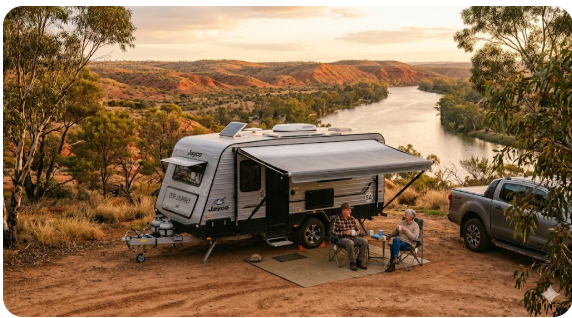
Free Camping South Australia 2026 — Complete Senior Grey Nomad Guide
GPS-verified free camps, self-contained rules, regional guides and honest real-world conditions for senior grey nomads travelling SA by caravan, motorhome or van.
📅 Last reviewed: May 2026 | South Australia | Free & low-cost camping guide for senior travellers
📋 What’s in This Guide
- What counts as free camping in SA
- Self-contained vehicle requirements in SA
- Riverland SA — Murray River free camps
- Flinders Ranges — outback free camps
- Port Augusta — SA’s junction town
- Port Augusta — SA’s junction town
- Eyre Peninsula — coastal free camps
- Yorke Peninsula — beachside free camps
- Outback SA — Stuart Highway free camps
- Fleurieu Peninsula — coastal free camps
- Top 10 free camps in SA — table
- Safety for solo senior free campers in SA
- Dump points in SA
- Fire ban seasons in SA
- FAQ — 8 common questions answered
Free camping in South Australia is one of the great underrated pleasures of the grey nomad life. From the slow green curves of the Murray River in the Riverland to the ancient red ridges of the Flinders Ranges, from the wild oyster coast of Eyre Peninsula to the sweeping beaches of Yorke Peninsula — SA offers an extraordinary variety of free and low-cost overnighting that suits every style of senior traveller.
Whether you’re rolling through on a big loop of Australia, wintering in the outback warmth or simply spending a season exploring one corner of the state, free camping South Australia can save you hundreds of dollars a week while putting you closer to the landscape you came to see. And unlike some states, SA has a surprisingly generous spread of free camps, roadside rest areas and council-managed sites once you know where to look.
This guide is written specifically for senior grey nomads aged 60 and over. We’ll cover the rules, the real-world conditions, the safety considerations and the GPS locations you need — all in plain language, before you leave home. If you’re crossing from Victoria, our Melbourne to South Australia — Complete Senior Grey Nomad Rest Area Guide 2026 is a great companion piece to read first.
What Counts as Free Camping in South Australia?
Before you pitch up somewhere and assume it’s fine, it’s worth understanding what “free camping” actually means in SA — because the rules differ depending on the type of land you’re on.
Rest Areas and Roadside Stops
SA’s main highways are managed by the Department for Infrastructure and Transport. Designated rest areas are signed and legal for overnight stays, generally up to 20 hours. These are not campgrounds — there are usually no facilities beyond a toilet (sometimes a long-drop), a picnic table and perhaps a bin. They are designed primarily for driver fatigue management, but grey nomads are very welcome to use them for an overnight stop.
Roadside stops without signage are a grey area. If there’s no sign saying overnight camping is prohibited, many travellers stop — but it pays to check with local councils if you’re unsure.
Council-Managed Free Camps
Many SA councils actively welcome grey nomads and have designated free camping areas — sometimes with a 48-hour or 72-hour limit, occasionally longer. These tend to be the most reliable and comfortable free camps in the state. Always check current rules with the relevant council before arrival, as limits and conditions do change.
National Parks and Reserves
Camping inside SA national parks almost always requires a fee and a booking through the SA National Parks and Wildlife Service. Some parks offer very low-cost designated sites. Free camping is not permitted inside national park boundaries unless a specific area is gazetted as a free or self-registration site.
Crown Land
SA has significant areas of Crown Land where camping is permitted, subject to conditions. This is where the most remote and spectacular bush camping happens — but it requires research, self-sufficiency and appropriate vehicles.
Self-Contained Vehicle Requirements in South Australia
South Australia does not currently mandate a formal self-containment certificate for free camping on most public land in the same way some other jurisdictions do. However, self-containment is expected — and in some council areas, explicitly required.
What “Self-Contained” Means in Practice
- Toilet: A cassette toilet, composting toilet or portable toilet that you can empty at a dump point. No waste discharged on the ground.
- Grey water: All washing water (kitchen, sink, shower) held in a grey water tank — not discharged on the ground. This is one of the most commonly overlooked requirements.
- Fresh water: An onboard fresh water supply sufficient for your stay.
- Waste management: All rubbish carried out.
CMCA Self-Containment Certificate
While SA doesn’t require it everywhere, having a Campervan and Motorhome Club of Australia (CMCA) self-containment certificate or similar accreditation can open up access to some council areas that restrict camping to self-contained vehicles. It’s worth considering if you’re doing a serious SA tour.
Vans and Smaller Vehicles
If you’re travelling in a van rather than a caravan or motorhome, self-containment is still expected. A portable cassette toilet and a modest grey water collection system is the minimum you should have. Read our honest guide to Sleeping in a Campervan in Australia for setup ideas that work for senior travellers.
Riverland SA — Murray River Free Camps
The Riverland is one of the most rewarding free camping regions in South Australia — and one of the most popular with grey nomads for very good reason. The Murray River cuts through a landscape of red cliffs, river gums, houseboats and pelicans, and there are a surprising number of free or low-cost spots along its banks.
Banrock Station Wetlands Area (Overland Corner)
Near the township of Kingston-on-Murray, this area offers access to wetlands walking trails and Murray River views. The surrounding flats have been used by grey nomads for informal overnight stays — check current council rules with the Berri Barmera Council before arrival.
Lyrup Flats Conservation Park
A beautiful area of river red gums and lignum swamps on the Murray. Basic free camping is permitted in designated areas. No facilities — fully self-contained required. Access is via gravel tracks suitable for most caravans, but check conditions after rain.
Moorook
The Moorook free camp on the Murray is one of the Riverland’s most popular grey nomad stops. Riverside setting, pelicans and birdlife abundant. 48-hour limit typically applies. Check with the Loxton Waikerie Council for current rules.
Renmark Riverfront
The Renmark riverfront area has both a caravan park and nearby free camping options. It’s close to town for shopping and medical services — a reassuring feature for senior travellers wanting to combine river scenery with access to facilities.
Flinders Ranges — Outback Free Camps
The Flinders Ranges are arguably South Australia’s most dramatic landscape — ancient folded mountains in shades of ochre, purple and rust, kangaroos grazing at dusk, wedge-tailed eagles riding thermals above. And there are some genuinely good free camps in and around the ranges.
Brachina Gorge (Ikara-Flinders Ranges National Park)
Camping inside the national park requires a fee and booking. However, the areas immediately outside the park boundary offer informal free camping on Crown Land. The drive through Brachina Gorge itself is one of SA’s great geological experiences — an absolute must for grey nomads.
Hawker Showgrounds
The Hawker Showgrounds offer very affordable camping — not technically free but often $10–$15 per night with basic facilities. This is a well-regarded grey nomad stop and the town has fuel, a supermarket and medical services. GPS: approximately -31.891, 138.423.
Wilpena Area — Outside Park Boundary
The areas around Rawnsley Park and along the road towards Wilpena have informal free camping options on station and Crown Land. Conditions vary — do your research via WikiCamps or Campermate before committing.
Parachilna Gorge
A spectacular and less-visited gorge with some informal camping areas nearby. The Prairie Hotel at Parachilna is famous among grey nomads and worth a stop even if you’re not camping there.
Eyre Peninsula — Coastal Free Camps
The Eyre Peninsula is one of Australia’s great road trip destinations — and for grey nomads who love coastal scenery, seafood and wild beaches, it delivers spectacularly. The Lincoln Highway and Flinders Highway loop offers dozens of council-managed and informal free camps.
Coffin Bay National Park Surrounds
Coffin Bay town has a council-managed campground. The national park itself requires fees and permits. However, the roads around the bay offer some informal pull-offs with extraordinary views. Famous for its wild oysters — many grey nomads spend a week here and struggle to leave.
Elliston — Waterloo Bay
Elliston on the west coast of Eyre Peninsula has a beautiful foreshore camping area. Fees apply but they’re very modest — and the clifftop sculptures walking trail is one of the genuine hidden gems of SA tourism.
Streaky Bay Foreshore
The Streaky Bay foreshore is one of the most popular grey nomad stops on the Eyre Peninsula. Powered and unpowered sites available at low cost. Stunning sunsets over the bay. The local bakery is legendary.
Port Augusta — SA’s Junction Town
Port Augusta sits at the head of Spencer Gulf where the Stuart Highway (north to Darwin), Eyre Highway (west to Perth) and the Adelaide highway all converge. Every grey nomad doing a lap of Australia passes through. Full facilities, two supermarkets, hospital and free/low-cost camping on the foreshore. See our Free Camping Near Port Augusta SA — Grey Nomad Guide 2026 for GPS coordinates, arrival advice and the three-way route split guide.
Port Augusta — SA’s Junction Town
Port Augusta sits at the head of Spencer Gulf where the Stuart Highway (north to Darwin), Eyre Highway (west to Perth) and the Adelaide highway all converge. Every grey nomad doing a lap of Australia passes through. Full facilities, two supermarkets, hospital and free/low-cost foreshore camping. See our Free Camping Near Port Augusta SA — Grey Nomad Guide 2026 for GPS, arrival advice and the three-way route split guide.
Ceduna Surrounds
Ceduna marks the western edge of Eyre Peninsula and the last major town before the Nullarbor crossing. There are free and low-cost camps on the foreshore and in the surrounding area, and the town has full facilities including a hospital — critical for senior travellers to note before the long run west. See our dedicated Free Camping Near Ceduna SA — Grey Nomad Guide 2026 for GPS coordinates, dump point details and Nullarbor crossing prep advice.
🌊 Eyre Peninsula Seafood Culture
Fresh oysters, whiting, King George whiting and blue swimmer crabs are part of the Eyre Peninsula experience. Many free camps are close to boat ramps where you can buy fresh catch directly from local fishermen. Factor this into your budget and your meal planning.
Port Lincoln — Seafood Capital and Eyre Peninsula Anchor
Port Lincoln sits at the southern tip of Eyre Peninsula — 650km from Adelaide via Port Augusta — and is the seafood capital of Australia. Boston Bay foreshore offers flat walks past pelicans and fishing boats. Day trips to Coffin Bay (45km) for oysters and Lincoln National Park are accessible to most senior grey nomads. See our dedicated Free Camping Near Port Lincoln SA — Grey Nomad Guide 2026 for GPS coordinates, overnight options, rig suitability and access notes.
Yorke Peninsula — Beachside Free Camps
Yorke Peninsula is one of SA’s most accessible free camping regions — close to Adelaide, easy roads, magnificent beaches and a string of heritage copper mining towns. It’s ideal for grey nomads who want a relaxed coastal experience without the long drives of Eyre Peninsula or the Outback.
Port Vincent Foreshore
A popular free camp on the eastern coast of Yorke Peninsula with access to the beach and a boat ramp. 48-hour stay limit generally applies. Facilities include toilets and a playground. Good mobile signal. GPS: approximately -34.777, 137.855.
Inneston Historic Village (Innes National Park)
Camping inside Innes National Park requires fees and booking. However, the heritage village at Inneston offers unique and affordable accommodation — not traditional free camping, but worth mentioning for senior travellers who appreciate something different.
Tiddy Widdy Beach
A small, peaceful beachside free camp on the eastern Yorke Peninsula. Very popular with grey nomads. Best in shoulder seasons — can be crowded in summer school holidays. 48-hour limit.
Ardrossan Oval
The Ardrossan Oval offers budget camping (usually a small nightly fee) with basic facilities. Close to town, which is reassuring for senior travellers who need nearby services. The town overlooks the Gulf St Vincent.
Outback SA — Stuart Highway Free Camps
The Stuart Highway runs north from Port Augusta through the red heart of South Australia — Pimba, Glendambo, Coober Pedy, Marla — and on into the Northern Territory. For grey nomads doing the classic north-south crossing, knowing where to stop along this highway is essential.
Pimba Rest Area
Pimba is the turnoff for Woomera and sits about 170km north of Port Augusta. There’s a roadhouse, fuel and a rest area suitable for overnight stops. A logical first-night stop when heading north from Port Augusta. GPS: approximately -31.247, 136.789.
Glendambo Rest Area
Glendambo has a roadhouse with fuel and basic supplies. The rest area here is a standard overnight stop — no facilities beyond toilets. Distance from Port Augusta: approximately 260km. GPS: approximately -30.966, 135.753.
Coober Pedy Area
Coober Pedy is the underground opal mining town that every grey nomad should visit at least once. There are caravan parks in town (not free) but some informal camping exists on the outskirts. The town has a hospital, fuel, supermarkets and all services — a critical supply point for anyone heading north.
Marla — Gateway to the Northern Territory
Marla Travellers Rest is the last major stop before the NT border. Fuel, basic supplies and caravan parking are available. It’s not free but it’s essential — fuel prices increase significantly the further north you go, so fill up here.
Fleurieu Peninsula — Coastal Free Camps
The Fleurieu Peninsula sits just 83km south of Adelaide and is one of the most accessible coastal free camping regions in South Australia — ideal for senior grey nomads wanting ocean scenery, whale watching and easy driving on sealed roads. Victor Harbor is the regional hub, and the council operates a legitimate free overnight RV parking trial right on the Encounter Bay foreshore at Hayborough.
Victor Harbor — Dump Beach Car Park, Hayborough
Council-approved free overnight RV parking at Dump Beach Car Park (GPS: -35.5180, 138.6390) — 6pm to 9am only, self-contained vehicles required. A free dump point with water is located 300 metres away on Adelaide Road (GPS: -35.5207, 138.6343). Whale watching season May–October brings Southern right whales and humpbacks visible from the shore at Nakurami Kondoli Whale Lookout. The historic horse-drawn tram to Granite Island is fully seated — ideal for seniors with mobility limitations.
Rapid Bay
Located 25km west of Victor Harbor via sealed road, Rapid Bay offers budget camping at approximately $5 per night — the closest formal campsite to the Victor Harbor free overnight parking area. Suitable for caravans. Beautiful sheltered bay setting.
Goolwa
The historic town of Goolwa at the Murray mouth, 22km north-east of Victor Harbor, is a natural Fleurieu stopping point and connects grey nomads to the Riverland Murray River corridor further north.
Goolwa — Murray Mouth and Paddle Steamer Town
Goolwa sits 22km north-east of Victor Harbor at the mouth of the Murray River — a natural loop stop pairing the two towns on the Fleurieu circuit. The PS Oscar W paddle steamer, Cockle Train heritage rail to Victor Harbor, Hindmarsh Island birdwatching and Signal Point Museum give grey nomads more quality activity per kilometre than almost anywhere else on the Fleurieu. See our dedicated Free Camping Near Goolwa SA — Grey Nomad Guide 2026 for GPS, overnight options and road access notes.
Top 12 Free Camps in SA for Grey Nomads — 2026
The table below covers our top picks across all SA regions. GPS coordinates are provided for planning purposes — always verify conditions before arrival using a current app such as WikiCamps or Campermate.
| Location | GPS (approx) | Facilities | Overnight Limit | Big Rig Friendly |
|---|---|---|---|---|
| Moorook, Riverland | -34.266, 140.359 | Toilets, river access, picnic tables | 48 hours | ✅ Yes |
| Lyrup Flats, Murray River | -34.192, 140.649 | None — self-contained required | Check with DEWNR | ✅ Most rigs OK |
| Hawker Showgrounds, Flinders | -31.891, 138.423 | Basic toilets, water nearby | Nightly fee applies (~$10–15) | ✅ Yes |
| Port Vincent Foreshore, Yorke | -34.777, 137.855 | Toilets, beach access, boat ramp | 48 hours | ✅ Yes |
| Tiddy Widdy Beach, Yorke | -34.429, 137.927 | Toilets, beach access | 48 hours | ⚠️ Moderate — tight access |
| Streaky Bay Foreshore, Eyre | -32.800, 134.213 | Powered/unpowered sites, toilets, showers | Low-cost fee applies | ✅ Yes |
| Coffin Bay Town Camp, Eyre | -34.616, 135.478 | Toilets, close to town | Council rules apply | ✅ Yes |
| Pimba Rest Area, Stuart Hwy | -31.247, 136.789 | Toilets, roadhouse nearby | 20 hours (rest area rules) | ✅ Yes — HV OK |
| Glendambo Rest Area, Stuart Hwy | -30.966, 135.753 | Toilets, roadhouse nearby | 20 hours | ✅ Yes — HV OK |
| Parachilna Gorge, Flinders | -31.137, 138.422 | None — self-contained required | 2–3 nights informal | ⚠️ Moderate — check track |
| Victor Harbor, Fleurieu | -35.5180, 138.6390 | Dump point 300m, water on-site | 6pm–9am only (trial) | ✅ Yes — all rigs |
| Ceduna Foreshore, Eyre | -32.130, 133.672 | Dump point, water, hospital nearby | Council rules apply | ✅ Yes — all rigs |
Safety for Solo Senior Free Campers in SA
South Australia is a genuinely safe state to travel through — but it contains some of Australia’s most remote and unforgiving country. If you’re a senior grey nomad travelling solo or as a couple, the preparation you do before you leave home is the most important safety measure of all.
Satellite Communication — Non-Negotiable in Remote SA
Mobile coverage disappears quickly once you leave the coastal fringe and the main towns. North of Port Augusta on the Stuart Highway, you can travel hundreds of kilometres without a single bar. A satellite communicator — such as a Garmin inReach or SPOT device — is essential for remote SA travel. These devices allow you to send an SOS, share your GPS location with family and send and receive messages from anywhere on Earth.
EPIRB for Very Remote Travel
For travel on very remote tracks and off the Stuart Highway, a registered 406MHz EPIRB (Emergency Position Indicating Radio Beacon) provides an additional layer of protection. Register it with the Australian Maritime Safety Authority (AMSA) and carry it at all times when away from your vehicle.
Royal Flying Doctor Service (RFDS)
South Australia has excellent RFDS coverage — one of the great reassurances for senior travellers heading into the Outback. The RFDS operates from Port Augusta, Adelaide and bases in the far north. Know how to call for assistance: in remote areas, a registered satellite communicator or an HF radio are your primary contact options.
Trip Planning and Check-In Routines
- Always tell someone your intended route and expected arrival dates before you leave.
- Set up a regular check-in schedule with family or a trusted contact — at least once a day when in remote areas.
- If you’re overdue, your contact should know who to call — in SA that’s the SA Police on 131 444.
- Use the free “Adventure Smart” trip plan service (adventuresmart.org.au) to log remote travel intentions.
Heat Management — Critical for Outback SA
Outback SA summer temperatures are genuinely dangerous. Temperatures above 45°C are not uncommon in December, January and February between Port Augusta and Coober Pedy. As a senior traveller, your body is less efficient at managing heat than a younger person’s.
- Travel in outback SA between April and September — avoid December to February entirely if possible.
- If caught in extreme heat, stay with your vehicle. Do not walk for help.
- Carry a minimum of 10 litres of drinking water per person per day in remote conditions — more in summer.
- Know the signs of heat exhaustion and heat stroke. Both are medical emergencies.
Medical Planning
Before any SA trip, especially into remote regions, speak with your GP. Carry sufficient prescription medications for your full trip plus extra in case of delays. Know the locations of hospitals and medical centres along your route — Port Augusta, Whyalla, Port Lincoln and Ceduna all have hospitals.
Dump Points in South Australia — How to Find Them
A dump point is where you empty your cassette toilet cartridge and grey water tank safely and legally. Finding one before you need one is a basic discipline of grey nomad travel. In SA, dump points are reasonably well distributed along major highways and in most regional towns.
The Best Apps for Finding SA Dump Points
- WikiCamps Australia — the gold standard for grey nomad planning. Shows dump points, free camps, caravan parks and rest areas with GPS coordinates and user reviews.
- Campermate — free app with excellent SA dump point data, recently updated for 2025/2026.
- Dump Point Finder — a simple, dedicated app for locating dump points across Australia.
- CMCA RV Daily — the Campervan and Motorhome Club of Australia’s app includes dump point data.
Key Dump Point Locations Along SA Highways
- Port Augusta — multiple dump points including at the Shoreline Caravan Park area and near the information centre.
- Whyalla — foreshore area and caravan park dump points.
- Port Lincoln — dump point at the foreshore caravan park area.
- Renmark — riverfront area dump point.
- Coober Pedy — dump point at the caravan park (fee may apply).
- Hawker — check locally for current dump point availability.
- Ceduna — foreshore area dump point.
Full SA Rest Area and Dump Point Map
For a complete overview of SA rest areas — including those with dump points — our Rest Areas South Australia 2026 guide is the most thorough resource available for senior grey nomads.
Fire Ban Seasons in SA — What Grey Nomads Need to Know
South Australia has one of the most serious bushfire climates in Australia. As a grey nomad free camping in SA, understanding the fire ban rules is not optional — it’s a legal responsibility and a matter of personal safety.
SA CFS Fire Ban Seasons
The Country Fire Service (CFS) declares a Fire Danger Season each year. In most parts of SA, this runs from approximately November through to April, though exact dates vary by region and year. During the Fire Danger Season, all campfires outside designated fire pits at gazetted campgrounds are either restricted or banned on days of elevated fire danger.
Total Fire Ban Days
On Total Fire Ban (TFB) days, no fire of any kind is permitted in the open air — including campfires, wood fires, gas BBQs and solid fuel cookers. This includes campfires at free camps, even if the site normally permits them.
- Always check the CFS website (cfs.sa.gov.au) each morning during the fire danger season.
- Sign up for CFS Total Fire Ban alerts by region — free SMS notifications are available.
- Never assume yesterday’s rules apply today. Fire danger can escalate rapidly in SA.
Outside the Fire Danger Season
Between May and October, campfires are generally permitted at sites that allow them, subject to local council rules. Many free camps in SA have a fireplace or ring — but always check signage at the site and always use an existing fire ring rather than making a new one.
Best Practice for Grey Nomad Campfires
- Carry a gas cooker as your primary cooking method — it works in all conditions.
- Only light a campfire when it is clearly legal to do so.
- Keep fires small and attended at all times.
- Extinguish completely before sleeping — pour water, stir, pour again until cold to touch.
- Never light a fire on a windy day, even outside a Total Fire Ban.
Frequently Asked Questions — Free Camping South Australia
Is free camping legal in South Australia?
Yes — free camping is legal in South Australia in designated rest areas, on suitable Crown Land, in council-managed free camping areas and at some conservation parks. It is not legal inside national parks without a paid permit and booking, and it is not legal on private land without the owner’s permission. Always check signage at each site and verify current rules with the relevant council or land manager before arrival.
Do I need a self-contained certificate to free camp in SA?
South Australia does not universally mandate a formal self-containment certificate for free camping, but self-containment — meaning an enclosed toilet, grey water tank and onboard fresh water — is expected and required at most designated free camps. Some councils explicitly restrict free camping to self-contained vehicles. Having a CMCA self-containment certificate is a good investment if you’re doing a serious SA tour.
What is the best free camping in South Australia?
This depends entirely on what you’re looking for. For river scenery and relaxed camping, the Moorook area on the Murray River in the Riverland is hard to beat. For dramatic outback landscape, the areas around Hawker and the Flinders Ranges are spectacular. For coastal beauty and seafood, Streaky Bay and Coffin Bay on Eyre Peninsula are consistently rated among SA’s best free camping experiences. Our top 10 table above covers the best across all regions.
Is it safe to free camp alone in the SA outback?
Yes — with the right preparation. The key requirements are a satellite communicator, sufficient water, a full spare tyre, emergency food supplies and a clear check-in routine with someone back home. The RFDS provides excellent medical coverage across outback SA. Travel between April and September to avoid the extreme summer heat. Read our Grey Nomad Safety Tips for the complete remote travel safety checklist.
Are there free camps near Adelaide?
Free camping immediately adjacent to Adelaide is limited, as council regulations in the greater Adelaide area are generally restrictive. However, within 1–2 hours of the city there are good options. Yorke Peninsula (approximately 1.5–2 hours from Adelaide) has numerous coastal free camps. The Barossa Valley and Adelaide Hills areas have some low-cost options. Check WikiCamps or Campermate for the most current options closest to the city.
Can I free camp in SA national parks?
No — free camping is not permitted inside SA national parks. All camping within national park boundaries requires a paid permit and advance booking through the SA National Parks and Wildlife Service booking system (bookings.parks.sa.gov.au). Fees are generally modest and the bookings can be made online well in advance. Some parks have very basic self-registration camping areas but a fee still applies.
What apps should I use for free camping in SA?
The three apps we recommend most to senior grey nomads are WikiCamps Australia (the most comprehensive database with user reviews and GPS data), Campermate (free, excellent for coastal SA areas) and Hema Explorer (best for outback and 4WD track navigation). For dump points specifically, the Dump Point Finder app is useful. Download all apps and their offline maps before you leave phone coverage.
What is the longest I can stay at a free camp in SA?
This varies significantly by location. SA roadside rest areas typically have a 20-hour maximum stay under the Road Traffic (Road Rules — Ancillary and Miscellaneous Provisions) Regulations. Council-managed free camps typically allow 48–72 hours, and some allow up to 7 days. Crown Land camping limits vary. Always check the signage at each individual site — limits are legally enforceable and local councils do patrol popular free camps, particularly in peak season.
Plan Your Full SA Route — More Guides Coming
South Australia is a big, rewarding state to explore — and the more planning you do before you leave, the more you’ll enjoy every kilometre. Free camping is just one piece of the puzzle. Knowing where the rest areas are, where to fuel up and how to time your drives is equally important.
If you’re crossing from Victoria into SA, our Melbourne to South Australia — Complete Senior Grey Nomad Rest Area Guide 2026 covers every major rest area on that crossing in detail.
For a complete picture of rest areas right across SA — including those with dump points, toilets and heavy vehicle access — bookmark our Rest Areas South Australia 2026 guide and keep checking back as we add individual highway guides.
And if you’ve been free camping in Victoria before heading into SA, our Free Camping Victoria 2026 — Complete Senior Grey Nomad Guide is the best place to start your Victorian planning.
For grey nomads who want to stretch their travel budget even further, our Vanlife Savings Spots guide highlights the best value stopping points right across Australia — and our Best Routes for Grey Nomads will help you plan the big picture of your Australian circuit.
★★★★★ “We spent six weeks free camping in SA last winter and it was the best value travel we’ve ever done. The Moorook camp on the Murray was our favourite — sat there for three nights watching the pelicans and the sun setting over the river gums. Absolutely magic.”
— Ros and Brian, Bendigo VIC, travelling in a 21ft caravan
★★★★★ “Solo in my motorhome at 68 and never felt unsafe in SA. The satellite communicator gave me peace of mind in the Flinders and I loved every minute of it. Just do your homework on water and fuel stops before you go.”
— Margaret, Toowoomba QLD, solo motorhome traveller