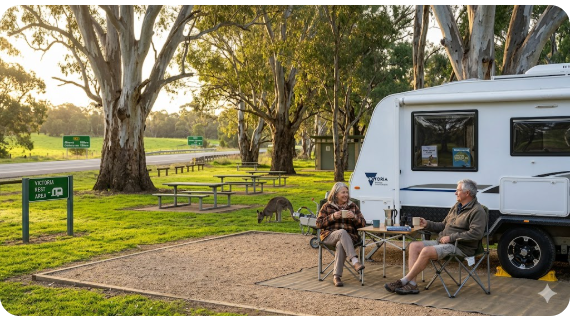
Free Camping Victoria 2026 — Complete Senior Grey Nomad Guide
A practical, honest guide to free and low-cost camping across Victoria for senior grey nomads aged 60 plus — covering rest areas, facilities, overnight rules, safety and health planning for every stop on your Victorian circuit.
📅 Last reviewed: May 2026 | Victoria, Australia | This guide covers rest areas and free stops along major Victorian corridors including the Hume Highway, Goulburn Valley Highway, Princes Highway and the Murray region.
Cost to Stay
Locations Covered
Health & Safety Notes
Key Corridors
Last Reviewed
Victoria offers a surprising number of genuine free overnight stops for grey nomads travelling the Hume Highway corridor, the Goulburn Valley, the Murray River region and the Princes Highway to the New South Wales border. This guide brings together eight verified Victorian rest areas and free stops, giving senior travellers an honest picture of what facilities are actually available, what overnight rules apply, which locations suit health-conscious travellers and where to plan your resupply. Nothing in this guide is invented. If it is uncertain, we say so.
- State: Victoria, Australia
- Guide type: Multi-location free camping and rest area reference guide
- Best for: Senior grey nomads aged 60 plus travelling solo or as a couple in caravans, motorhomes or campervans
- Toilets: Available at selected locations — confirmed where known, noted as uncertain where not verified
- Dump points: Not available at rest areas — nearest options noted per location
- Potable water: Not reliably available at most rest areas — carry your own supply
- Power: No powered sites at any free rest area covered in this guide
- Phone signal: Variable — Telstra generally strongest across regional Victoria; Optus and Vodafone patchy away from major towns
- Key corridors: Hume Highway (Broadford, Seymour, Euroa), Goulburn Valley (Shepparton), Murray (Cobram), Princes Highway (Cann River), Port Phillip Bay (Matthew Flinders Park)
- Nearest major services: Melbourne VIC 3000 for southern stops; Albury NSW 2640 for northern corridor; Bairnsdale VIC 3875 for Princes Highway stops
Table of Contents
- Location, GPS Coordinates and How to Find Each Stop
- Overnight Stays — What the Rules Actually Say
- Facilities — Toilets, Water and What to Expect
- Mobile Signal and Wi-Fi Coverage
- Road Access and Driving Notes for Caravans
- Realistic Arrival Conditions — What Others Don’t Tell You
- Safety — Personal and Trip Planning
- Medical Services and Emergency Planning
- Dump Points, Supplies and Resupply Planning
- Activities and Things to Do Nearby
- Seasonal Conditions and Best Time to Visit
- Rest Area Etiquette and Access Restrictions
- Pre-Departure Checklist for Senior Travellers
- GPS Master Reference Table
- Frequently Asked Questions
- Honest Verdict — Is Free Camping Victoria Worth It?
1. Location, GPS Coordinates and How to Find Each Stop
Victoria’s free rest areas are concentrated along three main travel corridors used by grey nomads heading north toward Queensland, east toward New South Wales, or looping through the Murray River region. The Hume Highway corridor through Broadford, Seymour and Euroa is the most heavily used route for travellers heading north from Melbourne. The Goulburn Valley Highway through Shepparton and the Murray River stop at Cobram serve those heading into the Riverina and Murray-Darling basin. The Princes Highway through Cann River connects Victoria to southern New South Wales for travellers on the coastal route. Matthew Flinders Park on the Mornington Peninsula serves those exploring the bay region.
Each stop in this guide has its own detailed page with current conditions, GPS coordinates and senior-specific notes. The GPS coordinates below are publicly available planning coordinates. Always confirm your exact stopping position using posted signs on arrival, as rest area boundaries and designated parking zones can differ from satellite imagery.
Use the individual location guides linked below alongside this overview guide for the most complete picture before you commit to a night at any of these stops.
📍 GPS Coordinates — Eight Victorian Free Stops at a Glance
See individual location guides for exact coordinates
Broadford Rest Area: Broadford Rest Area Guide — Hume Highway, Broadford VIC 3658
Seymour Rest Area: Seymour Rest Area Guide — Hume Highway, Seymour VIC 3660
Euroa Rest Area: Euroa Rest Area Guide — Hume Highway, Euroa VIC 3666
Shepparton Rest Areas: Shepparton Rest Areas Guide — Shepparton VIC 3630
Cobram Rest Area: Cobram Rest Area Guide — Murray Valley Highway, Cobram VIC 3644
Cann River Rest Area: Cann River Rest Area Guide — Princes Highway, Cann River VIC 3890
Matthew Flinders Park: Matthew Flinders Park Guide — Mornington Peninsula VIC
Sydney to Victoria — Princes Highway: Princes Highway Corridor Guide — NSW/VIC border route
From Melbourne, the Hume Highway rest area corridor begins at Broadford, approximately 75 km north of the CBD, accessible via the Hume Freeway (M31). From Sydney heading south, the Princes Highway corridor enters Victoria near Genoa and passes through Cann River before connecting to Bairnsdale and Melbourne. Allow generous travel time with rest breaks built in — these are not destinations in themselves but rather strategic stopping points on a longer circuit.
2. Overnight Stays — What the Rules Actually Say
Victorian rest areas on state highways are managed by VicRoads under the Road Management Act 2004. Rest areas designated for overnight stays are generally those signed as “rest areas” rather than “stopping places” — though this distinction is not always obvious from the road. The standard allowance at VicRoads-managed rest areas is up to 24 hours for a single stay, though individual sites may carry shorter time limits posted on local signage. Some stops along the Hume Highway corridor have had time limits reduced in recent years due to misuse, and council-managed areas may carry entirely different rules that are not reflected in general highway guidance.
At community parks and town-adjacent stops such as those in Cobram and Shepparton, rules are set by the relevant local council — Greater Shepparton City Council and Moira Shire Council respectively — and may include designated overnight areas, time limits, and restrictions on slide-outs, awnings and generators. The Matthew Flinders Park area on the Mornington Peninsula falls under Mornington Peninsula Shire Council jurisdiction and has its own specific rules that should be verified before arrival.
- VicRoads highway rest areas generally allow stays up to 24 hours — check posted signage on arrival for any site-specific reduction
- Council-managed town stops may have shorter time limits — commonly 48 hours maximum but sometimes as low as 18 hours in high-use areas
- Generators are typically prohibited after 10pm and before 7am at community-adjacent stops — some sites prohibit generators entirely
- Awnings, outdoor furniture and slide-outs that extend beyond your vehicle footprint are not permitted at roadside rest areas — this is a safety and access issue
- No fires, camp stoves or naked flame cooking outside your vehicle at highway rest areas — gas cooking inside or self-contained units only
- Pets must be on a lead at all times and waste must be collected and removed — do not assume all sites are dog-friendly
- If a new sign has been posted since this guide was reviewed, the sign takes legal precedence — always follow the most current on-site instruction; see our overnight parking Australia guide for a full breakdown of how these rules work nationally
For seniors managing time-sensitive medications, insulin that requires refrigeration or CPAP machines requiring overnight power, a free rest area without power is not always the safest overnight choice. If you are health-critical, treat these stops as genuine rest breaks — a few hours of sleep before continuing — rather than multi-night stays. Plan a powered caravan park night every second or third night on any extended Victorian circuit.
3. Facilities — Toilets, Water and What to Expect
Facilities vary significantly across the eight locations covered in this guide. The Hume Highway rest areas at Broadford, Seymour and Euroa are purpose-built highway stops with the most consistent infrastructure. Community-adjacent stops in Shepparton, Cobram and Cann River may offer more amenities in terms of shade and nearby town access but fewer formal rest area fixtures. Matthew Flinders Park has a different character again as a recreation reserve rather than a highway stop. Do not assume any Victorian free stop offers power, dump points or potable water unless confirmed in the individual location guide.
| Facility | Available? | Senior Travel Notes |
|---|---|---|
| Toilets | Available at most Hume Highway rest areas — uncertain at some town-adjacent stops | Verify at each location via individual guides — flush toilets are not universal; drop toilets or vault toilets common at smaller stops; night access may be poor without a head torch |
| Potable water | Not reliably available — do not assume | Carry a minimum of 15 litres per person before arriving at any Victorian rest area; seniors managing diabetes or on blood pressure medication must stay well hydrated regardless of temperature |
| Powered sites | Not available at any free rest area in this guide | CPAP users must bring a fully charged battery pack or adequate solar setup; do not attempt a full night on a CPAP without confirmed power or battery capacity |
| Dump point | Not available at rest areas — nearest options vary by location | See Section 9 for dump point distances; never use park drainage, stormwater or roadside areas — illegal under Victorian EPA regulations |
| Shade and seating | Variable — better at community parks than highway stops | Shade is important for seniors managing heat sensitivity or medications affected by temperature; arrive and check before committing |
| Rubbish bins | Available at most highway rest areas — not at all town stops | Carry a rubbish bag regardless — if bins are full or absent, take your waste with you; do not leave rubbish as it contributes to site closures |
| Overnight lighting | Minimal to none at most sites | A head torch is essential for safe movement after dark — uneven ground, kerbs and picnic furniture are trip hazards in low light |
| Dog access | On lead at most highway rest areas and community parks | Confirm at each location — some reserves have seasonal restrictions; always carry waste bags and dispose of waste appropriately |
4. Mobile Signal and Wi-Fi Coverage
Mobile signal across Victoria’s free camping locations follows the same pattern as most of regional Australia — Telstra provides the most reliable coverage on the Hume Highway corridor, the Goulburn Valley and the Murray region, while Optus and Vodafone coverage becomes significantly patchy away from major regional centres. At Cann River and along the Princes Highway east of Bairnsdale, even Telstra coverage can be intermittent in valleys and forested terrain. Do not plan your emergency communications strategy around the assumption of reliable mobile coverage at any of these stops.
- Telstra: Best general coverage across all eight locations — strongest on the Hume Highway corridor at Broadford, Seymour and Euroa; weaker but generally present at Cobram and Shepparton; intermittent at Cann River depending on exact position
- Optus: Adequate near town centres in Shepparton and Cobram; limited at highway rest areas between towns; not reliable at Cann River or Matthew Flinders Park without testing on arrival
- Vodafone / TPG: Urban and near-urban coverage only — do not rely on Vodafone or TPG for signal away from Shepparton CBD or major highway service centres
- Wi-Fi: No Wi-Fi at any rest area covered in this guide — public Wi-Fi may be available at Shepparton and Cobram libraries and visitor centres during business hours only
- Satellite devices: A Garmin inReach, SPOT or equivalent personal locator beacon is strongly recommended for any senior travelling solo in Victoria’s east — Cann River and the Princes Highway corridor east of Orbost represent genuine signal dead zones where satellite contact may be your only reliable emergency option
5. Road Access and Driving Notes for Caravans
Approaching Victorian free stops from key directions
- From Melbourne northbound (Hume Highway — Broadford, Seymour, Euroa): Take the M31 Hume Freeway from Melbourne’s northern suburbs. The highway is dual carriageway and caravan-friendly, with rest areas clearly signed from the road. Allow 75 to 150 km depending on your chosen stop. Fuel and services are available at major townships along the route.
- From Sydney southbound (Princes Highway — Cann River): Enter Victoria via Genoa on the Princes Highway. The road narrows significantly east of Bairnsdale with tight bends, steep grades and limited overtaking opportunities — this is a demanding drive for long caravans and motorhomes. See the Sydney to Victoria Princes Highway guide for detailed corridor notes.
- From Albury southbound (Murray corridor — Cobram, Shepparton): Head south on the Murray Valley Highway from Albury-Wodonga, or take the Goulburn Valley Highway south from Shepparton. Roads are generally good with wide shoulders — caravan-friendly through most of this region. Watch for agricultural machinery on rural roads near Cobram.
- From Melbourne southbound (Mornington Peninsula — Matthew Flinders Park): Access via the Mornington Peninsula Freeway or Peninsula Link, then local roads through Frankston and Mornington. Traffic through the peninsula is heavy on weekends and school holidays — plan arrival at Matthew Flinders Park on a weekday where possible. See the Matthew Flinders Park guide for parking dimensions and approach notes.
Specific road cautions for caravan and motorhome drivers
- Rest area entry and exit points on the Hume Highway require early signage identification — approach speed reduction must begin well before the entry because deceleration from highway speeds in a heavy caravan takes longer than most drivers anticipate
- The Princes Highway east of Bairnsdale has no overtaking lanes for extended sections — if you are travelling at or below 80 km/h on grades, be prepared for traffic to bank up behind you and use designated slow vehicle turnouts to allow safe passing
- Check VicRoads road condition alerts at vicroads.vic.gov.au before departing — the Princes Highway in particular can be affected by fallen trees, flood damage and road works that significantly affect caravan travel
- LPG vehicles: check that your vehicle complies with current tunnel regulations if routing through Melbourne via CityLink or EastLink — LPG caravans and motorhomes are subject to specific restrictions in tunnels
- Agricultural roads near Cobram and Shepparton carry wide farm machinery during harvest periods (February to April and again in October to November) — leave extra clearance and expect slow-moving traffic on rural connector roads
- Do not attempt to turn a large van around inside a rest area without walking the area first — many Victorian highway rest areas have narrow internal loops with fixed infrastructure that limits turning radius for rigs over 9 metres
6. Realistic Arrival Conditions — What Others Don’t Tell You
Many online free camping directories present Victorian rest areas as straightforward, welcoming stops with clear facilities and easy access. The reality for a senior arriving in a large caravan or motorhome after a long day of driving is often more complicated. Hume Highway rest areas at Broadford, Seymour and Euroa are genuinely functional stops — purpose-built, reasonably maintained and used regularly by grey nomads. However, they are also adjacent to one of Australia’s busiest highways, and road noise from heavy vehicles continues through the night. Light sleepers and seniors with noise sensitivity should factor this in before choosing a highway-adjacent rest area over a quieter town stop.
Community-adjacent stops like Cobram and Shepparton offer a quieter overnight environment but may have less formal overnight infrastructure. At some town stops, you will be parking in a general reserve or near a public park rather than in a designated overnight area — this means your vehicle is visible and accessible to the public throughout the night. Matthew Flinders Park and the Cann River stop have their own specific character which is addressed fully in the individual guides linked above.
- Arrive before 4pm wherever possible — assessing a site in daylight, choosing a level parking spot and settling in before dark reduces stress and eliminates a significant trip hazard
- Highway rest areas on the Hume are often partially occupied by truckies doing their mandatory rest breaks — this is legal and expected, but it can affect the quietness of the stop and the availability of parking in the dedicated car and caravan areas
- Some rest areas have been partially fenced or had infrastructure removed since previous reviews — do not expect facilities to be exactly as described in older online listings
- If the rest area is full or conditions are not what you expected, have your next destination already identified before you leave the highway — searching for alternatives on a phone with patchy signal while tired is dangerous
- Always have a confirmed backup plan — the nearest caravan park address and phone number should be saved in your phone before you attempt any free overnight stop on this circuit
7. Safety — Personal and Trip Planning
Personal safety at Victorian free stops
- Site visibility and lighting: Highway rest areas are well-lit from passing headlights but may have no fixed overhead lighting — community park stops are often darker and more isolated after midnight; a bright external light on your vehicle and an internal motion sensor can deter opportunistic interference
- Travelling solo: Solo senior travellers should tell at least two people their planned stopping points each day — not just the general route but the specific rest area name and the time they expect to arrive; if no contact is made by an agreed time, that person should know to call for a welfare check
- Vehicle security: Lock your vehicle while sleeping and keep valuables — including medications, cash and devices — out of sight; do not leave medication in a hot vehicle during the day; insulin and some blood pressure medications have specific temperature storage requirements that can be compromised in a vehicle interior reaching 50°C or more in summer
- Night-time movement: Uneven ground, picnic furniture, wheel stops and drainage channels are fall risks in low light; wear shoes — not thongs or bare feet — for any night-time movement outside the vehicle; keep a head torch within arm’s reach of your bed
- Other travellers at the stop: Most people using Victorian rest areas are tired drivers doing the right thing; however, if a situation makes you uncomfortable, trust that instinct — you are not obligated to stay at a free stop; start your engine and move on to the next option without engaging
Trip safety planning before you leave home
- Notify a trusted person of your full itinerary including planned overnight stops, route and expected check-in times — update them when plans change
- Keep your phone charged using a quality USB car charger and carry a 20,000 mAh or larger power bank as a backup — a flat phone at a rest area with no power is a serious problem for a solo traveller
- Register your EPIRB or PLB before departure at beacons.amsa.gov.au — this is free and means emergency services can locate you even without mobile signal
- Carry a minimum seven-day buffer of all prescription medications — do not time resupply to the exact day; pharmacies in small Victorian towns may not stock every medication and may require your GP to authorise a prescription repeat before they can dispense
- Check road conditions via vicroads.vic.gov.au before each day’s drive — the Princes Highway in particular can be affected by storm damage, landslides or road works that make a planned stop unreachable
For a full caravan security checklist and safe parking habits for grey nomad travellers, read our guide to grey nomad safety tips — staying safe on the road after 60.
8. Medical Services and Emergency Planning
Victoria has a well-developed regional health network compared to more remote states, but the distance from a free rest area to a functioning emergency department can still be 30 to 80 kilometres depending on your location. For seniors managing cardiac conditions, insulin-dependent diabetes, respiratory conditions requiring CPAP or oxygen, or any condition that can deteriorate rapidly overnight, the distance to emergency care at a free stop is a genuine risk factor that deserves honest planning — not dismissal.
| Service | Location | Distance from Key Victorian Stops | Notes |
|---|---|---|---|
| Goulburn Valley Health — Shepparton Campus | Shepparton VIC 3630 | Approximately 10 km from Shepparton rest areas; approximately 90 km from Euroa; approximately 60 km from Cobram | Public hospital with 24-hour emergency department; major regional facility serving the Goulburn Valley — the most significant hospital in the region for travellers on the northern Victorian corridor |
| Bairnsdale Regional Health Service | Bairnsdale VIC 3875 | Approximately 100 km west of Cann River along the Princes Highway | Public hospital with emergency department — the nearest major ED for travellers stopped at Cann River; ambulance response from Cann River is extended due to distance and terrain; carry a PLB |
| GP or medical centre | Nearest town centre to each stop — Seymour, Euroa, Shepparton, Cobram or Bairnsdale | Varies by stop — generally 2 to 10 km from town-adjacent stops; further from highway-only stops | Business hours only — not 24-hour; useful for prescription repeats, blood pressure checks and non-urgent queries; some rural clinics require advance appointments |
| Emergency — 000 | Australia-wide | N/A | Call 000 for ambulance, fire or police — ambulance response times to remote stops such as Cann River can exceed 45 minutes; at highway rest areas near Seymour and Euroa, response times are shorter but still not immediate |
| Healthdirect — 1800 022 222 | Phone service — Australia-wide | N/A | Free 24-hour nurse-on-call line — useful for assessing whether a symptom requires emergency care tonight or can safely wait until morning; requires a working phone signal to access |
9. Dump Points, Supplies and Resupply Planning
There is no dump point at any of the free rest areas covered in this guide. Using park drainage, stormwater infrastructure or roadside areas to discharge grey water or black water waste is illegal under the Environment Protection Act 2017 (Victoria) and carries significant fines — penalties of up to $1,652 for individuals have been applied under infringement notices, with court-imposed penalties substantially higher for deliberate dumping.
| Supply Need | Nearest Option | Approximate Distance |
|---|---|---|
| Dump point | Seymour Caravan Park or Shepparton Caravan Park — verify current availability before travelling as dump point access policies change; many caravan parks offer dump point access for a small fee to non-guests | Within 5 km of Seymour and Shepparton town centres; 30+ km from highway-only stops |
| Drinking water | Town taps in Broadford, Seymour, Euroa, Cobram and Shepparton — fill before leaving each town | Within 2 to 5 km of town-adjacent stops; plan before arriving at highway-only stops |
| LPG refill | Seymour, Shepparton, Bairnsdale service stations — call ahead to confirm cylinder swap or refill availability as not all regional stations carry all cylinder sizes | 5 to 100 km depending on location — Cann River has very limited LPG availability; plan LPG resupply at Bairnsdale before heading east |
| Groceries and fresh food | Woolworths and Coles in Shepparton, Cobram and Seymour; IGA in Broadford, Euroa and Cann River; limited supplies at Cann River — stock up at Bairnsdale | Within 2 to 5 km of most town-adjacent stops; Cann River IGA is the only option east of Orbost on the Princes Highway |
| Fuel | Service stations in Broadford, Seymour, Euroa, Shepparton, Cobram and Bairnsdale — use petrolspy.com.au to compare fuel prices before filling; Cann River has fuel but at remote pricing — fill at Bairnsdale for better value | Within 2 to 10 km for most stops; fill before leaving Bairnsdale if heading to Cann River |
For help planning a longer grey nomad circuit with reliable resupply stops built in, visit our vanlife savings spots directory.
10. Activities and Things to Do Nearby
Best senior-friendly ideas at Victorian free stops
| Activity | Distance from Nearest Stop | Senior Accessibility Notes |
|---|---|---|
| Cobram River Beach and Murray River foreshore walk | Within 1 km of Cobram rest area | Flat grassed foreshore with sealed paths near the main beach area — excellent for gentle morning walks; some sections have uneven grass; seating available at regular intervals; shaded by river gums |
| Shepparton Art Museum (SAM) | Approximately 3 km from Shepparton rest areas | Fully accessible building with lift access, seating throughout galleries and café on site — one of regional Victoria’s finest art museums and genuinely worth a morning visit; free entry for general collection |
| Lake Nagambie and Nagambie foreshore | Approximately 30 km from Seymour rest area via the Goulburn Valley Highway | Flat foreshore walking path with views over the lake; public toilets and seating; café and bakery nearby; a pleasant half-day excursion from the Seymour corridor |
| Euroa town centre heritage walk | Approximately 4 km from Euroa rest area | Flat town centre streetscape with heritage-listed buildings; good footpaths; bakery, café and supermarket within easy walking distance of the main street car park — an ideal lunch stop |
| Cann River Rainforest Walk — Delegate River Track | Within 5 km of Cann River rest area | Short walk through cool temperate rainforest — terrain is uneven and rooted in places; not suitable for mobility aids; best for seniors who are steady on their feet and comfortable on natural bush trails; bring water and insect repellent |
| Matthew Flinders Park foreshore and bay views | On site at Matthew Flinders Park | Open grassed reserve with Port Phillip Bay views; mostly flat terrain with some gentle slopes; accessible for most seniors; best visited in the morning before sea breezes strengthen; no sealed walking path but firm ground on most days |
For verified free and low-cost stops across Australia that suit senior grey nomads, visit our vanlife savings spots directory.
11. Seasonal Conditions and Best Time to Visit
| Season | Typical Conditions | Senior Travel Rating |
|---|---|---|
| Summer (Dec–Feb) | Hot to very hot across the Hume corridor and Murray region — Shepparton and Cobram regularly exceed 38°C; Princes Highway stays cooler with coastal influence but humidity increases east of Orbost; fire danger is real and Princes Highway can close with short notice during fire events | ⚠️ Caution — not recommended for heat-sensitive seniors without power for cooling; insulin and medications may be compromised by vehicle temperatures; the Princes Highway corridor carries genuine bushfire risk in summer |
| Autumn (Mar–May) | Ideal conditions across most of Victoria — temperatures moderate, fire risk reduces after April, tourist traffic drops; excellent foliage in alpine and foothill areas accessible from the Hume corridor; mornings can be cool, especially in May | ✅ Best season for most senior travellers — comfortable temperatures, manageable traffic, good road conditions across all corridors |
| Winter (Jun–Aug) | Cold to very cold overnight — Hume corridor temperatures can drop to 2°C to 5°C overnight at Seymour and Euroa; Cann River area is wet and cool with frequent rain; Murray region frost is common June through August; shorter daylight hours reduce arriving-in-light opportunities | ⚠️ Manageable for well-prepared travellers with adequate heating — but cold weather in a vehicle without power for an electric heater is a hypothermia risk for seniors; warm layers must be accessible, not packed |
| Spring (Sep–Nov) | Warming and variable — September can still produce cold snaps and strong westerly winds; October and November are generally excellent with mild days, low fire risk and green landscapes; wildflowers on the Princes Highway corridor in September and October | ✅ Excellent for most senior travellers — particularly October and November when conditions are consistently comfortable across all Victorian corridors |
12. Rest Area Etiquette and Access Restrictions
Victoria’s free rest areas and community park stops exist because local councils and state authorities have chosen to allow grey nomads and travellers to use public infrastructure for overnight stays. That permission is not permanent — several Victorian stops have had overnight access removed in recent years after repeated misuse, waste dumping, noise complaints and damage to infrastructure. Every grey nomad who uses a free stop responsibly protects access for those who follow. Every person who leaves rubbish, runs a generator past 10pm or camps beyond their time limit increases the probability of that stop being closed permanently.
- Arrive at a reasonable time — pulling into a rest area after 9pm with a large rig and bright manoeuvring lights is disruptive to others already settled; aim to arrive before 5pm when possible
- Generators must be off by 10pm and should not be started before 7am — at some stops the limit is earlier or generators are prohibited entirely; check posted signage on arrival and comply with whatever is posted, not whatever you read online
- Do not deploy awnings, outdoor furniture, mat rugs or slide-outs beyond your vehicle footprint at roadside rest areas — this is an access and safety issue, not just a preference; emergency vehicles and other caravans need to pass
- Remove all your rubbish when you leave — if bins are full, take your waste with you; the appearance of a rest area directly affects council decisions about whether to maintain or close the site
- Do not damage, cut or remove vegetation — shade trees and native plantings at rest areas take years to establish and are not replaceable quickly; campfire damage to grass and root systems is permanent
- Respect posted time limits strictly — if the sign says 24 hours, move on at or before 24 hours; staying longer to save the cost of a caravan park is not a grey area under VicRoads or council regulations and can result in fines
13. Pre-Departure Checklist for Senior Travellers
| Item | Action Required | Why It Matters on a Victorian Circuit |
|---|---|---|
| Water supply — minimum 15 litres per person | Fill before leaving last town | No potable water at any Victorian rest area in this guide — dehydration risk is real for seniors managing diabetes and blood pressure conditions, even in mild autumn temperatures |
| Medication supply — minimum 7-day buffer | Check quantities and expiry dates before departing home | Rural pharmacies in Euroa, Broadford and Cann River may not carry all specialist medications — do not time resupply to the exact day; Shepparton has the most complete pharmacy options in the region |
| CPAP battery or solar solution | Confirm fully charged and functional before departure | No power at any free rest area on this circuit — a flat CPAP battery means a night without therapy; for sleep apnoea sufferers this is a genuine health event, not merely an inconvenience |
| Fuel — above half tank before arriving at each stop | Fill at Seymour, Shepparton or Bairnsdale as applicable | Fuel at Cann River is available but expensive; between Orbost and the NSW border options are very limited; never arrive at a remote stop below a quarter tank |
| Emergency contact notified of itinerary | Send a text with your planned stop name and arrival time before leaving each morning | Mobile signal is not guaranteed at any stop east of Bairnsdale — if your contact does not hear from you by an agreed time, they need enough information to raise an alert |
| EPIRB or PLB registered and charged | Confirm registration at beacons.amsa.gov.au and test device function | The Princes Highway corridor east of Orbost and parts of the Cann River area have genuine dead zones for mobile signal — satellite communication may be your only emergency option |
| Backup overnight plan confirmed | Save the name, address and phone number of the nearest caravan park before departing each day | If a rest area is full, restricted or unsuitable on arrival, you need a fallback plan you can execute without searching in the dark on a weak signal |
| Road conditions checked | Check vicroads.vic.gov.au before each day’s travel | The Princes Highway is subject to closure or restriction due to bushfire, flood and storm damage — a planned route to Cann River can become impassable with little notice |
| Warm layers accessible — not packed deep in storage | Keep a thermal layer and extra blanket within arm’s reach inside the vehicle | Victoria’s overnight temperature drops are faster than many grey nomads from warmer states expect — rummaging through external storage in the dark on a cold night is a fall risk |
| Head torch and spare batteries | Confirm working before departure and place beside your bed each night | No overhead lighting at most Victorian rest areas — uneven ground, picnic furniture and kerbs are genuine trip hazards in complete darkness |
COPY PROMPT ➔ ASK AI ➔ SAVE TO FORM ➔ ADD SPOT PIN ➔ GET DIRECTIONS
📍 Interactive map — find free camps, rest areas and overnight stops. Enable location for best results.
14. GPS Master Reference Table
| Location | GPS Coordinates (Approx) | Notes |
|---|---|---|
| Broadford Rest Area | −37.2011° S, 145.0497° E | Planning coordinates only — verify exact stopping position using posted signage; Hume Highway, Broadford VIC 3658 |
| Seymour Rest Area | −37.0316° S, 145.1289° E | Planning coordinates only — Hume Highway corridor, Seymour VIC 3660; nearest ED is Goulburn Valley Health Shepparton, approximately 90 km north |
| Euroa Rest Area | −36.7530° S, 145.5710° E | Planning coordinates only — Hume Highway, Euroa VIC 3666; Shepparton approximately 90 km west for major medical services |
| Shepparton Rest Areas | −36.3833° S, 145.3997° E | Planning coordinates for Shepparton town centre area — multiple rest areas; Goulburn Valley Health emergency department within 10 km |
| Cobram Rest Area | −35.9225° S, 145.6470° E | Planning coordinates only — Murray Valley Highway, Cobram VIC 3644; Shepparton approximately 60 km south for major hospital |
| Cann River Rest Area | −37.5667° S, 149.1569° E | Planning coordinates only — Princes Highway, Cann River VIC 3890; nearest major ED is Bairnsdale Regional Health, approximately 100 km west |
| Matthew Flinders Park | −38.4833° S, 145.1167° E | Planning coordinates only — Mornington Peninsula VIC; Mornington Peninsula Shire Council jurisdiction; verify current overnight rules before arrival |
| Goulburn Valley Health — Shepparton (ED) | −36.3810° S, 145.4076° E | Nearest major 24-hour emergency department for northern Victorian corridor stops — Shepparton VIC 3630 |
| Bairnsdale Regional Health Service (ED) | −37.8349° S, 147.6134° E | Nearest major emergency department for Cann River and Princes Highway east corridor — Bairnsdale VIC 3875; approximately 100 km west of Cann River |
For a broader list of verified free and low-cost stops across Australia, visit our vanlife savings spots directory.
15. Frequently Asked Questions
Can I legally stay overnight at Victorian highway rest areas?
Yes — VicRoads-managed rest areas on state highways are generally open for overnight stays of up to 24 hours. However, the time limit and specific rules are set by on-site signage, not by any general policy. Some stops have had overnight access restricted or removed since guides were last reviewed. Always read the sign when you arrive — if it says no overnight parking, that instruction is legally current regardless of what any website says. Council-managed community parks and town-adjacent stops have their own rules set by the relevant local council, which may differ from VicRoads standards.
Do Victorian rest areas have toilets?
Most purpose-built highway rest areas on the Hume Highway corridor — including at Broadford, Seymour and Euroa — have toilet facilities, though these are typically non-flush vault or drop toilets rather than flush amenities. Community-adjacent stops vary. Toilets can be closed for maintenance, damaged or locked without notice. Senior travellers — particularly those with bladder or bowel conditions — should carry a self-contained toilet backup and never assume toilet access will be available at any free stop. Check the individual location guides linked throughout this post for the most current facility information for each stop.
How far are these stops from Melbourne?
The Hume Highway rest areas begin at Broadford, approximately 75 km north of Melbourne CBD — roughly 60 to 70 minutes of driving without traffic. Seymour is approximately 100 km from Melbourne and Euroa approximately 150 km. Shepparton is approximately 185 km north of Melbourne. Cobram is approximately 250 km north. Cann River is approximately 400 km east of Melbourne along the Princes Highway — a demanding six-hour drive not to be underestimated with a caravan. Matthew Flinders Park on the Mornington Peninsula is approximately 70 to 80 km south of Melbourne depending on your route.
Is it safe for a senior travelling solo to use Victorian rest areas overnight?
Highway rest areas on the Hume corridor at Broadford, Seymour and Euroa are generally well-used, reasonably visible and used by a mix of long-haul truckies and grey nomads — they are not isolated stops. Town-adjacent stops at Shepparton and Cobram are similarly visible. Cann River is more remote and isolated and deserves more careful consideration for solo travellers. General personal safety principles apply: lock your vehicle, keep valuables out of sight, trust your instincts and have a backup plan ready. Tell someone your exact stopping point before you settle in for the night. Read our grey nomad safety tips guide for a comprehensive solo travel safety framework.
Is there a dump point at Victorian free rest areas?
No. There is no dump point at any of the eight free stops covered in this guide. The nearest dump points are typically at caravan parks in the nearest major town — Seymour, Shepparton, Cobram and Bairnsdale all have caravan parks that may offer dump point access for a small fee to non-guests. Call ahead to confirm availability before relying on any specific dump point. Never discharge waste into park drainage, stormwater infrastructure or roadside areas — this is illegal under the Environment Protection Act 2017 (Victoria) and carries significant fines.
What mobile coverage can I expect at Victorian free camping stops?
Telstra provides the best general coverage across all eight locations in this guide. On the Hume Highway corridor at Broadford, Seymour and Euroa, Telstra coverage is generally reliable. In Shepparton and Cobram, both Telstra and Optus perform adequately near town centres. At Cann River, coverage is variable even on Telstra — valleys and dense bush reduce signal significantly. Matthew Flinders Park generally has reasonable coverage given its proximity to suburban Melbourne. Do not rely on Vodafone or TPG for signal at any location outside major town centres. Carry a PLB or satellite communicator as a non-network emergency backup for any remote stop.
What are the best months to visit Victorian free camping stops?
October and November are the most consistently comfortable months for senior grey nomads on a Victorian circuit — temperatures are mild, fire risk is low, wildflowers are out along the Princes Highway corridor and daylight hours are generous. March and April are also excellent, with the added benefit of autumn foliage in foothill areas accessible from the Hume corridor. Avoid December to February at inland stops — Shepparton, Cobram and the Hume corridor can experience extreme heat events exceeding 40°C that make a vehicle without power genuinely dangerous for seniors. June through August is manageable for well-prepared travellers but cold overnight temperatures require adequate non-powered heating solutions.
Can I use my CPAP machine at a Victorian free rest area?
There are no powered sites at any free rest area covered in this guide. CPAP users must bring a fully charged battery pack — a purpose-built CPAP battery such as the ResMed Power Station II or a compatible lithium battery pack — or a solar charging solution with sufficient capacity for a full night’s therapy. A standard CPAP running at moderate pressure uses approximately 30 to 60 watt-hours per night depending on the device and settings. A 100Ah lithium battery will run most CPAP machines for one to two nights without solar input. Do not attempt a full night on a CPAP at a free rest area without confirmed battery capacity — an interrupted night of therapy is a health event for most CPAP users.
Can I bring my dog to Victorian free camping stops?
Dogs are generally permitted on a lead at highway rest areas and most community parks in Victoria. However, rules vary by location and some reserves have seasonal restrictions or specific areas where dogs are prohibited — particularly near foreshore and wildlife habitat areas. Always carry waste bags and dispose of dog waste appropriately. At Matthew Flinders Park specifically, check current Mornington Peninsula Shire Council rules as dog access conditions at foreshore reserves on the peninsula can change. Never leave a dog in a locked vehicle in summer — internal vehicle temperatures in Victoria’s summer can become lethal within minutes.
16. Honest Verdict — Is Free Camping Victoria Worth It?
For healthy, well-prepared senior grey nomads who are genuinely self-contained — meaning they carry their own water, have no overnight power dependency, have a working PLB or satellite device, and have a confirmed backup plan if a site is unsuitable — Victoria’s free rest areas represent genuine value on a longer circuit. The Hume Highway stops at Broadford, Seymour and Euroa are among the most functional and consistently maintained highway rest areas in southern Australia. The Murray River stop at Cobram and the Shepparton area stops offer a more relaxed environment with better access to town services. These are not luxury overnight stops, but they are honest, practical places to break a long drive without spending $50 to $80 on a caravan park site every single night.
For seniors managing health conditions that require overnight power, rapid access to emergency care or stable temperatures for medication storage, the honest assessment is different. A free rest area without power, potentially 80 to 100 kilometres from the nearest hospital, is not the right overnight choice if your health genuinely requires those things. The cost of a powered caravan park site is real money, but so is the cost of a health emergency in a location where ambulance response may take 45 minutes. Use these stops for what they are good at — daytime rest breaks, short overnight stops on healthy travel days, and strategic fuel-saving on a circuit that also includes properly serviced caravan park nights.
Daytime rest stop: ✅ Excellent — all eight locations are worthwhile daytime breaks with varying levels of amenity
Overnight stay: ✅ Suitable for self-contained, healthy senior travellers — ⚠️ not recommended as the only overnight option for health-critical travellers
Senior health suitability: ⚠️ Good for self-sufficient travellers; requires honest assessment if managing power-dependent equipment, medications or cardiac and respiratory conditions
Best for: Grey nomads on a Victorian or national circuit who are genuinely self-contained, travel with a PLB and use powered caravan parks every two to three nights as a planned part of their circuit
For verified overnight stops with facilities, see our vanlife savings spots directory.
- What is free camping in Australia — the complete seniors guide
- Overnight parking Australia — rules, locations and what to expect
- What rangers look for at overnight van parking spots in Australia
- Free camping for retirees — how long can you stay and how much can you save?
- Stealth camping Australia — honest guide for senior travellers
- Van life savings spots — verified free and low-cost camps across Australia
- Free camping NSW — where seniors can legally stop for free
- Queensland free camping guide — the best spots for grey nomads
- Grey nomad safety tips — staying safe on the road after 60
- Broadford Rest Area — complete senior grey nomad guide
- Seymour Rest Area — complete senior grey nomad guide
- Euroa Rest Area — complete senior grey nomad guide
- Shepparton Rest Areas — complete senior grey nomad guide
- Cobram Rest Area — complete senior grey nomad guide
- Cann River Rest Area — complete senior grey nomad guide
- Matthew Flinders Park — complete senior grey nomad guide
- Sydney to Victoria via the Princes Highway — grey nomad driving guide
🏨 Site full or conditions not right? Search Local Accommodation Below.
Free campsites fill fast during school holidays and peak season. If your preferred Victorian stop is already taken or unsuitable, search remaining accommodation options below.
Accommodation and flight search powered by Expedia. As an affiliate, I earn from qualifying purchases at no extra cost to you.🗺️ Plan your Victorian grey nomad circuit with RV LIFE Trip Wizard
Route planning built for caravans and motorhomes — avoid low bridges, tight turns and unsuitable roads before you leave home.
Plan Your Route with RV LIFE Trip Wizard
🔒 Protect Your Vehicle on Every Victorian Stop — StarterStopper Immobiliser
Rest area security starts with knowing your vehicle cannot be started without you. Use promo code RTV5 for 5% off all StarterStopper products.
Visit StarterStopper.com.au As an affiliate, I earn from qualifying purchases at no extra cost to you.