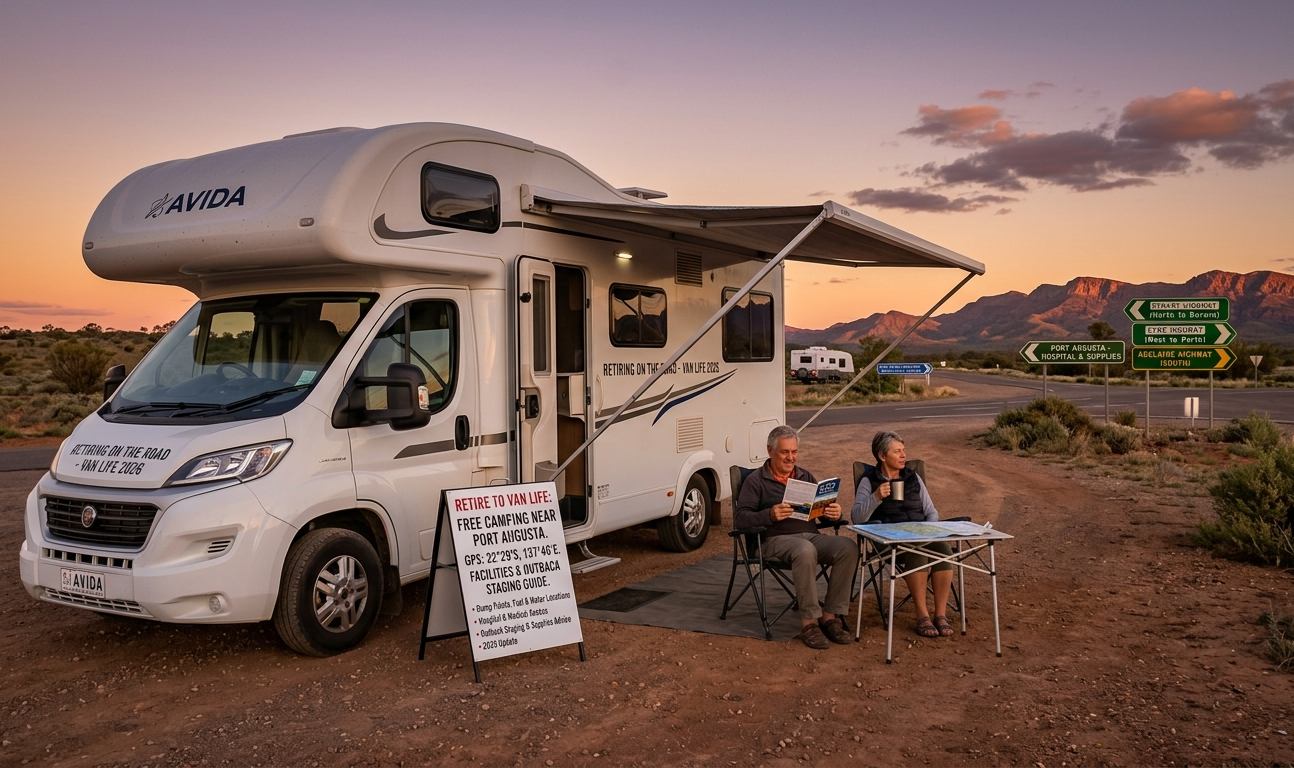
Free Camping Near Port Augusta SA — Grey Nomad Guide 2026
Port Augusta is where every serious lap of Australia passes through. This honest guide covers free and low-cost overnight options, facilities, fuel, hospital access and which direction to head next — written for grey nomads 60 and over travelling by caravan, motorhome or campervan.
📅 Last reviewed: May 2026 | Port Augusta SA 5700 | Located at the junction of the Stuart, Eyre and Adelaide highways — sealed access throughout town, with dirt or unsealed options further north and west.
Nightly Cost
08 8668 7199
In Town
Available in Town
Before Nullarbor or Outback
Port Augusta sits at the top of Spencer Gulf and the crossroads of three major highway corridors — north to Darwin via the Stuart Highway, west to Perth via the Eyre Highway, and south to Adelaide. For grey nomads doing a lap of Australia, this town is unavoidable and genuinely useful. It has a real hospital, both major supermarkets, diesel, LPG and AdBlue, a dump point, and several free or very low-cost overnight options within a short drive. This guide covers what actually matters for travellers over 60 with a caravan or motorhome in tow.
- Name: Port Augusta — crossroads junction town
- State: South Australia
- Use: Free and low-cost overnight stops, resupply, rest before major highway runs
- Best for: Grey nomads staging for the Nullarbor, Stuart Highway north, or Flinders Ranges
- Toilets: Yes — at main rest areas and Arid Lands Botanic Garden; limited at informal spots
- Dump point: Yes — Port Augusta dump point available (confirm location on arrival)
- Potable water: Available in town; not guaranteed at free camping spots — carry your own
- Power: No — free spots are unpowered; Standpipe Golf Motor Inn offers powered sites at low cost
- Phone signal: Good Telstra and Optus coverage in town; deteriorates rapidly north and west
- Nearest town: Port Augusta SA 5700
- Nearest major services west: Ceduna SA 5690 (approximately 468 km)
- Nearest major services north: Coober Pedy SA 5723 (approximately 540 km)
Table of Contents
- Location, GPS Coordinates and How to Find It
- Overnight Stays — What the Rules Actually Say
- Facilities — Toilets, Water and What to Expect
- Mobile Signal and Wi-Fi Coverage
- Road Access and Driving Notes for Caravans
- Realistic Arrival Conditions — What Others Don’t Tell You
- Safety — Personal and Trip Planning
- Medical Services and Emergency Planning
- Dump Points, Supplies and Resupply Planning
- Activities and Things to Do Nearby
- Seasonal Conditions and Best Time to Visit
- Rest Area Etiquette and Access Restrictions
- Pre-Departure Checklist for Senior Travellers
- GPS Master Reference Table
- Frequently Asked Questions
- Honest Verdict — Is It Worth Stopping?
1. Location, GPS Coordinates and How to Find It
Port Augusta is located approximately 317 kilometres north of Adelaide via the Augusta Highway. It sits at the very top of Spencer Gulf, where the land narrows before the outback opens up in every direction. The town itself is well-serviced and easy to navigate with a caravan — most roads through the central area are wide, sealed and signposted for heavy vehicles.
The three main camping and overnight areas relevant to grey nomads are: the area near the Standpipe Golf Motor Inn on the highway approach from the south (which has a low-cost overflow area and is known in the grey nomad community as a reliable fallback), the Stirling North area across the causeway to the east of Port Augusta, and the Woolundunga rest area further north on the Stuart Highway. Each suits a different travel direction and rig size. All three are described in detail in Section 2.
To enter Port Augusta from Adelaide, follow the Augusta Highway north directly into town. From the west (Eyre Highway / Nullarbor direction), you enter via the Lincoln Highway junction at the southern end. From the north (Stuart Highway / Coober Pedy direction), you arrive directly into the northern end of town. Fuel, supermarkets and the hospital are all accessible without complicated manoeuvring.
📍 GPS Coordinates — Port Augusta Key Points
Port Augusta Town Centre: −32.4927° S, 137.7680° E
Standpipe Golf Motor Inn area: −32.5212° S, 137.7748° E
Stirling North rest area: −32.5007° S, 137.8121° E
Woolundunga Rest Area (Stuart Hwy north): approximately −32.3500° S, 137.7500° E — confirm with current signage on arrival
2. Overnight Stays — What the Rules Actually Say
Port Augusta itself is not a designated free camping town — you won’t find a council-endorsed free camp right in the centre. However, several legitimate options exist within a short distance that are consistently used by grey nomads and are broadly accepted for short-term overnight stays.
Standpipe Golf Motor Inn overflow area — Located on the Augusta Highway approaching from the south, this private property overflow area is used regularly by travellers who need a safe, quiet stopover. The Motor Inn itself offers powered sites at a modest fee (typically under $20 per night). The overflow unpowered area is sometimes available at no charge or a small caretaker fee. Confirm directly with the property on arrival — do not assume it is free without checking. The surface is generally flat and suitable for large rigs.
Stirling North — The small township of Stirling North, approximately 8 km east of Port Augusta across the causeway, has informal overnight areas that are used by travellers. This is a quiet residential area — treat it accordingly. No dedicated facilities. Best for self-contained rigs only.
Woolundunga Rest Area — Located north of Port Augusta on the Stuart Highway, this is a designated roadside rest area managed by the South Australian Department for Infrastructure and Transport. Short-term overnight stays (typically up to 20 hours) are the general intent of rest areas across South Australia. Toilets may be present — confirm on arrival. Suitable for one to two nights maximum while staging for the outback run north.
3. Facilities — Toilets, Water and What to Expect
Facility quality varies significantly between the three overnight options near Port Augusta. The table below reflects the most commonly reported conditions as of May 2026. Facilities at informal and rest area stops can change without notice — always verify on arrival.
| Facility | Standpipe / Motor Inn Area | Stirling North Informal | Woolundunga Rest Area |
|---|---|---|---|
| Toilets | Yes — via Motor Inn (if staying) | No | Yes — pit or drop toilet on site |
| Potable water | Check with Motor Inn | No | No — do not rely on this |
| Showers | Via Motor Inn (fee may apply) | No | No |
| Power | Powered sites available (fee) | No | No |
| Dump point | Check with Motor Inn | No | No |
| Shade / shelter | Limited | Minimal | Limited roadside trees |
| Surface | Gravel / flat | Mixed | Gravel — generally flat |
| Suitable large rigs | Yes | Smaller rigs only | Yes — highway rest area |
4. Mobile Signal and Wi-Fi Coverage
Port Augusta is the last point of reliably strong mobile coverage before either the Nullarbor run west or the outback push north. Use this stop deliberately — update maps, download offline content, check weather forecasts and make any calls that matter before you leave.
- Telstra: Strong 4G coverage throughout Port Augusta town centre and along the highway approaches. This is the recommended network for outback travel — coverage extends further north and west than any other provider.
- Optus: Good coverage in the town centre. Coverage drops significantly once you leave Port Augusta in any direction.
- Vodafone: Town centre only. Do not rely on Vodafone for outback or Nullarbor travel — coverage gaps are substantial and begin very close to town.
- Wi-Fi: Available at the Port Augusta library (free, time-limited). McDonald’s and some cafés offer guest Wi-Fi. The Motor Inn may offer Wi-Fi to overnight guests — confirm on arrival.
5. Road Access and Driving Notes for Caravans
Approaching and navigating Port Augusta with a caravan or motorhome
- From Adelaide (south): The Augusta Highway is a well-maintained two-lane highway — sealed, flat and suitable for all rig sizes. Allow approximately 3.5 to 4 hours from Adelaide. The approach into town is straightforward with good signage.
- From the Eyre Highway (west): Road surface is generally good on sealed sections. Wide loads and long rigs are common on this route — give road trains appropriate space and merge early at fuel stops.
- From the Stuart Highway (north): The highway south from Coober Pedy is largely sealed with some sections subject to repair works. Check road conditions via the South Australian road conditions line or app before departure.
- Within town: Port Augusta’s main streets are wide enough for caravans and motorhomes. The Woolworths and Coles carparks can be tight at peak times — arrive before 9am or after 3pm to make manoeuvring easier.
- Low-clearance caution: There are no significant low-clearance obstructions on main routes through town, but always confirm your rig height before diverting onto side streets.
- Road trains: Common on all three highways approaching Port Augusta. Give them a full kilometre of clear road before overtaking. Do not cut back in early after passing — road trains cannot brake quickly.
6. Realistic Arrival Conditions — What Others Don’t Tell You
Port Augusta is a working town, not a tourist resort. Arriving with realistic expectations makes the stop more useful and less frustrating. The town has seen significant changes over the past decade and some areas are rougher in appearance than travellers expect. That said, the practical infrastructure — fuel, food, hospital, bank, hardware — is all there and functioning.
- The Standpipe Golf Motor Inn overflow area can fill quickly in peak season (June to August) when northbound and westbound grey nomads are staging at the same time. Arrive before 2pm if you want a reliable spot.
- The Stirling North informal area is genuinely quiet but has no facilities at all. It suits experienced self-contained travellers, not those who need toilets or water within walking distance.
- The Woolundunga rest area north of town is exposed to highway noise and wind. Sleep quality can be poor. It is more useful as a pre-dawn staging point before an early outback departure than as a comfortable overnight stop.
- Summer temperatures in Port Augusta regularly exceed 40°C. Air conditioning overnight is not possible at unpowered free camps without a generator or lithium battery setup. Plan accordingly.
- The town centre has experienced some issues with petty crime — keep your rig locked and valuables out of sight. This is general good practice, not a specific alarm about Port Augusta.
7. Safety — Personal and Trip Planning
Personal safety
- Solo travellers: Port Augusta is a transit town with a mix of travellers, truck drivers and locals. The free camping spots are generally safe but not isolated from the highway. Solo women travellers should choose the Motor Inn overflow or Woolundunga rest area over the Stirling North informal spot at night.
- Vehicle security: Lock your rig every time you leave it. Do not leave generators, bikes, or outdoor equipment unsecured overnight. Consider a quality immobiliser — the StarterStopper system (see affiliate block below) is used by a number of grey nomads for exactly this reason.
- Heat and dehydration: Between October and March, temperatures can be dangerous. Do not walk long distances during the middle of the day. Keep at least 10 litres of drinking water accessible inside the van at all times.
- Night safety: Woolundunga rest area has no lighting. Use a torch or headlamp for any movement outside the van after dark. Highway rest areas attract fatigue-affected drivers at all hours.
- Know your neighbours: At any rest area, be aware of who is parked near you. Trust your instincts. If a situation feels wrong, move on — there is no obligation to stay anywhere.
Trip safety before leaving Port Augusta
- Tell someone your plan: Before heading north or west, share your planned route, estimated arrival times and check-in schedule with a family member or friend. This is not optional in outback conditions.
- Emergency beacon: If you do not have an EPIRB or PLB registered with AMSA, Port Augusta is the last major town where you can purchase one before the true outback begins. Register at beacons.amsa.gov.au.
- Fuel and range calculation: Calculate your rig’s fuel range conservatively — loaded caravans use significantly more than the tow vehicle’s rated economy. Add 20 percent to your expected consumption when towing in headwinds or hot conditions.
- Medical supplies: Check your medication supply before leaving Port Augusta. The next major pharmacy west is Ceduna (468 km). North, Coober Pedy has a pharmacy but stock can be limited. Fill prescriptions here.
- Tyre condition: Inspect all tyres including the caravan before departure. Outback highway surfaces and debris can cause rapid tyre failure. Carry a full-size spare for the caravan, not just a space-saver.
For broader safety planning, our grey nomad safety tips guide covers communications, emergency plans and outback preparation in detail.
8. Medical Services and Emergency Planning
Port Augusta Hospital is the last major hospital before either Ceduna to the west or Coober Pedy to the north. This is not a minor detail — it is a critical planning fact for any traveller with existing health conditions. Do not leave Port Augusta without knowing where the next medical facility is and how long it would take to reach in an emergency.
| Service | Location | Contact | Notes |
|---|---|---|---|
| Port Augusta Hospital | Port Augusta SA 5700 | 08 8668 7199 | Full emergency department. Last major hospital before Ceduna (west) or Coober Pedy (north). |
| Coober Pedy Hospital | Coober Pedy SA 5723 | 08 8672 5009 | Approximately 540 km north. Smaller facility — serious cases may require air evacuation to Adelaide. |
| Emergency — Triple Zero | Australia-wide | 000 | Call 000 for ambulance, fire or police. Mobile coverage is not guaranteed on outback highways — use an EPIRB or satellite communicator if out of range. |
| Healthdirect | Australia-wide phone service | 1800 022 222 | 24-hour nurse advice line. Useful for non-emergency health questions while travelling. Requires phone signal. |
9. Dump Points, Supplies and Resupply Planning
Port Augusta has a dump point — this is confirmed as of May 2026 but its exact location within the town area can be updated. Check with the Port Augusta City Council or use the Campermate or WikiCamps app to confirm the current dump point location on arrival. Do not leave Port Augusta with a full cassette or tank if heading west or north — the next confirmed dump points are a significant distance away in either direction.
| Supply | Availability in Port Augusta | Notes |
|---|---|---|
| Supermarket | Woolworths and Coles both in town | Full grocery range. Stock up here — next comparable shopping west is Ceduna, north is Coober Pedy. |
| Diesel | Yes — multiple service stations | Compare prices using PetrolSpy. Diesel is cheaper here than at outback stops. |
| LPG (swap and fill) | Yes — available in town | Fill or swap LPG cylinders here. Availability becomes unreliable north and west. |
| AdBlue | Yes — available at major service stations | If your diesel rig requires AdBlue, fill here. Outback availability is not reliable. |
| Pharmacy | Yes — multiple pharmacies in town | Fill all prescriptions before departing. Next pharmacy west: Ceduna (468 km). Next north: Coober Pedy (540 km). |
10. Activities and Things to Do Nearby
Best senior-friendly ideas at Port Augusta
Port Augusta has more to offer than a fuel stop and a supermarket run. Two attractions in particular are genuinely worth your time — especially if the weather turns or you want a slower morning before a long drive.
| Activity | Distance | Cost | Senior-friendly? |
|---|---|---|---|
| Arid Lands Botanic Garden | Within Port Augusta | Free entry | Yes — flat sealed paths, wheelchair accessible, excellent for mobility-limited visitors |
| Wadlata Outback Centre | Port Augusta town centre | Entry fee applies | Yes — indoor, air-conditioned, excellent wet or hot weather option |
| Quorn (Flinders Ranges gateway) | Approximately 40 km east | Free to visit town | Moderate — some unsealed roads nearby but main town is sealed |
| Hawker (Flinders Ranges) | Approximately 100 km east | Free to visit | Moderate — further drive but access road is sealed |
| Spencer Gulf foreshore walk | Port Augusta waterfront | Free | Yes — flat, sealed path along the water |
| Matthew Flinders Day Use Area | Port Augusta area | Free | Yes — foreshore access, good for a morning coffee stop |
Arid Lands Botanic Garden — This is a genuinely excellent free attraction that is consistently underrated in grey nomad planning. The garden covers around 250 hectares of native arid-zone plants but the visitor area has flat, sealed paths that are accessible for those with mobility aids or who find uneven ground difficult. It is free to enter, opens early and provides good shade in sections. Perfect for a quiet morning walk before a long driving day.
Wadlata Outback Centre — If the heat is too much for outdoor activity, Wadlata is a well-presented interpretive centre covering the geology, history and culture of the outback. It is fully air-conditioned and takes around 1.5 to 2 hours at a comfortable pace. A good investment on a 40°C day.
Flinders Ranges day trip or stopover note — Quorn is only 40 kilometres from Port Augusta on a sealed road and makes an easy half-day side trip. Hawker at 100 kilometres is a longer commitment but offers access to Wilpena Pound and the main Flinders Ranges circuit. If you are not pressed for time and the Flinders Ranges were on your list, Port Augusta is your best logical base before committing to either the outback north or the Nullarbor west. See our broader guide to free camping in South Australia for Flinders Ranges options.
11. Seasonal Conditions and Best Time to Visit
| Season | Conditions | Suitability | Notes |
|---|---|---|---|
| December – February (Summer) | Extreme heat — regularly 40°C to 47°C. Dry. Occasional thunderstorm. | Not recommended | Free camps are unsafe without power and adequate cooling. CPAP users, blood pressure patients and diabetics face genuine health risk. Avoid. |
| March – May (Autumn) | Cooling rapidly. Pleasant days, cool nights. Minimal rain. | Good | Good shoulder season. Less crowded than peak. Temperatures manageable at free camps. |
| June – August (Winter) | Cool to cold overnight (sometimes near 0°C). Warm sunny days. Clear skies. | Excellent — peak grey nomad season | This is when most northbound grey nomads pass through. Free camp spots fill early. Arrive before 2pm for best chance of a space. |
| September – November (Spring) | Warming. Windy at times. Can be excellent conditions. | Good to very good | Southbound traffic increases as nomads return. Fewer crowds than June–August. Flinders Ranges in wildflower bloom — good time for a side trip. |
12. Rest Area Etiquette and Access Restrictions
Port Augusta’s free and low-cost camping options attract a high volume of grey nomads during peak season. The following etiquette points are not just courtesy — they protect access for future travellers by demonstrating that grey nomads are responsible users of these spaces.
- Stay no more than one to two nights at any single rest area or informal spot. These locations are for transit, not extended camping.
- Keep your setup compact. Full awning deployment, outdoor rugs, tables and chairs laid out signals a camp rather than a rest stop. Keep it tidy and minimal at rest areas.
- Generator hours: At the Motor Inn overflow area, follow any posted generator hours. At rest areas, avoid generator use after 8pm and before 7am out of respect for other travellers.
- Grey water and waste: Never empty grey water or dump cassette waste at an informal area or roadside. Use the Port Augusta dump point before leaving town.
- Noise: Highway rest areas attract tired people at all hours. Keep noise low from 9pm. This includes TV, radio and extended conversations outside the van.
- Litter: Leave the area cleaner than you found it. This is the single most reliable way to keep rest areas open and maintained.
13. Pre-Departure Checklist for Senior Travellers
Before leaving Port Augusta in any direction, work through this checklist. It is particularly important if you are heading north toward Coober Pedy or west toward Ceduna — both directions involve long isolated stretches with limited services.
| Item | Status to confirm |
|---|---|
| Fuel tanks | Full — diesel, petrol or LPG as required for your rig |
| AdBlue (if applicable) | Topped up — do not risk running out on an outback highway |
| Fresh water tanks | Full — plus additional carry containers filled |
| LPG cylinders | Swapped or filled — especially if winter heating is essential |
| Dump point used | Cassette or tank emptied before departure |
| Supermarket resupply | At least 5 days of food and consumables on board |
| Medications | All prescriptions filled and accessible — not buried in storage |
| Emergency beacon | EPIRB or PLB charged and registered — beacons.amsa.gov.au |
| Trip plan shared | Route, stops and check-in times sent to a contact at home |
| Tyres inspected | All van and tow vehicle tyres including spare — pressure checked |
COPY PROMPT ➔ ASK AI ➔ SAVE TO FORM ➔ ADD SPOT PIN ➔ GET DIRECTIONS
📍 Interactive map — find free camps, rest areas and overnight stops near Port Augusta. Enable location for best results.
14. GPS Master Reference Table
Use these coordinates as a starting reference. Always confirm with current signage on arrival, particularly for the informal and rest area spots which can change. Our Vanlife Savings Spots directory maintains a regularly updated list of verified stops across South Australia.
| Location | GPS Coordinates | Use |
|---|---|---|
| Port Augusta Town Centre | −32.4927° S, 137.7680° E | Navigation reference — supermarkets, hospital, fuel |
| Standpipe Golf Motor Inn Area | −32.5212° S, 137.7748° E | Low-cost/free overflow overnight — confirm on arrival |
| Stirling North Informal Area | −32.5007° S, 137.8121° E | Informal overnight — self-contained only, no facilities |
| Woolundunga Rest Area (approx) | −32.3500° S, 137.7500° E | North of town on Stuart Hwy — rest area, toilets, short stay |
| Port Augusta Hospital | −32.4893° S, 137.7710° E | Emergency department — 08 8668 7199 |
15. Frequently Asked Questions
Is there free camping right in Port Augusta town?
Not in the traditional sense of a dedicated free camp with facilities. The closest practical options are the Standpipe Golf Motor Inn area (which may be free or low-cost — confirm on arrival), the Stirling North informal area, and the Woolundunga rest area north of town on the Stuart Highway. None of these are official council-designated free camps, but all are regularly used by grey nomads for short-term overnight stops.
Can I use the Standpipe Golf Motor Inn overflow without staying at the Motor Inn?
This depends on current arrangements with the property owner. In the past, travellers have been able to self-register or use the overflow at no cost or minimal cost. However, this is a private property and conditions can change. Always approach the Motor Inn office first and ask — do not simply park and assume you are welcome without checking.
What is the best option for CPAP users needing overnight power?
The Standpipe Golf Motor Inn offers powered sites at a modest nightly fee. This is the most practical option for CPAP users or anyone who needs reliable overnight power. Alternatively, a large lithium battery system can power a CPAP for two to three nights without external power, but this requires proper setup. Free camps near Port Augusta do not provide power.
Is Port Augusta hospital able to handle serious emergencies?
Yes — Port Augusta Hospital (08 8668 7199) has a full emergency department and is a regional hospital with surgical capacity. Very serious cases may require transfer to the Royal Adelaide Hospital via air ambulance, but the Port Augusta ED is equipped for genuine emergencies. It is the last major hospital before either Ceduna (west, 468 km) or Coober Pedy (north, 540 km).
Which direction should I head from Port Augusta?
This depends entirely on your lap direction and timing. In brief: heading south to Adelaide — the Augusta Highway is the obvious route, well maintained and suitable for all rigs; heading north on the Stuart Highway — your next major stop is Coober Pedy at 540 km, with limited services at Pimba/Woomera roughly halfway; heading west on the Eyre Highway toward the Nullarbor — your next major stop is free camping near Ceduna SA at 468 km. See our section below on direction-specific advice.
What is the best time of year to pass through Port Augusta?
May through August is the optimal window — temperatures are manageable, the outback and Nullarbor are at their most tolerable, and the Flinders Ranges are at their best. Avoid December through February entirely if you are travelling in a rig without reliable air conditioning and an independent power source.
Are there Woolworths and Coles in Port Augusta?
Yes — both Woolworths and Coles have full-size stores in Port Augusta. This makes it one of the most important resupply points in outback South Australia. Stock up thoroughly — the next comparable shopping is 468 km west in Ceduna or 540 km north in Coober Pedy.
Is mobile coverage reliable in Port Augusta?
In town, yes — Telstra and Optus both provide solid 4G coverage. However, coverage drops significantly as soon as you leave town in any direction. Telstra extends furthest into the outback and along the Nullarbor and is the recommended network for grey nomads heading into remote areas. Use your Port Augusta stop to update software, download maps and make calls before coverage deteriorates.
Is the Flinders Ranges accessible from Port Augusta as a day trip?
Yes. Quorn is only 40 kilometres east on a sealed road and is an easy half-day return trip. Hawker at 100 kilometres is manageable as a long day trip. The main Flinders Ranges attractions — Wilpena Pound, Brachina Gorge — are further and better visited as a multi-day stopover. If the Flinders Ranges are a priority, budget two to three extra days before committing to your next highway direction.
16. Honest Verdict — Is It Worth Stopping?
Port Augusta is not a camping destination — it is a strategic junction that every serious grey nomad doing a lap of Australia will pass through, whether they intend to or not. The free and low-cost camping options here are functional, not scenic. You will not be waking up to mountain views or a quiet river bend. What you will have is a flat, safe spot to sleep before or after a major highway run, with full town services available within a few kilometres.
The real value of Port Augusta is logistical. If you use the stop properly — fuel, water, dump point, LPG, supermarket, pharmacy, and a proper check of your rig — you will leave Port Augusta in genuinely better shape than you arrived. That matters more than a pretty campsite when you are about to drive 500 kilometres through isolated country. For direction-specific advice: heading west, see our guide to free camping near Ceduna SA; heading north, see our guide on Coober Pedy grey nomads; for broader SA planning, our free camping South Australia guide covers the full picture.
- Free camping quality: Functional — not scenic, but safe and accessible for all rig sizes
- Facilities: Good in town — limited at free camping spots themselves
- Value as a stopover: Very high — the most important resupply and staging point in outback SA
- Best use: One to two night stop for resupply, rest and route planning — not a destination stay
- Senior suitability: Good — hospital nearby, full town services, flat terrain at camping spots
- Avoid if: You need comfortable facilities at the free camp itself, or are travelling in summer without independent power and cooling
- Recommended for: All grey nomads staging for the Nullarbor, Stuart Highway north or Flinders Ranges — this stop is not optional, it is essential
Related Guides
- Free camping South Australia — full state guide
- Rest areas South Australia
- Free camping near Ceduna SA
- Free camping near Victor Harbor SA
- Coober Pedy grey nomads — Oasis Tourist Park
- Murray Bridge rest areas
- Riverland SA free camping
- Free camping near Whyalla
- Grey nomad safety tips
- Best routes to drive around Australia
- Melbourne to South Australia rest areas
- Vanlife Savings Spots directory
Free campsites and powered sites fill fast during school holidays and peak season. If your preferred site is already gone, search remaining accommodation options below to explore the region.
Accommodation and flight search powered by Expedia. Booking through this search supports this website at no extra cost to you. As an affiliate, I earn from qualifying purchases at no extra cost to you.

As an affiliate, I earn from qualifying purchases at no extra cost to you.
As an affiliate, I earn from qualifying purchases at no extra cost to you.