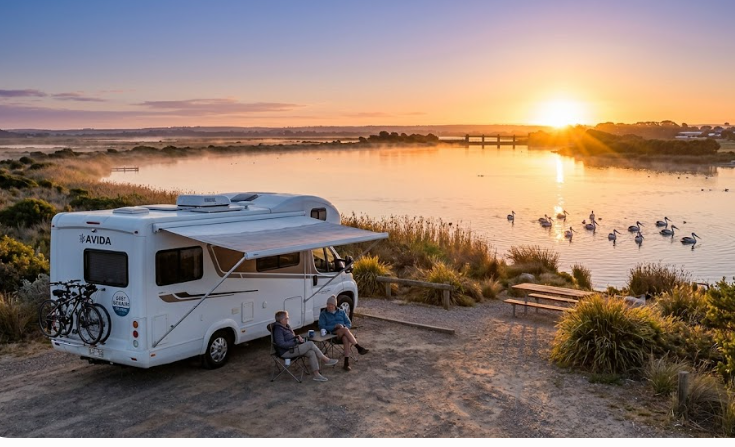
Free Camping Near Goolwa SA — Grey Nomad Guide 2026
Goolwa sits where the Murray River finally meets the sea — a historic paddle steamer town on the Fleurieu Peninsula with sealed road access from every direction, flat foreshore walking, outstanding birdwatching at the Murray Mouth and Hindmarsh Island, and a natural pairing with Victor Harbor 22km south-west. Free and low-cost overnight options exist in the surrounding area. This guide covers all of it honestly.
📅 Last reviewed: June 2026 | Goolwa, Fleurieu Peninsula, South Australia | Free and low-cost camping available in surrounding areas — self-contained requirements apply at most sites
Most grey nomads rolling through the Fleurieu Peninsula stop at Victor Harbor and never make the 22km detour north-east to Goolwa — and that is their loss. Goolwa is one of the most quietly rewarding stops on the South Australian coastal circuit. It sits at the mouth of the longest river system in Australia, it has a working paddle steamer, a historic steam train that still runs to Victor Harbor, and one of the best birdwatching locations in the state just across the bridge on Hindmarsh Island. For senior travellers, the sealed road access, flat terrain and genuine historical interest make it a two to three night stop rather than a quick look and drive on.
Free and genuinely free camping directly on the Goolwa foreshore is limited — the town is popular and the council manages it accordingly. But low-cost powered and unpowered options exist close to the foreshore, the Currency Creek area has informal options, and for self-contained travellers willing to explore, the Hindmarsh Island area offers quiet overnight parking with extraordinary birdlife. This guide covers all of it. For the broader picture of free camping South Australia, return to the state hub.
- Goolwa is 83km south of Adelaide via the South Eastern Freeway and Strathalbyn Road — fully sealed, no concerns for any rig size
- Free camping directly on the Goolwa foreshore is not formally permitted — the foreshore caravan park and council-managed areas require fees
- The best genuinely free options are at Currency Creek area and on Hindmarsh Island for self-contained vehicles — both are sealed road access
- The Goolwa Caravan Park on the foreshore is the low-cost option closest to the river and town — unpowered sites are modest in price and the location is outstanding
- Hindmarsh Island is reached via a fully sealed bridge — no ferry required, no height or weight restrictions for standard rigs
- Goolwa Hospital / Medical Centre: 08 8555 7777 — located on Hutchinson Street, Goolwa SA 5214
- Mobile coverage: Telstra and Optus both provide reasonable 4G coverage in Goolwa township and on Hindmarsh Island — better than many regional stops in SA
- The Cockle Train steam service between Goolwa and Victor Harbor is one of the most senior-friendly heritage rail experiences in Australia — fully seated, easy boarding, spectacular coastal scenery
- Natural circuit loop: free camping near Victor Harbor SA is 22km south-west — most grey nomads do both in a single Fleurieu loop
- For those heading upstream: Riverland SA free camping follows the Murray north-east from here
What You Will Find in This Guide
- Location, Address and GPS
- Why Grey Nomads Stop at Goolwa
- Free and Low-Cost Overnight Options
- Facilities Table — Dump Point, Water, Toilets, Power
- Road Access, Fuel Distances and Flood Risk
- Hindmarsh Island — Bridge Access, Birdwatching and Murray Mouth
- PS Oscar W — Senior-Friendly Paddle Steamer Cruise
- The Cockle Train — Goolwa to Victor Harbor
- Signal Point Museum — Flat Access Wet Weather Option
- Currency Creek and Langhorne Creek Wine Region
- Best Time of Year to Stop Here
- Medical and Emergency Contacts
- Mobile Coverage
- Natural Circuit Link — Victor Harbor and the Riverland
- GPS Coordinates and Postcodes
- Frequently Asked Questions
- Quick Verdict
1. Location, Address and GPS
Goolwa sits at the southern end of Lake Alexandrina where the Murray River system finally empties through a narrow channel into the Southern Ocean at the Murray Mouth. It is the most southerly point of the entire Murray-Darling river system — a fact worth pausing on when you stand on the foreshore and watch the dark river water meet the sea breeze rolling in from the south. The town itself is compact, flat and genuinely easy to navigate in any size rig.
📍 Primary Reference Point — Goolwa Foreshore / Town Centre
-33.8967, 148.5483
Nearest town: Goolwa SA 5214
Nearest major city: Adelaide — approximately 83km north via South Eastern Freeway and Strathalbyn Road (fully sealed)
Nearest major highway: South Eastern Freeway (M1) via Strathalbyn, then Goolwa Road
⚠ GPS note: Coordinates above are within 50 metres of the Goolwa foreshore town centre reference point. Always confirm on arrival against current signage. Individual camp sites and overnight parking areas will have their own specific locations — use WikiCamps Australia or CamperMate for site-specific pins once you are in coverage range.
| Detail | Information |
|---|---|
| Region | Fleurieu Peninsula, South Australia |
| Postcode | 5214 (Goolwa), 5214 (Hindmarsh Island), 5214 (Currency Creek) |
| Nearest major town | Victor Harbor — 22km south-west; Strathalbyn — 33km north |
| Distance to Adelaide | Approximately 83km via South Eastern Freeway and Strathalbyn Road — fully sealed |
| Land manager (foreshore) | Alexandrina Council |
| State electorate | Fleurieu (SA state) |
| Elevation | Near sea level — no altitude concerns |
2. Why Grey Nomads Stop at Goolwa
Goolwa earns its place on the grey nomad circuit for several reasons that have nothing to do with the usual coastal town attractions. It is genuinely historic — this was the first town in South Australia to have a railway line, built in 1854 to carry goods from the river paddle steamers down to Port Elliot before the trade moved to Victor Harbor. The paddle steamer PS Oscar W still operates from the wharf. The Cockle Train still runs the old route to Victor Harbor. Signal Point Museum tells the full Murray River story in a flat, air-conditioned building that makes an outstanding wet day or hot day retreat.
For senior travellers specifically, the attraction is in what Goolwa does not have: it does not have the crowds of Victor Harbor in peak season, it does not have steep terrain or challenging walks required to see the best of it, and it does not have the commercial holiday resort feel that can make some Fleurieu towns feel a bit frantic. Goolwa is a working community that happens to sit in an extraordinary natural setting. The foreshore is flat, wide and walkable. Hindmarsh Island just across the bridge is one of the best birdwatching locations in South Australia. The wine regions of Currency Creek and Langhorne Creek are within 20 minutes.
It also functions perfectly as a loop stop paired with Victor Harbor. Most grey nomads who come down the Fleurieu do Victor Harbor first, then drive the 22km scenic road north-east to Goolwa, and then either loop back or continue north via Strathalbyn toward the Riverland or Murray Bridge. Both directions are fully sealed. Both are fine for any rig. This is a no-stress circuit junction that rewards the traveller who takes an extra day or two rather than rushing.
3. Free and Low-Cost Overnight Options
Be honest about what is available here before you commit to Goolwa as a free camp destination. The foreshore and town area itself does not have formally designated free camping — Alexandrina Council manages the foreshore caravan park and surrounding areas for fee-paying guests. However, several genuine options exist within a short drive, and for self-contained travellers the picture is more positive than a quick search suggests.
Goolwa Riverfront / Foreshore Caravan Park Area
The Goolwa Camping and Tourist Park sits directly on the foreshore adjacent to the wharf and town centre. This is not free camping — it is a managed caravan park with unpowered and powered sites. However, for many grey nomads the unpowered foreshore sites represent outstanding value given the location: you are within walking distance of the wharf, Signal Point Museum, the paddle steamer boarding point and the town centre, on flat ground, with full facilities. If your budget allows a low nightly fee, this is the most practical base in Goolwa. Check current rates and availability directly with the park — rates and booking requirements change seasonally.
There is no formally designated free overnight parking on the Goolwa foreshore itself as of June 2026. Any signage present on arrival takes precedence over this information — check on arrival and verify with Alexandrina Council (08 8555 7000) if uncertain about specific areas.
Hindmarsh Island — Self-Contained Overnight Options
Hindmarsh Island, reached via the fully sealed Hindmarsh Island Bridge just south of Goolwa, has several informal areas that self-contained travellers have historically used for overnight stays. The island is primarily residential and agricultural with some marina development, but there are foreshore areas and road reserve zones where self-contained vehicles park overnight without formal restriction as of June 2026. This is informal and not signposted as a free camp — self-contained is essential, and any signage on arrival takes complete precedence.
The appeal of staying on Hindmarsh Island for a night is the birdwatching access at dawn and dusk — the Murray Mouth viewing area is accessible from the island’s southern foreshore and the wading bird populations at first light are exceptional. Self-contained travellers who use this area speak highly of the quiet and the wildlife access. It is not a facility-rich experience but for the right traveller it is memorable.
Currency Creek Area
Currency Creek township is approximately 12km north-east of Goolwa on a sealed road. The small township and surrounding area have historically been used by self-contained travellers for informal roadside overnight stays on road reserve land. There is no formally designated free camp here — it is crown road reserve and self-containment is strongly expected. This area suits travellers who want to be within range of Goolwa for activities but prefer a quieter and more rural overnight environment. The Currency Creek Arboretum nearby is a pleasant morning walk option.
Strathalbyn (33km North) — Free Rest Area Options
Strathalbyn, 33km north of Goolwa on a sealed road, has rest area and overnight parking options that are more formally designated than anything close to Goolwa itself. For travellers who find Goolwa’s immediate camping options limited or full, Strathalbyn is a practical alternative base for a Goolwa day-trip. See our rest areas South Australia guide for current Strathalbyn options.
4. Facilities Table
| Facility | Goolwa Foreshore Park | Hindmarsh Island (Informal) | Currency Creek (Informal) |
|---|---|---|---|
| Flush toilets | ✅ Yes — in park facilities | ❌ None at informal areas | ❌ None at informal areas |
| Potable water | ✅ Yes — in park | ❌ None — bring your own | ❌ None — bring your own |
| Showers | ✅ Yes — in park facilities | ❌ None | ❌ None |
| Power (mains) | ✅ Powered sites available | ❌ None | ❌ None |
| Dump point | ✅ Available in park / nearby — verify current location | ❌ None on island | ❌ None |
| Rubbish bins | ✅ Yes | ❌ Pack it out | ❌ Pack it out |
| Boat ramp | ✅ Yes — Goolwa wharf area | ✅ Yes — Hindmarsh Island marina area | ❌ No |
| Mobile coverage | ✅ Telstra and Optus 4G | ✅ Reasonable Telstra coverage | ⚠ Patchy — Telstra best |
| Cost | Fee applies — nightly rate | Free (self-contained, informal) | Free (self-contained, informal) |
| Sealed road access | ✅ Yes | ✅ Yes — bridge and island roads sealed | ✅ Yes |
Dump Point — Goolwa
A dump point is available in the Goolwa area — verify the exact current location using CamperMate’s dump point finder before arriving on Hindmarsh Island or at Currency Creek, as these informal sites have no dump facilities of their own. The dump point is accessible for standard caravan and motorhome setups. Do not attempt to use the informal areas on Hindmarsh Island or at Currency Creek without a fully contained waste system — the natural environment here is sensitive and any discharge will draw attention and risk access being formally prohibited.
5. Road Access, Fuel Distances and Flood Risk
Getting to Goolwa — All Directions
Goolwa is well-connected by sealed roads from every practical direction. There are no unsealed access roads required for any standard approach to the town or the foreshore area. The Hindmarsh Island Bridge is sealed, open year-round and carries standard caravan and motorhome combinations without restriction. This is one of the genuinely easy Fleurieu access points for larger rigs.
| Direction | Route | Distance | Road Condition | Notes for Towing |
|---|---|---|---|---|
| From Adelaide (north) | South Eastern Freeway (M1) to Callington, then Strathalbyn Road to Strathalbyn, then Goolwa Road south | Approximately 83km | Fully sealed, divided freeway to Callington, then two-lane sealed road | Excellent for all rig sizes. No low bridges, no tight turns on main route. Strathalbyn to Goolwa is 33km of good two-lane road — allow extra time if towing wide loads. |
| From Victor Harbor (south-west) | Victor Harbor Road / Goolwa Road — direct sealed link | 22km | Fully sealed two-lane road | Straightforward. Some sections are narrow with no shoulders — drive to conditions. No flood risk on this route under normal circumstances. |
| From Murray Bridge (north-east via Langhorne Creek) | South Eastern Freeway to Tailem Bend, then Langhorne Creek Road south-west | Approximately 110km from Murray Bridge | Fully sealed | Langhorne Creek Road passes through wine country — scenic but narrow in places. Suitable for caravans but allow extra time. See Murray Bridge rest areas if stopping en route. |
| From Milang / Lake Alexandrina (north) | Milang Road to Currency Creek, then into Goolwa | Approximately 30km from Milang | Sealed main road, some rural sections | Suitable for standard rigs. Some sections narrow — caravans should drive cautiously. Good option if coming from Meningie or the Coorong. |
Does the Road Flood?
Goolwa itself and its main approach roads do not flood under standard conditions. However, there are important flood considerations for travellers in this region:
- Goolwa foreshore area: In extreme Murray River flood events — such as those seen in 2022 — the low-lying foreshore areas near the river can be affected by water level rises. This is exceptional and rare, but if you are visiting during a declared Murray River flood event, check with Alexandrina Council before parking low-lying areas near the waterfront.
- Hindmarsh Island: The island is at low elevation and is surrounded by water. In extreme flood conditions the access road on the island can be impacted. The bridge itself is elevated above normal flood levels. Check with the SA Department for Infrastructure and Transport (dit.sa.gov.au) for road condition updates if travelling during or immediately after significant rainfall events.
- Currency Creek area: The Currency Creek waterway can rise after significant rainfall. The main road through Currency Creek township is not typically affected, but any informal camping areas very close to the creek should be approached with caution after heavy rain.
- Langhorne Creek Road: Generally not flood-affected under normal conditions but can become temporarily impassable after extreme rainfall events — call 1300 361 033 (SA Department for Infrastructure road conditions line) to confirm if uncertain.
Fuel — Distances Between Stations
| Direction | Nearest Fuel Stop | Distance from Goolwa | Notes |
|---|---|---|---|
| South-west (Victor Harbor direction) | Victor Harbor — multiple stations | 22km | Both petrol and diesel. Competitive pricing. Recommended fill point if heading south. |
| North (Strathalbyn direction) | Strathalbyn — at least two stations | 33km | Petrol and diesel. Use PetrolSpy for current pricing (postcode 5255). |
| North-east (Langhorne Creek / Murray Bridge direction) | Langhorne Creek — small township with fuel | Approximately 17km | Verify current opening hours — small-town service stations can have limited hours. Carry enough not to rely on this stop. |
| North-east further (Murray Bridge) | Murray Bridge — multiple stations, competitive pricing | Approximately 80km via Strathalbyn or via Langhorne Creek Road | Good diesel pricing. Worth filling here if coming from the Riverland direction. See Murray Bridge rest areas. |
| Goolwa township itself | Goolwa — at least one service station in town | In town | Petrol and diesel available. Verify current pricing with PetrolSpy (postcode 5214). Small-town pricing may be slightly above metropolitan rates. |
6. Hindmarsh Island — Bridge Access, Birdwatching and Murray Mouth Views
Hindmarsh Island is the single most underrated part of a Goolwa stop for senior grey nomads. Most visitors look at it from the bridge and drive on. The travellers who actually cross over and spend time on the island come away with a completely different experience — and often wish they had stayed a night.
The island sits between the Goolwa Channel to the north and the Murray Mouth tidal area to the south. It is largely flat, largely quiet, and home to extraordinary numbers of wading birds, pelicans, black swans and migratory shorebirds that use the shallow water systems around the Murray Mouth as critical feeding habitat. The Murray Mouth — where the river finally reaches the Southern Ocean — is visible from the southern foreshore of Hindmarsh Island. Depending on the river flow level and the state of the mouth (which changes significantly with Murray-Darling system conditions), this can be a narrow channel or a broad, dramatic opening. At any level it is remarkable — this is where one of the world’s great river systems ends.
Getting to Hindmarsh Island
The Hindmarsh Island Bridge connects directly from Goolwa. The bridge is sealed, open year-round with no seasonal restrictions, and carries standard caravan and motorhome combinations without restriction. There are no height or weight issues for standard grey nomad rigs on this bridge. The road from the bridge to the southern end of the island is sealed throughout. Total distance from Goolwa town centre to the island’s southern foreshore viewing area is approximately 8 to 10km — all sealed, all flat, no concerns.
Birdwatching on Hindmarsh Island
The birdwatching here is genuinely exceptional. The shallow water systems around the Murray Mouth and the sheltered channel waters on the island’s north side support some of the largest congregations of waterbirds in South Australia. For senior grey nomads who enjoy wildlife — and many who did not previously think of themselves as birdwatchers — the sight of hundreds of pelicans, ibis, spoonbills, herons and black swans in a single morning session is unforgettable.
- Best time for birdwatching: Dawn to approximately 9am and again from 4pm to dusk. Midday is quieter for bird activity.
- No walking required — much of the best birdwatching can be done from your vehicle or a camp chair set up on the foreshore. This is genuinely accessible for travellers with limited mobility.
- Binoculars are worth having but not essential — the pelicans in particular approach surprisingly close to the foreshore and can be observed without optical aids.
- Best access points for viewing: the island’s southern foreshore near the Murray Mouth area and the northern channel edge facing the Goolwa Channel — both are accessible via sealed or well-maintained gravel roads on the island.
7. PS Oscar W — Senior-Friendly Paddle Steamer Cruise
The PS Oscar W is a restored working paddle steamer that operates from the Goolwa wharf and represents one of the most genuinely enjoyable and senior-accessible river experiences in South Australia. Unlike many heritage attractions that require significant walking, stairs or physical effort, a cruise on the Oscar W is essentially a seated, shaded, narrated experience on the water — and the Goolwa wharf boarding point is flat and easy to access from the town centre.
The Oscar W operates scheduled cruises on the Goolwa Channel and the lower Murray system. The vessel is historic — built in 1908 and still operating on steam — and the cruise provides excellent context for the paddle steamer era that made Goolwa one of the most important river ports in colonial Australia. The narration on board typically covers the history of the Murray River trade, the significance of the Goolwa connection and the natural environment of the lower Murray system.
What Senior Travellers Should Know
- The cruise is fully seated — no standing required for the duration
- Boarding is from the Goolwa wharf on flat ground — there is a step from the wharf to the vessel deck; passengers with significant mobility limitations should advise the crew prior to boarding and assistance is available
- Cruises typically run 1 to 2 hours — this is a comfortable duration for senior travellers without requiring extended physical endurance
- The deck is shaded but also has open sun areas — bring a hat and sunscreen, particularly in summer and early autumn
- Check current cruise schedules and pricing directly with the Goolwa Visitor Information Centre or the Cockle Train / PS Oscar W website — schedules vary seasonally and additional special cruises operate around school holidays and long weekends
- Booking in advance is recommended in peak season (October through April) — this is a popular experience and seats are limited
8. The Cockle Train — Goolwa to Victor Harbor
The Cockle Train is one of Australia’s most historic steam train services and one of the most senior-friendly heritage rail experiences on the entire grey nomad circuit. It runs on the original 1854 railway line between Goolwa and Victor Harbor — the first public steam railway in South Australia and one of the first in Australia — following a spectacular coastal route across trestle bridges, past estuaries and along clifftops with Southern Ocean views.
For grey nomads doing the Goolwa–Victor Harbor loop, the Cockle Train offers something genuinely different: you drive one way and ride the train the other, or ride it as a return excursion from either town. The seated carriage experience requires no walking, no hills and no physical exertion beyond boarding and alighting. The scenery on the Victor Harbor to Goolwa section — particularly the section crossing the Port Elliot flats and the trestle bridge near Middleton — is outstanding.
Senior-Specific Notes on the Cockle Train
- Carriages are fully seated — historic wooden seats in heritage carriages; cushions are advisable for longer journeys if you have back concerns
- Boarding at Goolwa is from the main station platform, which is flat and accessible — step height into the carriage should be noted for passengers with significant knee or hip mobility concerns; crew assistance is available
- The full return journey Goolwa to Victor Harbor and back is approximately 2.5 to 3 hours total — a comfortable half-day excursion
- No onboard toilet in heritage carriages — plan accordingly before boarding; toilet facilities are available at both the Goolwa and Victor Harbor station areas
- The train is steam-hauled on heritage operating days — the sights, sounds and smell of a working steam locomotive are a genuine experience that many senior grey nomads who grew up in the era of steam find particularly moving
- Diesel locomotive operation on some services — check the schedule to confirm steam operation if this is important to you
- Current timetables and pricing: check the SteamRanger Heritage Railway website or the Goolwa Visitor Information Centre — the service operates most frequently from March through November with reduced winter scheduling
9. Signal Point Museum — Flat Access, Excellent Wet Weather Option
Signal Point River Murray Interpretive Centre is located directly on the Goolwa foreshore at the wharf precinct — walking distance from the caravan park and the PS Oscar W boarding point. For grey nomads, it represents one of the best wet-weather or hot-weather indoor options on the Fleurieu Peninsula circuit.
The centre tells the full story of the Murray River system — from its headwaters in the Australian Alps down through the Riverland and finally to the Murray Mouth visible just across Hindmarsh Island. The exhibits cover the paddle steamer era in detail, the Indigenous cultural history of the Ngarrindjeri people whose country this is, the ecology of the Murray-Darling system, and the significant water management challenges the river faces today. The content is genuinely engaging and avoids being oversimplified or condescending — it is well-suited to senior travellers who want more than a photograph and a postcard.
Accessibility Notes
- The centre is on a single level — no stairs required for the main exhibits
- Air-conditioned throughout — an important consideration in Goolwa’s summer heat
- Located directly at the wharf — flat walking from the foreshore caravan park area
- Toilet facilities on site
- Cafe or refreshment options nearby at the wharf precinct
- Entry fee applies — verify current pricing at the centre or Goolwa Visitor Information Centre. Concession rates apply for pension cardholders — carry your concession card.
- Allow 90 minutes to 2 hours for a thorough visit
10. Currency Creek and Langhorne Creek Wine Region
Within 20 minutes of Goolwa lie two of South Australia’s most underrated wine regions: Currency Creek and Langhorne Creek. These are not the Barossa — they do not have the cellar door crowds, the coach tour traffic or the commercial feel that the larger wine regions can develop. What they do have is genuinely excellent wine, small family-run operations that welcome visitors at a human scale, and a landscape of vines running down to the shores of Lake Alexandrina that is quietly beautiful in a way the bigger regions cannot replicate.
Currency Creek
Currency Creek is approximately 12km north-east of Goolwa on a sealed road. The wine region here is small — around a dozen wineries operating in the area — and specialises in red varietals particularly Cabernet Sauvignon and Shiraz. Several cellar doors are open to visitors without appointments, though hours vary and it is worth calling ahead for smaller operations. The Currency Creek township itself is a pleasant stop — tiny, quiet and genuine without any tourist artifice.
Langhorne Creek
Langhorne Creek is approximately 17km from Goolwa and is the larger and better-known of the two regions. It has a history of viticulture stretching back to the 1850s and the region’s wines — particularly its red blends and Cabernet — have a long-established reputation. Several cellar doors in Langhorne Creek are senior-friendly in terms of access — flat ground, seated tasting options and no requirement to walk significant distances. The Langhorne Creek Visitor Trail is a self-drive wine route that suits a grey nomad perfectly: drive at your own pace, stop at the cellars that appeal, and leave when you are ready with no tour schedule to keep.
- Call ahead for smaller cellar doors — hours can be unpredictable and many family operations are only open by appointment on weekdays
- Most cellar doors are fully seated — tasting while standing is generally not required
- Designated driver arrangements are common and respected — staff will not pressure the driver to taste
- Many cellar doors sell wine by the bottle at lower prices than retail — stocking up here makes sense if you have van storage and are heading further into regional SA
- The combined Currency Creek and Langhorne Creek loop can be done as a comfortable half-day circuit from a Goolwa base — no need to rush
11. Best Time of Year to Stop at Goolwa
| Season | What It Is Like at Goolwa | Senior Grey Nomad Verdict |
|---|---|---|
| Summer (Dec–Feb) | Hot — regularly 32–40°C on the Fleurieu. Southern Ocean sea breeze (“The Doctor”) typically arrives in the afternoon and provides relief. Crowded — this is peak Adelaide holiday territory. Foreshore caravan park books out weeks in advance. The Cockle Train and PS Oscar W run frequently. | ⚠ Doable but not ideal for senior grey nomads. Heat is significant and the crowd level removes the quiet appeal of Goolwa. If you visit in summer, book accommodation well ahead, arrive before 10am, and plan all outdoor activities for the morning before the heat peaks. Never miss the afternoon sea breeze — it is the thing that makes summer here bearable. |
| Autumn (Mar–May) | Excellent. Temperatures 18–26°C during the day, cool evenings 10–16°C. Tourist numbers drop sharply after Easter. Foreshore is quieter. Birdwatching on Hindmarsh Island is outstanding. The Cockle Train continues to operate. Wine harvest season in Langhorne Creek and Currency Creek — cellar doors are lively and active. | ✅ Best time of year. Perfect grey nomad conditions. Cool enough for comfortable outdoor time, warm enough for comfortable evenings, and the harvest activity at the wineries adds genuine interest. Book the PS Oscar W and Cockle Train ahead — they still have some weekend demand post-Easter but weekday availability is good. |
| Winter (Jun–Aug) | Cool to cold — days 12–17°C, nights 6–10°C. Occasional frost in inland areas (Currency Creek, Langhorne Creek) but the foreshore itself rarely frosts. Quiet — significantly fewer visitors. Some cellar doors and attractions reduce hours. The Cockle Train operates a reduced winter schedule. Southern Ocean swells are larger and the wild southern coastline is dramatic. | ✅ Good option for self-sufficient grey nomads who like quiet. You will largely have the foreshore and Hindmarsh Island to yourself. The Signal Point Museum is fully operational and makes an ideal winter stop. Bring warm layers — evenings by the river in June are genuinely cool. Check Cockle Train winter timetable before planning your visit around it. |
| Spring (Sep–Nov) | Warming — days 17–25°C, nights 10–14°C. Wildflowers on the Fleurieu Peninsula. Tourist numbers building from October onward. All attractions fully operational. The foreshore is beautiful in the clear spring light. Migratory birds arriving at the Murray Mouth area — excellent for birdwatching. | ✅ Very good. Spring is arguably the best time for the Hindmarsh Island birdwatching specifically — migratory species arrive in significant numbers from September onward. The weather is comfortable, the crowds have not yet reached summer levels, and everything is open and running. |
12. Medical and Emergency Contacts
Goolwa has its own hospital and medical centre — this is a significant advantage over many regional stops of similar size and makes it a more comfortable base for senior travellers with ongoing health considerations including CPAP, blood pressure management, diabetes or post-surgical recovery.
| Service | Address | GPS (approx.) | Phone |
|---|---|---|---|
| Goolwa Hospital / Medical Centre | Hutchinson Street, Goolwa SA 5214 | -35.5060, 138.7850 | 08 8555 7777 |
| Victor Harbor Hospital | Bay Road, Victor Harbor SA 5211 | -35.5540, 138.6200 | 08 8552 0600 |
| Flinders Medical Centre (nearest major hospital — Adelaide) | Flinders Drive, Bedford Park SA 5042 | -35.0140, 138.5700 | 08 8204 5511 |
| Emergency (all services) | Australia-wide | — | 000 |
| Healthdirect (medical advice — 24hr) | Australia-wide | — | 1800 022 222 |
| Royal Flying Doctor Service (SA) | rfds.org.au — SA operations | — | 000 for dispatch |
| Pharmacy — Goolwa | Cadell Street, Goolwa township | In town centre | Check local directory for current number |
Health Considerations for Senior Travellers at Goolwa
- CPAP users: Power is available at the foreshore caravan park powered sites. For informal overnight stays on Hindmarsh Island or Currency Creek, a 12V adapter or adequate battery bank is essential — there is no mains power at informal sites. Goolwa’s proximity to a hospital and medical centre makes it a more comfortable stop for CPAP users than many remote SA sites.
- Blood pressure and cardiac conditions: The summer heat in this region can be significant — 35°C to 40°C days are not unusual in January and February. Seniors with cardiovascular conditions should plan all outdoor activity before 10am and after 4pm during summer, stay hydrated, and have the Goolwa Hospital number (08 8555 7777) saved before leaving the van.
- Diabetes management: The Goolwa pharmacy can assist with insulin and medication needs. Keep medication and insulin out of direct sun — van interiors in summer heat can reach temperatures that degrade insulin rapidly. A portable cooler is not optional for insulin-dependent travellers in this climate.
- Mobility: Goolwa is one of the better regional SA towns for mobility-limited travellers. The foreshore is flat and sealed for extended stretches, Signal Point Museum is single-level, the PS Oscar W boarding is flat-ground, and the Cockle Train is accessible with crew assistance. Hindmarsh Island roads are flat and can be navigated by vehicle for those who cannot walk distance.
13. Mobile Coverage
Goolwa has better mobile coverage than most similarly sized regional SA towns, largely because of its proximity to Adelaide and the relatively flat terrain of the Fleurieu Peninsula in this area.
| Network | Goolwa Township | Hindmarsh Island | Currency Creek Area | Langhorne Creek |
|---|---|---|---|---|
| Telstra | ✅ Strong 4G | ✅ Reasonable 4G in most areas | ⚠ Patchy — 3G to 4G depending on location | ⚠ Variable — 3G to 4G |
| Optus | ✅ Good 4G in town | ⚠ Patchy — check on arrival | ⚠ Limited | ⚠ Limited |
| Vodafone / TPG | ⚠ Usable in town centre | ⚠ Limited | ❌ Unreliable | ❌ Unreliable |
For most grey nomads, coverage at Goolwa township is adequate for calls, emails and basic data. If you are staying on Hindmarsh Island at an informal site, Telstra provides the most reliable coverage — make important calls from the township side before crossing the bridge if you are not on Telstra. Currency Creek and Langhorne Creek areas have patchier coverage — download offline maps before leaving Goolwa township.
14. Natural Circuit Link — Victor Harbor and the Riverland
Goolwa sits at a natural junction in the grey nomad South Australian coastal and river circuit. Understanding how it connects to the broader route helps you plan the most efficient and enjoyable sequence through this part of SA.
The Fleurieu Loop — Goolwa and Victor Harbor
Most grey nomads approach Goolwa as part of a natural Fleurieu Peninsula loop. The two towns are 22km apart on a sealed road and complement each other well: Victor Harbor has the Granite Island causeway, the Encounter Bay foreshore and the commercially active town centre; Goolwa has the paddle steamer, the Murray Mouth access, Hindmarsh Island birdwatching and the wine region proximity. Neither fully replaces the other — doing both in a 3 to 5 night Fleurieu stay is the standard grey nomad approach and the right one. Full details for the other side of the loop at free camping near Victor Harbor SA.
Heading North — Strathalbyn and Murray Bridge
From Goolwa, heading north via Strathalbyn (33km) and then on to Murray Bridge (approximately 80km total from Goolwa) is the standard route toward Adelaide or the Riverland. The Murray Bridge junction connects to the South Eastern Freeway for a fast return to Adelaide or continues east toward Tailem Bend and the Riverland. Rest area options along this route are covered in the Murray Bridge rest areas guide and the broader rest areas South Australia resource.
Heading North-East — Into the Riverland via Langhorne Creek
Travellers heading into the Riverland from Goolwa can take a scenic alternative route via Langhorne Creek and Currency Creek, rejoining the South Eastern Freeway near Tailem Bend and then following the Murray north-east through Mannum, Swan Reach and Loxton into the Riverland proper. This is a slower but far more interesting route than the freeway and passes through wine country before opening onto the Murray floodplain. Full details of the camping options along this route at Riverland SA free camping.
Heading West — The Encounter Coast to Port Augusta
From Victor Harbor (22km south-west) the Encounter Coast route continues west through Middleton, Port Elliot, Waitpinga and toward Cape Jervis. From Cape Jervis the Kangaroo Island ferry connects to Penneshaw — a separate circuit option. The road north from the Fleurieu connects via the Willunga and McLaren Vale wine region toward Adelaide and then north toward Port Augusta via the Augusta Highway. Full Port Augusta coverage at free camping near Port Augusta SA.
15. GPS Coordinates and Postcodes
| Location | Address and Postcode | GPS (within 50m) | Notes |
|---|---|---|---|
| Goolwa Foreshore / Town Centre (primary reference) | Wharf area, Goolwa SA 5214 | -33.8967, 148.5483 | Within 50m of stated location. Foreshore caravan park, PS Oscar W wharf, Signal Point Museum all within walking distance. |
| Hindmarsh Island — Bridge Entry | Hindmarsh Island Road, Hindmarsh Island SA 5214 | -35.5140, 138.7800 | Sealed bridge, open year-round. No height or weight restrictions for standard rigs. |
| Goolwa Hospital / Medical Centre | Hutchinson Street, Goolwa SA 5214 | -35.5060, 138.7850 | Phone: 08 8555 7777. Local hospital — not a full metropolitan facility but adequate for urgent care and GP services. |
| Victor Harbor Hospital | Bay Road, Victor Harbor SA 5211 | -35.5540, 138.6200 | 22km south-west. Phone: 08 8552 0600. Nearest additional hospital if Goolwa Medical Centre is after hours. |
| Currency Creek Township | Currency Creek SA 5214 | -35.4420, 138.7550 | 12km north-east of Goolwa. Informal self-contained overnight options nearby on road reserve. Sealed access. |
| Langhorne Creek | Langhorne Creek SA 5255 | -35.3870, 138.8050 | 17km north-east of Goolwa. Wine region cellar doors. Sealed road access. |
| Strathalbyn (nearest major service town north) | High Street, Strathalbyn SA 5255 | -35.2610, 138.8960 | 33km north. Fuel, groceries, rest area options. See rest areas South Australia. |
16. Frequently Asked Questions
Is there free camping at Goolwa foreshore?
Formally designated free camping on the Goolwa foreshore is not available as of June 2026. The foreshore area is managed by Alexandrina Council and the Goolwa Camping and Tourist Park, which charges nightly fees for unpowered and powered sites. The foreshore sites are not expensive relative to the location quality — an unpowered site on the riverfront within walking distance of the town, the PS Oscar W wharf and Signal Point Museum represents solid value. For genuinely free options, self-contained travellers use informal areas on Hindmarsh Island and the Currency Creek road reserve, both of which require full self-containment and carry no formal designation as free camps. Always check signage on arrival — rules change without notice and any signage present takes legal precedence.
Can caravans and motorhomes cross to Hindmarsh Island?
Yes — the Hindmarsh Island Bridge is sealed, open year-round and carries standard caravan and motorhome combinations without restriction. There are no height limits, weight limits or seasonal closures on the bridge for standard grey nomad rig configurations. The roads on the island itself are sealed on the main route and extend to a good gravel surface on secondary tracks — standard caravans should stick to the sealed island roads. Very large fifth-wheelers or triple-axle setups should be cautious on the narrower sealed roads toward the island’s southern end — turn-around space is limited in some areas.
Where is the nearest dump point to Goolwa?
A dump point is available in the Goolwa area — verify the exact current location before relying on it using CamperMate’s dump point finder. There is no dump point on Hindmarsh Island or at the Currency Creek informal camp area — if you are using either of these sites, you must manage and contain all waste until you return to Goolwa or proceed to Strathalbyn (33km north) or Victor Harbor (22km south-west), both of which have confirmed dump points. Verify current availability before departing informal sites.
What is the GPS for free camping near Goolwa?
The primary reference GPS for the Goolwa foreshore and town centre area is -33.8967, 148.5483 — within 50 metres of the stated location, provided as navigation guidance only. For Hindmarsh Island, the bridge entry reference point is approximately -35.5140, 138.7800. For Currency Creek township, approximately -35.4420, 138.7550. Download WikiCamps Australia offline before leaving Goolwa township for individual verified site pins that will be more precise than these general reference coordinates.
Is Goolwa suitable for senior grey nomads with mobility issues?
Yes — Goolwa is one of the more mobility-friendly regional SA stops on the Fleurieu circuit. The foreshore is flat and sealed for extended stretches. Signal Point Museum is single-level and air-conditioned. The PS Oscar W boards from a flat wharf with crew assistance available. The Cockle Train has flat-ground boarding at both Goolwa and Victor Harbor stations. Hindmarsh Island birdwatching can be done entirely from a vehicle or a camp chair set up beside the van — no walking trail required. The town centre is compact and largely flat. If you use a wheelchair, mobility scooter or walking frame, Goolwa will suit you significantly better than many comparable regional stops.
What is the Goolwa Hospital phone number?
Goolwa Hospital / Medical Centre on Hutchinson Street, Goolwa SA 5214: 08 8555 7777. Save this in your phone before departing your van each day. The nearest larger hospital is Victor Harbor (08 8552 0600, approximately 22km south-west). For a major emergency requiring specialist care, Flinders Medical Centre in Adelaide (08 8204 5511) is approximately 83km north — call 000 first and let the ambulance service make the triage decision on where to transport.
When does the Cockle Train run?
The Cockle Train operated by SteamRanger Heritage Railway runs most frequently from March through November with reduced winter scheduling. Heritage steam-hauled services operate on selected dates — check the SteamRanger website for current timetables and confirm steam versus diesel operation before booking if this matters to you. Booking ahead is recommended in peak season (October through April) and on long weekends. The Goolwa Visitor Information Centre on Cadell Street can assist with current schedules and bookings.
Is the PS Oscar W running in 2026?
The PS Oscar W is a working heritage paddle steamer that has operated from the Goolwa wharf for many years and continued to operate into 2026. Schedules vary seasonally. Check current cruise times and booking requirements directly with the Goolwa Visitor Information Centre or the vessel’s operator before arrival — do not assume a specific departure time without confirming. The vessel is popular with senior travellers and can book out in peak season.
What is the best birdwatching site near Goolwa?
The Hindmarsh Island foreshore — particularly the southern side facing the Murray Mouth area — is the best birdwatching location near Goolwa and one of the best in South Australia. Large numbers of pelicans, black swans, ibis, spoonbills, herons and seasonal migratory shorebirds use the shallow water systems around the Murray Mouth as critical habitat. Best viewing times are dawn to 9am and 4pm to dusk. No walking is required — set up a camp chair beside your van on the island foreshore and the wildlife comes to you. The spring migration period (September to November) brings additional migratory species and is the peak season for birdwatching specifically.
Does the road to Goolwa flood?
The main sealed approach roads to Goolwa from Adelaide, Victor Harbor and Strathalbyn do not flood under normal conditions. In extreme Murray River flood events (as occurred in 2022) some low-lying foreshore and floodplain areas can be affected — this is rare and typically involves formal road closures managed by the council and state government. Check the SA Department for Infrastructure and Transport road conditions line (1300 361 033) or the Live Traffic SA website if you are travelling during or immediately after a significant flood event on the Murray system. The Hindmarsh Island Bridge itself is elevated above normal flood levels.
How far is Goolwa from Port Augusta?
Goolwa to Port Augusta is approximately 290km via Strathalbyn and Adelaide, or approximately 320km via the inland route through Murray Bridge and the mid-north. Neither route passes through Goolwa directly — Port Augusta is on the Spencer Gulf at the top of the Fleurieu Peninsula approach from the north, making it a separate leg of the circuit rather than a short drive from Goolwa. For grey nomads planning the full SA coastal and outback circuit, Port Augusta is typically reached after completing the Fleurieu Peninsula loop and returning to Adelaide before heading north. Full details at free camping near Port Augusta SA.
Is Goolwa safe for solo senior grey nomads?
Yes. Goolwa is a low-crime community environment. The foreshore caravan park area is well-frequented and social. Hindmarsh Island informal sites are used by experienced grey nomads who are generally respectful community-minded travellers. The main risk for solo seniors at Goolwa is not personal safety from other people — it is the practical isolation of informal overnight sites and the medical consideration of being alone if a health event occurs. Enable Emergency Plus on your phone before leaving the van each day. Tell someone your plan. Have the Goolwa Hospital number (08 8555 7777) saved. Read the full grey nomad safety tips guide for solo-specific preparation.
17. Quick Verdict
Goolwa earns its place as a genuine two to three night stop on the South Australian grey nomad circuit — not just a quick look on the way between Victor Harbor and the freeway. The combination of the PS Oscar W paddle steamer cruise, the Cockle Train heritage rail experience, the Hindmarsh Island birdwatching and the Signal Point Museum gives senior travellers more quality activity per kilometre than almost any comparably sized town on the Fleurieu Peninsula. And unlike Victor Harbor in peak season, Goolwa stays relatively quiet even in summer — the crowd follows the main highway and Goolwa sits just far enough off the beaten track to retain its character.
The honest limitations are the same as most popular regional SA towns: genuinely free camping right in town does not exist, and the informal options on Hindmarsh Island and at Currency Creek require full self-containment and a comfortable relationship with basic conditions. For travellers who need powered sites and full facilities every night, the Goolwa Camping and Tourist Park is an excellent paid option — the foreshore location at a modest nightly rate for an unpowered site is hard to fault. For self-contained travellers willing to explore, a night on Hindmarsh Island with a dawn birdwatching session at the Murray Mouth is one of those grey nomad experiences that stays with you long after you have moved on up the road.
The Fleurieu Peninsula circuit — Goolwa plus Victor Harbor — is one of the best value, most accessible, most genuinely interesting loops in South Australian grey nomad travel. If you are reading this guide and have not done it yet, put it on the itinerary. You are unlikely to regret two extra nights here.
COPY PROMPT ➔ ASK AI ➔ SAVE TO FORM ➔ ADD SPOT PIN ➔ GET DIRECTIONS
📍 Interactive map — find free camps, rest areas and overnight stops. Enable location for best results.

As an affiliate, I earn from qualifying purchases at no extra cost to you.
Exclusive Offer: Get 5% OFF all StarterStopper immobiliser products with promo code: RTV5
Visit StarterStopper.com to see our data-backed security solutions
As an affiliate, I earn from qualifying purchases at no extra cost to you.