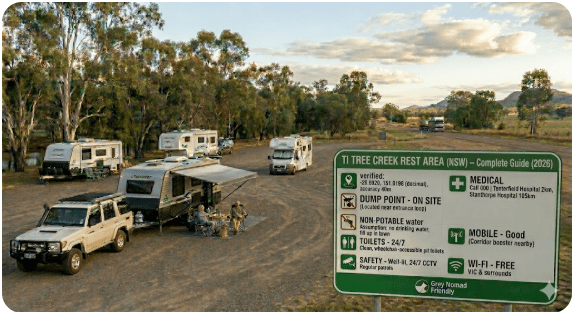
NSW Rest area Grey Nomads Updated for 2026
Ti Tree Creek Rest Area Complete Guide (Senior Grey Nomad Guide 2026)
Ti Tree Creek Rest Area is a practical “reset stop” used by travellers moving along the Tenterfield ↔ Inverell ↔ Warialda corridor in Northern NSW. In 2026, this section of highway travel is all about smart pacing: distances between major towns can feel longer when you add towing speed, roadworks, weather, and fatigue breaks.
This guide is written for Grey Nomads and senior travellers who want the real-world details: how to approach safely with a caravan or motorhome, what to plan for if facilities are minimal, how to avoid dusk wildlife risks, and how to build an A/B/C stop plan so you’re never “driving on hope”.
https://retiretovanlife.com/tenterfield-to-warialda-rest-areas-2026
This hub page helps you plan multiple rest areas and backups in NSW so you’re not forced into risky late-day decisions.
Rest area rules and facilities can change due to upgrades, storm damage, drought management (water taps turned off), or council/road authority updates. Always treat the entrance signage as the final authority for time limits and overnight rules.
- Why Grey Nomads Stop at Ti Tree Creek Rest Area
- Free Camping — Know the Limits for Seniors
- Your Two Main Options Side by Side
- Quick Facts and Key Details in 2026
- How to Get to Ti Tree Creek Rest Area + GPS (Best Method)
- Road Conditions, Flooding and Unsealed Sections
- Parking, Turning, and Truck Etiquette (Towing-Friendly)
- Heat and Remoteness — Seniors
- Wildlife — What to Watch For (Dawn/Dusk)
- What Other Google Websites Don’t Tell You
- Best Time to Visit This Stretch — Month-by-Month (2026)
- Free and Low-Cost Camping Alternatives Nearby
- Dump Points Near This Highway Section
- Free Water Sources (Where to Look + How to Verify)
- Fuel Stops and Distance Planning (North/South/East/West)
- Showground Donation or Caravan Park — Paid Alternative
- Full Facilities Comparison Table
- Rates — Typical 2026 Ranges
- Senior Checklist — Safety On & Off the Road (Not Printable)
- What to Do Near Ti Tree Creek Rest Area (Senior-Friendly)
- 🗺️ Vanlife Saving Spots — Save Every Stop (Map)
- Phone Signal and Emergency Communications
- Campfires, Cooking Restrictions & Food Options
- Pets at Ti Tree Creek Rest Area
- Accessibility for Seniors with Mobility Limitations
- Permits, Etiquette and Waste Management
- Emergency Scenarios — What to Do
- Packing List for This Highway Section
- Nearby Rest Areas (Internal Links)
- Reviews — What Grey Nomads Commonly Say
- Frequently Asked Questions (2026)
- Quick-Reference Card
- Disclaimer
- SEO Setup + Schema (Copy/Paste)
Why Grey Nomads Stop at Ti Tree Creek Rest Area
Senior travellers use rest areas for one reason: fatigue management. Everything else is a bonus. In 2026, Ti Tree Creek Rest Area is useful because it gives you a planned point to:
- break the driving day into safer chunks (especially when towing)
- do a quick rig check (tyres, coupling, chains, lights, load straps)
- reset your body: walk, stretch, hydrate
- avoid the most common Grey Nomad mistake: pushing through mid-afternoon fatigue
Free Camping — Know the Limits for Seniors
“Free” does not always mean “overnight allowed”. In NSW, rest area rules are typically controlled by on-site signage (and sometimes patrols). In 2026, the most common restrictions you’ll see include:
- Time limits (e.g., 1 hour, 8 hours, 20 hours, 24 hours)
- No camping (day-use rest only)
- No generators (or generator-hour limits)
- Truck priority zones (do not block heavy-vehicle bays)
If the sign doesn’t clearly allow overnight stays, treat Ti Tree Creek Rest Area as a break-only stop and continue to a legal overnight option in a nearby town (showground or caravan park). It’s not worth the stress—especially when you’re tired.
Your Two Main Options Side by Side
| Option | Best for | Trade-offs |
|---|---|---|
| Ti Tree Creek Rest Area | Fatigue break, short nap, tea/meal stop, quick safety checks; overnight only if signage permits | Noise from freight traffic, limited facilities, no guaranteed water/power |
| Town stop (showground / caravan park) | Recovery night, shower, laundry, power, better sleep, more security | Cost, check-in times, may be busy during peak travel periods |
Quick Facts and Key Details in 2026
| Item | What seniors need to know |
|---|---|
| Type | Roadside rest area in NSW used by travellers and freight traffic. |
| Region | Part of the Northern NSW corridor covered in the Tenterfield to Warialda Rest Areas (2026) hub. |
| Road surface | Main corridor travel is typically on sealed highway; internal bay surfaces may be sealed or compacted gravel depending on site design. |
| Facilities | Varies by rest area; assume minimal. Toilets/water are not guaranteed. |
| Overnight rules | Controlled by entrance signage and time limits. |
| Best arrival time | Earlier in the day for easier parking and safer assessment (especially if you have mobility limitations). |
How to Get to Ti Tree Creek Rest Area + GPS (Best Method)
When towing, “missing the turn-off” can become stressful fast. Use this method to keep it simple in 2026:
- Open your page first: https://retiretovanlife.com/ti-tree-creek-rest-area/
- Open the location in your navigation app
- Confirm you’re heading to the correct side/direction (some rest areas have directional variants)
- Drop a pin at the entrance in Google Maps and copy the coordinates into your notes
I don’t publish guessed coordinates. The safest approach is to copy the public latitude/longitude directly from the Google Maps or OpenStreetMap pin for the exact entrance you’ll use.
Main site reference: https://retiretovanlife.com
Do not attempt risky U-turns. Continue to the next safe turning point, then loop back. Seniors towing caravans are especially vulnerable in “panic correction” moments.
Road Conditions, Flooding and Unsealed Sections
The main travel corridor through this part of NSW is generally sealed, but conditions can change quickly with weather and roadworks. What matters most to senior drivers is not just surface type—it’s traction, visibility, and shoulder stability.
Does the road flood?
Flooding is typically event-based after heavy rain. Even if the highway remains open, you can encounter:
- sheet water (longer stopping distance)
- debris washed onto the lane (branches/gravel)
- soft shoulders (dangerous if you drift while tired)
- fog after rain in cooler stretches (visibility risk)
Use NSW Live Traffic for hazards/closures and Bureau of Meteorology for storm/flood risk.
Is it unsealed?
Most unsealed risk comes from detours and rest area internal surfaces. If the bay area is gravel:
- enter slowly (stone flick risk)
- watch for potholes and uneven edges
- be careful stepping out of the vehicle (trip hazards)
Parking, Turning, and Truck Etiquette (Towing-Friendly)
In 2026, the biggest safety factor at rest areas is not crime—it’s traffic movement. These stops are designed for heavy vehicles, and caravanners do best when they act predictably.
Best practice for caravans and motorhomes
- Arrive earlier than you think (late afternoon is peak fatigue time)
- Choose a level bay (better sleep, less strain, safer steps)
- Keep clear of truck turning circles and reversing lines
- Don’t block multiple bays unless the layout forces it
If trucks are present, park away from the main truck line where possible, keep your setup minimal, and use earplugs. The goal is sleep and safety—not “camp mode”.
Heat and Remoteness — Seniors
Even when you’re not far from a service town, senior travellers should plan as if help might be delayed—because it can be. In 2026, heat and dehydration remain a common trigger for fatigue and poor decisions.
Senior-friendly “minimum kit” for a rest area stop
- 2–5L drinking water per person (plus extra for pets)
- snacks that don’t melt (nuts, crackers, fruit)
- power bank + 12V charging lead
- offline maps downloaded
- headlamp/torch (trip hazard prevention)
- Drink water first (before coffee)
- 5-minute walk + ankle/hip loosen
- Quick tyre + hitch scan
- Decide: continue now or move to a paid site for recovery
Wildlife — What to Watch For (Dawn/Dusk)
On this NSW corridor, wildlife risk is not a small issue—especially when you add fatigue. Watch for:
- kangaroos at dusk and dawn (and after rain)
- birds around bins (sudden take-offs)
- snakes in warm months near long grass edges
Aim to be parked before dusk whenever possible. Many animal strikes happen in the last 30 minutes of daylight—exactly when drivers are tired and visibility is dropping.
What Other Google Websites Don’t Tell You
- Rest areas aren’t campgrounds: keep your stop simple, quick, and respectful. Minimal setup = minimal stress.
- Level matters: seniors sleep and move better when the van/caravan is level—less joint pain, fewer night-time trips/falls.
- Noise isn’t personal: if trucks idle, it’s usually operational. Earplugs and earlier arrival make the biggest difference.
- Facilities can vanish: toilets may be temporarily closed; taps can be off. Always travel self-contained.
Best Time to Visit This Stretch — Month-by-Month (2026)
Use this table as a senior comfort and safety guide for Northern NSW inland travel patterns. Exact conditions vary year to year.
| Month | Senior-friendly notes |
|---|---|
| Jan | Hot + storm bursts. Start early, stop early. Check for debris after rain. |
| Feb | Humidity and fatigue risk. Hydrate and plan more breaks. |
| Mar | Often comfortable. Great for long touring days with daylight margins. |
| Apr | Mild, reliable. One of the easiest months for senior caravanners. |
| May | Cool mornings; possible fog. Delay departure if visibility is poor. |
| Jun | Cold nights; frost possible in cooler pockets. Watch shaded areas early. |
| Jul | Coldest month. Good visibility on clear days; plan warm bedding. |
| Aug | Cool and comfortable daytime touring. Popular with Grey Nomads. |
| Sep | Spring winds can affect towing stability—slow down and widen margins. |
| Oct | Busy travel month. Rest areas and town sites can fill earlier. |
| Nov | Heat returns. Avoid long late-afternoon legs. |
| Dec | Holiday traffic. Have backups ready; consider booking paid sites. |
Free and Low-Cost Camping Alternatives Nearby
If Ti Tree Creek Rest Area is busy, noisy, signed “no overnight”, or you simply want a better sleep, your best senior move is to switch early to a legal option.
Choose a primary stop plus two backups using the hub page:
https://retiretovanlife.com/tenterfield-to-warialda-rest-areas-2026
Dump Points Near This Highway Section
Dump points are typically found in towns (caravan parks, council facilities, showgrounds), not at standard rest areas.
Never dump greywater or toilet waste at a rest area unless a clearly marked dump point exists. Doing the right thing keeps these stops open for everyone.
Free Water Sources (Where to Look + How to Verify)
For senior travellers, water planning should be as routine as fuel. Look for potable water in towns at:
- visitor information centres
- public parks with taps marked drinking water / potable
- showgrounds (permission-based; sometimes donation)
- some service stations (ask first)
Only fill from taps clearly marked potable/drinking. If it’s unmarked, ask locally. If you’re unsure, buy a top-up—health first.
Fuel Stops and Distance Planning (North/South/East/West)
You asked for distance planning in all directions. Because travellers approach this corridor from multiple towns and servo hours can change, the safest 2026 strategy is to use service towns as fuel anchors and plan by time rather than chasing exact kilometre claims.
Senior fuel rules that reduce stress
- Towing buffer: refuel around half a tank if the next town is uncertain
- Trading hours reality: don’t assume every servo is open late
- Don’t push to save cents: cheaper fuel isn’t worth dusk driving or fatigue
- Time matters: roadworks + rain + fatigue breaks can add an hour easily
| Direction after your stop | Senior-friendly strategy (2026) |
|---|---|
| Eastbound | Traffic can increase. Refuel earlier to avoid arriving in a town near closing or during peak congestion. |
| Westbound | Use major inland towns as your “fuel anchors”. If below half a tank, top up at the next reliable service town. |
| Northbound | Keep daylight margins. Plan a rest area break before fatigue hits, then refuel in the next service town rather than gambling. |
| Southbound | Avoid the “late afternoon push”. If you’ll arrive late, fuel earlier so you can stop sooner if wildlife or weather becomes an issue. |
Showground Donation or Caravan Park — Paid Alternative
If you’re tired, sick of noise, or the weather turns, a paid stop is often the best “free camping strategy” because it protects your health and lets you keep travelling safely.
- I’m arriving late afternoon and feel my attention slipping
- I need a shower and a real sleep
- It’s windy / wet and I want stability and comfort
- I need power for medical devices or charging
- I need reliable communications (family/work)
Full Facilities Comparison Table
| Feature | Ti Tree Creek Rest Area | Town caravan park / showground |
|---|---|---|
| Cost | $0 (signage rules apply) | Paid |
| Toilets | Varies (not guaranteed) | Usually yes |
| Showers | No | Usually yes |
| Power | No | Often yes |
| Water | Not guaranteed | Usually potable water |
| Noise | Often higher (freight corridor) | Usually lower |
| Best use | Fatigue break + quick reset | Recovery night(s) |
Rates — Typical 2026 Ranges
| Type | Typical 2026 range (AUD) | Notes |
|---|---|---|
| Roadside rest area | $0 | Subject to time limits and signage |
| Showground/community camping | $10–$30 | Often donation-based; rules vary |
| Caravan park (powered) | $45–$85 | Higher during peak periods |
| Caravan park (unpowered) | $30–$60 | Availability varies |
Senior Checklist — Safety On & Off the Road (Not Printable)
- Entry: indicate early, slow smoothly, avoid sudden braking while towing
- Parking: choose level ground; keep clear of truck manoeuvring zones
- Body: drink water, short walk, gentle stretch
- Rig: tyre scan (heat/bulges), hitch pin, chains, plug, lights
- Decision rule: if you feel tired, stop and reset—don’t “push to make time”
What to Do Near Ti Tree Creek Rest Area (Senior-Friendly)
Rest areas aren’t tourist attractions—but you can still use them to improve your day:
- Mobility walk: 5–10 minutes to reduce stiffness and boost alertness
- Breathing reset: 2 minutes of slow breathing reduces stress and improves focus
- Checklist stop: turn your stop into a routine (water, snack, tyre scan)
- Plan the next leg: choose your next fuel town and your backup rest area now, not later
🗺️ Vanlife Saving Spots — Save Every Stop (Map)
Use this interactive map to find and save free camps, rest areas and overnight stops, then build your NSW corridor plan.
COPY PROMPT ➔ ASK AI ➔ SAVE TO FORM ➔ ADD SPOT PIN ➔ GET DIRECTIONS
📍 Interactive map — find free camps, rest areas and overnight stops. Enable location for best results.
🗺️ Free camps, rest areas, or parks (allowed stays) — structured logbook
To keep coordinates accurate and publicly verifiable, copy them from Google Maps/OpenStreetMap pins.
| Name | Address / Road | Postcode | Latitude / Longitude | Coordinate source | Notes | Nearby public WiFi options |
|---|---|---|---|---|---|---|
| Ti Tree Creek Rest Area | NSW highway corridor (verify in maps) | Varies by nearest locality | Copy from Google Maps pin | Google Maps / OpenStreetMap (public) | Check entrance signage for time limits and overnight rules | Usually none on-site; try nearest town library/visitor info/cafés |
| Nancy Coulton Lookout Rest Area | NSW highway corridor | Varies | Copy from Google Maps pin | Google Maps / OpenStreetMap (public) | Lookout stop; wind can be a factor | Nearest town services |
| Sinclair Lookout Rest Area | NSW highway corridor | Varies | Copy from Google Maps pin | Google Maps / OpenStreetMap (public) | Lookout stop; signage rules apply | Nearest town services |
Phone Signal and Emergency Communications
Signal can be patchy between towns. Senior-friendly best practice in 2026:
- assume no reception at the rest area
- send “arrived safe” messages when you regain signal
- keep a power bank charged
- download offline maps before your driving day
Campfires, Cooking Restrictions & Food Options
Fire rules vary by season and local conditions. Always follow signage and check fire bans when travelling in NSW.
- Campfires: only if signage allows and no fire ban is in place
- Cooking: a contained stove is usually safest; set up away from dry grass
- Food: keep it simple and low-mess (quick pack-up reduces stress)
Pets at Ti Tree Creek Rest Area
Pets are generally fine if leashed and cleaned up after (follow any posted rules). For seniors:
- avoid truck lanes and reversing areas
- carry water (don’t rely on taps)
- check paws on hot sealed surfaces
Accessibility for Seniors with Mobility Limitations
Rest areas can include gravel, uneven edges and potholes. If you have mobility limitations:
- arrive in daylight when possible
- choose the closest level bay
- use a headlamp at night to avoid falls
Permits, Etiquette and Waste Management
- park within bays; don’t block truck manoeuvring space
- take rubbish with you if bins are full
- no greywater dumping
- keep noise and lights considerate at night
- follow time limits and all signage
Emergency Scenarios — What to Do
If you feel unwell (heat stress, dizziness, chest pain)
- stop driving immediately in a safe bay
- cool down, hydrate, and assess symptoms
- call emergency services when possible (or drive only if safe to a service town)
If you have a tyre issue or towing problem
- slow gently, avoid harsh braking
- pull into the next safe bay
- inspect tyres (including caravan tyres), coupling, chains, plug and lights
- don’t continue if you see bulges, cords, or a damaged coupling
Packing List for This Highway Section
- drinking water + backup
- snacks (non-melting)
- first aid + medications
- power bank + charging cables
- headlamp/torch
- high-vis vest
- warm layer (nights can cool quickly inland)
Nearby Rest Areas (Internal Links)
Reviews — What Grey Nomads Commonly Say
Across NSW rest areas in this type of corridor, the most common Grey Nomad feedback themes are:
- “Easy in/out” matters most for towing travellers
- Noise can vary depending on truck volumes and time of day
- Facilities are not guaranteed—self-contained travellers have the best experience
- Signage decides everything (overnight vs break-only)
Frequently Asked Questions (2026)
Can you stay overnight at Ti Tree Creek Rest Area?
Only if the entrance signage permits overnight stays and you follow the posted time limit.
Is Ti Tree Creek Rest Area suitable for caravans and motorhomes?
Generally suitable for a break. Suitability for longer stays depends on bay length, traffic levels, and staying clear of truck manoeuvring space.
Are there toilets and water?
Not guaranteed. Travel self-contained with water and a backup toilet plan.
What’s the best alternative if it’s full?
Use the corridor hub to choose two backup rest areas or switch early to a town site: Tenterfield to Warialda Rest Areas (2026).
Quick-Reference Card
- Need a break now? Stop and reset.
- Overnight unclear? Follow signage—if uncertain, don’t stay.
- Too tired? Choose a paid site in town for recovery.
- Approaching dusk? Stop earlier to reduce wildlife risk.
Disclaimer
This guide is for general information only. Conditions, facilities, and rules can change without notice due to weather, fire conditions, roadworks and maintenance. Always follow on-site signs and check official sources (NSW Live Traffic, BoM, local council/visitor info) before relying on any stop for overnight use.
Free campsites and powered sites fill fast during school holidays and peak season. If your preferred site is already gone, search remaining accommodation options below to explore the region.
Accommodation and flight search powered by Expedia. Booking through this search supports this website at no extra cost to you. As an affiliate, I earn from qualifying purchases at no extra cost to you.

As an affiliate, I earn from qualifying purchases at no extra cost to you.
Exclusive Offer: Get 5% OFF all StarterStopper immobiliser products with promo code: RTV5
Visit StarterStopper.com to see our data-backed security solutions
As an affiliate, I earn from qualifying purchases at no extra cost to you.