NSWBruxner Highway (B76)Grey NomadsUpdated for 2026
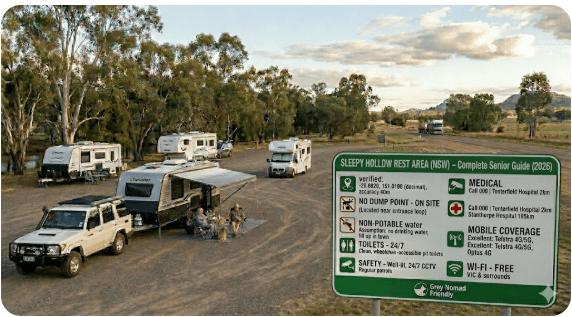
Sleepy Hollow Rest Area Complete Guide (Senior Grey Nomad Guide 2026)
If you’re driving the Bruxner Highway (B76) in Northern NSW, Sleepy Hollow Rest Area is one of those practical, low-stress stops that can turn a “push through” day into a safer senior-friendly travel day. This guide is written for Grey Nomads, caravanners, motorhome travellers, campervan road-trippers, and anyone towing in 2026—especially if you’re planning the run between Tenterfield, Inverell and Warialda.
https://retiretovanlife.com/tenterfield-to-warialda-rest-areas-2026
All locations discussed in this guide are in NSW.
- Why Grey Nomads Stop at Sleepy Hollow Rest Area
- Free Camping — Know the Limits for Seniors
- Your Two Main Options Side by Side (Rest Area vs Paid)
- Quick Facts and Key Details in 2026
- How to Get to Sleepy Hollow Rest Area + GPS (Best Method)
- Road Conditions, Flooding and Unsealed Sections
- Heat and Remoteness — Seniors
- Wildlife — Birds, Roos, Reptiles and What to Watch For
- What Other Google Websites Don’t Tell You
- Best Time to Visit This Stretch — Month-by-Month (2026)
- Free & Low-Cost Camping Alternatives Nearby
- Dump Points Near This Section of Highway
- Free Water Sources (Where to Look + How to Verify)
- Fuel Stops Along the Bruxner Highway (Planning for Seniors)
- Showground Donation or Caravan Park — Paid Alternative
- Full Facilities Comparison Table
- Rates — All Options Near Here (Typical 2026 Ranges)
- Senior Checklist — Safety On & Off the Road (Not Printable)
- What to Do Nearby — Senior Activity Guide
- 🗺️ Vanlife Saving Spots — Save Every Stop (Map)
- Phone Signal and Emergency Communications
- Campfires, Cooking Restrictions & Food Options
- Pets at Sleepy Hollow Rest Area
- Accessibility for Seniors (Mobility Notes)
- Permits, Fees, Etiquette & Waste Management
- Emergency Scenarios — What to Do
- Packing List for This Highway Section
- Rest Areas Nearby (Quick List)
- Reviews — What Grey Nomads Commonly Say
- Frequently Asked Questions (2026)
- Quick-Reference Card
- Disclaimer
- SEO Setup (Copy/Paste)
Why Grey Nomads Stop at Sleepy Hollow Rest Area
On long highway days, the safest decision is often the simplest: stop early, stop calm, stop level. Seniors and long-distance travellers like Sleepy Hollow Rest Area because rest areas on the Bruxner are typically designed with truck access in mind, which often translates into:
- Easier entry/exit even with a caravan, fifth-wheeler, or motorhome
- Longer parking bays than a tight town street stop
- Less reversing stress if you arrive before the late-afternoon rush
- A predictable place to reset: stretch, tea/coffee, snack, medication check, and a quick “systems check” (tyres, hitch, lights)
If you’re fine mid-morning but “hit the wall” between 2–4 pm, you’re not alone. That window is a high-risk time for lane drift, late braking, and poor decisions (especially in glare, heat, or after a big lunch). Planning a rest-area stop before you need it is one of the most effective safety habits on regional NSW highways.
Free Camping — Know the Limits for Seniors
Not every “rest area” is an “overnight area”. In NSW, the rules are typically set by on-site signage (time limits, no-camping rules, truck-only zones, and “no generators” notes). In 2026, you’ll see common limits like 1 hour, 8 hours, 20 hours, or 24 hours depending on the stop.
I’m not on-site with you. Always follow the posted sign at Sleepy Hollow Rest Area. If signage says “No overnight camping” or a short time limit, treat it as a safety rest stop only and move on to a legal overnight option (showground, campground, caravan park, or council-approved area).
Your Two Main Options Side by Side (Rest Area vs Paid)
| Option | Best for | Trade-offs |
|---|---|---|
| Sleepy Hollow Rest Area (free roadside stop) | Breaks, fatigue management, quick reset, late arrival when you just need sleep (only if signage permits) | Noise from trucks, limited/variable facilities, no guaranteed water, usually no power, signage may restrict overnight |
| Caravan park / showground in a nearby town | Recovery nights, hot shower, laundry, medical rest day, better security, longer stays | Cost, check-in times, may book out in peak periods |
Quick Facts and Key Details in 2026
| Item | What seniors need to know |
|---|---|
| Location | Sleepy Hollow Rest Area is on the Bruxner Highway (B76) in NSW, used by caravanners and heavy vehicles travelling between major service towns (e.g., Tenterfield / Inverell / Warialda corridor). |
| Road surface | Bruxner Highway is generally sealed on the main corridor; conditions can change quickly after storms. |
| Facilities | Rest area facilities vary by stop. Expect basics (parking, bins, sometimes a table). Toilets/water are not guaranteed—arrive prepared. |
| Overnight rules | Depends on on-site signage. Some rest areas allow limited-duration stays; others are day-use only. |
| Best vehicle types | Suitable for most vehicles including caravans and motorhomes if bays are free and you can park clear of truck movement areas. |
| Safety focus | Arrive earlier, choose a level bay, stay visible, keep emergency comms charged, and avoid blocking truck turning space. |
How to Get to Sleepy Hollow Rest Area + GPS (Best Method)
Because some NSW rest areas share names, have duplicate “eastbound/westbound” entries, or sit on opposite sides of the highway, the most reliable approach in 2026 is:
- Use Google Maps and search: “Sleepy Hollow Rest Area (Bruxner Highway)”
- Confirm you’re selecting the correct side/direction (if applicable)
- Cross-check using your preferred app (Waze / Apple Maps / RV trip planner)
- Use the Vanlife Saving Spots map in this article to save the pin and keep it for later
I only publish coordinates when I can verify them from a publicly available mapping source. If you want the exact latitude/longitude for your direction of travel, the fastest method is to open the location in Google Maps, press-and-hold to drop a pin, and copy the coordinates—then save it into your notes or the map tool below.
If you already have a preferred GPS app, you can also use my site’s location pages and hub planner as a cross-check:
https://retiretovanlife.com
Tenterfield to Warialda Rest Areas (2026 hub)
If you miss the entry, don’t attempt a risky U-turn. Continue to the next safe turning point or town, then loop back. On regional highways, “saving 2 minutes” can become the most expensive decision of the day.
Road Conditions, Flooding and Unsealed Sections
For the Bruxner Highway corridor in NSW, the main travel lane is typically sealed, but safety changes with weather and traffic mix. Here’s what matters most to seniors in 2026:
Is the road unsealed?
On the main Bruxner Highway route, you should generally expect sealed pavement. Unsealed conditions are more likely on detours, roadworks side-tracks, or if you divert onto local roads for a back route, farm access, or scenic loop.
Does it flood?
Flooding on this corridor is typically event-based (after heavy rain), where water can sit across low points, creek approaches, or on shoulders. Even when the highway remains open, you can get:
- Sheet water (reduced braking and increased trailer sway risk)
- Debris (branches, gravel washed onto the lane)
- Hidden shoulder drop-offs (particularly dangerous if you drift left)
- Fog + wet on higher, cooler sections (reduced visibility)
Before you roll, check NSW Live Traffic for closures, hazards and roadworks. For storm/flood risk, check Bureau of Meteorology (BoM).
Roadworks and heavy vehicles
The Bruxner is a working freight route. Expect overtakes, wide loads, and trucks using rest areas heavily—especially outside peak holiday traffic windows. As a senior driver, your easiest safety gains are:
- Drive your own pace and let tailgaters pass when safe
- Stop earlier and more often (less fatigue, better decisions)
- Avoid dusk driving when roos become active
Heat and Remoteness — Seniors
“NSW” doesn’t always mean “mild”. In 2026, more travellers are planning around heat days and storm bursts. Even in tableland regions, cabins can heat quickly and dehydration creeps up (especially with medication that affects thirst or fluid balance).
If you’re waiting until you feel thirsty, you’re already behind. Keep a bottle within reach, and add a planned “water stop” every 90–120 minutes—whether you feel like it or not.
Carry this, even on “short” legs
- 2–5 litres drinking water per person (minimum), plus extra for the dog if you travel with pets
- Paper map or offline maps (coverage gaps still happen)
- Basic recovery gear (even 2WD travellers benefit from a shovel, traction mat, and tyre gauge)
- Charged power bank and 12V charger lead
Wildlife — Birds, Roos, Reptiles and What to Watch For
This NSW corridor is classic “roo country” around dawn/dusk. Wildlife risk is not only about impact—it’s about panic braking and trailer instability.
Most common hazards near rest areas
- Kangaroos moving between tree lines and open verges
- Birdlife scavenging near bins (watch for sudden take-offs)
- Snakes in warmer months—particularly around long grass edges and log lines
If it’s safe, pull over well off the lane, turn on hazards, check everyone for shock/injury, and assess vehicle damage (radiator leaks and tyre damage are common trip-enders). In rural areas, help can be slower—plan for self-sufficiency.
What Other Google Websites Don’t Tell You
Most short directory listings won’t tell you the real-world stuff that matters when you’re 60+ and towing:
- Noise management: if trucks are present, choose a bay that’s not directly beside idling rigs (when possible).
- Level matters more than scenery: a slightly less “pretty” spot that’s level can mean better sleep and less back/hip pain.
- Toilet uncertainty: always travel with your own backup plan (portable toilet / liner bags) for rest areas that are full, closed, or missing facilities.
- Rest area etiquette affects safety: parking across two bays, blocking turning circles, or setting up chairs in truck lanes increases conflict and risk.
Arrive before late afternoon, pick your bay, have dinner early, and lock in a wind-down routine. “One more town” decisions at 5 pm are where seniors get caught driving tired.
Best Time to Visit This Stretch — Month-by-Month (2026)
This is a practical planning guide for the Bruxner corridor and surrounding NSW inland climate patterns. Exact conditions vary year to year.
| Month | What to expect (senior travel planning) |
|---|---|
| Jan | Hot spells + storm bursts. Start early, stop early, watch for wet-road debris after storms. |
| Feb | Similar to Jan. Humidity can increase fatigue. Keep hydration and rest breaks tight. |
| Mar | Often more comfortable. Great for longer touring days if storms ease. |
| Apr | Mild days, cooler nights. One of the easiest months for seniors to travel this region. |
| May | Cooler mornings; possible fog patches. Plan later starts if visibility is low. |
| Jun | Cold nights; potential frost in higher areas. Warm bedding and morning tyre-pressure checks help. |
| Jul | Coldest month. Excellent driving visibility on clear days; be cautious of wildlife in low-light periods. |
| Aug | Still cool. Good month for comfortable daytime touring. |
| Sep | Warming up; spring winds can affect towing stability—slow down and allow extra space. |
| Oct | Comfortable, popular travel month. Some locations busier—arrive earlier. |
| Nov | Heat returns. Avoid long afternoon legs; plan shaded lunch stops. |
| Dec | Holiday traffic increases. Booking for paid sites becomes more important; rest areas can fill earlier. |
Free & Low-Cost Camping Alternatives Nearby
If Sleepy Hollow Rest Area is signed as “no overnight”, full, noisy, or just not comfortable, your best senior move is to pivot to a legal, calmer overnight option. Options commonly used by Grey Nomads include:
- Town showgrounds (often donation/low-cost, check local rules)
- Caravan parks for recovery nights (showers, laundry, power)
- Other signed rest areas along the Bruxner with more suitable bays
Tenterfield to Warialda Rest Areas (2026)
If you’re leapfrogging west or east, this hub page helps you avoid “hope-based travel” (driving until you’re forced to stop).
Dump Points Near This Section of Highway
Dump point availability changes with council upgrades and maintenance. In 2026, the most reliable approach is to:
- Check official town visitor info pages or council websites
- Use a current camping app listing (and cross-check with signage)
- Ask at the visitor information centre or caravan park on arrival
Never dispose of cassette waste or greywater at a rest area unless there is a clearly marked, purpose-built dump point. Illegal dumping is the #1 reason councils tighten camping rules.
Free Water Sources (Where to Look + How to Verify)
Free potable water is most commonly found in towns rather than roadside stops. For seniors (and anyone with medical hydration needs), treat water like fuel: plan it.
Typical places to find potable town water
- Visitor information centres
- Showgrounds (ask permission; sometimes coin/donation)
- Public parks with marked “drinking water” taps
- Some service stations (ask—don’t assume)
Only fill from taps marked drinking water / potable. If it’s unmarked, ask locally. When in doubt, use filtered water or buy a top-up—your health is worth more than saving a few dollars.
Fuel Stops Along the Bruxner Highway (Planning for Seniors)
On this NSW corridor, fuel planning is less about “running out” and more about avoiding stress—especially if you prefer daylight driving and don’t want to arrive in a town at closing time.
Senior-friendly fuel planning rules
- Refuel earlier than you think if you’re towing or running a heavier motorhome
- Keep a buffer so you can skip a town if it’s busy or you’re fatigued
- Don’t rely on small-town trading hours—arrive with options
Distances between major towns can feel longer when you add roadworks, weather, slower towing speeds, and fatigue breaks. Plan with time—not just kilometres.
A Showground Donation or Caravan Park — Paid Alternative
If you need a proper reset (hot shower, laundry, power for medical devices, or a quiet night), a paid stop is sometimes the best “free camping hack” you can use—because it protects your health and keeps you travelling.
- I’m tired enough that reaction time feels slow
- Weather is turning and I want solid shelter and power
- I need laundry and a long shower to recover
- I have a minor issue (stomach bug, headache, medication change)
- I’m arriving late and don’t want to risk a noisy/unsafe rest area
Copy/paste the list above into your phone and use it as a decision trigger.
Full Facilities Comparison Table
The table below is designed to help you decide quickly, even when you’re tired. Facilities at rest areas can vary—always confirm by signage and visual check.
| Feature | Sleepy Hollow Rest Area | Town caravan park / showground (nearby) |
|---|---|---|
| Cost | Free (subject to rules/signage) | Paid (varies by town/season) |
| Toilets | May or may not be available (varies by site) | Usually yes (amenities block) |
| Showers | No | Usually yes |
| Power | No | Often available (powered sites) |
| Water | Not guaranteed | Usually potable water access |
| Noise | Often high (trucks) | Often lower (still can have road noise) |
| Pet friendliness | Typically okay on leash (follow signage) | Usually okay with rules (leash, fees, breed rules sometimes) |
| Best use | Safety break, short stay, fatigue stop | Recovery night(s), comfort, longer stays |
Rates — All Options Near Here (Typical 2026 Ranges)
Exact prices vary by town, season, and whether it’s a powered/unpowered site. Use these as planning ranges in 2026:
| Type | Typical 2026 price range (AUD) | Notes |
|---|---|---|
| Roadside rest area | $0 | Subject to posted time limits and rules. |
| Showground / community camping | $10–$30 / night | Often donation-based; may include basic facilities; rules vary. |
| Caravan park (powered) | $45–$85 / night | Higher during peak periods; discounts may apply for longer stays. |
| Caravan park (unpowered) | $30–$60 / night | Availability varies; can be limited in some towns. |
Senior Checklist — Safety On & Off the Road (Not Printable)
- Before you leave: meds, water, hats/sunscreen, and a snack within reach
- Every stop: 3-minute walk + shoulder/neck stretch (stiffness is fatigue)
- Tyre scan: look for bulges, nails, heat; check caravan plug and safety chains
- Eye comfort: sunglasses, reduce glare; avoid driving into low sun if possible
- Decision rule: if you feel “just a bit off”, stop and reassess—don’t negotiate with fatigue
What to Do Nearby — Senior Activity Guide
Rest areas are about recovery, but the Bruxner corridor also gives you easy senior-friendly “add-ons” when you overnight in a nearby town:
- Visitor information centres: local history, maps, and current road condition advice
- Easy walks: flat town park loops (good circulation and joint mobility)
- Local bakeries/cafés: simple morale boost on long trips
- Scenic lookouts: short stops that break up long highway legs
Pair a rest-area break with a “one town task”: fuel + water + dump point (if available) + a 10-minute walk. It keeps the trip smooth and reduces decision load.
🗺️ Vanlife Saving Spots — Save Every Stop (Map)
Use this to find free camps, rest areas and overnight stops, then save pins and build your own “corridor plan” for NSW travel.
COPY PROMPT ➔ ASK AI ➔ SAVE TO FORM ➔ ADD SPOT PIN ➔ GET DIRECTIONS
📍 Interactive map — find free camps, rest areas and overnight stops. Enable location for best results.
Vanlife Savings Spots (NSW) — data table (fill-as-you-go)
You asked for a table with coordinates. I won’t guess coordinates (accuracy matters). The most reliable approach is to open each linked location page or map pin and copy the public lat/long. Use the table below as your structured logbook.
| Name | Address / Road | Postcode | Latitude / Longitude | Coordinate source | Overnight notes | Nearby public WiFi options |
|---|---|---|---|---|---|---|
| Sleepy Hollow Rest Area | Bruxner Highway (B76), NSW | Varies by nearest locality | Use Google Maps pin → copy coordinates | Google Maps / OpenStreetMap (public) | Check signage for time limits and overnight rules | Usually none on-site; check nearest town libraries/visitor centres |
| Sleepy Hollow Rest Area (Southbound) | NSW (direction-specific rest area) | Varies | Use Google Maps pin → copy coordinates | Google Maps / OpenStreetMap (public) | Confirm correct direction + signage | Usually none on-site |
| Tenterfield (town stop) | Tenterfield NSW (town services) | 2372 | Use town centre pin (public) | OpenStreetMap / Google Maps | Good services base; use legal camping options | Library, cafés, visitor info (varies) |
| Inverell (town stop) | Inverell NSW (town services) | 2360 | Use town centre pin (public) | OpenStreetMap / Google Maps | Major services hub (fuel, groceries, repairs) | Library, cafés, visitor info (varies) |
| Warialda (town stop) | Warialda NSW (town services) | 2402 | Use town centre pin (public) | OpenStreetMap / Google Maps | Good staging point westward | Library / community hubs (varies) |
Phone Signal and Emergency Communications
Expect patchy reception in parts of regional NSW, especially between towns. Senior-friendly approach:
- Assume you may have no reception at a rest area
- Send an “arrived safe” message when you have signal
- Keep offline maps downloaded
- Consider a satellite communicator for remote touring if you regularly travel outside town-to-town corridors
If you’re broken down on the highway, prioritise visibility and safe position off the lane/shoulder where possible. Use triangles if you carry them, and keep your passenger side away from traffic.
Campfires, Cooking Restrictions & Food Options
Most NSW roadside rest areas have strict rules around fires, especially during fire danger periods. Even if a fire is technically allowed somewhere, it may be prohibited by local conditions (wind, total fire ban, or signage).
- Campfires: only if signage allows and there are no fire bans (check NSW RFS)
- Cooking: safer option is a self-contained stove used responsibly, away from grass, and never left unattended
- Food: do your main grocery run in larger towns; keep rest-area stops simple (tea, fruit, sandwich)
Pets at Sleepy Hollow Rest Area
In most rest areas, pets are fine if they’re on leash and you clean up. For seniors:
- Walk dogs away from truck movement zones
- Carry water (don’t rely on site taps)
- Check for ticks/grass seeds after walks
Accessibility for Seniors (Mobility Notes)
Accessibility varies widely. If you have mobility limitations, aim to arrive in daylight so you can select the safest bay and assess surfaces (gravel, uneven edges, distance to any facilities).
- Look for level parking to reduce fall risk
- Use a headlamp at night to avoid stepping into potholes
- If toilets are present, verify the path is stable (not soft gravel)
Permits, Fees, Etiquette & Waste Management
Keep rest areas open for everyone by travelling light and leaving no trace:
- Park within bays and keep truck lanes clear
- Take rubbish with you if bins are full
- Don’t dump greywater
- Keep noise low and lights considerate at night
- Follow signage—time limits are enforced in many corridors
Emergency Scenarios — What to Do
If you feel unwell (dizziness, chest pain, confusion)
- Stop driving immediately in a safe area
- Call emergency services if severe
- Use air conditioning/ventilation, hydrate, and cool down
- Do not “push to the next town” if symptoms are serious
If your rig is unstable (wind, sway, mechanical issues)
- Slow down gently (no harsh braking)
- Pull into the next safe bay
- Check tyre pressures and load balance
- Delay travel if wind gusts are strong—seniors benefit from conservative decisions
Packing List for This Highway Section
- Drinking water + backup
- Snacks that don’t melt (nuts, fruit, crackers)
- Basic first aid + personal medications
- Power bank + charging cables
- Headlamp/torch
- High-vis vest
- Paper towel + hand sanitiser
- Warm layer (nights can cool quickly inland)
Rest Areas Nearby (Quick List)
If you’re stitching these stops into a safe day plan, use the hub page and pick two backup options (one before and one after your intended stop):
https://retiretovanlife.com/tenterfield-to-warialda-rest-areas-2026
Reviews — What Grey Nomads Commonly Say
Most experienced travellers judge a rest area by the same practical criteria. Typical Grey Nomad feedback patterns include:
- “Easy in/out” matters more than almost anything when towing
- Truck noise is the most common downside (earplugs help)
- Cleanliness varies—bring your own basics and leave it better than you found it
- Signage clarity determines whether it’s a nap stop or a legal overnight
Frequently Asked Questions (2026)
Can you sleep overnight at Sleepy Hollow Rest Area?
Sometimes—only if the on-site signage permits overnight stays and within the posted time limit. If signage restricts camping, use it as a rest break and move on.
Is Sleepy Hollow Rest Area suitable for caravans and motorhomes?
Generally, yes, because rest areas on freight corridors often have longer bays. The limiting factor is space availability and safe separation from truck manoeuvring zones.
Are there toilets and water?
Not guaranteed. Facilities vary between rest areas. Always carry your own water and have a backup toilet plan.
Is the Bruxner Highway safe for seniors?
Yes with sensible planning: daylight driving, regular breaks, conservative speeds while towing, and checking weather/Live Traffic for hazards.
What’s the best alternative if the rest area is full?
Pick the next signed rest area (within legal rules) or head to a nearby town for a caravan park/showground option for a quieter recovery night.
Quick-Reference Card
- I’m alert + daylight: stop, stretch, snack, continue.
- I’m fading (2–4 pm): stop longer, caffeine + walk, reassess.
- I’m too tired: only overnight if signage permits; otherwise go to a paid site in town.
- Bad weather coming: choose town accommodation/campground for security and comfort.
Disclaimer
This guide is for general information only. Conditions, facilities, and camping rules can change quickly due to maintenance, weather, fire danger, council updates, and signage changes. Always follow on-site signs and check official sources (NSW Live Traffic, BoM, and local council/visitor info) before relying on any stop for overnight use.
Free campsites and powered sites fill fast during school holidays and peak season. If your preferred site is already gone, search remaining accommodation options below to explore the region.
Accommodation and flight search powered by Expedia. Booking through this search supports this website at no extra cost to you. As an affiliate, I earn from qualifying purchases at no extra cost to you.

As an affiliate, I earn from qualifying purchases at no extra cost to you.
Exclusive Offer: Get 5% OFF all StarterStopper immobiliser products with promo code: RTV5
Visit StarterStopper.com to see our data-backed security solutions
As an affiliate, I earn from qualifying purchases at no extra cost to you.