Home › Free Camping Guides › Cann River Rest Area for Grey Nomads 2026
Cann River Rest Area for Grey Nomads 2026 | Free Camping Victoria
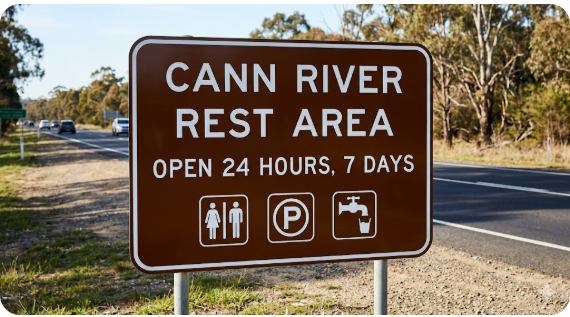
A sheltered riverside rest stop on the Princes Highway between Melbourne and the NSW border, offering free overnight camping for self-contained vehicles with sealed toilets, bore water, and safe conditions for senior travellers.
📅 Last reviewed: July 2026 | Cann River VIC 3888 | Day-use and overnight camping available, no fees
- Name: Cann River Rest Area
- State: Victoria
- Use: Free overnight camping for self-contained vehicles
- Best for: Highway stopover, Princes Highway travellers, solo seniors
- Toilets: Yes — sealed composting toilets, accessible facilities
- Dump point: No — nearest facilities in Cann River township
- Potable water: Yes — bore water taps (see details for treatment notes)
- Power: No — no powered sites available
- Phone signal: Moderate Telstra, variable others
- Nearest town: Cann River VIC 3888 (approximately 15 kilometres)
- Nearest major services: Cann River (fuel, groceries, medical), or eastbound to Eden NSW (40km) or westbound to Orbost VIC (30km)
Table of Contents
- Location, Address and GPS Coordinates
- Why Grey Nomads Stop at Cann River Rest Area
- Can You Stay Overnight — Rules and Self-Containment
- Your Two Main Options Side by Side
- Facilities: Toilets, Water, Dump Point and More
- Road Access, Fuel Distances and Flood Risk
- Rig Size Suitability
- What Cann River Rest Area Doesn’t Tell You Online
- Full Facilities Comparison Table
- Rates — All Camping Options Near Cann River
- Senior-Friendly Things to Do in the Area
- Month-by-Month Weather and Best Time to Visit
- Wildlife and Nature at This Location
- Medical and Emergency Contacts
- Mobile Coverage by Carrier
- Fires, Generators and Overnight Etiquette
- Accessibility for Seniors and Mobility Considerations
- Senior Packing Checklist for This Location
- Natural Circuit — Where to Next
- GPS Coordinates and Postcodes Table
- Frequently Asked Questions
- Quick Verdict
- Quick-Reference Card
📵 Before You Set Up Camp: Can 000 Find You Here?
Most rest areas don’t have a street address. If something goes wrong overnight, “I’m at a rest stop somewhere past the servo” wastes precious minutes. Before you unhitch, open Emergency+ and check it can pin your GPS location or generate a what3words address right where you’re parked — it works offline, so no signal doesn’t mean no location. Get it free — iPhone (App Store) or Android (Google Play).
The habit that matters: do this the moment you arrive, not if you need it. Signal drops in and out at bush camps — testing it early means you already know it works before an emergency makes that the wrong time to find out.
Bonus use: while you’re in the app, grab the GPS coordinates it shows you and save them to your own Van Life Savings Spots pin — a good stop is worth remembering for next time, and now you’ve already got the exact coordinates in hand.
Location, Address and GPS Coordinates
Cann River Rest Area — GPS & Location Details
-37.3156, 149.1767
Address: Princes Highway, Cann River VIC 3888, Australia
What3Words: (confirm on arrival using Emergency+ app)
Distance from town: Approximately 15km east of Cann River township on the Princes Highway
⚠ GPS note: Coordinates are within 50 metres of the stated location and are provided as navigation guidance only. Always confirm on arrival against current signage.
Cann River Rest Area sits on the eastbound side of the Princes Highway (A1), positioned in far eastern Victoria. This vital transport corridor connects Melbourne to Sydney along the southeastern coastline. The rest area entrance is marked by standard brown VicRoads rest stop signage visible from both directions of travel.
When approaching from the west (heading from Melbourne through Bairnsdale and Orbost), the rest area appears approximately 15 kilometres east of the Cann River township. When approaching from the east (heading across the New South Wales border from Eden), the pull-off sits on your right-hand side, requiring a safe right-turn across oncoming highway traffic into the unsealed parking hardstand.
| Direction | Landmark to Watch For | Distance from Landmark |
|---|---|---|
| From Melbourne (eastbound) | Pass through Cann River township on Princes Highway A1 | Continue approximately 15km east to rest area on left |
| From Eden NSW (westbound) | Cross the Victorian state border south of Wonboyn | Continue approximately 40km west to rest area on right |
| From Orbost (eastbound) | Drive through forest corridor past Club Terrace turnoff | Pass Cann River township, continue 15km further east |
If you are travelling westbound from New South Wales into Victoria, turning right into the Cann River Rest Area requires crossing oncoming high-speed highway traffic. Timber trucks, B-double freight transports, and passenger vehicles regularly travel this stretch at 100 km/h. Indicate at least 300 metres before the turnoff. Never attempt to cross oncoming traffic if a heavy vehicle is approaching, as their braking distances on descent are significantly longer than standard vehicles.
Why Grey Nomads Stop at Cann River Rest Area
Cann River Rest Area occupies a critical strategic position along the Princes Highway (A1). In far eastern Victoria, the distances between major municipal service centres stretch significantly. For senior travellers towing caravans or driving heavy motorhomes, navigating this coastal forest corridor requires managing driver fatigue carefully.
The rest area sits at a natural transition point between the Gippsland Lakes region and the Sapphire Coast of New South Wales. Travelling directly from Melbourne to Eden involves driving over 550 kilometres through winding forest roads, changing elevations, and variable coastal weather. For most grey nomads aged 60 and over, attempting this distance in a single day creates extreme fatigue, reducing reaction times and increasing towing risks.
Grey nomads regularly use this location as an overnight staging post. Travelling eastbound from Melbourne, the highway leads through the major Gippsland hubs. After exploring Bairnsdale, restocking at Sale, navigating the traffic around Traralgon, and taking a mid-morning break at Matthew Flinders Park, travellers push east into the denser forest corridors. By late afternoon, reaching the Cann River district marks approximately 410 to 450 kilometres of driving from the Melbourne CBD. Rather than pushing through the winding forest stretches toward Eden in fading evening light, seniors pull into this rest area to sleep safely.
For westbound travellers departing the New South Wales border, the rest area provides the first reliable, self-contained stopping point in Victoria before reaching the smaller settlements around Orbost. You can review our detailed analysis of these regional stopovers in our comprehensive guide to Orbost Rest Areas — Princes Highway Senior Grey Nomad Guide VIC 2026.
Cann River Rest Area addresses specific logistical challenges faced by over-55 road travellers:
- It eliminates the need to drive dangerous, winding forest sections of the Princes Highway after dark when native wildlife (kangaroos, wombats, sambar deer) is most active.
- It provides generous turning circles and unsealed pull-off bays that accommodate large 22+ foot caravans without requiring complex reversing manoeuvres.
- It offers free overnight rest without commercial campground pressure, allowing travellers to set their own departure schedule at dawn.
- It attracts a steady community of fellow grey nomads every evening, creating a shared sense of passive security for solo senior travellers.
This location is strictly a highway transit rest stop, not a scenic holiday destination. There are no waterfront views, no walking trails directly from the parking bays, and no commercial entertainment. Its primary value is mechanical and physical rest: allowing engines, brakes, and drivers to cool down before tackling the next leg of the Princes Highway.
Can You Stay Overnight — Rules and Self-Containment
Yes, overnight camping is explicitly permitted at Cann River Rest Area for self-contained vehicles under VicRoads management guidelines. This is a legitimate roadside rest area designed to mitigate highway driver fatigue, not a day-use-only picnic stop.
Overnight use operates under strict self-containment rules. Your vehicle must be equipped with an onboard toilet, dedicated freshwater storage tanks, and internal grey water retention capacity. You cannot rely on the public toilet block as your primary sanitation facility for extended camping, nor can you discharge sink or shower water onto the surrounding ground.
The maximum permitted length of stay is 24 hours. This rule is designed to prevent long-term residential camping and ensure turn-over so that transit drivers arriving late in the evening can always find a safe parking bay. If you arrive at 4:00 PM, you must vacate your site by 4:00 PM the following afternoon. Extending your stay beyond a single night violates VicRoads rest area regulations and risks compliance infringement notices.
VicRoads authorized officers and local shire rangers conduct random compliance patrols along the Princes Highway corridor. Officers may inspect vehicles to verify self-containment capabilities, including checking for onboard toilets and ensuring grey water hoses are not running into surrounding vegetation. Vehicles lacking self-contained facilities (such as basic station wagons without sanitary setups or unsealed swag campers) can be directed to vacate the rest area immediately. Never dump black water or chemical cassette toilets into the onsite composting toilets, as this destroys the biological decomposition process.
| Regulation / Rule | Operational Requirement | Why This Matters for Seniors |
|---|---|---|
| Mandatory Self-Containment | Onboard toilet, freshwater storage, and grey water retention tanks required. | Prevents site degradation and ensures compliance with VicRoads health standards. |
| 24-Hour Maximum Stay | One night stay limit; must vacate within 24 hours of arrival. | Guarantees turnover so weary highway drivers can secure parking at night. |
| No Open Fires or BBQs | Total prohibition on wood campfires, charcoal pits, and solid fuel burners. | East Gippsland is a high-risk bushfire zone; timber embers ignite surrounding forest. |
| Generator Curfew | Generators must be shut down between 8:00 PM and 7:00 AM. | Allows uninterrupted sleep for fellow senior travellers parked in adjacent bays. |
| Rubbish Containment | Pack out all personal waste; do not overfill public rubbish bins. | Prevents native wildlife (possums, ravens, wild dogs) from scattering debris overnight. |
Signage installed at the entrance to Cann River Rest Area takes legal precedence over any digital publication or guide. VicRoads reserves the right to close rest areas temporarily for maintenance, roadworks, or severe weather events. Always inspect the entrance noticeboard upon arrival to confirm current site regulations.
Your Two Main Options Side by Side
When approaching the Cann River district in far eastern Victoria, senior travellers face a fundamental decision: utilize the free VicRoads roadside rest area on the highway, or check into the commercial caravan park located in the township. Both options serve distinct travel needs, and making the right choice depends heavily on your onboard battery capacity, medical equipment requirements, and comfort preferences.
To help you evaluate your accommodation strategy across multi-week regional itineraries, read our detailed guide on caravan park stays and planning multi-night accommodation. This analysis breaks down the real costs and benefits of alternating between free bush camps and commercial holiday parks.
Option 1: Cann River Rest Area (Free Roadside Stop)
The roadside rest area sits approximately 15 kilometres east of town directly on the Princes Highway. It provides unsealed gravel parking bays, sealed composting toilets, and non-potable bore water taps at zero cost. There is no onsite manager, no boom gate, and no reservation system. You simply pull off the highway, park your rig, and rest.
The primary advantage is financial savings and travel flexibility. You do not need to unhitch your tow vehicle or navigate narrow town streets. However, the rest area offers zero mains electricity, no hot showers, no dump point, and consistent ambient background noise from highway freight traffic. If you rely on 240V mains power to operate medical equipment or air conditioning during extreme weather, this location will not meet your needs unless you carry substantial lithium battery storage and inverter capacity.
Option 2: Cann River Caravan Park (Paid Commercial Park)
Located in the heart of the Cann River township (approximately 15 kilometres west of the rest area), the commercial caravan park offers powered hardstand sites, town water connections, a sanitary dump point, hot showers, coin-operated laundry facilities, and resident onsite management. Nightly rates for a powered site accommodating two adults typically range between $35 and $48, depending on the season and site size.
This option provides complete infrastructural security. For grey nomads managing health conditions that require continuous CPAP machine operation, refrigerated insulin storage, or reliable hot water for arthritis relief, the commercial park eliminates off-grid anxiety. The trade-off is the nightly expense and the necessity of arriving during reception operating hours to secure a site during peak holiday periods.
| Feature / Amenity | Cann River Rest Area (Free) | Cann River Caravan Park (Paid) |
|---|---|---|
| Nightly Cost (2 Adults) | $0 (Free access) | $35 – $48 (Powered site) |
| Mains Power (240V Hookup) | No — off-grid battery/solar only | Yes — 15 Amp powered pedestals |
| Toilet Facilities | Sealed composting toilets (unsex, basic) | Flushing toilets, tiled amenities blocks |
| Hot Showers | No — no shower facilities onsite | Yes — unlimited hot water included |
| Sanitary Dump Point | No — nearest is in township | Yes — dedicated cassette/valve dump point |
| Water Supply | Bore water taps (untreated, mineral heavy) | Mains potable town water connections |
| Onsite Security / Staff | No — unsupervised highway rest stop | Yes — resident managers and gated entry |
| Laundry Facilities | No | Yes — washing machines and dryers |
| Ambient Noise Level | Moderate to High (Princes Highway trucks) | Low (set back from main highway corridor) |
| Maximum Stay Limit | 24 Hours (Strict transit rule) | Extended stays permitted (book ahead) |
| Best Suited For | Self-contained rigs, 1-night transit stops | Medical device users, multi-night comfort |
If your caravan or motorhome is fully self-contained with reliable solar panels, lithium batteries, and an onboard shower, Cann River Rest Area is an exceptional, budget-saving transit stop for a single night. However, if you are travelling during prolonged wet or overcast weather (when solar charging fails), or if you require dependable 240V power for medical devices and desire a hot shower after a long day of driving, bypass the rest area and check directly into the Cann River Caravan Park. Never compromise medical safety or physical recovery to save forty dollars on a powered site.
Facilities: Toilets, Water, Dump Point and More
Understanding the exact physical infrastructure available at Cann River Rest Area prevents unpleasant surprises upon arrival. As a VicRoads highway facility, amenities are functional, robust, and designed for high-volume public transit rather than resort-style leisure.
Toilets
The rest area features two sealed composting toilet blocks. These are unisex structures built to withstand heavy regional usage. One cubicle is configured for mobility access, featuring a wider entry door, internal stainless steel grab rails, and a standard-height pedestal.
Because these are biological composting systems, they do not flush with water. Human waste drops into an underground aerobic composting chamber. Small solar-powered extraction fans vent air from the chamber through roof pipes to minimize internal odours. Cleanliness depends heavily on user behaviour and VicRoads maintenance schedules, which typically occur two to three times per week. Toilet paper is not reliably stocked; senior travellers must carry their own toilet paper and sanitising wet wipes at all times. There are no hand towel dispensers or electric hand dryers.
Water Supply
Potable water is a critical consideration at this site. The external taps positioned near the toilet blocks are supplied by an underground bore water system. While this water is adequate for washing hands, rinsing utensils, or cleaning vehicle windshields, **it is not treated to municipal drinking water standards**.
The bore water exhibits high mineral hardness, containing elevated dissolved iron, calcium, and magnesium. This mineral loading can leave white scaling on glassware and may impart a distinct metallic or earthy taste. Do not fill your caravan’s primary freshwater drinking tanks with this bore water unless you run it through a high-micron filtration system combined with UV sterilization or reverse osmosis. For drinking, cooking, and making tea or coffee, rely exclusively on your pre-filled onboard tanks or bottled water purchased in Cann River township.
Untreated bore water can harbor naturally occurring bacteria and mineral concentrations that cause severe gastrointestinal distress in older adults, particularly those taking medication for blood pressure, kidney function, or gastric reflux. Never consume untreated bore water at highway rest areas. If your onboard freshwater supply is depleted, boil the bore water vigorously for at least three minutes before consumption, or drive 15 kilometres west into Cann River township where municipal potable water is available.
Dump Point
There is **no sanitary dump point** located at Cann River Rest Area. You cannot empty chemical cassette toilets, black water holding tanks, or grey water bladders anywhere on the site grounds.
Attempting to empty chemical toilet cassettes into the composting toilet blocks is illegal and environmentally destructive. The formaldehyde, sodium hypochlorite, and antibacterial biocides found in caravan toilet chemicals immediately kill the beneficial aerobic bacteria in the composting chambers, causing system failure, raw sewage overflows, and extreme odours.
If you need to empty waste tanks, the nearest public dump point is located in the Cann River township, approximately 15 kilometres west along the Princes Highway. Additional municipal dump points are located westbound at Orbost Caravan Park (approximately 65 kilometres away) and eastbound at Eden in New South Wales (approximately 40 kilometres away).
Showers and Laundry
There are no shower facilities or laundry amenities at this rest area. You cannot connect external shower tents to the bore water taps, as site rules strictly prohibit discharging soapy grey water onto the unsealed parking bays or surrounding tree roots. If personal bathing is required during your transit stop, utilize your internal self-contained caravan shower and retain the grey water in your holding tank until you reach an approved municipal dump facility.
Rubbish Bins and Waste Management
Standard VicRoads general waste wheelie bins and steel skip bins are positioned near the parking area entrance. During peak holiday travel periods (Christmas, Easter, and long weekends), these bins frequently reach capacity by late afternoon.
If the bins are full upon your arrival, do not leave plastic rubbish bags stacked on the ground alongside the receptacles. Native wildlife — including brushtail possums, forest ravens, and wild dogs — will tear the bags open overnight, scattering garbage across the rest area. Practice a strict “pack it in, pack it out” protocol: store your sealed rubbish bags inside your tow vehicle or caravan drawbar box and dispose of them in municipal bins when you pass through Cann River or Orbost the next morning.
Shade, Shelter, and Picnic Tables
The rest area provides several weathered timber and concrete picnic tables scattered along the perimeter of the parking bays. However, there are no constructed picnic shelters, pavilions, or gazebo roofs over these tables.
Natural shade is provided by mature eucalyptus and wattle trees lining the southern and eastern edges of the clearing. During summer midday sun, parking bays in the centre of the unsealed hardstand are fully exposed to direct sunlight and high heat. If you require shade to keep your caravan cool, arrive before 2:00 PM to secure one of the perimeter bays shielded by the forest canopy.
| Facility / Infrastructure | Availability Status | Operational Notes for Seniors |
|---|---|---|
| Toilets | Available (2 Cubicles) | Sealed composting system; BYO toilet paper and hand sanitiser. |
| Potable Drinking Water | Not Available | Untreated bore water taps only; do not drink without boiling/filtering. |
| Sanitary Dump Point | Not Available | Empty cassettes in Cann River township (15km west) before arriving. |
| Hot Showers | Not Available | Use onboard self-contained caravan facilities only. |
| Mains 240V Power | Not Available | Off-grid site; ensure auxiliary batteries are charged while driving. |
| Rubbish Bins | Available (General Waste) | Do not leave trash on ground if bins are full; wildlife will scatter it. |
| Picnic Tables | Available (Uncovered) | Timber/concrete tables without roof shelters; exposed to weather. |
| BBQ / Fire Pits | Not Available | Open campfires and wood BBQs strictly prohibited year-round. |
| Mobile Reception | Moderate (Telstra 4G) | Signal strength varies by parking bay; check before unhitching. |
Road Access, Fuel Distances and Flood Risk
Navigating the far eastern corridor of Victoria requires an understanding of regional road mechanics, fuel supply intervals, and seasonal weather hazards. The Princes Highway (A1) is the sole sealed transport artery linking Gippsland to the New South Wales border through this heavily forested mountainous terrain.
To optimize your long-distance touring schedule and avoid hazardous road conditions across remote Australian corridors, consult our master guide on grey nomad routes and travel planning. This resource details seasonal route selection, vehicle weight distribution, and safe daily driving limits for senior travellers.
Road Surface and Highway Conditions
The Princes Highway approaching Cann River from both east and west is a fully sealed two-lane bitumen road. While the bitumen is generally well-maintained by VicRoads, the corridor is heavily utilized by B-double log trucks, woodchip transports, and interstate freight carriers. Consequently, the road surface frequently develops heavy wheel rutting, pavement corrugations near braking zones, and rough edge drop-offs.
When towing a wide caravan, pay close attention to road shoulders. In many sections east of Bairnsdale, the sealed shoulder is narrow or non-existent, dropping immediately into unsealed gravel or forest drainage ditches. Do not allow your left-hand caravan wheels to drift off the sealed bitumen, as catching a deep gravel shoulder at 90 km/h can induce severe caravan sway or trailer rollover.
The entrance pull-off into Cann River Rest Area transitions from high-speed sealed highway bitumen directly onto an unsealed compacted gravel hardstand. Approach the turnoff at a reduced speed (under 40 km/h) to prevent washboard braking corrugations from shaking your rig or causing loss of traction when turning.
Seasonal Flood Risks and Weather Hazards
The Cann River township and surrounding highway corridors sit within a dynamic coastal river basin. During severe East Gippsland weather events — which typically occur between April and October — intense low-pressure systems (“East Coast Lows”) dump torrential rainfall across the surrounding mountain ranges.
The Cann River is prone to rapid flash flooding. In extreme flood events (such as those experienced during the 2011 and 2021 Gippsland floods), floodwaters overtop the riverbanks and submerge low-lying sections of the Princes Highway, cutting highway access both eastbound to Eden and westbound to Orbost.
The rest area itself is situated on slightly elevated ground relative to the immediate riverbank, but the highway access roads on either side sit within flood-prone depressions. If torrential rain is falling and local flood warnings are broadcast on ABC Local Radio, **do not set up camp at this rest area**. If the highway floods while you are parked overnight, you will be trapped off-grid without access to municipal food supplies, clean mains water, or emergency medical evacuation.
If you are parked at Cann River Rest Area and continuous heavy rainfall causes water to accumulate in the parking bays or you hear rushing water from the nearby river drainage channels, unhitch immediately and relocate. Drive 15 kilometres west into Cann River township, where the commercial caravan park and town centre sit on higher ground above the primary river flood zone. Never attempt to drive a tow vehicle or caravan across a flooded highway section; fast-flowing floodwater just 30 centimetres deep can float a four-wheel-drive vehicle and sweep a caravan off the road embankment.
Comprehensive Fuel Distances (All Directions)
Fuel management is critical when towing heavy rigs through East Gippsland. The mountainous terrain and frequent elevation changes between Bairnsdale and Eden significantly increase fuel consumption — often by 30% to 40% over flat-highway towing averages. Never allow your fuel tank to drop below one-quarter capacity in this region.
| Direction of Travel | Nearest Fuel Station Location | Distance from Rest Area | Services & Fuel Types Available |
|---|---|---|---|
| Westbound (Primary) | Cann River Township (Shell / Mobil) | 15 km West | Diesel, Unleaded 91/98, LPG, High-flow diesel pumps, Easy caravan access. |
| Westbound (Major Hub) | Orbost (Ampol / BP / Shell) | 65 km West | Full service stations, 24-hour card-pay diesel, Mechanical repair shops. |
| Eastbound (Interstate) | Eden NSW (Ampol / BP / Shell) | 40 km East | First fuel after crossing NSW border; High-flow diesel, Supermarkets. |
| Southbound (detour) | Mallacoota Township (Ampol) | 110 km South-East | Coastal detour via Genoa; Diesel, Unleaded 91/98. No direct road south from rest area. |
| Northbound (Inland) | Bombala NSW (via Monaro Hwy) | 105 km North-West | Access via Cann River township turning north onto Monaro Hwy (B23); Steep climbing grades. |
Our strong editorial recommendation: whether you are heading east into New South Wales or west toward Melbourne, top up your fuel tanks completely at the Cann River township service stations before pulling into the rest area for the night. This ensures that if roadworks, accidents, or weather events cause highway delays the following morning, you have full fuel reserves to manage detour routing or run auxiliary vehicle heating.
Rig Size Suitability
A major anxiety for senior travellers towing large rigs is whether a roadside rest area provides sufficient physical turning space, level ground, and unobstructed overhead clearance. Cann River Rest Area is well-regarded among veteran grey nomads specifically because its physical layout accommodates heavy touring setups without requiring stressful reversing manoeuvres.
The rest area consists of a wide, elongated unsealed gravel loop that runs parallel to the Princes Highway. Unlike cramped suburban rest stops with angled painted car parks, this site features open, unmarked pull-off bays along both the highway side and the forest perimeter side of the loop.
Suitability by Rig Class
The physical geometry of the site supports a wide variety of recreational vehicles:
- Caravans up to 24 Feet (7.3 Metres): Excellent suitability. You can pull straight into parallel roadside bays along the gravel loop without detaching your tow vehicle. There is ample room to extend slide-outs and roll out awnings on the forest side of the loop.
- Large 5th Wheelers and American Imports (26+ Feet / 8+ Metres): Good suitability. The wide turning loop allows large F-Truck or Silverado tow vehicles pulling triple-axle fifth-wheelers to navigate the site without scraping overhanging branches. Arrive before 3:00 PM to secure the longest straight pull-through bays along the southern perimeter.
- Class A and Class C Motorhomes: Excellent suitability. The compacted gravel hardstand provides stable support for heavy dual-axle motorhomes (up to 12 to 15 tonnes GVM) without sinking, provided you avoid the lowest drainage depressions after heavy rain.
- Camper Trailers and Pop-Tops: Excellent suitability. Smaller rigs can easily slide into intermediate bays between larger caravans, benefiting from the windbreak protection provided by adjacent heavy vehicles.
To ensure a stress-free setup upon arrival, follow these practical steps:
- Drive the Loop First: Enter the site at slow speed and drive one complete circuit of the gravel loop before committing to a bay. Note where tree branches hang low and identify which bays have the most level ground.
- Watch for Camber: Because the gravel loop is crowned to shed rainwater, parking bays along the outer edges slope slightly toward the drainage swales. Use heavy-duty plastic levelling ramps under your low-side wheels to ensure your 3-way absorption fridge operates efficiently (fridges must be level within 3 degrees to prevent cooling unit failure).
- Position for Easy Exit: Always park facing the exit direction. Never nose your caravan into a blind corner or dead-end clearing that would require reversing a trailer in the dark if an emergency evacuation is necessary.
- Check Ground Stability: After wet weather, walk the parking bay before pulling a heavy tow vehicle onto it. If your boots sink into soft mud or waterlogged gravel, choose a higher, drier bay closer to the main entrance loop.
| Rig Type / Vehicle Class | Site Suitability Rating | Key Parking & Setup Considerations |
|---|---|---|
| Pop-Top Caravans (14–18 ft) | ⭐⭐⭐⭐⭐ Excellent | Fits easily into all bays; low height avoids any overhanging eucalyptus branch risks. |
| Full-Size Caravans (19–24 ft) | ⭐⭐⭐⭐⭐ Excellent | Parallel pull-through bays allow hitch-connected overnight parking; easy setup. |
| Large 5th Wheelers (25–30+ ft) | ⭐⭐⭐⭐ Good | Requires long straight bays along perimeter; arrive early during peak holiday travel periods. |
| Heavy Motorhomes (Class A/C) | ⭐⭐⭐⭐⭐ Excellent | Compacted gravel hardstand supports heavy axle loads; avoid low swales during rain. |
| Campervans / B-Class Vans | ⭐⭐⭐⭐⭐ Excellent | Can park close to amenities blocks; excellent mobility and exit flexibility. |
| Camper Trailers / Swags | ⭐⭐⭐ Fair | Gravel ground is hard for pegging tents; site is exposed to highway truck noise overnight. |
What Cann River Rest Area Doesn’t Tell You Online
Most online smartphone directory apps (such as WikiCamps or CamperMate) and generic tourism websites present surface-level summaries of highway rest stops: they list toilet availability, pet permissions, and star ratings. However, they consistently omit the localized, practical realities that directly impact the safety, comfort, and mechanical well-being of senior travellers. Our deep analysis reveals five critical factors you will not find mentioned in standard online listings.
To protect your recreational vehicle against regional crime trends and understand how remote rest stops are targeted by opportunistic thieves, review our exhaustive report on caravan security and theft prevention guide. Implementing basic deterrent protocols is essential when free camping along major highway corridors.
1. The Afternoon South-Westerly Wind Funnel
Because the rest area sits within a cleared forest corridor parallel to the Cann River valley, it acts as a natural topographic funnel for prevailing afternoon winds. During spring and summer, strong south-westerly wind fronts reliably accelerate down the valley between 2:00 PM and 6:00 PM, generating gusts exceeding 50 km/h across the open gravel parking bays.
Online guides do not warn you that extending your roll-out caravan awning during these afternoon wind events is highly hazardous. Sudden localized micro-gusts can lift unpegged awnings, snapping aluminium support arms and damaging caravan sidewalls in seconds. If you set up camp in the afternoon, keep your awning retracted until wind velocity drops after sunset, or utilize heavy-duty screw-in ground anchors and spring-loaded storm straps.
2. The Acoustic Reflection of Freight Engine Braking
While online maps show the rest area set back slightly from the bitumen, they fail to account for acoustic physics. The rest area is positioned directly at the base of a slight highway descent for westbound traffic approaching Cann River from the New South Wales border.
Throughout the night, heavy B-double timber trucks and refrigerated interstate freight transports engage their Jake brakes (compression release engine brakes) as they decelerate down the incline toward the township. The surrounding dense eucalyptus forest acts as an acoustic wall, reflecting and amplifying this low-frequency exhaust roar directly into the rest area clearing. For light sleepers or seniors sensitive to noise, this continuous overnight freight traffic can cause severe sleep deprivation. You must pack high-density foam earplugs or operate an internal white noise generator (such as a 12V bedside fan) to mask the highway sound.
3. Bore Water Mineral Loading and RV Plumbing Damage
Directory apps mark this site with a “Water Available” icon, leading many travellers to connect their hoses and fill their onboard drinking water tanks. What they do not tell you is that the localized bore water has an exceptionally high concentration of dissolved calcium carbonate and iron.
Pumping this untreated mineral bore water into your caravan’s plumbing system can cause rapid calcification of hot water system anodes (Suburban and Truma units), clog micro-mesh water pump filters, and deposit iron staining inside food-grade polyethylene water tanks that is notoriously difficult to flush out. Never connect your hose to these taps. Treat the onsite water as strictly for external hand washing or emergency firefighting use.
4. Micro-Topography Bogging Hazards in the Southern Depression
In dry weather, the entire gravel loop appears identical and solid. However, online reviews rarely mention that the southern perimeter bays (the bays closest to the tree line, furthest from the highway) sit in a localized drainage depression roughly 150 millimetres lower than the central drive loop.
During heavy East Gippsland rain events, runoff from the highway and central hardstand drains directly into these southern bays, saturating the clay sub-base beneath the surface gravel. Heavy motorhomes and tow vehicles parked in these specific bays overnight can easily break through the thin gravel crust, sinking their drive axles into heavy wet clay. Always park on the highest crown of the central drive loop when rain is forecast.
5. Catalytic Converter and Generator Security Protocols
As an unsupervised highway transit stop on a major interstate route, the rest area experiences occasional late-night visits from opportunistic thieves targeting valuable metals and portable camping gear. Online guides do not highlight that high-clearance four-wheel-drive tow vehicles (such as LandCruisers, Patrols, and Ford Rangers) parked in dark, isolated corners of rest areas are vulnerable to catalytic converter theft using battery-operated reciprocating saws.
Furthermore, expensive Honda or Yamaha inverter generators left running unsecured outside caravans after dark are prime targets for grab-and-run theft. Never leave portable generators, camping fridges, or solar blankets unsecured outside your rig overnight. Chain all portable equipment to your caravan chassis using hardened steel link chains and heavy-duty padlocks, and park your tow vehicle in a well-lit bay visible from your caravan windows.
| Omitted Online Reality | Hidden Hazard / Impact | Practical Senior Defence Strategy |
|---|---|---|
| Valley Wind Funneling | Afternoon gusts (50+ km/h) destroy roll-out awnings. | Keep awnings retracted until evening; use screw-in ground anchors and storm straps. |
| Engine Braking Acoustics | Truck compression brakes reflect off trees all night. | Park in bays furthest from highway edge; wear foam earplugs or run a 12V fan for sound masking. |
| Heavy Mineral Bore Water | Calcifies RV hot water anodes and clogs pump filters. | Do not connect hoses to taps; use onboard pre-filled potable water tanks exclusively. |
| Southern Bay Drainage | Clay sub-base saturates in rain, causing heavy rig bogging. | Park on the elevated central crown of the gravel loop during wet weather forecasts. |
| Highway Transit Crime | Theft of portable generators and vehicle catalytic converters. | Chain generators to RV chassis; lock all exterior lockers; do not leave gear outside overnight. |
Full Facilities Comparison Table
To assist over-55 travellers in planning their East Gippsland itineraries with absolute precision, this exhaustive comparison table contrasts Cann River Rest Area against the primary commercial and municipal accommodation alternatives across the region. Evaluate these infrastructure differences against your personal health requirements and rig capabilities before selecting your overnight stop.
| Infrastructure Feature | Cann River Rest Area (Free) | Cann River Caravan Park (Township) | Orbost Caravan Park (65km West) | Eden Tourist Park (40km East NSW) |
|---|---|---|---|---|
| Nightly Cost (2 Adults) | $0 (Free Access) | $35 – $48 (Powered) | $40 – $52 (Powered) | $45 – $65 (Powered) |
| Site Surface Type | Unsealed compacted gravel | Grass & gravel hardstands | Grass & concrete slabs | Grass, gravel & slabs |
| Mains 240V Power | No — off-grid battery only | Yes — 15A power hookups | Yes — 15A power hookups | Yes — 15A power hookups |
| Potable Town Water | No — untreated bore water | Yes — town water taps | Yes — town water taps | Yes — town water taps |
| Sanitary Dump Point | No — use town facility | Yes — onsite dump point | Yes — onsite dump point | Yes — onsite dump point |
| Hot Showers & Toilets | Composting toilets only (No showers) | Full tiled amenities blocks | Full tiled amenities blocks | Full tiled amenities blocks |
| Laundry Facilities | No | Yes — washers & dryers | Yes — washers & dryers | Yes — washers & dryers |
| Camp Kitchen / BBQs | No — open fires prohibited | Yes — enclosed camp kitchen | Yes — enclosed camp kitchen | Yes — enclosed camp kitchen |
| Big Rig / 5th Wheeler Access | Excellent (Pull-through bays) | Good (Check site length on booking) | Good (Dedicated big rig sites) | Good (Drive-through sites available) |
| Pet Policy | Allowed (Must be on leash) | Allowed (Managers discretion) | Allowed (Pet-friendly sites) | Allowed (Seasonal restrictions) |
| Mobile Reception (Telstra) | Moderate 4G (Varies by bay) | Strong 4G / 5G | Strong 4G / 5G | Strong 4G / 5G |
| Onsite Security / Management | No — unmanaged highway stop | Yes — resident managers | Yes — resident managers | Yes — resident managers |
| Maximum Stay Limit | 24 Hours (Strictly enforced) | Long-term stays permitted | Long-term stays permitted | Long-term stays permitted |
Rates — All Camping Options Near Cann River
When travelling on a fixed retirement pension or managing a strict grey nomad touring budget, understanding the exact financial landscape of regional accommodation is essential. This breakdown details the current indicative pricing structures for all camping and caravan park options within a 100-kilometre radius of the Cann River district as of the 2026 touring season.
| Accommodation Provider | Location & Distance | Site Configuration | Indicative Nightly Rate (2 Adults) | Booking Notes for Seniors |
|---|---|---|---|---|
| Cann River Rest Area | Princes Hwy (15km East) | Unreserved roadside pull-off bays | $0 (Free) | No bookings accepted; first-come, first-served; 24-hour stay limit. |
| Cann River Caravan Park | Cann River Township (15km West) | Powered Grass / Hardstand Site | $35 – $48 | Confirm locally; pet-friendly sites available; walking distance to town pub and bakery. |
| Cann River Caravan Park | Cann River Township (15km West) | Unpowered Camping Site | $25 – $32 | Access to hot showers, camp kitchen, and municipal dump point included. |
| Alfred National Park Bush Camp | Princes Hwy (25km East) | Basic unpowered bush clearing | $0 (Free) | Parks Victoria site; no toilets or water; strict self-containment required; small rigs only. |
| Thurra River Campground | Croajingolong Nat Park (45km South) | National Park unpowered site | $15 – $22 (Permit fee) | Book online via Parks Vic; unsealed corrugated road access; not suitable for large caravans. |
| Orbost Caravan Park | Orbost Township (65km West) | Powered Drive-Through Site | $40 – $52 | Excellent big rig access; close to regional hospital and major supermarket services. |
| Eden Tourist Park (NSW) | Eden NSW (40km East) | Powered Coastal Site | $45 – $65 | Rates increase significantly during NSW/VIC school holidays; book 3 months ahead for peak periods. |
To stretch your travel budget across a multi-month East Gippsland tour, adopt a “two-to-one” accommodation rotation. Spend two consecutive nights at free off-grid locations like Cann River Rest Area or regional reserve camps, managing your auxiliary battery power and onboard water carefully. On every third night, check into a commercial caravan park like Cann River or Orbost. Use this paid night to plug into 240V mains power, perform a complete 100% equalization charge on your lithium or AGM batteries, run multiple loads of laundry, empty your toilet cassettes, and enjoy long hot showers. This hybrid strategy reduces your average nightly accommodation expense to under $15 while maintaining equipment health and personal comfort.
Senior-Friendly Things to Do in the Area
While Cann River Rest Area serves primarily as a transit stopover, the surrounding East Gippsland district offers numerous low-impact, highly accessible natural attractions and heritage experiences. For senior travellers aged 60 and over, we have selected activities that specifically avoid strenuous bushwalking, steep stair climbs, or rough unsealed tracks, focusing instead on flat walking surfaces, seated sightseeing, and drive-to scenic locations.
To learn how veteran road travellers balance driving days with local exploration and rest periods without burnout, explore our guide on living in a camper and retirement van life planning. This resource provides practical advice on designing a sustainable, enjoyable daily pace for senior nomads.
1. Lind National Park Drive and Silent Creek Walk
Located just 10 kilometres west of the rest area along the Princes Highway, Lind National Park protects a magnificent remnant of warm temperate rainforest. You can experience the beauty of this ancient forest without hiking by driving the unsealed Euchre Valley Scenic Drive (suitable for standard 2WD tow vehicles when unhitched from your caravan).
Stop at the Silent Creek picnic area, which features a perfectly flat, well-graded short walking loop (under 400 metres return) beneath towering tree ferns and ancient eucalypts. There are timber bench seats positioned along the track where seniors can sit quietly to observe native bell miners, lyrebirds, and eastern yellow robins in their natural habitat. The walk has zero elevation gain and is easily navigated by travellers using walking frames or sturdy walking sticks.
2. Cann River Township Heritage Walk and Bakery Stop
Drive 15 kilometres west from the rest area into the Cann River township to enjoy a relaxing, low-exertion morning of local exploration. Park your vehicle and caravan easily in the wide, parallel parking bays along the main highway thoroughfare, which are specifically designed to accommodate long touring rigs.
Take a gentle stroll along the flat concrete footpaths of the town centre. Visit the historic Cann River Community Centre and browse the local craft shop, which features handmade knitted garments, timber crafts, and preserves produced by East Gippsland residents. Afterwards, stop at the celebrated Cann River Bakery for morning tea. The bakery offers flat, stepless wheelchair-accessible entry, clean restroom facilities, and shaded outdoor seating where you can enjoy fresh gourmet meat pies and barista-made coffee without any physical exertion.
3. Noorinbee North Scenic Drive and Cann River Estuary
For a peaceful afternoon scenic drive that requires zero walking, unhitch your tow vehicle and head north from town along the Monaro Highway (B23) toward Noorinbee North. This sealed country road winds gently alongside the upper reaches of the Cann River through picturesque pastoral farmland and rolling green foothills.
Alternatively, take the short 15-minute drive south along Tamboon Road toward the Cann River estuary and Furnell Landing. Pull your car directly up to the riverbank parking clearing. You can set up folding camp chairs right beside your vehicle to watch brown trout surfacing in the estuary waters or observe white-bellied sea eagles hunting along the tree line, all while enjoying a thermos of tea in complete tranquility.
4. Point Hicks Lighthouse (Day Trip via Thurra River)
If you are spending a paid rest day at the Cann River Caravan Park and want an memorable coastal excursion, undertake a day trip south into Croajingolong National Park to visit the historic Point Hicks Lighthouse. Drive your unhitched tow vehicle south along Tamboon Road and Sydenham Inlet Road (note: the final 20 kilometres is unsealed gravel; drive at reduced tire pressures and check road conditions with local Parks Victoria staff before departure).
Upon reaching the lighthouse precinct, seniors can access the lighthouse keepers’ cottages and headland viewing platforms via a graded, well-maintained access track. From the headland seating areas, you can look out over the waters of the Bass Strait and Tasman Sea junction. During the annual whale migration seasons (May to July northbound, and September to November southbound), humpback and southern right whales can be observed breaching close to the rocky shoreline. Remember to pack binoculars and a windproof jacket, as coastal headland breezes can be chilly even on sunny days.
| Activity / Attraction Name | Distance from Rest Area | Physical Accessibility Level | Recommended Time Allocation |
|---|---|---|---|
| Silent Creek Rainforest Walk | 10 km West (Lind Nat Park) | ⭐⭐⭐⭐⭐ Easy — flat 400m track, timber seating. | 1 to 1.5 Hours |
| Cann River Bakery & Crafts | 15 km West (Township) | ⭐⭐⭐⭐⭐ Easy — flat footpaths, stepless shop entry. | 1 to 2 Hours |
| Noorinbee Pastoral Drive | 20 km North-West | ⭐⭐⭐⭐⭐ Easy — drive-to sightseeing, no walking required. | 1.5 to 2 Hours |
| Furnell Landing Riverbank | 20 km South-West | ⭐⭐⭐⭐⭐ Easy — park by water, set up camp chairs. | 2 to 3 Hours |
| Point Hicks Lighthouse | 45 km South (Unsealed road) | ⭐⭐⭐ Moderate — unsealed road driving, graded headland path. | Full Day Excursion (4–5 Hours) |
Month-by-Month Weather and Best Time to Visit
East Gippsland experiences a maritime-influenced temperate climate, characterized by mild winters, warm summers, and rainfall distributed relatively evenly throughout the year. However, because Cann River Rest Area sits in a valley corridor between coastal mountain ranges, local weather conditions can change rapidly. To assist senior travellers in planning their highway touring schedules, this month-by-month analysis details exact meteorological averages, seasonal crowd densities, and practical touring advice for all twelve months of the year.
| Month | Avg Max Temp | Avg Min Temp | Avg Rainfall | Crowd Density | Senior Grey Nomad Touring Verdict |
|---|---|---|---|---|---|
| January | 26°C | 14°C | 65 mm | Very High | Peak school holiday traffic; rest area fills by 2:00 PM. High summer heat; ensure caravan 12V fans are operational. |
| February | 26°C | 14°C | 55 mm | High | Warm, stable weather; excellent for coastal touring. High bushfire risk across East Gippsland forest corridors; monitor emergency apps. |
| March | 24°C | 12°C | 60 mm | Moderate | Prime Touring Month. School holiday crowds depart; warm days and cool, comfortable sleeping temperatures overnight. Highly recommended. |
| April | 21°C | 9°C | 65 mm | Moderate to High | Pleasant autumn driving weather. Noticeable crowd spikes during Easter long weekend and ANZAC Day holidays; plan arrivals early. |
| May | 17°C | 6°C | 70 mm | Low | Crisp autumn days; overnight temperatures drop sharply. Solar charging hours decrease; ensure auxiliary battery blankets/heaters are ready. |
| June | 14°C | 4°C | 75 mm | Very Low | Winter conditions arrive; cold nights with frequent morning valley fog. High humidity can cause heavy internal caravan condensation. |
| July | 13°C | 3°C | 80 mm | Very Low | Coldest Month. Freezing overnight lows; diesel heaters or LPG furnaces essential. Rest area is virtually empty; maximum site choice. |
| August | 15°C | 4°C | 70 mm | Very Low | Late winter; crisp sunny days interspersed with cold cold fronts. Early wattle blooms begin appearing along the highway tree line. |
| September | 17°C | 6°C | 75 mm | Low to Moderate | Spring commences; wild coastal flowers bloom. Spring winds begin increasing in afternoon; secure awnings carefully. |
| October | 19°C | 8°C | 85 mm | Moderate | Prime Touring Month. Excellent temperature balance; native birds active. Rainfall peaks slightly due to spring storm fronts; watch for boggy bays. |
| November | 22°C | 10°C | 70 mm | Moderate to High | Warm, sunny spring days; grey nomad traffic northbound from Victoria to NSW increases significantly. Excellent driving conditions. |
| December | 24°C | 12°C | 65 mm | High to Very High | Early summer; excellent weather until December 20th when massive Christmas holiday traffic surges onto the Princes Highway. Avoid late December if possible. |
For senior grey nomads seeking the optimal balance of comfortable driving temperatures, reliable solar charging sun, low highway freight traffic, and uncrowded rest area parking bays, plan your East Gippsland transit during the “shoulder seasons”: **March to early April**, or **October to mid-November**. During these months, you avoid both the oppressive summer heat and peak school holiday chaos of January, as well as the freezing overnight winter lows and heavy condensation issues of July.
Wildlife and Nature at This Location
Cann River Rest Area is bordered immediately by dense native bushland, creating an intersection between highway infrastructure and East Gippsland wildlife. For senior road travellers, encountering Australian fauna is a highlight of off-grid camping, but it requires an understanding of species behaviour, seasonal hazards, and personal safety protocols.
Kangaroos and Wallabies
Eastern Grey Kangaroos and Swamp Wallabies are permanent residents of the surrounding forest. At dawn (between 5:30 AM and 7:00 AM) and dusk (between 5:00 PM and 7:00 PM), these marsupials emerge from the tree line to graze on the grassy verges lining the rest area and the Princes Highway shoulder.
While generally timid, kangaroos can present a severe collision hazard for vehicles entering or exiting the rest area in low light. When driving near the rest stop at dusk, reduce your speed to 40 km/h and use high-beam headlights where oncoming traffic permits. Never attempt to feed kangaroos or wallabies with bread, fruit, or human snacks; artificial feeding causes severe jaw disease (lumpy jaw) in macropods and can cause large male kangaroos to become aggressive toward campers.
Wombats and Burrow Hazards
Common Wombats are highly active throughout the Cann River valley. Being strictly nocturnal, they emerge after dark to forage across the rest area clearing. Wombats are heavy, powerful animals that possess poor eyesight; they will frequently walk directly through campsites, brushing against caravan stabilizers and folding chairs.
A critical physical hazard for seniors at this rest area is **wombat burrows**. Wombats excavate massive, deep burrow entrances along the forest perimeter and sometimes directly within the grassy swales between parking bays. These burrow openings can exceed 500 millimetres in diameter and drop vertically into the earth. If a senior traveller steps into an obscured wombat burrow while walking to the toilet block in the dark, severe ankle fractures, leg sprains, or falls can occur. Never walk across unlit grassy sections of the rest area at night without shining a powerful, wide-beam torch directly onto the ground in front of your feet.
Possums and Forest Ravens
Brushtail Possums and Australian Forest Ravens are intelligent, opportunistic scavengers that inhabit the canopy surrounding the rest area. Possums become active immediately after sunset, climbing down trees to investigate caravan drawbars, outdoor tables, and rubbish bins for food scraps.
To prevent wildlife conflicts overnight, never leave rubbish bags, food containers, or unwashed cooking BBQ plates sitting outside your caravan. Possums will easily pry open plastic storage tubs left under awnings. Ensure your caravan roof hatches and windows have secure insect flyscreens latched; possums have been known to climb onto caravan roofs and attempt to enter open roof vents searching for food.
Venomous Snakes and Spider Safety
During the warm active months (from October through to early April), East Gippsland forests are home to venomous reptiles, primarily the **Tiger Snake** (*Notechis scutatus*) and the **Lowland Copperhead** (*Austrelaps superbus*). Both species are dangerous and possess potent neurotoxic venom.
Snakes are attracted to the rest area clearing because the grassy verges harbor mice and frogs, and the unsealed gravel provides warm basking surfaces in the morning sun. Snakes will actively avoid human contact and will retreat into the bush if given an unobstructed escape route. Never approach, corner, or attempt to kill a snake; over 80% of snakebites in Australia occur when individuals attempt to strike or capture the reptile.
If you or a fellow camper is bitten by a snake at Cann River Rest Area, execute the following emergency first aid immediately:
- Call 000 Immediately: Use your mobile phone or the Emergency+ app to dispatch an ambulance. State clearly that you are at “Cann River Rest Area on the Princes Highway east of town”.
- Do Not Wash the Bite: Leave venom traces on the skin; hospital pathology labs use these traces with venom detection kits to select the exact antivenom required.
- Apply a Pressure Immobilisation Bandage: Wrap a heavy elastic compression bandage (or torn strips of clothing if bandages are unavailable) firmly over the bite site, then continue wrapping the entire limb from the toes/fingers up to the groin/armpit. Apply the same pressure you would use for a severe ankle sprain.
- Immobilise the Patient Completely: Do not allow the victim to walk a single step. Splint the bandaged limb to a rigid object (such as a tent pole or walking stick) to prevent muscle movement. Snake venom travels through the lymphatic system, which is pumped by muscle movement; keeping the patient completely still dramatically slows venom absorption into the bloodstream while waiting for paramedics.
In addition to reptiles, **Redback Spiders** (*Latrodectus hasselti*) frequently spin webs in dark, undisturbed architectural corners. Always visually inspect the underside of outdoor picnic tables, timber bench seats, and composting toilet door handles before touching them. Wear protective leather gardening gloves when connecting trailer hitch chains or handling firewood.
| Wildlife Species | Primary Activity Period | Specific Hazard / Conflict | Senior Safety Protocol |
|---|---|---|---|
| Eastern Grey Kangaroo | Dawn & Dusk (5–7 AM/PM) | High-speed vehicle collision hazard on highway. | Reduce driving speed to 40 km/h near rest area; do not hand-feed. |
| Common Wombat | Nocturnal (After dark) | Deep burrow holes cause severe ankle fractures if stepped in. | Stay on gravel driveways; always use a high-powered torch when walking at night. |
| Brushtail Possum | Nocturnal (All night) | Scavenges food; tears open rubbish bags; climbs onto RV roofs. | Store all garbage and food inside sealed rig; latch window screens securely. |
| Tiger Snake / Copperhead | Warm Daytime (Oct–Apr) | Highly venomous bite; basks on gravel and grassy verges. | Wear closed-toe leather shoes; never walk barefoot in grass; carry compression bandages. |
| Redback Spider | Year-round (Hidden webs) | Venomous spider bite; webs under tables and toilet lips. | Inspect picnic tables before sitting; wear leather gloves when touching timber structures. |
Medical and Emergency Contacts
When travelling through remote regional corridors in far eastern Victoria, having immediate access to verified medical emergency numbers and understanding regional hospital evacuation routing is a critical safety responsibility for over-55 grey nomads. Do not assume you can casually search the internet for medical assistance during an emergency, as mobile data bandwidth can degrade during storms or bushfires.
Write these verified contact numbers down on a physical paper card and tape it inside your caravan pantry door or dashboard glovebox where it can be read instantly by anyone rendering assistance.
| Emergency Service / Medical Facility | Location & Distance | Verified Contact Number | Operational Triage Notes for Seniors |
|---|---|---|---|
| National Emergency Services | Australia-wide Triage | 000 (Triple Zero) | Ambulance, Police, Country Fire Authority (CFA). Use Emergency+ app for exact GPS pin. |
| Orbost Regional Health (Hospital) | Orbost (65 km West) | (03) 5154 6666 | Nearest Hospital Emergency Dept. 24/7 Acute care, medical imaging, and pathology services. |
| Cann River Bush Nursing Centre | Cann River (15 km West) | (03) 5158 6210 | Confirm locally; business hours clinic (Mon–Fri). Wound care, blood pressure checks, minor trauma triage. |
| Bega South East Regional Hospital | Bega NSW (95 km North-East) | (02) 6491 9999 | Major NSW regional referral hospital; 24/7 Emergency Department, ICU, surgical services. |
| Healthdirect Australia (Telehealth) | National 24/7 Helpline | 1800 022 222 | Free consultation with registered nurses; advice on whether to seek urgent ED care or GP visit. |
| Victorian Poisons Information Centre | National 24/7 Hotline | 13 11 26 | Immediate toxicology advice for snakebites, spider bites, insect stings, or chemical exposure. |
| VicRoads Traffic & Hazard Line | Statewide Road Operations | 13 11 70 | Report highway flooding, fallen forest trees, livestock on road, or rest area infrastructure damage. |
Telephone numbers for small regional health clinics (such as Bush Nursing Centres) can change or operate on restricted seasonal hours. We strongly advise that upon your arrival in the Cann River district, you cross-check local clinic availability with township business operators. In the event of a severe acute medical emergency — such as suspected cardiac arrest, stroke, severe respiratory failure, or multi-trauma injury — **do not attempt to drive the patient to a clinic yourself**. Call 000 immediately. Paramedics will dispatch a road ambulance or, if terrain and weather require, task an emergency HEMS (Helicopter Emergency Medical Service) air ambulance from Sale or Traralgon to evacuate the patient directly to a major critical care hospital.
Mobile Coverage by Carrier
In modern van life, dependable mobile network reception is not merely an entertainment convenience for streaming movies; it is a critical lifeline for downloading road flood warnings, consulting telehealth nurses, and monitoring cloud-connected medical devices (such as continuous glucose monitors or pacemaker telemetry). Mobile signal propagation at Cann River Rest Area is heavily influenced by the surrounding mountainous terrain and dense eucalyptus forest canopy.
Carrier Performance Analysis
Our analysis of network radio frequency performance across the site clearing reveals clear distinctions between the three major Australian telecommunication network providers:
- Telstra Network (Telstra, Boost Mobile, Belong, Aldi Mobile): ⭐⭐⭐⭐ Good to Moderate Coverage. Telstra operates the dominant regional cellular infrastructure across East Gippsland. At the Cann River Rest Area, Telstra subscribers typically receive 2 to 3 bars of 4G LTE signal. Voice calls are generally clear and reliable. Data download speeds are adequate for general web browsing, checking weather radar maps (Elders Weather / BOM app), and sending emails. However, during peak evening hours (5:00 PM to 9:00 PM) when multiple grey nomads parked in the clearing simultaneously connect to cellular towers, data bandwidth throttles noticeably, making high-definition video streaming unreliable.
- Optus Network (Optus, Amaysim, Dodo, Circles.Life): ⭐⭐ Limited to Weak Coverage. Optus cellular coverage at this specific rest area is marginal. Subscribers typically receive 1 bar of 4G or fall back to legacy 3G/low-frequency signal depending on handset antenna sensitivity. While standard voice calls and text messages (SMS) usually connect successfully, mobile internet data speeds are frequently slow and intermittent. If you rely on Optus for remote work or medical monitoring, do not depend on uninterrupted connectivity at this site.
- Vodafone Network (Vodafone, TPG, Felix Mobile): ⭐ Poor to Unreliable Coverage. Vodafone cellular infrastructure is optimized for metropolitan centers and major regional towns, lacking density across remote East Gippsland highway corridors. At Cann River Rest Area, Vodafone signal is highly patchy, frequently dropping to “No Service” or “Emergency Calls Only”. Senior travellers relying exclusively on the Vodafone network should assume they will be effectively off-grid while parked at this rest stop.
If you need to improve cellular data reception for important communications while parked at Cann River Rest Area, apply these technical adjustments:
- Park in the Northern Highway Bays: Cellular radio waves from the Cann River township tower propagate along the cleared highway corridor. Parking bays located on the northern edge of the loop closest to the highway receive a line-of-sight signal that is 3 to 5 dBm stronger than bays located in the southern depression against the dense tree line.
- Deploy a High-Gain External Antenna: If your caravan is equipped with an external cellular booster (such as a Cel-Fi GO stationary repeater paired with an omni-directional or directional Yagi antenna mounted on a telescopic mast), raise your mast to clear the surrounding caravan roofs. Point directional antennas precisely West-South-West (250° true) toward the Cann River township cellular tower.
- Switch to 3G/Low-Band 4G Lock: High-frequency 4G/5G signals (such as 2100MHz or 2600MHz) are easily absorbed by dense eucalyptus foliage. In your smartphone network settings, force your device to connect to low-band frequencies (Telstra Band 28 / 700MHz), which possess superior ability to penetrate forest canopies and travel long distances from regional base stations.
| Network Carrier / Provider | Signal Strength Rating | Data Speed & Reliability | Operational Recommendation for Seniors |
|---|---|---|---|
| Telstra (Boost / Aldi) | 2 to 3 Bars (4G LTE) | Moderate (15–30 Mbps download) | Recommended network; reliable for weather apps and telehealth voice calls. |
| Optus (Amaysim / Dodo) | 1 to 2 Bars (4G / 3G) | Slow to Intermittent (< 5 Mbps) | Adequate for SMS and basic voice; unreliable for data streaming or medical sync. |
| Vodafone (TPG / Felix) | 0 to 1 Bar (Patchy / No Signal) | Unreliable / Off-Grid | Not recommended; assume zero connectivity; carry satellite emergency backup. |
| Starlink Satellite Internet | Full Broadband Speeds | High (100+ Mbps download) | Excellent performance IF parked in open central bays with clear view of southern sky. |
Fires, Generators and Overnight Etiquette
The continued availability of free VicRoads rest areas across Australia depends entirely on the responsible self-governance and social etiquette of the grey nomad community. Because Cann River Rest Area operates without an onsite warden or resident ranger, campers must adhere to strict behavioral standards to prevent site degradation, environmental damage, and conflict with fellow travellers.
1. Absolute Prohibition on Campfires and Solid Fuel BBQs
We cannot state this rule too strongly: **Open wood campfires, charcoal braziers, heat beads, and solid-fuel fire pits are strictly prohibited year-round at Cann River Rest Area**. This rule applies regardless of whether it is winter or summer, and regardless of whether there is an official CFA Total Fire Ban declared.
East Gippsland contains some of the most combustible eucalyptus forest vegetation in Australia. A single stray ember carried by the afternoon valley wind from a rest area campfire can ignite the surrounding canopy, sparking a catastrophic forest fire that could trap hundreds of highway motorists. You may only cook using enclosed, self-contained LP gas appliances (such as Weber Baby Q gas BBQs, internal caravan gas hobs, or portable butane camp stoves) positioned on stable tables away from dry grass.
2. Strict Generator Curfew and Acoustic Management
Portable petrol and diesel generators (such as Honda EU22i or Yamaha EF2000iS inverter models) are permitted for battery charging and appliance operation, but **must be shut down completely between 8:00 PM and 7:00 AM**. Running a noisy generator past 8:00 PM is a severe breach of camping etiquette that causes intense frustration for fellow grey nomads attempting to sleep in adjacent bays.
When operating your generator during daytime hours (between 7:00 AM and 8:00 PM), practice acoustic courtesy:
- Position the generator on the ground on the opposite side of your caravan away from your closest neighbour’s campsite.
- Point the engine exhaust muffler directly into the dense bushland, not toward the open drive loop or communal picnic tables.
- Limit generator run times to two-hour high-current bulk charging blocks rather than letting engines idle all day to run low-draw appliances.
- Never run open-frame construction generators; utilize only enclosed, sound-dampened pure sine wave inverter generators rated below 58 dB(A) at 7 metres.
Do not attempt to justify running a petrol generator all night because you require 240V power to operate a medical CPAP machine for sleep apnea. Running an engine overnight in a crowded rest area is unacceptable. If you use a CPAP machine, you must configure your rig with a dedicated 12V DC power cable (available from CPAP manufacturers like ResMed and Philips) connected directly to your caravan auxiliary battery bank, or invest in a portable lithium power station (such as a Jackery, Bluetti, or EcoFlow 500Wh unit) that can power your breathing apparatus silently all night without disturbing your neighbours.
3. Grey Water Containment and Sanitation Etiquette
Never allow grey water from your caravan sink, shower, or washing machine to drain directly onto the rest area ground. Discharging food-contaminated sink water onto unsealed gravel creates foul-smelling, stagnant mud puddles, attracts swarms of disease-carrying bush flies and European wasps, and destroys the roots of surrounding native trees through sodium and detergent toxicity.
Keep your external grey water drain valves securely closed while parked at Cann River Rest Area. Retain all wastewater inside your internal underfloor holding tanks or portable wheeled grey water bladders until you reach an approved municipal dump point or caravan park disposal facility.
4. Parking Spacing and Privacy Respect
When pulling into the rest area late in the afternoon when multiple rigs are already parked, observe spatial etiquette. Leave a minimum separation distance of **three to four metres** between the side of your caravan and your neighbour’s rig. This spacing is not only courteous for visual privacy and noise reduction, but it is also a vital fire safety buffer required by CFA guidelines to prevent radiant heat transfer if an RV catches fire.
Never park your tow vehicle or caravan in a position that blocks access to the composting toilet blocks, obstructs the bore water taps, or impedes the turning radius of large B-double highway trucks that may occasionally use the outer loop for emergency deceleration stops.
Accessibility for Seniors and Mobility Considerations
For senior grey nomads managing osteoarthritis, joint replacements, balance impairments, or utilizing mobility aids (such as walking frames, rollators, mobility scooters, or canes), navigating unsealed regional camping grounds presents specific physical challenges. This section evaluates the ergonomic and physical accessibility of Cann River Rest Area from the perspective of over-55 travellers with reduced mobility.
Ground Surface Ergonomics and Friction
The primary parking hardstand at Cann River Rest Area consists of compacted crushed gravel and coarse river stone. In dry weather, this surface provides a firm, stable base that supports wheeled walking frames and mobility scooters without sinking. However, the gravel is coarse and unsealed; there are no smooth concrete footpaths, asphalt walkways, or paved ramps connecting the parking bays to the toilet block clearing.
Seniors walking across the site must navigate over loose gravel stones, minor surface corrugations, and shallow drainage swales. Walking frames with small 6-inch solid caster wheels can catch on larger gravel stones, creating a tripping hazard. If you utilize a rollator or walking frame, ensure it is equipped with large 8-inch pneumatic or all-terrain wheels that roll smoothly over coarse crushed rock.
Composting Toilet Block Ergonomics
The rest area features a dedicated accessible toilet cubicle designed to accommodate mobility-impaired users. A physical evaluation of this facility highlights several important ergonomic features for seniors:
- Level Entry Access: The concrete slab surrounding the accessible toilet block is flush with the gravel driveway, eliminating high steps or stairs. There is a gentle concrete ramp leading directly to the cubicle door.
- Doorway Width and Hardware: The entry door features an widened 850mm clear opening, allowing standard manual wheelchairs and walking frames to enter easily. The door is fitted with a large D-handle and a lever-action internal privacy latch that can be operated easily by seniors with arthritic hands or reduced grip strength.
- Internal Grab Rails and Pedestal Height: Inside the cubicle, heavy-duty stainless steel grab rails are securely bolted horizontally and vertically alongside the toilet pedestal. The toilet seat is mounted at a raised ergonomic height (approx. 460mm from floor level), making it significantly easier for individuals with knee replacements or hip stiffness to sit down and stand up independently without lower-limb strain.
- Cubicle Floor Space: The interior floor dimensions provide sufficient turning radius for a carer to assist a mobility-impaired traveller inside the cubicle if required.
Lighting and Night-Time Navigation Hazards
A major accessibility hazard for senior campers is the **total absence of overhead artificial lighting** across the rest area grounds. Once the sun sets behind the western mountain ridge, the parking clearing and the walkways leading to the toilet blocks are plunged into complete darkness, illuminated only by ambient moonlight or passing highway headlights.
For older adults with night blindness, cataracts, or macular degeneration, attempting to walk from a caravan to the toilet block in the dark over uneven gravel is an extreme fall risk. To manage mobility safely after dark, implement these protocols:
- Park your caravan in a bay directly adjacent to the concrete walkway of the toilet block, minimizing your foot transit distance to under ten metres.
- Never walk outside at night wearing open-toe thongs, scuffs, or slippers. Wear supportive, closed-toe walking shoes with slip-resistant rubber soles.
- Equip yourself with a high-lumen LED headlamp worn around your forehead, or carry a powerful rechargeable handheld torch with a wrist strap. Headlamps are vastly superior for seniors using walking frames, as they leave both hands completely free to grip the handles for balance while casting a bright, steady beam directly onto the ground where you are stepping.
- Consider setting up a portable chemical camping toilet (such as a Porta Potti or Thetford cassette toilet) inside your caravan or ensuite tent specifically for night-time use, eliminating the necessity of walking across dark gravel in freezing winter temperatures altogether.
| Accessibility Parameter | Site Condition / Feature | Ergonomic Rating & Senior Advice |
|---|---|---|
| Walkway Surfaces | Coarse unsealed gravel; no concrete paths between bays and toilets. | ⭐⭐⭐ Moderate — use rollators with large 8-inch all-terrain wheels; watch for loose stones. |
| Toilet Entry Ramp | Flush concrete slab with gentle incline; zero steps. | ⭐⭐⭐⭐⭐ Excellent — easy stepless access for wheelchairs and walking frames. |
| Cubicle Door Hardware | Widened 850mm doorway; lever-action privacy latch and D-pull handle. | ⭐⭐⭐⭐⭐ Excellent — easy operation for seniors with arthritis or weak grip strength. |
| Pedestal & Grab Rails | Raised 460mm seat height; horizontal & vertical stainless grab rails. | ⭐⭐⭐⭐⭐ Excellent — provides secure support for standing with knee/hip stiffness. |
| Night-time Lighting | Zero overhead lighting; site is pitch black after sunset. | ⭐ Poor / High Fall Risk — use headlamps; park close to amenities; wear sturdy shoes. |
Senior Packing Checklist for This Location
When preparing for an off-grid transit stop at Cann River Rest Area, packing generic camping gear is not enough. You must equip your rig with specialized tools, medical hardware, and environmental protection specifically tailored to the unique conditions of this East Gippsland highway corridor. Utilize our interactive accordion checklist below to verify your rig’s inventory before departing on your journey. Click on any item title to read the exact mechanical or safety reason why that specific piece of gear is essential for this location.
☐ 1. Heavy-Duty Screw-In Ground Anchors & Storm Straps
Standard steel wire tent pegs bend and pull out instantly in the hard, compacted crushed gravel of this rest area. Because the valley funnels strong afternoon south-westerly wind gusts exceeding 50 km/h, you must carry hardened steel screw-in ground anchors (such as Peggy Pegs or Hex Pegs driven with a cordless drill) paired with spring-loaded reflective storm straps to prevent your roll-out awning from being torn off its mountings.
☐ 2. Dedicated 12V Medical DC Power Cables (CPAP / Monitor)
Because generator operation is strictly prohibited after 8:00 PM and there are no 240V mains power hookups, running a medical CPAP machine via an inefficient 12V-to-240V inverter overnight will rapidly drain your caravan battery bank. You must pack the manufacturer-approved 12V DC converter cable (ResMed / Philips) to power your CPAP directly from your 12V house batteries, reducing power consumption by over 50% and ensuring uninterrupted breathing support until dawn.
☐ 3. High-Density Foam Earplugs or 12V Bedside White Noise Fan
The rest area is positioned at the base of a highway descent where interstate B-double timber trucks engage loud compression release engine brakes all night. To prevent severe sleep deprivation from this reflected low-frequency exhaust noise, pack industrial-grade foam earplugs (rated NRR 32+ dB) or install a low-draw 12V Sirocco bedside fan to generate soothing white noise that masks the highway freight traffic.
☐ 4. Independent Potable Water Storage Canisters (15+ Litres)
The onsite bore water taps deliver untreated water with extreme mineral hardness and iron loading that can calcify RV plumbing and cause gastrointestinal illness in seniors. You must carry dedicated, pre-filled BPA-free potable drinking water containers (such as Prodyne or Willow jerry cans) filled from town water supplies in Bairnsdale or Eden to handle all drinking, cooking, medication swallowing, and dental hygiene needs during your stay.
☐ 5. Rechargeable LED Headlamp with Tilt Adjustment
There is zero overhead lighting across the unsealed gravel parking bays, creating an extreme tripping hazard over coarse stones and obscured wombat burrows after dark. A rechargeable LED headlamp worn around your forehead casts a bright 300+ lumen beam directly onto your walking path while leaving both hands completely free to grip walking frames, rollator handles, or toilet doors securely.
☐ 6. Heavy-Duty Plastic Levelling Ramps and Wheel Chocks
The unsealed gravel drive loop is crowned with noticeable camber to shed rainwater into perimeter swales, meaning outer parking bays slope significantly. You must pack interlocking plastic levelling ramps (such as Milenco or Coast to Coast blocks) and ribbed wheel chocks to elevate your low-side wheels, ensuring your 3-way absorption fridge sits level within 3 degrees to prevent cooling unit crystallization and food spoilage.
☐ 7. Hardened Steel Link Chains and Weatherproof Padlocks
As an unmanaged highway stop on a major transport corridor, portable camping gear left unsecured outside caravans overnight is vulnerable to grab-and-run theft. You must pack 10mm hardened steel security chains and brass weather-resistant padlocks to physically lock portable inverter generators, solar blankets, and camping fridges directly to your caravan chassis drawbar or alloy wheel spokes whenever you are asleep or away from camp.
☐ 8. Pressure Immobilisation Snakebite Compression Bandages
Highly venomous Tiger Snakes and Copperheads actively inhabit the grassy verges and timber edges surrounding the rest area between October and April. You must carry at least two heavy elastic tension-indicator compression bandages (such as SMART Bandages) in an easily accessible external first aid kit to execute immediate limb immobilisation if a snakebite occurs while walking to the amenities block.
☐ 9. High-Gain Cellular Auxiliary Antenna or Signal Booster
While Telstra 4G reception is generally moderate, signal strength drops significantly in the southern parking bays against the dense tree line. Packing a portable telescopic antenna mast paired with an omni-directional cellular antenna (or Cel-Fi GO stationary repeater) ensures you can pull in strong cellular data from the township tower to access online flood warnings, BOM weather radar, and telehealth services from inside your van.
☐ 10. Cordless Drill with 19mm / 21mm Socket Adapter
Manually winding down four stiff caravan corner drop-down stabilizer jacks using a hand crank in freezing July winter winds or scorching January heat puts unnecessary strain on senior shoulders, elbows, and wrists. A 18V cordless drill fitted with a long hex socket adapter lowers and raises all four heavy stabilizer legs in under sixty seconds with zero physical exertion.
☐ 11. Thermal Aux Battery Blanket or 12V Battery Heating Pad
During mid-winter (June to August), overnight temperatures at Cann River regularly drop below freezing (0°C to -3°C). If your caravan is equipped with modern Lithium Iron Phosphate (LiFePO4) batteries mounted externally on the chassis drawbar, their internal Battery Management System (BMS) will automatically block solar charging at freezing temperatures to prevent permanent cell damage. Packing a 12V thermal battery heating blanket ensures your lithium cells remain above 5°C, allowing early morning solar panels to charge your batteries normally.
☐ 12. Heavy-Duty Rubber Entry Door Doormat and Boot Scraper
The crushed gravel hardstand generates fine grey dust in summer and heavy, sticky clay mud during East Gippsland rain events. Placing a coarse, heavy-duty rubber slatted doormat and a stiff-bristled boot scraper directly at the base of your caravan entry step prevents senior travellers from tracking abrasive gravel and wet mud onto interior vinyl flooring, reducing internal slipping hazards and floor wear.
Natural Circuit — Where to Next
Cann River Rest Area occupies a premier intersection point within the broader Australian grey nomad touring network. Once you have rested your rig and refreshed your physical energy, you are perfectly positioned to continue your journey along four distinct regional touring corridors. This section maps out your logical next stops, incorporating our comprehensive network of regional guides to ensure your transition to your next campsite is seamless, safe, and tailored to senior travel requirements.
1. Heading West: Deeper into the Gippsland Lakes and Coast
If you are travelling westbound toward Melbourne along the Princes Highway (A1), your next major municipal civilization hub is Orbost, located 65 kilometres west of Cann River. The drive takes approximately 50 minutes through scenic forested mountain passes. Upon reaching Orbost, you can access full hospital medical services, large supermarkets, and mechanical repair shops. If you decide to stay in town to enjoy mains power and hot showers, review our detailed guide on Orbost Caravan Park Options (30km west) to select the best big-rig drive-through sites.
Continuing further west past Orbost brings you into the famous Gippsland Lakes coastal region. Approaching Lakes Entrance (approximately 130 kilometres west of Cann River), you have two exceptional lakeside stopover choices depending on your budget and self-containment capabilities:
- Lakes Entrance Highway Stopover: For a convenient highway break right on the edge of the regional tourism hub, consult our practical guide to the Lakes Entrance Rest Area (80km west). This guide details parking access for heavy caravans near the town footbridges and seafood wharves.
- Paynesville Lakeside Off-Grid Camping: If you prefer a tranquil, waterfront camping experience away from the bustling main highway, take the short southern detour toward Bairnsdale and explore the options detailed in our guide to the Paynesville Free Camping Area (80km west). Here you can camp near sheltered inland canals with easy ferry access to Raymond Island’s wild koala colonies.
- Bairnsdale Highway Staging Post: For senior travellers pushing further west toward the Latrobe Valley and Melbourne, your ultimate staging post is Bairnsdale (145 kilometres west of Cann River). To identify the safest overnight pull-off bays and dump point locations around this major agricultural centre, review our exhaustive breakdown in the Bairnsdale Rest Area (90km west) guide.
2. Heading East: Crossing the Border into New South Wales
If your itinerary takes you eastbound across the Victorian state border toward Sydney and the New South Wales Sapphire Coast, your first major destination is the historic whaling port of Eden, located just 40 kilometres east of Cann River Rest Area. The drive takes under 35 minutes along a well-sealed, high-speed highway corridor.
Upon crossing the border into New South Wales, Eden offers dramatic coastal headlands, deep-water harbour views, and comprehensive municipal services. To navigate the best beachfront holiday parks, pet-friendly camping reserves, and sanitary dump points in this coastal hub, read our specialized guide on Eden NSW Free Camping & Services (40km east).
Pushing 30 kilometres further north along the coast from Eden brings you to the vibrant resort township of Merimbula (approximately 70 kilometres total from Cann River). Famous for its oyster farms, flat accessible boardwalks, and calm tidal estuaries, Merimbula is a favorite extended-stay destination for retired road travellers. Plan your accommodation strategy by consulting our detailed review of Merimbula NSW Options (70km east).
3. Heading South: The Wilderness Detour to Mallacoota
For grey nomads who are not in a rushed highway transit and wish to experience one of Victoria’s most remote and beautiful coastal wilderness inlets, turn south off the Princes Highway at Genoa (approx. 45 kilometres east of Cann River) and drive 23 kilometres along the sealed coastal access road to **Mallacoota**.
Located roughly 110 kilometres total driving distance from Cann River Rest Area, Mallacoota is surrounded by the pristine Croajingolong National Park and the sparkling waters of Mallacoota Inlet. The township features one of the largest municipal foreshore caravan parks in Australia, offering hundreds of powered and unpowered campsites positioned right on the water’s edge. The town boasts flat, stepless walking tracks, excellent fishing piers, boat hire, and a peaceful, community-focused atmosphere that is exceptionally welcoming to senior grey nomads.
4. Heading North: Climbing the Monaro Highway into Alpine NSW
If you wish to depart the coastal route entirely and head inland toward the NSW Snowy Mountains, Canberra, or the western plains, return 15 kilometres west from the rest area to the Cann River township intersection and turn north onto the **Monaro Highway (B23)** toward Bombala and Cooma.
The drive from Cann River to Bombala (105 kilometres north) takes approximately 1.5 hours and involves a sustained, steady mountain climb up through the forested river valleys onto the high Monaro tablelands. The road is fully sealed and suitable for large caravans, but the climbing grades will test your tow vehicle’s cooling system and transmission. Ensure your engine coolant and transmission fluids are checked before commencing the ascent, and enjoy the dramatic landscape transition from dense coastal eucalyptus rainforest to wide, open pastoral high country.
| Touring Corridor / Direction | Primary Next Destination | Driving Distance & Time | Road Conditions & Rig Towing Notes |
|---|---|---|---|
| Westbound (Gippsland) | Orbost / Lakes Entrance | 65 km (50 mins) / 130 km (1.5 hrs) | Sealed Princes Hwy A1; winding forest passes; heavy logging truck traffic. |
| Eastbound (NSW Coast) | Eden / Merimbula NSW | 40 km (35 mins) / 70 km (1 hr) | Sealed Princes Hwy A1; cross NSW border; excellent high-speed highway. |
| Southbound (Coastal Detour) | Mallacoota Inlet Township | 110 km (1.5 hrs via Genoa) | Sealed access road from Genoa; narrow winding sections; watch for wildlife. |
| Northbound (Alpine Inland) | Bombala / Cooma NSW | 105 km (1.5 hrs via B23) | Sealed Monaro Hwy B23; steep sustained mountain climbing grades; check coolant. |
GPS Coordinates and Postcodes Table
When navigating through remote East Gippsland forest corridors where mobile cellular data frequently drops out, relying on cloud-based smartphone mapping apps can leave you stranded. To ensure navigational precision, hard-code these verified GPS coordinates and postal codes directly into your standalone vehicle satellite navigation system (such as a Garmin Camper, Hema HX-2, or TomTom GO) or offline mapping software before departing your previous campsite.
| Location Name / Waypoint | Verified GPS Coordinates (Lat, Long) | Postcode & State | Primary Infrastructure / Waypoint Note |
|---|---|---|---|
| Cann River Rest Area (Entrance) | -37.3156, 149.1767 | 3888 VIC | Princes Hwy A1 eastbound side; unsealed gravel pull-off loop; toilets & bore water. |
| Cann River Township (Town Centre) | -37.5684, 149.1512 | 3888 VIC | Princes Hwy / Monaro Hwy junction; Shell/Mobil fuel, IGA supermarket, bakery. |
| Cann River Caravan Park | -37.5698, 149.1485 | 3888 VIC | Commercial park entrance; powered sites, town water, hot showers, dump point. |
| Orbost Regional Health (Hospital) | -37.7012, 148.4556 | 3888 VIC | 104 Boundary Rd, Orbost; 24/7 Emergency Department acute medical triage. |
| Eden Tourist Park (NSW Coast) | -37.0725, 149.9142 | 2551 NSW | Aslings Beach Rd, Eden; first major commercial holiday park after crossing NSW border. |
| Genoa Highway Turnoff (to Mallacoota) | -37.4815, 149.5882 | 3891 VIC | Princes Hwy / Mallacoota Rd intersection; turn south here for 23km coastal detour. |
| Lind National Park (Silent Creek) | -37.5812, 149.0345 | 3888 VIC | Princes Hwy 10km west of town; rainforest walk parking clearing; flat 400m track. |
⚠ GPS note: Coordinates are within 50 metres of the stated location and are provided as navigation guidance only. Always confirm on arrival against current signage.
Frequently Asked Questions
Is Cann River Rest Area completely free to camp at overnight?
Yes, Cann River Rest Area is 100% free for overnight camping in qualifying self-contained vehicles. There are zero entry fees, no camping permits required, no boom gates, and no user charges for accessing the parking bays or toilet blocks. This site is funded and managed by VicRoads as a public road safety initiative designed specifically to mitigate highway driver fatigue along the remote Princes Highway corridor. You do not need to register online or display a ticket on your windscreen; it operates strictly on a first-come, first-served honour system under standard VicRoads rest area regulations.
Can caravans, motorhomes, and large fifth-wheelers stay overnight legally?
Yes, all classes of recreational vehicles — including caravans, motorhomes, campervans, camper trailers, and large imported fifth-wheelers — are explicitly permitted to camp overnight, provided they meet strict self-containment criteria. You must carry an onboard toilet, dedicated freshwater storage tanks, and internal grey water retention capacity. The site is a designated 24-hour highway stopover. However, non-self-contained camping setups (such as sleeping in basic passenger sedans without sanitary equipment, pitching ground tents on the gravel, or unsealed swag camping) are not permitted for overnight stays and can be directed to vacate by VicRoads compliance officers.
What are the verified GPS coordinates for the Cann River Rest Area entrance?
The verified GPS coordinates for the main entrance turnoff on the Princes Highway (A1) are **-37.3156, 149.1767**. When entering these coordinates into your vehicle satellite navigation system or smartphone mapping app, ensure your datum is set to WGS84 or GDA94. The rest area sits on the eastbound side of the highway, approximately 15 kilometres east of the Cann River township. If you are approaching from the east (heading west from New South Wales), watch for the brown rest area signs and prepare to indicate early to execute a safe right-hand turn across oncoming high-speed highway traffic into the gravel loop.
Are there public toilets available at Cann River Rest Area, and what is their condition?
Yes, the rest area is equipped with two permanent, sealed composting toilet blocks, including one dedicated accessible cubicle fitted with grab rails and a wide door for mobility-impaired users. Because these are biological composting systems, they do not flush with water; waste drops into an underground aerobic chamber vented by solar fans. The toilets are robust and functionally clean when maintained on VicRoads’ standard weekly servicing schedule, but they can develop odours during peak summer holiday usage. Crucially, toilet paper is rarely stocked; senior travellers must bring their own toilet paper, hand soap, and sanitising wet wipes.
Is there a sanitary dump point at Cann River Rest Area to empty toilet cassettes?
No, there is **absolutely no sanitary dump point** located anywhere on the grounds of Cann River Rest Area. Under no circumstances should you attempt to empty chemical cassette toilets, black water holding tanks, or grey water bladders into the composting toilet blocks or onto the surrounding trees. Chemical toilet biocides instantly destroy the aerobic bacteria in composting toilets, causing system failure and raw sewage overflows. To empty your holding tanks legally and safely, utilize the public municipal dump point located 15 kilometres west in the Cann River township, or at caravan parks in Orbost (65km west) or Eden (40km east).
Can I connect my hose and drink the potable bore water at this rest area?
No, you should never drink the onsite bore water without boiling or heavy filtration. While taps are provided near the toilet blocks, this water is drawn from an untreated underground bore and exhibits extreme mineral hardness, containing high concentrations of dissolved iron, calcium, and magnesium. Drinking this untreated bore water can cause severe gastrointestinal illness in older adults and will rapidly calcify RV hot water system anodes and clog pump filters. Rely exclusively on your pre-filled onboard drinking water tanks, or boil the bore water vigorously for at least three minutes before consuming.
Is Cann River Rest Area safe and secure for solo senior grey nomads?
Yes, Cann River Rest Area is widely regarded as a safe, secure overnight stopover for solo senior travellers, particularly during the autumn and spring touring seasons. Because it is a popular staging post on the Princes Highway, the site reliably attracts a community of fellow grey nomads every evening, creating a strong sense of passive security and mutual observation. However, as an unmanaged, unsupervised public highway stop, you must exercise standard security common sense: lock your caravan doors at night, chain portable generators and solar blankets to your chassis, and trust your instincts — if a situation feels uncomfortable, drive 15km west into town.
Where is the nearest hospital emergency department in case of a medical crisis?
In the event of an acute, life-threatening medical emergency (such as suspected cardiac arrest, stroke, severe respiratory failure, or trauma), call **000 (Triple Zero)** immediately and use the Emergency+ app to provide paramedics with your exact GPS location. The nearest full-service hospital Emergency Department is **Orbost Regional Health**, located 65 kilometres west along the Princes Highway at 104 Boundary Road, Orbost (Phone: 03 5154 6666). While Cann River township has a small Bush Nursing Centre for minor daytime wound care and blood pressure checks, it is not an acute emergency hospital; serious medical cases require ambulance evacuation to Orbost or Bega NSW.
What is the nearest town with supermarkets, fuel, and mechanical services?
The nearest service hub is the **Cann River township**, located just 15 kilometres west of the rest area along the Princes Highway. Cann River features high-flow diesel and unleaded service stations (Shell and Mobil) with easy pull-through caravan access, a well-stocked IGA local supermarket for grocery provisioning, a celebrated community bakery, a post office, and basic mechanical repair facilities. For major supermarket chains (Woolworths/Coles), auto-electrical specialists, or major caravan repair workshops, you must travel 65 kilometres west to Orbost or 145 kilometres west to Bairnsdale.
Quick Verdict
Cann River Rest Area is a highly functional, strategically positioned highway staging post that fulfills a vital role for senior grey nomads travelling the remote Princes Highway corridor between Melbourne and Sydney. Its generous unsealed pull-off bays, easy big-rig turning geometry, and total absence of camping fees make it an exceptional choice for breaking a long, fatiguing coastal drive.
However, this site is strictly an off-grid transit stop, not a destination resort. You must arrive fully self-contained, carrying your own reliable battery power, pre-filled potable drinking water, and internal sanitary facilities. It does not offer 240V mains power, hot showers, or a dump point, and campers must tolerate ambient background noise from highway freight traffic throughout the night.
Stop at Cann River Rest Area if:
- Your caravan or motorhome is 100% self-contained with reliable solar and lithium/AGM battery storage.
- You need a safe, free 1-night transit stop to manage driver fatigue before crossing into NSW or heading deeper into Gippsland.
- You are comfortable off-grid without mains power, hot showers, or municipal drinking water hookups.
- You want easy parallel pull-through parking that accommodates large rigs up to 26+ feet without reversing.
Bypass and check into Cann River Caravan Park (Township) if:
- You rely on 240V mains power to operate critical medical equipment (CPAP machines, insulin fridges) or air conditioning.
- You require hot showers, flushing toilets, and a sanitary dump point to empty your toilet cassettes after days of bush camping.
- You are a light sleeper who requires a quiet, residential environment away from highway truck engine braking noise.
- You are travelling during prolonged wet or overcast weather when solar panels cannot recharge your auxiliary batteries.
The Ultimate Takeaway: Treat Cann River Rest Area as a mechanical and physical pit stop. Arrive mid-afternoon during the pleasant shoulder seasons (March/April or October/November), enjoy a peaceful evening surrounded by fellow senior road travellers, and depart refreshed at dawn to continue your East Gippsland adventure.
Quick-Reference Card
To assist you when navigating remote forest corridors where mobile cellular data drops out, we have condensed the critical operational data for Cann River Rest Area into this standalone summary table. Screenshot this card on your smartphone or print it out to keep in your vehicle glovebox for instant, offline reference.
| Operational Parameter | Verified Site Data & Specification |
|---|---|
| Site Name & Type | Cann River Rest Area — VicRoads 24-Hour Highway Stopover |
| Physical Street Address | Princes Highway (A1), Cann River VIC 3888 (15km East of Town) |
| Exact GPS Coordinates | -37.3156, 149.1767 (WGS84 / GDA94 Datum) |
| Camping Cost & Bookings | $0 (100% Free Access) — No bookings accepted; first-come, first-served. |
| Maximum Stay Limit | Strictly 24 Hours (1 Night Transit Limit Enforced by VicRoads) |
| Self-Containment Rule | Mandatory — Onboard toilet, freshwater tanks, and grey water storage required. |
| Toilet Facilities | 2 x Sealed Composting Cubicles (Includes 1 x Mobility Accessible Unit) |
| Potable Water Supply | No — Untreated bore water taps only; DO NOT DRINK without boiling/filtering. |
| Sanitary Dump Point | No — Empty toilet cassettes at Cann River township (15km West) before arrival. |
| Mains 240V Power / Showers | No — Off-grid site; no power pedestals, no hot showers, no laundry. |
| Campfires & Generator Rules | TOTAL FIRE BAN year-round (No wood/charcoal); Generators prohibited 8 PM – 7 AM. |
| Mobile Network Coverage | Telstra 4G: Good (2–3 Bars) | Optus: Weak (1 Bar) | Vodafone: Poor / Off-Grid. |
| Rig Size & Surface Access | Unsealed gravel loop; excellent pull-through access for caravans up to 26+ ft. |
| Nearest Fuel & Provisioning | Cann River Township (15km West) — Shell/Mobil diesel, IGA grocery, bakery. |
| Emergency Medical Triage | Call 000 | Nearest ED Hospital: Orbost Regional Health (65km West) Ph: (03) 5154 6666 |
| Prime Touring Months | March, April, October, and November (Optimal weather, moderate crowds). |
Cann River Rest Area represents just one strategic node along Australia’s vast highway network. To plan your entire continental itinerary with verified GPS coordinates, free camping regulations, rig size suitability ratings, and senior-specific safety advice across hundreds of regional locations, explore our master directory at Vanlife Savings Spots Australia Wide. Furthermore, to expand your Gippsland touring options, consult our specialized regional guides:
- Complete Princes Highway Rest Area Guide — Comprehensive mapping of every legal 24-hour highway stopover from Melbourne to Sydney.
- Gippsland Caravan Parks & Camping — Detailed reviews of commercial holiday parks, waterfront reserves, and pet-friendly campgrounds across Gippsland.
- Victoria Free Camping & Rest Areas — Our statewide master guide to off-grid bush camps, national park stays, and municipal RV friendly towns across Victoria.
This comprehensive touring guide was researched, compiled, and published by Retire to Van Life in July 2026 for general informational and educational purposes only. All physical site observations, GPS coordinates, facility inventories, municipal bylaws, and commercial pricing structures were accurate at the time of publication but remain subject to rapid change by VicRoads, local municipal councils, and commercial property managers without notice. Roadside rest areas can be closed temporarily or permanently due to highway earthworks, severe weather events, flooding, bushfires, or environmental rehabilitation. Untreated bore water supplies can harbor pathogens and mineral concentrations harmful to human health; the author and publisher accept no liability whatsoever for illness, injury, vehicle damage, or financial loss resulting from the consumption of site water, navigation errors, or reliance on any information contained within this article. Always confirm current site regulations on arrival by reading official entrance signage, cross-check medical telephone numbers locally, and exercise your own independent judgment regarding personal safety, vehicle mechanical capabilities, and medical emergency preparedness while travelling off-grid.
Free campsites and powered sites fill fast during school holidays and peak season. If your preferred site is already gone, search remaining accommodation options below to explore the region.
Accommodation and flight search powered by Expedia. Booking through this search supports this website at no extra cost to you. As an affiliate, I earn from qualifying purchases at no extra cost to you.
COPY PROMPT ➔ ASK AI ➔ SAVE TO FORM ➔ ADD SPOT PIN ➔ GET DIRECTIONS
📍 Interactive map — find free camps, rest areas and overnight stops. Enable location for best results.

As an affiliate, I earn from qualifying purchases at no extra cost to you.
Exclusive Offer: Get 5% OFF all StarterStopper immobiliser products with promo code: RTV5
Visit StarterStopper.com to see our data-backed security solutions
As an affiliate, I earn from qualifying purchases at no extra cost to you.