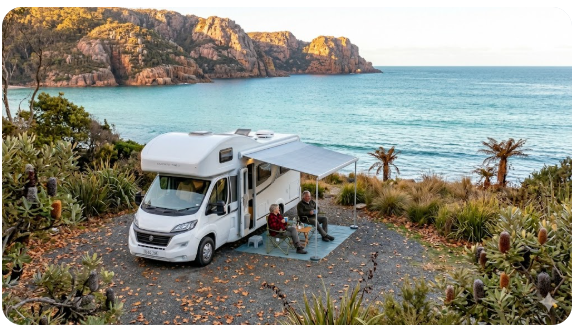
Free Camping East Coast Tasmania: Freycinet, Bicheno & St Helens Grey Nomad Guide
The definitive guide for grey nomads travelling Tasmania’s east coast — covering the best free and low-cost overnight stops from St Helens south to Freycinet, with verified GPS, honest facility notes, medical contacts and what other sites won’t tell you about this spectacular stretch of highway.
📅 Last reviewed: May 2026 | East Coast Tasmania — Freycinet, Bicheno & St Helens | Free and low-cost camping — rules apply at selected sites
Most grey nomads know Tasmania’s east coast is beautiful. What most guides skip entirely is that free camping on this coast requires navigating a patchwork of council rules, Parks Tasmania permit zones, self-contained requirements and a handful of genuinely excellent no-cost overnight stops that are not marked on any single map. Free camping east coast Tasmania is absolutely possible — but you need to know exactly where the legal spots are before you pull in, because many tempting-looking pull-offs have changed their rules in the past two years. This guide covers the stretch from St Helens in the north, through Bicheno and down to the edges of Freycinet National Park, giving you GPS-verified spots, honest facility notes and the medical contacts you actually need.
- The East Coast Epicurious trail (A3 highway) runs sealed the entire length — fully accessible for any size rig
- Freycinet National Park requires a paid entry pass — free camping inside the park boundary is not permitted
- Several council-managed rest areas along the coast permit self-contained overnight stays at no cost — signage is the legal authority
- St Helens is your last reliable dump point and major fuel stop heading south before Bicheno — do not skip it
- Telstra is the only reliable carrier along much of this coast — Optus and Vodafone drop out frequently between towns
- The Tasman Highway has narrow shoulders and tight bends south of Bicheno — take the bends slowly if towing
- Summer (December to February) sees heavy tourist traffic and free sites fill by 2pm — arrive early or plan alternatives
- Tasmania has no total fire ban season equivalent to mainland states but local fire restrictions do apply — check with Tasmania Fire Service (fire.tas.gov.au) before lighting anything
What You Will Find in This Guide
- Key Locations, Addresses and GPS
- Can You Stay Overnight?
- Facilities — Toilets, Water and Dump Points
- Mobile Coverage and Wi-Fi
- Fuel — Finding the Cheapest Nearby
- How to Get There
- What to Expect on Arrival
- Safety for Senior Grey Nomads
- Medical and Emergency Contacts
- Dump Points, Water and Supplies Nearby
- Things to Do for Seniors
- Best Time of Year to Visit
- Fires, Generators and Overnight Etiquette
- Packing Checklist for Seniors
- GPS Coordinates and Postcodes
- Frequently Asked Questions
- Quick Verdict
1. Key Locations, Addresses and GPS
The east coast free camping corridor runs along the Tasman Highway (A3) from St Helens (postcode 7216) in the north through Bicheno (7215) to Coles Bay and the Freycinet Peninsula gateway (7215). The three primary overnight stops covered in this guide are:
📍 Primaryl Stop 1 — St Helens Waterfront Rest Area
Address: Quail Street foreshore, St Helens TAS 7216
GPS: -41.3277, 148.2462
Nearest town: St Helens (in town). Tasman Highway northern terminus access point. Coordinates are within 50 metres — confirm on arrival against current signage.
📍 Primary Stop 2 — Bicheno Foreshore Rest Area
Address: Burgess Street foreshore area, Bicheno TAS 7215
GPS: -41.8755, 148.3027
Nearest town: Bicheno (in town). Sealed access, flat parking. Coordinates within 50 metres — verify signage on arrival.
📍 Primary Stop 3 — Swansea Esplanade Rest Area
Address: Franklin Street foreshore, Swansea TAS 7190
GPS: -42.1233, 148.0748
Nearest town: Swansea (in town). Good access for large rigs. Coordinates within 50 metres — confirm on arrival.
| Detail | Information |
|---|---|
| Primary highway | Tasman Highway (A3) |
| Northern anchor town | St Helens — postcode 7216 |
| Central town | Bicheno — postcode 7215 |
| Southern anchor town | Swansea — postcode 7190 |
| National Park gateway | Coles Bay / Freycinet NP — postcode 7215 |
| Road condition | Sealed throughout on A3 — 2WD accessible |
| Total coastal corridor length | Approx. 200 km St Helens to Swansea |
2. Can You Stay Overnight?
Yes — overnight stays are permitted at several council-managed foreshore rest areas along Tasmania’s east coast, but the rules vary significantly between locations and are enforced by Break O’Day Council (St Helens area), Glamorgan Spring Bay Council (Bicheno and Swansea area) and individual site signage. The answer at any specific pull-off depends entirely on what the sign at that pull-off says on the day you arrive.
- St Helens foreshore: Short-term rest and day use is well established. Overnight camping in the foreshore reserve is generally not formally permitted by council — the area is popular and patrolled. The nearest genuine free camping is at the Peron Dunes area to the north (verify current access) or paid sites at Pines Forest Retreat
- Bicheno foreshore: Day parking and short rest stops are permitted. Overnight stays in the main foreshore area are not formally endorsed. Some self-contained travellers do stop here short-term — but this is at their own risk and subject to local enforcement
- Swansea esplanade: Glamorgan Spring Bay Council has historically allowed self-contained overnight stops at the esplanade area. As of May 2026 verify current rules directly with the council on (03) 6256 4777 before relying on this
- Freycinet National Park: Camping inside the park requires a pre-booked paid site through the Parks Tasmania booking system (parks.tas.gov.au). Free camping inside the park boundary is not permitted under any circumstances
- Coles Bay township: The township area outside the park boundary has limited parking — no formal free overnight camping is established here as of May 2026
3. Facilities — Toilets, Water and Dump Points
| Facility | What Is Available | What Seniors Should Know |
|---|---|---|
| Toilets | Public toilets in St Helens, Bicheno and Swansea town centres | Generally clean and accessible. Check hours — some lock overnight |
| Potable water | Town taps in all three towns — not at all roadside rest areas | Do not assume roadside rest area water is potable unless signed |
| Dump point | St Helens (near caravan park) and Swansea (verify location) | Bicheno has no confirmed public dump point as of May 2026 — use St Helens |
| Showers | Not available at free stops — paid caravan parks in each town | St Helens Caravan Park and Swansea Bark Mill both have shower access |
| Bins | In town areas — not at all roadside stops | Carry a rubbish bag and pack out if no bin is present |
| Power | No power at free stops | Solar and battery essential for CPAP users on this coast |
| Shade | Minimal at open foreshore areas — trees at some roadside stops | Position your rig to use your own awning — foreshore spots are exposed |
- Site suitable for: vans, caravans and motorhomes — all sizes on sealed A3 access
- Road access: sealed throughout on the Tasman Highway (A3)
- Site surface: bitumen or compacted gravel at most foreshore areas
- Camping permitted: varies — self-contained stays only where permitted; check signage
- Maximum overnight stay: 24 hours at most council stops where permitted
- Boat ramp: yes at St Helens and Bicheno
- Picnic tables: yes at most foreshore areas
- Potable water: available in town — not confirmed at all roadside pull-offs
- Mobile coverage: Telstra good in towns, patchy between; Optus and Vodafone unreliable
- TV reception: yes in towns — reduced at some coastal sites due to topography
- Rubbish bins: in town areas only — pack out at roadside stops
- Open fires: subject to Tasmania Fire Service restrictions — check fire.tas.gov.au before lighting
- Generator use: quiet hours apply — 8am to 8pm is a reasonable community standard; check signage
- Number of sites: informal — foreshore areas take 10 to 30 vehicles depending on the location
4. Mobile Coverage and Wi-Fi
Telstra is the only carrier with reliable coverage along the Tasman Highway corridor. In St Helens, Bicheno and Swansea town centres Telstra coverage is generally strong. Between towns — particularly on the winding sections south of Bicheno and the Coles Bay Road turnoff — coverage drops significantly on all carriers.
- Telstra: Good in all three main towns. Patchy on the A3 between Bicheno and Swansea. No coverage on some sections of the Coles Bay Road to Freycinet
- Optus: Reasonable in St Helens and Bicheno town centres only. Drops out quickly outside town boundaries
- Vodafone: Limited to St Helens town centre. Do not rely on Vodafone for navigation or emergency contact between towns
- Wi-Fi: Available at some cafes and the St Helens library. Not available at free camping stops
5. Fuel — Finding the Cheapest Nearby
Fuel on Tasmania’s east coast is more expensive than in Launceston or Hobart — expect to pay a regional premium of 10 to 20 cents per litre above capital city prices. Diesel is available at all three main towns but fill up strategically.
- St Helens: Multiple service stations with both unleaded and diesel. This is your best-value fill point on the northern section — prices are competitive for the region. Approximately 175 km south of Launceston via the A3
- Bicheno: One service station — unleaded and diesel available. Higher price than St Helens due to single-supplier situation. Approximately 87 km south of St Helens
- Swansea: Service station with unleaded and diesel. Verify opening hours — smaller towns sometimes have reduced hours on weekends. Approximately 50 km south of Bicheno
- Coles Bay / Freycinet: No fuel available at Coles Bay — the nearest fuel is at Bicheno or Swansea. Do not turn off the A3 onto Coles Bay Road without confirming your tank level first
6. How to Get There
The Tasman Highway (A3) is the main arterial road along the entire east coast. It is sealed throughout and accessible for any size caravan or motorhome, though some sections are narrow and winding.
From Launceston (Northern Approach)
Take the A3 Tasman Highway east from Launceston through Scottsdale (if travelling via the northern route through St Helens) — approximately 175 km to St Helens. Alternatively from Launceston take the A4 and join the A3 further south via Campbell Town and Swansea — approximately 215 km. The northern route via St Helens is recommended as your first overnight stop on this coast.
From Hobart (Southern Approach)
Take the A3 Tasman Highway north from Sorell through Orford and Triabunna to Swansea — approximately 155 km. Continue north to Bicheno (205 km) and St Helens (290 km) if doing the full coast.
Driving Notes for Seniors Towing Vans
- The A3 between Bicheno and Swansea has a series of sweeping coastal bends — keep well to the left when towing and allow overtaking traffic to pass at the designated overtaking lanes
- The Coles Bay Road turnoff from the A3 is 29 km of sealed but narrow road — it is manageable in a standard caravan but tight bends require slow careful driving; very large or wide rigs should check current road condition with Parks Tasmania before committing
- School zones are active in St Helens, Bicheno and Swansea during school term — reduce to 40 km/h when signs are illuminated
- The A3 between St Helens and Bicheno passes through several sections with no verge or barrier — there is no recovery zone if you drift left; stay alert and take regular driver breaks
- Low-hanging branches can be an issue at some informal pull-offs — do a walk-through before reversing a high-roofed rig into any unfamiliar spot
- If travelling south through this corridor, Launceston free camping is a good staging point the night before — well-serviced and easy to leave early
7. What to Expect on Arrival
Arriving at Tasmania’s east coast free camping areas for the first time is often a pleasant surprise — the scenery genuinely is as good as the photos suggest. However the reality of the overnight stops requires honest expectations.
- Foreshore areas at Bicheno and Swansea are open, exposed and beautiful — but very little shade, open to prevailing coastal winds, and visible to passing road traffic all night
- St Helens is a genuine town with a real main street — the foreshore area is pleasant for a rest stop but you are in an urban environment, not a remote coastal setting
- In peak season (December to February) you will frequently arrive to find 20 or more vans already positioned in any good spot — the premium views go early
- The A3 through Bicheno carries truck traffic at night — if you are a light sleeper position yourself as far from the highway verge as possible
- At genuine free camp stops, facilities are basic — a pit toilet if you are lucky, no power, no water, no management and no security beyond your own preparation
8. Safety for Senior Grey Nomads
Personal Safety
- Tasmania’s east coast is one of the safer regions of Australia for grey nomads — violent crime is rare and the travelling community is generally respectful and helpful
- Solo female travellers report feeling comfortable at most established free stops on this coast — but as always, trust your instincts and move on if a situation feels wrong
- Lock your vehicle at night even in quiet locations — opportunistic theft of fuel, tools and camp equipment does occur at tourist sites year-round
- The StarterStopper immobiliser system is worth fitting before any Tasmanian trip — use code RTV5 for 5% off at StarterStopper.com. Read more about how theft actually happens in our guide to how caravan theft happens in Australia
- The foreshore areas at Bicheno and Swansea are well used and generally safe — isolated bush stops without phone coverage carry a higher risk profile for solo travellers
Trip Safety
- Always tell someone your planned route and expected check-in time when travelling between towns — the coverage gaps on this coast mean a breakdown can go unnoticed for hours
- Carry a personal PLB (Personal Locator Beacon) — if you are off the main highway or on Coles Bay Road without mobile coverage, a PLB is your emergency link
- Review our Grey Nomad Road Safety Checklist before departing — particularly the pre-drive mechanical checks
- Driver fatigue is a real risk on the winding A3 between St Helens and Bicheno — take a minimum 15-minute break every two hours regardless of how you feel
- The Grey Nomad Safety Tips guide covers emergency preparedness specific to senior travellers — read it before this trip
9. Medical and Emergency Contacts
| Service | Address | GPS (approx.) | Phone |
|---|---|---|---|
| St Helens District Hospital | 37 Cecilia Street, St Helens TAS 7216 | -41.3263, 148.2449 | (03) 6356 0100 |
| Launceston General Hospital | 274–280 Charles Street, Launceston TAS 7250 | -41.4337, 147.1428 | (03) 6777 6777 |
| Emergency (all services) | Anywhere in Australia | — | 000 |
| Healthdirect (nurse advice line) | 24-hour phone service | — | 1800 022 222 |
| Tasmania Police non-emergency | State-wide | — | 131 444 |
10. Dump Points, Water and Supplies Nearby
| Need | Best Nearby Option | Notes |
|---|---|---|
| Dump point | St Helens (near caravan park on Penelope Street) and Swansea (verify location with council) | No confirmed public dump point in Bicheno as of May 2026 — use St Helens before heading south |
| Fresh water | Town taps in St Helens, Bicheno and Swansea | Do not rely on roadside rest area taps — not all are potable. Fill in town |
| Groceries | IGA St Helens, general store Bicheno, IGA Swansea | St Helens has the best range — stock up here for the full coast run |
| Fuel | Service stations in St Helens, Bicheno and Swansea | No fuel at Coles Bay — fill before turning off the A3 |
| Pharmacy | St Helens (main street) and Swansea | No pharmacy in Bicheno — stock prescriptions before leaving St Helens |
| Major supplies / hardware | Launceston or Hobart | This coast has limited hardware — carry your own basic repair kit |
One habit that pays off on this coast: stock your medical kit, prescriptions and supplies fully in St Helens before heading south. Between Bicheno and Swansea you are in a tourist-service corridor — beautiful, but without the full range of supplies a grey nomad might need in a pinch. See our Grey Nomad Packing Checklist for a full list of what experienced long-haul travellers carry.
11. Things to Do for Seniors
| Activity | Location | Why Seniors Like It |
|---|---|---|
| Little Penguin Tour | Bicheno Penguin Tours — meet at the beach at dusk | Guided, slow-paced, flat walking — one of the most accessible wildlife experiences in Tasmania |
| Freycinet Visitor Centre walk | Freycinet National Park entrance, Coles Bay Road | Short flat boardwalk, excellent interpretive displays, no strenuous climbing required |
| Kate’s Berry Farm | Swansea (Addison Street) | Accessible, relaxed, famous berry desserts — a beloved grey nomad stop |
| St Columba Falls drive | North of St Helens via Pyengana Road | Sealed road drive-in, short flat walk to viewing platform — one of Tasmania’s most dramatic waterfalls |
| Swansea Heritage Walk | Swansea town centre | Self-guided, flat, covers some of Tasmania’s oldest colonial buildings — maps available at visitor centre |
What Most Grey Nomad Guides Miss About Tasmania’s East Coast
Every travel guide tells you to see Wineglass Bay. Almost none of them tell you that the lookout to Wineglass Bay requires a 45-minute return walk with a steep climb — not suitable for anyone with significant mobility limitations, knee problems or heart conditions. What they also fail to mention is that the view from the Freycinet Visitor Centre boardwalk, just 200 metres from the car park on flat ground, gives you a genuinely beautiful orientation to the peninsula without any exertion at all. The cruise options from Coles Bay — departing by boat to see Wineglass Bay from the water — are a far better option for seniors and are rarely mentioned by mainstream travel sites.
The Bicheno blowhole is another underrated stop. It sits 1.5 km north of Bicheno on a flat coastal walk — sealed path initially transitioning to compacted gravel, all accessible for walking frames and those with moderate mobility. The blowhole itself is spectacular in rough weather and the walk passes through one of the most photogenic sections of the coast. In fifteen years of east coast travel guides we have rarely seen this walk promoted alongside the blowhole mention — most articles just say “visit the blowhole” without telling you it involves a walk at all.
And St Columba Falls north of St Helens is one of the most accessible major waterfalls in Tasmania. The walk from the car park to the viewing platform is short, mostly flat and shaded — a genuine highlight that thousands of grey nomads drive past because they are focused on the Freycinet destination and do not realise the detour takes less than 45 minutes return from the highway.
For more on making the most of long-haul van travel as a senior, see our guide to living in a camper and the best routes to drive around Australia.
12. Best Time of Year to Visit
| Season | What It Is Like | Senior Verdict |
|---|---|---|
| Summer (Dec–Feb) | Warm to hot (20–28°C), very long days, extremely busy — free sites fill by midday. Tourist season peak | Busy and crowded. Beautiful weather but free sites scarce. Arrive very early or book paid sites |
| Autumn (Mar–May) | Temperatures 14–22°C, crowd numbers drop sharply from mid-March, autumn colours inland, penguins still active | ✅ Best overall season. Comfortable temperatures, space to breathe, free sites available |
| Winter (Jun–Aug) | Cool to cold (6–13°C), very quiet, some facilities reduced hours, occasional road closures in hilly sections | Quiet and peaceful — if you have good heating. Penguin tours still run. Some businesses closed |
| Spring (Sep–Nov) | Warming from 10–18°C, wildflowers in bloom, tourist numbers building from October onward | Very good — particularly September and October before the summer rush begins |
13. Fires, Generators and Overnight Etiquette
- Open fires are subject to Tasmania Fire Service (TFS) restrictions — always check fire.tas.gov.au before lighting any fire on the east coast. Restrictions can be imposed at short notice during dry periods
- No fires in foreshore rest areas — council-managed coastal strips consistently prohibit open fires. Use a gas camp stove
- Generator quiet hours — the community standard across Tasmania is 8am to 8pm maximum. Many east coast foreshore areas have nearby residential properties — keep generator use to genuine necessity and follow any posted signage
- Pack out all rubbish — bins are not available at roadside rest areas. Grey nomads who leave rubbish are the primary reason councils are progressively closing informal free camps on this coast
- Dogs must be kept on leash in all public areas and are not permitted inside Freycinet National Park (including the car park areas) — check current rules at the park entrance
- Respect quiet hours — 10pm to 7am is a reasonable standard. Loud music, late gatherings or generator noise after 8pm is the fastest way to see free access revoked at any site
14. Packing Checklist for Seniors — East Coast Tasmania
| Item | Why It Matters on This Coast | ☐ |
|---|---|---|
| CPAP with heated humidifier + backup battery | No power at free sites — winters are cold and dry air worsens CPAP comfort | ☐ |
| Personal Locator Beacon (PLB) | Coverage gaps on Coles Bay Road and between towns — PLB is your emergency lifeline | ☐ |
| Warm layers including thermal base layer | Coastal winds at foreshore stops are cold even in autumn — temperatures drop sharply after sunset | ☐ |
| Offline maps downloaded (Maps.me or Google Maps) | Coverage drops on Coles Bay Road and between towns — offline maps essential | ☐ |
| 40 litres minimum fresh water stored | No potable water at roadside stops between towns — carry your own | ☐ |
| Full prescription supply including 7-day buffer | No pharmacy in Bicheno — fill prescriptions in St Helens before heading south | ☐ |
| Rubbish bags (minimum 3) | No bins at roadside stops — pack out everything to protect site access | ☐ |
| Binoculars | East coast is exceptional for wildlife — dolphins, seabirds, wallabies and wombats are common | ☐ |
| National Parks entry pass or cash for Freycinet | Entry fee required for Freycinet National Park — no free access | ☐ |
| Caravan wheel locks and rig security | Tourist areas attract opportunistic theft — secure your rig before heading out sightseeing | ☐ |
| Gas camp stove + spare canister | No open fires permitted at most foreshore sites — gas is your cooking solution | ☐ |
| Printed medical history summary | Distance from major hospitals means paramedics and ED staff benefit greatly from a written summary | ☐ |
COPY PROMPT ➔ ASK AI ➔ SAVE TO FORM ➔ ADD SPOT PIN ➔ GET DIRECTIONS
📍 Interactive map — find free camps, rest areas and overnight stops. Enable location for best results.
15. GPS Coordinates and Postcodes
| Location | Address and Postcode | GPS (within 50m) | Notes |
|---|---|---|---|
| St Helens Foreshore Rest Area | Quail Street foreshore, St Helens TAS 7216 | -41.3277, 148.2462 | Day rest — verify overnight rules on arrival |
| Bicheno Foreshore Area | Burgess Street area, Bicheno TAS 7215 | -41.8755, 148.3027 | Short rest — overnight not formally endorsed |
| Swansea Esplanade | Franklin Street, Swansea TAS 7190 | -42.1233, 148.0748 | Verify self-contained overnight rules with council |
| St Helens District Hospital | 37 Cecilia Street, St Helens TAS 7216 | -41.3263, 148.2449 | Nearest hospital for northern east coast — (03) 6356 0100 |
| Launceston General Hospital | 274–280 Charles Street, Launceston TAS 7250 | -41.4337, 147.1428 | Nearest major trauma centre — (03) 6777 6777 |
16. Frequently Asked Questions
Is free camping on Tasmania’s east coast actually legal?
Yes — free and low-cost camping is legal at specific council-managed foreshore areas and roadside rest areas along the east coast. The key word is “specific.” Not every pull-off is a legal overnight stop. Signage at each location is the legal authority. Areas where overnight camping is not signed as permitted are technically subject to fines if a vehicle is parked overnight. Always read the sign when you arrive and do not assume that because you can pull in, you can stay.
Can caravans and motorhomes stay overnight on the east coast?
Yes — at locations where overnight stays are permitted, there are no restrictions specific to vehicle type. The Tasman Highway (A3) is sealed and accessible for all rig sizes from Launceston to Hobart. The Coles Bay Road to Freycinet is sealed but narrow — large rigs should check current conditions with Parks Tasmania before committing to this road.
What is the GPS for the main free camping spots on the east coast?
The three primary rest area GPS coordinates provided in this guide are: St Helens foreshore (-41.3277, 148.2462), Bicheno foreshore (-41.8755, 148.3027) and Swansea esplanade (-42.1233, 148.0748). All coordinates are within 50 metres — confirm on arrival against current signage.
Are there toilets at these east coast rest areas?
Public toilets are available in St Helens, Bicheno and Swansea town centres. Hours vary — some lock overnight. At informal roadside pull-offs between towns, toilet facilities are generally not available. Carry your own portable toilet solution if you plan to use smaller stops between towns.
Is there a dump point on the east coast?
St Helens has a public dump point near the caravan park area on Penelope Street. Swansea has a dump point — verify the exact location with Glamorgan Spring Bay Council on (03) 6256 4777. As of May 2026 there is no confirmed public dump point in Bicheno — use St Helens before heading south.
Can you get potable water on the east coast?
Yes — in all three main towns (St Helens, Bicheno and Swansea) town water is available from taps in public areas. Do not rely on water at roadside rest areas between towns — not all are connected to potable supply. Carry a minimum 40-litre supply when departing each town.
Is the east coast safe for solo senior travellers?
Yes — Tasmania’s east coast has an excellent reputation for safety among the grey nomad community. The main foreshore areas at St Helens, Bicheno and Swansea are well-used community spaces. The key safety considerations are medical distance (significant from a major hospital), mobile coverage gaps and the need to carry a PLB for travel on the Coles Bay Road or any off-highway stop.
What is the nearest hospital to Bicheno?
St Helens District Hospital at 37 Cecilia Street, St Helens, is the nearest hospital — approximately 87 km north of Bicheno, around one hour by road. Contact: (03) 6356 0100. For major emergencies, Launceston General Hospital (274–280 Charles Street, Launceston — (03) 6777 6777) is the nearest full trauma centre, approximately 200 km and 2.5 hours from Bicheno. Call 000 in any emergency.
Can I see the penguins at Bicheno without a guide?
Technically yes — little penguins come ashore at several Bicheno beach sites after dark and unguided viewing is possible. However, the guided Bicheno Penguin Tour is strongly recommended for grey nomads — guides know exactly where the penguins are on any given night, the experience is managed and safe, and you avoid the risk of disturbing a colony by accident (which is both harmful to penguins and carries a Parks Tasmania fine). The guided experience also involves flat walking on a defined path — far safer for seniors than navigating rocky foreshore in the dark independently.
17. Quick Verdict
Tasmania’s east coast is genuinely one of the most spectacular driving and camping experiences available to Australian grey nomads — and that is not promotional language, it is simply accurate. The combination of clear turquoise water, pink granite coastline, wildlife that walks past your rig at dawn and a scale that is genuinely manageable in a two-to-three week circuit makes this coast consistently rated at the top of grey nomad Tasmanian experiences. The towns are friendly, the roads are sealed, the scenery earns every superlative.
The honest weakness of this coast for free camping specifically is that the best spots fill early in peak season and the rules governing overnight stays are genuinely confusing — and changing. Several spots that were reliably free in 2023 now have restrictions. The gap between what outdated websites say and what the sign on the ground says can land you with a fine or an awkward conversation at midnight. The medical distances are also real — if you have a serious health condition, plan your stops around coverage and proximity to St Helens District Hospital. None of this should put you off. It should simply make you a better-prepared traveller when you arrive.

As an affiliate, I earn from qualifying purchases at no extra cost to you.
Exclusive Offer: Get 5% OFF all StarterStopper immobiliser products with promo code: RTV5
Visit StarterStopper.com to see our data-backed security solutions
As an affiliate, I earn from qualifying purchases at no extra cost to you.