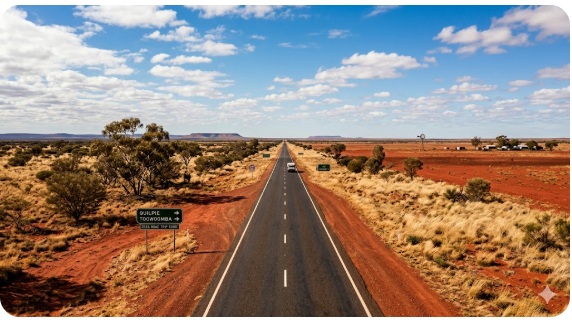
Queensland Inland Routes For Grey Nomads 2026
Complete guide to Queensland’s inland highways including Matilda Highway, Warrego Highway, Savannah Way and Developmental Road — with rest area locations, fuel planning, wet season warnings, heat management and cattle grid safety for senior grey nomads.
📅 Last reviewed: June 2026 | Inland Queensland Regional Guide | Covers Outback, Gulf Country, Central West and Atherton Tablelands routes
Inland Queensland — from the red dirt of the channel country west through Longreach and Winton, north through Gulf country to Normanton and Burketown, and across the tablelands from Atherton to Cairns — is big country. Distances between towns are measured in hundreds of kilometres, not tens. Fuel planning is not optional. Wet season flooding can close roads for weeks. Summer heat exceeds 45°C in many areas. Mobile coverage disappears for long stretches even on major sealed highways. And cattle grids, wandering livestock, road trains and unsealed sections demand constant attention even on routes marked as sealed on maps. This guide breaks down the major inland Queensland corridors, what rest areas exist along each, what grey nomads need to know before departure, and how to plan safely for travel through one of Australia’s most rewarding — and most demanding — regions.
- Region: Inland and outback Queensland — west of Great Dividing Range
- Main routes: Matilda Highway, Warrego Highway, Landsborough Highway, Savannah Way, Developmental Road
- Rest areas: 50+ documented stops across inland corridors
- Road conditions: Mostly sealed but unsealed sections exist — check before departure
- Fuel gaps: Can exceed 300km — conservative planning essential
- Wet season: November to April — flooding closes roads, avoid if possible
- Mobile coverage: Telstra only and patchy — long stretches with no signal
- Best season: May to September — dry season, cooler temperatures, roads open
- Summer heat: Regularly exceeds 40°C, dangerous for seniors
- Medical distance: Can exceed 200km between hospitals in remote areas
- Wildlife and livestock: Kangaroos, emus, cattle and road trains present daily hazards
Table of Contents
- Why Inland Queensland Is Different From Coastal Travel
- Wet Season vs Dry Season — When to Travel Inland Queensland
- Major Inland Queensland Routes Overview
- Matilda Highway — Charleville to Karumba
- Warrego Highway and Southern Inland Corridor
- Savannah Way — Gulf Country Route
- Developmental Road — Atherton to Gulf
- Central West — Longreach, Winton and Channel Country
- Fuel Planning — Where to Refuel on Inland Routes
- Mobile Coverage and Satellite Communication
- Safety for Senior Grey Nomads in Inland Queensland
- Medical Facilities and Emergency Planning
- What to See and Do in Inland Queensland
- Packing Checklist for Inland Queensland Routes
- Frequently Asked Questions
- Final Verdict — Is Inland Queensland Right for You?
Why Inland Queensland Is Different From Coastal Travel
If your grey nomad experience has been along Queensland’s coast — Brisbane to Cairns via the Bruce Highway with its frequent towns, excellent rest areas and reliable services — inland Queensland will feel like another country. The coast has towns every 30 to 50 kilometres. Inland routes have gaps of 150 to 300 kilometres between fuel stops. The coast has reliable mobile coverage across all carriers. Inland Queensland has patchy Telstra-only coverage with dead zones that last for hours. The coast has hospitals in every regional centre. Inland Queensland has nursing posts in small towns and hospitals only in major centres like Longreach, Mount Isa, or Cloncurry — sometimes over 200 kilometres from where you are stopped.
Wet season is the other fundamental difference. The coast experiences wet season as heavy rain and occasional flooding. Inland Queensland experiences wet season as road closures, impassable river crossings, and multi-week isolation of entire towns. From November through April, even sealed highways can be closed by floodwaters that take weeks to recede. Unsealed roads become impassable quagmires. What was a three-hour drive in June becomes impossible in January. Grey nomad travel in inland Queensland is seasonal — dry season (May to October) is when you go. Wet season is when you stay away.
| Factor | Coastal Queensland | Inland Queensland |
|---|---|---|
| Distance between towns | 30–70km typically | 100–300km common on inland routes |
| Mobile coverage | Good across all carriers | Telstra only and patchy — long dead zones |
| Fuel availability | Service stations frequent | Gaps of 200–300km — conservative planning essential |
| Medical facilities | Hospitals in most regional centres | Can be 200km+ to nearest hospital |
| Wet season impact | Heavy rain, some flooding | Road closures, impassable crossings, week-long isolation |
| Road conditions | Fully sealed, well-maintained | Sealed major routes but unsealed sections exist — check conditions |
| Summer temperatures | Hot and humid — 30–38°C | Extreme heat — regularly 40–48°C, dangerous for seniors |
| Wildlife and livestock | Moderate — kangaroos at dawn/dusk | High — kangaroos, emus, cattle on roads, road trains common |
Wet Season vs Dry Season — When to Travel Inland Queensland
Season is everything in inland Queensland. Travel at the wrong time and you face road closures, extreme heat, flooding, and isolation. Travel in the right season and inland Queensland is accessible, safe and unforgettable. This table breaks down what to expect across the year.
| Season | Conditions Inland Queensland | Grey Nomad Verdict |
|---|---|---|
| Wet Season (Nov–Apr) | Heavy rain, monsoonal downpours, road closures, flooding, extreme humidity, temperatures 35–45°C with high humidity making it feel hotter. | Avoid. Roads close without warning. River crossings become impassable. Towns can be isolated for weeks. Medical evacuation difficult. Heat and humidity are dangerous for seniors. This is not grey nomad season. |
| Dry Season (May–Oct) | Little to no rain, roads open and accessible, temperatures 25–35°C days, cool nights especially June–August, clear skies, low humidity. | Ideal. This is when inland Queensland is accessible and safe. Roads are open, river crossings are passable, temperatures are manageable. Peak grey nomad season is June to August — popular stops fill faster. |
| Shoulder Months (Apr, Nov) | Transition between wet and dry. April sees wet season ending but roads may still be affected by recent flooding. November sees wet season beginning — rain increases, temperatures rise. | April can work if you verify road conditions daily and are flexible. November is risky — wet season can start early and catch travellers unprepared. Better to finish inland travel by October. |
Major Inland Queensland Routes Overview
Inland Queensland travel follows several main highway corridors, each with its own character, challenges and appeal. Understanding these routes before you plan helps you choose the right corridor for your experience level, vehicle capability and travel goals.
| Route | From — To | Distance | Road Condition | Difficulty |
|---|---|---|---|---|
| Matilda Highway | Charleville to Karumba via Longreach, Winton, Cloncurry | ~1,700km | Sealed major sections, unsealed far north sections | Moderate to High |
| Warrego Highway | Brisbane to Charleville via Roma | ~770km | Fully sealed | Easy to Moderate |
| Landsborough Highway | Morven to Winton via Longreach | ~700km | Fully sealed | Moderate |
| Savannah Way | Cairns to Normanton to Burketown (QLD section) | ~1,100km | Sealed major sections, unsealed Gulf sections | High |
| Developmental Road | Atherton to Normanton | ~420km | Unsealed sections — 4WD recommended wet season | High |
| Flinders Highway | Townsville to Mount Isa via Cloncurry | ~900km | Fully sealed | Moderate |
The easiest inland Queensland route for first-time grey nomads is the Warrego Highway from Brisbane or Toowoomba west to Charleville, then optionally continuing north on the Landsborough Highway to Longreach. Both are fully sealed, have reasonable rest area coverage, pass through multiple towns with services, and are accessible to all vehicle types year-round. The Matilda Highway from Charleville north through Longreach to Winton and beyond is more remote but still manageable in dry season for experienced travellers with proper planning.
The Gulf routes — Savannah Way, Developmental Road, and roads to Normanton and Burketown — are significantly more challenging. Unsealed sections exist, corrugations are common, river crossings can be tricky even in dry season, distances between fuel stops are longer, and mobile coverage is almost non-existent in many areas. These routes are not recommended for first-time inland travellers or those towing large caravans without remote travel experience.
Matilda Highway — Charleville to Karumba
The Matilda Highway is Queensland’s iconic outback route, running roughly 1,700 kilometres from Charleville in the south through Longreach, Winton and Cloncurry to the Gulf of Carpentaria at Karumba. This is dinosaur country, channel country, opal country and cattle country. It passes through Longreach (home of Qantas and the Australian Stockman’s Hall of Fame), Winton (where Waltzing Matilda was first performed), and ends at the remote fishing village of Karumba on the Gulf. It is one of the great inland Queensland journeys — but it demands respect, planning and dry season travel only.
Southern Section: Charleville to Longreach
This section is sealed and relatively straightforward. Rest areas are spaced reasonably along the route, towns appear every 100 to 150 kilometres, and fuel is available at Charleville, Tambo, Blackall, Barcaldine and Longreach. This is where most grey nomads begin their inland Queensland journey.
Key Rest Areas — Charleville to Longreach
- Tambo Rest Area — Full Guide
- Blackall Rest Area — Full Guide
- Yaraka Rest Area — Full Guide
- Morella Creek Rest Area — Full Guide
- Longreach Darr River Waterhole — Full Guide
Central Section: Longreach to Winton
The stretch from Longreach to Winton via Ilfracombe is sealed but more remote. Fuel is available in Longreach, Ilfracombe and Winton. Rest areas become more basic and distances between services increase.
Key Rest Areas — Longreach to Winton
Northern Section: Winton to Cloncurry and Beyond
North of Winton, the Matilda Highway continues through increasingly remote country to Cloncurry and the Gulf. Fuel gaps increase, mobile coverage becomes patchier, and the landscape becomes more arid and open. This section is still sealed on major routes but requires more conservative planning.
Key Rest Areas — Winton to Cloncurry
Warrego Highway and Southern Inland Corridor
The Warrego Highway connects Brisbane and Toowoomba west to Roma, Mitchell, Morven and Charleville. It is the primary access route into inland Queensland for grey nomads travelling from the southeast, and it is one of the easiest inland routes in the state — fully sealed, well-maintained, and passing through regular towns with full services.
Key Rest Areas — Warrego Highway Corridor
- Roma Rest Area — Full Guide
- Mitchell Rest Area — Full Guide
- Morven Rest Area — Full Guide
- Charleville Rest Area — Full Guide
Southern Inland Extension — Goondiwindi and St George
The southern inland corridor extends south from the Warrego Highway through St George and Goondiwindi to the NSW border. This route is popular with grey nomads travelling between Queensland and Victoria via inland NSW.
Key Rest Areas — Southern Extension
- St George Rest Area — Full Guide
- Dirranbandi Rest Area — Full Guide
- Goondiwindi Rest Area — Full Guide
Savannah Way — Gulf Country Route
The Savannah Way crosses northern Australia from Cairns in Queensland to Broome in Western Australia. The Queensland section runs from Cairns west through the Atherton Tablelands and Gulf Country to Normanton, Burketown and the Northern Territory border. This is remote, challenging and spectacular travel. Unsealed sections exist, wet season makes much of it impassable, and distances between services are long. This is not beginner territory.
Atherton Tablelands to Gulf Section
The Developmental Road runs from Atherton on the tablelands down to Normanton on the Gulf — a distance of around 420 kilometres. Sections are unsealed and can be heavily corrugated. This route is best travelled in dry season and is not recommended for large caravans without 4WD and significant outback experience.
Key Rest Areas — Atherton and Tablelands
- Atherton Rest Area — Full Guide
- Ravenshoe Rest Area — Full Guide
- Mount Surprise Rest Area — Full Guide
- Georgetown Rest Area — Full Guide
Gulf Country — Normanton, Burketown, Croydon
The Gulf country is flat, remote and beautiful in a harsh way. Normanton is the main town, Burketown is tiny and remote, and Croydon is a historic gold mining settlement. Roads are long, straight and often unsealed. Fuel gaps can exceed 200 kilometres. Mobile coverage is almost non-existent outside the towns themselves. This is serious remote travel.
Key Rest Areas — Gulf Country
- Normanton Rest Area — Full Guide
- Burketown Rest Area — Full Guide
- Croydon Rest Area — Full Guide
- Doomadgee Rest Area — Full Guide
- Hells Gate Rest Area — Full Guide
- Leichhardt River Rest Area — Full Guide
- Gilbert River East Rest Area — Full Guide
- Valley of the Lagoons Road Rest Area — Full Guide
Developmental Road — Atherton to Gulf
The Developmental Road (also called the Gulf Developmental Road) connects the Atherton Tablelands to the Gulf of Carpentaria via Georgetown and Croydon. It is roughly 420 kilometres and includes significant unsealed sections that can be rough, corrugated and challenging even in dry season. This road is passable to caravans and motorhomes in dry season if driven carefully, but it is not a beginner route and requires constant attention to road conditions.
Rest areas on the Developmental Road are basic and infrequent. Fuel is available in Atherton, Ravenshoe, Mount Surprise, Georgetown, Croydon and Normanton — but gaps between stops can exceed 150 kilometres and prices are significantly higher than coastal Queensland. Always refuel when you have the opportunity.
Central West — Longreach, Winton and Channel Country
Central west Queensland is Longreach, Winton, Barcaldine, Blackall and the channel country south toward Birdsville. This is the heartland of inland Queensland — cattle stations, artesian bores, dinosaur fossils, opal fields and vast red plains that stretch to the horizon. The main highways through this region are sealed and accessible. Side tracks and less-travelled routes are often unsealed and require 4WD, especially after rain.
Key Rest Areas — Central West Queensland
- Emerald Rest Area — Full Guide
- Capella Rest Area — Full Guide
- Jericho Rest Area — Full Guide
- Barcoo River Rest Area — Full Guide
- Belyando River Rest Area — Full Guide
- Six Mile Creek Rest Area — Full Guide
- Cooningheera Waterhole Rest Area — Full Guide
- Thomson River Weir Camp — Full Guide
- Isisford to Bimerah Rd Rest Area — Full Guide
- Moolayember Rest Area — Full Guide
- Blythdale Rest Area — Full Guide
- Bilyana Rest Area — Full Guide
- Packsaddle Creek Rest Area — Full Guide
- Yowah Rest Area — Full Guide
Fuel Planning — Where to Refuel on Inland Routes
Fuel planning in inland Queensland is not optional — it is survival planning. Gaps between service stations can exceed 300 kilometres on some routes. Fuel prices are significantly higher in remote areas than on the coast. And not all service stations shown on maps are actually open when you arrive — some operate limited hours, some close on Sundays, and some close permanently without warning. Never assume fuel will be available. Always plan conservatively.
| Route | Fuel Stops | Maximum Gap | Planning Notes |
|---|---|---|---|
| Warrego Highway | Toowoomba, Dalby, Chinchilla, Miles, Roma, Mitchell, Morven, Charleville | ~130km (Morven to Charleville) | Frequent fuel — easiest inland route for fuel access |
| Landsborough Highway | Morven, Augathella, Tambo, Blackall, Barcaldine, Longreach, Winton | ~150km (Blackall to Barcaldine) | Reasonable spacing — refuel at half tank |
| Matilda Highway (north) | Winton, Kynuna, Cloncurry, Julia Creek, Normanton | ~200km+ (Winton to Kynuna, Cloncurry to Normanton) | Long gaps — carry jerry cans if towing heavy |
| Developmental Road | Atherton, Ravenshoe, Mount Surprise, Georgetown, Croydon, Normanton | ~180km (Croydon to Normanton) | Limited stations — expensive fuel, confirm opening hours |
| Savannah Way (Gulf) | Normanton, Burketown, Doomadgee (limited) | ~230km (Normanton to Burketown) | Very limited fuel — plan carefully, carry extra capacity |
Fuel Planning Rules for Inland Queensland
- Refuel at half a tank — never run below quarter tank in remote areas
- Confirm fuel station hours before relying on them — phone ahead if possible
- Carry extra fuel capacity if towing a heavy caravan or travelling Gulf routes — jerry cans are essential on some corridors
- Expect to pay 20 to 40 cents per litre more than coastal prices in remote areas
- Fill up in major towns like Longreach, Charleville, Cloncurry before heading into more remote sections
- Use Fuel Map Australia app to identify every station along your route and note opening hours before departure
Mobile Coverage and Satellite Communication
Mobile coverage in inland Queensland is limited to Telstra across most routes, and even Telstra has significant dead zones that can last for hours or days. Optus and Vodafone are largely useless outside major towns. If you rely on mobile data for navigation, communication or emergency contact, you will lose it repeatedly and for long stretches on inland routes. Download offline maps, carry paper maps as backup, and consider satellite communication for remote routes.
Mobile Coverage by Route
- Warrego Highway: Telstra and Optus work in most towns, patchy or no signal between towns — expect dead zones of 30 to 60 minutes
- Landsborough Highway: Telstra coverage in towns, limited or no signal between stops — dead zones can last 90 minutes or more
- Matilda Highway north of Winton: Telstra only, very patchy — expect to be out of coverage for hours at a time
- Developmental Road: Almost no coverage except in towns — treat as no signal and plan accordingly
- Savannah Way and Gulf routes: No coverage outside towns — satellite communication essential for safety
Satellite Communication Options
If you are travelling remote inland Queensland routes — particularly Gulf country, Savannah Way or Developmental Road — carry a registered Personal Locator Beacon (PLB) or satellite messenger. PLBs are one-way emergency-only devices that alert search and rescue when activated. Satellite messengers like Garmin inReach allow two-way messaging, location sharing and SOS alerts. Both work anywhere on Earth regardless of mobile coverage.
Safety for Senior Grey Nomads in Inland Queensland
Personal Safety
- Inland Queensland is generally very safe — crime is rare and most people you encounter are fellow travellers, station workers or locals who will help if you need it
- Solo travellers should still let someone at home know their planned route and check in daily — especially on remote routes with no mobile coverage
- Carry a PLB or satellite messenger for remote routes where mobile coverage does not exist for days at a time
- Lock your vehicle overnight and park facing the exit at rest areas so you can leave quickly if needed
- Trust your instincts — if a rest area feels wrong or unsafe when you arrive, move on to the next option or use a caravan park in the nearest town
Road Safety
- Wildlife strikes are a serious risk — kangaroos, emus and cattle wander onto roads especially at dawn and dusk. Reduce speed during these periods and watch for movement at the roadside
- Road trains are common on inland Queensland highways — give them plenty of space, wait for safe passing opportunities, and never assume they can stop quickly
- Cattle grids are frequent — slow down before crossing them, especially if towing a caravan. A cattle grid hit at speed can damage suspension, tyres and van chassis
- Unsealed sections require constant attention — corrugations, potholes, soft edges and dust all demand slower speeds and active steering
- Fatigue builds faster on long monotonous roads — take breaks every 90 minutes whether you feel tired or not
- Never drive at night on inland Queensland routes if you can avoid it — wildlife, livestock and poor visibility make night driving significantly more dangerous than daytime travel
Medical Facilities and Emergency Planning
Medical facilities in inland Queensland are concentrated in regional centres like Longreach, Charleville, Cloncurry, Mount Isa and Cairns. Small towns have nursing posts or remote area nurse services, but serious medical events require evacuation to the nearest hospital — which can be over 200 kilometres and two to three hours away in some areas. For seniors managing ongoing health conditions, this distance is not hypothetical — it directly affects how you plan your route and what you carry with you.
| Emergency Service | Contact | Coverage | When to Use |
|---|---|---|---|
| Emergency Services | 000 | Works from mobile with signal — may work with very weak signal | Any life-threatening emergency |
| Healthdirect | 1800 022 222 | Requires phone coverage | Health advice when unsure if emergency care needed |
| Royal Flying Doctor Service | 1300 669 569 | Operates across all inland Queensland | Serious medical events in remote areas |
| Poisons Information Centre | 13 11 26 | National — works from any phone with coverage | Medication queries, poisoning, accidental ingestion |
Major Hospitals Inland Queensland
- Longreach Hospital — Eagle Street, Longreach QLD 4730 — Full hospital services including emergency department
- Charleville Hospital — Wills Street, Charleville QLD 4470 — Emergency and general medical services
- Cloncurry Multi-Purpose Health Service — McIlwraith Street, Cloncurry QLD 4824 — Emergency and basic hospital services
- Mount Isa Hospital — Camooweal Street, Mount Isa QLD 4825 — Full regional hospital with emergency department
- Cairns Hospital — The Esplanade, Cairns QLD 4870 — Major regional hospital — closest for far north Queensland
What to See and Do in Inland Queensland
Inland Queensland is not just about transit — the region has exceptional cultural, historical and natural attractions that are worth building into your route. Many are senior-friendly, accessible, and offer air-conditioned comfort during the heat of the day.
| Attraction | Location | Why Grey Nomads Like It |
|---|---|---|
| Qantas Founders Museum | Longreach | World-class aviation museum — fully accessible, air-conditioned, excellent guided tours including Boeing 747 and 707 access |
| Australian Stockman’s Hall of Fame | Longreach | Comprehensive outback history and culture museum — accessible, air-conditioned, can easily spend half a day here |
| Australian Age of Dinosaurs Museum | Winton | World’s largest collection of Australian dinosaur fossils — guided tours, lab tours, stunning mesa-top location |
| Waltzing Matilda Centre | Winton | Interactive museum about Australia’s unofficial anthem — accessible, well-presented, includes local history |
| Outback at Isa | Mount Isa | Mining heritage, fossil displays, underground mine tours — some tours require moderate fitness, others fully accessible |
Best Senior-Friendly Experiences in Inland Queensland
- Sunset at Thomson River in Longreach — park beside the river and watch the sun go down over red gums and water
- Historic Cobb & Co coach ride in Charleville — gentle, entertaining and genuinely historic
- Lark Quarry dinosaur trackways near Winton — short accessible walk to see fossilized dinosaur stampede tracks in situ
- Opal fossicking at Yowah — gentle activity, shade available, and you might actually find something worth keeping
- Artesian spa baths in various inland towns — warm natural mineral water in outdoor pools, relaxing after days on the road
Packing Checklist for Inland Queensland Routes
Packing for inland Queensland is different from packing for coastal travel. Heat, distance, limited services and potential isolation all demand more self-sufficient preparation. This checklist is specific to the challenges of inland Queensland for senior grey nomads.
| Item | Why It Matters in Inland Queensland | Packed |
|---|---|---|
| Minimum 40 litres fresh water (20L per person) | Rest areas rarely have water. Towns can be 200km apart. Heat increases water needs dramatically. | ☐ |
| Personal Locator Beacon (PLB) registered with AMSA | Mobile coverage disappears for hours or days on remote routes. PLB is your emergency lifeline. | ☐ |
| Extra fuel capacity — jerry cans minimum 20L | Fuel gaps can exceed 200km. Towing increases consumption. Roadhouses can be closed unexpectedly. | ☐ |
| Offline maps downloaded (Wikicamps, Maps.me, Google offline) | Mobile data disappears between towns. Offline maps are essential for navigation and rest area location. | ☐ |
| Written medical summary with medications and dosages | Nearest hospital can be 200km away. Emergency services need this information immediately. | ☐ |
| 12V fridge or insulated medication cooler | Heat-sensitive medications like insulin destroyed by van temperatures exceeding 50°C in summer. | ☐ |
| Insect repellent and fly nets | Flies are relentless in inland Queensland — make outdoor activity unbearable without protection. | ☐ |
| Warm bedding (all seasons) | Even after 40°C days, inland Queensland nights can drop to near zero in winter. Temperature swings are extreme. | ☐ |
| Dust covers for van vents and openings | Dust on unsealed roads coats everything. Protecting vents and keeping dust out improves comfort and protects equipment. | ☐ |
| Spare tyre in good condition plus tools | Corrugations, potholes and cattle grids are hard on tyres. Roadside assistance can take hours in remote areas. | ☐ |
| Portable toilet and grey water containment | Rest area toilets can be unpleasant or non-functional. Having your own removes uncertainty. | ☐ |
| Cash — minimum $200 | Some remote roadhouses have broken EFTPOS and only accept cash. ATMs are rare outside major towns. | ☐ |
COPY PROMPT ➔ ASK AI ➔ SAVE TO FORM ➔ ADD SPOT PIN ➔ GET DIRECTIONS
📍 Interactive map — find free camps, rest areas and overnight stops across inland Queensland. Enable location for best results.
Frequently Asked Questions
Can you travel inland Queensland in a caravan?
Yes — major sealed inland routes including the Warrego Highway, Landsborough Highway and sealed sections of the Matilda Highway are suitable for caravans of all sizes. Unsealed routes like the Developmental Road and some Gulf tracks are passable to caravans in dry season but require careful driving, appropriate tyre pressures and realistic expectations about road conditions. Very large caravans or those without off-road capability should stick to fully sealed routes. Always check current road conditions before departure.
When is the best time to travel inland Queensland?
May to September is the best window for inland Queensland travel. This is the dry season — roads are open, river crossings are passable, temperatures are manageable (though still hot), and wet season flooding is not a concern. July and August are peak grey nomad season and popular towns fill faster. Avoid November to April — wet season brings road closures, flooding, extreme heat and humidity, and isolation risk.
Do I need a 4WD to travel inland Queensland?
No — not for the major sealed inland routes. The Warrego Highway, Landsborough Highway and sealed sections of the Matilda Highway are all accessible to 2WD vehicles, campervans, motorhomes and caravans. Unsealed routes like the Developmental Road, Gulf tracks and side roads to remote areas are more suitable for 4WD, especially if travelling in or shortly after wet season. If you stick to sealed highways, a well-maintained 2WD is sufficient.
How far apart are fuel stations in inland Queensland?
Fuel station spacing varies significantly by route. On the Warrego Highway, gaps are typically 80 to 130 kilometres. On the Landsborough and Matilda Highways, gaps can reach 150 to 200 kilometres. On remote Gulf routes, gaps can exceed 230 kilometres. Always refuel at half a tank, carry extra fuel capacity if towing heavy or travelling remote routes, and confirm fuel station opening hours before relying on them.
Is mobile coverage available in inland Queensland?
Mobile coverage is limited to Telstra across most inland Queensland routes, and even Telstra has significant dead zones that can last for hours. Optus and Vodafone work in some towns but are unreliable or non-existent between towns. Download offline maps before leaving the coast. Carry a PLB or satellite messenger for remote routes where mobile coverage does not exist for days at a time.
Can you free camp in inland Queensland?
Yes — Queensland generally supports free camping more than southern states. Many rest areas permit overnight stays, and some towns have designated RV-friendly overnight areas. However, rules vary by location and council. Always check signage on arrival. Some areas require self-contained vehicles. Wet season can close free camping areas temporarily. For a complete state overview, see our Queensland Free Camping Guide.
What is wet season and why does it matter?
Wet season in inland Queensland runs roughly November to April and brings monsoonal rain, flooding, road closures and isolation. Rivers that are dry or easily crossed in June become impassable torrents in January. Sealed highways flood and close for weeks. Unsealed roads turn to mud. Towns can be cut off from supplies. Medical evacuation becomes difficult or impossible. Grey nomad travel in inland Queensland is a dry season activity — May to October. Do not attempt inland routes November to April unless you have extensive wet season experience and accept significant risk.
Are there crocodiles in inland Queensland?
Saltwater crocodiles are present in rivers and waterholes in far north Queensland including Gulf country rivers and some coastal rivers near Cairns. Freshwater crocodiles are present in some inland rivers but are less dangerous. Never swim in rivers, waterholes or billabongs in northern Queensland unless you have confirmed with locals that the water is crocodile-free. Obey all crocodile warning signs. Most grey nomad travel in inland Queensland is south of crocodile territory, but if you travel Gulf routes, assume crocodiles are present in any water body.
What are cattle grids and why do they matter?
Cattle grids are metal grates across roads designed to prevent cattle crossing between paddocks. They are common on inland Queensland roads. Hit a cattle grid at speed and you can damage suspension, tyres, or caravan chassis. Always slow down before crossing cattle grids — approach at walking pace, cross steadily, and accelerate gently afterward. If towing, take them even slower to avoid shock loading the coupling and van axles.
Final Verdict — Is Inland Queensland Right for You?
Inland Queensland is not for every grey nomad — and there is no shame in recognizing that. It demands more planning, more self-sufficiency, higher heat tolerance, and greater acceptance of isolation and distance than coastal or southern travel. If you want daily coastal swims, frequent towns with cafes and shops, reliable mobile coverage, and medical facilities within 30 minutes, inland Queensland will not meet those expectations. But if you want big skies, genuine outback remoteness, dinosaur country, historic mining and cattle towns, and the satisfaction of successfully navigating one of Australia’s most challenging regions, inland Queensland delivers all of that and more.
The sealed inland routes — Warrego Highway, Landsborough Highway, and sealed sections of the Matilda Highway — are accessible to most grey nomads with proper planning, dry season travel, and conservative fuel and water management. These routes offer a genuine outback experience without requiring 4WD capability or extreme remote travel skills. The unsealed and Gulf routes — Developmental Road, Savannah Way, tracks to Burketown and beyond — are significantly more challenging and not suitable for inexperienced travellers, large caravans without off-road capability, or anyone travelling alone without satellite communication.
- Queensland Rest Areas — Complete State Guide
- Tambo Rest Area — Full Guide
- Blackall Rest Area — Full Guide
- Longreach Darr River Waterhole — Full Guide
- Ilfracombe Rest Area — Full Guide
- Cloncurry Rest Area — Full Guide
- Normanton Rest Area — Full Guide
- Burketown Rest Area — Full Guide
- Charleville Rest Area — Full Guide
- Roma Rest Area — Full Guide
- Mitchell Rest Area — Full Guide
- Emerald Rest Area — Full Guide
- Atherton Rest Area — Full Guide
- Ravenshoe Rest Area — Full Guide
- Richmond Rest Area — Full Guide
Inland Queensland summer heat can be dangerous for seniors. If temperatures exceed 40°C or you need air conditioning for medical reasons, search powered caravan parks or motels below to stay safe and comfortable.
Accommodation search powered by Expedia. Booking through this search supports this website at no extra cost to you. As an affiliate, I earn from qualifying purchases at no extra cost to you.

As an affiliate, I earn from qualifying purchases at no extra cost to you.
Exclusive Offer: Get 5% OFF all StarterStopper immobiliser products with promo code: RTV5
Visit StarterStopper.com to see our data-backed security solutions
As an affiliate, I earn from qualifying purchases at no extra cost to you.