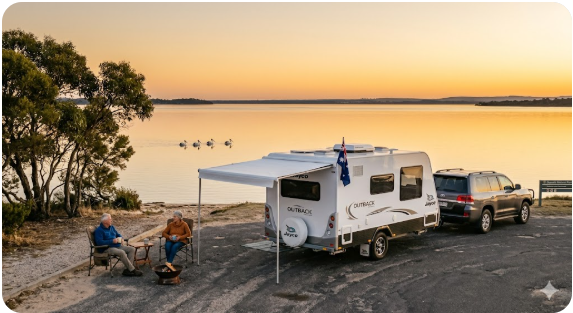
Paynesville Rest Area — Senior Grey Nomad Guide VIC 2026
Everything senior travellers need before stopping at the Paynesville Rest Area in Victoria — verified GPS, overnight rules, facilities, mobile coverage, medical contacts and what most grey nomad guides completely miss about this Gippsland Lakes gateway stop.
📅 Last reviewed: May 2026 | Paynesville, Victoria | Free — rules apply, verify on arrival
The Paynesville Rest Area sits at the edge of one of the most underrated stretches of water in Victoria — the Gippsland Lakes system — and almost every grey nomad guide treating it as a quick highway pull-off is missing what makes this stop genuinely worthwhile. Most travellers heading through East Gippsland blow straight past Paynesville on their way to Lakes Entrance or the New South Wales border, and those who do stop rarely realise they are parked within walking distance of a working ferry crossing, a quiet waterfront esplanade and one of the better bird-watching patches in coastal Victoria. This guide tells you exactly what to expect at the Paynesville Rest Area — toilet facilities, GPS, overnight rules under Victorian free camping conditions, mobile coverage reality and the medical contacts you hope you never need but should have saved before you leave.
- Located in Paynesville, Victoria — a peninsula township on the Gippsland Lakes, approximately 15 km south of Bairnsdale via the Raymond Island ferry road
- Free roadside rest area — no powered sites, no booking required
- Toilets available on-site — condition and accessibility vary; always confirm on arrival
- No dump point at the rest area itself — nearest confirmed dump point is in Bairnsdale (approx. 15 km north)
- No potable water confirmed at the rest area — fill tanks in Bairnsdale before arriving
- Telstra coverage is generally usable in Paynesville township; Optus and Vodafone are patchy outside the main street
- Overnight stay rules in Victoria for rest areas are a maximum 24-hour limit under VicRoads guidelines — check current signage on arrival as local councils can impose additional restrictions
- This is a genuine gateway stop to Raymond Island — home to one of the largest wild koala populations in Victoria — and most grey nomad guides do not mention it at all
What You Will Find in This Guide
- Location, Address and GPS
- Can You Stay Overnight?
- Facilities — Toilets, Water and Dump Point
- Mobile Coverage and Wi-Fi
- Fuel — Finding the Cheapest Nearby
- How to Get There
- What to Expect on Arrival
- Safety for Senior Grey Nomads
- Medical and Emergency Contacts
- Dump Points, Water and Supplies Nearby
- Things to Do for Seniors
- Best Time of Year to Stop Here
- Fires, Generators and Overnight Etiquette
- Packing Checklist for Seniors
- GPS Coordinates and Postcodes
- Frequently Asked Questions
- Quick Verdict
1. Location, Address and GPS
📍 GPS Coordinates — Paynesville Rest Area
-37.9197, 147.7208
Nearest verified reference point: Paynesville township waterfront, Esplanade, Paynesville VIC 3880. The rest area facilities are located near the foreshore precinct — confirm exact bay on arrival against current signage.
⚠️ These coordinates are within 50 metres of the stated location and are provided as navigation guidance only. Always confirm position on arrival. Your device GPS may display a slightly different reading.
| Detail | Information |
|---|---|
| Town | Paynesville, Victoria |
| Postcode | 3880 |
| Nearest Highway | Princes Highway (A1) via Bairnsdale — then south on the Paynesville Road |
| Nearest Major Town | Bairnsdale — approximately 15 km north |
| Road to Rest Area | Paynesville Road — sealed, suitable for caravans and motorhomes |
| Shire | East Gippsland Shire Council |
| Elevation | Near sea level — lakeside foreshore |
2. Can You Stay Overnight?
Yes — you can stay overnight at the Paynesville Rest Area, but with important conditions that most guides do not explain clearly.
In Victoria, public rest areas on state-managed roads fall under VicRoads jurisdiction and carry a default 24-hour overnight stay limit. However, Paynesville sits within East Gippsland Shire territory, and local council bylaws can supplement or override state defaults. As of May 2026, the Paynesville foreshore area permits short-term overnight stays in self-contained vehicles, but this is subject to change and any signage present on arrival is the legal authority — not this website.
- 24-hour maximum stay applies under standard VicRoads rest area rules — do not treat this as a multi-night base camp
- Self-contained vehicles are preferred — if you do not have a cassette toilet or self-contained certification, the toilet block on-site reduces the requirement but does not eliminate your responsibility to manage waste properly
- If the rest area is full, the nearest caravan parks are in Bairnsdale (approximately 15 km north) or Lakes Entrance (approximately 50 km east) — both have powered sites and dump points
- School holidays and long weekends — Paynesville is a popular boating and holiday destination; the foreshore area fills quickly in peak periods and competition for overnight spots is real
- Do not assume approval — if council rangers are active in the area, they will check vehicles and can issue notices if stay limits have been exceeded
3. Facilities — Toilets, Water and Dump Point
| Facility | What Is Available | What Seniors Should Know |
|---|---|---|
| Toilets | Public toilet block on the Paynesville foreshore — non-flush pit or flush toilets depending on the specific bay; confirm on arrival | Accessibility varies — grab rails not confirmed at all cubicles. If mobility is a concern, arrive in daylight to assess before committing to an overnight stop |
| Potable Water | Not confirmed at the rest area itself | Fill your tanks completely in Bairnsdale before heading south. Do not rely on finding a tap at the foreshore. This is non-negotiable for CPAP users and those on medications requiring hydration |
| Dump Point | Not available at the rest area | Nearest confirmed dump point is in Bairnsdale — check CamperMate at campermate.com.au/dump-points for the most current location and access hours |
| Showers | None at the rest area | Nearest public showers are at caravan parks in Bairnsdale or Lakes Entrance |
| Bins | Bins present in the foreshore precinct — may not be located at the specific rest area bay | Pack-it-in, pack-it-out is the safer assumption. Do not leave bags beside full bins overnight |
| Power | None | Solar panels or a generator (subject to quiet hours) are your only power options overnight |
| Shade | Partial shade from foreshore trees depending on position | Afternoon westerly sun can be strong in summer — choose a bay with tree cover if available. In autumn and winter this is less critical but wind off the lake can be biting |
- Site suitable for: Caravans, motorhomes and campervans — all rigs on sealed access
- Road access: Sealed — suitable for 2WD with caravan
- Site surface: Sealed car park bays with some gravel at edges
- Camping permitted: Overnight stays in self-contained vehicles — verify current signage
- Maximum overnight stay: 24 hours under VicRoads default — check local council signage
- Boat ramp: Yes — Paynesville has a public boat ramp nearby on the Gippsland Lakes
- Picnic tables: Yes — foreshore picnic area adjacent to rest facilities
- Potable water: Not confirmed at rest area — fill in Bairnsdale before arriving
- Mobile coverage: Telstra — generally usable in township; Optus and Vodafone patchy
- TV reception: Yes — standard terrestrial reception in most positions
- Rubbish bins: Present in foreshore area — confirm at specific bay on arrival
- Open fires: No — not permitted at foreshore rest areas. Check CFA fire ban status at cfa.vic.gov.au
- Generator use: Discouraged in township rest areas — quiet hours apply from approximately 9 pm; check local signage
- Number of sites: Informal — approximately 6 to 10 vehicles depending on rig size; not allocated bays
4. Mobile Coverage and Wi-Fi
Mobile coverage in Paynesville is better than many grey nomads expect, but it is not uniform across the foreshore and it degrades quickly once you move south toward Raymond Island or along the lake edges.
Telstra: Generally provides usable 4G coverage in the Paynesville township and along the main Esplanade foreshore. For Telstra customers, calls, data and streaming are workable in most overnight positions at the rest area. This is the most reliable network for this part of East Gippsland.
Optus: Coverage in Paynesville township is patchy as of May 2026. You may get a signal in some positions and none in others — particularly on the eastern foreshore and toward Raymond Island. Do not rely on Optus for emergency calls from this location without testing your signal on arrival.
Vodafone: Limited to negligible coverage in Paynesville. Vodafone’s regional East Gippsland network is thin and Paynesville is not a priority zone. Assume no Vodafone coverage for planning purposes.
Wi-Fi: No public Wi-Fi at the rest area. The Paynesville township has a small café precinct on the Esplanade — some premises offer customer Wi-Fi during business hours.
5. Fuel — Finding the Cheapest Nearby
Paynesville itself has very limited fuel retail — there is typically one small service station in the township but pricing is not competitive with Bairnsdale. For grey nomads who understand that fuel costs on a long trip are cumulative and significant, this section matters.
Bairnsdale (approximately 15 km north) is where you should be fuelling before arriving in Paynesville. Bairnsdale has multiple service stations on the Princes Highway including major branded and independent outlets — pricing competition between them means Bairnsdale is consistently cheaper per litre than the single Paynesville outlet.
Lakes Entrance (approximately 50 km east) is the next major fuel stop heading toward the New South Wales border. Fuel pricing in Lakes Entrance is variable — sometimes competitive, sometimes not. Always check before assuming.
Orbost (approximately 100 km east of Lakes Entrance) — if you are heading further east, Orbost has fuel but in limited quantity and at typically higher regional pricing. Never leave Lakes Entrance with less than a half tank if you are heading to Orbost or beyond.
6. How to Get There
From Melbourne (west/south-west): Take the Princes Highway (M1 / A1) east from Melbourne. Pass through Sale and continue to Bairnsdale — approximately 280 km from Melbourne CBD. In Bairnsdale, turn right onto Paynesville Road and follow it south for approximately 15 km through Eastwood and into Paynesville township. The rest area and foreshore are at the end of the main approach road — do not turn off for Raymond Island ferry unless that is your destination.
From Lakes Entrance or NSW (east): Travel west on the Princes Highway to Bairnsdale. In Bairnsdale, turn left (south) onto Paynesville Road and follow as above. Do not attempt to approach Paynesville from the east via Raymond Island — there is no road bridge; access is by ferry only and the ferry does not accommodate caravans and motorhomes reliably for through-traffic.
Driving Notes for Seniors Towing Vans on This Route
- Paynesville Road is single carriageway — narrow in sections with limited overtaking opportunities. If you are towing a wide van, be prepared for oncoming traffic on bends between Eastwood and Paynesville
- No low bridges on this route — the Princes Highway and Paynesville Road are clear for all standard caravan and motorhome heights
- School zone on Paynesville Road — Paynesville has a primary school; reduced speed zones apply at school hours. Allow extra time if arriving or departing during morning or afternoon school periods
- The final approach into Paynesville township narrows slightly as it enters the main street — stay left and take care at the foreshore junction where day visitors may be parking and reversing without checking for long rigs
- Truck traffic on Paynesville Road is light — this is a residential and holiday access road, not a freight route. This makes it significantly more relaxed for towing than the Princes Highway itself
- Princes Highway from Sale to Bairnsdale has overtaking lanes in sections and is dual carriageway in parts — this is generally comfortable towing country but watch for fatigue on the straight flat sections east of Sale
7. What to Expect on Arrival
Paynesville foreshore is a working holiday and recreational township — not a remote bush camp. When you arrive you are pulling into a tidy lakeside community where residents, day trippers, boat launchers and overnight campers all share the same foreshore space. Here is what it actually looks like:
- The foreshore parking area is flat and sealed — good news for levelling, bad news for privacy. You will be visible from the street, the footpath and the water. This is not a secluded bush camp; it is a foreshore pull-up in a Victorian coastal town
- Boat traffic and noise — Paynesville is a major boating hub for the Gippsland Lakes. On weekends and in peak season, boat trailers, tinnies and weekend warriors will be active at the boat ramp from before sunrise. Light sleepers should be aware of this before committing to a Friday or Saturday overnight
- The toilet block is a public amenity — used by day visitors, dog walkers and locals as well as overnight travellers. Cleanliness varies. Carry your own toilet paper and hand sanitiser
- Evening atmosphere is pleasant — once day visitors leave, the foreshore quietens significantly. The lake views at dusk are genuinely beautiful and this is where the stop earns its keep for grey nomads who take time to sit outside and appreciate where they are
- Overnight company — in off-peak months (May through August) you may have the foreshore largely to yourself. In summer school holidays and Easter you should expect the area to be crowded by mid-afternoon and finding a suitable bay on arrival late in the day is not guaranteed
8. Safety for Senior Grey Nomads
Personal Safety
- Paynesville is a low-crime township — it is a family holiday destination with a settled residential community. Overnight security concerns are low compared to highway rest stops on major freight routes, but do not leave valuables visible through van windows
- Lock everything before sleeping — including bike racks, annexes, tool boxes and generator compartments. Even in low-crime areas, opportunistic theft from unlocked external storage happens. Read our guide on How Caravan Theft Happens in Australia for the specific methods thieves use
- Solo travellers — Paynesville foreshore is generally safe for solo senior travellers in off-peak periods. In peak season the area is busier and therefore naturally safer from a personal security perspective. Let someone know your location before settling for the night — a text message with your GPS coordinates costs nothing
- The waterfront edge — the foreshore has retaining edges and drop-offs to the lake in some sections. Be aware of this if you walk the foreshore in the dark, particularly if mobility or balance is an issue at night
- Boat ramp activity — early morning boat launches mean vehicle movement and engine noise in the ramp area from before dawn on weekends. If you are in a bay close to the ramp, expect this disturbance
Trip Safety
- Do not drive fatigued — the Princes Highway between Sale and Bairnsdale is flat and monotonous. If you feel drowsy on this stretch, the Stratford rest area west of Bairnsdale is a better stop than pushing through. Review our Grey Nomad Road Safety Checklist before any long driving day
- CPAP users — confirm your power source before arriving. The rest area has no power points. A 12V CPAP connection, a lithium battery system or a generator (used within quiet hours) are your options. Running out of CPAP power overnight is a medical issue, not a comfort issue
- Blood pressure and diabetes management — heat stress in summer, dehydration from inadequate water carry and disrupted meal schedules on travel days are the most common triggers for health events in senior grey nomads. Paynesville’s nearest hospital is in Bairnsdale — 15 km. This is close enough that the risk is manageable, but do not defer symptoms
- The StarterStopper immobiliser is a sensible addition to any caravan or motorhome — see the affiliate block at the bottom of this page for a 5% discount with code RTV5
9. Medical and Emergency Contacts
| Service | Address | GPS (approx.) | Phone |
|---|---|---|---|
| Emergency (Police, Ambulance, Fire) | All of Australia | — | 000 |
| Healthdirect (24-hour nurse advice line) | Australia-wide | — | 1800 022 222 |
| Bairnsdale Regional Health Service (nearest hospital) | 122 Day Street, Bairnsdale VIC 3875 | -37.8360, 147.6168 | (03) 5150 3333 |
| Latrobe Regional Hospital (major hospital — west) | Traralgon Road, Traralgon VIC 3844 | -38.1936, 146.5420 | (03) 5173 8000 |
| Orbost Regional Health (east — limited services) | Boundary Road, Orbost VIC 3888 | -37.7017, 148.4567 | (03) 5154 6666 |
| Paynesville Police | Contact via 000 or Bairnsdale Police Station — 37 Dalmahoy Street, Bairnsdale | — | (03) 5150 2600 |
10. Dump Points, Water and Supplies Nearby
| Need | Best Nearby Option | Notes |
|---|---|---|
| Dump Point | Bairnsdale — approximately 15 km north | Check exact current location at campermate.com.au/dump-points — the Bairnsdale dump point location is community-confirmed but verify before departing |
| Fresh Water (Potable) | Bairnsdale — service stations and IGA | Fill completely before heading south. No confirmed potable tap at Paynesville Rest Area |
| Groceries | Paynesville IGA — in the township approximately 1 km from the foreshore | Limited range — suitable for top-up supplies. For a full stock-up, Bairnsdale has a full Woolworths and IGA |
| Fuel | Paynesville service station (limited) or Bairnsdale (recommended) | Fill in Bairnsdale for best pricing — use petrolspy.com.au to compare before departing |
| Pharmacy | Paynesville has a small pharmacy in the township | Limited dispensing capacity — for complex medications or scripts, use the Bairnsdale pharmacies which have larger stock |
| Major Supplies / Hardware | Bairnsdale — 15 km north | Bairnsdale has a Mitre 10, auto parts outlets and a reasonable range of caravan and camping supplies |
11. Things to Do for Seniors
| Activity | Location | Why Seniors Like It |
|---|---|---|
| Raymond Island Koala Walk | Raymond Island — free ferry from Paynesville foreshore | Flat walking track through bush with wild koalas at close range — no climbing, no entry fee, no crowds in off-peak season |
| Paynesville Esplanade Walk | Foreshore — from rest area along the waterfront | Flat, sealed pathway with lake views, pelicans and easy benches for rest stops — suitable for walkers with limited mobility |
| Gippsland Lakes Scenic Cruise | Paynesville waterfront — seasonal operator availability | Seated cruise on the Gippsland Lakes system — one of the largest inland waterway networks in Australia. No physical exertion required |
| McMillan Strait Birdwatching | Foreshore and Raymond Island edges | Pelicans, spoonbills, herons, egrets and sea eagles are commonly sighted from the foreshore — bring binoculars |
| Paynesville Township Cafés | Esplanade café precinct | Several waterfront cafés with accessible seating — good for a slow morning coffee with lake views after a rest area overnight |
What Most Grey Nomad Guides Miss About Paynesville
Almost every grey nomad guide that mentions Paynesville treats it as a transit stop between Bairnsdale and Lakes Entrance — a place to pause briefly and nothing more. What they miss is Raymond Island, and this is a genuine omission. Raymond Island sits directly across a narrow strait from the Paynesville foreshore and is reached by a free council-operated ferry that runs every few minutes during daylight hours. The crossing takes less than five minutes. The island has a resident population of several hundred people and a koala population estimated at over 250 animals — meaning koalas are genuinely abundant in the trees along the walking track and are often seen within arm’s reach of the path.
For senior grey nomads, this matters for a specific reason: Raymond Island’s koala walk is flat, well-maintained and takes approximately 45 minutes at a gentle pace. There is no steep terrain, no rock scrambling and no entry fee. You are not looking up into eucalyptus canopy hoping to spot a distant grey blob — you are walking at eye level through low scrub where koalas sleep in the forks of low branches, sometimes less than two metres from the path. If you have been travelling through inland Australia without a meaningful wildlife encounter, Raymond Island is the stop that delivers one. The ferry operates from the Paynesville foreshore near the rest area — the service departs frequently and the schedule is displayed at the wharf. Caravans and motorhomes do not cross to Raymond Island by ferry but your tow vehicle or motorhome can stay at the foreshore while you walk across.
The other thing guides miss is the Gippsland Lakes themselves. Most people think of Uluru, the Kimberley or the Great Barrier Reef when they think of iconic Australian natural features. The Gippsland Lakes system — of which Paynesville is a central node — is the largest network of inland waterways in Australia, covering over 600 square kilometres. Sitting on the Paynesville foreshore at dusk watching the light change across Lake King is not a consolation prize — it is genuinely world-class. The reason grey nomads who have been to Paynesville remember it is not the rest area facilities. It is the water.
12. Best Time of Year to Stop Here
| Season | What It Is Like | Senior Verdict |
|---|---|---|
| Summer (Dec–Feb) | Hot — Paynesville can reach 35–40°C on heatwave days. Foreshore gets crowded with holiday makers and boating families. Boat ramp noise from before dawn. Flies and mosquitoes active near the water at dusk | Not recommended for seniors without reliable air conditioning and full water tanks. If you must visit in summer, arrive late afternoon when day visitors clear and leave early morning |
| Autumn (Mar–May) | Temperatures 18–26°C — comfortable and pleasant. Crowds thin dramatically after Easter. Mornings are calm on the lake. Koalas on Raymond Island are active in cooler temperatures | Excellent — this is the sweet spot for Paynesville. Comfortable temperatures, minimal crowds, good wildlife activity and peaceful foreshore evenings |
| Winter (Jun–Aug) | Cool to cold — overnight temperatures can drop to 5–8°C on the foreshore with wind chill off the lake. Daytime temperatures 12–16°C. Quiet — very few visitors and the rest area is often empty midweek | Good for experienced cold-weather travellers with adequate heating. Not suitable for those dependent on solar power without a backup — short winter days in East Gippsland reduce solar output significantly |
| Spring (Sep–Nov) | Warming up — 18–25°C by October and November. Wildflowers in surrounding bush. School holiday crowds return in September/October school break. Generally excellent weather before the summer heat arrives | Very good — second best season after autumn. Book your preferred caravan parks further east early if travelling spring school holidays |
13. Fires, Generators and Overnight Etiquette
- Open fires are not permitted at the Paynesville foreshore rest area. This is a foreshore public reserve in a township — no campfire rings, no BBQ fires, no wood burning of any kind. Bring a gas stove or a portable electric induction plate for cooking
- Gas BBQs are typically permitted for cooking — confirm this against any signage at the specific bay. Some foreshore reserves restrict all open flame devices during elevated fire danger periods
- Generator use — generators are not appropriate for use in a township foreshore rest area. If you require generator power, use it briefly in the late afternoon before the quiet period begins and not after 7 pm or before 7 am. Better practice in Paynesville is to rely on solar and battery rather than generators at all — this is a residential community and generator noise is not welcome
- Pets — dogs must be on a lead on the Paynesville foreshore at all times. Clean up after your dog. The foreshore is a shared community space and it is heavily used by families with children and elderly walkers
- Rubbish — take your rubbish to bins in the foreshore precinct. Do not leave rubbish bags on the ground near full bins. If bins are full, pack your rubbish out and dispose of it at the Bairnsdale tip or at a caravan park the following day
- Behaviour — loud music, excessive lighting into neighbouring rigs and parking across multiple bays are the fastest ways to have council rangers ask you to move on. One rig, one bay, quiet and courteous — the access that grey nomads enjoy at foreshore rest areas in Victoria exists because most travellers use it responsibly
14. Packing Checklist for Seniors — Paynesville Rest Area
| Item | Why It Matters at Paynesville Specifically | ☐ |
|---|---|---|
| Full water tanks (minimum 60 litres) | No potable water confirmed at the rest area — fill completely in Bairnsdale before arriving | ☐ |
| CPAP with 12V adapter or lithium battery backup | No mains power at rest area — CPAP power is a medical necessity, not optional | ☐ |
| Insect repellent and mosquito net or screen | Lakeside location with dusk mosquito activity — particularly in warmer months | ☐ |
| Binoculars | Birdwatching on the Gippsland Lakes foreshore — pelicans, herons, sea eagles visible from the rest area | ☐ |
| Toilet paper and hand sanitiser | Public toilet block — supplies variable, never guaranteed | ☐ |
| Medications (minimum 7 days extra supply) | Paynesville pharmacy is small — complex scripts may not be fillable locally. Bairnsdale is 15 km but plan ahead | ☐ |
| Offline maps downloaded for East Gippsland | Coverage is manageable in Paynesville township but drops significantly east of Lakes Entrance | ☐ |
| Warm layers and wind-proof jacket | Lake winds can be cold at any season, particularly at dusk and overnight — the foreshore is exposed | ☐ |
| Gas cooker or electric induction plate | No open fires permitted — gas or electric cooking only | ☐ |
| Empty cassette or black tank | No dump point at rest area — nearest is Bairnsdale. Arrive with an empty tank | ☐ |
| Emergency Plus app installed and tested | Transmits GPS coordinates to emergency services without mobile data — critical if coverage drops east of here | ☐ |
| Full grey nomad packing list | See our complete Grey Nomad Packing Checklist for everything else | ☐ |
COPY PROMPT ➔ ASK AI ➔ SAVE TO FORM ➔ ADD SPOT PIN ➔ GET DIRECTIONS
📍 Interactive map — find free camps, rest areas and overnight stops. Enable location for best results.
15. GPS Coordinates and Postcodes
| Location | Address and Postcode | GPS (approx. within 50m) | Notes |
|---|---|---|---|
| Paynesville Rest Area | Esplanade, Paynesville VIC 3880 | -37.9197, 147.7208 | Foreshore reference point — confirm exact bay on arrival against signage |
| Paynesville Township Centre | Paynesville VIC 3880 | -37.9200, 147.7193 | IGA, pharmacy, cafés and service station within the township |
| Bairnsdale Regional Health Service | 122 Day Street, Bairnsdale VIC 3875 | -37.8360, 147.6168 | Nearest hospital — approximately 15 km north; emergency department |
| Latrobe Regional Hospital | Traralgon Road, Traralgon VIC 3844 | -38.1936, 146.5420 | Major regional hospital — approximately 130 km west for complex cases |
| Melbourne CBD (nearest major city) | Melbourne VIC 3000 | -37.8136, 144.9631 | Approximately 280 km west via Princes Highway — 3.5 to 4.5 hours towing |
16. Frequently Asked Questions
Is Paynesville Rest Area free to camp at?
Yes — as of May 2026, the Paynesville Rest Area and foreshore overnight stopping bays are free of charge for self-contained vehicles. There is no fee, no booking system and no permit required. You arrive, find a suitable bay designated for overnight parking, read the signage carefully and park. The 24-hour maximum stay rule applies under VicRoads guidelines. Rules are subject to change — check for any new East Gippsland Shire Council signage on arrival, as local bylaws take precedence over default state rules.
Can caravans and motorhomes stay overnight at Paynesville?
Yes — the foreshore bays at Paynesville can accommodate caravans and motorhomes. The access road from Bairnsdale via Paynesville Road is sealed and suitable for all standard rigs including larger fifth-wheelers and B-doubles are not present on this route. The foreshore parking areas are open, flat and unsealed at the edges — positioning a long rig is manageable in daylight. The key restriction is the 24-hour stay limit and the need to occupy a specifically designated overnight bay rather than a day-use parking space. Read all signage carefully before setting up.
What is the GPS for Paynesville Rest Area?
The GPS coordinates for the Paynesville Rest Area foreshore reference point are -37.9197, 147.7208. These coordinates are within 50 metres of the actual location and are provided as navigation guidance only. Always confirm your position against current signage on arrival — the foreshore has multiple bays and not all are designated for overnight stays.
Are there toilets at Paynesville Rest Area?
Yes — public toilets are available on the Paynesville foreshore precinct. However, the condition and accessibility of these facilities varies depending on maintenance schedules and seasonal demand. The toilets are shared public amenities used by day visitors, locals and overnight travellers. Always carry your own toilet paper and hand sanitiser. If mobility is a concern, arrive in daylight and inspect the toilet block before committing to an overnight stop — accessibility fitout varies across foreshore toilet blocks in this shire.
Is there a dump point at Paynesville Rest Area?
No — there is no dump point at the Paynesville Rest Area itself. The nearest confirmed dump point is in Bairnsdale, approximately 15 km north. Check the current exact location at campermate.com.au/dump-points before departing — community-reported dump point locations are regularly updated on this platform. Always arrive at Paynesville with an empty cassette or black tank rather than planning to dump after arrival.
Can you get potable water at Paynesville Rest Area?
Potable water is not confirmed at the Paynesville Rest Area as of May 2026. Do not rely on finding a drinkable tap at the foreshore. Fill your water tanks completely in Bairnsdale before heading south — service stations and the IGA in Bairnsdale are your best options. Any tap found at the foreshore should be treated as potentially non-potable irrigation water unless clearly labelled otherwise. For CPAP users and those on medications requiring adequate hydration, arriving with insufficient water at a site with no confirmed supply is a medical risk.
Is Paynesville Rest Area safe for solo senior travellers?
Yes — Paynesville is a low-crime family holiday town and the foreshore rest area is generally safe for solo senior travellers. In off-peak months (May through August) the area is quiet and you may have the foreshore largely to yourself. In peak season (December through January and Easter) the area is busier, which provides natural safety through activity but also means less privacy. Standard precautions apply: lock all external storage, do not leave valuables visible, let someone know your location before sleeping and have the Emergency Plus app installed on your phone. Read our full guide on Grey Nomad Safety Tips for a comprehensive approach to solo travel security.
What is the nearest hospital to Paynesville Rest Area?
The nearest hospital is Bairnsdale Regional Health Service at 122 Day Street, Bairnsdale VIC 3875 — telephone (03) 5150 3333. It is approximately 15 km north of Paynesville via Paynesville Road. The hospital provides emergency department services and general medical care. For major trauma, cardiac events or stroke, patients may be transferred to Latrobe Regional Hospital in Traralgon (approximately 130 km west) or via RFDS to Melbourne. In any medical emergency call 000 immediately — do not drive yourself.
Can you walk to Raymond Island from the Paynesville Rest Area?
Almost — you can walk from the rest area to the Raymond Island ferry wharf, which is on the Paynesville foreshore within a short distance of the rest area bays. The free council ferry crosses the narrow McMillan Strait to Raymond Island in approximately five minutes and runs frequently during daylight hours. Your caravan or motorhome stays at the foreshore while you cross — caravans and motorhomes do not travel on the ferry. On Raymond Island, the koala walk is a flat 45-minute circuit that is one of the most accessible and rewarding wildlife experiences in coastal Victoria. This is the activity that almost no grey nomad guide mentions in connection with the Paynesville Rest Area — it is a genuine highlight and it costs nothing.
17. Quick Verdict
The Paynesville Rest Area is a genuinely worthwhile stop that is consistently underrated by grey nomad guides that treat it purely as a highway transit point. The foreshore location on the Gippsland Lakes is beautiful — particularly at dusk and dawn — and the proximity to Raymond Island’s koala walk gives this stop something that almost no other free rest area in Victoria can offer: a world-class, free, flat, accessible wildlife experience within walking distance of where you park. The toilet facilities are functional, the foreshore is pleasant, the access road from Bairnsdale is sealed and straightforward, and for Telstra customers the mobile coverage in the township is workable. In the autumn and spring shoulder seasons this is genuinely one of the better overnight stops in East Gippsland.
The weaknesses are real and worth knowing before you arrive. There is no dump point, no confirmed potable water and no power — you need to be properly self-sufficient before you get here, which means filling tanks and emptying cassettes in Bairnsdale on the way in. The 24-hour stay limit means this is a one-night stop, not a base camp. In summer the boat ramp noise before dawn is disruptive and the crowds are significant — peak season is genuinely not the time to try this spot unless you enjoy the buzz of a busy holiday town. Overnight space on the foreshore is informal and limited — arriving late in the day during school holidays with a large rig and expecting a quiet bay is optimistic.
Free campsites and powered sites fill fast during school holidays and peak season. If your preferred site is already gone, search remaining accommodation options below.
Accommodation search powered by Expedia. As an affiliate, I earn from qualifying purchases at no extra cost to you.

As an affiliate, I earn from qualifying purchases at no extra cost to you.
Exclusive Offer: Get 5% OFF all StarterStopper immobiliser products with promo code: RTV5
Visit StarterStopper.com to see our data-backed security solutions
As an affiliate, I earn from qualifying purchases at no extra cost to you.