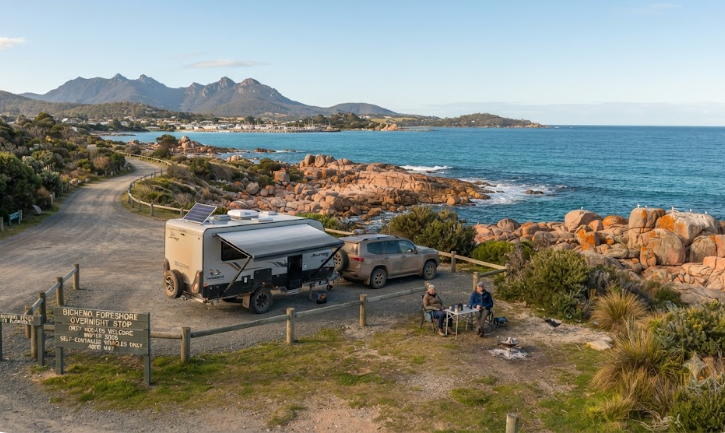
Free Camping Bicheno Tasmania — East Coast Grey Nomad Guide 2026
Honest overnight options, self-containment rules, facilities, fuel distances and everything a 60+ traveller in a caravan or motorhome needs before pulling in off the Tasman Highway.
Last reviewed: July 2026. Facilities and rules change — confirm locally before arrival.
- Location: Tasman Highway (A3), Bicheno TAS 7215 — between Coles Bay turn-off and St Helens
- Free camping: Limited self-contained options in and immediately around town — details in full below
- Self-containment: Required at most roadside and informal spots — carry your waste management kit
- Toilets: Public toilets available in Bicheno township (confirm current locations on arrival)
- Dump point: Writer to confirm nearest current location — do not rely on this guide alone; check Dump Point Finder or WikiCamps before travel
- Fuel: Available in Bicheno township — fill up; next reliable fuel north is St Helens (~87 km)
- Nearest hospital: Writer to confirm — see Medical section; carry a plan
- Mobile coverage: Telstra best on East Coast; Optus and Vodafone patchy in places
- Best time: Autumn (March–May) and spring (September–October) — avoid Christmas and Easter school holidays
- Rig suitability: Bicheno township roads are manageable for most rigs; some informal spots better suit smaller setups
📋 Table of Contents
- Emergency Safety — Before You Set Up Camp
- Location, Address and GPS
- Why Grey Nomads Stop at Bicheno
- Can You Stay Overnight — Rules and Self-Containment
- Your Two Main Options Side by Side
- Facilities Table
- Road Access, Fuel Distances and Flood Risk
- Rig Size Suitability
- What Bicheno Doesn’t Tell You Online
- Full Facilities Comparison — Free vs Paid
- Rates — All Overnight Options Near Bicheno
- Senior-Friendly Things to Do
- Month-by-Month Weather and Best Time to Visit
- Wildlife and Nature
- Medical and Emergency Contacts
- Mobile Coverage
- Fires, Generators and Overnight Etiquette
- Accessibility for Seniors
- Senior Packing Checklist — Bicheno
- The East Coast Circuit — Internal Links
- GPS Coordinates and Postcodes Table
- FAQ
- Quick Verdict
- Quick-Reference Card
- Planning Tip and Internal Links
- Disclaimer
📵 Before You Set Up Camp: Can 000 Find You Here?
Most rest areas don’t have a street address. If something goes wrong overnight, “I’m at a rest stop somewhere past the servo” wastes precious minutes. Before you unhitch, open Emergency+ and check it can pin your GPS location or generate a what3words address right where you’re parked — it works offline, so no signal doesn’t mean no location. Get it free — iPhone (App Store) or Android (Google Play).
The habit that matters: do this the moment you arrive, not if you need it. Signal drops in and out at bush camps — testing it early means you already know it works before an emergency makes that the wrong time to find out.
Bonus use: while you’re in the app, grab the GPS coordinates it shows you and save them to your own Van Life Savings Spots pin — a good stop is worth remembering for next time, and now you’ve already got the exact coordinates in hand.
Location, Address and GPS
Bicheno sits on the Tasman Highway (A3) on Tasmania’s East Coast. It lies roughly 185 kilometres north of Hobart, approximately 51 kilometres north of the Coles Bay–Freycinet turn-off, and approximately 87 kilometres south of St Helens. Those distances make it the natural midpoint stop on the full East Coast circuit.
The town faces east onto the Tasman Sea. The main street — Burgess Street — runs parallel to the foreshore. Most services, including fuel, a supermarket, takeaway food and public toilets, are within a compact walking distance of the waterfront.
📍 Bicheno Township Centre — Navigation Reference
-41.8734, 148.3018
Bicheno, TAS 7215 — Tasman Highway (A3), East Coast Tasmania
Use this coordinate to navigate to the Bicheno township centre. Adjust your destination once you have confirmed your specific overnight spot.
⚠ GPS note: Coordinates are within 50 metres of the stated location and are provided as navigation guidance only. Always confirm on arrival against current signage.
Why Grey Nomads Stop at Bicheno — Location Context and Overview
Bicheno is not a destination town in the way that Freycinet or Wineglass Bay is. It is a working fishing village first. That is precisely why it works so well as an overnight stop. It has fuel, a supermarket, takeaway food, a bakery, public toilets and a flat foreshore walkway — all within a few hundred metres of where you park.
The East Coast circuit is one of the most popular grey nomad routes in Australia. Travellers heading north from Hobart typically spend a night or two at Coles Bay before pushing on. The next natural fuel-and-rest stop heading north on the A3 is Bicheno. After Bicheno, the next main service town is St Helens, roughly 87 kilometres away.
Bicheno also has a few genuine drawcards. The blowhole at the northern end of the foreshore is worth a short walk. Little penguins nest on the rocky foreshore and come ashore at dusk from around late afternoon. The rockpool area near the town beach is flat, accessible and good for a quiet hour in calm weather.
None of that makes Bicheno a week-long stop. But it makes it a very good one-night to two-night stop — and that is exactly what most circuit travellers need at this point on the route.
Can You Stay Overnight — Rules and Self-Containment
This is where most online listings for Bicheno let grey nomads down. They mention free camping without explaining the rules clearly. Here is what you need to understand.
Self-Containment is the Starting Point
Tasmania does not have a single statewide freedom camping law equivalent to New Zealand’s. Instead, overnight camping on public land in Tasmania is governed by a mix of council bylaws, Crown land rules and reserve regulations. The Glamorgan Spring Bay Council manages the Bicheno area.
At informal roadside stops and any area that is not a designated campsite with toilets, self-containment is effectively expected and in many cases required. Self-contained means your vehicle can manage its own grey water, black water and waste — you are not relying on facilities that are not there.
If you do not have a self-contained setup, you need to stay at a caravan park or campsite with toilet and waste facilities.
What the Rules Actually Mean in Practice
There are no large designated free camping areas directly in Bicheno town itself in the way that some larger East Coast towns have formal free rest areas. The situation is more nuanced than that.
Some grey nomads park along the foreshore road or in the broader town area for a night. Whether this is strictly permitted depends on current council enforcement, which changes. Do not rely on what someone else did two years ago.
The most reliable approach is to contact the Glamorgan Spring Bay Council directly before your visit to confirm what is currently permitted and where. Their contact details are in the Medical and Emergency section below — the council phone number is the same entry point.
The Bicheno Caravan Park — Your Baseline Alternative
Bicheno has a caravan park that provides the reliable, no-stress overnight option. It has powered sites, amenities and dump point access. This is the correct default if you are not self-contained or if you want certainty. Details are in the rates and comparison sections below.
Your Two Main Options Side by Side
Every grey nomad stopping at Bicheno faces the same basic choice: find a free or low-cost informal spot, or pay for the caravan park. Here is an honest comparison.
| Factor | Free / Informal Roadside Option | Bicheno Cabin and Tourist Park (Paid) |
|---|---|---|
| Cost | Free (if permitted) | Unpowered from approx. $30–$40/night; powered from approx. $45–$60/night — confirm current rates directly |
| Toilets | Public toilets nearby in town — not at your specific spot | Full amenities block on site |
| Showers | None at informal spots | Hot showers on site |
| Power | None — solar or battery only | Powered sites available — essential if you run CPAP |
| Dump point | None at informal spots — self-containment required | Dump point on site or nearby — confirm when booking |
| Security | Open roadside — variable | Managed park with other travellers around you |
| Noise | Variable — some foreshore spots exposed to road noise or wind | Managed park noise — quieter after 10pm |
| CPAP users | Battery or 12V only — plan ahead | Powered sites recommended — confirm availability |
| Certainty | Low — rules and enforcement can change | High — book in advance, especially peak season |
| Best for | Self-contained, flexible travellers comfortable with uncertainty | Anyone who needs power, facilities or certainty — especially first-time Tasmania travellers |
Facilities Table — Bicheno Overnight Options
| Facility | Informal / Roadside Spots | Bicheno Caravan Park | Notes |
|---|---|---|---|
| Toilets | Public toilets in town — not at spot | ✅ On site | Public toilets near foreshore — confirm current location on arrival |
| Potable water | ❌ Not at spot | ✅ On site | Top up tanks in town before heading to informal spots |
| Showers | ❌ None | ✅ On site | No shower access at informal stops |
| Power (mains) | ❌ None | ✅ Powered sites available | CPAP users — powered sites only at caravan park |
| Dump point | ❌ None at spot | Confirm with park directly | Check Dump Point Finder app before travel — writer to confirm nearest public dump point |
| Shade | Variable — some spots exposed | Variable — confirm when booking | East-facing foreshore can be exposed to morning sun and sea wind |
| Bins | Public bins in town | ✅ On site | Carry your rubbish to public bins if at informal spot |
| Fires | ❌ Not permitted at informal spots | ❌ Check park rules — generally no open fires | Total Fire Ban rules apply — see Fires section |
| Generators | Use with consideration — no formal rules at informal spots | Restricted hours — confirm with park | See etiquette section — early morning generator use is the most common complaint from other travellers |
| Dogs | Generally permitted — keep on lead | Confirm with park — many parks allow dogs | Dogs not permitted on beaches with penguin habitat |
| Mobile signal | Patchy — Telstra best | Patchy — Telstra best | See mobile coverage section for detail |
Road Access, Fuel Distances and Flood Risk
The Tasman Highway (A3) — What to Expect
The Tasman Highway between Hobart and St Helens is sealed along its entire length through Bicheno. You are not dealing with unsealed roads to reach the town itself. The highway is a narrow two-lane road in places. It winds through coastal ranges and farmland. It is not a fast road.
Driving speeds on this highway are limited by the road geometry, not just the speed limit. Budget more time than the distance suggests. A 185-kilometre drive from Hobart to Bicheno can take three hours or more with a caravan in tow, depending on traffic and road conditions.
Flood Risk
The Tasman Highway itself through this section is not prone to flooding in the way that some inland Tasmanian roads are. However, heavy rainfall events can cause brief localised issues on lower sections near creek crossings. Check the Live Traffic Tasmania website or call 1300 139 011 (Tasmania road conditions line — confirm this number is current before travel) if travelling after significant rainfall.
The foreshore area at Bicheno can see high swell and spray in strong easterly conditions. If you park close to the waterfront, be aware that overnight easterly swells can bring spray surprisingly far inland in severe weather. This is not common but is worth knowing.
Fuel Distances — All Directions
| Direction | Nearest Fuel Town | Approximate Distance | Notes |
|---|---|---|---|
| In town | Bicheno | 0 km | Fuel available in Bicheno — confirm current operating hours; hours can be limited |
| North (A3) | St Helens | ~87 km | Full services including LPG — do not skip Bicheno fuel if running low |
| South (A3) | Swansea | ~38 km | Fuel available at Swansea — smaller range of services than St Helens |
| South further (A3) | Hobart (via midlands) | ~185 km | Multiple fuel stops available en route — Swansea is the first reliable stop |
| West (inland — C302/A4) | Campbelltown / Midland Highway | ~80 km+ inland | No direct westward fuel route from Bicheno — this is a coastal town |
LPG Availability
LPG availability in Bicheno is not guaranteed at all times. Confirm before arrival if LPG is essential to your setup. St Helens to the north is your best option for a reliable LPG refill on this section of the coast.
Road to Freycinet — Coles Bay
The road to Coles Bay turns off the Tasman Highway approximately 51 kilometres south of Bicheno. The Coles Bay Road from the turn-off to Coles Bay itself is sealed for its full length. It is suitable for caravans and motorhomes, though tight in places. See our Coles Bay free camping guide for full detail on that section.
Rig Size Suitability
Bicheno township roads are manageable for most rigs. The Tasman Highway itself is a sealed two-lane road and handles caravans and motorhomes routinely. The town streets are narrower in places — this is a small fishing village, not a purpose-built tourist town.
Pulling into the main foreshore area and turning around in a large rig requires care. Scout on foot or send one person ahead before committing a long van into a tight turn.
| Rig Type | Suitability at Bicheno | Notes |
|---|---|---|
| Campervan / small motorhome (under 6 m) | ✅ Easy | Flexible — most spots accessible |
| Motorhome (6–8 m) | ✅ Generally fine | Take care on tight township streets; caravan park preferred for larger rigs |
| Caravan + tow vehicle (combined under 15 m) | ✅ Manageable | Tasman Highway fine; township manoeuvring requires care |
| Large 5th-wheeler or A-class (over 10 m body) | ⚠ Caution advised | Stick to caravan park — informal spots not suitable for very large rigs |
| Truck camper / 4WD with rooftop tent | ✅ Easy | Most flexible option for informal spots |
What Bicheno Doesn’t Tell You Online
CamperMate, WikiCamps and generic travel blogs all list Bicheno as a stop on the East Coast circuit. Most of them stop at “there’s a caravan park and a blowhole.” Here are the things that matter but rarely appear in those listings.
1. The Penguin Viewing Has Rules That Matter for Overnight Parkers
Little penguins come ashore at Bicheno’s rocky foreshore after dark. This is well-known. What is less well-known is that the foreshore areas where penguins nest are managed, and there are restrictions on lights, dogs and movement after dark. If you park near the foreshore — even informally — you may be in or near penguin habitat. Using a torch or phone light on the beach at night can disorient penguins and is actively harmful. Bicheno Penguin Tours operates guided tours and does not appreciate independent visitors wandering the nesting area after dark. Keep dogs away from the rocky foreshore entirely. This is not optional — it is the responsible thing to do, and rangers do patrol.
2. The East Coast Has a Wind Problem That Generic Sites Ignore
Bicheno faces directly east onto the Tasman Sea. Easterly winds are common, particularly in spring and early summer. The foreshore area can be genuinely uncomfortable overnight in a strong easterly — spray, wind noise and rocking vans are all possible. Inland camping spots or the caravan park, which sits slightly sheltered from the foreshore, are a better choice when easterlies are forecast. Check the Bureau of Meteorology coastal waters forecast for the East Coast of Tasmania before arriving. A gale warning changes your overnight plan entirely.
3. The Bicheno Blowhole Is Only Impressive at High Swell
Every travel guide mentions the blowhole. At low swell, it does very little. At high swell with an easterly running, it is genuinely spectacular. Check the swell forecast — BOM’s East Coast Tasmania marine forecast will tell you. If swell is over 2 metres, it is worth a visit. If it is a calm day, temper your expectations. This matters because some grey nomads specifically time their Bicheno stop for the blowhole and are disappointed on a flat sea day.
4. Bicheno Fuel Hours Are Not 24-Hour Service Station Hours
Bicheno is a small town. The fuel station hours are not the same as a metropolitan servo. Arriving after 6pm or 7pm and needing fuel may mean waiting until morning. If you are arriving late in the day from Coles Bay and are running low, stop at Swansea (approximately 38 kilometres south of Bicheno) rather than gambling on Bicheno being open. Confirm current Bicheno fuel station hours before your trip.
5. The Dump Point Situation Is Genuinely Unclear in Current Listings
Multiple online sources reference a dump point in or near Bicheno, but the specific current location, condition and access for large rigs is not consistently reported. Before travel, use the Dump Point Finder app (available free) to verify the nearest currently operational dump point. Do not assume the one listed on a two-year-old CamperMate review is still there or still accessible. Confirm this locally or via the council.
Full Facilities Comparison — Free Option vs Paid Alternative
| Facility | Informal Roadside / Foreshore | Bicheno Caravan Park (Paid) |
|---|---|---|
| Cost per night | Free (if permitted) | ~$30–$60+ depending on site type — confirm directly |
| Toilets | Public toilets in town (not at spot) | On-site amenities block |
| Hot showers | ❌ | ✅ |
| Powered sites | ❌ | ✅ Available |
| Dump point | ❌ Not on spot | Confirm with park — likely yes |
| Fresh water on site | ❌ Not at spot | ✅ |
| Laundry | ❌ | Confirm with park — many parks have coin laundry |
| CPAP-friendly | Battery/12V only — plan carefully | ✅ Powered sites suitable |
| Dog-friendly | Generally yes — keep on lead | Confirm with park — policies vary |
| Certainty of access | Low — subject to council rules and enforcement | High — book in advance |
| Wind/exposure | Potentially high near foreshore | Better sheltered |
| Penguin zone proximity | Possible — check location | Not a concern in managed park |
| Booking required | No | Strongly advised in peak season |
Rates — All Overnight Options Near Bicheno
Rates for all Tasmanian caravan parks and paid camping change seasonally and year to year. The figures below are indicative based on research available in early 2026. Confirm all current rates directly with each operator before booking.
| Option | Type | Indicative Rate (2026) | Booking |
|---|---|---|---|
| Informal foreshore / roadside | Free (if currently permitted) | Free | No booking — confirm legality with council first |
| Bicheno Cabin and Tourist Park | Paid caravan park — unpowered sites | From approx. $30–$40 per night | Book directly — essential in peak season |
| Bicheno Cabin and Tourist Park | Paid caravan park — powered sites | From approx. $45–$60 per night | Book directly — confirm CPAP power availability |
| Diamond Island Resort | Resort accommodation — not caravan-oriented | Higher — confirm directly | Not relevant for most caravan travellers |
| Swansea (38 km south) | Nearest alternative caravan park south | Confirm with Swansea operators directly | An option if Bicheno is full or unsuitable |
Senior-Friendly Things to Do at Bicheno
Bicheno rewards those who slow down. The town is small. That is its strength. There are no major commercial tourist attractions that require a full day or significant physical effort. Most of what is worth doing here is gentle, outdoor and free.
The Foreshore Walk — Flat and Accessible
The Bicheno foreshore has a flat walking path that follows the waterfront. It connects the town beach with the blowhole area to the north and the rockpool area. The surface is generally hard and relatively flat. It is suitable for walkers with mobility aids in most sections, though some sections near the rocks are rougher. Wear non-slip footwear — the path near the rocks can be slippery when wet or when sea spray is present.
Distance from the town centre to the blowhole and back is roughly two kilometres return. This can be done at a slow pace and broken up with rest stops. There are some seats along the way — confirm current seating availability on arrival as these can be removed or relocated.
The Blowhole
The blowhole sits at the northern end of the foreshore walk. As noted above, its activity depends entirely on swell. On a flat sea day it may produce nothing notable. On a strong swell day it is one of the better blowholes on the East Coast. You can watch from solid ground at a safe distance. Do not approach the edge — the rocks are slippery and the ground can be unstable near the blowhole itself.
Rockpool Exploration
The rocky foreshore around Bicheno has good rock pools at low tide. This is a seated or slow-paced activity — you can find a flat rock and observe without needing to scramble. Good for a quiet hour in calm conditions. Footwear with grip is important here.
Little Penguin Viewing at Dusk
Little penguins return to shore after dark. The best way to see them is through the Bicheno Penguin Tours guided experience, which operates seasonal tours from the town. The guides use red-light torches, which do not disorient the penguins, and keep groups at a distance that does not stress the animals.
Do not attempt to see the penguins independently by wandering the rocky foreshore at night with a white torch or phone light. This is harmful to the penguins and is actively discouraged by rangers and the tour operators. The guided tour is not expensive and is a genuinely good experience. Contact Bicheno Penguin Tours directly for current tour times and pricing.
The Town Bakery and Foreshore Cafes
Bicheno has a small selection of cafes, takeaway options and a bakery. For grey nomads, this matters practically — a good coffee and a fresh pie after an early departure from Coles Bay is not a small thing. Most options are within easy walking distance of the foreshore. Hours can be limited outside peak season. Check before planning your arrival time around a meal.
The Bicheno Dive Centre and Marine Reserve
Bicheno sits within the Governor Island Marine Reserve. The diving and snorkelling here is considered excellent by Tasmanian standards. For most 60+ travellers this is an observer activity — you may see dive gear being loaded at the foreshore. Non-divers can appreciate the clarity of the water from the beach and rocks without getting in.
Day Trip to Freycinet — Scenic Drive Option
If you have already stayed at Coles Bay, you know the Freycinet Peninsula. But if you skipped it or want a return visit, the Freycinet National Park turn-off is approximately 51 kilometres south of Bicheno. The drive itself along the A3 is scenic. Note that access to Wineglass Bay lookout requires a significant uphill walk that is not suitable for all seniors — the Coles Bay Lagoon and the Hazards Beach (flat walk) are better alternatives for those with limited mobility.
Suggested One-Day Senior-Friendly Itinerary
- 7:00 am — Early morning at the foreshore before the wind picks up. Good light on the Tasman Sea.
- 8:00 am — Breakfast at the bakery or a foreshore cafe.
- 9:30 am — Walk to the blowhole (allow 45–60 minutes return at a comfortable pace). Check swell forecast first.
- 11:00 am — Rockpool area at low tide — check tide times on the BOM website.
- 12:30 pm — Lunch in town. Fuel up vehicle if leaving next day.
- 2:00 pm — Rest at van. Afternoon wind often picks up on the East Coast — inside is more comfortable in strong easterlies.
- 5:30 pm — Pre-penguin dusk walk along the quieter end of the foreshore.
- After dark — Bicheno Penguin Tour (book in advance — not a walk-up experience).
Month-by-Month Weather and Best Time to Visit
Bicheno sits on the eastern coast of Tasmania. East Coast Tasmania has a drier climate than the west coast and milder summers than inland areas. It is also more exposed to easterly weather systems. The table below covers all 12 months to help you plan regardless of when you read this guide.
| Month | Avg. Max (°C) | Avg. Min (°C) | Rainfall Tendency | Crowd Level | Verdict for Grey Nomads |
|---|---|---|---|---|---|
| January | ~23°C | ~13°C | Low | 🔴 Very high — peak holiday | Avoid if possible — parks full, roads busy, prices peak |
| February | ~23°C | ~13°C | Low | 🔴 High — still school holiday tail | Better than January but still crowded; book well ahead |
| March | ~21°C | ~11°C | Moderate | 🟡 Moderate — crowds easing | Good — pleasant temperatures, quieter foreshore |
| April | ~18°C | ~9°C | Moderate | 🟡 Moderate — Easter can spike | Good overall — avoid Easter long weekend specifically |
| May | ~15°C | ~7°C | Moderate | 🟢 Low | Excellent — quiet, clear autumn days, crisp nights |
| June | ~13°C | ~5°C | Moderate–High | 🟢 Very low | Cold nights — manageable for well-equipped rigs; town very quiet |
| July | ~12°C | ~4°C | Higher | 🟢 Very low | Cold — some services reduce hours; good for those who like solitude |
| August | ~13°C | ~5°C | Moderate | 🟢 Low | Cold but improving — winter camping for experienced setups only |
| September | ~15°C | ~6°C | Moderate | 🟢 Low–Moderate | Very good — spring beginning, wildflowers, cool and clear |
| October | ~17°C | ~8°C | Moderate | 🟢 Low–Moderate | Excellent — one of the best months; warm days, quiet, no crowds |
| November | ~19°C | ~9°C | Low–Moderate | 🟡 Moderate — pre-Christmas build | Good — pleasant, starting to fill; still manageable |
| December | ~21°C | ~11°C | Low | 🔴 High — school holiday ramp-up | Avoid Christmas week — parks booked out weeks in advance |
Wildlife and Nature Relevant to Bicheno
Little Penguins
Little (fairy) penguins are Bicheno’s most famous wildlife attraction. They nest in the rocky foreshore burrows and return from the sea each evening after dark. Viewing them requires patience, a red-light torch (or no torch at all), and respect for the nesting area. The guided tour option is strongly recommended — do not wander the nesting area independently at night.
Shorebirds
Bicheno’s foreshore and rockpool areas host a variety of shorebirds year-round. Oystercatchers, terns and cormorants are commonly seen from the foreshore path. Bring binoculars. The foreshore walk is a good low-effort birdwatching circuit.
Marine Wildlife — Governor Island Marine Reserve
The waters off Bicheno are part of the Governor Island Marine Reserve. From the shore and rocks, it is possible to see sea life including sea dragons, seals and dolphins in the water, particularly in calm conditions. Seals occasionally haul out on the rocks near the foreshore. Keep a respectful distance — do not approach resting seals.
Wallabies and Pademelons
Forester kangaroos and pademelons are found in grassy areas around East Coast Tasmania. If you park near bush edges or grassed areas — including at the caravan park — you may see pademelons at dusk and dawn. Drive slowly on the A3 at night, especially between dusk and dawn — wildlife strikes are a genuine risk on East Coast Tasmanian roads. Wallaby strikes at dusk are the most common cause of caravan damage on this highway.
Echidnas
Echidnas are slow-moving and often found on roadsides in Tasmania. They do not move out of the way quickly. Be prepared to stop and wait if one is crossing the road — do not swerve at speed to avoid one.
Medical and Emergency Contacts
Bicheno is a small town. It does not have a hospital. The nearest hospital with emergency services is located in St Helens to the north or in the Launceston / Hobart directions for major emergencies.
| Service | Location | Approximate Distance | Phone | Notes |
|---|---|---|---|---|
| Emergency — all services | Anywhere in Australia | — | 000 | Always call 000 first in any life-threatening emergency |
| Bicheno Medical Centre / GP | Bicheno | In town | Writer to confirm — contact Glamorgan Spring Bay Council or search Health Direct (healthdirect.gov.au) for current details | Small town GP service — hours may be limited; confirm before travel if you have regular medical needs |
| St Helens District Hospital | St Helens | ~87 km north | (03) 6387 5570 — confirm this number is current before travel | Nearest hospital with inpatient and emergency capability — writer recommends confirming current services and phone number directly |
| Launceston General Hospital | Launceston | ~200 km northwest | (03) 6777 6777 — confirm current | Major regional hospital for serious emergencies |
| Royal Hobart Hospital | Hobart | ~185 km south | (03) 6166 8308 — confirm current | Major hospital — southbound option for serious emergencies |
| Health Direct (nurse on call) | Phone service | — | 1800 022 222 | 24-hour health advice line — useful for non-emergency queries when GP not available |
| Tasmania SES | State-wide | — | 132 500 | Flood, storm and non-life-threatening emergency assistance |
| Glamorgan Spring Bay Council | Triabunna (council offices) | ~65 km south | (03) 6256 4777 — confirm current | For camping rule enquiries, dump point locations and local information |
Mobile Coverage at Bicheno — East Coast Tasmania
Mobile coverage on the East Coast of Tasmania is better than the west coast but is still patchy compared to mainland Australia. Do not assume your home-state coverage expectations apply here.
| Carrier | Coverage at Bicheno Township | Coverage on A3 Between Bicheno and St Helens | Notes |
|---|---|---|---|
| Telstra | ✅ Generally good in town | ⚠ Patchy in sections between towns | Best network on the East Coast — recommended for this route |
| Optus | ⚠ Variable — may have coverage in town | ⚠ Gaps likely between Bicheno and St Helens | Optus coverage less reliable on the East Coast than Telstra |
| Vodafone / TPG | ⚠ Limited — may not have reliable coverage in town | ❌ Likely poor to none in sections | Vodafone has limited rural Tasmania infrastructure — do not rely on it for this route |
| Starlink | ✅ Works if you have it | ✅ Works in open sky conditions | A growing option among grey nomads — worth considering for extended Tasmania travel |
What to Do Without Signal
- Download offline maps (Google Maps, Maps.me or Hema Explorer) before leaving your last major town.
- Download the Bureau of Meteorology app and cache the East Coast Tasmania forecast before you lose signal.
- Carry a satellite communicator (Garmin inReach or SPOT) if you are travelling solo or have health considerations. On East Coast Tasmania’s patchy sections, this is not overcautious — it is sensible.
- Note the coordinates of the nearest hospital before you lose signal. Save them in your phone’s notes app.
Fires, Generators and Overnight Etiquette
Open Fires
Open fires are not permitted at informal overnight spots in Bicheno or on the Tasmanian East Coast generally without an explicit permit or designated fire ring. Tasmania has a Total Fire Ban system that operates seasonally — usually from around October through to April or May, depending on conditions. During a Total Fire Ban, no open fires of any kind are permitted outdoors, including in fire pits or camp stoves using solid fuel.
Use a gas stove or LPG BBQ for cooking. Check the Tasmania Fire Service website (fire.tas.gov.au) for current fire danger ratings and ban status before lighting anything.
Generators
At informal roadside stops, there are no formal generator rules. However, running a generator before 7:00 am or after 9:00 pm in a residential area or near other campers is antisocial and will earn you the kind of reputation that grey nomad Facebook groups are quick to share.
At the caravan park, generator hours will be stipulated — follow them without exception.
If you rely on a generator for CPAP or refrigeration, the caravan park’s powered sites eliminate the problem entirely. That is the practical solution, not an early morning generator run.
Grey Water and Waste
Do not discharge grey water onto the ground at informal spots near the Bicheno foreshore. The foreshore is an ecologically sensitive area. Grey water dumped near the beach, penguins or rockpools is both environmentally harmful and potentially a council infringement. Self-contain your grey water properly — this is non-negotiable in sensitive coastal areas.
Noise and Neighbours
Bicheno is a small residential town. Residents live here year-round. Respect quiet hours as you would in any residential neighbourhood. This means conversations, music and generator noise kept within reason from 9:00 pm through to 7:00 am.
Accessibility for Seniors and Mobility Considerations
Bicheno is reasonably accessible for seniors with moderate mobility. It is not a purpose-built accessible tourism destination. Here is an honest assessment.
What Works Well
- The town is compact — most things are within a short, flat walk from the foreshore.
- The foreshore path is generally flat and hard-surfaced, suitable for walkers using frames or sticks.
- Fuel, food and public toilets are within easy reach of the main parking areas.
- The penguin tour is conducted on foot but at a slow pace — confirm with the tour operator if you have specific mobility needs before booking.
What Is Genuinely Difficult
- The blowhole and rocky foreshore areas involve uneven rock surfaces. These are not suitable for wheelchair users or anyone with significant balance or fall-risk issues.
- Rockpool areas require stepping over rocks. Wet rocks are slippery. Non-slip footwear is essential.
- There are no accessible bathrooms at informal overnight spots — public toilet access requires walking to town facilities.
- Strong easterly winds can make outdoor activity uncomfortable and, in very strong conditions, physically difficult for those with limited stability.
Caravan Park Access
If you have significant mobility limitations, the caravan park is the right choice over any informal spot. On-site toilets and showers eliminate the need for night-time walks across uncertain ground. Confirm when booking whether the amenities block has accessible facilities (grab rails, step-free shower entry). Many Tasmanian caravan parks have improved accessibility facilities in recent years but not all — ask specifically.
CPAP Users
If you use a CPAP machine, a powered site at the caravan park is the correct overnight choice at Bicheno. Running a CPAP from a 12V battery is possible if you have a large enough battery bank and a correctly sized inverter — but one night without adequate battery power is enough to disrupt your health and your trip. Book a powered site. It removes the variable.
Senior Packing Checklist — Bicheno Specific
This checklist is specific to Bicheno and East Coast Tasmania. It is not generic van life advice — each item below relates to a real consideration at this location.
☐ Red-light torch (or head torch with red mode)
White torches disorient little penguins and are actively harmful in the nesting areas near Bicheno’s rocky foreshore. A red-light torch lets you navigate safely at night without damaging wildlife. Bring one even if you are not planning an independent penguin walk — you may end up near the foreshore after dark.
☐ Windbreak (freestanding or vehicle-mounted)
Bicheno faces directly east onto the Tasman Sea. Easterly winds are common, especially in spring and early summer. A windbreak makes the difference between an enjoyable afternoon outside and retreating inside your van by 2:00 pm. This is not optional gear for East Coast Tasmania — it earns its space in the storage bay.
☐ Non-slip footwear (rubber-soled, closed toe)
The rocky foreshore at Bicheno — around the blowhole and rockpool areas — is irregular and can be slippery when wet or coated with sea spray. Thongs and sandals are inappropriate footwear here. Closed, rubber-soled shoes or trail runners significantly reduce fall risk on wet rock.
☐ Full fresh water tanks (topped up before leaving the last town)
If you plan to use an informal spot without on-site water, arrive with full tanks. There is no guarantee of water access at informal spots near the Bicheno foreshore. Fill up at Swansea if you are coming from the south and have any doubt about your tank levels.
☐ Self-contained grey water management (full, not leaking)
The Bicheno foreshore is ecologically sensitive. Grey water dumped on the ground near the beach, the penguin habitat or the rockpools is both harmful and potentially an infringement. Check your grey water tank capacity before arriving and know your nearest dump point before you need it.
☐ BOM coastal forecast downloaded (offline or noted)
The East Coast Tasmania coastal waters forecast tells you what the sea state and wind will do overnight. A strong easterly with high swell changes your overnight plan at Bicheno — a foreshore spot becomes uncomfortable or, in severe conditions, unsafe. Check the BOM East Coast forecast before you park and do not ignore a gale warning.
☐ Offline maps downloaded (Bicheno + A3 north to St Helens)
Mobile coverage drops on the A3 between Bicheno and St Helens. Sections of this 87-kilometre stretch have no signal. Download offline maps for this section before you leave Bicheno — once you lose signal, you cannot download them mid-trip.
☐ CPAP power plan confirmed before arrival
If you use a CPAP machine and plan to stay at an informal spot, your battery bank must be large enough for a full night’s operation with no mains recharge. If you are not certain of your battery capacity, book a powered site at the caravan park instead — one night at a powered site costs less than one night’s interrupted sleep and the health effects that follow.
☐ Emergency+ app tested at your exact overnight position
Test Emergency+ the moment you park — not if you need it. Signal at the Bicheno foreshore or informal spots may differ from what you had at the servo. Knowing it works, and having your GPS coordinate already noted, is the habit that matters most in a late-night medical situation.
☐ Fuel filled in Bicheno (if heading north next day)
The gap between Bicheno and St Helens is approximately 87 kilometres. With hills on the A3, a heavy caravan and headwinds from an easterly, this can consume more fuel than expected. Fill up in Bicheno before you leave — do not bet on a sub-50-kilometre range getting you to St Helens comfortably.
☐ Dog lead and waste bags (if travelling with a pet)
Dogs are not permitted in penguin habitat areas near the Bicheno foreshore. If you have a dog, keep it on lead at all times near the beach and rocks. Do not let it off lead near the rocky foreshore, even if it appears deserted — penguin burrows exist in the rocks and a dog can destroy them quickly.
☐ Medication summary card (in glove box, not just in your bag)
The nearest hospital is 87 kilometres away in St Helens. If you are taken there by ambulance, having a clear one-page list of your medications, allergies and your GP’s contact details in the glove box means that information travels with you — not just in a bag that may be left at the campsite.
The East Coast Circuit — Where Bicheno Fits
Bicheno sits in the middle of the classic East Coast Tasmania grey nomad circuit. Understanding where it fits helps you plan the days either side of your Bicheno stop.
If you are heading north from Hobart, the sequence is typically: Hobart → Swansea → Coles Bay (Freycinet) → Bicheno → St Helens → Bay of Fires.
If you are heading south from Launceston, the sequence reverses: Launceston → St Helens → Bicheno → Coles Bay → Swansea → Hobart.
See our full free camping Tasmania guide for the broader statewide picture, including which areas require self-containment and which have free camping areas managed by parks and local councils.
Your previous stop heading north from Bicheno’s direction: Coles Bay free camping guide — Freycinet Peninsula, facilities, self-containment rules and what the online listings miss about the Coles Bay area.
Your next stop heading north from Bicheno: St Helens free camping guide — the most service-complete town on the northern East Coast, with full fuel, dump point, hospital and a wider range of overnight options.
For tracking your savings on the circuit and identifying which stops are genuinely free versus technically free but practically limited, see our Van Life Savings Spots guide.
GPS Coordinates and Postcodes — Bicheno and Key Nearby Locations
| Location | GPS Coordinates | Postcode | Notes |
|---|---|---|---|
| Bicheno township centre | -41.8734, 148.3018 | 7215 | Navigation reference — confirm specific overnight spot separately |
| Bicheno foreshore / blowhole general area | Confirm on arrival — do not use estimated coordinates for specific navigation in this area | 7215 | Walk north along the foreshore path from the town centre |
| Swansea (nearest fuel south) | -42.1239, 148.0737 | 7190 | ~38 km south of Bicheno on A3 |
| St Helens (next stop north) | -41.3275, 148.2454 | 7216 | ~87 km north — nearest hospital, full fuel, dump point |
| Coles Bay turn-off (A3) | Approximately -42.1100, 148.2400 | 7215 | ~51 km south of Bicheno — turn-off to Freycinet area |
⚠ GPS note: Coordinates are within 50 metres of the stated location and are provided as navigation guidance only. Always confirm on arrival against current signage.
FAQ — Free Camping Bicheno Tasmania
Is there free camping at Bicheno Tasmania?
Free camping in Bicheno depends on current council rules and where specifically you intend to park. Bicheno does not have a large designated free campsite with facilities in the way that some other East Coast towns do. Some grey nomads park informally near the foreshore or in town areas, but whether this is currently permitted depends on Glamorgan Spring Bay Council bylaws and enforcement, which can change seasonally. The safest approach is to contact the council directly before arrival. If you are self-contained, your options are broader than if you are not. The caravan park is the guaranteed, no-uncertainty overnight choice.
Do I need to be self-contained to camp at Bicheno?
Yes, if you intend to use any informal spot or roadside area near Bicheno. Self-contained means your rig can manage its own grey water and black water without relying on external facilities. If you are not self-contained, you need to use the caravan park, which has amenities. Tasmania does not have a single statewide freedom camping law, so rules are set by local councils. The Glamorgan Spring Bay Council manages Bicheno. Contact them to confirm current requirements.
Where is the nearest dump point to Bicheno?
The exact current location and condition of the nearest dump point to Bicheno is not consistently reported in online listings, and this information changes. Before travel, use the Dump Point Finder app (free, available for iOS and Android) or WikiCamps to identify the nearest currently operational dump point. The caravan park may also have a dump point — confirm when booking. The Glamorgan Spring Bay Council can also advise on current public dump point locations.
What is the nearest hospital to Bicheno?
The nearest hospital to Bicheno is the St Helens District Hospital, approximately 87 kilometres north on the Tasman Highway. Its phone number is (03) 6387 5570 — confirm this is current before travel. Bicheno has a small GP service but it is not a full hospital. For major emergencies, always call 000 first — ambulance response will come from the nearest available service.
What is mobile coverage like at Bicheno?
Telstra has the best coverage at Bicheno and on the A3 between Bicheno and St Helens, though gaps exist on the highway between towns. Optus is variable. Vodafone is unreliable in this area. Even with Telstra, do not assume coverage at your specific overnight position just because you had signal driving through town. Test Emergency+ at your exact parking spot before settling in for the night.
What time do the penguins come out at Bicheno?
Little penguins return to their burrows after dark — the timing varies with the season and sunset time. Bicheno Penguin Tours operates guided walks that time the experience correctly for current conditions. They use red-light torches that do not disorient the penguins. Do not attempt independent penguin viewing by walking the rocky foreshore at night with a white torch — this is harmful to the penguins. Book the guided tour and follow their timing guidance. Contact them directly for current tour times.
Can I take my dog to Bicheno?
Dogs are generally welcome in Bicheno but must be kept on lead. Dogs are not permitted in penguin nesting habitat areas near the rocky foreshore. A dog — even a well-behaved one — can destroy penguin burrows and cause significant harm to nesting birds. If you have a dog, keep it away from the rocky foreshore, particularly around the blowhole and nesting areas. Dogs are also not permitted on some beaches — check for current signage on arrival. Many caravan parks allow dogs — confirm with the Bicheno park when booking.
Is Bicheno suitable for large caravans and motorhomes?
The Tasman Highway to Bicheno is sealed and handles caravans and motorhomes routinely. The township streets are narrower and require more care. Very large rigs — 5th-wheelers or A-class motorhomes over 10 metres — should use the caravan park rather than attempting to navigate informal spots or tight foreshore areas. Scout on foot before committing a large rig into any narrow road or turning area. Moderate-sized rigs (under 15 metres combined) are manageable with care.
What is the best time of year for grey nomads to visit Bicheno?
May, September and October are the best months. These shoulder seasons offer mild temperatures, quiet roads and foreshore areas, and available caravan park sites without advance booking pressure. Avoid Christmas week, January and Easter — these are peak periods when the town fills rapidly, informal spots become contested, the caravan park books out, and the quiet fishing village atmosphere disappears entirely. Autumn evenings are cool — ensure your rig has adequate heating before a May stop.
Is there a risk of flooding at Bicheno?
The Tasman Highway through Bicheno is not typically prone to flooding in the way some inland Tasmanian roads are. The foreshore area can be affected by high swell and easterly spray in storm conditions, which can push further inland than expected. If a strong easterly or gale is forecast during your stay, choose a site that is not directly on the foreshore. Check the Bureau of Meteorology East Coast coastal forecast before arriving and before settling on your overnight position.
Bicheno is a genuinely useful overnight stop on the East Coast circuit — not because it has abundant free camping, but because it has fuel, food, a flat foreshore and a reason to slow down for a night. The free camping situation is real but limited and subject to council rules that can change. If you are fully self-contained and flexible, informal options may work — but confirm with the Glamorgan Spring Bay Council before arrival.
For most grey nomads, the caravan park is the correct choice at Bicheno. It removes the uncertainty, provides powered sites for CPAP users and gives you a proper base for the penguin tour and the foreshore walk. The cost is modest and the peace of mind is worth it at this point on a long circuit.
The 87-kilometre fuel gap north to St Helens is the one thing most online guides underplay. Fill up in Bicheno. Every time. And test Emergency+ at your overnight position before dark — East Coast mobile coverage is patchy enough that leaving this until you need it is the wrong call.
Best for: Self-contained couples doing the East Coast circuit, CPAP users with a powered site booked, penguin-watchers, and anyone who needs one proper rest night between Freycinet and St Helens.
Not ideal for: Non-self-contained rigs seeking a free night without facilities, very large rigs looking for informal spots, or anyone arriving over Christmas or Easter without a booking.
Quick-Reference Card — Screenshot This
| Item | Detail |
|---|---|
| Location | Bicheno TAS 7215 — Tasman Highway (A3) |
| GPS (township centre) | -41.8734, 148.3018 |
| Free camping available? | Limited — confirm with council; self-containment required |
| Caravan park | Bicheno Cabin and Tourist Park — powered and unpowered sites — book ahead in peak season |
| Cost range | Free (informal, if permitted) to ~$60/night powered site — confirm current rates |
| Fuel in town | Yes — confirm hours; not 24-hour |
| Fuel north (next) | St Helens ~87 km |
| Fuel south (nearest) | Swansea ~38 km |
| Dump point | Confirm with Dump Point Finder app before travel |
| Nearest hospital | St Helens District Hospital ~87 km north — (03) 6387 5570 (confirm current) |
| Emergency | 000 |
| Mobile coverage | Telstra best — Optus variable — Vodafone poor — test at your spot |
| Road to Bicheno | Sealed — Tasman Highway all the way |
| Flood risk | Low on highway — foreshore spray risk in strong easterlies |
| Wildlife warning | Drive slowly A3 at dusk/dawn — wallaby strike risk; penguins — no white torches on foreshore |
| Best months | May, September, October |
| Avoid | Christmas week, January, Easter long weekend |
| Council contact | Glamorgan Spring Bay Council — (03) 6256 4777 (confirm current) |
- Free Camping Tasmania — full statewide overview of free camping rules, self-containment requirements and regional breakdown
- Coles Bay — Freycinet (previous stop heading north) — detailed guide to free and low-cost options at Coles Bay, Freycinet facilities and self-containment rules
- St Helens (next stop heading north) — the most service-complete town on the northern East Coast, with dump point, hospital and wider overnight options
- Van Life Savings Spots — track your East Coast circuit savings and save good stops for repeat visits
COPY PROMPT ➔ ASK AI ➔ SAVE TO FORM ➔ ADD SPOT PIN ➔ GET DIRECTIONS
📍 Interactive map — find free camps, rest areas and overnight stops. Enable location for best results.

As an affiliate, I earn from qualifying purchases at no extra cost to you.
Exclusive Offer: Get 5% OFF all StarterStopper immobiliser products with promo code: RTV5
Visit StarterStopper.com to see our data-backed security solutions
As an affiliate, I earn from qualifying purchases at no extra cost to you.