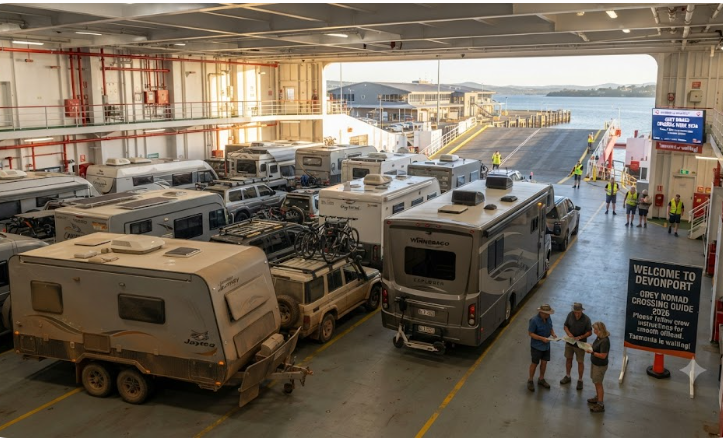
Spirit of Tasmania Ferry Guide for Grey Nomads 2026
Everything you need to know about taking your caravan or motorhome across Bass Strait — booking, costs, loading rules, arrival at Devonport and where to spend your first night in Tassie.
Last reviewed: July 2026. Pricing and sailing schedules change regularly — always confirm directly with TT-Line before booking.
- Ferry operator: TT-Line — Spirit of Tasmania I and II
- Route: Station Pier precinct, Geelong (Corio Quay) → Devonport, TAS
- Crossing options: Overnight (departs evening, arrives early morning) or Day sailing (departs morning, arrives afternoon/evening) — confirm current timetable with TT-Line
- Vehicles accepted: Caravans, motorhomes, campervans, fifth-wheelers (subject to height and length limits — see Section 4)
- Booking advice: Book 3–6 months ahead for December–February and Easter; 4–6 weeks is usually sufficient for May–August
- Pricing: Varies by sailing, cabin type, vehicle size and passenger numbers — confirm current fares at spiritoftasmania.com.au
- Self-containment: Not required for the ferry crossing itself — relevant once you are camping in Tasmania
- First night in Devonport: Multiple options available — see Section 8
📋 Table of Contents
- Why Grey Nomads Take the Spirit of Tasmania
- Booking — How Far Ahead and When to Click
- Costs and Current Fare Ranges
- Caravan and Motorhome Rules — Height, Length and Loading
- Your Two Main Crossing Options Side by Side
- Arriving at Devonport — What to Expect
- What the Spirit of Tasmania Doesn’t Tell You Online
- First-Night Planning — Where to Stop After You Dock
- Onboard Facilities — What’s There for Grey Nomads
- Senior-Friendly Onboard Experience
- Month-by-Month Crossing Conditions and Best Time to Go
- Medical and Emergency Contacts
- Mobile Coverage — Geelong, Bass Strait and Devonport
- Accessibility for Seniors and Mobility Considerations
- Senior Packing Checklist for the Crossing
- Natural Circuit — Where to Go After Devonport
- GPS Coordinates and Key Addresses
- FAQ — 10 Questions Grey Nomads Actually Ask
- Quick Verdict
- Quick-Reference Card
- Planning Tip and Internal Links
- Disclaimer
📵 Before You Set Up Camp: Can 000 Find You Here?
Most rest areas don’t have a street address. If something goes wrong overnight, “I’m at a rest stop somewhere past the servo” wastes precious minutes. Before you unhitch, open Emergency+ and check it can pin your GPS location or generate a what3words address right where you’re parked — it works offline, so no signal doesn’t mean no location. Get it free — iPhone (App Store) or Android (Google Play).
The habit that matters: do this the moment you arrive, not if you need it. Signal drops in and out at bush camps — testing it early means you already know it works before an emergency makes that the wrong time to find out.
Bonus use: while you’re in the app, grab the GPS coordinates it shows you and save them to your own Van Life Savings Spots pin — a good stop is worth remembering for next time, and now you’ve already got the exact coordinates in hand.
📍 Key Locations and Addresses
Departure Port — Geelong (Corio Quay Terminal):
-38.1127, 144.3533
Corio Quay, Geelong, VIC 3220. Confirm the exact check-in address directly with TT-Line when you book — the terminal location and check-in procedures may change.
Arrival Port — Devonport Ferry Terminal:
-41.1769, 146.3528
The Esplanade, Devonport, TAS 7310.
Open Devonport Terminal in Google Maps
⚠ GPS note: Coordinates are within 50 metres of the stated location and are provided as navigation guidance only. Always confirm on arrival against current signage.
1. Why Grey Nomads Take the Spirit of Tasmania
Tasmania is one of the most popular destinations for retired Australian travellers. The scenery is dramatic, the distances are manageable and the campgrounds are genuinely excellent. But getting there with a caravan or motorhome means crossing Bass Strait — and that means the Spirit of Tasmania ferry.
There is no road bridge. There is no alternative vehicle crossing. The Spirit of Tasmania is the only way to take your own rig to the Apple Isle, which gives TT-Line — the state-owned operator — a de facto monopoly on this crossing. That matters for pricing and booking, and grey nomads need to understand both.
The ferry runs between Geelong (on Port Phillip Bay, roughly an hour south-west of Melbourne’s CBD) and Devonport on Tasmania’s north coast. Devonport sits mid-north-coast, making it a logical starting point for either a clockwise or anti-clockwise circuit of the island.
For most over-60 travellers, the ferry is genuinely enjoyable. You load your rig, walk upstairs, find your cabin or seat, and let the ship do the work while you sleep or relax. Arriving in Devonport with your own vehicle, your own bed and your own kitchen setup already loaded is a vastly better experience than flying, hiring and scrambling. That is why the Spirit of Tasmania fills up fast — and why booking early is the single most important piece of advice in this guide.
2. Booking — How Far Ahead and When to Click
Booking the Spirit of Tasmania early is not optional advice for grey nomads — it is essential. This is especially true if you are travelling in a large rig (over 7.5 metres total length) or travelling during peak season.
Peak season: December to February and Easter
Summer sailings and school holiday periods sell out months in advance. TT-Line opens bookings approximately 12 months ahead. If you plan to cross in December, January or February, booking 3–6 months ahead is strongly recommended. Easter sailings often fill within weeks of opening.
Shoulder season: March, April, October, November
These months are increasingly popular as grey nomads discover shoulder season benefits — lower prices, less crowded campgrounds and more manageable weather. Book 6–10 weeks ahead to be comfortable. Last-minute availability is possible but not guaranteed.
Off-season: May to September
Winter crossings are quieter and often cheaper. Four to six weeks ahead is usually sufficient. Some sailings run reduced frequency in winter — confirm the current timetable with TT-Line before setting travel dates.
How to book
Book directly at spiritoftasmania.com.au. You can also call TT-Line directly — confirm the current number on their website. Third-party booking agents exist, but TT-Line’s own site typically has the most current availability and the clearest vehicle entry process. Have your rig’s exact measurements ready before you start — the system will ask for vehicle length and height, and getting this wrong creates problems at check-in.
Loyalty discounts and concessions
TT-Line has offered concession discounts for pensioner card holders in the past. Confirm whether these are current when you book — they are not always advertised prominently. Also check whether booking a return journey at the same time offers any price benefit.
3. Costs and Current Fare Ranges
TT-Line uses dynamic pricing. The cost of your crossing depends on the sailing date, how far ahead you book, the size of your vehicle, the number of passengers and the cabin or accommodation type you select.
Our recommendation: do not budget from any figure you find in a blog post, including this one. Use the TT-Line fare calculator at spiritoftasmania.com.au with your actual dates, vehicle and passenger numbers. That is the only accurate source.
That said, here is the structure of what you are paying for — so you know what to look for and what not to miss:
| Cost Component | What It Covers | Notes for Grey Nomads |
|---|---|---|
| Passenger fare (per person) | Your crossing, one way. Includes access to the ship’s public areas and a recliner seat if no cabin is booked. | Two passengers travelling together each need a separate passenger fare. Pensioner concessions may apply — confirm at time of booking. |
| Vehicle fare | Your tow vehicle or motorhome. Based on the vehicle’s length. | Measure accurately. Longer vehicles attract higher fares. |
| Caravan/trailer surcharge | Your towed unit (caravan, camper trailer, fifth-wheeler). Based on the trailer’s length. | This is charged separately from the tow vehicle. Measure your van accurately — length is measured from the tow ball to the rear of the caravan. |
| Cabin accommodation | A private or shared cabin for the overnight crossing. Options typically include two-berth and four-berth cabins, porthole or interior. | Strongly recommended for overnight crossings. Recliner seats are available but Bass Strait can be rough. A cabin is much more comfortable if you have a bad back, CPAP requirements or any mobility limitation. |
| Day sailing — no cabin required | Daytime crossings do not require overnight accommodation. Recliners and lounge areas are included in the passenger fare. | Day sailings are shorter in duration than overnight crossings. Some grey nomads find a full day at sea tiring without a cabin option — check whether cabin hire is available on your day sailing. |
| Meals and onboard dining | Restaurants, cafes and a buffet are available on board. These are not included in the base fare. | Budget separately for meals. The onboard dining is reasonable but not cheap. Bringing snacks for the crossing is sensible. |
| Pet surcharge | Pets travel in designated vehicle deck kennels. A per-pet fee applies. | You cannot access the vehicle deck during the crossing. Plan your pet’s needs (water, comfort) before departure. |
4. Caravan and Motorhome Rules — Height, Length and Loading
This is the section most grey nomads wish they had read more carefully. Loading a caravan or motorhome onto a ferry is not like driving into a car park. There are strict rules, and not understanding them creates real problems at check-in.
Height restrictions
The Spirit of Tasmania has vehicle deck height restrictions. TT-Line publishes maximum clearance figures on their website — confirm the current limit before you book. If your motorhome, caravan or any roof-mounted accessory (solar panels, air conditioner, roof pod, bike rack) exceeds the limit, your vehicle will not be loaded.
Measure your rig’s total height including all accessories. Do not assume your vehicle will clear because it looks fine. Roof-mounted air conditioners in particular can push a motorhome over the limit. Confirm your height against TT-Line’s published figures before you book — not on the day.
Length restrictions and total rig length
TT-Line measures the total rig length — your tow vehicle plus caravan, bumper to bumper, including any rear-mounted accessories (bike racks, spare tyre carriers). They also measure the individual components. Enter the correct figures when booking. Large fifth-wheelers and some longer rigs may not be accepted — confirm directly with TT-Line if your rig is over 19–20 metres combined length.
Width
Standard vehicle widths (up to approximately 2.5 metres) are typically accepted. Wider rigs — including some slide-out motorhomes when slides are extended — should be confirmed with TT-Line. Slides must be retracted for loading and transit.
How vehicles are loaded
You drive your rig onto the ship via a vehicle ramp under the direction of TT-Line crew. They direct you into your assigned vehicle deck position. In most cases, tow vehicles remain hitched to their caravans for the crossing — you do not disconnect. Motorhomes drive on as a single unit.
The vehicle deck is secured for sea. Do not expect to access the vehicle deck during the crossing — this is a strict safety rule. If you need medication, CPAP equipment, overnight bags or anything else from your rig, retrieve it before the vehicle deck closes. This is covered in the checklist section of this guide.
LPG cylinders
LPG cylinders on caravans and motorhomes must be turned off before loading. TT-Line crew will check. This is a safety regulation and is non-negotiable. Ensure all LPG valves are fully closed before you drive onto the ship.
Securing your rig on board
TT-Line crew chock and secure vehicles on the vehicle deck using their own equipment. You do not need to bring your own chocks or straps for this purpose. However, ensure any items inside your caravan or motorhome are stowed securely before loading — Bass Strait can be rough and unsecured items will move around.
5. Your Two Main Crossing Options Side by Side
Every grey nomad crossing Bass Strait faces the same core decision: overnight crossing or day sailing. Both have genuine advantages. Neither is the obvious right answer for everyone.
| Feature | Overnight Crossing | Day Sailing |
|---|---|---|
| Typical departure time | Evening (often 7:30–9:00 pm — confirm with TT-Line) | Morning (often 8:00–9:30 am — confirm with TT-Line) |
| Typical arrival time | Early morning (often 6:00–7:30 am) | Afternoon/early evening (often 5:00–7:00 pm) |
| Crossing duration | Approximately 10–11 hours | Approximately 9–10 hours |
| Cabin requirement | Yes — strongly recommended. Recliner seats available but uncomfortable for a full night at sea. | No cabin required. Recliner seats and lounges are available for the duration. |
| Cost | Higher — cabin accommodation adds significantly to the base fare. | Lower — no cabin needed. May be cheaper overall depending on sailing. |
| Best for grey nomads with… | Back pain, CPAP requirements, light sleeping, preference for arriving fresh and ready to drive. | Budget-conscious travellers, those who enjoy daytime scenery, those who sleep poorly in unfamiliar beds. |
| Arrival timing and first night | You arrive early morning. First day in Tasmania is fully available. However, campgrounds may not have sites available at 6:00 am — plan a first stop accordingly. | You arrive late afternoon or evening. First night requires a pre-booked site close to Devonport — arriving after dark with no booking is not ideal. |
| Sea conditions | Bass Strait can be rough overnight in winter. A cabin provides a bed and something to hold on to. Recliners on the open lounge deck can be miserable in heavy seas. | Same sea conditions, but easier to manage if you are awake and mobile. Daytime swell is usually less psychologically difficult than being woken by rolling seas at 2:00 am. |
| Honest trade-off | More comfortable, more expensive, more logistically straightforward on arrival. The right choice for most senior travellers with any health consideration. | Cheaper, but requires a firm plan for the first night. Fine for travellers who are sea-confident and sleep well anywhere. Not ideal in rough winter crossings without a cabin. |
6. Arriving at Devonport — What to Expect
Devonport is a working regional city on Tasmania’s north coast, population approximately 30,000. It is well-equipped to receive ferry arrivals. The terminal precinct is straightforward to navigate, and the city has fuel, supermarkets, medical facilities and caravan parks within a short drive of the wharf.
Disembarkation process
Once the ship docks, passengers are called back to the vehicle deck in stages. You will receive instructions on board. Do not rush — the process is orderly and senior travellers are generally treated courteously. Vehicle deck access is granted by TT-Line crew. Drive off the ship as directed.
On a busy summer morning, disembarkation can take 30–60 minutes from docking to your rig reaching the road. Factor this into your first-day planning. On a quiet winter sailing, it can be much faster.
Overnight arrival (early morning)
Overnight sailings typically dock in Devonport between approximately 6:00 and 7:30 am. This is early. Many campgrounds do not open their gates or their check-in process this early. Some grey nomads drive directly to a free rest area or roadside stop to have breakfast and wait until a campground is open. This is a sensible approach — see Section 8 for first-night options.
Day sailing arrival (afternoon/evening)
Day sailings typically arrive in the late afternoon or early evening. This gives you enough time to reach a campground before dark — but only if the campground is pre-booked and within a reasonable distance of Devonport. Arriving in Devonport at 6:00 pm without a plan is genuinely stressful with a caravan. Book ahead.
What Devonport has near the terminal
- Fuel stations within a few kilometres of the terminal — confirm local options on arrival
- Woolworths and Coles supermarkets within the city centre for restocking
- Laundromats, pharmacies and a hospital (see Section 12)
- Caravan parks within 5–10 kilometres of the ferry terminal
7. What the Spirit of Tasmania Doesn’t Tell You Online
Most travel guides — including TT-Line’s own FAQ — cover the basics. This section covers the specific, practical gaps that grey nomads consistently report catching them off guard.
1. The vehicle deck closes before departure — and that’s it
TT-Line locks the vehicle deck once loading is complete. This typically happens 30–45 minutes before departure. If you realise at 8:45 pm that your CPAP machine, medications, glasses or overnight bag are in the van — and departure is at 9:00 pm — you cannot get them. The crew will not unlock the deck for individual passenger retrieval. This catches people out every single sailing. The solution is not to try harder to remember — it is to use a pre-departure checklist. See Section 15.
2. Bass Strait has a genuine sea motion problem for some travellers
Most travel content about the Spirit of Tasmania underplays Bass Strait’s sea conditions. The strait is one of the roughest stretches of water in the Southern Hemisphere. In winter particularly, swells of 2–4 metres are common. This is not dangerous on a modern ferry — the ships are designed for it — but it is genuinely uncomfortable. If you have any history of motion sickness, sea sickness tablets taken well before departure make an enormous difference. Ask your GP or pharmacist before you travel. Over-the-counter options like Travacalm or Kwells work for many people. Ginger tablets are a gentler alternative some travellers find effective.
3. The LPG turn-off rule catches people off guard at the ramp
TT-Line crew check LPG cylinder valves before you drive on board. If they are not turned off, you will be directed to pull over and turn them off before you can proceed. This creates a delay and causes stress during a busy loading period. Turn off all LPG before you join the vehicle loading queue — not when you reach the ramp.
4. Dynamic pricing means your neighbour’s cabin may have cost half what you paid
TT-Line uses revenue management pricing. Book early for the same sailing and you will typically pay less than someone who books two weeks out. However, last-minute cancellations occasionally create cheaper fares on popular sailings. If you are flexible on dates, checking prices across several departure options before booking often reveals meaningful price differences between sailings only days apart.
5. The Geelong terminal location has changed — confirm it before you travel
Spirit of Tasmania sailings moved from Station Pier in Port Melbourne to Geelong (Corio Quay) as part of TT-Line’s operational shift. Some older travel guides, caravan club documents and even some GPS mapping systems still show the old Port Melbourne departure point. Always confirm the current departure terminal with TT-Line when you book. Arriving at the wrong terminal on departure day is not recoverable.
6. Pets have specific welfare requirements you cannot meet mid-crossing
Your pet travels in a kennel area on the vehicle deck. You cannot access the vehicle deck during the crossing. This means no toilet breaks, no comfort checks and no water top-ups from you for the full duration. You must plan your pet’s needs before loading — exercise them thoroughly, ensure they are well hydrated, and check that the kennel setup meets their needs for a full overnight or day crossing. TT-Line crew do make welfare checks, but the primary responsibility is yours to prepare your animal before the vehicle deck closes.
7. Early morning arrival and no campground access is a real planning gap
This is the most commonly overlooked logistical issue for first-time grey nomad ferry travellers. Overnight sailings arrive in Devonport before most campground reception desks open. Many travellers arrive expecting to drive straight to their site — and find themselves waiting in a carpark. Research your chosen campground’s check-in time before you travel and build a realistic first-morning plan around it.
8. First-Night Planning — Where to Stop After You Dock
Your first night in Tasmania needs more planning than any other night of your trip. Arrival timing — particularly on overnight sailings — often does not align neatly with campground check-in times. Here are the realistic options.
Option A: Pre-book a Devonport caravan park for night one
Several caravan parks operate in and around Devonport. Pre-booking one within 15–20 minutes of the terminal solves the first-night problem completely. If you arrive early morning, you can park, wait, have breakfast, and check in when reception opens. If you arrive late afternoon or evening, a pre-booked site means you drive straight in. This is the most reliable option for grey nomads.
Search for Devonport caravan parks on your preferred booking platform (Campermate, Big4, WikiCamps) to compare current options, facilities and pricing. Confirm directly with the park that they accommodate your rig size and that their check-in time works with your expected arrival.
Option B: Use a free rest area near Devonport for the first night
Tasmania has good free camping options, but not all of them are suitable for large rigs right off the ferry. The Mersey Bluff area near Devonport is a commonly used first stop for travellers arriving early — a flat, open area where you can park, have breakfast and make a plan. Confirm current rules and any self-containment requirements before you rely on this option.
For a comprehensive guide to free camping options across the state, see our Free Camping Tasmania guide.
Option C: Drive directly to your first touring stop
Some grey nomads prefer to push directly to their first destination — Stanley, Ulverstone, Penguin or further east toward Launceston — on arrival day. This is fine on a day sailing if you arrive early enough. On an overnight sailing arriving at 6:30 am, it means driving 90+ kilometres before you have had a proper sleep, which is not ideal for most seniors. Be honest with yourself about driving fatigue.
9. Onboard Facilities — What’s There for Grey Nomads
| Facility | Available Onboard | Notes for Grey Nomads |
|---|---|---|
| Private cabins | Yes — two-berth and four-berth options, porthole and interior | Book early — cabins sell out well ahead of popular sailings. Porthole cabins cost more but provide natural light and a sense of orientation. |
| Recliner seats | Yes — in dedicated lounges | Acceptable for daytime crossings. Not recommended for overnight crossings for anyone with back pain, sleep difficulties or mobility issues. |
| Restaurant / buffet dining | Yes — sit-down restaurant and buffet available | Quality is generally good. Book a sitting time for the restaurant if this is important to you — popular times fill quickly on full sailings. |
| Café and snack bar | Yes | A lighter and cheaper option than the restaurant. Suitable for a snack or light meal. |
| Bars | Yes | A licensed bar operates on board. Note that alcohol and rough seas are not a good combination for motion sickness management. |
| Gift shop / retail | Yes | Tasmania-themed gifts and travel items available. |
| Accessible bathrooms | Yes — accessible toilets available | Confirm cabin accessibility requirements when booking if you have mobility limitations. |
| Medical officer | Confirm with TT-Line — trained crew member typically available | Confirm onboard medical capacity directly with TT-Line at time of booking if you have a significant medical condition. |
| Wi-Fi | Limited connectivity at sea — do not rely on it | Download maps, medication lists and any documents you need before departure. Mobile coverage is minimal in Bass Strait. |
| Pet kennels (vehicle deck) | Yes — designated area on vehicle deck | Pets are not permitted in passenger areas. Owners cannot access vehicle deck during crossing. |
| Power outlets (cabins) | Yes — in cabins | CPAP users: bring your CPAP to your cabin, not left in the van. Cabin power is suitable for standard CPAP machines. |
| Deck access | Yes — outdoor decks available | Dress warmly. Bass Strait is cold outside the summer months. Wind on the outer decks can be strong even in good weather. |
10. Senior-Friendly Onboard Experience
The Spirit of Tasmania is a large, well-equipped vessel. For most grey nomads, the onboard experience is genuinely comfortable — but there are specific considerations worth knowing before you board.
Movement through the ship
The ship has multiple decks connected by stairs and lifts. If you have mobility limitations, confirm at check-in that a lift-accessible route connects your cabin level to the dining areas and bathrooms. The ship moves in rough weather — handrails are present throughout, but walking through the vessel in heavy swells requires care.
Sleep quality in cabins
Overnight cabin beds are compact but functional. The mattresses are standard hotel quality. In rough conditions, you will feel the ship moving. Most travellers find this manageable. If you are a particularly light sleeper or motion-sensitive, bring earplugs and consider a motion sickness tablet regardless of current weather forecasts — Bass Strait conditions can change overnight.
CPAP users
Bring your CPAP machine, power adaptor and a night’s supply of distilled water to your cabin. The cabin power outlet will run a standard CPAP. Do not leave it in the caravan. This is important enough that it appears first in the packing checklist in Section 15.
Medication management
All medications for the crossing period — including morning medications you will take on arrival day — must come to your cabin with you. This includes refrigerated medications if required. Confirm with TT-Line whether cabin-level refrigeration is available, or bring a small soft cooler if needed for the crossing duration.
Motion sickness management
Motion sickness affects some grey nomads more than younger travellers. If you have any history of seasickness or significant inner ear issues, speak with your GP before the crossing. Prescribed medications (such as hyoscine patches) work best when applied hours before exposure to motion. Over-the-counter tablets should be taken 30–60 minutes before departure, not after symptoms start. Once you are seasick on Bass Strait, recovery is difficult until conditions calm or you reach port.
11. Month-by-Month Crossing Conditions and Best Time to Go
Bass Strait conditions vary significantly through the year. So does demand, pricing and campground availability in Tasmania. Use this table to plan your crossing timing.
| Month | Bass Strait Conditions | Tasmania Weather | Demand / Booking Pressure | Grey Nomad Verdict |
|---|---|---|---|---|
| January | Summer — generally calmer, though swells still possible. Busiest sailing month. | Warm to hot, long days. Bushfire risk in drier areas. | Very high. Book 3–6 months ahead. Prices peak. | Best weather but most crowded and most expensive. Fine if pre-booked well ahead. |
| February | Summer — similar to January. Still busy. | Warm. Fire danger easing late month. | High. Book 3–4 months ahead. | Good option if January is fully booked. Campgrounds start to ease slightly late February. |
| March | Autumn settling in. Some increased swell frequency. | Excellent — warm days, cool nights, low crowds. Best foliage begins. | Moderate-high. Book 6–8 weeks ahead. | Excellent month for grey nomads. Weather and campground availability are both good. |
| April | Bass Strait becoming rougher. Easter sailings very busy. | Cooler, stunning autumn colour. Some rain. | High around Easter. Book 3–4 months ahead for Easter. | Excellent conditions for touring, but book Easter period very early. Non-Easter April is easier. |
| May | Increasingly rough. More frequent swells of 2–3 metres. | Cool to cold. Short days. Some crisp, clear days excellent for touring. | Low. Easy to book. Good prices. | Good for the budget-conscious. Not for those who are sea-sensitive. Layers and rain gear required. |
| June | Winter. Rough conditions common. 3–4 metre swells possible overnight. | Cold, wet, short days. Snow on highlands. Some sunny days. | Low. Easiest booking period. Lowest fares typically. | For confident, sea-hardy travellers only. Tasmania’s wilderness is stunning in winter but requires preparation. |
| July | Winter. Roughest month for Bass Strait crossings on average. | Cold. Snow common on highlands and inland. Short days. | Low. Good fares. Book 4 weeks ahead is usually sufficient. | Not recommended for first-time grey nomad ferry travellers. Fine for the experienced and well-prepared. |
| August | Winter ending. Still rough. Some improvements late August. | Cold but spring beginning. Wildflowers start appearing. | Low-moderate. Good fares. | Improving month-by-month. Late August can be pleasant on calm crossings. Be prepared for rough weather. |
| September | Spring. Conditions improving. Still variable. | Warming. Spring wildflowers. Unpredictable but often lovely days. | Moderate. Starting to book ahead more. Book 4–6 weeks ahead. | Good shoulder season option. Conditions improving, crowds not yet back. A solid choice. |
| October | Spring. Generally improving swell conditions. | Warm days arriving. Long days returning. Excellent touring weather. | Moderate-high. Book 6–8 weeks ahead. | One of the best months overall. Good weather, manageable crowds, reasonable prices. |
| November | Late spring. Generally good. Occasional rough patches. | Warm to hot. Long days. Excellent. | High. Book 8–10 weeks ahead. Prices rising. | Excellent month. Busy but not at peak summer pricing or peak summer crowds. |
| December | Summer beginning. Generally calmer but still variable. | Hot. Long days. Busy campgrounds. | Very high. Book 3–6 months ahead for Christmas/New Year sailings. These sell out. | Peak season pricing and crowds. Pre-Christmas sailings are among the hardest to book. Fine if organised well ahead. |
12. Medical and Emergency Contacts
Medical facilities in Devonport are reasonably well resourced for a regional Tasmanian city. Launceston — Tasmania’s second-largest city — is approximately 100 kilometres to the east and has a larger hospital.
| Service | Location | Contact | Notes |
|---|---|---|---|
| Emergency services | All locations | 000 | Police, ambulance, fire. Works even without mobile credit. |
| Non-emergency health advice | Phone service | 1800 022 222 (Healthdirect) | 24/7 registered nurse advice line. Useful for deciding whether you need to go to hospital or can wait for a GP. |
| Mersey Community Hospital | Latrobe, TAS (approx. 10 km south of Devonport) | Confirm locally via healthdirect.gov.au | Main hospital serving the Devonport region. Confirm current contact details and emergency department hours before travel. |
| Launceston General Hospital | Launceston, TAS (approx. 100 km east of Devonport) | Confirm locally via healthdirect.gov.au | Major regional hospital with a full range of specialist services. If you need anything beyond emergency stabilisation in Devonport, you may be transferred here. |
| Devonport GP clinics | Devonport city | Confirm locally via healthdirect.gov.au or 1800 022 222 | Multiple GP practices operate in Devonport. Walk-in availability is limited — call ahead. |
| Pharmacies | Devonport city centre | Confirm locally | Several pharmacies operate near the city centre. Useful for over-the-counter medications, CPAP supplies and minor health needs on arrival. |
| RFDS (Royal Flying Doctor Service) | Tasmania | 000 for emergencies | RFDS provides aeromedical retrieval from remote Tasmanian locations if required. |
13. Mobile Coverage — Geelong, Bass Strait and Devonport
Mobile coverage is relevant at three points: at the Geelong terminal before boarding, during the crossing itself, and in and around Devonport on arrival.
Geelong terminal (pre-boarding)
Geelong is well covered by all three major carriers — Telstra, Optus and Vodafone. You will have strong data and voice coverage in the terminal precinct and in the vehicle queue. Use this time to download offline maps, check your booking, and set up Emergency+ before you board.
During the crossing — Bass Strait
There is no meaningful mobile coverage once the ship is out of port. Bass Strait is open ocean — there are no towers. Satellite-based connectivity may provide limited Wi-Fi on board — confirm current status with TT-Line — but do not rely on it for anything critical. Assume you will have no mobile internet for the duration of the crossing.
This means: download your Devonport maps offline before you board. Download your campground booking confirmation to your phone in a format that does not require an internet connection. Have your contacts saved locally, not just in a cloud app that needs signal to open.
Devonport on arrival
Devonport city has coverage from Telstra, Optus and Vodafone in the urban area. Telstra typically offers the broadest regional coverage in rural and remote Tasmania beyond Devonport. If you are planning to travel to the west coast, the Tarkine or remote national parks, Telstra is strongly recommended as your primary carrier. Optus and Vodafone coverage drops quickly outside main centres.
14. Accessibility for Seniors and Mobility Considerations
The Spirit of Tasmania is a large vessel with genuine accessibility features. It is not perfect for all mobility situations, and grey nomads with specific requirements should confirm details directly with TT-Line before booking.
Lifts between decks
Lifts connect passenger decks on both vessels. If you use a walking frame, wheelchair or crutches, confirm at check-in that your cabin is accessible via lift from the vehicle boarding level. In rough weather, navigating a ship using stairs is difficult — a lift-accessible cabin is essential for anyone with limited mobility.
Accessible cabins
TT-Line offers accessible cabins on both vessels. These must be requested and confirmed at booking — do not assume a standard cabin will be suitable. Accessible cabins typically feature wider doorways, accessible bathroom facilities and lower bed heights. Availability is limited — book these early.
Walking distances on board
The ships are large. The distance from some cabin locations to the dining areas or outer decks is significant. If you have limited walking endurance, plan your onboard movements accordingly. A small bag to carry snacks, medications and a book reduces the number of trips you need to make.
Loading and unloading the vehicle deck
Vehicle deck loading requires you to drive your rig on and off the ramp unaided. There is no provision for a separate driver — you must be able to drive your vehicle onto and off the ship yourself. If you have had a recent medical event affecting your driving ability, this needs to be assessed before you book the crossing.
Devonport terminal accessibility
The Devonport terminal is generally flat and accessible for most mobility levels. Confirm current terminal layout with TT-Line if you use a wheelchair or mobility scooter.
15. Senior Packing Checklist for the Crossing
This checklist covers what to bring to your cabin before the vehicle deck closes. Once the deck is locked, you cannot retrieve anything from your rig until arrival. Expand each item for the specific reason it matters on this crossing.
☐ CPAP machine, power cord and distilled water
Cabin power outlets are standard Australian 240V. Bring your CPAP to the cabin — it cannot be used in the van once the vehicle deck is locked. Pack enough distilled water for the overnight crossing plus your first morning if you use a humidifier.
☐ All medications for the crossing and arrival day
Include morning medications you will take on arrival day, not just those for overnight. If you take refrigerated medications, confirm with TT-Line whether in-cabin refrigeration is available, or bring a soft cooler with ice for the crossing duration.
☐ Motion sickness tablets
Take these 30–60 minutes before departure — not after symptoms start. Bass Strait can be rough especially in winter months (May–August), and once seasick it is very difficult to recover until you reach port. Speak with your GP or pharmacist about the best option for you given any other medications you take.
☐ Overnight bag with toiletries and change of clothes
A small overnight bag with toothbrush, toiletries, pyjamas and a change of clothes for arrival day. The vehicle deck is inaccessible for the full crossing — typically 10–11 hours overnight. You will want to be able to freshen up before disembarkation.
☐ Glasses and hearing aids (and spare batteries)
These are the most commonly forgotten items. They are small and often stored in the van. Double-check these specifically before leaving the vehicle deck. Spare hearing aid batteries are small and light — keep them in your cabin bag permanently.
☐ Mobility aid (walking stick, frame or wheelchair)
The ship moves in rough weather. A walking stick provides stability on deck and in passageways if conditions deteriorate. If you use a frame or wheelchair, it must come to your cabin level — it cannot be accessed from the vehicle deck once locked.
☐ Phone charger and portable power bank
Cabin power outlets allow phone charging overnight. A power bank is a useful backup. Download Emergency+, offline Google Maps for Tasmania and your campground booking confirmation before you board — mobile data does not work in Bass Strait.
☐ Warm layers and a windproof jacket
Outer decks of the Spirit of Tasmania are exposed and cold, even in summer evenings. If you want to watch the departure from the deck, you will be cold in a t-shirt. Devonport on early morning arrival is cold in autumn and winter. Pack warm layers in your cabin bag, not just in the van wardrobe.
☐ Snacks and a reusable water bottle
Onboard food is available but not cheap. Having a few snacks and a water bottle in your cabin bag reduces unnecessary trips to the café and is useful if you are feeling unwell from sea motion and don’t want to walk to the dining area.
☐ Booking confirmation and ferry ticket (printed or offline screenshot)
Mobile internet does not work mid-crossing. A printed booking confirmation or an offline screenshot means you can show your details on arrival in Devonport without needing a data connection. Also useful if you need to show a specific sailing time or reference number at the terminal.
☐ Tasmania maps or offline navigation
Download your Tasmanian offline maps in Google Maps or Maps.me before you board. Bass Strait has no signal. If you rely on live-data navigation and forget to cache the maps, you will arrive in Devonport unable to navigate to your first campground without a signal.
☐ Pet needs — exercised, watered and settled before loading
You cannot access the vehicle deck kennel area during the crossing. Exercise your pet thoroughly before you join the vehicle queue. Ensure water access is set up in the kennel area and that the kennel setup meets their overnight comfort needs — TT-Line crew do welfare checks but cannot provide individual pet management.
16. Natural Circuit — Where to Go After Devonport
Devonport is a flexible starting point for a Tasmanian circuit. The island is manageable in 3–6 weeks by caravan or motorhome. Most grey nomads choose either a clockwise or anti-clockwise loop.
Clockwise from Devonport (heading east first)
Head east along the north coast toward Launceston, then south to the Midlands and the historic sites around Campbell Town, then east to the Freycinet Peninsula and the east coast. Continue south to Hobart, then west through the Derwent Valley toward Queenstown and Strahan, then north through the west coast back to Devonport. This is approximately 1,600–2,000 km depending on detours.
Anti-clockwise from Devonport (heading west first)
Head west to Stanley and the northwest coast, then south to the wild west — Cradle Mountain, Strahan, Queenstown — then east across the south to Hobart, up the east coast and back north. This puts the most remote and weather-exposed section (the west coast) early in the trip when your rig is fresh and you are fully rested.
Free camping throughout Tasmania
Tasmania has excellent free camping options, including national park camping with a Parks Pass, remote coastal sites and some council rest areas. For a comprehensive guide to free and low-cost camping across the state, see our Free Camping Tasmania guide.
For smart tips on reducing your overall costs during a Tasmanian circuit — including fuel, food and overnight strategies — see our Van Life Savings Spots guide.
17. GPS Coordinates and Key Addresses
| Location | GPS Coordinates | Address / Notes |
|---|---|---|
| Spirit of Tasmania — Geelong Departure Terminal (Corio Quay) | -38.1127, 144.3533 | Corio Quay, Geelong, VIC 3220. Confirm exact check-in address with TT-Line — terminal access points may vary. |
| Spirit of Tasmania — Devonport Arrival Terminal | -41.1769, 146.3528 | The Esplanade, Devonport, TAS 7310. |
| Devonport city centre | -41.1800, 146.3597 | Stewart Street precinct, Devonport, TAS 7310. Supermarkets, pharmacies and services within walking distance of main street. |
| Mersey Bluff area (near terminal) | -41.1685, 146.3408 | Mersey Bluff, Devonport, TAS 7310. Commonly used rest and orientation area for new arrivals — confirm current access and any self-containment rules before use. |
| Latrobe (location of Mersey Community Hospital area) | -41.2372, 146.4173 | Latrobe, TAS 7307. Approximately 10 km south of Devonport. Confirm Mersey Community Hospital location and current contact details via healthdirect.gov.au. |
⚠ GPS note: Coordinates are within 50 metres of the stated location and are provided as navigation guidance only. Always confirm on arrival against current signage.
18. FAQ — Questions Grey Nomads Actually Ask
How far ahead do I need to book the Spirit of Tasmania with a caravan?
For December to February sailings — including New Year and the Australia Day period — book 3–6 months ahead. These are the most popular sailings and they sell out. Easter sailings are similarly congested and should be booked as early as TT-Line opens the schedule (typically about 12 months ahead). For March, April, October and November, 6–10 weeks ahead is usually sufficient. For the winter months of June, July and August, 4–6 weeks is generally comfortable, though some sailings have reduced frequency in winter so availability can still be limited. As a general rule: if your travel dates are firm, book as soon as TT-Line opens the schedule for those dates. Dynamic pricing means early bookings are usually cheaper as well as more available.
Can I stay in my caravan or motorhome during the crossing?
No. The vehicle deck is locked once the ship departs and remains locked until arrival. You cannot access your van, motorhome or any vehicle for the full duration of the crossing — typically 9–11 hours depending on the sailing. All items you need for the crossing (medications, CPAP, overnight bag, mobility aids, glasses, hearing aids) must be brought to your cabin or recliner area before the vehicle deck closes. The packing checklist in Section 15 of this guide is specifically designed for this reason.
What happens if my caravan is too tall or too long for the ferry?
If your rig exceeds TT-Line’s published height or length limits, it will not be loaded. TT-Line crew measure vehicles at the terminal, and if your rig exceeds the limits you declared when booking, you may be turned away and lose your fare. Measure your rig accurately — including all roof-mounted accessories (solar panels, air conditioners, bike racks) for height, and all rear-mounted accessories (spare tyre carriers, extended draw bars) for length. Confirm the current limits with TT-Line before you book. Do not rely on figures from older guides or forum posts — the limits are set by the vessel configuration and can change.
Is Bass Strait rough? Should I worry about seasickness?
Bass Strait is one of the roughest stretches of water in the Southern Hemisphere. On a calm summer day, the crossing can be smooth and pleasant. In winter, swells of 2–4 metres are common and the crossing is genuinely rough. The ship is designed for these conditions — it is safe — but rough crossings are uncomfortable. If you have any history of motion sickness or seasickness, speak with your GP or pharmacist before travel. Seasickness medication works best when taken well before exposure to motion — not after symptoms start. Taking something as a precaution on a crossing you are uncertain about is always the smarter choice.
Do I need a self-containment certificate to take my van to Tasmania?
Self-containment is not required for the ferry crossing itself. Once you are in Tasmania, self-containment rules apply in the same way they apply elsewhere in Australia — they are relevant for free camping and some specific campground types. If your rig is CMVR self-contained certified, that certification is recognised in Tasmania. Check the requirements for the specific sites you plan to use during your Tasmanian circuit. Our Free Camping Tasmania guide covers this in detail.
What do I do with my pet during the crossing?
Your pet travels in designated kennel areas on the vehicle deck. They are not permitted in any passenger area of the ship. You cannot access the vehicle deck during the crossing, so your pet will be alone (with TT-Line crew welfare checks) for the full duration. Before loading, exercise your pet thoroughly, ensure adequate water access is set up in the kennel area, and confirm TT-Line’s current pet booking and welfare procedures when you book. TT-Line charges a per-pet fee, which must be included in your original booking. If you arrive with a pet not declared in your booking, there may be issues at the terminal.
Which is better for grey nomads — the overnight crossing or the day sailing?
For most grey nomads with any health consideration — CPAP requirements, back pain, motion sickness history, light sleeping, or mobility limitations — the overnight crossing with a private cabin is the better option. You sleep while the ship crosses, arrive in Devonport in the morning with a full day ahead, and you are in a proper bed rather than a recliner seat for the duration. It costs more. That extra cost is worth it for most senior travellers. The day sailing is a reasonable option if you are confident at sea, sleep poorly in unfamiliar beds, or are managing costs carefully — but ensure you have a pre-booked campground close to Devonport for the evening arrival.
What should I do in Devonport on my first morning after the overnight sailing?
After an overnight sailing arriving around 6:00–7:30 am, most campgrounds will not be ready to check you in. The practical first-morning routine for grey nomads is: drive off the ship, head to a fuel station and fill up, use the amenities, have breakfast at a café or in a layby, and contact your campground to confirm expected check-in time. Do not attempt to drive long distances on the morning after an overnight crossing without resting first. Your first day in Tasmania should be a short and slow one. Devonport has good coffee and a pleasant waterfront — use it.
What is the exact address of the Spirit of Tasmania terminal in Geelong?
The Spirit of Tasmania departs from Corio Quay in Geelong, Victoria. The GPS coordinates provided in this guide (-38.1127, 144.3533) are within 50 metres of the terminal area. However, terminal access, vehicle marshalling areas and check-in points can change — especially for large vehicles arriving with caravans. Confirm the current check-in address and any vehicle staging instructions directly with TT-Line when you book. TT-Line typically sends pre-departure instructions with your booking — read these carefully.
What is the situation with the new Spirit of Tasmania IV and V ferries?
Tasmania’s incoming Spirit of Tasmania IV and V ferries have faced significant delays due to port infrastructure limitations in Devonport, with a firm launch date not confirmed as of July 2026. Grey nomads should book based on the current fleet — Spirit I and II — and check TT-Line’s website for updates before assuming any new-ship features, capacity or timetables apply to their crossing. Do not plan your trip around features or specifications that have been announced for vessels not yet in service.
19. Quick Verdict
The Spirit of Tasmania is the only way to take your own rig to Tasmania, and for most grey nomads it is genuinely a good experience. The ships are large, the onboard facilities are comfortable, and arriving in Devonport with your own van and kitchen already set up is vastly better than flying and hiring.
The key success factors are simple: book early (especially for peak season), measure your rig accurately before you enter anything online, bring everything you need for the crossing to your cabin before the vehicle deck locks, take seasickness precautions if you have any history of motion sensitivity, and do not try to drive long distances on your arrival morning after an overnight crossing.
The Spirit of Tasmania IV and V delays are worth monitoring — but they do not affect the current crossing experience. Plan around the existing fleet and check TT-Line’s site for any service updates before you finalise your booking.
For most retired travellers with a well-planned approach, the crossing is the highlight of the journey — not just the gateway to it. Tasmania rewards those who arrive prepared.
20. Quick-Reference Card — Screenshot This
| Category | Detail |
|---|---|
| Ferry operator | TT-Line — Spirit of Tasmania I and II (current fleet as of July 2026) |
| New ships update | Spirit IV and V delayed — confirm status at spiritoftasmania.com.au before travel |
| Route | Geelong (Corio Quay) → Devonport, TAS |
| Overnight crossing duration | Approximately 10–11 hours |
| Day sailing duration | Approximately 9–10 hours |
| Booking website | spiritoftasmania.com.au |
| Peak season book-ahead | 3–6 months (Dec–Feb and Easter) |
| Winter book-ahead | 4–6 weeks generally sufficient |
| Height limit | Confirm current limit with TT-Line — measure all roof accessories |
| LPG rule | All cylinders must be off before loading — crew will check |
| Vehicle deck access during crossing | None — deck is locked from departure to arrival |
| CPAP onboard | Bring to cabin — 240V outlet available |
| Cabin recommendation | Strongly recommended for overnight crossings — book a private 2-berth |
| Mobile coverage at sea | None — download offline maps before boarding |
| Emergency number | 000 |
| Health advice line | 1800 022 222 (Healthdirect, 24/7) |
| Devonport terminal GPS | -41.1769, 146.3528 |
| Geelong terminal GPS (approx.) | -38.1127, 144.3533 — confirm exact check-in address with TT-Line |
| First night recommendation | Pre-book a Devonport area caravan park — do not arrive without a plan |
| Best months for grey nomads | March, October, November — good weather, manageable crowds |
21. Planning Tip and Useful Links
- ✅ Book your crossing at spiritoftasmania.com.au — do not wait
- ✅ Check TT-Line’s site for any Spirit of Tasmania IV/V updates before assuming new-ship features apply
- ✅ Measure your rig’s total length and maximum height before entering any booking details
- ✅ Confirm current vehicle height and length limits directly with TT-Line
- ✅ Pre-book your first night’s campground in Devonport before you travel
- ✅ Download Emergency+ and test it before you board — iPhone | Android
- ✅ Download offline maps for Tasmania before boarding — there is no mobile data in Bass Strait
- ✅ Pack a cabin bag with all crossing essentials before you join the vehicle loading queue
- ✅ For free camping throughout Tasmania, see our Free Camping Tasmania guide
- ✅ For smart ways to reduce trip costs across your Tasmanian circuit, see our Van Life Savings Spots guide
22. Disclaimer
Disclaimer: This guide is published for general information purposes and is accurate to the best of our research as of July 2026. TT-Line ferry schedules, fares, vehicle restrictions, cabin configurations, onboard facilities and terminal locations are subject to change without notice. The Spirit of Tasmania IV and V delivery timeline is subject to change — confirm current fleet status directly with TT-Line. Always confirm all details — including pricing, vehicle limits, sailing times and terminal addresses — directly with TT-Line at spiritoftasmania.com.au before booking.
Medical and emergency contact numbers are provided as a guide only. Hospital details should be confirmed via healthdirect.gov.au before travel. In any medical emergency, call 000.
GPS coordinates are provided within 50 metres of the stated location and are for navigation guidance only. Always confirm on arrival against current signage. retiretovanlife.com accepts no liability for decisions made based on information in this guide.
COPY PROMPT ➔ ASK AI ➔ SAVE TO FORM ➔ ADD SPOT PIN ➔ GET DIRECTIONS
📍 Interactive map — find free camps, rest areas and overnight stops. Enable location for best results.

As an affiliate, I earn from qualifying purchases at no extra cost to you.
Exclusive Offer: Get 5% OFF all StarterStopper immobiliser products with promo code: RTV5
Visit StarterStopper.com to see our data-backed security solutions
As an affiliate, I earn from qualifying purchases at no extra cost to you.