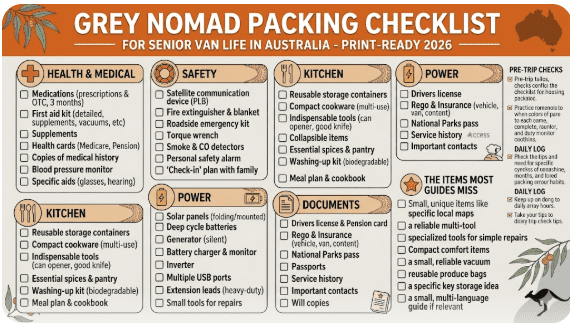
Grey Nomad Packing Checklist – Everything Senior Van Life Travellers Actually Need in 2026
The most complete packing checklist for senior grey nomads in Australia — covering health, safety, kitchen, bedding, power, communications, vehicle essentials and the items most guides forget to mention until something goes wrong.
📅 Last reviewed: June 2026 | Australia-wide | Relevant to motorhomes, caravans, campervans and converted vans
Most grey nomad packing lists are written by people who have never left their driveway for longer than a fortnight. They cover sleeping bags and portable chairs and forget insulin storage, PLB registration, CPAP battery capacity and the specific documents that will save you hours at a remote hospital admission desk. This list is different. It is built around the genuine needs of Australian travellers aged 60 and over — people who may be managing chronic health conditions, travelling solo, heading into areas with no mobile coverage, and planning to be away for months rather than weeks. Pack from this list and you will leave prepared. Leave items out and you will discover exactly why they were on it.
- Who this is for: Australian grey nomads aged 60+ in motorhomes, caravans and campervans
- How to use it: Print each section, tick as you pack, keep a copy in your glove box
- Most critical section: Section 2 — Health and Medical (read this first regardless of everything else)
- Most overlooked section: Section 8 — Documents and Legal (nobody thinks about this until they need it)
- Most underestimated section: Section 6 — Vehicle and Mechanical (the expensive one when you get it wrong)
- Print tip: Print each section separately — laminate the vehicle checklist for daily use
- Best companion resource: Vanlife Savings Spots directory for planning your overnight stops
Table of Contents
- Before You Pack: The Senior Grey Nomad Planning Framework
- Health and Medical Checklist — The Most Important Section
- Safety and Emergency Equipment Checklist
- Kitchen and Food Preparation Checklist
- Bedding, Clothing and Personal Care Checklist
- Vehicle and Mechanical Checklist
- Power, Solar and Communications Checklist
- Documents, Legal and Financial Checklist
- Campsite Setup and Comfort Checklist
- Water, Waste and Hygiene Checklist
- Navigation and Trip Planning Checklist
- Security and Anti-Theft Checklist
- Daily Departure Checklist — Print and Laminate This One
- The Items Most Guides Miss: Senior-Specific Additions
- Frequently Asked Questions
- Final Verdict: What Actually Matters and What You Can Leave Behind
1. Before You Pack: The Senior Grey Nomad Planning Framework
Packing for grey nomad van life is not the same as packing for a camping trip or a holiday. You are packing for a mobile home that needs to function as kitchen, bedroom, bathroom, office, medical storage facility and emergency shelter — sometimes all at once, sometimes in 38-degree heat, sometimes 400 kilometres from the nearest town. The framework below keeps you organised before a single item goes in the van.
The Four Questions to Answer Before You Start Packing
- How long are you going? A three-month circuit needs different preparation to a two-year circumnavigation. Medication quantities, spare parts inventory and clothing volume all scale with duration.
- Where are you going? Coastal Queensland in winter needs different gear to the outback NT in autumn. Identify your most remote planned stage and pack for that — not for your most comfortable planned stage.
- What are your health requirements? CPAP, insulin, blood pressure medications, mobility aids, compression stockings — every health requirement adds packing complexity that needs to be resolved before departure, not improvised in the field.
- Who is travelling? Solo travellers need more self-sufficiency and more safety redundancy. Couples can share some items. Either way, confirm who is responsible for each category of packing — undefined responsibility leads to gaps.
2. Health and Medical Checklist — The Most Important Section
Read this section before any other. Health and medical preparation is the area where under-packing carries the most serious consequences for senior travellers. Everything else on this list can be improvised or purchased on the road. Many medical items cannot.
Medications
- All current prescription medications — minimum 14-day buffer beyond planned trip length
- Webster pack or organised daily pill organiser for complex medication schedules
- Printed medication list — generic names, brand names, doses, schedule and prescribing doctor contact
- Repeat prescription authority letters from your GP for medications requiring controlled supply
- Over-the-counter pain relief (paracetamol and ibuprofen — check interactions with your medications)
- Antihistamines — oral and topical for insect reactions which are common in tropical Queensland and NT
- Electrolyte sachets — dehydration risk is elevated in older travellers in hot climates
- Antidiarrhoeal medication — stomach upsets from unfamiliar water sources are common on the road
- Laxatives — dietary changes during travel commonly cause constipation in older travellers
- Sunscreen SPF 50+ — large supply; Queensland UV is extreme and daily application is genuinely necessary
- Insect repellent — DEET-based for tropical areas; Ross River virus and dengue risk in northern QLD
Medical Equipment
- Blood pressure monitor — compact wrist or upper arm type; check readings weekly at minimum
- Blood glucose monitor with adequate test strips (diabetic travellers)
- Insulin storage — 12V medical fridge or insulin cooler wallet; never leave insulin in a hot van
- CPAP machine with 12V DC adapter
- CPAP battery bank sized to your machine’s actual nightly amp-hour draw — verify with your supplier
- CPAP distilled water supply or access plan — tap water in some areas damages CPAP humidifiers
- Thermometer — digital; useful for monitoring illness and also for checking fridge temperatures
- Pulse oximeter — inexpensive and genuinely useful for monitoring oxygen saturation at altitude or during illness
- Compression stockings — DVT risk increases during long driving days; put them on before you drive
- Mobility aids as required — walking stick, rollator, shower chair — with dedicated storage arranged in van
- Hearing aid batteries — carry a generous supply; remote areas do not stock specialist battery sizes
- Spare glasses — prescription sunglasses and reading glasses; optometrists are not common in outback areas
Medical Documents
- GP medical summary letter — signed, dated, covering all conditions, medications and allergies
- Medicare card — physical card plus digital copy in myGov app
- Private health insurance card and policy number
- Advance Care Directive if applicable — keep original accessible in van, copy with trusted contact
- Emergency contact list — minimum three contacts with name, relationship and phone number
- List of nearest hospitals along your planned route — updated before each major stage
| Health Condition | Critical Pack Items | Common Mistake |
|---|---|---|
| CPAP users | 12V adapter, battery bank, distilled water, machine manual | Assuming powered sites will always be available |
| Insulin-dependent diabetes | 12V fridge, cooler wallet, test strips, hypo treatment (glucose gel) | Relying on ambient storage in mild weather that becomes extreme |
| Cardiac conditions | Nitroglycerine spray if prescribed, medication list, nearest cardiology contacts | Not knowing the location of the nearest defibrillator at stops |
| Blood pressure | BP monitor, adequate medication supply, electrolytes for hot weather | Dehydration causing dangerous BP spikes in heat |
| Mobility limitations | Walking aids, shower chair, grab handles for van entry, non-slip mat | Not checking site accessibility before committing to a stop |
| Mental health conditions | Adequate medication supply, psychologist telehealth contact arranged, Beyond Blue number saved | Assuming isolation will not affect mental health because scenery is beautiful |
3. Safety and Emergency Equipment Checklist
Safety equipment is the category most commonly rationalised away to save weight or money before departure and most urgently wished for when something goes wrong. The items below are not aspirational — they represent the genuine minimum for safe grey nomad travel across Australia.
Emergency Communication
- PLB (Personal Locator Beacon) — registered with AMSA at beacons.amsa.gov.au before departure
- Satellite communicator (Garmin inReach or SPOT) — provides two-way messaging where PLB provides emergency activation only
- Telstra SIM card or device — best rural coverage across Australia; Optus and Vodafone not adequate for outback travel
- Hand-held UHF CB radio — channel 40 is the standard road channel for grey nomads and truck drivers
- Phone numbers saved offline — 000, Healthdirect 1800 022 222, RFDS 1300 669 569, your GP, nearest hospital on each route stage
First Aid
- Comprehensive first aid kit — not a basic travel kit; buy a kit rated for remote area use
- Wound closure strips and sterile dressings — older skin tears more easily and heals more slowly
- Irrigation syringe for wound cleaning
- Cold packs — instant cold packs for sprains and heat-related emergencies
- Triangular bandages and SAM splints
- Snake bite bandages — pressure immobilisation bandages; minimum four; know how to use them
- CPR face shield — if travelling with a companion who has cardiac risk
- First aid manual rated for remote and wilderness situations
- Tweezers — for splinters and tick removal; ticks are common in coastal and bush areas
Fire Safety
- Fire extinguisher — rated for vehicle fires (ABE type); mounted accessibly inside van
- Smoke detector — battery-operated; many van fires start at night
- Carbon monoxide detector — essential if you use any gas appliance inside the van
- Fire blanket — for kitchen fires specifically
4. Kitchen and Food Preparation Checklist
The van kitchen is where most grey nomads spend a surprising amount of time and where the difference between a well-equipped and a poorly equipped rig becomes most apparent on long trips. The goal is a kitchen that can produce simple, nutritious meals reliably — not a gourmet setup that weighs too much and breaks down in the heat.
Cooking Equipment
- Two-burner gas stove or induction cooktop — confirm your power capacity before choosing induction
- Frypan — non-stick, medium size; the most-used item in every van kitchen
- Saucepan set — two sizes; nesting preferred to save storage space
- Kettle — stovetop or electric depending on your power setup
- Cutting board — flexible chopping mat preferred over rigid board for storage
- Sharp knife set — minimum chef’s knife and paring knife; dull knives cause more injuries than sharp ones
- Colander or strainer
- Wooden spoon, spatula, ladle — one of each
- Tin opener — manual; do not rely on electric
- Grater
- Measuring cups and spoons
- Mixing bowl — one large, collapsible preferred
Food Storage
- 12V compressor fridge — Engel, Waeco or equivalent; sized for your trip (40–60 litre for couple)
- Airtight food storage containers — rodent and insect proof; essential in tropical areas
- Dry goods pantry items — rice, pasta, tinned vegetables, tinned protein, long-life milk, oats, stock
- Spice kit — compact selection of your most-used spices in small containers
- Coffee and tea supplies — this matters more than it sounds on cold outback mornings
- Reusable shopping bags — markets and grocery stores in regional Queensland often do not provide bags
- Esky or secondary cool box — for day trips when you leave the main fridge in the van
Dishes and Cleaning
- Plates, bowls, mugs — one set each per person; enamel or melamine preferred over ceramic
- Cutlery — one set per person plus spares
- Dishwashing liquid, sponge and dish brush
- Drying rack or tea towels
- Paper towel — stock generously; useful for cleaning, spills and hygiene
- Biodegradable soap — required when washing up near waterways
5. Bedding, Clothing and Personal Care Checklist
Bedding and Sleep
- Fitted sheets sized to your van mattress — standard mattress sizes often do not apply; measure before buying
- Lightweight summer quilt or doona
- Warmer blanket or sleeping bag liner for outback nights which can drop below 5°C in winter
- Pillow — bring from home; van pillows are rarely adequate
- Eye mask — rest area lighting and early sunrise in summer Queensland affects sleep quality
- Ear plugs — truck noise at highway rest areas is a consistent sleep disruptor
- Mattress topper — van mattresses vary widely in quality; a good topper makes a significant difference for older backs
Clothing — Senior Van Life Approach
- Lightweight breathable shirts — minimum five to seven; quick-dry fabric preferred
- Long-sleeve sun shirts — UPF 50+ rated; essential for Queensland and NT sun exposure
- Comfortable trousers or shorts — three to four pairs; avoid denim which is heavy and slow to dry
- Warm fleece or light down jacket — outback nights are cold; this is not optional in winter
- Waterproof rain jacket — packable type; takes minimal space and earns its weight regularly
- Wide-brimmed hat — non-negotiable for Australian outdoor travel; pack two if you tend to lose them
- Comfortable walking shoes with good support — ankle support matters more as we age
- Thongs or camp sandals — for campsite use; do not hike or walk long distances in thongs
- Warm socks — more than you think; cold outback nights mean socks in bed
- Underwear — seven days minimum; merino wool dries faster and handles temperature range better
- Swimwear — for coastal stops, hot springs and some caravan park pools
- Smart casual set — one outfit each for town visits, restaurants and medical appointments
Personal Care and Hygiene
- Toothbrush, toothpaste, dental floss — dental emergencies in remote areas are extremely difficult to manage
- Razor and shaving supplies
- Deodorant — stock generously; regional supermarkets do not always carry your preferred brand
- Shampoo and conditioner — travel size or decanted; saves space
- Moisturiser — skin dries significantly in low-humidity outback air
- Lip balm with SPF — cracked lips are a consistent van life complaint in dry inland areas
- Nail care kit
- Feminine hygiene products as required
- Toilet paper — carry a generous supply; rest area toilets frequently run out
- Hand sanitiser — for stops where hand-washing facilities are unavailable
- Wet wipes — for quick clean-ups when water is scarce
6. Vehicle and Mechanical Checklist
Vehicle preparation is the section that separates experienced grey nomads from beginners most clearly. Mechanical failures in remote Australia are expensive, time-consuming and potentially dangerous. The items below represent the genuine minimum for responsible outback travel.
Before Departure — Vehicle Condition
- Full service completed — oil, filters, belts, hoses, brakes checked by a qualified mechanic
- All tyres checked — pressure, tread depth and age (tyres older than five years should be replaced regardless of tread)
- Full-size spare tyre — not a space-saver; full-size spares are necessary on unsealed outback roads
- Wheel bearings checked — particularly on caravans which are often neglected
- Battery tested — vehicle and any auxiliary batteries; age and cold-cranking amps verified
- Brake lights, indicators and reversing lights confirmed working
- Tow ball and coupling inspected if towing — check for wear, correct weight rating confirmed
- Caravan safety chains in good condition and correctly attached
- Electric brake controller calibrated (caravans)
Roadside Emergency Equipment
- Tyre repair kit — plug kit and portable 12V compressor
- Jump starter pack (lithium type) — more reliable than jumper cables in remote areas
- Tow rope or snatch strap
- Warning triangles or flares — minimum two
- High-visibility vest — legally required in some states when stopped on a highway
- Torch and spare batteries — or rechargeable head torch
- Basic tool kit — adjustable spanner, screwdrivers (flat and Phillips), pliers, zip ties, duct tape
- Spare fuses — a selection matching your vehicle’s fuse box requirements
- Spare fan belt — if your mechanic identifies it as a likely failure point for your vehicle’s age
- Jerry can with fuel — minimum 10 litres for outback stages where fuel is 200+ km apart
- Engine oil — one litre of your vehicle’s correct grade
- Radiator coolant — one litre; overheating in outback heat is a genuine risk in older vehicles
7. Power, Solar and Communications Checklist
Power management is one of the most practically complex aspects of grey nomad van life and the area where expensive mistakes are most common. The checklist below covers the full power ecosystem — generation, storage, usage and communication.
Power Generation and Storage
- Solar panels — minimum 200W for basic use; 400W+ recommended for CPAP users or extended free camping
- MPPT solar charge controller — more efficient than PWM; worth the extra cost
- Auxiliary battery bank — lithium preferred for weight and usable capacity; AGM acceptable at lower cost
- Battery monitor — know your state of charge accurately; guessing is expensive when you run flat in the dark
- 240V inverter — sized to your actual appliance requirements; do not oversize (weight) or undersize (useless)
- Shore power lead — 15-amp rated, minimum 10 metres for caravan park connections
- Power board with surge protection — for caravan park use
- Generator — for extended low-sun periods; petrol inverter generator preferred for quiet operation
Lighting
- LED interior lighting — confirm all van lighting is LED to minimise power draw
- Portable LED lantern for campsite use
- Head torch — hands-free lighting for pack-down in the dark and mechanical checks
- Reading light — clip-on LED type for bedtime reading without disturbing a partner
Communications and Navigation
- Smartphone with adequate data plan — Telstra recommended for rural coverage
- Tablet or laptop for navigation, entertainment and administration
- 12V charging cables for all devices
- Hema Explorer GPS unit or app with offline maps loaded — do not rely on live data for navigation
- Physical road atlas — Hema Atlas of Australia; do not laugh at this; it has saved people’s lives
- UHF CB radio — hand-held or dash-mounted; channel 40 for road communication
- Wi-Fi booster — for extending caravan park and public Wi-Fi signal into your van
- Portable satellite Wi-Fi (Starlink RV or Elon’s equivalent) — significant cost but genuine game-changer for remote connectivity
8. Documents, Legal and Financial Checklist
Documents are the most consistently overlooked packing category in every grey nomad guide and the most urgently needed when something goes wrong. A hospital admission 800 kilometres from home is significantly more stressful without your Medicare card, your medication list and your insurance policy number. Spend one hour on this section before departure and save yourself potentially days of difficulty later.
Identity and Medical Documents
- Passport or Australian birth certificate — photo ID required for some medical and financial transactions
- Medicare card — physical and digital copy
- Private health insurance card and policy documents
- Drivers licence — current and valid; check expiry date before long trips
- GP medical summary letter — signed, with all conditions, medications, allergies and emergency contacts
- Advance Care Directive — original accessible in van; copy with trusted contact at home
- Organ donor registration confirmation if applicable
Vehicle and Insurance Documents
- Vehicle registration papers — current for all vehicles and any towed rig
- Comprehensive insurance policy documents — confirm full-time residential use is covered
- Roadside assistance membership card and number
- Roadworthy or safety certificate if recently obtained
- Towing capacity documentation — if towing, carry proof that your tow vehicle is rated for your van’s loaded weight
Financial and Administration
- Bank cards — minimum two from different networks (Visa and Mastercard) in case one is declined in remote areas
- Emergency cash — minimum $300–$500 in small notes; some remote roadhouses are cash only
- Centrelink reference number and myGov login details accessible offline
- Superannuation fund contact details
- Mail forwarding arrangement confirmed and active
- Will — ensure your will is current and a trusted person knows its location
- Power of Attorney — consider whether a medical or financial power of attorney is appropriate before extended remote travel
9. Campsite Setup and Comfort Checklist
Campsite Essentials
- Levelling blocks — foam or plastic wedge type; level sleeping is a health issue for older travellers, not just comfort
- Wheel chocks — prevent rig rolling when parked on any gradient
- Annexe or awning — essential for shade in Australian sun; confirm attachment and condition before departure
- Annexe walls or shade cloth — for wind and privacy in exposed sites
- Outdoor mat or astroturf — keeps dirt out of the van at the door
- Outdoor chairs — two lightweight folding chairs; prioritise back support over compactness
- Folding table — for outdoor meals and campsite use
- Clothes line and pegs — extendable cord type; laundry dries quickly in Australian sun
- Broom or hand brush — for sweeping dust and dirt from van interior daily
Comfort and Convenience
- Portable fan — 12V type; significant comfort improvement in warm nights at free camps without power
- Fly screen for door and windows — essential in tropical Queensland and NT where insects are extreme
- Mosquito coils or plug-in repellent — for campsite perimeter in insect-heavy areas
- Portable shower — 12V pump type or solar shower bag for sites without shower facilities
- Shoe storage — for keeping footwear outside the van to reduce interior dust and dirt
10. Water, Waste and Hygiene Checklist
Water Storage and Filtration
- Fresh water tank — built-in or supplementary; minimum 60 litres for two people between fill points
- Additional portable water containers — minimum 20 litres emergency reserve carried separately from main tank
- Water filter — inline or portable; Sawyer or similar rated for bacteria and protozoa
- Water testing strips — for checking bore water or uncertain sources before use
- Drinking water hose — white food-grade hose only; never use a standard garden hose for drinking water connection
- Hose fittings and adaptors — connector types vary between caravan parks and water points across states
Waste Management
- Grey water portable tank — for collecting sink and shower waste at sites without grey water drains
- Black water tank gauge monitor — know your capacity to plan dump stops
- Dump hose with fittings — keep separate from water hoses; label clearly
- Dump hose support rings — prevent waste running back along hose when dumping
- CMCA Dump Point Finder app downloaded and updated — plan dump stops before outback stages
- Chemical toilet treatment — if your van has a cassette toilet; carry adequate supply
- Rubber gloves — for dump point use; non-negotiable hygiene practice
- Hand sanitiser at dump point — for immediate post-dump hygiene before touching anything else
- Rubbish bags — heavy duty; carry waste out where bins are not provided
11. Navigation and Trip Planning Checklist
- Hema Explorer app — offline maps downloaded for entire intended route before departure
- Google Maps offline areas — downloaded for each major region; updated before losing connectivity
- WikiCamps Australia app — community campsite database with recent visitor reports and facility notes
- Physical Hema Atlas of Australia — current edition; keep in cab within reach of driver
- State-specific road maps — for areas of detailed navigation
- Queensland road conditions website bookmarked — qld.gov.au/transport/conditions
- NSW road conditions bookmarked — livetraffic.com
- SA, WA, NT road conditions bookmarked — check state transport authority websites before remote stages
- Trip itinerary shared with trusted contact — including planned overnight stops and expected check-in schedule
- Planned route noting fuel stops — confirm distances between fuel points on remote stages
- Planned route noting hospital locations — nearest hospital at each overnight stage identified in advance
- CMCA membership and app — community resources, campsite database and advocacy support
12. Security and Anti-Theft Checklist
Van theft in Australia is opportunistic in the vast majority of cases — thieves look for easy targets and move on from secured ones. The checklist below covers the practical security measures that make your rig a less attractive target without turning it into a fortress.
- Deadlock or quality lock upgrade on all van doors — standard van locks are frequently inadequate
- Steering wheel lock for motorhomes and tow vehicles — visual deterrent as well as physical barrier
- Hitch lock for caravans — prevents opportunistic coupling and towing
- Wheel clamp — for extended stays at less secure locations
- Vehicle immobiliser — consider a dedicated system; see our guide to how caravan theft happens in Australia for specifics on methods used and countermeasures
- Storage locks on all external compartments — keyed alike preferred to avoid key proliferation
- Safe or lockbox — for passports, cash, spare cards and medication that must not be accessible
- Window coverings — one-way privacy film or blackout blinds; prevents opportunistic assessment of van contents
- Valuables out of sight policy — never leave electronics, bags or anything of apparent value visible through windows
- Park near other grey nomads at rest areas — community presence is the best deterrent
13. Daily Departure Checklist — Print and Laminate This One
This is the checklist to laminate and mount near your van door. Run through it every single morning before moving the vehicle. The items on it are there because grey nomads have driven away without attending to each one and paid the consequences.
| Check | What to Verify | ☐ |
|---|---|---|
| Awning retracted and locked | Fully closed; lock engaged; no fabric caught | ☐ |
| Slide-outs retracted (if applicable) | Fully in and locked before moving | ☐ |
| TV aerial down | Lowered and secured; collisions with low branches are common | ☐ |
| Levelling blocks collected | All blocks retrieved and stowed; check behind tyres | ☐ |
| Wheel chocks collected | All chocks retrieved from all wheel positions | ☐ |
| Shore power disconnected | Lead unplugged, wound up and stowed; power point cover closed | ☐ |
| Water hose disconnected | Disconnected, drained and stowed; tap turned off | ☐ |
| Caravan coupling secured (towers) | Hitch locked; safety chains attached; breakaway cable connected | ☐ |
| Jockey wheel up (towers) | Fully raised and locked in travel position | ☐ |
| All external compartments locked | Walk full perimeter and check every latch | ☐ |
| Tyre visual check | No obvious flats or damage on all tyres including spare | ☐ |
| Brake lights and indicators working | Ask partner to confirm or use a wall reflection | ☐ |
| Fridge secure and running | Contents not loose; fridge set to travel lock if applicable | ☐ |
| Medication taken if morning dose | Do not leave before morning medications are taken | ☐ |
| PLB accessible in cab | Not packed in rear storage; immediately accessible to driver | ☐ |
| Next overnight stop identified | Backup stop also identified; arrival time estimated | ☐ |
COPY PROMPT ➔ ASK AI ➔ SAVE TO FORM ➔ ADD SPOT PIN ➔ GET DIRECTIONS
📍 Interactive map — find free camps, rest areas and overnight stops across Australia. Enable location for best results.
14. The Items Most Guides Miss: Senior-Specific Additions
These are the items that appear on almost no generic packing lists and on almost every experienced senior grey nomad’s real-world list after their first extended trip.
| Item | Why It Matters for Senior Travellers | Where to Get It |
|---|---|---|
| Grab handle for van entry | Reduces fall risk getting in and out; portable models clamp to door frame | Mobility equipment suppliers; major hardware stores |
| Non-slip bath mat | Van shower floors are slippery; fall risk is serious in a moving vehicle context | Any homewares store; pack two |
| Pill organiser with alarm | Complex medication schedules are easy to lose track of while travelling | Pharmacy; app-linked smart dispensers available |
| Folding walking stick or trekking poles | Uneven campsite terrain increases fall risk; poles provide confidence on gravel and grass | Outdoor equipment stores; compact folding versions available |
| Toilet frame or raised toilet seat | Van toilets are lower than home toilets; getting up is significantly harder with age | Mobility equipment suppliers; some chemists |
| Cooling towel or vest | Heat stroke risk is elevated in older adults; evaporative cooling is immediate relief | Outdoor equipment stores; online |
| Hydration reminder app or alarm | Older adults have reduced thirst sensation — dehydration happens before you feel thirsty | Free apps on iOS and Android |
| Magnifying glass or reading magnifier | Small print on medication labels, maps and menus is common; glasses are not always enough | Chemists; online |
| Portable step stool | For reaching overhead storage and entering high vehicles; reduces strain and fall risk | Hardware stores; camping suppliers |
| Printed emergency information card | Laminated card with your name, conditions, medications and emergency contact for your wallet | Print and laminate yourself; five minutes of preparation |
For deeper planning on how to make retirement van life work practically and financially, see our comprehensive guide to living in retirement on the road. For overnight stop planning across Australia, see the vanlife savings spots directory.
15. Frequently Asked Questions
How much does it cost to kit out a grey nomad van with everything on this list?
The cost varies enormously depending on what your rig already includes. A well-equipped motorhome or caravan will already have the kitchen, bedding and basic campsite setup covered. The additional purchases most grey nomads need to make for a fully equipped senior-specific setup — PLB, battery bank for CPAP, medical equipment, security additions, navigation tools and the senior-specific items in Section 14 — typically run to $1,500–$4,000 depending on existing equipment. The PLB alone ($300–$600) and the CPAP battery system ($400–$1,200) account for a significant portion of that. Do not cut corners on these two items specifically.
Is a PLB really necessary or is a satellite communicator enough?
A PLB and a satellite communicator serve different purposes. A PLB (Personal Locator Beacon) activates a distress signal via satellite that goes directly to AMSA and emergency services — it requires no subscription, no battery charging and works when everything else has failed. A satellite communicator (like Garmin inReach) allows two-way messaging and tracking but requires a subscription and ongoing battery management. For outback Australia, a PLB is the non-negotiable baseline. A satellite communicator is a valuable addition for anyone spending significant time in no-coverage areas — but it does not replace the PLB.
What is the most important thing to pack for CPAP users?
A battery bank sized to your machine’s actual nightly power draw — not a generic battery bank, but one specifically calculated for your CPAP model’s watt-hour consumption. Ask your CPAP supplier for your machine’s actual draw with and without humidifier. Then size your battery bank to provide at minimum three nights of use between charges, with adequate solar input to recharge it. Do not assume powered sites will be available. Do not rely on your vehicle’s starter battery to run your CPAP. A dedicated CPAP battery system is the only reliable solution for free camping.
Should I bring a generator?
For most grey nomads with adequate solar and battery capacity, a generator is not essential for summer travel but becomes more useful in winter when sun hours drop and consumption increases. If you rely on CPAP, run a medical fridge and want to use a microwave occasionally, a small petrol inverter generator (2kVA Honda or Yamaha equivalent) provides genuine security. Check the noise rules at sites you plan to use — most rest areas and free camps enforce quiet hours from 10pm and many discourage generators after 9pm. A generator that you cannot run when you need it most is a significant investment with limited return.
How do I manage medications that require refrigeration?
A 12V compressor fridge — not a thermoelectric cooler — is the correct solution. Thermoelectric coolers (the cheap plug-in type) only reduce temperature by a fixed amount below ambient and are not adequate in Australian summer heat. A compressor fridge maintains a set temperature regardless of ambient temperature. Engel and Waeco are the most trusted brands among grey nomads. Set it to 4–8°C for insulin and similar biological medications. Carry a backup cooler wallet with ice bricks for the period between fridges if your main fridge fails. Never assume that “it is not that hot today” is an adequate substitute for proper cold storage of temperature-sensitive medications.
What documents should I carry physical copies of?
At minimum: Medicare card, private health insurance card, drivers licence, vehicle registration, insurance policy number, GP medical summary letter, emergency contacts list and your roadside assistance membership card. These seven documents in a waterproof wallet in an accessible location in your van cover the most common urgent document needs. Everything else can reasonably be stored digitally — but these seven items should always exist as physical copies that do not depend on battery power, mobile signal or working electronics to access.
How do I stop my van from being broken into at rest areas?
The honest answer is that there is no guarantee, but opportunistic theft — which accounts for the vast majority of van thefts at rest areas — is significantly deterred by visible security measures. A steering wheel lock visible through the windscreen, quality deadlocks on doors, locked external compartments, nothing visible of value through windows, and parking near other occupied vans are the most effective combined measures. For a detailed breakdown of how van theft actually happens and how to prevent it specifically, see our guide to how caravan theft happens in Australia.
How do I keep my van cool enough for medications in outback summer heat?
A 12V compressor fridge handles medications that require cold storage. For the van interior itself, the combination of reflective window covers, a roof vent fan (Fantastik Vent or equivalent), a 12V portable fan and shade from your awning is the practical toolkit. A van parked in direct Queensland sun with no ventilation reaches dangerous temperatures within minutes regardless of ambient temperature. Never leave temperature-sensitive medications outside the fridge. Never leave a pet in a van in Australian summer. Never assume shade alone is sufficient — shade plus active air circulation is the minimum adequate setup.
What is the single most important item on this entire list?
The PLB. Not because other items are unimportant — they are all on the list for good reasons — but because the PLB is the item that covers the scenario where everything else has gone wrong simultaneously. Your phone battery is flat. Your satellite communicator was left in the van. You are 200 kilometres from help with a medical emergency. The PLB, registered, on your person, with the pin pulled, gets help to you from almost anywhere in Australia. Everything else on this list improves your comfort, safety and preparedness. The PLB potentially saves your life when the system fails completely. Register it at beacons.amsa.gov.au before you go anywhere remote.
16. Final Verdict: What Actually Matters and What You Can Leave Behind
After sixteen sections and more than two hundred items, it is worth being honest about hierarchy. Not everything on this list carries equal weight. The medical and safety sections — particularly the PLB, the medication management, the CPAP power solution and the medical documents — are genuinely non-negotiable for senior travellers. Getting these wrong carries consequences that no other packing error approaches in severity. Everything else on the list improves your trip in proportion to how well you have thought through your specific travel context. The kitchen checklist matters more if you are free camping heavily. The security checklist matters more at busy coastal rest areas. The clothing checklist matters more if you are hitting both outback winter and tropical summer in the same trip.
What you can leave behind is more personal than any list can specify — but the consistent advice from experienced grey nomads is to halve your clothing estimate, skip the rarely-used kitchen gadgets, resist the temptation to pack for every conceivable scenario and instead pack well for the scenarios you will actually face. The weight you save by leaving unnecessary items out improves your fuel efficiency, reduces your tyre wear, keeps you within your legal load limits and makes living in the van genuinely more comfortable. A well-curated van that carries exactly what you need is more liveable than a cluttered van that carries everything you might conceivably need. Pack smart, pack light where you can, and never compromise on health, safety and documents.
- Complete Free Camping and Vanlife Savings Spots Directory — Australia-wide
- Best Routes to Drive Around Australia for Grey Nomads
- Living in Retirement on the Road — Complete Grey Nomad Lifestyle Guide
- Living in a Camper Full-Time in Retirement — Complete Guide
- How Long Can You Stay at a Caravan Park in Australia?
- How Caravan Theft Happens in Australia — Grey Nomad Security Guide
- Free Camping Queensland — The Complete Grey Nomad Hub Guide
- Free Camping NSW — The Complete Grey Nomad Hub Guide
Free campsites and powered sites fill fast during peak season. If your preferred stop is already taken, search remaining accommodation options below to keep your trip moving.
Accommodation and flight search powered by Expedia. Booking through this search supports this website at no extra cost to you. As an affiliate, I earn from qualifying purchases at no extra cost to you.

As an affiliate, I earn from qualifying purchases at no extra cost to you.
Exclusive Offer: Get 5% OFF all StarterStopper immobiliser products with promo code: RTV5
Visit StarterStopper.com to see our data-backed security solutions
As an affiliate, I earn from qualifying purchases at no extra cost to you.