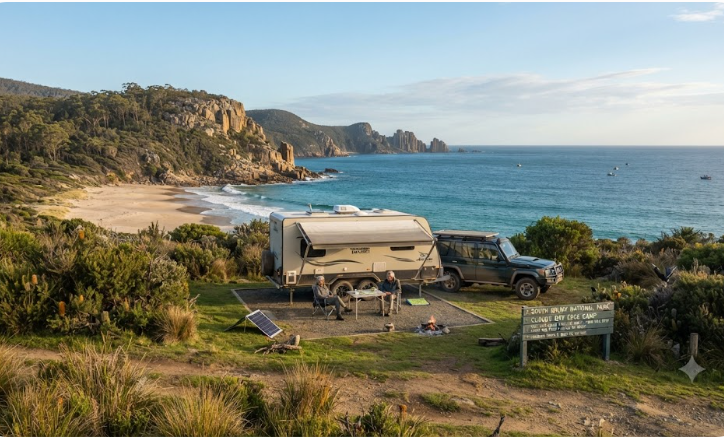
Free Camping Bruny Island Tasmania — Grey Nomad Guide 2026
Ferry access, free overnight options, caravan logistics and honest senior-friendly advice for one of Tasmania’s most rewarding island detours — including whether it’s worth towing your van across.
Last reviewed: July 2026. Ferry costs and booking rules change — confirm current fares with Bruny Island Ferries directly before travel.
How to get there: Drive to Kettering (approx. 35 km south of Hobart via the A6), then take the Bruny Island vehicle ferry to Roberts Point on North Bruny.
Is it towable? A full-size caravan can cross on the ferry, but roads on the island are a genuine challenge. Many experienced travellers recommend unhitching and taking the tow vehicle only — see the full section below.
Free camping: A small number of free and low-cost overnight options exist on Bruny Island. Facilities are minimal. Self-containment is strongly advisable.
Best time to visit: March to May (autumn) or September to October (spring). Summer school holiday queues at the Kettering ferry terminal can stretch to 2–3 hours.
Medical: Bruny Island has no hospital. The nearest full hospital is in Hobart — confirm current contact details locally before travel.
Fuel: Limited fuel availability on the island — fill up completely at Kettering or Huonville before boarding the ferry.
📖 Table of Contents
- Location, Ferry Access and Distance from Hobart
- Emergency Safety — Before You Set Up Camp
- GPS Coordinates and Address
- Why Grey Nomads Stop at Bruny Island
- Can You Stay Overnight — Rules and Self-Containment
- Your Two Main Options Side by Side
- Facilities Table — Bruny Island Camping Options
- Road Access, Fuel Distances and Flood Risk
- Rig Size Suitability — Honest Assessment
- What Bruny Island Doesn’t Tell You Online
- Full Facilities Comparison Table
- Rates — All Camping Options
- Senior-Friendly Things to Do
- Month-by-Month Weather and Best Time to Visit
- Wildlife and Nature
- Medical and Emergency Contacts
- Mobile Coverage by Carrier
- Fires, Generators and Overnight Etiquette
- Accessibility for Seniors and Mobility Considerations
- Senior Packing Checklist for Bruny Island
- Natural Circuit and Internal Links
- GPS Coordinates and Postcodes Table
- FAQ — Frequently Asked Questions
- Quick Verdict
- Quick-Reference Card
- Planning Tip and Internal Links
- Disclaimer
📵 Before You Set Up Camp: Can 000 Find You Here?
Most rest areas don’t have a street address. If something goes wrong overnight, “I’m at a rest stop somewhere past the servo” wastes precious minutes. Before you unhitch, open Emergency+ and check it can pin your GPS location or generate a what3words address right where you’re parked — it works offline, so no signal doesn’t mean no location. Get it free — iPhone (App Store) or Android (Google Play).
The habit that matters: do this the moment you arrive, not if you need it. Signal drops in and out at bush camps — testing it early means you already know it works before an emergency makes that the wrong time to find out.
Bonus use: while you’re in the app, grab the GPS coordinates it shows you and save them to your own Van Life Savings Spots pin — a good stop is worth remembering for next time, and now you’ve already got the exact coordinates in hand.
Location, Ferry Access and Distance from Hobart
Bruny Island sits off the south-eastern coast of Tasmania, separated from the Tasmanian mainland by the D’Entrecasteaux Channel. It is one of Tasmania’s most visited island destinations — and the only way to get there with a vehicle is by ferry.
The ferry departs from Kettering, a small town on the Huon Valley coast. Kettering is approximately 35 km south of Hobart by road via the B68 and A6. Allow around 35 to 45 minutes from Hobart’s southern suburbs in normal conditions. Add time if towing — the road narrows in sections.
The ferry crosses the D’Entrecasteaux Channel to Roberts Point on North Bruny Island. The crossing itself takes approximately 15 to 20 minutes under normal conditions. The ferry service is operated by Bruny Island Ferries (formerly Sealink Tasmania — confirm current operator name locally, as this has changed in recent years).
Once on the island, North Bruny and South Bruny are connected by a narrow land bridge called The Neck. Most of Bruny Island’s popular camping areas, national park land and key attractions are on South Bruny.
📍 Kettering Ferry Terminal — GPS
-43.0973, 147.2271
Kettering Ferry Terminal, Ferry Road, Kettering TAS 7155
This is the vehicle boarding point for Bruny Island. Arrive early — especially in summer. Queue times can exceed 2 hours on peak weekends.
⚠ GPS note: Coordinates are within 50 metres of the stated location and are provided as navigation guidance only. Always confirm on arrival against current signage.
Why Grey Nomads Stop at Bruny Island
Bruny Island is not a casual drive-through. Getting there requires a ferry, planning and a real decision about whether to tow your van across. That filter works in your favour. The island is quieter, more natural and more rewarding than most mainland stops — if you visit outside peak season.
The island covers roughly 362 square kilometres. It ranges from gentle rolling farmland on North Bruny to wild headlands, towering sea cliffs and dense eucalypt forest on South Bruny. The landscape shifts dramatically as you drive south.
Grey nomads are drawn here for several reasons. The South Bruny National Park offers coastal walks, lighthouse visits and wildlife encounters without the crowds of the central Tasmanian parks. The island is famous for its food producers — artisan cheese, fresh oysters, smoked salmon and locally made spirits are all available from small farm gates and producers along the road.
The pace is slow. The roads (outside the few sealed sections) demand patience. But for travellers who want to genuinely escape the highway ribbon of the main Tasmanian circuit and sit quietly in a coastal forest camp for two or three nights, Bruny Island delivers something most of the east coast circuit does not.
The honest caveat: this is not an easy destination for rigs over 7 or 8 metres. The island rewards those who unhitch, leave the caravan in a secure spot near Kettering or at a Hobart park, and explore by tow vehicle alone. More on that decision below.
Can You Stay Overnight — Rules and Self-Containment
Overnight camping on Bruny Island is permitted in designated areas only. You cannot simply pull over and camp on a roadside verge or beach — this applies to all of Tasmania and is enforced on the island.
The key areas for free or low-cost overnight stays are within or adjacent to South Bruny National Park, managed by the Tasmanian Parks and Wildlife Service. A national park entry fee or a valid Tasmanian Parks Pass applies to access most of these sites.
Self-containment: Tasmania does not yet operate a formal certified self-containment scheme equivalent to New Zealand’s NZMCA standard. However, most camping areas on Bruny Island have either no facilities or very basic pit toilets. Carrying and using your own waste system — a cassette toilet, composting toilet or similar — is strongly advisable. Without self-containment, you are restricted to the handful of sites that have operational toilets.
The island has limited dump point access. Confirm the current location of any dump point on the island before travel — this changes. One commonly referenced option is at the Alonnah township area, but verify this is still operational before relying on it.
Your Two Main Options Side by Side
Every grey nomad heading to Bruny Island faces the same core decision: stay in a free or low-cost campsite on the island itself, or base yourself near Kettering or Hobart and day-trip across. Here is an honest comparison of both paths.
| Factor | 🟢 Free/Low-Cost Camp on the Island | 🏕 Base Near Kettering or Hobart, Day-Trip |
|---|---|---|
| Cost | Low — national park fee applies; no powered site cost. Ferry cost is the main expense. | Higher nightly rate at a Kettering or Huonville caravan park, but no repeat ferry costs. |
| Towing the van | Possible, but island roads are challenging for full-size rigs. Narrow, unsealed sections exist south of The Neck. | Leave the van at a park near Kettering or Hobart — far easier and less stressful. |
| Facilities | Minimal — pit toilets at best on free sites. No powered sites in free/national park areas. | Full facilities at nearby caravan parks — power, showers, laundry. |
| Medical access | The nearest hospital is in Hobart. Ferry adds time in any emergency. Response time is longer. | Faster access to medical care — you are already on the mainland side. |
| Experience | Immersive — waking up in South Bruny forest or near the coast is genuinely different. | Day-trip gives you the highlights without the logistics. Shorter days are more manageable for some. |
| Best for | Self-contained motorhomes, smaller vans, camper trailers, experienced island campers. | Larger caravans, travellers with health considerations, anyone who prefers powered sites. |
| Honest trade-off | The free camping is real — but “free” does not account for ferry fares, which are significant for a car-and-van combination. | More expensive per night, but zero stress about ferry queues, road width and dump point access. |
Facilities Table — Bruny Island Camping Options
| Facility | Jetty Beach Campground (South Bruny NP) | Cloudy Bay Campground (South Bruny NP) | General Island (Free Roadside) |
|---|---|---|---|
| Toilets | Pit toilet — confirm current condition | Pit toilet — confirm current condition | None |
| Drinking water | No — carry your own | No — carry your own | No |
| Showers | No | No | No |
| Power | No | No | No |
| Dump point | Not on site — confirm Alonnah location | Not on site | No |
| Bins | No — carry out all waste | No — carry out all waste | No |
| Fires | Permitted in designated areas — check current fire rules with Parks Tasmania | Check current rules | Not recommended — check local rules |
| Shade | Moderate — some tree cover | Exposed — minimal shade | Varies |
| Generators | Check current rules with Parks Tasmania | Check current rules | Not recommended near other travellers |
| Booking required | Confirm with Parks Tasmania — may require booking in peak season | Confirm with Parks Tasmania | No formal booking |
| Fee | National park entry fee applies | National park entry fee applies | Free — where permitted |
| Senior-friendly | Moderate — access track can be rough | Lower — exposed and windy | Varies |
Jetty Beach Campground is one of the most consistently mentioned free/low-cost camping areas in South Bruny National Park. It sits near the coast with reasonable tree cover. The access track is unsealed and can be rough — confirm current road condition before driving a large vehicle in.
Cloudy Bay Campground is exposed to Southern Ocean weather. It is spectacular but genuinely harsh in winter and shoulder seasons. Wind, cold and the lack of any shelter make it better suited to experienced self-contained campers than to those who need consistent warmth and comfort overnight.
There are also a small number of informal roadside spots used by travellers — primarily on North Bruny. These are not formally gazetted camping areas. Use them only if you are confident you are not on private land and not in breach of local camping rules. When in doubt, stick to the designated Parks Tasmania sites.
Road Access, Fuel Distances and Flood Risk
Getting to Kettering from Hobart
From Hobart, take the A6 south through Margate, then turn onto the B68 toward Kettering. The road is fully sealed and in reasonable condition. Total distance from Hobart CBD to the Kettering ferry terminal is approximately 35 km. Allow 35 to 45 minutes without a caravan, and up to an hour if towing.
The road narrows and becomes more winding south of Margate. There are passing opportunities but traffic can back up on weekends. Plan to arrive at Kettering well ahead of your target ferry — the terminal does not guarantee boarding on a specific sailing if you arrive in a long queue.
Roads on the Island
The main road on North Bruny (connecting the ferry terminal at Roberts Point to The Neck) is sealed. It is two lanes in most sections, but narrow by mainland standards.
South of The Neck, road quality degrades significantly. The road to Adventure Bay is sealed but becomes narrower and more winding. Roads leading to South Bruny National Park camping areas — including tracks toward Jetty Beach and Cloudy Bay — are unsealed and can be rough. Corrugations, loose gravel and steep sections are common on these tracks.
Flood Risk
Bruny Island itself does not have the major flood-plain risk of some mainland Tasmanian rivers. However, unsealed tracks through coastal heath and forest can become extremely boggy after heavy rain — particularly in winter. A wet track to Cloudy Bay or Jetty Beach can trap a heavy rig. If rain has fallen heavily in the previous 48 hours, get current conditions from Parks Tasmania before driving an unsealed track.
Fuel Distances
| Direction | Nearest Fuel | Approximate Distance | Notes |
|---|---|---|---|
| On the Island | Alonnah (South Bruny) — confirm availability | Approx. 35 km south of ferry terminal | Fuel availability on the island is limited and hours are restricted — do not rely on this as your primary source. Confirm locally before travel. |
| Kettering (mainland) | Kettering township | At the ferry terminal end | Fill up here before boarding — this is the last reliable fuel before the island. |
| North (toward Hobart) | Margate or Kingston | Approx. 20–30 km north of Kettering | Multiple options — no supply gap on this route. |
| West / Huon Valley | Huonville | Approx. 25 km west of Kettering via Huon Highway | Huonville has a full range of fuel and services — a good pre-island stop. |
Rig Size Suitability — Honest Assessment
This is the question most grey nomad forums ask and most travel guides avoid answering directly. Here is an honest breakdown.
The Ferry
The Bruny Island ferry can accommodate vehicles towing caravans. However, the vessel has limits on total vehicle length and height. Contact the ferry operator directly to confirm current maximum vehicle dimensions before booking if you are towing. Rules on this can change seasonally and with vessel changes. Do not assume your rig fits — ask before you queue.
Loading and unloading on the ferry ramp requires careful manoeuvring. The ramp is angled and the lanes are narrow by mainland boat-ramp standards. Reversing a caravan onto or off the ferry is not required — but slow, careful forward driving in a confined space is. Travellers who are not confident with their rig in tight situations find this stressful, particularly when other vehicles are queued and waiting.
On the Island
Once across, the North Bruny main road is manageable for most rigs up to around 20–22 feet of caravan, provided you drive conservatively. The road is narrow in sections but passable.
South of The Neck, the situation changes. The road to Adventure Bay is sealed but involves tight bends that challenge longer combinations. Side roads and camp access tracks south of Adventure Bay are not suitable for standard caravans.
| Rig Type | Ferry | North Bruny Main Road | South Bruny to Adventure Bay | Camp Access Tracks |
|---|---|---|---|---|
| Motorhome under 7 m | ✅ Straightforward — confirm dimensions | ✅ Fine | ✅ Generally manageable | ⚠ Some tracks — check conditions |
| Motorhome 7–9 m | ✅ Confirm dimensions with operator | ✅ Generally fine | ⚠ Tight bends — take care | ❌ Avoid unsealed camp tracks |
| Van under 18 ft on tow | ✅ Confirm dimensions with operator | ✅ Manageable | ⚠ Some bends are tight | ❌ Do not attempt unsealed tracks |
| Van 20–24 ft on tow | ⚠ Confirm maximum length with operator | ⚠ Narrow sections — drive with care | ❌ Not recommended | ❌ Not suitable |
| Van over 24 ft / fifth-wheeler | ⚠ Likely not suitable — confirm with operator | ❌ Not recommended | ❌ Do not attempt | ❌ Do not attempt |
The practical advice for any rig over 20 feet: leave the van in a secure, flat site at Kettering or a nearby Hobart-area caravan park. Drive across in the tow vehicle. You will see everything Bruny Island has to offer, with none of the stress of navigating a long combination on roads that were not designed for them.
What Bruny Island Doesn’t Tell You Online
Most Bruny Island travel content — from tourism boards, booking sites and generic blogs — focuses on the food, the lighthouse and the wildlife. What gets left out consistently matters more for grey nomads planning an overnight stay.
1. The Ferry Queue Is a Genuine Planning Problem, Not Just an Inconvenience
In peak summer (December to February) and on long weekends, the queue at Kettering can reach 2 to 3 hours or longer. This is not an exaggeration. You can see queues stretch back up the hill from the terminal. Sitting in a hot vehicle (or worse, a hot caravan cab) for two or three hours before even getting on the boat is a real health risk for older travellers, particularly those with heart conditions or heat sensitivity.
The ferry does not operate a reliable booking system for standard vehicles (confirm current arrangements — this has changed before). Most travellers queue on a first-come, first-served basis. Arriving late morning on a summer Saturday can mean missing two or three sailings. Plan to arrive at the terminal by early morning or travel on weekdays.
2. “Free Camping” Doesn’t Account for Ferry Cost
The island camping is very low cost or free. The ferry is not. A car and caravan return crossing represents a meaningful cost — and this figure is simply not mentioned in most free-camping directories. Before you drive to Kettering expecting a budget overnight, confirm the current full return fare for your vehicle type. For many travellers, a powered site at a Huonville or Kettering caravan park may end up costing less in total.
3. Cloudy Bay Is Beautiful — But It’s Not Comfortable for Most Seniors Overnight
Cloudy Bay is one of Tasmania’s most photographed beaches and a wildly popular destination. It is also genuinely exposed to Southern Ocean weather. In winter and spring, overnight temperatures can drop sharply, wind can be severe, and the site offers almost no shelter. Many travel articles describe it as a “great camping spot” without mentioning that it is really suited to young, well-equipped campers who can handle exposure. If you rely on a steady overnight temperature for CPAP, medication storage or joint comfort, Cloudy Bay is not the right overnight pick for most of the year.
4. Dump Point Access Is Not Solved on the Island
Grey nomad forums frequently mention a dump point at or near Alonnah. Its current availability, condition and access hours are not reliably documented across consistent public sources. Do not plan your waste management around assuming it is operational. Carry sufficient cassette capacity to return to the mainland, or confirm its status by phoning the relevant local council or Parks Tasmania office before travel.
5. Mobile Coverage on the Southern End of the Island Is Genuinely Poor
Telstra is the dominant carrier on Bruny Island, but coverage becomes patchy and unreliable south of Adventure Bay. At some of the most popular camping spots — including Cloudy Bay and the approach to South Cape — you may have no usable signal at all. This is not a minor inconvenience. If you or a travelling companion have a medical condition that requires you to be able to call for help, or if you use mobile data for CPAP monitoring, plan offline contingencies before you leave for these southern sites. Download offline maps, set up Emergency+ before you move out of coverage, and let someone know your exact itinerary.
6. The Island Has No After-Hours Pharmacy or Medical Centre
Bruny Island has a medical clinic — at Alonnah on South Bruny — but services are limited and hours are not the same as a mainland clinic. There is no pharmacy on the island. Carry a full medication supply before boarding the ferry. If you run out of a prescription medication on the island, you will need to take the ferry back to the mainland and travel to a pharmacy in Huonville or Hobart. Do not assume the island clinic can dispense medications.
Full Facilities Comparison — Free vs Paid Alternatives
| Feature | South Bruny NP Campgrounds (Free/Low Cost) | Adventure Bay Holiday Park (Paid — confirm current availability) | Kettering Area Caravan Parks (Mainland Paid) |
|---|---|---|---|
| Cost per night | National park fee only — confirm current rate | Paid — confirm current rates directly | Paid — confirm current rates directly |
| Power | No | Some powered sites — confirm | Powered sites available |
| Hot showers | No | Confirm current facilities | Yes — standard caravan park |
| Dump point | Not on site — Alonnah location unconfirmed | Confirm on-site | Generally available — confirm |
| Drinking water | No — carry your own | Confirm on site | Yes |
| Laundry | No | Confirm | Typically yes |
| Wi-Fi | No | Unlikely — confirm | Some parks offer limited Wi-Fi |
| Mobile coverage | Patchy to none in southern areas | Patchy Telstra — confirm | Better — closer to Hobart |
| Rig size limit | Access tracks not suitable for large rigs | Confirm site dimensions with park | Generally suitable for most rigs |
| Medical proximity | Island clinic at Alonnah — limited hours. Hospital in Hobart. | Same — on island | Better — on mainland, closer to Hobart |
| Immersion / nature experience | High — genuine bush and coastal setting | High — on island | Lower — mainland service town |
Rates — All Camping Options Near Bruny Island
| Option | Cost Category | Booking Method | Notes |
|---|---|---|---|
| South Bruny NP campgrounds (Jetty Beach, Cloudy Bay) | Low — national park fee applies | Parks Tasmania booking system — confirm if advance booking required | Annual Tasmanian Parks Pass may be better value for a full circuit. Confirm current fee schedule with Parks Tasmania. |
| Bruny Island Ferry — vehicle crossing (return) | Moderate — variable by vehicle size | Queue at terminal or online — confirm current booking system with operator | This is the largest cost for a Bruny Island free-camping trip. Confirm current fares before travel. |
| Adventure Bay Holiday Park (if operating) | Moderate — paid powered and unpowered sites | Direct booking with park | Confirm current operating status and site availability before travel. |
| Kettering area caravan parks (mainland) | Moderate — standard caravan park rates | Direct booking | A good option if leaving the van on the mainland. Closer to Hobart services. |
| Huonville caravan parks | Moderate — standard rates | Direct booking | Huonville is approximately 25 km from Kettering. Full services available. A practical base for a Bruny day trip. |
Senior-Friendly Things to Do on Bruny Island
Bruny Island rewards a slow pace. The best experiences for over-60 travellers are not strenuous — they are unhurried, close to the coast and anchored in the island’s food, wildlife and natural character.
The Neck — Penguin and Shearwater Viewing (Evening)
The Neck is the narrow sand isthmus connecting North and South Bruny. There is a boardwalk and viewing platform here that is accessible for most mobility levels. In the evening, little penguins and short-tailed shearwaters return to their burrows. The boardwalk involves some steps but is generally flat and well-maintained. This is one of the best wildlife experiences in Tasmania that requires almost no physical effort. Arrive before sunset. Bring a warm layer — it gets cold quickly after dark even in summer.
Bruny Island Lighthouse (Cape Bruny)
The Cape Bruny Lighthouse is one of Australia’s oldest lighthouses and sits at the southern tip of Bruny Island. The road to the lighthouse is mostly sealed. There is a short walk to the lighthouse itself — the path involves some uneven ground. Guided tours of the lighthouse are offered at specific times — confirm current tour availability and access before making this a key part of your itinerary. The views from this headland across the Southern Ocean are outstanding. Dress for wind.
Adventure Bay — Flat Foreshore Walk
Adventure Bay has a flat, gentle foreshore with views across the bay. The walking is easy and there are benches for rest stops. This is a good morning walk for travellers with limited mobility. The bay was visited by several European explorers and has interpretive signs along the foreshore.
Bruny Island Food Trail — Farm Gate Visits
The island is home to an increasingly well-regarded group of food producers. Cheese, oysters, smoked seafood, whisky (Bruny Island Cheese Co., Get Shucked Oysters, and others — confirm current trading hours before visiting) are available at various points on the island. These are low-effort, deeply enjoyable stops for travellers who want to sit, eat and watch the scenery. Most farm gate operations are on the sealed road and accessible to any vehicle.
Cloudy Bay Beach — Walk and Views
Cloudy Bay is a long, exposed beach with a dramatic natural setting. The drive to Cloudy Bay involves some unsealed road. The beach itself is flat and walkable. Do not attempt to swim here — the surf is powerful and there are no patrolled sections. The beach walk is rewarding for those who can manage uneven sand. Return to the car if wind picks up — conditions can change quickly.
Suggested Day Plan — Senior Paced
- Morning: Drive to Adventure Bay — flat foreshore walk, stop at a food producer on the way south
- Midday: Lunch at Adventure Bay — bring supplies from the mainland as on-island food options are limited
- Afternoon: Drive to Cape Bruny Lighthouse — check tour times in advance. Return north via The Neck.
- Evening: The Neck boardwalk for penguin and shearwater viewing at dusk — allow time to find parking before other visitors arrive
Month-by-Month Weather and Best Time to Visit
Bruny Island has a cool temperate climate. It sits at the same latitude as southern Patagonia. Summers are mild but can have hot days; winters are cold and wet. The Southern Ocean drives weather rapidly — conditions can shift from calm sunshine to biting wind and rain within hours. Dress in layers every single day, regardless of the forecast.
| Month | Avg Temp (Day/Night) | Rainfall | Ferry Queue | Verdict for Grey Nomads |
|---|---|---|---|---|
| January | 20–21°C / 12°C | Low | 🔴 Very long — peak summer crowds | Avoid if possible — queues, crowds and ferry stress outweigh the warm weather |
| February | 20–21°C / 12°C | Low to moderate | 🔴 Still busy — school holidays end mid-month | Avoid first half; late February is more manageable |
| March | 18–19°C / 10°C | Moderate | 🟡 Easing — Easter weekend exception | Very good — warm days, thinning crowds, autumn colours beginning |
| April | 15–17°C / 8°C | Moderate | 🟢 Quiet — except Easter if it falls here | Excellent — one of the best months. Cool, uncrowded, food producers active |
| May | 13–14°C / 6°C | Moderate to higher | 🟢 Quiet | Good — cool nights require warm bedding. Fewer travellers, genuine solitude |
| June | 10–12°C / 4°C | Higher | 🟢 Very quiet | Cold — exposed campsites like Cloudy Bay are uncomfortable. Fine for motorhomes with good heating |
| July | 10–11°C / 3–4°C | Higher — wettest period | 🟢 Very quiet | Challenging — cold, wet, unsealed tracks can be boggy. Only for well-prepared self-contained travellers |
| August | 11–12°C / 4°C | High | 🟢 Quiet | Similar to July. Tracks can be muddy. Wildlife active — penguins and shearwaters returning to burrows |
| September | 13–14°C / 5°C | Moderate | 🟡 Beginning to pick up on weekends | Good — spring is arriving, days are lengthening. Still uncrowded most of the week |
| October | 16–17°C / 8°C | Moderate | 🟡 Moderate — weekends busier | Very good — warm days returning, ferry queues still manageable on weekdays |
| November | 17–18°C / 9°C | Low to moderate | 🟡 Increasing | Good — one of the last comfortable months before the summer rush builds |
| December | 19–20°C / 11°C | Low | 🔴 Busy from mid-December — Christmas/New Year peak | Avoid from the second week onward. Pre-Christmas mid-week can still be good |
Wildlife and Nature on Bruny Island
Bruny Island has a wildlife profile that genuinely differs from most of mainland Tasmania. The relative isolation means some species are more accessible and less disturbed than elsewhere.
Little Penguins (Fairy Penguins)
Little penguins nest at The Neck and in several other coastal locations on the island. They come ashore after dark to return to their burrows. The Neck boardwalk is the most accessible viewing location. Stay on the boardwalk, keep torches pointed downward (red-light torches are better than white-beam torches for the penguins), and keep noise low. These animals are wild — do not approach or attempt to handle them.
Short-Tailed Shearwaters (Muttonbirds)
Shearwaters nest in burrows alongside the penguins at The Neck. They return noisily after dark in enormous numbers during the nesting season (September to April). The sound of thousands of birds calling overhead in the dark is genuinely spectacular — and completely free to experience.
White Wallabies
Bruny Island is one of the few places in the world where the white (leucistic) form of Bennett’s wallaby occurs naturally. These are not albino — they have pigmented eyes — but their white or pale cream colouring makes them unmistakable. Sightings are not guaranteed but are relatively common, particularly at dawn and dusk in grassy clearings on South Bruny.
Echidnas and Wombats
Both are present on the island. Echidnas are often encountered on roadsides — drive slowly at dawn and dusk. Wombats are active at night. Take particular care driving after dark, as wombat strikes cause serious vehicle damage and are distressing for the animals.
Sea Eagles and Raptors
Wedge-tailed eagles, white-bellied sea eagles and various hawks are common over the island’s coastal heath and grassland. The cape area near the lighthouse is a reliable raptor-watching point on calm days.
Marine Life
Dolphins are regularly seen in the D’Entrecasteaux Channel and in Adventure Bay. Seals can sometimes be seen on coastal rocks in the south. Whale sightings are possible in the channel during migration periods — primarily May to August.
Medical and Emergency Contacts
| Service | Location | Contact | Notes |
|---|---|---|---|
| Emergency — Police, Fire, Ambulance | All of Australia | 000 | Always the first call in a life-threatening emergency. Coverage on southern Bruny may be patchy — use Emergency+ app for GPS location if possible. |
| Royal Hobart Hospital (RHH) | 48 Liverpool Street, Hobart TAS 7000 | (03) 6166 8308 | Nearest full public hospital with 24-hour emergency department. Approximately 35–45 km from Kettering, plus ferry crossing time from the island. |
| Bruny Island Medical Clinic (Alonnah) | South Bruny Island — Alonnah area | Confirm locally — hours and services are limited. Contact via local listings or the Huonville-based GP clinic network before travel. | Limited hours. No after-hours service. No pharmacy. Emergency presentations should call 000. |
| Healthdirect (24-hour nurse advice line) | Australia-wide | 1800 022 222 | Free 24-hour health advice by phone. Available when mobile coverage allows. |
| Huonville Hospital / Huon Valley Health Centre | Huonville TAS | Confirm locally — listed on healthdirect.gov.au | Smaller regional health centre. For serious emergencies, patients are typically transferred to Royal Hobart Hospital. |
| Nearest Pharmacy (mainland) | Huonville or Kingston | Confirm locally | No pharmacy on Bruny Island. Carry a full medication supply before boarding the ferry. |
The Royal Hobart Hospital is the definitive medical facility for any serious emergency involving travellers on Bruny Island. Confirm the hospital’s current main switchboard number via the healthdirect.gov.au website or the Tasmanian Health Service website before travel — do not rely solely on any printed source.
Mobile Coverage by Carrier
Mobile coverage on Bruny Island is significantly more limited than the Tasmanian mainland. Plan for this before leaving the ferry terminal.
| Carrier | North Bruny / Ferry Terminal Area | Adventure Bay Area | South Bruny NP / Cloudy Bay / Cape Bruny |
|---|---|---|---|
| Telstra | ✅ Generally workable — 4G in townships | ✅ Patchy but usually present | ⚠ Unreliable to none — especially at Cloudy Bay and the cape area |
| Optus | ⚠ Patchy — may work near ferry terminal | ⚠ Unreliable | ❌ Unlikely to have coverage |
| Vodafone / TPG | ⚠ Very limited — roams onto Telstra in some areas | ❌ Unlikely | ❌ Do not rely on Vodafone on South Bruny |
Satellite communicators (Garmin inReach, SPOT, Zoleo or similar) are genuinely worth considering for any traveller spending nights on South Bruny without reliable mobile coverage. They allow two-way messaging and SOS activation without any cellular network. This is not alarmist — it is appropriate preparation for an island location with real coverage gaps and slow emergency access.
Fires, Generators and Overnight Etiquette
Campfires
Open fires in South Bruny National Park are subject to Parks Tasmania rules, which change seasonally and can be suspended during Declared Fire Danger Periods. Do not assume fires are permitted. Check the current fire permit and restriction status via the Tasmania Fire Service website or by calling the Parks Tasmania information line before your visit. Bruny Island’s coastal heath and dry eucalypt bush is genuinely fire-sensitive.
Outside national park areas, the same Fire Danger Period restrictions apply. In summer (December to March), Total Fire Bans are possible on multiple days. Check every morning during summer travel.
Generators
Parks Tasmania generally restricts generator use in national park campgrounds — but specific rules vary by site and season. Confirm the current rules for each specific campground before travel. As a general rule: if you rely on a generator for CPAP or medical equipment, confirm in writing with Parks Tasmania that generator use is permitted at your intended campsite on the dates you plan to stay. Do not assume.
In the spirit of island camping etiquette: generators in a small, quiet coastal campsite affect everyone within earshot. If generator use is permitted, observe reasonable hours — not before 7 am or after 9 pm is a widely accepted standard in Australian camping areas, though this is not universally enforced.
General Overnight Etiquette
- Carry out all rubbish — there are no bins at most national park campsites on Bruny Island
- Use designated toilet facilities — do not dig cat holes in national park areas
- Keep noise low after dark — other campers are there for the quiet
- Do not feed wildlife — this applies particularly to sea eagles and white wallabies near campsites
- Do not use bright white torches on the beach or boardwalk areas where penguins are active
- Keep pets on leash in all national park areas — check current pet access rules as these can change
Accessibility for Seniors and Mobility Considerations
Bruny Island is genuinely mixed in terms of accessibility. Some experiences are excellent for travellers with limited mobility. Others are effectively inaccessible without significant physical capability.
What Is Accessible
- The Neck boardwalk: Generally accessible for most mobility levels. Some steps at the viewing platform — confirm current condition before travel. The surface is mostly level.
- Adventure Bay foreshore: Flat and easy. Good for walkers who need a level surface. Benches available.
- Farm gate food stops: Most are roadside with easy vehicle access and minimal walking required.
- Cape Bruny Lighthouse area: The drive is accessible. The path to the lighthouse involves some uneven ground — manageable for most people who can walk short distances on rough surfaces.
What Is Difficult or Not Accessible
- Cloudy Bay campsite: The access track is unsealed and rough. The site itself is exposed, windy and has no shelter. Not recommended for travellers with balance, joint or cold-sensitivity issues.
- Jetty Beach campsite: The access track is unsealed. On-site terrain can be uneven. A walker or walking frame would struggle on the track and campsite surface.
- Most South Bruny coastal walking tracks: These are bush tracks with significant elevation changes, roots and rocky surfaces. Not suitable for anyone with limited lower body strength or balance issues.
- The ferry boarding ramp: Moving between your vehicle and the ferry passenger area involves a ramp that can be steep depending on the tide. If you have significant mobility limitations, remain in your vehicle during the crossing — confirm this is permitted with the ferry operator in advance.
CPAP and Power-Dependent Equipment
There are no powered sites in South Bruny National Park camping areas. If you use CPAP or any power-dependent medical equipment, you need either a lithium battery system with sufficient capacity for your intended nights, a solar setup capable of maintaining charge in Tasmania’s often-cloudy winter conditions, or a powered site at a paid park.
Tasmania in winter has short days and significant cloud cover — a solar setup that works in Queensland may not maintain charge through a Bruny Island winter night. Size your battery capacity conservatively and carry a backup plan.
Senior Packing Checklist — Bruny Island Specific
☐ Full medication supply (minimum 5 days extra)
There is no pharmacy on Bruny Island. If ferry cancellations delay your return — which can happen in rough weather — you need several days of buffer in your medication supply. Do not board the ferry with only enough medication to cover your planned stay.
☐ Emergency+ app downloaded and tested before departure
Mobile coverage on southern Bruny is unreliable. Emergency+ works offline and can provide GPS coordinates for emergency services even without signal. Download it before you leave Hobart and test it at the Kettering terminal while you still have coverage.
☐ Satellite communicator (Garmin inReach or similar)
Cloudy Bay, Jetty Beach and the cape area can have no usable mobile signal. A satellite communicator allows two-way messaging and SOS activation from anywhere on the island. For travellers with health conditions, this is worth the hire or purchase cost for Bruny Island overnight stays.
☐ Water — minimum 20 litres additional capacity
No drinking water is available at South Bruny National Park campsites. Fill your tanks completely at Kettering before boarding the ferry, and carry additional stored water in case your tank runs low during a longer stay or a rough-weather delay.
☐ Full fuel tank before boarding the ferry
Fuel on Bruny Island is limited and opening hours are restricted. Fill at Kettering or Huonville before you board. Do not assume fuel is available on the island when you need it.
☐ Wind-rated shelter or windbreak
Southern Bruny is exposed to Southern Ocean weather systems. Even on clear days, wind can make sitting outside uncomfortable — and at Cloudy Bay, genuinely unpleasant. A good quality windbreak makes a significant difference to campsite comfort.
☐ Warm layers including thermal base and fleece — all year
Bruny Island temperatures drop sharply after dark regardless of season. Evenings at The Neck for penguin watching can be cold even in summer. Always carry thermal underlayers and a fleece regardless of the daytime forecast.
☐ Lithium battery bank or solar with sufficient winter capacity
There are no powered sites in the national park camping areas. Tasmanian winter days are short and often cloudy, which significantly reduces solar yield. Size your battery system conservatively — what works in northern Australia in summer may not maintain charge through a Bruny Island July night.
☐ Self-contained waste system — cassette toilet or equivalent
Toilets at Bruny Island campgrounds are pit toilets in basic condition. The dump point on the island is not reliably confirmed as operational. Carry your own cassette system and plan to dispose of waste at a confirmed mainland dump point after your return ferry crossing.
☐ Red-light torch for evening wildlife viewing
White-beam torches distress little penguins on the beach and boardwalk at The Neck. A red-filter torch (or a head torch with a red-light mode) is the correct tool for any after-dark movement near penguin nesting areas.
☐ All food and supplies for your stay
Bruny Island has a small general store at Alonnah and limited supplies at Adventure Bay. Do not rely on on-island shopping for a full self-contained stay. Buy all food, cooking supplies and camp essentials in Hobart or Huonville before crossing.
☐ Current fire rules — printed or saved offline
Fire rules on Bruny Island change seasonally and can change with 24 hours’ notice during declared fire danger periods. Save a screenshot of the current Tasmania Fire Service restrictions before you leave Kettering — you may have no signal to check them again once you are on the island.
☐ Offline maps downloaded (OzMaps, Maps.me or similar)
Google Maps’ offline function covers Bruny Island but is less reliable for unsealed tracks. Download a dedicated offline map app before departure while you have a data connection. This is essential navigation backup for any road south of The Neck.
Natural Circuit — Where Bruny Island Fits in a Tasmanian Tour
Bruny Island works best as a dedicated 2–4 night detour during a broader southern Tasmania circuit. It is not a logical stop on the way from A to B — you have to cross by ferry and come back. Plan it as a standalone chapter of your Tasmanian itinerary.
The most natural sequence for grey nomads doing a southern circuit is:
- Base in or near Hobart for 2–3 nights (resupply, washing, city sights)
- Cross to Bruny Island for 2–4 nights — leave the van if towing a full-size rig
- Return to Kettering, then head west or south through the Huon Valley toward Geeveston, Hartz Mountains or the Esperance Coast
- Continue to the southwest if conditions and access permit — Cockle Creek is the southernmost driveable point in Australia
For broader free-camping planning across Tasmania, see our full guide: Free Camping Tasmania.
If you are watching your travel budget carefully and looking for the best value stops across your full Australian circuit, the planning framework in Van Life Savings Spots is worth reading before you commit your itinerary.
GPS Coordinates and Postcodes — Key Bruny Island Locations
| Location | GPS Coordinates | Postcode | Notes |
|---|---|---|---|
| Kettering Ferry Terminal | -43.0973, 147.2271 | 7155 | Vehicle boarding point — arrive early in peak season |
| Roberts Point (Ferry Landing, North Bruny) | -43.2298, 147.2791 | 7150 | Island arrival point — main road begins here northward and southward |
| The Neck (isthmus and boardwalk) | -43.3280, 147.2710 | 7150 | Penguin and shearwater viewing — arrive before sunset |
| Adventure Bay | -43.3589, 147.3296 | 7150 | Main township on South Bruny — foreshore walk, limited supplies |
| Alonnah (South Bruny township) | -43.3780, 147.2530 | 7150 | Approximate location of island medical clinic and reported dump point — confirm locally |
| Cape Bruny Lighthouse (approximate) | -43.4968, 147.1445 | 7150 | Southernmost point of Bruny Island — road is mostly sealed to car park |
| Jetty Beach Campground (approximate) | -43.4050, 147.2430 | 7150 | Approximate only — confirm exact location with Parks Tasmania before travel. Access track is unsealed. |
| Cloudy Bay Beach (approximate) | -43.4640, 147.3020 | 7150 | Approximate only — confirm with Parks Tasmania. Exposed, Southern Ocean facing. |
| Huonville (nearest town with full services) | -43.0333, 147.0500 | 7109 | Fuel, supermarket, pharmacy, hardware — stock up here before heading to Kettering |
⚠ GPS note: All coordinates in this table are within 50 metres of the stated location and are provided as navigation guidance only. Always confirm on arrival against current signage. Campground coordinates are approximate — Parks Tasmania signage is the definitive guide on the ground.
FAQ — Free Camping Bruny Island Tasmania
Is there free camping on Bruny Island?
Yes, there are free and low-cost camping options on Bruny Island, primarily within South Bruny National Park. Sites such as Jetty Beach Campground and Cloudy Bay Campground are accessible with a valid Tasmanian Parks Pass or daily entry fee — making them very low cost rather than strictly free. A small number of informal roadside spots on North Bruny are used by travellers, but these are not formally gazetted camping areas and you must confirm you are not on private land before stopping. The most significant cost in any “free camping” trip to Bruny Island is the vehicle ferry return fare — confirm this with the operator before assuming the trip is budget-friendly.
Can I tow a caravan on the Bruny Island ferry?
The Bruny Island ferry can accommodate vehicles towing caravans, but there are limits on total vehicle length and the loading ramp demands careful manoeuvring in a confined space. Contact the ferry operator directly to confirm maximum vehicle dimensions before travel — do not assume your combination fits. Travellers towing large caravans (20 feet or longer) should seriously consider leaving the van at a secure mainland site near Kettering or Hobart and exploring the island by tow vehicle alone. Roads south of The Neck are narrow and the unsealed access tracks to campgrounds are not suitable for standard caravans.
What is the best time to visit Bruny Island to avoid ferry queues?
March to May (autumn) and September to October (spring) are the best periods for grey nomads. Ferry queues in these months are typically manageable, particularly on weekdays. In December, January and February, queue times at Kettering can exceed two to three hours on weekends and school holiday periods. If you must travel in summer, arrive at the terminal by early morning — the first sailing or two of the day are typically less congested than mid-morning sailings. Avoid public holidays and long weekends at any time of year.
Is there a hospital on Bruny Island?
No. Bruny Island has a small medical clinic at Alonnah on South Bruny, but this operates with limited hours and no after-hours emergency service. There is no pharmacy on the island. The nearest full public hospital with a 24-hour emergency department is the Royal Hobart Hospital in Hobart. In a serious medical emergency on South Bruny, you are looking at a ferry crossing plus a road journey to Hobart — a combined time that can exceed 90 minutes. Grey nomads with complex or unstable health conditions should factor this into their planning and discuss the trip with their GP before travel.
What mobile coverage can I expect on Bruny Island?
Telstra is the only carrier with meaningful coverage on Bruny Island, and even Telstra coverage becomes patchy and unreliable south of Adventure Bay. At Cloudy Bay campground, Cape Bruny and the national park camping areas, you may have no usable signal at all. Optus and Vodafone users should not rely on their network for any coverage beyond the northern end of the island near the ferry terminal. For overnight stays on South Bruny, a satellite communicator is strongly recommended for any traveller with a medical condition that requires reliable emergency contact capability.
Do I need to be self-contained to camp on Bruny Island?
Tasmania does not currently operate a formal self-containment certification scheme. However, the national park campgrounds on Bruny Island have only basic pit toilets — there is no dump point on site. You need to carry your own waste management capability and dispose of waste at a mainland dump point after your return crossing. Without a cassette or composting toilet system, you are limited to sites with operational pit toilets. For any multi-night stay on South Bruny, full self-containment — including waste, water and power — is strongly recommended. Do not rely on the reported Alonnah dump point without first confirming it is currently operational.
Is there fuel on Bruny Island?
There is reportedly a fuel outlet at Alonnah on South Bruny, but opening hours are restricted and fuel supply cannot be guaranteed. Do not treat island fuel as a reliable planning assumption. Fill your tank completely at Kettering or Huonville before boarding the ferry. If your rig has a large tank and good range, this is not a concern — but smaller vehicles or motorhomes with high fuel consumption should plan carefully and avoid relying on island fuel.
What is the best campsite on Bruny Island for a grey nomad?
Jetty Beach Campground in South Bruny National Park is generally considered more sheltered and more suitable for senior travellers than Cloudy Bay, which is exposed and often windy. Jetty Beach has some tree cover and is closer to the sealed road network. Neither site has powered sites, showers or drinking water — so “better” is relative. For grey nomads who want a genuine national park experience with some shelter and relative peace, Jetty Beach is the stronger choice. Confirm current site access, conditions and booking requirements with Parks Tasmania before travel.
Can I take my dog to Bruny Island camping areas?
Pets are generally not permitted in national park camping areas in Tasmania, including South Bruny National Park. This is particularly important at The Neck and other penguin nesting areas. Confirm current pet access rules with Parks Tasmania before travel — travelling with a dog significantly limits your options on the island. The ferry does allow pets, but once on the island, most of the formal camping areas will require your pet to remain off park land.
Quick Verdict
Bruny Island is genuinely one of Tasmania’s most rewarding overnight destinations — but it rewards those who plan carefully and travel with the right rig. It is not the easy, drop-in free camp that some directories imply. The ferry is a real cost and a real logistical commitment. The roads on South Bruny challenge large rigs. The medical safety net is thin.
That said: for a self-contained motorhome or small caravan that can manage its own power, waste and water for 2–4 nights, this island delivers an experience that simply does not exist on the Tasmanian mainland. White wallabies at dawn, penguins returning to their burrows at dusk, a Southern Ocean coastline to yourself on a mid-week autumn morning — these things are real, not promotional fiction.
Go if: You have a rig under 7.5 metres, are fully self-contained, travel outside peak summer, have checked the ferry dimensions in advance and have a satellite communicator for the southern nights.
Rethink if: You tow a full-size caravan, rely on powered sites for medical equipment, have limited mobility that would make rough track access difficult, or are planning a summer school holiday trip expecting an easy, low-cost overnight.
Quick-Reference Card — Screenshot This
| Item | Detail |
|---|---|
| Ferry departure point | Kettering Ferry Terminal, Ferry Road, Kettering TAS 7155 |
| Ferry landing (island) | Roberts Point, North Bruny Island |
| Ferry fare | Confirm directly with ferry operator — do not rely on printed estimates |
| Distance Hobart → Kettering | Approx. 35 km — allow 40–60 min when towing |
| Best free/low cost camping | Jetty Beach Campground, South Bruny NP — national park fee applies |
| Drinking water on island | None at campgrounds — carry your own |
| Fuel on island | Limited — Alonnah reportedly available but unreliable. Fill at Kettering. |
| Dump point | Alonnah — confirm operational status before travel |
| Best mobile coverage | Telstra only — patchy on South Bruny, none at some southern sites |
| Nearest hospital | Royal Hobart Hospital — confirm current contact via healthdirect.gov.au |
| Emergency | 000 — use Emergency+ app for GPS location if signal is poor |
| Best time to visit | March–May or September–October — weekdays preferred |
| Rig limit for island roads | Leave full-size caravan on mainland. Motorhomes under ~7.5 m best suited. |
| Parks Pass needed? | Yes — for South Bruny National Park. Annual pass recommended for Tas circuit. |
| Fires | Check Tasmania Fire Service restrictions before lighting any fire |
Bruny Island is one stop in a much larger island. For free and low-cost camping options across the whole state, our full guide covers the top stops with honest senior-focused detail: Free Camping Tasmania.
Watching your budget across a long trip? The savings framework in Van Life Savings Spots helps you identify the best value overnight stops before you commit your route — a useful read before you finalise your Bruny ferry booking.
COPY PROMPT ➔ ASK AI ➔ SAVE TO FORM ➔ ADD SPOT PIN ➔ GET DIRECTIONS
📍 Interactive map — find free camps, rest areas and overnight stops. Enable location for best results.

As an affiliate, I earn from qualifying purchases at no extra cost to you.

As an affiliate, I earn from qualifying purchases at no extra cost to you.