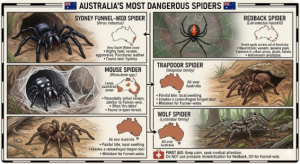
Australia has more species of venomous spider than almost anywhere else on earth. And as a grey nomad, you are spending every single day in exactly the environments they prefer — camp toilet blocks, firewood piles, annexe floors, shoes left outside overnight, sleeping bags rolled out in dark corners, storage bays that haven’t been opened since last week. Most encounters come to nothing. But there are things about spiders and senior vanlifers that almost nobody writes about. The real camp scenarios. The medication interactions that change the risk picture for over-60s. The quiet daily habits that keep experienced travellers bite-free for years. This guide covers all of it.
Key Takeaways
| Question | Short Answer |
|---|---|
| Which spiders are most dangerous for grey nomads at camp? | The Redback, Sydney Funnel-web, Eastern Mouse Spider, White-tail and Huntsman — each connected below to the specific grey nomad camp moments where encounters happen. |
| What do most spider guides leave out for over-60s? | If you take beta-blockers, blood pressure medication or blood thinners, Funnel-web venom interacts with those drugs in ways that complicate treatment. Your doctor almost certainly never mentioned it. We cover this in Section 2. |
| Where do Redbacks actually hide at camp? | Under toilet seats, inside camp chair legs, in annexe joins, under BBQ lids, in shoes left outside and inside storage bins left on the ground. The six hiding spots are in Section 3. |
| What is the critical difference between Funnel-web and Redback first aid? | Funnel-web bites require pressure immobilisation immediately. Redback bites do NOT — pressure immobilisation makes Redback symptoms worse. Full first aid guide in Section 9. |
| Is there a printable checklist I can keep in my first aid kit? | Yes — our free Grey Nomad Spider Safety Checklist is at the bottom of this guide. Print it, laminate it and keep it with your bandages alongside the Snake Safety Checklist. |
| Where do I save the nearest hospital GPS for each camp? | Add it to our Vanlife Savings Spots community map before you leave so it is accessible even without mobile signal. |
1. Why Grey Nomads Face A Different Spider Risk — And What Nobody Talks About
This guide is about spider safety for grey nomads in Australia — and specifically about the information that does not appear in standard camping safety content.
Australia records around 2,000 spider bite hospital presentations each year. Deaths are extremely rare since the introduction of antivenom — but that low fatality number misses something important for senior travellers camping in regional and remote areas.
You might be 90 kilometres from the nearest antivenom stock. You might be solo. And if you or your partner is on beta-blockers, blood pressure medication or blood thinners — which a large proportion of over-60s are — Funnel-web venom interacts with those drugs in ways that can complicate treatment significantly. That information almost never appears in standard spider safety content.
We do not frame this as fear. We frame it the same way we frame tyre checks, snake kits and fuel planning — as practical preparation that lets you travel confidently for years, not just weeks.
Our Pre-Trip Vanlife Checklist covers what needs to be in your first aid kit before any regional or remote leg. This guide is the why behind those items.
2. The Medication Problem: What Your Doctor Never Told You About Spider Venom
This is the section that genuinely surprises people — and it almost never appears in standard spider safety content.
Sydney Funnel-web venom causes a massive release of neurotransmitters that sends the nervous system into overdrive — surging blood pressure, racing heart rate, severe sweating, muscle spasms. For someone already on beta-blockers or blood pressure medication, this creates a complicated treatment picture. Those medications are already working to suppress the cardiac response the treating team needs to manage.
What this means in practice at camp
When you call 000 after a spider bite, state immediately what medications the victim takes. Name the drug and the dose. This information affects which treatments are safe and what monitoring is put in place. Say it again when you arrive at hospital.
We recommend every grey nomad carry a written medication list with their spider and snake first aid kit — not just on their phone — so it is accessible in a high-stress moment even if the wrong person is bitten, or stress affects recall.
Antivenom — where it is and how far away you might be
Funnel-web antivenom and Redback antivenom are stocked at major hospitals and some regional hospitals — but not at every remote clinic or roadside medical centre. Before each remote leg, check what emergency services are available at your nearest hospital and how far that hospital is from your camp.
Our Healthcare and Budget on the Road guide covers how to document your medications and set up your emergency paperwork before you leave home.
3. The Redback — The One In The Camp Toilet
The Redback is the spider most grey nomads will actually encounter. It is found across almost all of Australia — including arid and semi-arid regions that other dangerous spiders avoid. It prefers dry, sheltered, dark spaces close to human activity. Which makes camp toilet blocks, van annexes and camp furniture its natural habitat.
Redbacks are not aggressive. They bite when disturbed or accidentally sat on, reached past or picked up. The vast majority of recorded Redback bites happen because the victim simply did not know the spider was there.
The six places Redbacks hide at camp
These are the locations that come up repeatedly in real bite reports and grey nomad community discussions.
Inside folding camp chair and table legs. Any hollow metal or plastic leg left outside is an ideal home. Tap them before unfolding. Check before sitting.
Annexe joins and floor edges. The junction between your annexe floor and the van wall, particularly in corners and low dark gaps that are not disturbed regularly.
Under BBQ lids and camp kitchen lids. A covered BBQ left sitting for a few days is a Redback’s preferred microclimate. Lift lids with a tool, not your bare hand.
Inside shoes and boots left outside overnight. Shake footwear vigorously before putting it on. Every morning without exception.
Inside storage bins and annexe boxes on the ground. Any dark, sheltered container left undisturbed for more than a day. Tap the outside before opening.
What a Redback bite actually feels like
The initial bite is often described as a minor sting — easily dismissed as a scratch or insect bite. Serious symptoms develop over hours, not minutes. Localised pain intensifies and spreads. Sweating, nausea and headache follow. In severe cases, generalised pain, muscle weakness and vomiting develop.
Older patients are more likely to experience severe symptoms and complications faster than younger adults. If you suspect a Redback bite, do not wait to see if symptoms progress. Call the Poisons Information Centre on 13 11 26 or go directly to the nearest emergency department.
4. The Funnel-Web — The One That Moves Fast And Means It
The Sydney Funnel-web is the spider most medical professionals point to when asked about Australia’s most dangerous to humans. Its range is primarily the greater Sydney basin and surrounding ranges, with related species across eastern Australia. But grey nomads passing through that corridor in the right season need to understand this spider clearly.
Male Funnel-webs are the dangerous ones. They roam in summer and autumn — wandering away from their burrow to find mates. They are found in shoes, under logs, in gloves, in cool damp corners, and occasionally inside structures including vans parked in their range.
Why Funnel-web envenomation is a genuine emergency
Funnel-web venom attacks the human nervous system rapidly. Unlike in other mammals, humans are highly susceptible — the venom component that is largely harmless to cats and dogs is acutely toxic to people. Serious symptoms can develop within 15 to 30 minutes. Without antivenom, severe envenomation can be fatal.
Since antivenom was introduced in 1980, no confirmed deaths from Sydney Funnel-web bites have occurred in patients who received antivenom in time. That phrase “in time” is the entire equation — and for grey nomads an hour from a regional hospital, it is the detail that matters most.
The shoe rule — specific to Funnel-web country
Male Funnel-webs enter enclosed, cool, dark spaces when roaming. A shoe left on the ground overnight in their range is an attractive shelter. A glove, a rolled sleeping bag, a bag on the ground. Shake everything thoroughly every morning. Do not reach into anything you cannot see through.
5. The Mouse Spider — The One That Looks Like A Funnel-Web
The Eastern Mouse Spider is found across most of eastern Australia — including many of the inland routes grey nomads travel. It looks strikingly similar to a Funnel-web and its venom has a comparable mechanism. First aid and treatment are the same as for Funnel-web bites.
Mouse Spiders tend to be found in open, dry terrain — roadsides, open woodland and grassland camping areas. Males roam after rain, which is when grey nomads in those areas are most likely to encounter them.
6. The White-Tail — The One In The Sleeping Bag
The White-tail is widespread across most of Australia and is a consistent grey nomad camp companion. It is a hunter rather than a web-builder — which means it actively moves into warm, sheltered spaces during the day, including sleeping bags, folded clothing, towels and bedding left accessible.
White-tail bites cause localised pain, burning and redness. There is a long-standing belief they cause skin ulcers and necrosis — this has not been confirmed in controlled studies, but local reactions can be significant and secondary infection is a real risk, particularly for older travellers with slower wound healing.
The one habit that prevents most White-tail bites
Never leave a sleeping bag, towel or clothing unrolled and accessible on the van floor during the day. Store them in sealed bags or sealed compartments when not in use. Shake sleeping bags and clothing before use. This single habit eliminates most White-tail encounters at camp.
7. The Huntsman — The One That Causes The Most Near-Accidents
The Huntsman is not medically dangerous. A bite causes localised pain and swelling — unpleasant, but not a medical emergency. We include it here because Huntsmans cause more grey nomad incidents than any other spider — not from their bite, but from the reaction to finding one.
A large Huntsman appearing on the inside of a windscreen at highway speed, or dropping from a van ceiling onto a bunk at 2 AM, has caused documented swerving, panic and falls in older travellers. The spider is harmless. The reaction is not always harmless.
8. The Seven Camp Moments Where Bites Actually Happen
Most grey nomad spider bites do not happen in dramatic circumstances. They happen in ordinary camp moments. These are the seven situations that come up repeatedly in real incident reports and grey nomad community discussions.
Using the camp toilet without checking
The number one Redback bite scenario in Australia. Lift the toilet seat and check the underside before sitting. At night, use your head torch first. Every time, at every camp — including camps you have used before. Redbacks rebuild webs quickly.
Putting on shoes left outside overnight
Bang shoes together vigorously over the ground before putting them on. Boots, thongs, camp sandals — anything left on the ground or on a step. In Funnel-web country, store shoes inside the van at night.
Reaching into dark gaps without looking
Reaching under storage bins, into annexe corners, under camp furniture or behind van panels. Always use a torch first. Always tap the outside of a container before opening it. Use a tool or gloved hand for anything in a dark, undisturbed space.
Handling firewood and camp debris
Redbacks and other spiders nest under bark, in wood piles and in leaf debris. Always wear gloves when handling firewood. Work from the outside of a pile inward. Tap pieces of wood together before picking them up close to the body.
Opening the van first thing in the morning after a warm night
Spiders move toward warmth at night. Annexe joins, floor edges and low interior corners are attractive. When opening up in the morning, check corners and low spaces before putting bare feet onto the floor.
Pulling on unshaken clothing or reaching into bags
A shirt left draped over a chair overnight, a towel on a camp rail, jeans on the van floor — shake everything before putting it on. White-tails and Huntsmans actively seek out fabric for shelter during the day.
Sitting in camp chairs that haven’t been used for a few days
A folded camp chair stored in an annexe or under the van for a few days is a Redback’s ideal home. Always shake and check before opening. Tap the legs on the ground before sitting down.
9. First Aid — The Critical Difference Between Funnel-Web And Redback
This is the section most people get wrong — and getting it wrong matters. Funnel-web and Redback bites require opposite first aid approaches. Applying pressure immobilisation to a Redback bite can concentrate venom and worsen local tissue damage. Not applying it to a Funnel-web bite can accelerate a life-threatening envenomation. Know the difference before you need it.
Funnel-web and Mouse Spider — pressure immobilisation immediately
Step 1 — Call 000 immediately. Tell the operator it is a suspected Funnel-web or Mouse Spider bite. Give your GPS location. Name any heart or blood pressure medications the victim takes — this directly affects treatment.
Step 2 — Keep the victim completely still. Venom travels through the lymphatic system, activated by muscle movement. Bring transport to the victim — do not walk them out.
Step 3 — Apply pressure immobilisation bandage. Using a broad elastic bandage (10–15 cm wide), bandage firmly from fingers or toes upward, covering the entire limb. As firm as a bandage on a sprained ankle. Bandage over clothing. Mark the bite location on the outside of the bandage with a pen.
Step 4 — Splint the limb. Immobilise both joints around the bite to prevent muscle activation that spreads venom.
Step 5 — Keep the victim flat, calm and still until emergency services arrive or transport reaches hospital. Do not remove the bandage until in hospital with resuscitation equipment available.
Redback — cold pack, not pressure bandage
For confirmed Redback bites, applying pressure immobilisation can trap venom and concentrate local tissue damage. The correct approach: apply a cold pack wrapped in cloth to the bite site to reduce local pain, keep the victim calm, call 13 11 26 for advice, and get to medical care. Redback antivenom is highly effective — the priority is hospital, not wrapping.
What never to do for any spider bite
Do not cut the bite site or attempt to suck out venom. Do not apply a tourniquet. Do not give food, water or alcohol. Do not assume symptoms will resolve on their own and wait it out at a remote camp. Do not dismiss any bite as “just a spider” — even mild initial symptoms can develop significantly over hours.
10. If You Are Solo When It Happens
For solo grey nomads, a spider bite situation has one extra layer worth thinking through before you need it. You are your own first responder.
Call 000 immediately. If it is a suspected Funnel-web, apply PIT to yourself as best you can and stay as still as possible. Activate your personal locator beacon (PLB) if you are in a remote area with no mobile signal. If symptoms are developing and you cannot get help to come to you, get to a hospital — accepting the risk of movement while doing what you must to survive.
For a suspected Funnel-web bite with 15 to 30 minutes before serious symptoms can develop, a PLB is not a luxury item. It is the difference between a medical team reaching you and not reaching you at all. We cover the full check-in system and PLB strategy for solo grey nomads in our Rolling Solo guide.
Poisons Information Centre: 13 11 26 — available 24 hours, seven days, for non-emergency questions about spider bites. Save both in your phone. Write them on your Spider Safety Checklist.
11. Your Spider First Aid Kit — What To Actually Carry
Every rig travelling regional or remote Australia needs a spider first aid kit alongside the snake kit. Not combined with the general first aid kit. Clearly labelled. Stored where both occupants can find it without searching.
| Item | Purpose | Notes |
|---|---|---|
| 3 × broad elastic bandages (10–15 cm wide) | Pressure immobilisation — Funnel-web and Mouse Spider bites only | Standard 7.5 cm bandages are too narrow. Purpose-made snake/spider bandages with pressure indicators are best. |
| Rigid splint | Immobilise limb after bandaging | Tent pole, timber offcut — anything rigid works. |
| Cold pack (reusable or instant) | Redback bite pain relief | Wrap in cloth — do not apply ice directly to skin. |
| Sharp scissors | Cutting over clothing if needed | Bandage over clothing — do not remove it. |
| Permanent marker | Mark bite location on outside of bandage | Helps medical staff locate envenomation site quickly. |
| Written medication list (paper copy) | Inform emergency services of cardiac medications | Not just in your phone — paper copy accessible in the kit. |
| Printed Spider Safety Checklist (laminated) | First aid reference under stress | Download below — print, laminate, keep in kit with bandages. |
Pre-save the GPS location of the nearest hospital before you leave for each camp. Add it to our Vanlife Savings Spots community map alongside your camp coordinates so it is accessible even without mobile signal.
12. The Daily Habits That Make The Biggest Difference
Ask any grey nomad who has done multiple big laps and they will tell you that spider awareness becomes completely automatic within a few weeks — the same way watching for roos at dusk or checking tyre pressure does. It is not fear. It is situational awareness built into the daily routine.
The habits experienced grey nomads build in
Lift the toilet seat and check before sitting — every time, at every camp. Shake shoes before putting them on — every morning. Tap storage bays and container lids before opening. Shake clothing and sleeping bags before use. Check camp chairs before sitting. Use a torch for any dark gap you are about to reach into. Store shoes inside the van at night in Funnel-web country. Take 60 seconds when setting up camp to clear debris from immediately around the van and annexe footprint.
None of these take more than a few seconds. Together they reduce your risk to the level where the odds are consistently with you across months and years on the road.
We see many grey nomads report that after the first month these habits are completely automatic — the same way you stop thinking about checking your mirrors before reversing. It is just what you do.
Download The Free Grey Nomad Spider Safety Checklist
We put everything in this guide — the spider identification table, the Funnel-web PIT steps, the Redback cold pack steps, the DO and DON’T list, the first aid kit contents and both emergency numbers — into one printable reference card. Print it, laminate it and keep it in your first aid kit alongside your bandages and the Snake Safety Checklist.
There is also a section to write in the nearest hospital GPS for each region you travel through — fill it in as you go so it is there when you need it.
Download the Spider Safet Checklist — Free Text File Also grab the Snake Safety Checklist — keep both laminated in your first aid kit.
How To Use The Vanlife Savings Spots App For Spider Safety
Our Vanlife Savings Spots community map is built by grey nomads for grey nomads — and spider sighting notes at specific camps are some of the most practically useful entries on it.
When you visit a camp and notice spider activity — Funnel-web holes near the Blue Mountains, a Redback-infested toilet block, seasonal patterns in the Top End — add a note. The next traveller on the same route sees your warning and can check the toilet seat, seal their shoes and inspect their camp chair before sitting. That collective real-world knowledge is the kind of thing no generic camping guide can provide.
To add a location: open the app, enter your GPS coordinates, add a short description and any safety notes, then tap Add Spot. Your real experience becomes part of the collective knowledge that helps the whole community travel more confidently.
FAQs — Spider Safety For Grey Nomads
Q: I got bitten but I did not see the spider — should I still go to hospital?
A: Call 13 11 26 (Poisons Information Centre) immediately and describe your symptoms. They will advise whether you need emergency care or can monitor at home. If you develop sweating, severe spreading pain, nausea, muscle weakness or breathing difficulty — call 000. In a remote area, do not wait for symptoms to worsen before heading toward medical care.
Q: I am on beta-blockers. Do I need to do anything different if bitten by a Funnel-web?
A: First aid is the same — PIT, 000, completely still. What you must do additionally is tell the 000 operator immediately that you take beta-blockers, name the medication and dose, and repeat this to every medical staff member at hospital. Beta-blockers can complicate the management of cardiac instability during treatment — this information directly affects the care you receive.
Q: Should I kill the spider to show the hospital?
A: If you can safely photograph it without risk of a second bite, do that. Do not attempt to catch or kill it. A second bite in the process is a worse outcome than arriving without a specimen. A clear photo on your phone is sufficient for species identification in most cases.
Q: Are spider repellents worth using around camp?
A: Not reliably. The most effective deterrent is a clean, uncluttered camp — removing debris from around the van, sealing the van at night and eliminating the dark undisturbed gaps spiders prefer. Your behaviour matters far more than any product.
Q: What is the difference between Redback and Funnel-web antivenom?
A: They are completely different products for completely different venoms. Redback antivenom targets the effects of Redback venom. Funnel-web antivenom targets the atracotoxin component that makes Funnel-web venom acutely dangerous to humans. A hospital needs to know which type of spider was involved to administer the correct antivenom — which is why the bite photo rule matters.
Q: What is the Poisons Information Centre number?
13 11 26 — available 24 hours, seven days. For non-emergency questions about spider and snake bites. Save it in your phone alongside Triple Zero before you leave home. Write it on both your Spider and Snake Safety Checklists.
Conclusion
So, is spider safety realistic for grey nomads spending months at a time in regional and remote Australia? With the right preparation and the right habits, our answer is yes — for most travellers, most of the time.
We see grey nomads travel widely and safely through spider country for years when they treat awareness as a set of daily habits, not a one-time decision. The medication interaction your doctor never mentioned, the Redback under the toilet seat at every camp in Australia, the Funnel-web in the shoe left outside overnight in the Blue Mountains ranges, the White-tail in the sleeping bag — that is the information that changes behaviour. And changed behaviour is what keeps people on the road.
Download the checklist. Carry the kit. Save the hospital GPS before each remote camp. The road is genuinely better when you are not anxious about the dark gap you are about to reach into — and you earn that comfort through preparation, not by hoping for the best.
Here are the resources we recommend alongside this guide:
- Australia’s Most Dangerous Snakes: What Grey Nomads Need To Know — the companion guide to this post
- Vanlife Savings Spots Community Map — save hospital locations and spider sighting notes for every camp
- Pre-Trip Vanlife Checklist — spider and snake first aid kits listed as required pre-departure items
- Healthcare and Budget on the Road — medication documentation and managing emergencies while travelling
- Rolling Solo After 55 — PLB strategy, check-in systems and solo safety planning
- Grey Nomads 55+ Safety Guide — broader safety planning for older travellers on the road
Medical disclaimer: This guide provides general information for educational purposes only and is not a substitute for professional medical advice or formal first aid training. Always call 000 immediately for any suspected Funnel-web or Mouse Spider bite in Australia. For Redback bites, call 13 11 26 for guidance on whether emergency care is required. We strongly recommend completing a formal first aid course before travelling in remote areas.

As an affiliate, I earn from qualifying purchases at no extra cost to you.
As an affiliate, I earn from qualifying purchases at no extra cost to you.