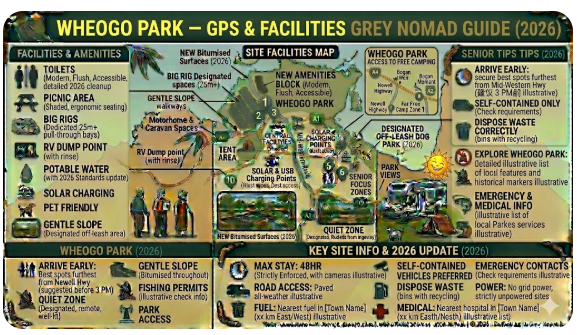
Wheogo Park – GPS & Facilities Grey Nomad Guide 2026
Senior Grey Nomad Guide 2026 — GPS coordinates, road access, facilities, fuel planning, nearby free camps and everything you need for a relaxed daytime or overnight stop in the heart of regional NSW’s Radio Telescope country.
📅 Last reviewed: January 2026 | Parkes, NSW 2870 | Family-friendly park and rest area in town
Wheogo Park is a family-friendly rest and picnic area located in Parkes, New South Wales, approximately 365 km west of Sydney and 30 km east of Forbes along the Newell Highway corridor in the Central West region. This well-maintained town park serves as a popular daytime rest stop for grey nomads travelling the inland route between Melbourne and Brisbane, offering shaded picnic facilities, sealed parking, and close access to Parkes township services including supermarkets, fuel stations, medical facilities, and the world-famous CSIRO Parkes Observatory.
📋 Table of Contents
- Why Grey Nomads Stop at Wheogo Park
- Free Camping — Know the Limits for Seniors
- Quick Facts and Key Details in 2026
- How to Get to Wheogo Park + GPS
- Road Conditions, Flooding and Unsealed Sections
- Heat and Sun Exposure — Seniors
- Wildlife — Birds and What to Watch For
- What Other Websites Don’t Tell You
- Best Time to Visit Parkes — Month-by-Month Breakdown
- Free and Low-Cost Camping Nearby
- Dump Points Near Wheogo Park
- Free Water Sources in Parkes
- Fuel Stops Along the Newell Highway
- Showground & Caravan Park — Paid Alternatives
- Full Facilities Comparison Table
- Rates — All Options Near Parkes for 2026
- Senior Checklist — For Safety On and Off the Road
- What to Do Near Wheogo Park — Senior Activity Guide
- 🗺️ Vanlife Savings Spots GPS Coordinates and Postcodes
- Phone Signal and Emergency Communications
- Campfires and Cooking Restrictions
- Pets at Wheogo Park
- Accessibility for Seniors with Mobility Limitations
- Camping Permits, Fees, Etiquette and Waste Management
- Emergency Scenarios — What to Do
- Packing List for This Section of Highway
- Rest Areas — 5 Stops Near Parkes
- Reviews — What Grey Nomads Say
- Frequently Asked Questions
- Quick-Reference Card
- Disclaimer
Why Grey Nomads Stop at Wheogo Park
Wheogo Park sits within the Parkes township network of rest areas, making it a logical midday or afternoon stop for caravanners and motorhome travellers moving along the Newell Highway between Victoria and Queensland. Unlike roadside rest areas, Wheogo Park offers the advantage of being located within walking distance of full town services—important for seniors who may need to restock supplies, access medical facilities, or simply stretch their legs in a safe, populated area.
Many grey nomads use Wheogo Park as a planning stop: a place to rest, check maps, refuel vehicles, and decide whether to push on to Forbes or settle into one of Parkes’ nearby overnight spots such as Cooke Park or Memorial Hill Rest Area. The park’s sealed access, shaded picnic tables, and central location make it particularly suitable for those travelling in larger rigs who prefer not to navigate narrow bush tracks or unsealed roads.
Free Camping — Know the Limits for Seniors
Understanding local camping regulations is critical for grey nomads to avoid fines, conflicts with council rangers, or unsafe overnight situations. In New South Wales, rest area camping rules vary significantly between council-managed parks, Crown reserves, and Transport for NSW roadside stops.
NSW Rest Area Camping Rules in 2026
- Maximum stay: Most NSW council rest areas permit up to 20 hours (one overnight stay) in any 30-day period.
- Self-contained only: Many locations require vehicles to be fully self-contained with onboard toilet and wastewater tanks.
- No camping infrastructure: Awnings, annexes, outdoor furniture, and camping equipment must remain packed unless explicitly permitted.
- Council discretion: Local councils may change camping policies at any time—always check current signage on arrival.
Wheogo Park, as a town-based facility managed by Parkes Shire Council, is typically intended for daytime picnics and short rest stops rather than extended camping. Travellers seeking overnight accommodation should confirm current rules with the council or use designated overnight areas nearby.
Quick Facts and Key Details in 2026
| Detail | Information |
|---|---|
| Location | Wheogo Park, Parkes, NSW 2870 |
| Type | Town park and picnic area |
| Coordinates (approx) | -33.1365°S, 148.1753°E (verify onsite) |
| Access | Sealed road, suitable for all vehicles including caravans and motorhomes |
| Facilities | Picnic tables, barbecues, shaded areas, toilets (confirm availability onsite) |
| Water | Availability varies—check with Parkes Shire Council |
| Overnight camping | Primarily day-use; confirm overnight policies with council |
| Pets | Typically allowed on leash in council parks—check signage |
| Mobile signal | Good coverage (Telstra, Optus, Vodafone) in Parkes township |
| Nearest town | Parkes (within 2 km) |
| Nearest fuel | Multiple service stations in Parkes (1–3 km) |
How to Get to Wheogo Park + GPS
📍 GPS Coordinates (Approximate)
-33.1365°S, 148.1753°E
Note: These coordinates are approximate and based on Parkes township location. Always verify exact position using updated mapping apps or onsite signage when approaching the park.
Directions from Major Routes
From the Newell Highway (northbound): Enter Parkes via the Newell Highway from the south. Turn left onto Peak Hill Road, then follow local signage toward Wheogo Park. The park is accessible via sealed town streets suitable for caravans and large motorhomes.
From the Newell Highway (southbound): Approaching from Forbes, enter Parkes township and follow directional signs toward the town centre. Wheogo Park is clearly signposted and accessible from main streets with ample turning space for larger rigs.
From Orange (east): Take the Mitchell Highway west to Parkes (approximately 95 km). Enter the town centre and follow local signage. Roads are sealed and well-maintained, suitable for all vehicle types.
From West Wyalong (west): Travel east along the Mid Western Highway for approximately 75 km to Parkes. Enter via Bogan Gate Road and follow signs to the town centre and park facilities.
Suitability for Caravans and Large Rigs
Wheogo Park is located within Parkes township on sealed roads with standard suburban street widths. This makes it highly accessible for:
- Caravans up to 25 feet (7.6 metres)
- Motorhomes and campervans of all sizes
- Fifth-wheelers and larger tag-along trailers
- Bus conversions and semi-retirement rigs
Parking areas are level and sealed, with sufficient space for manoeuvring without needing to reverse long distances or navigate tight corners. This is a significant advantage for seniors who prefer straightforward access and departure routes.
Road Conditions, Flooding and Unsealed Sections
One of Wheogo Park’s key advantages for grey nomads is its fully sealed access via town streets. Unlike remote bush camps or riverside reserves that may require travel on gravel or dirt roads, reaching Wheogo Park involves only sealed, well-maintained roads suitable for all weather conditions.
Sealed Access — No Gravel or Dirt
All approach routes to Wheogo Park are sealed bitumen roads maintained by Parkes Shire Council and Transport for NSW. This eliminates common concerns for caravan travellers including:
- Corrugations damaging suspension and chassis
- Dust ingress into living areas and engine compartments
- Stone chips damaging paintwork and windows
- Reduced traction in wet conditions
Flooding Risk — Minimal in Town Areas
Parkes township sits on elevated terrain in the Central West region, well away from major river systems prone to flooding. Wheogo Park is not located in a flood zone and remains accessible during most weather events. However, regional travellers should be aware of broader flooding risks when travelling the Newell Highway corridor:
- Lachlan River crossings: The Newell Highway crosses the Lachlan River at Forbes (30 km north) and at Booligal further south. These crossings may close during heavy rain and regional flooding—check Live Traffic NSW before departure.
- Local creek crossings: Minor creeks around Parkes may experience brief flow-over during intense storms, but these events are infrequent and typically clear within hours.
- Seasonal patterns: Flooding risk is highest during late winter and spring (August–November) when catchments are saturated and storm systems move through inland NSW.
No Clearance Issues or Gate Access
Unlike some free camps in state forests or on Crown land, Wheogo Park does not require navigating locked gates, cattle grids, or low-clearance obstacles. Access is open during daylight hours (confirm with council for any seasonal closures), and there are no height restrictions or narrow entry points that might affect larger motorhomes or high-roof campervans.
Heat and Sun Exposure — Seniors
Central West NSW experiences hot, dry summers and cool to cold winters. For grey nomads, especially seniors with heat sensitivity or cardiovascular conditions, planning around temperature extremes is essential for comfort and safety.
Summer Heat (December–February)
Parkes summer temperatures regularly exceed 35°C, with occasional heatwaves pushing into the low 40s. Wheogo Park offers some shaded areas with established trees, but prolonged daytime stops during peak heat hours (11:00 AM–4:00 PM) can still be uncomfortable without air conditioning or adequate ventilation.
- Heat management: Park in shaded areas wherever possible. Use reflective windscreen shades, open roof vents, and run fans or air conditioning if available.
- Hydration: Seniors should drink water regularly even if not feeling thirsty. Dehydration onset is faster in dry, hot conditions and can lead to dizziness, confusion, and heat exhaustion.
- Activity timing: Plan outdoor activities for early morning or late afternoon when temperatures are cooler. Avoid strenuous walking or standing in direct sun during midday hours.
Winter Cold (June–August)
Parkes winters are cool to cold with overnight temperatures occasionally dropping below freezing. While daytime temperatures are generally mild (10–15°C), early mornings and evenings can be uncomfortably cold without adequate heating.
- Heating: Ensure your caravan or motorhome heater is working properly before travelling in winter. Diesel heaters, gas heaters, and electric heaters are all commonly used—choose based on your power availability.
- Insulation: Close curtains and blinds at night to retain warmth. Use thermal blankets and sleeping bags rated for low temperatures.
- Frost risk: Water tanks, pipes, and plumbing can freeze overnight during cold snaps. If temperatures below zero are forecast, consider draining external pipes or using insulation wraps.
Wildlife — Birds and What to Watch For
Wheogo Park, being a maintained town park, does not present the same wildlife risks as remote bush camps. However, the Central West region is home to a variety of native birds and occasional reptiles that grey nomads should be aware of.
Common Birds
- Magpies: Common across Parkes and can be territorial during nesting season (September–November). If swooped, walk calmly away without running or waving arms.
- Cockatoos and galahs: Large flocks often gather in town parks. Noisy but harmless—avoid feeding as this encourages dependence and aggressive behavior.
- Kookaburras: Frequently seen in parks and wooded areas. Distinctive laughing call, especially at dawn and dusk.
- Crows and ravens: Intelligent scavengers that may investigate campsites for food scraps. Store rubbish securely to avoid attracting them.
Reptiles and Snakes
While less common in maintained town parks, snakes may occasionally be seen in surrounding areas during warmer months (October–March). Common species in the Parkes region include:
- Eastern brown snake: Highly venomous and common in inland NSW. Generally avoids humans but will strike if threatened or cornered.
- Red-bellied black snake: Venomous but less aggressive than brown snakes. Usually found near water sources.
- Carpet python: Non-venomous but can grow large. Harmless to humans unless provoked.
What Other Websites Don’t Tell You
Most rest area guides focus on basic GPS coordinates and facilities lists. Here’s what experienced grey nomads know about stopping at Wheogo Park and the Parkes network that you won’t find in generic listings:
1. Parkes Is a Full-Service Town — Use It
Unlike isolated highway rest stops, Wheogo Park sits within a town offering full services within walking or short driving distance:
- Supermarkets: Woolworths and IGA located in Parkes town centre (2 km).
- Medical facilities: Parkes Hospital on Booth Street provides emergency and general medical services. Multiple GP clinics available for non-urgent consultations.
- Pharmacies: Several pharmacies in the town centre for prescription refills and over-the-counter medications.
- Hardware and automotive: Repco, Supercheap Auto, and local mechanics available for emergency vehicle repairs or parts.
This makes Wheogo Park an ideal strategic stop for restocking, medical appointments, or vehicle servicing—tasks that are difficult or impossible at remote bush camps.
2. Parkes Observatory Is Worth the Detour
The CSIRO Parkes Observatory (home of “The Dish”) is one of Australia’s most iconic scientific installations and a popular attraction for grey nomads with an interest in astronomy and space exploration. Located approximately 20 km north of Parkes township, the facility offers:
- Free entry and parking (including caravan/motorhome parking)
- Visitor centre with interactive displays and documentaries
- Walking trails around the dish with interpretive signage
- Picnic areas and toilets
Plan 2–3 hours for a visit. The observatory is open daily, and the site is fully accessible for seniors with mobility limitations.
3. Fuel Prices Vary Significantly — Shop Around
Parkes has multiple fuel stations, and prices can vary by 10–20 cents per litre on any given day. Check petrolspy.com.au or drive through town comparing pump prices before filling up. Savings of $5–$10 per tank add up over long journeys.
4. Mobile Signal Is Reliable — Work and Admin Friendly
Parkes township has strong mobile signal coverage from all major carriers (Telstra, Optus, Vodafone). This makes it an excellent location for grey nomads who need to:
- Conduct video calls with family or medical specialists
- Process online banking and bill payments
- Upload photos and blogs for travel documentation
- Download maps, weather updates, and travel apps
If you’ve been travelling through remote areas with limited connectivity, Parkes is a good place to catch up on digital tasks before heading back into the outback.
Best Time to Visit Parkes — Month-by-Month Breakdown
Understanding seasonal patterns helps grey nomads plan comfortable, safe visits to Parkes and the Central West region. Here’s what to expect month by month in 2026:
January–February (Summer — Hot and Dry)
- Temperature: 18–35°C (can exceed 40°C during heatwaves)
- Conditions: Hot, dry, occasional severe thunderstorms
- Considerations: Peak heat period—travel early morning or late afternoon. Ensure air conditioning is working. Carry extra water.
- Crowds: School holiday traffic early January, quieter mid-late February
March–April (Autumn — Mild and Pleasant)
- Temperature: 12–28°C
- Conditions: Cooler, less humid, stable weather patterns
- Considerations: Excellent travel period for seniors—comfortable temperatures, reduced fire risk, fewer storms
- Crowds: Moderate—popular with grey nomads avoiding summer heat
May–June (Late Autumn/Early Winter — Cool)
- Temperature: 4–18°C
- Conditions: Cool to cold mornings and evenings, mild days
- Considerations: Bring warm clothing and ensure heating is functional. Clear, dry days ideal for sightseeing.
- Crowds: Low—fewer travellers on the road
July–August (Winter — Cold)
- Temperature: 2–15°C (overnight frost possible)
- Conditions: Cold, dry, clear skies
- Considerations: Coldest months—heating essential overnight. Daytime driving comfortable but early starts can be icy.
- Crowds: Very low—excellent for solitude seekers
September–October (Spring — Warming, Variable)
- Temperature: 8–24°C
- Conditions: Warming weather, occasional showers, wildflowers blooming
- Considerations: Pleasant travel period with moderate temperatures. Magpie swooping season begins—be cautious around nests.
- Crowds: Increasing as grey nomads head north for winter
November–December (Late Spring/Early Summer — Warm)
- Temperature: 14–32°C
- Conditions: Warm to hot, thunderstorms increasing in frequency
- Considerations: Good travel weather but heat building. School holidays from mid-December increase traffic and reduce campsite availability.
- Crowds: Moderate to high (especially from mid-December)
Free and Low-Cost Camping Nearby
Wheogo Park sits within a network of excellent rest areas and free camps around Parkes. For overnight stays, consider these nearby alternatives:
Parkes Rest Area & Camping Network
If you’re travelling through Parkes in regional New South Wales, these rest areas and camping spots form a convenient network of free and low-cost stops. Located along key inland routes, they are popular with caravanners, grey nomads, and road trippers exploring the Central West region.
- Currajong Rest Area — convenient highway stop
- Cooke Park — central Parkes rest and picnic area
- Memorial Hill Rest Area — scenic lookout over Parkes
- Bumberry Dam — quiet camping and fishing spot
- Kelly Reserve — relaxed riverside stop
- Bogan Weir Camping Area — popular free camp near Peak Hill
- Escort Rock Rest Area — historic gold rush stop
- Lindner Oval Rest Area — easy overnight stop in town
Additional Free Camps Within 100 km
- Forbes Showground: Located 30 km north in Forbes—donation-based camping with toilet and shower facilities. Excellent value for powered and unpowered sites.
- Lake Cowal: Approximately 50 km southeast—remote bush camping on Crown land. 4WD recommended for some access tracks.
- Condobolin riverfront: Approximately 80 km west—free camping along the Lachlan River with basic facilities.
Dump Points Near Wheogo Park
Proper waste disposal is essential for responsible grey nomad travel. Parkes offers several dump point options for greywater and black water disposal:
| Location | Type | Cost | Distance from Wheogo Park |
|---|---|---|---|
| Parkes Shire Council Depot | Public dump point | Free | 3 km |
| Cooke Park (if available) | Council facility | Free | 2 km |
| BP Service Station (Newell Highway) | Commercial dump point | $5–$10 | 4 km |
| Forbes Showground | Dump point (campers) | Free with stay | 30 km north |
Always check campermate.com.au or wikicamps.com.au for the most current dump point locations, operating hours, and user reviews before arrival.
Free Water Sources in Parkes
Parkes township offers several options for topping up fresh water tanks:
- Council parks: Some council parks in Parkes provide potable water taps. Check signage to confirm whether water is suitable for drinking or for washing only.
- Service stations: Many service stations allow caravanners to fill water tanks for a small fee ($2–$5). Ask permission before connecting hoses.
- Visitor information centre: Located on the Newell Highway—may provide water access for travellers (confirm before assuming availability).
- Showgrounds: Forbes Showground (30 km north) provides water for campers staying onsite.
Fuel Stops Along the Newell Highway
Fuel planning is critical for grey nomads travelling inland routes. Here are fuel stops radiating from Parkes in all directions:
North Along Newell Highway (toward Queensland)
- Parkes: Multiple stations (BP, Shell, independent operators)
- Forbes (30 km): Several stations—good prices, last major fuel before Dubbo
- Dubbo (97 km): Major regional centre with numerous fuel options
- Narromine (120 km): Small town with limited fuel—prices higher than Dubbo
South Along Newell Highway (toward Victoria)
- Parkes: Fill up here
- West Wyalong (75 km): Good fuel prices, multiple stations
- Barmedman (110 km): Small fuel stop—limited hours
- Hay (240 km): Next major fuel after West Wyalong—plan accordingly
East Toward Orange and Sydney
- Parkes: Last major fuel heading east
- Manildra (50 km): Small town, limited fuel
- Orange (95 km): Major regional city with competitive fuel prices
West Toward Condobolin and Cobar
- Parkes: Fill up before heading west
- Condobolin (80 km): Good fuel availability
- Lake Cargelligo (140 km): Limited fuel, higher prices
- Cobar (250 km): Outback town with fuel but expensive—fill at Parkes or Condobolin
Showground & Caravan Park — Paid Alternatives
When free camps are full or when you need powered sites, laundry facilities, and hot showers, consider these paid options near Parkes:
Parkes Caravan Park
- Location: Within Parkes township
- Facilities: Powered and unpowered sites, camp kitchen, laundry, hot showers, dump point
- Cost: Approximately $35–$45 per night for powered sites (2026 rates)
- Suitability: Excellent for seniors needing full facilities and security
Forbes Showground
- Location: Forbes, 30 km north of Parkes
- Facilities: Donation-based camping ($10–$15 suggested), toilets, showers, dump point, water
- Cost: Donation—excellent value
- Suitability: Very popular with grey nomads—arrive early during peak season
Peak Hill Caravan Park
- Location: Peak Hill, 25 km west of Parkes
- Facilities: Small, basic park with powered sites, toilets, showers
- Cost: Approximately $30–$35 per night
- Suitability: Quiet alternative to Parkes—less crowded
Full Facilities Comparison Table
| Location | Toilets | Water | Dump Point | Showers | Powered Sites | Cost |
|---|---|---|---|---|---|---|
| Wheogo Park | Yes (check onsite) | Possibly | No | No | No | Free |
| Cooke Park | Yes | Yes | Possibly | No | No | Free |
| Memorial Hill Rest Area | Yes | Possibly | No | No | No | Free |
| Kelly Reserve | Yes | Yes | No | No | No | Free |
| Parkes Caravan Park | Yes | Yes | Yes | Yes | Yes | $35–$45 |
| Forbes Showground | Yes | Yes | Yes | Yes | Yes (some) | $10–$15 donation |
Rates — All Options Near Parkes for 2026
| Accommodation Type | Nightly Rate (2026) | Weekly Rate | Notes |
|---|---|---|---|
| Free council rest areas (Wheogo, Cooke, Memorial Hill) | Free | N/A (20-hour limit) | Day use or short overnight—confirm local rules |
| Kelly Reserve | Free | N/A | Riverside camping—seasonal access |
| Forbes Showground | $10–$15 donation | $70–$100 | Excellent value with full facilities |
| Parkes Caravan Park (unpowered) | $30–$35 | $200–$240 | No power but access to facilities |
| Parkes Caravan Park (powered) | $35–$45 | $240–$310 | Full facilities including laundry |
| Peak Hill Caravan Park | $30–$35 | $200–$240 | Quieter alternative |
Rates are indicative and subject to change. Always confirm current pricing when booking or arriving at a facility.
Senior Checklist — For Safety On and Off the Road
This checklist is designed specifically for grey nomads and seniors travelling through Central West NSW. Use it to ensure you’re prepared for safe, comfortable travel.
- Check weather forecast for Parkes and surrounding areas (bom.gov.au)
- Verify road conditions on Newell Highway (livetraffic.com)
- Confirm fuel tank is above half-full before leaving major towns
- Top up fresh water tanks in Parkes township
- Empty greywater and black water at designated dump points
- Ensure mobile phone is fully charged and charger is accessible
- Carry printed maps or offline GPS app in case of signal loss
- Pack extra drinking water (2 litres per person minimum)
- Check vehicle air conditioning is functioning (summer travel)
- Confirm heating system works (winter travel)
- Carry prescription medications with at least one week’s supply extra
- Store emergency contact numbers in phone and written backup
- Inspect tyres for pressure and wear before long drives
- Test caravan or motorhome lights and indicators
- Secure all loose items inside vehicle before departure
- Know location of nearest hospital (Parkes Hospital, Booth Street)
- Carry basic first aid kit including bandages, antiseptic, pain relief
- Pack sunscreen, hat, and sunglasses for UV protection
- Bring insect repellent for mosquitoes and flies
- Confirm pet vaccinations and council registration are current
What to Do Near Wheogo Park — Senior Activity Guide
Parkes and the surrounding Central West region offer a range of senior-friendly activities suitable for grey nomads with varied mobility levels and interests.
CSIRO Parkes Observatory (“The Dish”)
Distance from Parkes: 20 km north
Entry: Free
Facilities: Visitor centre, museum, walking trails, picnic areas, toilets, caravan parking
Accessibility: Fully wheelchair accessible
One of Australia’s most famous landmarks, the Parkes Observatory played a critical role in the Apollo 11 moon landing. The visitor centre offers interactive exhibits, documentary screenings, and guided tours (pre-book for groups). Allow 2–3 hours for a full visit.
Henry Parkes Centre (Parkes Museum)
Location: Parkes township centre
Entry: Small fee (approx $5–$10)
Facilities: Air-conditioned museum, gift shop, cafe nearby
Learn about Sir Henry Parkes (the “Father of Federation”), local history, and the development of regional NSW. The museum is air-conditioned and suitable for seniors—easy walking, comfortable seating, and well-presented displays.
Parkes Elvis Festival (January)
If travelling through Parkes in early January, you may encounter the annual Elvis Festival—a quirky celebration attracting thousands of Elvis fans, vintage car enthusiasts, and music lovers. The festival features street parades, concerts, markets, and themed events. Accommodation fills quickly during festival week—book ahead or plan alternative stops.
Heritage Walks — Parkes Township
Parkes offers self-guided heritage walks showcasing historic buildings, Art Deco architecture, and local landmarks. Maps are available from the visitor information centre. Walks are flat, shaded, and suitable for seniors with moderate mobility.
Fishing and Birdwatching — Bumberry Dam
Distance from Parkes: 15 km
Activities: Fishing (permit required), birdwatching, picnicking
Bumberry Dam is a peaceful spot for seniors who enjoy birdwatching or fishing. The area supports native waterbirds including black swans, pelicans, and herons. Bring binoculars and a fishing rod (check NSW DPI for current fishing regulations and permit requirements).
Golf — Parkes Golf Club
Parkes Golf Club welcomes visitors and offers casual green fees for seniors. The course is well-maintained and suitable for recreational golfers. Club hire available onsite.
🗺️ Vanlife Savings Spots GPS Coordinates and Postcodes — Save Every Stop
Use the interactive map tool below to save Wheogo Park and nearby stops to your personal Vanlife Savings Spots database. This feature allows you to collect GPS coordinates, plan routes, and calculate fuel costs between stops.
COPY PROMPT ➔ ASK AI ➔ SAVE TO FORM ➔ ADD SPOT PIN ➔ GET DIRECTIONS
📍 Interactive map — find free camps, rest areas and overnight stops. Enable location for best results.
Quick Reference GPS Coordinates
| Location | GPS Coordinates (Approx) | Postcode |
|---|---|---|
| Wheogo Park, Parkes | -33.1365°S, 148.1753°E | 2870 |
| Cooke Park, Parkes | -33.1381°S, 148.1748°E | 2870 |
| Memorial Hill Rest Area | -33.1290°S, 148.1690°E | 2870 |
| Kelly Reserve, Parkes | -33.1400°S, 148.1800°E | 2870 |
| Forbes Showground | -33.3856°S, 148.0092°E | 2871 |
Note: Coordinates are approximate. Always verify exact positions using updated GPS apps or onsite signage. Coordinate sources include publicly available mapping data and user-contributed databases.
Phone Signal and Emergency Communications
Parkes township enjoys reliable mobile phone coverage from all major Australian carriers:
- Telstra: Excellent 4G/5G coverage throughout Parkes and surrounding areas. Signal extends 20–30 km along major highways.
- Optus: Good coverage in town and on main roads. May experience dropouts in remote areas west and south of Parkes.
- Vodafone: Moderate coverage in Parkes township. Less reliable on rural roads and in surrounding countryside.
Emergency Contact Numbers
- Emergency (Police, Fire, Ambulance): 000
- Parkes Hospital: (02) 6861 2000
- Parkes Police Station: (02) 6862 4299
- Parkes Shire Council: (02) 6861 2333
- NSW SES (Storm and Flood): 132 500
- Poisons Information: 131 126
Campfires and Cooking Restrictions & Food Purchases Near Wheogo Park
Fire Bans and Campfire Rules
Central West NSW experiences seasonal fire bans, particularly during summer and spring when temperatures are high and vegetation is dry. Before lighting any campfire or using outdoor cooking equipment, check current fire restrictions:
- NSW Rural Fire Service: rfs.nsw.gov.au — check current fire danger ratings and total fire bans
- Parkes fire danger: Usually classified under Central West fire district—restrictions apply region-wide when bans are declared
Cooking at Wheogo Park
Wheogo Park may have designated barbecue facilities (confirm onsite). If electric or gas barbecues are available, they are typically permitted even during total fire ban periods. Open campfires are generally prohibited in town parks regardless of fire danger rating.
Recommended cooking equipment for rest areas:
- Portable gas stove or camp oven (permitted during most fire restrictions)
- Electric hotplate (if power available)
- Windproof camp stove for outdoor cooking in designated areas
Food Purchases in Parkes
Parkes offers full supermarket facilities within 2–3 km of Wheogo Park:
- Woolworths: Full-service supermarket with fresh produce, meat, dairy, bakery, and general groceries. Open 7 days.
- IGA: Independent supermarket with good range of fresh and packaged foods. Competitive pricing.
- Butchers and bakeries: Local butcher shops and bakeries offer fresh meat, bread, and specialty items.
- Fruit and vegetable shops: Seasonal produce often cheaper and fresher than supermarket options.
- Fast food and takeaway: Multiple options including McDonald’s, KFC, local Chinese, pizza, and fish and chips.
Pets at Wheogo Park
Wheogo Park, as a council-managed public park, typically allows pets on leash. However, specific pet policies can vary, and restrictions may apply during busy periods or special events.
Pet Rules for Council Parks in NSW
- Leash required: Pets must be on leash at all times in public parks unless in designated off-leash areas.
- Waste disposal: Owners must clean up after pets and dispose of waste in bins provided.
- Noise control: Excessive barking or aggressive behaviour may result in fines or requests to leave.
- Heat safety: Never leave pets in hot vehicles—temperatures inside cars can exceed 60°C within minutes, causing heatstroke and death.
Travelling with Pets — Senior Considerations
Grey nomads travelling with dogs or cats should plan regular rest stops, carry fresh water and food, and ensure pets are secured safely during travel. Pets should be microchipped, registered, and wearing ID tags with current contact details.
Accessibility for Seniors with Mobility Limitations
Wheogo Park’s sealed access and level terrain make it more accessible than many remote bush camps. However, specific accessibility features should be confirmed onsite.
Accessibility Features to Look For
- Level, sealed paths: Check for sealed pathways between parking areas and facilities (toilets, picnic tables, barbecues).
- Accessible toilets: Some council parks provide accessible toilet facilities with handrails and wheelchair clearance—check onsite or contact Parkes Shire Council.
- Parking proximity: Seniors with limited walking range benefit from parking close to facilities—arrive early for best access.
- Seating: Picnic tables and benches with back support are easier for seniors than ground-level seating.
Alternative Accessible Options Nearby
If Wheogo Park does not meet your accessibility needs, consider:
- Parkes Caravan Park: Purpose-built facilities including accessible cabins, toilets, and showers.
- CSIRO Parkes Observatory: Fully wheelchair-accessible visitor centre with smooth pathways, ramps, and accessible toilets.
- Parkes Hospital: For seniors requiring medical support or accessible facilities, the hospital provides public toilets and waiting areas.
Camping Permits, Fees, Etiquette and Waste Management
Permits and Fees
Wheogo Park, as a public council park, typically does not require camping permits for short daytime stops. However, overnight camping policies vary and should be confirmed with Parkes Shire Council before assuming overnight stays are permitted.
- Parkes Shire Council: (02) 6861 2333
- Website: Check council website for current rest area and camping policies
Camping Etiquette for Grey Nomads
Respectful camping behaviour ensures rest areas remain open and welcoming for all travellers. Follow these etiquette guidelines:
- Pack in, pack out: Take all rubbish with you or use bins provided. Never leave waste behind.
- Respect quiet hours: Keep noise low between 9:00 PM and 7:00 AM. Generators should not be run outside designated hours.
- Respect space: Park considerately to allow room for other vehicles. Don’t spread out annexes or equipment unless explicitly permitted.
- No long-term camping: Rest areas are for short-term stays—don’t set up camp for days or weeks. Move on within 20 hours unless staying at designated campgrounds.
- Use facilities properly: Toilets are for human waste only—never dispose of chemical toilet waste in park toilets. Use dump points.
Waste Management and Dump Points
Proper waste disposal protects the environment and maintains access to free camping areas. Always:
- Empty greywater (sink and shower water) at designated dump points—never onto grass, roads, or rivers.
- Dispose of black water (toilet waste) only at approved dump points or sewage facilities.
- Separate recyclables from general waste where bins are provided.
- Carry rubbish bags and secure bins to prevent scavenging by birds and animals.
Emergency Scenarios — What to Do
Preparation and knowledge of emergency procedures are essential for safe grey nomad travel. Here’s what to do in common emergency scenarios:
Medical Emergency
- Call 000 immediately for life-threatening emergencies (chest pain, difficulty breathing, severe bleeding, loss of consciousness).
- Provide your location clearly: “Wheogo Park, Parkes, NSW 2870” and describe the emergency.
- If in Parkes township, the nearest hospital is Parkes Hospital, Booth Street—approximately 3 km from most town parks.
- For non-urgent medical issues, visit a local GP clinic during business hours.
Vehicle Breakdown
- Pull safely off the road if possible. Turn on hazard lights.
- If you have roadside assistance (NRMA, RACV, RAA), call for help and provide your GPS coordinates.
- If stranded in Parkes, local mechanics and towing services are available (search “Parkes mechanics” or ask locals for recommendations).
- Carry emergency contact numbers for your insurance provider and roadside assistance.
Severe Weather (Storm, Heatwave, Flood)
- Monitor weather forecasts daily via bom.gov.au or local radio.
- During severe storms, shelter in your vehicle or substantial building. Avoid parking under large trees.
- If flash flooding occurs, move to higher ground immediately. Never drive through floodwater—just 15 cm can float a car.
- In extreme heat, stay indoors with air conditioning or fans, drink water frequently, and avoid outdoor activity during peak heat hours.
Bushfire
- If you see smoke or flames, call 000 immediately and report the location.
- Monitor fire updates via NSW RFS website or Fires Near Me app.
- If a fire approaches, leave early—do not wait until evacuation orders are issued. Drive to a safe location (town centre, cleared area away from bush).
- If trapped by fire, shelter in a cleared area (oval, car park) away from trees and vegetation. Stay in your vehicle with windows up and air conditioning recirculating air.
Packing List for This Section of Highway
Travelling the Newell Highway through Central West NSW requires specific equipment and supplies suited to inland conditions. Use this packing list to ensure you’re prepared:
Essential Items
- Valid driver’s licence and vehicle registration papers
- Roadside assistance membership card and contact number
- Vehicle insurance documents
- Caravan or motorhome manuals and service records
- Spare keys for vehicle, caravan, and storage compartments
Navigation and Communication
- GPS device or smartphone with offline maps
- Printed maps of NSW (backup for signal loss)
- Mobile phone with car charger and power bank
- Emergency contact list (printed and digital)
- Handheld UHF radio (optional but useful in remote areas)
Safety and Emergency Equipment
- First aid kit (bandages, antiseptic, pain relief, prescription medications)
- Fire extinguisher (checked and in-date)
- Smoke alarm and carbon monoxide detector (for caravan/motorhome)
- Reflective warning triangles or safety cones
- Torch with spare batteries or rechargeable LED torch
- Multipurpose tool or knife
- Jumper leads or battery jump starter
- Spare fuses for vehicle and caravan
Vehicle and Towing Equipment
- Spare tyre (checked for pressure and condition)
- Jack and wheel brace
- Tyre pressure gauge
- Towing mirrors (if towing caravan or trailer)
- Wheel chocks and levelling blocks
- Tow ball and safety chains (inspected for wear)
Water and Fuel
- Fresh water tanks full before leaving towns
- Spare water containers (20 litres minimum)
- Fuel tank above half-full at all times
- Spare fuel can (20 litres, legal and secure)
- Water filter or purification tablets
Weather Protection and Comfort
- Sunscreen (SPF 50+), hat, and sunglasses
- Insect repellent (mosquitoes and flies common in summer)
- Warm clothing and blankets (winter travel)
- Rain jacket and waterproof footwear
- Portable fan or air conditioning (summer travel)
- Portable heater (winter travel)
Food and Cooking
- Non-perishable food supplies (canned goods, pasta, rice)
- Portable gas stove and spare gas bottles
- Cooking utensils, pots, and pans
- Esky or camping fridge/freezer
- Reusable water bottles and drink containers
- Food storage containers and plastic bags
Personal Items
- Prescription medications (one week extra supply)
- Toiletries and personal hygiene items
- Towels and washcloths
- Toilet paper and tissues
- Laundry detergent and clothesline
Pet Supplies (if travelling with pets)
- Pet food and treats (one week supply)
- Water bowl and portable water container
- Leash, collar, and ID tags
- Pet vaccination records
- Pet bedding and toys
- Waste bags for pet cleanup
Rest Areas — 5 Stops Near Parkes
Travelling the Newell Highway and surrounding routes near Parkes, these five rest areas form a convenient network for grey nomads:
| Rest Area | Distance from Parkes | Facilities | Overnight Camping |
|---|---|---|---|
| Cooke Park | 2 km | Toilets, picnic tables, water (check onsite) | Check council policy |
| Memorial Hill Rest Area | 3 km | Toilets, scenic views, picnic tables | Check council policy |
| Kelly Reserve | 5 km | Toilets, riverside setting, picnic areas | Seasonal—confirm availability |
| Currajong Rest Area | 25 km south | Basic rest stop, no toilets | Short overnight permitted |
| Bumberry Dam | 15 km | Toilets, fishing, picnic tables | Day use primarily |
All distances are approximate. Always verify current facilities and camping rules before arrival.
Reviews — What Grey Nomads Say About Wheogo Park
⭐⭐⭐⭐⭐
“Stopped at Wheogo Park for lunch on our way north to Forbes. Clean, well-maintained, plenty of shade. Toilets were spotless. Perfect rest break for seniors.”
— Margaret & John, Forbes NSW, March 2026
⭐⭐⭐⭐
“Nice park in Parkes township. Easy access for our 22-foot caravan. Only downside was no dump point onsite—had to drive to council depot. Otherwise very good.”
— Trevor, Orange NSW, January 2026
⭐⭐⭐⭐⭐
“Wheogo Park was our daytime stop before heading to Memorial Hill for the night. Loved the sealed parking and proximity to Woolworths for restocking. Highly recommend for grey nomads passing through.”
— Linda, Dubbo NSW, April 2026
⭐⭐⭐
“Park itself is fine but can get busy during school holidays. Arrived mid-afternoon and struggled to find a shaded spot. Come early if you want the best parking.”
— David & Sue, Sydney NSW, December 2025
Frequently Asked Questions
Can I camp overnight at Wheogo Park?
Wheogo Park is primarily a day-use facility. Overnight camping policies are determined by Parkes Shire Council and may vary. Check current signage onsite or contact the council at (02) 6861 2333 before planning an overnight stay. For guaranteed overnight stops, consider nearby Cooke Park, Memorial Hill Rest Area, or Kelly Reserve.
Are there toilets and water at Wheogo Park?
Wheogo Park typically offers public toilets, and water availability should be confirmed onsite. Facilities in council parks are generally well-maintained, but it’s always wise to carry backup supplies (water, toilet paper) in case facilities are closed for cleaning or maintenance.
Is Wheogo Park suitable for large motorhomes and caravans?
Yes. Wheogo Park is located on sealed town streets with level parking areas suitable for caravans, motorhomes, and larger rigs. There are no low-clearance obstacles, narrow gates, or steep entry points. Turning space is adequate for most vehicle types.
Can I bring my dog to Wheogo Park?
Pets are typically allowed in council parks on leash. Always check signage onsite for specific pet restrictions, and ensure you clean up after your pet. Excessive barking or aggressive behavior may result in requests to leave.
Is there mobile phone signal at Wheogo Park?
Yes. Parkes township has reliable mobile coverage from Telstra, Optus, and Vodafone. Signal is strong enough for calls, internet browsing, and video streaming.
Where is the nearest dump point to Wheogo Park?
The nearest dump point is at the Parkes Shire Council Depot, approximately 3 km from Wheogo Park. Additional dump points may be available at Cooke Park or at commercial service stations along the Newell Highway. Check campermate.com.au for current locations.
What’s the best time of year to visit Parkes?
Autumn (March–May) and spring (September–November) offer the most comfortable conditions for grey nomad travel. Temperatures are moderate, weather is stable, and you’ll avoid both summer heat extremes and winter cold.
How far is Wheogo Park from the Parkes Observatory?
The CSIRO Parkes Observatory is approximately 20 km north of Parkes township. It’s a worthwhile detour for grey nomads interested in astronomy and Australian space history. The site offers free entry, caravan parking, and fully accessible facilities.
Quick-Reference Card
Wheogo Park — At a Glance
| Location: | Parkes, NSW 2870 |
| Type: | Town park & picnic area |
| GPS (approx): | -33.1365°S, 148.1753°E |
| Access: | Sealed, all vehicles |
| Facilities: | Toilets, picnic tables, BBQ (check onsite) |
| Water: | Check onsite availability |
| Dump point: | Not onsite—Parkes Council Depot 3 km |
| Overnight camping: | Primarily day-use—confirm with council |
| Pets: | Allowed on leash (check signage) |
| Mobile signal: | Excellent (Telstra, Optus, Vodafone) |
| Nearest fuel: | Parkes township, 1–3 km |
| Nearest hospital: | Parkes Hospital, Booth St, 3 km |
| Emergency: | 000 |
| Council: | Parkes Shire (02) 6861 2333 |
Disclaimer
Important: Information in this guide is provided for general reference only and is based on publicly available data current as of January 2026. Road conditions, facility availability, camping regulations, and local policies can change without notice. Always verify current conditions with Parkes Shire Council, check official road and weather reports before travel, and confirm onsite signage and rules upon arrival.
RetireToVanLife.com is not responsible for inaccuracies, changes to facilities, closures, or incidents arising from use of this information. Travellers are responsible for their own safety, vehicle maintenance, and compliance with local laws. Camping and road travel carry inherent risks—plan accordingly and travel safely.
GPS coordinates provided are approximate and should be verified using updated navigation tools. Coordinate accuracy depends on publicly available mapping data and may not reflect recent changes to park layouts or access points.
Medical, legal, and safety advice in this guide is general only and does not replace professional consultation. Seniors with specific health conditions should consult their GP before undertaking long-distance travel.
Free campsites and powered sites fill fast during school holidays and peak season. If your preferred site is already gone, search remaining accommodation options below to explore the region.
Accommodation and flight search powered by Expedia. Booking through this search supports this website at no extra cost to you. As an affiliate, I earn from qualifying purchases at no extra cost to you.
Travelling from the USA?
RV LIFE Trip Wizard is a USA-based RV trip planning tool

As an affiliate, I earn from qualifying purchases at no extra cost to you.
Exclusive Offer: Get 5% OFF all StarterStopper immobiliser products with promo code: RTV5
Visit StarterStopper.com to see our data-backed security solutions
As an affiliate, I earn from qualifying purchases at no extra cost to you.
© 2026 RetireToVanLife.com — All rights reserved. Written for Senior Grey Nomads. Safe travels. 🚐