What Is Free Camping in Australia? A Senior’s Guide to Safe, Legal & Low-Cost Camps
The Complete 2026 Grey Nomad Guide to Finding, Verifying, and Using Free Campsites Across Every State and Territory
You’re in the Right Place
You’ve been told Australia has thousands of free campsites. You’ve heard grey nomads talk about travelling for months without paying a single night’s accommodation. And somewhere along the way, someone mentioned an app, a book, or a website that supposedly lists them all.
What nobody tells you clearly — before you’ve already driven 300km off-route — is that free camping in Australia is not one thing. It is six different things, each with its own rules, its own definitions, and its own consequences for getting it wrong.
This guide is written specifically for senior travellers: couples in caravans, solo nomads in motorhomes, and anyone who needs more than a vague promise of a “free spot” before they commit to a destination. You need to know what self-contained means and whether your vehicle qualifies. You need to know which states will fine you and which ones are genuinely welcoming. You need to know what a rest area is versus a free camp versus a state forest clearing versus a council RV park. And you need to know how to save a GPS location into your Vanlife Savings Spots app so you can find it again without internet.
This guide gives you all of that. No spin. No outdated information from a blog that hasn’t been updated since 2019. Just the actual picture in 2026, filtered through the specific practical needs of a senior traveller on the road in Australia.
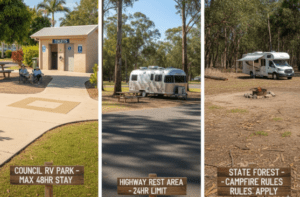
Quick Answer: The Six Types of Free (or Near-Free) Camping in Australia
Before the full detail, here is the essential framework. There are six distinct types of places where you can stay for free or near-free in Australia.
| Type | What It Is | Facilities | Self-Contained Required? | Typical Stay Limit |
|---|---|---|---|---|
| Council Free RV Parks | Council-run, signed, registered stops | Water, sometimes dump point. Rarely toilets or showers | Often yes | 24–72 hrs |
| Highway Rest Areas | TMR/state road authority managed | Toilets, picnic tables. No showers or dump points | No — but good to be | 20–24 hrs |
| State Forest Clearings | Undeveloped spots on public forest land | None | No — but essential | Varies, often 3 nights |
| National Park Campgrounds | Designated sites in national parks | Varies — drop toilets to full facilities | Depends on park | Booked in advance |
| Low-Cost Council Campgrounds | Paid, but $5–$15/night. Not truly free | Flush toilets, showers often included | No | 3–7 nights typical |
| Private Station Stays | Outback properties welcoming travellers | Varies widely | No, usually | 1–3 nights |
⚠️ The Critical Warning Before You Read Further: The single most expensive mistake grey nomads make is assuming that because a campsite is listed on an app, it is legal, current, and available. Apps are crowd-sourced and can be years out of date. Council rules change. Sites close. Restrictions are added. Always verify with the relevant council or parks authority before you rely on an app entry. This guide will show you exactly how to do that.
Before You Go: What Every Senior Needs to Know First
The Self-Containment Question — and Why It Matters More Than Anything Else
The most important thing you need to know before planning a free camping trip in Australia is whether your vehicle is self-contained. Not whether you have a porta-potty. Not whether you have a jerry can of water. But whether your vehicle meets the formal self-containment standard.
Self-contained means: your vehicle has an on-board toilet, sink, and fresh water system that are permanently plumbed or fitted into the vehicle itself. A cassette toilet that slides into a cupboard counts in some jurisdictions. A separate portable toilet does not count anywhere. Grey water must be held in a sealed tank — not draining to the ground.
This matters because a growing number of free camping options in Australia — particularly council-run RV parks — are restricted to self-contained vehicles only. The logic is sound: if a site has no dump point and no toilets, the council can only allow vehicles that manage their own waste internally.
Councils that are caught out by non-self-contained vehicles using self-contained-only sites lose the goodwill that allowed those free sites to exist in the first place. When the sites get trashed, the councils close them. That is why this matters so much — not just for you personally, but for every grey nomad who comes after you.
If you are not sure whether your vehicle qualifies: contact the Caravan Industry Association of Australia (CIAA) or refer to the CMCA (Campervan and Motorhome Club of Australia) for guidance on self-containment standards in your state.
The State-by-State Patchwork — Why There Is No Single National Rule
Australia has no single national free camping law. What is legal in Victoria’s state forests may be completely illegal on the roadside in Queensland. What requires a permit in NSW may be completely free in the Northern Territory. What was a free council camp last year may now cost $15 a night.
This is not a minor administrative detail. It has real consequences. In Queensland, sleeping in your vehicle outside a designated camping area — even a rest area — is technically prohibited and carries fines. In Western Australia, camping on Crown land without a permit can result in fines up to $1,000. In Victoria, state forests offer over 200 free camping clearings with a 3-night maximum and no permit required.
The practical implication for senior travellers: you cannot apply the rules from your home state to every state you drive through. Before crossing a state border, spend 10 minutes on the relevant state parks website to understand what is and is not allowed on the other side.
Phone Reception and the Download-First Strategy
The most critical thing you can do before heading to a free campsite is to download everything you need while you still have signal. This applies to maps, booking confirmations, QR check-in codes for council RV parks, and your camping apps.
Telstra has the broadest rural and remote coverage in Australia. If you are on Optus or Vodafone, your coverage will drop significantly outside major regional towns. If you rely heavily on camping apps for navigation to free sites, consider a Telstra SIM for your dedicated travel device.
The download-first strategy: before you leave the last regional town with strong signal, open your camping app, find your next intended stop, and download the offline map of that region. Open the booking confirmation or check-in QR code. Screenshot it. Save it to your camera roll. This takes five minutes and prevents a two-hour problem when you arrive at 5pm with no signal.
The Medical Reality Every Senior Traveller Must Plan For
Free campsites are, by their nature, located away from major services. That is why they are free — nobody else wants that land for commercial use. The flip side of the beautiful view and the quiet night is that you may be 80km from the nearest hospital.
Before you commit to any free campsite, do one thing first: open your mapping app, type in the address of the campsite, and then type in the nearest hospital. Check the drive time. Check whether the road is suitable for your vehicle at night. Know whether you have phone reception to call 000 if needed.
For senior couples: agree in advance what your “turn around” criteria are. If one of you is unwell before you leave a town, use the town’s facilities — not a remote free camp.
The Six Types of Free Camping: Full Detail for Senior Travellers
Type 1: Council Free RV Parks — The Best Option for Most Seniors
A growing number of Australian local councils operate free or very low-cost RV parks within their towns as a way of encouraging grey nomad spending in the local economy. You stop for a night or two, you shop at the local supermarket and eat at the local cafe, and the council gets foot traffic into the town. Everyone wins.
Council RV parks are almost always located in townships, which means you are walking distance from supermarkets, pharmacies, medical centres, and public toilets. The sites are usually flat, sealed, or compacted gravel. They are signed. They are managed.
The rules that catch seniors out:
- Most council RV parks have a 48-hour or 72-hour maximum stay
- Many require online check-in or QR code registration on arrival
- Self-contained requirements are enforced at more sites every year
- Seasonal closures are common — particularly in wet season across Queensland and the Top End
Verified Examples:
| Location | Address | GPS | Postcode | Stay Limit | Self-Contained? |
|---|---|---|---|---|---|
| Proserpine RV Park (QLD) | 126 Main St, Proserpine | -20.4033, 148.5750 | 4800 | 48 hrs | Yes — required |
| Collinsville RV Park (QLD) | Railway Rd, Collinsville Showgrounds | -20.5527, 147.8433 | 4804 | 72 hrs | No — toilets & showers on site |
| Babinda Rotary Park (QLD) | Howard Kennedy Dr, Babinda | -17.3480, 145.9262 | 4861 | 72 hrs | No — flush toilets on site |
📍 Save to Vanlife Savings Spots App: Copy the Postcode, Latitude and Longitude from the GPS column above into your Vanlife Savings Spots app to save these stops and get directions.
Type 2: Highway Rest Areas — The Reliable Toilet Stop Strategy
Managed by state road authorities, highway rest areas are designed for driver fatigue management. They are not campgrounds. But most allow you to stay overnight for 20–24 hours, and they have flush toilets.
For a grey nomad with a bladder condition, IBS, or any other condition requiring regular toilet access, highway rest areas are the backbone of a road trip. Knowing where the next flush toilet is — and that it is reliable, clean, and accessible — is not a luxury. It is a trip-planning necessity.
The key facts:
- Maximum stay is almost always 20–24 hours. No exceptions
- Toilets are usually flush and wheelchair accessible
- No dump points at most sites
- No showers
- Telstra is the most reliable network at remote sites
- Self-contained is not required, but practically essential for overnight stops without toilets
Verified Examples:
| Location | Address | GPS | Postcode | Toilets | Stay Limit |
|---|---|---|---|---|---|
| Guthalungra Rest Area (QLD) | Bruce Hwy, Guthalungra | -19.9234, 147.8428 | 4805 | Flush + wheelchair | 20 hrs |
| Cardwell Rest Area (QLD) | Bruce Hwy, Cardwell | -18.2631, 146.0284 | 4849 | Flush + disabled | 20 hrs |
| Marlborough Rest Area (QLD) | Bruce Hwy, Marlborough | -22.8209, 149.8851 | 4705 | Flush toilets | 20 hrs |
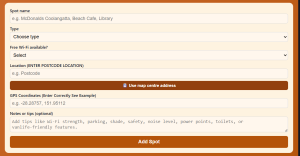
📍 Save to Vanlife Savings Spots App: Copy the Postcode, Latitude and Longitude into your Vanlife Savings Spots app to save these stops and get directions.
Type 3: State Forest Clearings — For Self-Sufficient Seniors Only
In Victoria, Queensland, New South Wales, and Tasmania, state forests contain undeveloped clearings or designated camping areas where overnight stays are permitted without a fee. Victoria has the most generous system — over 200 free camping sites with a typical 3-night maximum and no permit required.
If you are fully self-contained, experienced with remote driving, comfortable with no phone reception, and carry your own water for 3+ days — state forest camping can be genuinely excellent. If you are not self-contained, have limited mobility, or depend on regular medical check-ins — state forest camping is not your friend. These sites have no toilets, no water, no signal, and no help if something goes wrong.
State-by-state summary:
- Victoria: Over 200 free sites in state forests. No permit required. 3-night maximum. No facilities.
- New South Wales: State forests permit camping in designated clearings. Check the NSW Forestry Corporation website. Some require a pass.
- Queensland: All QPWS sites require a permit even if the fee is zero. Book at qpws.usedirect.com or phone 13 74 68.
- Tasmania: Some of the best wilderness camping in Australia. Check parks.tas.gov.au before visiting.
- Western Australia: Check the DBCA at exploreparks.dbca.wa.gov.au for approved sites.
- South Australia: Limited state forest camping. National parks require permits — contact SA National Parks and Wildlife Service.
- Northern Territory: Remote camping requires extreme self-sufficiency and a satellite communicator. Always carry an EPIRB or Garmin inReach.
Type 4: National Park Campgrounds — Affordable but Not Technically Free
Most Australian national park campgrounds charge a fee — typically $6–$20 per night per person. However, some remote walk-in or boat-in sites are genuinely free. All formal national park campgrounds in NSW, Victoria, Queensland, and the NT now require booking in advance through the relevant state parks booking system.
- NSW: nationalparks.nsw.gov.au
- Victoria: parks.vic.gov.au
- Queensland: qpws.usedirect.com or 13 74 68
- WA: exploreparks.dbca.wa.gov.au
- Tasmania: parks.tas.gov.au
- SA: parks.sa.gov.au
- NT: nt.gov.au/leisure/parks-reserves
Senior Tip: If you plan to visit multiple national parks in a single state, check whether an annual parks pass is available. In WA, a holiday pass covers all national parks for 4 weeks and is significantly cheaper than paying per entry. Similar passes exist in NSW and Victoria.
Type 5: Low-Cost Council Campgrounds ($5–$15/Night) — The Sweet Spot for Seniors
Many Queensland, NSW, and SA councils operate campgrounds that charge a token fee — typically $5 to $15 per night — in exchange for significantly better facilities than free sites: flush toilets, hot showers, dump points, and sometimes even powered sites.
The practicality for seniors is simple. The difference between a $0 free camp with a pit toilet 50 metres away in the dark and a $10 council campground with flush toilets 10 metres from your van is not $10. It is the difference between a good night’s sleep and a bad one. For most seniors, $10 is not the barrier. Comfort, safety, and toilet access is.
Type 6: Private Station Stays — Outback Hospitality at Its Best
Across outback Queensland, the NT, and WA, many cattle and sheep stations open their properties to grey nomads, offering free or very low-cost overnight stops. Some are listed on camping apps. Many are found by word of mouth or by stopping and asking.
Station stays offer something caravan parks and free camps do not — the company of genuine outback Australians, real water, and someone who knows the country. Always ask permission before camping on station property. Buy whatever the station is selling. Leave the area cleaner than you found it.
What Everyone Gets Wrong About Free Camping in Australia
Myth 1: “If It’s on an App, It’s Legal”
Camping apps including CamperMate, WikiCamps, and Camps Australia Wide are crowd-sourced databases updated by users, not by councils or parks authorities. A site can be listed as free and legal on an app while simultaneously being closed, subject to a new self-containment requirement, or actively being patrolled by rangers. Use apps to find candidates, then verify with the relevant council before you commit.
Myth 2: “Rest Areas Are for Sleeping In — Like Campgrounds”
Rest areas are designated for driver fatigue management, not camping. Staying beyond the posted limit (usually 20–24 hours) is an infringement. Putting out chairs, awnings, or camp furniture technically changes your status from “resting driver” to “camping” — which is prohibited at many highway rest areas.
Myth 3: “Self-Contained Just Means I Have a Toilet in My Van”
Formal self-containment standards vary by council and state. In the Whitsunday Regional Council area, self-contained means a permanently plumbed toilet, shower, and sink — not a portable toilet placed on the floor. A separate porta-potty, camp shower bag, or grey water bucket does not qualify. Verify what that specific council’s standard actually is before relying on the claim.
Myth 4: “Free Camping Is Free — There Are No Hidden Costs”
Free camps involve real costs. If you are not self-contained, you need to find a dump point before and after every free camp — which may require a detour of 40–80km. If there is no water, you need to carry enough for your stay. If there are no toilets, you need a portable toilet and chemicals. None of this is free in terms of time, fuel, or consumables.
Myth 5: “I Can Camp Anywhere in Queensland on the Side of the Road”
Queensland is the strictest state in Australia for roadside camping. Sleeping in your vehicle outside of a designated camping area or rest area is prohibited. The Gold Coast, Noosa, Cairns, and the Whitsundays all have active enforcement programs. Fines range from $250 to over $2,000.
Myth 6: “The Apps Work Offline So I Don’t Need to Plan Ahead”
Apps work offline for maps. They do not work offline for booking systems, QR code check-in platforms, or council registration portals. Download everything before you leave signal range — including the council phone number as a backup.
Myth 7: “All of Tasmania’s Free Camping Is Unrestricted”
Tasmania has some of Australia’s best free camping but it is not unrestricted. The Bay of Fires Conservation Area has designated camping areas, fire restrictions, and vehicle limits at some locations. Going outside designated zones risks a fine and contributes to degradation of one of the country’s most beautiful coastal environments.
If You Are Travelling Without Self-Contained Equipment
Strategy 1: Pair Free Camps With Low-Cost Council Campgrounds
Use a free camp or rest area for your transit nights. Use a low-cost council campground for your nights in each destination, where you want a proper shower, a dump point, and flush toilets within reach. Two free nights plus three paid nights at $10–$15 gives you five nights for $30–$45 — roughly the cost of one night at a mid-range caravan park.
Strategy 2: Use the National Public Toilet Map to Plan Every Leg
The Australian Government’s National Public Toilet Map at toiletmap.gov.au lists every publicly accessible toilet in Australia — including accessibility features, opening hours, and whether facilities include showers or disabled access. Download the app version before your trip. Use it to identify the toilet locations along every leg of your journey before you leave, not after you are desperate.
Strategy 3: Know Your Dump Point Before You Need It
Before arriving at any overnight destination — paid or free — identify the nearest dump point. The National Public Toilet Map lists sewage dump points as well as public toilets. Never arrive at a free camp with a full tank expecting to find a dump point there. Plan to dump at the last town before your campsite.
If You Are Travelling With a Pet
State Forests and Rest Areas: Generally Pet Friendly
In most state forests and remote Crown land camping areas, dogs are permitted provided they are on a lead. Victoria’s state forest camping is generally dog-friendly. Highway rest areas are dog-friendly on lead.
National Parks: Dogs Usually Prohibited
Dogs are prohibited in most Australian national parks — even in car parks in many cases. If you travel with a dog and plan to spend time in national park areas, you need a fallback camp outside the park boundary. Some NSW national parks permit dogs in specific vehicle-accessible campgrounds — check nationalparks.nsw.gov.au for specific rules.
Wildlife Hazards for Dogs by Region
- Tropical North Queensland: Saltwater crocodiles are present in all coastal and estuarine waterways. Do not allow your dog near any water’s edge at dawn or dusk — or any time in crocodile country.
- Northern Territory and outback WA: Dingoes are a risk to small dogs in remote camping areas. Keep dogs inside the vehicle or secured at night.
- Tasmania: Dogs that harass wildlife in national parks are subject to serious penalties. Keep your dog on a lead at all times outside the vehicle.
- Everywhere: Snake season runs from September through April across most of Australia. Dogs are at higher risk of snake strike than humans. Keep leads short in long grass.
⚠️ The Critical Pet Planning Rule: Before booking any free camping site, search the specific site name plus “dogs” or “pets” to verify the current rules. Council RV parks, rest areas, and state forest sites all vary. Never assume pet-friendliness — always verify.
If You Are a Grey Nomad Doing the Big Lap of Australia
Many senior travellers are not just doing a regional trip — they are doing the full circuit of Australia, commonly called the Big Lap. This is typically 12,000–20,000km over 3–6 months.
The Big Lap Route and Free Camping Reality, State by State
Queensland (Bruce Highway and Cape York): The most structured free camping network in Australia for grey nomads. Council RV parks are plentiful from Townsville north. Rest areas on the Bruce Highway are consistent and reliable. Cape York is primarily permit-based national park camping — book ahead.
New South Wales (Pacific Highway and Hume Highway): Fewer council free camps than Queensland. National park campgrounds booked in advance are the primary option. Budget for paid caravan parks along the Pacific Highway corridor.
Victoria (Great Ocean Road and inland): State forest free camping is excellent — the most generous free system in Australia. However, tourist areas along the Great Ocean Road have very limited free options.
South Australia (Eyre Peninsula and Flinders Ranges): SA has council-managed campgrounds at low cost across the Eyre Peninsula. The Nullarbor has Eyre Highway rest areas at roughly 100–150km intervals.
Western Australia (Southwest and Pilbara): WA has some of Australia’s best free camping in the remote north — around Exmouth, Broome, and the Pilbara. Around Perth and the southwest coast, free camping is heavily restricted. Fines up to $1,000 for camping outside designated areas.
Northern Territory (Stuart Highway and Kakadu): Generally camper-friendly on long outback routes. Always carry a satellite communicator in the NT — mobile reception disappears completely in vast stretches.
Tasmania (Bass Highway and East Coast): Arguably the best free camping in Australia relative to its size. The Bay of Fires, Maria Island, and many state forest areas offer genuine free options.
The Big Lap Planning Rule for Seniors
For a 4–6 month Big Lap, plan to alternate between free camps and paid sites rather than trying to free camp every night. Three or four free or low-cost nights per week, with two or three paid nights per week for showers, dump points, laundry, and resupply, gives you a realistic and comfortable rhythm.
What I Would Do If I Were Starting the Big Lap Today
Step 1 — Equipment audit: Six weeks before departure, audit your vehicle’s self-containment status. If you are not self-contained and want access to the full range of council RV parks, plan the upgrade now — not on the road.
Step 2 — App setup: Download WikiCamps ($9.99 one-off, best database), CamperMate (free, good for day-to-day navigation), and the National Public Toilet Map (free, Australian Government). Set all apps to offline map download before you leave your last town with signal.
Step 3 — The first 500km plan: Do not rely on free camping for the first two nights. Use paid caravan parks near your start point to settle into your routine and check that all systems work — water pump, grey tank, toilet, electrical — before you are remote.
Step 4 — Council RV park research for your route: Research every council RV park along your route using the individual council websites — not just an app. Note opening dates, self-containment requirements, and check-in procedures. Save each one to your Vanlife Savings Spots app with GPS coordinates and postcode.
Step 5 — The state border brief: Two days before crossing each state border, spend 30 minutes reading the relevant state parks authority’s website. Understand the difference in rules on the other side.
Step 6 — The medical network: Before you leave, identify the nearest hospital to every major overnight stop on your planned route. Focus on remote stretches where the nearest ED is more than 60 minutes away.
Step 7 — Communication: If you are going into areas with no Telstra reception, carry a personal locator beacon (PLB) registered with the Australian Maritime Safety Authority (AMSA). Registration is free at beacons.amsa.gov.au.
The Senior Grey Nomad Checklist — Free Camping Across Australia
Before You Leave Home
- ☐ Confirm vehicle self-containment status (built-in toilet + shower + sink, plumbed in)
- ☐ Check your intended free camp is open for your travel dates
- ☐ Download WikiCamps, CamperMate, and National Public Toilet Map — set to offline
- ☐ Register PLB with AMSA if travelling remote (free: beacons.amsa.gov.au)
- ☐ Save council 24-hr number for each stop before you leave signal range
- ☐ Research dump point locations for first two weeks of route
- ☐ Book any national park campgrounds that require advance booking
- ☐ Check seasonal closures for all intended free camping stops
- ☐ Carry 80 litres of fresh water capacity minimum before remote stretches
- ☐ Carry 7 days of food and medication before entering outback routes
- ☐ Save the nearest hospital address to every major overnight stop
On Arrival at Any Free Camp
- ☐ Check current signage — rules can change after an app entry was made
- ☐ Complete any QR code or phone check-in required by council
- ☐ Note your arrival time and set departure alarm 2 hrs before maximum stay expires
- ☐ Identify the nearest hospital and save the address
- ☐ Check phone reception — if none, activate satellite communicator
- ☐ Check the access road is suitable for departure in wet conditions
- ☐ Do NOT set up annexe, awning, or camp furniture at rest areas
Departure from Any Free Camp
- ☐ Use dump point before leaving or plan next dump stop
- ☐ Confirm maximum stay has not been exceeded
- ☐ Note no-return period if applicable
- ☐ Carry all rubbish with you — leave no trace
- ☐ Confirm next overnight stop is open and available
Frequently Asked Questions
Is free camping legal in Australia?
Yes — but only in designated areas that permit it. Free camping is legal at highway rest areas, council-operated free RV parks, designated state forest clearings, and specific national park sites. It is not legal on roadsides, in car parks, on beaches, in public parks, or on private property without permission. The rules vary significantly by state.
What is the difference between free camping and freedom camping?
In Australia, the two terms are often used interchangeably, but strictly speaking they differ. Free camping means camping without a fee at a designated site. Freedom camping implies camping in a location of your choice away from designated areas — which is often illegal without specific authorisation.
Do I need a self-contained vehicle to free camp in Australia?
Not universally — but increasingly yes. Highway rest areas do not require self-containment. State forest clearings in Victoria do not formally require it. But council RV parks — the most convenient free camping option for seniors — are increasingly restricted to self-contained vehicles only.
How do I find the nearest dump point?
Use the National Public Toilet Map at toiletmap.gov.au — it lists sewage dump points as well as public toilets. The Full Range Camping Directory at fullrangecamping.com.au also maintains a reliable Australian dump point database. Always verify before relying on the entry, as dump points do close.
What apps do grey nomads use to find free camping?
The three most widely used are: WikiCamps ($9.99 one-off, most comprehensive), CamperMate (free, good day-to-day tool), and Camps Australia Wide (produced by the grey nomad community). For official government sites, use the relevant state parks booking platform.
What happens if I overstay at a rest area?
Overstaying beyond the posted maximum (usually 20–24 hours) is an infringement. Fines vary by state — typically $250–$500 for a first offence. In Queensland and WA, enforcement is more active, particularly at popular rest areas near tourist towns.
Can I have a campfire at free camps?
It depends on the site, the time of year, and current fire restrictions. Most council RV parks and highway rest areas prohibit fires completely. State forest clearings often have designated fire rings, but fires are prohibited during declared fire ban periods. Never light a fire without checking current restrictions — particularly between October and April.
What is the best time of year to do the Big Lap?
Most grey nomads travel north during the Queensland and NT dry season (April through October) and return south before the wet season in November. For WA’s north — the Kimberley, Broome, Exmouth — the dry season is May through October. The southeast — Victoria, Tasmania, SA — is best in summer (November through March).
How to Check Before You Go — Official Sources by State
Do not rely solely on camping apps. Verify free camping information directly through these official sources before each leg of your journey.
| State/Territory | Parks Authority Website | Free Camp / RV Info | Phone |
|---|---|---|---|
| Queensland | parks.des.qld.gov.au | Council RV parks: check individual council sites | 13 74 68 (QPWS) |
| New South Wales | nationalparks.nsw.gov.au | State forest: forestry.nsw.gov.au | 1300 072 757 |
| Victoria | parks.vic.gov.au | State forests: ffm.vic.gov.au | 13 19 63 |
| Western Australia | exploreparks.dbca.wa.gov.au | Parks Stay: parkstay.dbca.wa.gov.au | 08 9219 9000 |
| South Australia | parks.sa.gov.au | environment.sa.gov.au | 1300 361 033 |
| Tasmania | parks.tas.gov.au | Free camps by area listed on site | 03 6165 4400 |
| Northern Territory | nt.gov.au/leisure/parks-reserves | NT Parks booking: nt.gov.au/parks | 08 8999 4555 |
| National Toilet Map | toiletmap.gov.au | Dump points, public toilets, accessibility info | Australian Government |
GPS Quick Reference — Verified Free Camping Examples Across Australia
All coordinates below have been verified against at least two independent official sources including the National Public Toilet Map, official council websites, and state parks authorities.
| Location | State | GPS | Postcode | Type | Self-Contained? |
|---|---|---|---|---|---|
| Proserpine RV Park | QLD | -20.4033, 148.5750 | 4800 | Council RV Park | Yes |
| Collinsville Showgrounds RV Park | QLD | -20.5527, 147.8433 | 4804 | Council RV Park | No |
| Babinda Rotary Park Campground | QLD | -17.3480, 145.9262 | 4861 | Council Campground | No |
| Guthalungra Rest Area | QLD | -19.9234, 147.8428 | 4805 | Highway Rest Area | Recommended |
| Proserpine Dump Point | QLD | -20.4040, 148.5717 | 4800 | Dump Point | N/A |
| Airlie Beach Lagoon Toilets | QLD | -20.2674, 148.7171 | 4802 | Day Use Toilets | N/A |
📍 Save to Vanlife Savings Spots App: Copy the Postcode, Latitude and Longitude from the GPS column above into your Vanlife Savings Spots app to save each stop and get directions.
The Real Picture of Free Camping in Australia
Free camping in Australia is one of the great privileges of the grey nomad lifestyle. Done properly — with the right vehicle, the right planning, and the right knowledge — it can reduce your accommodation costs to near zero while putting you in locations of extraordinary natural beauty that paid caravan parks can never offer.
Done without preparation, it is one of the most reliable ways to get a fine, end up in a difficult situation, or find yourself in a remote location at 9pm with no functioning toilet, no phone signal, and no obvious plan B.
The framework is not complicated. Know your vehicle. Know the rules for the state you are in. Verify before you rely. Carry enough water, food, and medication for longer than you think you need. Have a satellite communicator if you are going anywhere genuinely remote. Know where the nearest hospital is before you need it.
Australia has over 10,000 free and low-cost camping locations. The best of them are places where you will wake up to a view that makes you understand exactly why you chose this life. The goal of this guide is to make sure that the practical foundations are solid enough that you can actually enjoy those places — without the anxiety, the guesswork, or the unexpected fine.
That is free camping in Australia in 2026. Understood clearly. Planned properly. Enjoyed safely.
Article verified: February 2026. All GPS coordinates confirmed from official government sources including toiletmap.gov.au (National Public Toilet Map), individual Queensland council websites, and Queensland Parks and Wildlife Service. State rules and policies correct as at time of publication — verify current conditions before travelling.

As an affiliate, I earn from qualifying purchases at no extra cost to you.
As an affiliate, I earn from qualifying purchases at no extra cost to you.