How to Stay Connected on the Road in Australia: Internet and Phone Plans for Grey Nomads
If there is one thing that surprises new grey nomads more than anything else on their first big trip, it is not the distance between fuel stops or the cost of caravan parks. It is how quickly you start to feel cut off from the world when your phone shows no signal and your data has dropped out somewhere west of Broken Hill.
Staying connected on the road in Australia is genuinely achievable — even in remote areas — but it requires the right setup before you leave, not after you are already parked in the middle of nowhere wondering why nothing is working. The good news is that the options available to grey nomads in 2025 are better than they have ever been, and you do not need to be particularly tech-savvy to get a reliable system working in your van or motorhome.
This guide covers everything you need to know about mobile phone plans, data options, wi-fi boosters, satellite internet, and staying in touch with family while travelling Australia — written specifically for over-55 grey nomads who want practical answers without the technical jargon.
Why Staying Connected Matters More Than You Think
For many grey nomads, the idea of disconnecting from the world is part of the appeal. And there is real value in switching off occasionally — a night under the Milky Way with no notifications is one of the great pleasures of life on the road.
But full disconnection for extended periods is a different matter entirely, and most experienced grey nomads will tell you that reliable connectivity is not a luxury — it is a genuine safety and lifestyle necessity.
Staying connected means you can video call your grandchildren from a clifftop in the Kimberley. It means you can check road conditions before heading down an unfamiliar track. It means your family knows you are safe. It means you can manage your banking, report to Centrelink fortnightly, stream a film on a rainy afternoon, and call for help if something goes wrong in a remote area.
Getting your connectivity setup right before you leave is one of the best investments you can make in your time on the road.
The Honest Truth About Mobile Coverage in Australia
Before diving into plans and devices, there is one truth about Australian mobile coverage that every grey nomad needs to accept: no single network covers everywhere, and large parts of inland and remote Australia have no mobile coverage at all from any provider.
Australia is an enormous country with a relatively small population concentrated along the coastlines. The mobile networks that exist are genuinely impressive given the scale of the challenge, but the outback, the Kimberley, Cape York, and vast stretches of the interior simply do not have towers close enough to provide reliable coverage.
This is not a problem that a better phone plan will solve. For truly remote travel, a different technology — satellite communication — is the only reliable answer, and we will cover that separately later in this guide.
For the main highway routes, coastal areas, regional towns, and most popular grey nomad destinations, mobile coverage from the right network is perfectly adequate for everyday connectivity needs.
Which Mobile Network Is Best for Grey Nomads?
Telstra — The Clear Winner for Regional and Remote Coverage
If you are travelling beyond the major cities and coastal tourist strips, Telstra has significantly better regional and remote coverage than any other Australian network. This is not a matter of opinion — Telstra’s network covers more of the Australian landmass than Optus and Vodafone combined, and for grey nomads travelling through outback Queensland, WA, the NT, and rural South Australia, this difference is felt every single day.
Telstra is more expensive than its competitors. That is simply true, and there is no point pretending otherwise. But for grey nomads who are travelling remote routes, the premium is worth paying. Losing connectivity for days at a time because you chose a cheaper plan on a smaller network is a false economy when you are depending on your phone for safety, navigation, and family contact.
Telstra’s prepaid plans are a popular choice among grey nomads because they offer flexibility without lock-in contracts. You can choose a monthly plan, recharge when it suits you, and adjust your data allowance as your needs change on the road.
Optus — Good for Coastal and Regional Travel
Optus has solid coverage in major cities, along most of the eastern seaboard, and in many popular regional areas. If your Big Lap is focused primarily on the coast — the Great Ocean Road, the Queensland coast, the south-west of WA — Optus can be a cost-effective alternative to Telstra.
Where Optus falls short is in the remote interior and the north-west. If your route includes outback Queensland, the Red Centre, the Kimberley, or the Gulf country, Optus coverage gaps will frustrate you. Many grey nomads who travel with a partner choose to carry both a Telstra SIM and an Optus SIM in separate devices, covering more ground between the two networks.
Vodafone and Other MVNOs
Vodafone’s coverage outside metropolitan areas is limited compared to both Telstra and Optus, and it is generally not recommended as a primary network for grey nomads doing the Big Lap. Many of the budget Mobile Virtual Network Operators — brands like Boost, Aldi Mobile, Woolworths Mobile, and others — run on either the Telstra or Optus network and can offer genuinely good value. Boost Mobile in particular runs on the Telstra network and offers competitive prepaid plans at a lower price point than Telstra directly, making it a popular choice for cost-conscious grey nomads who still want Telstra coverage.
Mobile Data Plans — What Grey Nomads Actually Need
How Much Data Do You Really Use?
This is the question most new grey nomads underestimate. When you are at home with a fixed broadband connection, your phone’s mobile data usage is minimal because you are almost always on wi-fi. On the road, your mobile data becomes your primary internet connection for everything — and usage adds up quickly.
Streaming one hour of video on a standard definition setting uses approximately 1GB of data. A video call with family for half an hour uses around 300MB to 500MB depending on the platform. Browsing, social media, email, and navigation use modest amounts individually but accumulate over a month of daily use.
A grey nomad couple who streams a couple of hours of television most evenings, video calls family a few times a week, and uses their phone normally for browsing and social media during the day will typically use between 50GB and 150GB of data per month. Plans below 30GB are likely to leave you rationing data before the month is out.
Prepaid vs Postpaid Plans for Grey Nomads
Postpaid plans — the monthly contract or no-lock-in plans billed in arrears — offer higher data allowances and often include additional features like international calls. They require a credit check and a billing address, which is straightforward to maintain even while travelling full-time.
Prepaid plans are simpler, more flexible, and require no credit check. You pay in advance and use what you have paid for. For grey nomads who want maximum flexibility and no ongoing billing obligations, prepaid plans from Telstra or Boost Mobile are a very practical choice.
Many experienced grey nomads run two separate SIMs — a high-data Telstra or Boost plan as their primary connection, and a smaller Optus prepaid SIM as a backup for areas where Optus coverage fills in gaps.
Mobile Wi-Fi Devices and Data Modems for the Van
Why a Dedicated Mobile Wi-Fi Device Makes Sense
Using your smartphone as a personal hotspot to connect a laptop or tablet works perfectly well but has two significant drawbacks. It drains your phone battery quickly, and it means your phone needs to be physically near your other devices to share the connection.
A dedicated mobile wi-fi device — often called a MiFi or mobile hotspot — solves both problems. These small devices connect to the mobile network and create a wi-fi bubble inside your van that multiple devices can connect to simultaneously. They have their own battery, so your phone stays charged and available. You can connect your phone, your partner’s phone, a laptop, and a tablet all at once.
Dedicated modems — devices that connect via USB or sit in a fixed location in your van — are another option, particularly if you want a more permanent setup with an external antenna for better signal reception.
External Antennas — A Game Changer in Fringe Coverage Areas
One of the most practical upgrades a grey nomad can make to their connectivity setup is adding an external antenna to their mobile data device. In areas where your phone shows one bar of signal or intermittent coverage, a good quality external antenna mounted on the roof of your van can pull in a significantly stronger signal and transform a frustrating half-connection into a usable one.
Brands like Cel-Fi, weBoost, and Poynting are popular among Australian grey nomads for external antenna setups. The installation is straightforward and the difference in fringe coverage areas is remarkable. If you are spending time in regional and remote Australia, an external antenna is worth every cent.
Satellite Internet — The Solution for Truly Remote Areas
Starlink — The Option That Has Changed Everything
Until recently, staying connected in truly remote Australia meant accepting that you simply would not have internet access for days or weeks at a time. Satellite internet existed but was expensive, slow, and came with frustrating data caps.
Starlink, the low earth orbit satellite internet service operated by SpaceX, has fundamentally changed this situation. Starlink delivers genuinely fast internet — speeds that comfortably support video streaming, video calls, and normal browsing — to virtually anywhere in Australia with a clear view of the sky. And for grey nomads, that means almost everywhere you are likely to camp.
The Starlink Roam plan is specifically designed for mobile use and has become enormously popular among Australian grey nomads since it became widely available. You pay a monthly subscription fee and a one-off cost for the dish hardware. The dish is compact enough to mount on a van roof or set up on a tripod beside your van at camp.
Starlink is not cheap. The hardware cost and monthly subscription represent a meaningful ongoing expense. But for grey nomads who work remotely, rely heavily on video calls with family, or simply refuse to accept weeks of connectivity blackouts in the outback, many find the cost completely justified. Grey nomad forums and Facebook groups are full of converts who say it is the single best investment they made for life on the road.
Satellite Phones and Personal Locator Beacons
Satellite internet solves the data connectivity problem in remote areas, but it is worth separating connectivity for safety purposes from connectivity for everyday use.
A Personal Locator Beacon, known as a PLB, is a small device that sends a distress signal to emergency services via satellite when activated. It does not require a subscription, it works everywhere in Australia, and it could save your life in a remote emergency. Every grey nomad travelling in remote or outback areas should carry one. Register your PLB with the Australian Maritime Safety Authority — registration is free and takes only a few minutes online.
A satellite communicator such as a Garmin inReach goes further than a PLB — it allows two-way text messaging via satellite, GPS tracking that family members can follow on a map, and an SOS function. Many grey nomads use an inReach to send regular check-in messages to family when travelling through areas with no mobile coverage, providing peace of mind for everyone involved.
Wi-Fi at Caravan Parks — What to Expect
Most caravan parks in Australia now advertise wi-fi as a feature, and for grey nomads who are spending extended periods in one park, this can sound like a solution to all connectivity needs. The reality is more complicated.
Caravan park wi-fi varies enormously in quality. In some parks — particularly newer or well-managed facilities — the wi-fi is fast, reliable, and genuinely useful. In many others, it is slow, unreliable, drops out frequently, and becomes unusable in the evenings when every guest is trying to stream television at the same time.
It is worth treating caravan park wi-fi as a useful bonus rather than a reliable primary connection. Use it when it works well, particularly for large downloads or uploads that would chew through your mobile data allowance. But do not plan your connectivity strategy around it.
Staying in Touch With Family — Practical Tips for Grey Nomads
Video Calling Apps
Video calling has transformed how grey nomads stay in touch with family, and the options available are excellent. FaceTime works beautifully between Apple devices and uses relatively modest data. WhatsApp video calls work across both Apple and Android and are widely used by grey nomad families for their flexibility. Zoom and Facebook Messenger video are other popular choices, particularly for calling grandchildren who may be on different devices.
The key is agreeing on a preferred platform with your family before you leave and making sure everyone has it set up and working. Trying to troubleshoot a video calling app issue while parked somewhere with limited connectivity is an experience worth avoiding.
Scheduled Check-Ins
Many experienced grey nomads establish a regular check-in schedule with family — perhaps a video call every Sunday evening, or a daily text message to confirm they are safe. This simple practice provides enormous reassurance to family members at home, particularly when you are travelling through remote areas, and it reduces the anxious phone calls that can otherwise interrupt your days on the road.
If you are travelling through an area with no mobile coverage, letting family know in advance — and giving them an expected date when you will be back in range — prevents unnecessary worry.
Social Media and Blogging
Many grey nomads share their journey on social media — Facebook, Instagram, and YouTube are all popular platforms for the grey nomad community. Beyond being an enjoyable creative outlet, sharing your journey publicly means family and friends can follow along passively without needing you to provide constant updates. Several grey nomads have built genuinely large audiences sharing their Big Lap adventures, and the community that forms around these accounts can become a meaningful part of the experience.
The Recommended Grey Nomad Connectivity Setup
For most grey nomads doing the Big Lap, the following combination covers the vast majority of situations comfortably.
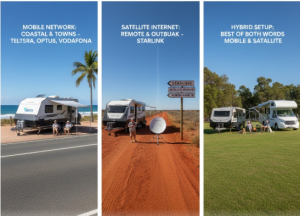
A Telstra or Boost Mobile SIM with a generous data allowance — 100GB or more per month — as your primary mobile connection. A dedicated mobile wi-fi device or modem with an external antenna for better reception in fringe coverage areas. A Starlink Roam subscription for extended stays in remote areas where mobile coverage is absent. A registered Personal Locator Beacon carried at all times when travelling remote routes. A Garmin inReach or similar satellite communicator for two-way messaging and family tracking in remote areas.
Not every grey nomad needs every element of this setup. If your route stays close to the coast and major highways, Starlink may be an unnecessary expense. If you are never venturing far from mobile coverage, a PLB and inReach may feel excessive. Build your setup around your actual route and your tolerance for connectivity gaps.
Frequently Asked Questions
Is Telstra Really Worth the Extra Cost for Grey Nomads?
For grey nomads travelling remote routes, yes — almost universally. The coverage difference in outback and remote areas is significant enough that experienced travellers recommend Telstra without hesitation. For nomads staying close to the coast and major regional centres, a Boost Mobile plan on the Telstra network offers a good compromise between coverage and cost.
Can I Stream Television in My Van Every Night?
Yes, if you have sufficient data and adequate signal strength. Most grey nomads who plan to stream regularly choose a plan with at least 100GB of data per month and supplement it with caravan park wi-fi where available. A Starlink setup makes nightly streaming possible even in remote areas.
What Is the Best Setup for a Grey Nomad Who Works Remotely?
Remote workers need the most robust connectivity setup. A Telstra SIM with maximum data, a high-quality modem with an external antenna, and a Starlink subscription for remote areas will cover almost any work requirement. A backup Optus SIM provides an additional safety net. Many remote-working grey nomads treat their connectivity setup as a professional tool and budget accordingly.
How Do I Manage My Centrelink Reporting on the Road?
Download the Express Plus Centrelink app on your smartphone and set up your myGov account before you leave home. Fortnightly reporting takes only a few minutes through the app and can be done anywhere you have a mobile signal. For areas with no coverage, plan your reporting around your return to signal range and ensure you do not miss your reporting window.
Final Word
Staying connected on the road in Australia in 2025 is easier than it has ever been, and the technology available to grey nomads now makes it possible to be genuinely well-connected even in remote corners of the country — if you set things up correctly before you leave.
The biggest mistake new grey nomads make is underestimating how much connectivity matters until they are somewhere without it. Get your SIM sorted, consider an external antenna, look seriously at Starlink if you are heading remote, and carry a PLB every time you venture off the main highway.
Do all of that, and the only thing interrupting your video call with the grandkids will be the sunset over the Kimberley demanding your full attention. And that, frankly, is a problem worth having.

As an affiliate, I earn from qualifying purchases at no extra cost to you.

As an affiliate, I earn from qualifying purchases at no extra cost to you.