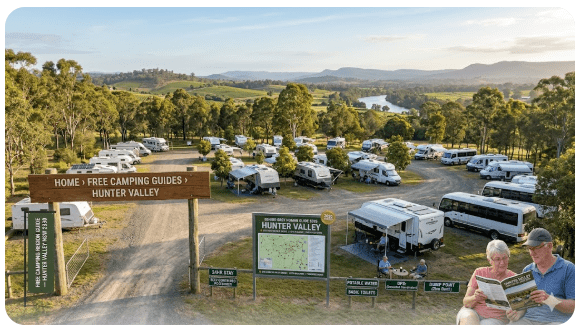
Hunter Valley Free Camping
A practical senior grey nomad guide to free and low-cost overnight stops across the Hunter Valley NSW — covering GPS coordinates, facilities, safety, medical access and honest arrival expectations for caravans, motorhomes and campervans.
📅 Last reviewed: June 2026 | Hunter Valley NSW 2330–2335 | Publicly accessible rest areas and free camping zones — rules subject to change, always verify on arrival
The Hunter Valley is one of New South Wales’s most accessible touring regions for senior grey nomads, sitting within two hours of Sydney and offering a patchwork of free camping areas, roadside rest areas, and low-cost overnight stops spread across vineyards, state forests and river flats. From the wine country around Cessnock and Pokolbin to the broader river corridors near Singleton and Maitland, this region rewards those who plan carefully. Facilities vary enormously from site to site, and conditions on the ground often differ from what online sources suggest. This guide gives you honest, practical information so you can travel with confidence.
- Region: Hunter Valley, NSW
- State: NSW
- Use: Free overnight stops, roadside rest areas, state forest camps
- Best for: Caravans, motorhomes, campervans — senior grey nomads passing through or exploring the wine region
- Toilets: Present at some locations — not all. Verify at each stop before arrival.
- Dump point: Available in Cessnock, Singleton and Maitland — not at roadside rest areas
- Potable water: Not reliably available at free stops. Carry your own supply.
- Power: No power at free camping areas. CPAP users must plan for battery or solar.
- Phone signal: Telstra generally best. Patchy in state forest and valley corridors.
- Nearest major town: Cessnock NSW 2325 (wine region hub)
- Nearest major services: Maitland NSW 2320 (approximately 35km from Cessnock) — full medical, shopping and dump point access
Table of Contents
- Location, address and GPS
- Can you stay overnight in the Hunter Valley?
- Facilities: toilets, water, bins and dump point
- Nearby public Wi-Fi and mobile coverage
- How to get there
- What to expect on arrival
- Safety for senior grey nomads
- Medical and emergency contacts
- Dump points, water and supplies nearby
- Things to do for seniors in the area
- Best time of year to stop here
- Fires, generators and overnight etiquette
- Packing checklist for seniors
- GPS coordinates and postcodes: save every stop
- Frequently Asked Questions
- Quick verdict
- Hunter Valley Free Camping — Nearby Rest Areas and NSW Links
Section 1 — Location, Address and GPS
The Hunter Valley free camping region spans a broad corridor of central-eastern NSW, anchored between the townships of Cessnock, Singleton, Maitland and Muswellbrook. The key free overnight areas used by grey nomads include Wollombi Brook rest areas, Singleton rest areas along the New England Highway, Broke Road corridor pullouts, and Barrington River Tops State Forest access points on the northern fringes. Below are the primary reference GPS coordinates used for regional navigation.
📍 Primary GPS Reference — Cessnock (Regional Hub)
Cessnock NSW 2325 — use as your regional navigation anchor for the wine country free camping zones.
📍 Secondary GPS Reference — Singleton Rest Area (New England Hwy)
Singleton NSW 2330 — primary rest area reference for northbound travellers on the New England Highway corridor.
| Detail | Information |
|---|---|
| Region Name | Hunter Valley Free Camping Zone |
| State | New South Wales (NSW) |
| Key Postcodes | 2325 (Cessnock), 2330 (Singleton), 2320 (Maitland), 2333 (Muswellbrook) |
| Primary Road Access | New England Highway (A15), Wine Country Drive, Broke Road |
| Nearest City | Newcastle NSW 2300 (approx. 55km southeast of Cessnock) |
| Nearest Major Town | Maitland NSW 2320 (approx. 35km from Cessnock) |
| Local Government | Cessnock City Council / Singleton Council / Maitland City Council |
| State Forest Areas | Yengo National Park (west), Barrington Tops State Forest (north) |
| Typical Camp Types | Roadside rest areas, council-permitted stops, state forest camps, showground overnight parking |
| Coordinates Accuracy Note | Planning coordinates only — always confirm against on-site signage |
For a broader list of verified free camping GPS stops across NSW and Australia, see our Vanlife Savings Spots guide.
Section 2 — Can You Stay Overnight in the Hunter Valley?
Yes — in specific designated areas. The Hunter Valley contains several legitimate free and low-cost overnight camping options for grey nomads, but the rules differ significantly depending on whether you are on a roadside rest area managed by Transport for NSW, a council-permitted area, or a state forest site managed by the NSW National Parks and Wildlife Service (NPWS) or Forestry Corporation NSW.
Roadside rest areas along the New England Highway (such as those near Singleton and Muswellbrook) permit overnight stops but are intended for rest breaks of up to 24 hours, not extended camping. Stays beyond this window may attract attention from local rangers or police patrols, particularly during peak travel periods.
- Rest areas on state highways: typically up to 24 hours, no cost, no facilities guaranteed
- Cessnock Showground: historically permitted overnight parking — check with Cessnock City Council before each visit as rules have changed periodically
- State forest camps (Barrington Tops, Yengo fringes): require NPWS or Forestry NSW permits in some zones — check before arrival
- Wollombi area informal stops: on private or Crown land — legal status uncertain, always look for permit or council signage
- Private property and farmstay arrangements: require explicit permission from the landowner and should not be assumed
Section 3 — Facilities: Toilets, Water, Bins and Dump Point
Facilities across Hunter Valley free camping areas vary enormously. Some roadside rest areas have basic pit or drop toilets; many do not. Do not assume facilities are present at any stop — always carry your own water, toilet solution, and waste management supplies as a baseline.
| Facility | What Is Available | What Seniors Should Know |
|---|---|---|
| Toilets | Present at selected rest areas on New England Hwy (Singleton area) and at Cessnock Showground when open. Not present at most informal stops. | Confirm toilet presence via Campermate or WikiCamps before arrival. Pit toilets may not be suitable for those with mobility issues. |
| Potable Water | Not reliably available at any free stop in this region. Cessnock, Singleton and Maitland town centres have public taps. | Carry a minimum 20–40 litres of drinking water. Do not rely on creek or bore water without testing. Dehydration risk is real in summer heat. |
| Dump Point | Not at roadside rest areas. Available at Cessnock Showground (when operating), Singleton Visitor Information Centre area, and Maitland. | Plan your cassette or black tank disposal before reaching camp. See Section 9 for full dump point locations. |
| Showers | No showers at any free stop in this region. | Nearest paid shower access is at local caravan parks in Cessnock, Singleton and Maitland. Day rate shower access is usually $5–$10. |
| Bins | Present at some highway rest areas. Absent at most informal bush stops. | Carry your own bin bags and practice pack-in, pack-out. Do not leave rubbish — it directly threatens access for all nomads. |
| Power | No power at any free camping area in the Hunter Valley. | CPAP users must use battery banks, solar or 12V systems. Plan power needs before arrival. Nearest powered sites at Cessnock Tourist Park. |
Section 4 — Nearby Public Wi-Fi and Mobile Coverage
Mobile coverage in the Hunter Valley is generally reasonable in the major towns but drops off quickly once you move into the valley corridors, state forest access roads or the Wollombi and Yengo fringes. Plan your connectivity before heading to camp, and download offline maps before leaving the nearest town.
- Cessnock township (2325): Telstra, Optus and Vodafone all have reasonable 4G coverage in the town centre. Free public Wi-Fi is available at Cessnock Library (Aberdare Road). Check opening hours.
- Singleton township (2330): Good Telstra and Optus coverage in town. McDonald’s on John Street offers free Wi-Fi. Singleton Library on Civic Avenue also has free public internet access.
- Maitland (2320): Strong Telstra and Optus coverage. Maitland City Library (High Street) offers free Wi-Fi and computer access during business hours.
- Muswellbrook (2333): Telstra coverage generally solid. Optus is reasonable in town. Coverage drops on the outskirts heading toward Aberdeen.
- Wollombi Valley and Broke Road corridor: Coverage is patchy to non-existent on Telstra and essentially absent on Optus and Vodafone. Treat this area as a no-signal zone.
- Barrington Tops fringes (north of Singleton): Minimal to no coverage on any network. Download offline maps before entering.
Section 5 — How to Get There
The Hunter Valley is well-accessed from multiple directions. The routes below cover the two most common approaches for grey nomads: from Sydney to the south and from the New England Highway corridor to the north.
From Sydney (southbound approach — approximately 2 hours)
Take the M1 Pacific Motorway north from Sydney, then exit onto the Hunter Expressway (A15) westbound toward Cessnock and Branxton. This is a modern, divided highway with good shoulder width and gentle grades — well-suited for towing. From Branxton, follow Wine Country Drive south toward Cessnock (approximately 12km). For the New England Highway corridor and Singleton, continue on the Hunter Expressway past Branxton and join the New England Highway northbound.
From the New England Highway (northbound or southbound)
Travellers coming from Tamworth or Armidale southbound will enter the Hunter Valley via the New England Highway through Muswellbrook and Singleton. The highway is well-maintained and suitable for caravans, though some sections between Muswellbrook and Aberdeen include curves that require attention when towing. Travellers coming from Newcastle westbound should take the Hunter Expressway from the M1 junction near Beresfield.
Driving notes for seniors towing vans
- The Hunter Expressway (A15) between Branxton and Cessnock is excellent for caravans — well-maintained, wide lanes, minimal heavy vehicle traffic during off-peak hours.
- Wine Country Drive between Cessnock and Pokolbin has narrow sections, unsealed shoulders and tourist traffic on weekends — take extra care when towing wide vans.
- The Putty Road (B52) between Windsor and Singleton is scenic but has long sections of winding two-lane highway — not recommended for large rigs or those new to towing.
- Broke Road between Cessnock and Broke has sections of poor road surface and sharp bends — suitable for smaller vans only.
- Fuel up before heading into Wollombi, Broke or Barrington Tops access roads. Fuel availability in these areas is limited and expensive.
- Avoid school peak hours (8–9am and 3–4pm) on Wine Country Drive and the main Cessnock approaches — congestion can build quickly around the town centre roundabouts.
Section 6 — What to Expect on Arrival
Arriving at Hunter Valley free camping areas is rarely the polished experience that social media posts suggest. Most free stops in this region are simple roadside pullouts, cleared state forest areas or showground car parks — functional but basic. Expect variation in condition, especially after wet weather, and do not be surprised to find a spot occupied, muddy, or lacking the facilities listed on apps. The region’s popularity with tourists means that prime spots near Cessnock and Pokolbin can fill on Friday and Saturday nights even in off-peak months.
- Rest areas on the New England Highway near Singleton are typically clean and well-signed but small — turnover is frequent and spaces for large rigs are limited, particularly the 24-hour bays.
- Cessnock Showground access varies by season and event calendar — the grounds are used for local events and access is not guaranteed. Always call ahead: Cessnock City Council 02 4993 4100.
- Informal stops near Wollombi and Broke are primitive — expect basic cleared areas, no signage confirming legality, and no facilities. Ground surfaces may be uneven and unsuitable for large vans.
- State forest camp areas near Barrington Tops (north of Singleton) are genuinely beautiful but require rough unsealed road access — not appropriate for all rigs. Check road conditions before attempting.
- Noise levels vary. Rest areas on the New England Highway carry heavy vehicle traffic noise 24 hours a day — bring quality earplugs or white noise for sleep.
Section 7 — Safety for Senior Grey Nomads
Personal Safety
- Highway rest areas on the New England Highway are high-traffic, well-lit public spaces — generally considered safe for overnight stops, though you are not isolated from public access at any time.
- Informal stops near Wollombi and Broke are more secluded — solo travellers should inform someone of their location and expected check-in time before stopping in these areas.
- Lock all vehicle and van doors at night, regardless of how quiet the area appears. Opportunistic theft does occur at roadside stops — see our caravan theft prevention guide for practical steps.
- Trust your instincts on arrival. If a location feels uncomfortable, does not match what you expected, or has other visitors whose behaviour concerns you, move on without hesitation. There is no obligation to stay.
- Keep a charged personal mobile phone and a backup power bank accessible at all times, even when you are inside the van. In an emergency, a flat phone is a serious problem.
Trip Safety
- Share your itinerary with a family member or trusted contact — including specific GPS stops and expected travel dates — before entering areas with limited mobile coverage such as the Wollombi Valley or Barrington Tops.
- Carry a personal locator beacon (PLB) if you plan to access state forest or remote bush camps. In areas without mobile coverage, a PLB is your primary emergency contact device.
- Check the Bureau of Meteorology forecast for the Hunter Valley region before arrival. Flash flooding can affect low-lying river camps rapidly, particularly along the Hunter, Wollombi Brook and Paterson River corridors.
- The Hunter Valley experiences significant heat from December to February. If temperatures exceed 35°C, do not remain in an unventilated van or motorhome — heat stress in seniors can escalate quickly to a medical emergency.
- Carry a minimum three-day supply of any prescription medications, plus extra in case of unexpected delays accessing a pharmacy. Nearest major pharmacies are in Cessnock, Singleton and Maitland.
Section 8 — Medical and Emergency Contacts
The Hunter Valley has reasonable medical infrastructure in its major towns, but response times in remote valley areas and state forest camps can be extended. Know your nearest hospital before you set up camp — do not rely on searching for it in an emergency.
| Service | Address | GPS | Phone |
|---|---|---|---|
| Cessnock District Hospital | Sultan Street, Cessnock NSW 2325 | -32.8350° S, 151.3542° E | (02) 4993 4300 |
| Singleton District Hospital | Loder Street, Singleton NSW 2330 | -32.5675° S, 151.1698° E | (02) 6578 6100 |
| Emergency (Police, Fire, Ambulance) | Australia-wide | — | 000 |
| Healthdirect (24hr nurse helpline) | Australia-wide | — | 1800 022 222 |
| Hunter New England Health (general) | — | — | (02) 4921 4242 |
Section 9 — Dump Points, Water and Supplies Nearby
There is no dump point at any roadside rest area or informal free camping stop in the Hunter Valley. Grey nomads using cassette toilets or black tanks must plan disposal stops in advance. The following table covers all essential supply needs for a typical one-to-three-night stay in the region.
| Need | Best Nearby Option | Notes |
|---|---|---|
| Dump Point | Cessnock Showground (when operating) — McDonald Street, Cessnock; Singleton Visitor Centre area — New England Hwy, Singleton; Maitland showground area | Availability varies. Call ahead. Cessnock: 02 4993 4100. Do not use without confirming access is currently available. |
| Fresh Water | Cessnock, Singleton and Maitland town tap points. Some service stations allow tank top-up — ask before using. | Carry a minimum 40L supply. Do not rely on finding water on arrival at camp. |
| Groceries and Fuel | Cessnock: Woolworths and Coles on Vincent Street. Singleton: Coles on John Street. Both towns have Caltex and BP fuel. | Fuel is cheaper in Cessnock and Singleton than at tourist-zone service stations near Pokolbin. |
| Major Supplies (hardware, medical) | Maitland — Bunnings, Chemist Warehouse, Target. Newcastle — full range of major retailers. | For larger van parts or specialist medical supplies, Newcastle is the reliable choice (approx. 55km from Cessnock). |
| Alternative Town Option | Muswellbrook NSW 2333 — northbound travellers. Has Woolworths, Coles, pharmacies and a hospital. | Good refuelling stop for those heading to Tamworth or beyond on the New England Highway. |
For advice on how to plan your stays around powered sites and dump point access as part of an extended grey nomad trip, see our guide on how long you can stay in a caravan park in Australia.
Section 10 — Things to Do for Seniors in the Area
The Hunter Valley sits within easy reach of some of Australia’s most senior-friendly regional experiences — flat cellar door settings, heritage villages, accessible gardens and scenic river drives that require minimal physical exertion while delivering genuine rewards. You do not need to be a wine enthusiast to enjoy this region; the Hunter Valley’s cultural and natural appeal is broad.
| Activity | Location | Why Seniors Like It |
|---|---|---|
| Hunter Valley Gardens | Broke Road, Pokolbin NSW 2320 | Flat, well-paved walking paths through themed garden displays. Accessible for those with mobility aids. Cafés on-site. Entry fee applies. |
| Cessnock Heritage Walk | Cessnock township, NSW 2325 | Self-guided flat walk through historic mining-era buildings. Free. Brochure available at Cessnock Visitor Centre. |
| Wollombi Valley Drive | Cessnock to Wollombi via Wollombi Road | Scenic country drive through historic villages, no hiking required. Stop at Wollombi Tavern (historic pub, circa 1831). Suit small to mid vans only. |
| Singleton Historic Precinct | Singleton township, NSW 2330 | Heritage buildings, riverside parkland and flat walking paths. Singleton is a relaxed country town with good café access. |
| Cellar Door Tastings — Pokolbin | McDonalds Road and Broke Road, Pokolbin NSW 2320 | Many cellar doors have flat car parks and accessible tasting rooms. Tyrrell’s, Brokenwood and Audrey Wilkinson are senior-friendly with seating and parking. |
Best Senior-Friendly Ideas at the Hunter Valley
- Start your mornings early at the cellar doors — arrive before 11am to avoid tour bus crowds and secure a parking spot suitable for your rig.
- The Hunter Valley Gardens are at their best in spring (September to November) — the rose gardens and seasonal displays are genuinely spectacular and require only a slow flat walk.
- Wollombi village is worth the drive for history enthusiasts — the colonial-era village is small, quiet and requires no significant walking.
- Singleton’s riverside parkland along the Hunter River is flat, shaded and peaceful — ideal for a quiet morning walk or afternoon rest stop.
- If you enjoy local markets, the Cessnock Markets and various Hunter Valley weekend markets offer low-key browsing without crowds on most weekday mornings.
For inspiration on making the most of extended stays in regional areas like the Hunter Valley, read our guide to living in a camper full-time.
Section 11 — Best Time of Year to Stop Here
| Season | What It Is Like | Senior Verdict |
|---|---|---|
| Summer (Dec–Feb) | Hot to very hot — temperatures regularly exceed 35°C and occasionally 40°C. Bushfire risk is real. Wine tourist peak season. Rest areas and informal camps fill quickly on weekends. | Not recommended for sensitive campers or those in vans without reliable ventilation or air conditioning. Plan for early morning and late afternoon activity only. |
| Autumn (Mar–May) | Mild, stable and genuinely beautiful. Vine leaves turn golden in the vineyards. Temperatures 15–25°C. Lower tourist numbers than summer peaks. | Best season overall for senior grey nomads. Comfortable overnight temperatures, lower competition for rest area spaces, beautiful scenery. |
| Winter (Jun–Aug) | Cool to cold overnight — temperatures can drop to 3–7°C in valley areas. Daytime is typically mild (12–18°C). Low humidity and clear skies. Wine events common. | Good for those with appropriate heating in their van. Diesel heater or reverse cycle essential overnight. Excellent for exploring without summer heat risk. |
| Spring (Sep–Nov) | Warming temperatures, occasional rain. Hunter Valley Gardens peak season. School holiday periods in September and October bring increased tourism. | Excellent season — avoid September school holiday weeks if you want quieter rest areas. October and November are ideal balance of weather and crowd levels. |
Section 12 — Fires, Generators and Overnight Etiquette
Behaviour at Hunter Valley free camping areas directly determines whether these spaces remain available. Areas that attract complaints about noise, fire risk or rubbish are regularly closed by councils and land managers — sometimes permanently. Every grey nomad has a responsibility to maintain good camp etiquette.
- Open fires: Prohibited at all roadside rest areas in the Hunter Valley at all times. In state forest areas, fire bans apply during Total Fire Ban days declared by the NSW Rural Fire Service — check the RFS website or app before lighting any fire. During total fire bans, no fire of any kind is permitted, including camping stoves using solid fuel. Gas stoves remain permitted.
- Generators: Not permitted at roadside rest areas under NSW road rules relating to noise. In state forest camps, generators are generally discouraged and most areas impose a quiet-hours rule — typically 8pm to 8am. Check signage at each specific location.
- Noise: Keep music and television audio at low levels after 9pm regardless of location. Travel with headphones for evening entertainment as a default.
- Rubbish: Pack out everything you bring in. Do not leave rubbish at bin-free sites. Fly-tipping at rest areas is the single most common reason access is removed by councils and Transport for NSW.
- Toilet and grey water: Never discharge grey water or black water waste onto the ground at any free camping location. This is a health violation and a direct cause of site closures.
- Length of stay: Respect the posted maximum stay limits. Most highway rest areas specify 24 hours. Do not overstay and do not return to the same rest area repeatedly to extend your stay — rangers are aware of this practice.
Section 13 — Packing Checklist for Seniors
The Hunter Valley’s combination of variable facilities, summer heat risk, limited mobile coverage in some areas and distance from major medical services means your packing list needs to reflect real local conditions — not a generic camping checklist.
| Item | Why It Matters at This Location | ☐ |
|---|---|---|
| 40+ litres of drinking water | No reliable potable water at any free stop — carry your own supply from the last town. | ☐ |
| Portable cassette toilet or composting toilet | Many informal stops have no toilet facilities. Do not rely on finding toilets on arrival. | ☐ |
| Battery bank or solar system (200Ah+) | No power at free stops. CPAP machines, medical devices and phone charging require reliable off-grid power. | ☐ |
| Minimum 3-day prescription medication supply | Pharmacy access requires a trip to Cessnock, Singleton or Maitland — plan ahead. | ☐ |
| Cooling system (fan, portable air cooler) | Summer temperatures exceed 35°C regularly — heat illness risk is real for seniors in enclosed vans. | ☐ |
| Personal Locator Beacon (PLB) | State forest and remote valley camps have no mobile coverage — PLB is your emergency lifeline. | ☐ |
| Offline maps downloaded (Google Maps or Maps.me) | Wollombi Valley and Barrington Tops access roads have no mobile signal for navigation. | ☐ |
| Rubbish bags and portable waste system | Many free stops have no bins — pack in, pack out is mandatory to preserve access for all nomads. | ☐ |
| Quality earplugs or white noise device | New England Highway rest areas have continuous heavy vehicle noise overnight — sleep quality can be severely affected. | ☐ |
| Insulation and warm bedding (winter) | Valley overnight temperatures drop to 3–7°C in winter — inadequate heating is a genuine cold-weather risk for seniors. | ☐ |
COPY PROMPT ➔ ASK AI ➔ SAVE TO FORM ➔ ADD SPOT PIN ➔ GET DIRECTIONS
📍 Interactive map — find free camps, rest areas and overnight stops near the Hunter Valley NSW. Enable location for best results.
Section 14 — GPS Coordinates and Postcodes: Save Every Stop
Save these coordinates to your GPS, phone or navigation app before leaving phone coverage. Having offline GPS references is essential when travelling in areas with limited or no mobile signal.
| Location | Address + Postcode | GPS | Notes |
|---|---|---|---|
| Singleton Rest Area (New England Hwy) | New England Highway, Singleton NSW 2330 | -32.5667° S, 151.1690° E | 24hr highway rest area — toilets present, truck traffic noise overnight |
| Cessnock (Regional Hub) | Vincent Street, Cessnock NSW 2325 | -32.8323° S, 151.3556° E | Fuel, groceries, pharmacy, visitor centre, dump point (showground) |
| Cessnock District Hospital | Sultan Street, Cessnock NSW 2325 | -32.8350° S, 151.3542° E | Nearest hospital to Pokolbin wine region free camping zones |
| Singleton District Hospital | Loder Street, Singleton NSW 2330 | -32.5675° S, 151.1698° E | Nearest hospital for northern Hunter Valley and New England Hwy corridor camps |
| Newcastle (Major City) | Hunter Street, Newcastle NSW 2300 | -32.9283° S, 151.7817° E | Nearest major city — John Hunter Hospital, full retail, specialist medical services |
For a comprehensive collection of verified GPS coordinates for free camping and overnight stops across NSW and Australia, bookmark our Vanlife Savings Spots guide and refer to it at each planning stage of your trip.
Section 15 — Frequently Asked Questions
Is the Hunter Valley free to camp at?
In part, yes. There are genuine free camping options in the Hunter Valley including roadside rest areas on the New England Highway, select council-approved overnight parking areas such as Cessnock Showground (when available), and some state forest access areas on the northern and western fringes of the region. However, free does not mean unrestricted — each location has its own rules about stay duration, fires, generators and waste disposal. There is no single “Hunter Valley free camp” — it is a collection of individual sites, each with different land managers and different rules.
Can caravans and motorhomes stay overnight?
Yes, caravans and motorhomes can stay overnight at designated rest areas and approved camping zones in the Hunter Valley. The most reliable formal options for larger rigs are the highway rest areas near Singleton and the Cessnock Showground (when operating). Informal stops near Wollombi and Broke are physically accessible for smaller vans but legal certainty is lower — always look for council or land manager signage before staying. Do not assume that being parked on Crown land makes an overnight stay legal without signage confirming it.
What is the GPS for Hunter Valley free camping areas?
Key reference GPS coordinates are: Cessnock regional hub -32.8323° S, 151.3556° E; Singleton rest area -32.5667° S, 151.1690° E. These are planning coordinates. Individual camp spots within the broader region each have their own specific GPS — refer to Section 14 of this guide for the full five-stop GPS table, and use the interactive map in Section 13 to find additional stops near your specific route.
Are there toilets at Hunter Valley free camping areas?
Some locations have toilets and some do not. The Singleton highway rest areas generally have basic toilet facilities. Cessnock Showground has amenities when the grounds are accessible. Informal stops near Wollombi, Broke Road and state forest access points typically have no toilet facilities at all. The only reliable approach is to confirm toilet presence via a recent Campermate or WikiCamps report before arriving, and to carry a portable toilet solution as a standard part of your grey nomad kit regardless of what any website states.
Is there a dump point at Hunter Valley free camping areas?
No — there is no dump point at any roadside rest area or informal free camp in the Hunter Valley. The nearest dump points are located at Cessnock Showground (operational availability varies — call 02 4993 4100 to confirm), the Singleton visitor centre area and in Maitland. Plan your cassette or black tank disposal before reaching camp and confirm access is available before making the trip to any specific dump point.
Can you get potable water at Hunter Valley free camps?
No. Potable water is not reliably available at any free camping location in the Hunter Valley. Some highway rest areas may have a tap, but water quality and availability cannot be guaranteed. Fill your tank at town taps in Cessnock, Singleton or Maitland before heading to your camp. Do not use creek or river water from the Hunter River catchment without appropriate filtration and chemical treatment — agricultural and industrial runoff makes natural water sources in this region unsuitable for direct consumption.
Is the Hunter Valley safe for solo senior travellers?
Generally yes, with appropriate precautions. Highway rest areas are public and well-travelled. The wine region around Cessnock and Pokolbin is heavily tourist-oriented and is broadly considered safe. More isolated stops near Wollombi, Broke or state forest areas carry the typical risks of remoteness — limited mobile coverage, no immediate help if something goes wrong, and potential for opportunistic interference with unattended vehicles. Solo seniors should always inform a trusted contact of their location, carry a PLB in coverage-free areas, lock all doors overnight and trust their instincts if a location feels wrong.
What is the nearest hospital to Hunter Valley free camping areas?
For the Cessnock and Pokolbin wine region: Cessnock District Hospital, Sultan Street, Cessnock NSW 2325, phone (02) 4993 4300. For the Singleton corridor and New England Highway rest areas: Singleton District Hospital, Loder Street, Singleton NSW 2330, phone (02) 6578 6100. For serious cardiac, stroke or trauma events from anywhere in the Hunter Valley, ambulance services may transport patients to John Hunter Hospital in Newcastle — the major tertiary facility for the region. GPS: -32.9283° S, 151.7817° E, phone (02) 4921 3000.
What is the Hunter Valley wine harvest season and does it affect free camping?
The Hunter Valley vintage (wine harvest) runs from approximately late January through March each year. This is a period of high tourist traffic, winery events and significantly increased weekend visitor numbers throughout the Cessnock and Pokolbin wine region. Free camping spots near the wine trails fill faster than usual during this period, and rest areas near Cessnock can be congested on weekend mornings. If you plan to visit during vintage, arrive on a weekday, have a backup caravan park option ready, and consider that traffic on Wine Country Drive can be heavier than usual. The vintage period is lively and enjoyable — just not the quietest time for grey nomads seeking a peaceful overnight stop.
Section 16 — Quick Verdict
The Hunter Valley is a genuinely worthwhile destination for senior grey nomads, but it requires honest expectation management around the free camping component. The region’s strengths are considerable: proximity to Sydney, excellent regional road access, a good spread of services across Cessnock, Singleton and Maitland, and a cultural offering — vineyards, heritage towns, gardens and scenic drives — that suits the pace and interests of most grey nomad travellers without demanding physical exertion. Autumn in particular delivers everything the Hunter Valley promises: mild temperatures, beautiful landscapes, quieter tourism numbers and a relaxed atmosphere across the wine region.
The weaknesses of the free camping situation are equally honest. There is no purpose-built free camping facility in the core wine region. Roadside rest areas are functional but exposed to highway noise. Informal stops near Wollombi and Broke carry uncertain legal status and no facilities. Water and dump points require planning before departure rather than relying on finding them at camp. CPAP and power-dependent seniors must bring a full off-grid solution. And the region’s popularity with weekend tourists means that peak-period stays near Cessnock and Pokolbin can be louder, busier and more pressured than a seasoned grey nomad might prefer. Go in with clear eyes, a full tank of water, a backup plan and a copy of your GPS stops saved offline — and the Hunter Valley will reward you well.
- Browse all NSW free camping and vanlife savings spots
- Grey Nomad Route Planning — Australia-wide guide
- Singleton Rest Area — New England Highway, Singleton NSW 2330
- Muswellbrook Rest Areas — New England Highway, Muswellbrook NSW 2333
- Cessnock Showground Overnight Parking — McDonald Street, Cessnock NSW 2325 (confirm access before arrival)
- Maitland Riverside Parkland — Maitland NSW 2320 (day use and limited overnight — confirm with Maitland City Council)
- Wollombi Village informal stop — Wollombi NSW 2325 (no facilities, uncertain legal status — check on arrival)
- Dungog rest areas — Dungog NSW 2420 (north of the Hunter Valley on the Williams River corridor)
- Barrington Tops State Forest camps — north of Singleton (rough access, remote, no facilities — PLB required)
- Broke Road pullouts — Broke NSW 2330 (small vans only, no facilities, check signage on arrival)
- Aberdeen rest area — New England Highway, Aberdeen NSW 2336 (northbound travellers between Muswellbrook and Scone)
- Scone showground — Scone NSW 2337 (further north on New England Highway — confirm with Upper Hunter Shire Council)
17. Hunter Valley Free Camping — Nearby Rest Areas and NSW Links
The Hunter Valley sits at the southern end of the New England Highway corridor. Every rest area below is GPS-verified and covered in a full senior grey nomad guide on this site. Use these links to plan your complete NSW route before or after your Hunter Valley stay.
Singleton Rest Area
24hr free camping on the New England Highway at Singleton — the closest major rest area to the Hunter Valley wine country.
Full GPS Guide →Singleton East Rest Area
East of Singleton on the New England Highway — GPS, overnight rules and safety notes for grey nomads.
Full GPS Guide →Singleton Rest Areas Guide
Complete overview of all free camping options in and around Singleton — all stops in one place.
Full Overview →Gungal Rest Area
Quiet stop between Singleton and Muswellbrook on the New England Highway — GPS and overnight guide.
Full GPS Guide →Bulahdelah Rest Area
Pacific Highway stop northeast of the Hunter Valley — GPS, overnight rules and senior guide 2026.
Full GPS Guide →New England Highway Rest Areas
Complete corridor guide — every rest area north from the Hunter Valley through Inverell to Glen Innes GPS verified.
Full Corridor Guide →Rest Areas NSW
Every GPS-verified rest area in New South Wales by highway and region — plan your full NSW route here.
Full NSW Guide →Free Camping NSW
Complete free camping guide across all of NSW for senior grey nomads — all highways and regions covered.
Full NSW Guide →Free campsites and powered sites fill fast during school holidays and peak season. If your preferred site is already gone, search remaining accommodation options below to explore the region.
Accommodation and flight search powered by Expedia. Booking through this search supports this website at no extra cost to you. As an affiliate, I earn from qualifying purchases at no extra cost to you.

As an affiliate, I earn from qualifying purchases at no extra cost to you.
Exclusive Offer: Get 5% OFF all StarterStopper immobiliser products with promo code: RTV5
Visit StarterStopper.com to see our data-backed security solutions
As an affiliate, I earn from qualifying purchases at no extra cost to you.