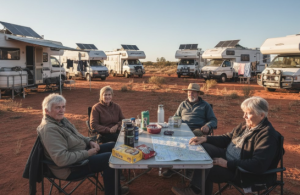
Do Free Camps Really Save Retirees Money Long-Term? And How Long Can You Actually Stay?
If you have spent any time researching vanlife or grey nomad travel in Australia, you have almost certainly come across the promise of free camping. Sleep anywhere for nothing. Wake up to a river view with no one around. Travel Australia for almost nothing. It sounds almost too good to be true — and like most things that sound that way, the reality is more nuanced than the headline suggests.
Free camping in Australia is real, it is legal in the right places, and for retirees who use it strategically it can save tens of thousands of dollars over the course of a long trip. But it also comes with limits, conditions, and practical requirements that many new grey nomads do not fully understand before they hit the road. How long you can stay at a free camp varies enormously depending on where you are, who manages the land, and what rules apply in that specific location. Getting it wrong can mean a fine, a forced move, or a confrontation you would rather have avoided.
This guide gives you the honest picture — the genuine long-term savings that free camping delivers for retirees, the rules around how long you can stay at different types of free camps, and the practical strategies experienced grey nomads use to make the most of Australia’s extraordinary free camping network without falling foul of the rules.
What Is Free Camping and Why Do Retirees Love It So Much
Free camping — sometimes called bush camping, free camping, or boondocking — refers to overnight stays at locations where no site fee is charged. In Australia this covers an enormous range of environments: designated free camp areas managed by local councils, rest areas on highways and rural roads, national park campgrounds that charge no fee, crown land that permits overnight camping, and private properties including farms and stations that welcome self-sufficient travellers at no charge.
For retirees living on a fixed income — the Age Pension, superannuation drawdowns, or a combination of both — free camping is not just a novelty. It is a genuine financial strategy. The difference between paying for accommodation every night and free camping most nights can be the difference between a trip that lasts twelve months and one that lasts three years.
Beyond the money, experienced grey nomads will tell you that some of their most memorable nights on the road were spent at free camps rather than caravan parks. A riverbed camp in the Kimberley. A clifftop rest area on the Nullarbor with the Southern Ocean stretching to the horizon. A quiet bush clearing in the Flinders Ranges with nothing but birdsong and starlight. These experiences are not available in caravan parks at any price — and at a free camp they cost nothing at all.
The Real Long-Term Savings From Free Camping
Running the Numbers Honestly
The financial case for free camping is straightforward when you run the numbers honestly. A standard powered caravan park site in Australia costs between $35 and $80 per night depending on location, season, and facilities. In popular destinations during peak grey nomad season — Broome, Exmouth, Airlie Beach, Noosa — powered site fees regularly exceed $60 to $80 per night for two people.
A free camp costs nothing. The saving per night is therefore equal to whatever the local caravan park charges — somewhere between $35 and $80 every single night you choose a free camp over a paid site.
Over a twelve-month trip, a grey nomad couple who free camps four nights out of every seven and uses paid caravan parks for the remaining three nights will spend approximately $5,500 to $8,000 on accommodation for the year. A couple who stays in paid parks every night at an average of $55 per night will spend approximately $20,000 on accommodation for the same year. The difference — $12,000 to $14,500 saved through strategic free camping over a single year — is a number that tends to concentrate the mind considerably.
Over a three-year Big Lap, that saving compounds to between $36,000 and $43,000. For retirees on a fixed income, that is the difference between having to go home and being able to keep going.
The Hidden Costs of Free Camping
Any honest assessment of free camping savings has to acknowledge the costs that come with it. Free camping requires self-sufficiency, and self-sufficiency requires investment.
To free camp comfortably and legally for extended periods, you need a sufficient solar power system to run your lights, refrigerator, devices, and other appliances without access to a mains power connection. You need adequate water storage — tanks large enough to carry several days of water supply between refill points. You need a toilet solution — a composting toilet, cassette toilet, or porta-potti — because most free camps have no amenities. And you need a grey water management system to handle washing and kitchen wastewater responsibly.
A complete self-sufficient free camping setup — solar panels, battery bank, water tanks, toilet, grey water management — can add $5,000 to $15,000 to the cost of setting up your van or motorhome depending on the scale and quality of the components you choose. This is a real upfront cost that needs to be factored into the long-term savings calculation.
However, for retirees planning a trip of twelve months or more, even the most comprehensive self-sufficient setup typically pays for itself within the first six to twelve months of free camping savings. After that, the savings are pure gain.
How Long Can You Stay at a Free Camp?
This is where many new grey nomads get caught out. The assumption that you can simply park anywhere and stay as long as you like is incorrect, and the rules vary significantly depending on the type of land you are camping on and who manages it.
Rest Areas on Highways and Rural Roads
Rest areas on Australian highways and rural roads are managed by state road authorities and are intended primarily as safety stops for tired drivers. Most rest areas that permit overnight stays do so under a twenty-four hour rule — you may stay for up to twenty-four hours but no longer.
Some rest areas have signage that explicitly states the maximum stay. Others have no signage, which creates ambiguity. As a general principle, treating all rest area stays as twenty-four hour maximum is the safe approach. Staying two or three nights at the same rest area — even if no one appears to be enforcing a limit — is technically in breach of the rules in most states and can attract fines if a ranger or police officer decides to act on it.
The one exception to the twenty-four hour rule at rest areas is during periods when fatigue-related safety campaigns are running — some states temporarily extend permitted rest area stays during holiday periods to encourage tired drivers to sleep rather than push on. Check current signage at each rest area you use.
Council-Managed Free Camps
Local councils across Australia manage a large number of designated free camping areas, and these vary enormously in their permitted stay durations. Some council free camps allow stays of forty-eight hours. Others permit stays of up to seven days. A small number allow stays of fourteen days or more, particularly in remote or less popular areas.
The permitted stay at a council free camp is almost always posted on a sign at the site entrance. Reading this sign before you set up camp takes thirty seconds and can save you a fine or a confrontation with a ranger. If there is no sign or you are uncertain, a quick search on WikiCamps for the specific location will usually surface reviews from other travellers that clarify the rules.
Council rangers do patrol free camping areas in popular regions, particularly during peak season. Fines for overstaying at council-managed free camps range from approximately $200 to $500 depending on the state and council. More significantly, repeated or flagrant overstaying can result in the council closing a free camp permanently — which is what has happened to several popular free camping spots in tourist regions in recent years. Respecting stay limits is not just about following rules — it is about preserving free camping access for the entire grey nomad community.
National Park Campgrounds
National park campgrounds in Australia range from fully serviced sites with amenities and fees comparable to caravan parks, to basic bush camping areas with no facilities and no charge. The free campgrounds within national parks are typically limited to short stays — most commonly two to three nights — and require a national park entry pass in many states even when the campsite itself is free.
National park camping rules are enforced and fines for overstaying or camping outside designated areas can be significant. Permits for national park camping are often required to be booked in advance through the relevant state or territory parks authority, even for free sites in high demand areas. Checking the specific national park’s rules and booking requirements before arrival is essential.
Crown Land
Crown land — land owned by the state or territory government that is not part of a national park, reserve, or other managed area — is available for camping in most Australian states, though the rules vary by jurisdiction.
In Queensland, camping on unallocated state land is generally permitted for up to three months in any one location, making it one of the most generous crown land camping allowances in the country. In New South Wales, camping on crown land is permitted in many areas but restricted in others, with a general limit of twenty-eight days in any one location. In Western Australia and South Australia, crown land camping rules are more complex and location-specific, and checking with the relevant state land management agency before camping is advisable.
The practical challenge of crown land camping is knowing whether a specific piece of land is indeed crown land and whether camping is permitted on it. The WikiCamps app and the Hema Explorer app both have user-contributed data on known crown land camping spots, which provides a practical starting point.
Station and Private Property Stays
Stays on private stations and farming properties — often facilitated through the GAS App or direct arrangement with the property owner — are governed by whatever agreement you reach with the landowner. There is no standard rule for how long you can stay, and many grey nomads develop ongoing relationships with station owners that see them returning for extended stays of several weeks year after year.
The unwritten rule of station and private property stays is to leave the place exactly as you found it, to respect the landowner’s privacy and property, and to ask before you assume anything is acceptable. Landowners who have had bad experiences with disrespectful campers often close their properties to travellers entirely — and given the extraordinary access that station stays provide to remote and beautiful parts of Australia, protecting these relationships is in every grey nomad’s interest.
The Rules That Apply Everywhere
Regardless of where you free camp in Australia, a set of basic rules and courtesies apply at virtually every location and form the foundation of responsible free camping behaviour.
Leave no trace is the overarching principle. Everything you bring in leaves with you. No rubbish left behind, no grey water dumped on the ground, no human waste left unburied or improperly disposed of. Free camping access in Australia has been progressively restricted in many areas over the past decade — often directly because of the behaviour of a small number of irresponsible campers who left their sites in unacceptable condition. Every grey nomad who camps responsibly is preserving access for every grey nomad who comes after them.
Fires are subject to local rules that vary by season and location. During total fire ban periods, no fires are permitted anywhere. Outside total fire ban periods, fires are generally only permitted in designated fire rings or cleared areas, and collecting firewood is restricted or prohibited in many national parks and reserves. Carrying a portable gas cooker and using it instead of an open fire in all but the most clearly fire-appropriate situations is the approach most experienced grey nomads take.
Generators are a source of genuine conflict at free camps, particularly at sites that attract families and light sleepers. Observing quiet hours — typically 10pm to 7am — for generator use is both courteous and increasingly mandatory at managed free camping areas. Many free camps that once permitted generators have restricted or banned them as a result of noise complaints from other campers.
How to Find the Best Free Camps in Australia
WikiCamps Australia
WikiCamps remains the most comprehensive and most used free camping resource for Australian grey nomads. The app covers more than 50,000 locations including free camps, rest areas, caravan parks, dump points, water refill stations, and other facilities, and each location has user-contributed reviews and photographs that give you a genuine preview of what to expect.
The search filters in WikiCamps allow you to find free camps specifically, filter by facilities — toilets, water, powered sites, dump points — and check the maximum stay duration noted by other travellers. The app is updated constantly by its user community, which means it reflects current conditions far more accurately than any printed guide.
Campermate
Campermate is a free alternative to WikiCamps with solid coverage across Australia and New Zealand. It includes a good selection of free camping spots and is particularly strong on facilities information. Many grey nomads run both WikiCamps and Campermate and cross-reference the two for locations where they want maximum information before committing to a stay.
Hema Explorer
The Hema Explorer app is built on Hema’s renowned Australian mapping database and is particularly valuable for remote and outback free camping. It includes detailed topographic maps, track information, and camping spots that are not always captured by WikiCamps or Campermate. For grey nomads heading into truly remote areas — the Kimberley, Cape York, outback Queensland, the Simpson Desert — Hema Explorer is an essential tool.
Camps Australia Wide
The Camps Australia Wide book and app is a long-established resource specifically focused on free and low-cost camping options around Australia. Updated regularly, it provides detailed information on stay limits, facilities, and access requirements for thousands of sites. Many grey nomads carry the physical book as a backup reference alongside their digital apps.
Practical Tips for Making Free Camping Work Long-Term
Set up your van for genuine self-sufficiency before you leave. A minimum solar setup of 200 to 400 watts of panels with a 100 to 200 amp hour battery bank will cover the basics for most grey nomads. Add more capacity if you rely heavily on air conditioning, a CPAP machine, or other high-draw appliances.
Carry more water than you think you need. A minimum of 60 to 100 litres of water storage allows several days of comfortable camping between refill points. Know where the water refill points are on your route — WikiCamps shows dump points and water stations, many of which are free.
Track your stay duration at every site. Set a phone reminder when you arrive so you know exactly when your permitted stay expires. Moving on one day early is far less disruptive than being asked to leave by a ranger or facing a fine.
Use paid caravan parks strategically for amenities resets. A night or two at a good caravan park every week or two allows you to do laundry, top up water tanks, empty waste systems, shower properly, charge devices from mains power, and restock groceries. This rhythm — free camping most nights with occasional caravan park amenity stops — is the sweet spot that experienced grey nomads settle into naturally.
Respect the free camping community. The single biggest threat to free camping access in Australia is irresponsible behaviour by a minority of campers. Leaving a site cleaner than you found it, respecting other campers, and following the rules at every location you use is both the right thing to do and a direct contribution to preserving the free camping culture that makes grey nomad life in Australia possible.
Frequently Asked Questions
Can I Free Camp in a National Park for Free?
Some national park campgrounds charge no site fee and are technically free camps. However, national park entry fees apply in most states even when the campsite itself is free, and permits are often required. Check the relevant state or territory parks authority website for the specific national park before assuming a site is completely free.
What Happens If I Overstay at a Free Camp?
Overstaying at a designated free camp can result in a fine from the relevant council, parks authority, or road authority. Fine amounts vary but are typically between $200 and $500. More importantly, repeated overstaying at popular sites contributes to those sites being closed to camping permanently — a loss for the entire grey nomad community.
Do I Need a 4WD to Access Free Camps?
Many excellent free camps are accessible in a standard two-wheel drive vehicle or motorhome on sealed or well-maintained gravel roads. Some of the best and most remote free camps do require a 4WD. The WikiCamps app notes access requirements for most listed sites, allowing you to filter for locations accessible in your specific vehicle.
Is Free Camping Safe for Solo Retirees?
Free camping safety for solo travellers depends on location and common sense. Popular and well-reviewed free camps — those with multiple reviews and regular visitor traffic — are generally very safe. Truly remote and isolated locations carry more risk for solo travellers, particularly in areas with no mobile coverage. Carrying a Personal Locator Beacon and using a satellite communicator to check in with family regularly are the key safety measures for solo grey nomads camping remotely.
Final Word
Free camping in Australia is one of the genuine gifts of the grey nomad lifestyle — a way of living that puts some of the country’s most spectacular landscapes within reach of every retiree willing to set up their van for self-sufficiency and learn the rules of the road.
The long-term savings are real and they are substantial. The rules around how long you can stay are clear and manageable once you know what to look for. And the experience of waking up to a view that no caravan park can replicate, having paid nothing for the privilege, is one that never quite gets old no matter how many times you do it.
Learn the rules. Respect the limits. Leave every site better than you found it. And enjoy the extraordinary freedom that responsible free camping in Australia makes possible.

As an affiliate, I earn from qualifying purchases at no extra cost to you.
As an affiliate, I earn from qualifying purchases at no extra cost to you.