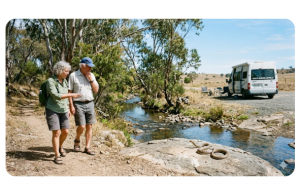
Australia’s Most Dangerous Snakes: What Grey Nomads Don’t Get Told
Australia is home to more venomous snake species than anywhere else on earth — and as a grey nomad or senior vanlifer, you spend your days in exactly the kind of country these snakes live in. Dry creek beds, grassy rest areas, coastal scrub, national park camping reserves, red earth free camps. Most of the time you will never see them.
But there are things about snakes and senior travellers that almost nobody writes about — the real scenarios, the medical risks specific to older bodies, the moments that catch experienced travellers completely off guard. This guide covers all of it, alongside the first aid facts you genuinely need to know.
Key Takeaways
| Question | Short Answer |
|---|---|
| Which snakes pose the biggest risk to grey nomads? | The Eastern Brown, Coastal Taipan, Tiger Snake, Death Adder and King Brown. Each is covered in detail below, with the specific grey nomad scenarios where encounters happen. |
| What’s the one thing most grey nomads don’t know? | If you take blood thinners, warfarin, aspirin or cardiac medications — Eastern Brown venom triggers a blood clotting disorder that interacts catastrophically with those drugs. Your doctor almost certainly never mentioned it. |
| Can a snake actually get inside my van? | Yes. King Brown snakes follow mouse trails into vans. A Death Adder bit a man at a caravan park near Broome while he was walking back from his evening shower in a darkened area. Real incidents, not hypotheticals. |
| What do I do if bitten? | Call 000. Apply pressure immobilisation bandage. Keep victim completely still. Do not wash the bite. Do not remove bandage until hospital. Full steps in Section 8. |
| What’s the one habit that would prevent most bites at camp? | Wearing closed shoes and long trousers after dusk. The majority of snakebites in Australia are on the lower leg or foot — and most happen when people aren’t wearing footwear. |
| Where do I find the nearest hospital before a remote camp? | Save it to our Vanlife Savings Spots community map before you leave. Add it alongside your camp GPS so it’s available offline. |
1. The Part No-One Writes About: Why Grey Nomads Face A Different Risk
Australia records around 3,000 snakebite incidents each year. Between four and six people die. That low number is the headline everyone leads with — and while it is reassuring, it misses something important for senior travellers camping in regional and remote Australia. You might be 90 kilometres from the nearest hospital.
You might be solo. The person who gets bitten might need to drive themselves out. And if you are on blood thinners, cardiac medication or aspirin — which a significant proportion of over-60s are — certain Australian snake venoms interact with those drugs in ways that can accelerate bleeding complications dramatically.
That last point almost never appears in standard snake safety guides. It is not about fear — it is practical, senior-specific information that changes how urgently you need to act and what you tell the emergency operator when you call.
Snake Bite Victim “AGE”
Saying “the patient is over 60” helps the 000 operator prioritize the response and this prioritizes what questions to ask next. You’re not giving a diagnosis — you’re giving them the context they need so they can dispatch help appropriately and quickly.
000 Emergency operators don’t treat all callers the same — they triage based on risk factors, and age is one of them.
The grey nomads who travel safely across Australia for years are not the ones who worry most. They are the ones who prepared before they left — proper kit, proper first aid knowledge, hospital locations saved before each remote camp. Our Pre-Trip Vanlife Checklist includes snake first aid gear as a required item for exactly this reason.
2. The Blood Thinners Problem: What Your Doctor Never Told You
This is the section that genuinely surprises people, and it is not written about in most camping safety guides. If you take warfarin, aspirin, clopidogrel or any anticoagulant medication — read this carefully. Eastern Brown snake venom and Tiger Snake venom both cause a condition called venom-induced consumption coagulopathy (VICC) — a severe blood clotting disorder that, in simple terms, stops your blood from clotting properly.
For someone already on blood thinners, this creates a compounded and potentially catastrophic interaction. Studies of rattlesnake bites in the United States — which cause a similar coagulopathy — found that patients on antiplatelet or anticoagulant medications experienced major bleeding at nearly seven times the rate of patients not on those medications. The same mechanism applies to Australian elapid venoms.
It means that if you are on blood thinners and bitten by an Eastern Brown, the risk of serious internal bleeding is significantly higher than it is for a younger, medication-free traveller. What this means practically: when you call 000, say immediately that you are on blood thinners and name the medication. Say it again when you arrive at hospital.
This information directly affects which antivenom they give you, how fast they administer it, and what monitoring they put in place. Our Healthcare and Budget on the Road guide covers how to carry and document your medications on the road — including keeping a written medication list accessible for exactly these situations.
3. The Mouse Plague Connection Most Campers Don’t Make
Eastern Australia has experienced significant mouse plagues in recent years, and there is a direct line between mice and snakes that vanlifers need to understand. Snakes are predators that follow their food source.
When mice are abundant – in rural areas, along the grain belt, and increasingly in camping areas where food scraps are left out — snakes follow. They enter sheds, storage areas, and yes, caravans and vans following mouse trails.
The mouse-snake chain runs directly to your camp. Food crumbs attract mice. Mice attract snakes. A camp kitchen box that smells of last night’s dinner, stored in an unsealed annexe, is mouse bait — and mouse bait is snake bait.
This is not theoretical. Grey nomad forums report snakes found coiled in storage bays, annexe floors, and under vans parked in farming country at night. Seal all food in airtight containers.
Clean camp kitchens properly after every meal. Store pet food inside the van, not in the annexe. Keep rubbish sealed and deposited away from your site before dark. These habits reduce mouse activity, and reduced mouse activity means snakes move on.
4. The Snakes You Will Actually Encounter — Real Grey Nomad Scenarios
Every camping safety guide lists Australia’s deadliest snakes. What they rarely do is connect those snakes to the specific daily moments in a grey nomad’s life where encounters happen. Here is that information.
Eastern Brown Snake — The one responsible for most deaths
The Eastern Brown kills more Australians than any other snake. It lives in farmland, bush, grassland and urban fringe areas across all of eastern and central Australia — exactly the country grey nomads travel through every day.
It is fast, frequently aggressive when disturbed, and notoriously variable in colour from pale straw to near black. Many people cannot identify one even after they have seen it.
Eastern Browns are the snake most commonly found in firewood piles, in long grass around camp toilets, and near water sources. They are primarily daytime hunters but also active at dusk. The Eastern Brown’s venom causes a rapid and severe blood clotting disorder — without antivenom, victims can collapse within minutes.
The University of Queensland’s research has actually led to a medical gel being developed from Eastern Brown venom proteins to treat uncontrolled bleeding — which tells you something about what that venom does to your blood system.
Death Adder — The Night Toilet Snake
Here is the blunt version: the Death Adder is the reason you need a head torch for the walk to the camp toilet at 2 AM, every single time, without exception. Death Adders are nocturnal, slow-moving, and rely entirely on camouflage — lying motionless in leaf litter, gravel or sand, completely invisible until something steps on them. Unlike most other venomous snakes, they do not move away from approaching footsteps because they rely on being unseen.
The path between your van and the amenities block at night is prime Death Adder territory in a huge proportion of Australian camping areas. A confirmed incident reported in grey nomad forums: a man at a caravan park near Broome was bitten by a Death Adder while returning from his evening shower.
He had been walking through a darkened area. He was rushed to Broome Hospital. The snake had been seen in the park for months — but in a darkened area, at night, without a torch, it was invisible. Torch. Closed shoes. After dark. Every time.
King Brown (Mulga) — The One That Gets Inside
The King Brown has the largest venom output of any Australian snake by volume. It is widespread across most of mainland Australia. It is also the snake most documented entering caravans, campervans and vans. King Browns follow mice into structures. They enter through floor drainage holes, unsealed vents and gaps between floor panels.
They have been found coiled under vans that were parked in farming country overnight, attracted by the residual warmth of the engine and drivetrain. In tropical areas, any tent or van left at ground level with unsealed gaps is a potential entry point for a snake seeking warmth at night.
Check under your van with a torch before getting in each morning, particularly after parking in farming country, scrub or any area where you have seen mouse activity. Check annexe floors before walking into them barefoot at night.
Coastal Taipan — The Grey Nomad Route Snake
The Queensland coast route — one of the most popular grey nomad corridors in Australia — passes directly through Coastal Taipan country. The cane fields of Far North Queensland, coastal scrub areas and camping grounds near Cairns, Townsville, Mackay and the Whitsundays are all within the Coastal Taipan’s range. The Taipan is fast, capable of multiple rapid strikes in a single defensive encounter, and its neurotoxic venom can cause paralysis quickly. If you are grey nomading the Queensland coast in the dry season — which most people are — this snake is present in many of the free camps and rest areas you will use.
Tiger Snake — The Southern Free Camp Problem
Tiger snakes are common in southern Australia and Tasmania and they love the same environments that grey nomads choose for free camps — creek edges, wetland reserves, coastal grasslands. They are active both day and night and are notoriously aggressive when cornered, flattening their body and neck in a threat display before striking. For grey nomads doing the southern loop through Victoria, South Australia and Tasmania — particularly those who camp near water — Tiger snakes are a consistent presence from spring through autumn.
5. The Six Moments Bites Happen At Camp — And What To Do Differently
| Moment | What Happens |
|---|---|
| Most grey nomad bites do not happen dramatically in the middle of the day. They happen in ordinary camp moments that catch people completely off guard. These are the six situations that come up repeatedly in grey nomad forums and incident reports. | |
| The night toilet walk | No torch or just a phone screen used as a light, walking across gravel or grass to the amenities block. Death Adders and Tiger Snakes both lie motionless in exactly these paths. Always use a head torch. Always shine it directly at the ground ahead of each step. Wear closed shoes. |
| Picking up firewood | Reaching into or lifting a firewood pile is one of the highest-risk activities at a campsite. Always approach a wood pile from the outside in, using a tool or heavy gloves. Never thrust your bare hand into a pile you cannot see through. Make noise as you approach — snakes feel vibration and will often move away before you see them. |
| Stepping over logs | Never step over a log without checking the far side first. Snakes rest against the shaded side of logs for shelter and warmth. The safe habit is to step onto the log first, look at the ground on the other side, then step over. |
| Common Camp Movements That Lead to Snake Encounters | This one habit alone prevents a significant number of bites on bushwalks and camp walks. |
| Checking under and inside the van in the morning | Particularly in farming country or after parking in scrub overnight. Check under the van with a torch before opening doors. Tap the outside of storage bays before opening them. |
| Checking the annexe floor | Check the annexe floor with a light before walking in barefoot. |
| Walking in long grass near water | Birding, fishing, camp exploration near creeks, wetlands and coastal grass areas all put you in prime snake territory. Long pants, ankle boots, and walking on cleared paths where possible reduces risk significantly. |
| Thongs at camp in the evening | Most snakebites in Australia are on the lower leg or foot, and most happen when people are not wearing appropriate footwear. Thongs or bare feet after dinner, walking around camp in the dusk — this is the single most common footwear situation when bites occur. Closed shoes after dusk is the habit that would prevent the largest number of camp bites. |
6. What Snakes Are Actually Doing — And Why This Changes How You React
Understanding what a snake is actually doing when it encounters you changes your reaction from panic to calm, deliberate action — and calm, deliberate action is always the safer response. Snakes do not perceive humans as food. They cannot eat us. A snake’s venom is for subduing small prey — frogs, mice, lizards. Every snake bite on a human is a defensive act, not a predatory one. The snake is frightened. It is trying to escape.
If it bites you, it is because it felt it had no other option. A Queensland snake catcher with extensive experience put it clearly: if you have enough time to go and get a shovel, you had enough time to get your phone and call a professional. Snakes do not start fights. They end them when they feel they have no escape.
Practically, this means: if you see a snake at camp, give it a clear exit route and back away slowly. Do not corner it, do not threaten it, do not attempt to move or kill it. Stand still if you are very close — within five or six metres — and wait for it to retreat. Most snakes disappear within a few minutes if you give them space.
The entire risk picture drops dramatically the moment you stop being a perceived threat. Snakes are also protected species under law in all Australian states and territories. It is illegal to kill, injure or remove a snake from the wild in most circumstances — and attempting to kill one is consistently the highest-risk moment for a bite to occur.
7. When Your Risk Is Highest — The Seasonal Reality For Grey Nomad Routes
Grey nomads follow the weather — and so do snakes. Understanding where activity peaks coincides with your route timing is genuinely useful planning information. In southern Australia, peak snake activity runs from October through April, with the highest activity in late spring and early summer when snakes emerge from brumation, breeding activity peaks, and temperatures first rise sharply. In the tropical north — Far North Queensland, the NT and the Kimberley — snakes are active year-round but most active during the build-up season from October to December.
Here is the catch for the classic grey nomad big lap: you leave southern Australia in autumn as activity drops, spend the cool season in the tropical north where daytime activity is lower, then begin heading south through Queensland from September. That southbound run in September, October and November puts you on the east coast route — through Tiger Snake, Eastern Brown and Taipan country — exactly as activity ramps back up to its annual peak.
In summer across most of Australia, the hottest-day species shift from daytime to nocturnal hunting to avoid the heat. That shift coincides with grey nomads being most comfortable sitting outside at night — which is exactly when Death Adders and King Browns are most active around camp.
8. First Aid — What To Do In The First Five Minutes
| Step | What To Do |
|---|---|
| The Pressure Immobilisation Technique (PIT) was developed by Australian researcher Struan Sutherland and is the official ANZCOR‑recommended first aid for all Australian snake bites. Know it before you need it. Applied immediately and correctly, it dramatically slows venom movement through the lymphatic system and buys critical time to reach hospital. | |
| Step 1 — Call 000 immediately | Call 000 immediately. Do this first, or have your partner do it while you begin first aid. Tell the operator it is a snake bite. Give your GPS location. Mention any blood thinners or cardiac medications the victim takes — this information is critical for antivenom selection and dosing. |
| Step 2 — Keep the victim completely still | Snake venom travels primarily through the lymphatic system, which muscle movement activates. Every movement the victim makes accelerates venom spread through the body. Bring transport to the victim — do not walk them out if you can avoid it. |
| Step 3 — Apply the pressure immobilisation bandage | Using a broad elastic bandage (10–15 cm wide — standard 7.5 cm bandages are too narrow), bandage firmly from the toes or fingers of the bitten limb upward, covering the entire limb. Pressure should be as firm as a bandage on a sprained ankle — tight but not circulation‑stopping. Bandage over clothing, not under it. Mark the bite location on the outside of the bandage. |
| Step 4 — Splint the limb | Anything rigid will do — a walking stick, a tent pole, a piece of timber. The goal is to immobilise both joints around the bite so muscle movement is prevented. |
| Step 5 — Keep the victim flat, still and calm | Reassurance directly reduces heart rate and slows venom spread. Do not remove the bandage until you are at a hospital with resuscitation equipment available — when PIT is removed, venom can enter the bloodstream rapidly. |
| What Not To Do |
Do not wash the bite site — venom on the skin helps identify the species and select correct antivenom. Do not cut the wound or suck out venom — completely ineffective and introduces infection. Do not apply a tourniquet — dangerous and not recommended for any Australian snake bite. Do not try to catch or kill the snake. Do not assume it was a dry bite — symptoms can be delayed by an hour or more and many deaths have resulted from this assumption. Never wait to see if symptoms develop. Apply PIT and call 000 immediately regardless. |
9. If You Are Solo When It Happens
For solo vanlifers and grey nomads, snakebite has an extra dimension worth thinking through before you need it. You are your own first responder. Call 000 immediately. Apply PIT to yourself as best you can — awkward but achievable on a limb bite. Stay as still as possible. If you are using a personal locator beacon (PLB), activate it.
If you cannot summon help to come to you and have no other option, the guidance is that getting yourself to help is the last resort — accepting that movement will accelerate venom spread while doing what you must to survive.
This makes two things non-negotiable for solo travellers in remote snake country: always tell someone your camp location before going off-grid, and carry a PLB. A PLB costs under $300 and hired units are available at outdoor stores. For solo senior travellers doing remote legs, it is not a luxury item — it is the difference between a medical team finding you in time or not. Our Rolling Solo guide covers the full check-in system and PLB strategy for solo travellers.
10. Your Snake First Aid Kit — What To Actually Carry
Every rig travelling regional or remote Australia should carry a dedicated snake first aid kit, separate from the general kit, clearly labelled and stored where both occupants can find it quickly. The minimum is three broad elastic bandages at least 10–15 cm wide. Standard 7.5 cm bandages are too narrow to apply proper PIT.
Purpose-made snake bandages with pressure indicator markings are available at most pharmacies for under $10 each — they show you visually whether you are applying the right amount of pressure, which removes the guesswork in a stressful moment. Add a rigid splint, sharp scissors and a permanent marker. Pre-save the GPS location of the nearest hospital to each new camp before you leave for that camp.
Add it to our Vanlife Savings Spots community map alongside the camp location so it is available offline if you lose phone signal. Those few minutes of preparation before you leave is what ensures you spend less time searching and more time driving when it matters.
11. The Daily Habits That Make A Real Difference
Ask any grey nomad who has done multiple big laps and they will tell you that snake awareness becomes second nature quickly — the same way checking tyre pressure or watching for animals on the road at dusk does. It is not fear. It is practical situational awareness built into your daily routine. Closed shoes and long trousers after dusk, every night, no exceptions.
Head torch for every night walk, shining it at the ground ahead. Firewood moved with tools or gloves, never bare hands into a pile. Storage bays tapped before opening. Under the van checked with a torch each morning. Van sealed at night — all floor-level gaps, drainage holes and vents checked and blocked.
Campsite kept clean — food sealed, rubbish deposited away from your site before dark. Long grass and rock piles avoided for camp setup where possible. None of these habits take more than a few seconds each. Together they reduce your risk substantially — not to zero, but to the kind of level where the odds are consistently with you across months and years of travel.
How To Use The Vanlife Savings Spots App For Snake Safety
📍 Save to Vanlife Savings Spots App: Copy the Postcode, Latitude and Longitude from the GPS column above into your Vanlife Savings Spots app to save these stops and get directions.
Our Vanlife Savings Spots community map is built by grey nomads for grey nomads — and snake safety notes are some of the most valuable entries on it. When you visit a camp and notice snake activity — a sighting, a warning from camp hosts, a known high-risk habitat type — add a note to the map. Other travellers on the same route see your notes and can adjust their precautions.
You can also save the nearest hospital location alongside every camp GPS so it is accessible even without phone signal. To add a location: open the app, enter your GPS coordinates, add a description and any safety notes, then tap Add Spot. Your first-hand experience becomes part of the collective knowledge that helps the community travel more confidently.
FAQs — Snake Safety For Grey Nomads
Q: The bite barely hurts and I only see two small marks — do I still need to call 000? A: Yes. Immediately. A grey nomad at Bay of Fires in Tasmania in March 2024 did not see the snake, felt barely anything, noticed two small puncture marks and pink blood on her hand — and ended up in intensive care in Launceston after being flown out by the Flying Doctor Service following antivenom treatment at a regional hospital. Symptoms can be delayed by an hour or more. A “minor” bite can be a very serious envenomation. The only correct response to any suspected snake bite is PIT and 000.
Q: I’m on warfarin. Do I need to do anything different if bitten? A: The first aid steps are the same — PIT, 000, completely still. What you must do additionally is tell the emergency operator immediately that you are on warfarin (or aspirin, or clopidogrel, or any anticoagulant), name the medication and the dose, and repeat this information to every medical staff member you speak with at hospital. Eastern Brown and Tiger Snake venoms cause a clotting disorder that interacts with anticoagulant medications — this information changes your treatment.
Q: Should I carry antivenom in my van? A: No. Australian snake antivenom must be administered by trained medical staff in a hospital setting with resuscitation equipment immediately available. Antivenom itself can cause a severe allergic reaction that requires emergency management. Focus your preparation on PIT equipment, hospital GPS locations saved in advance, and getting to hospital quickly — that is your job. Antivenom is the hospital’s job.
Q: Are snake repellents worth using around camp? A: Commercial snake repellents have mixed evidence for effectiveness and are not reliably endorsed by herpetologists. The best repellent is a clean, tidy campsite with no food scraps, no rubbish attracting mice, and no low cover where snakes shelter. Your behaviour and the state of your campsite matters more than any product.
Q: If there’s a snake inside my van, what do I do? A: Keep everyone well away from it. Do not attempt to handle or kill it. Give it a clear exit route and wait — most snakes will leave on their own if they can. If it will not leave, call your state wildlife emergency line or a licensed snake catcher. Do not sleep in a van with an unlocated snake inside. Notify camp hosts and neighbouring travellers immediately.
Q: What’s the Poisons Information Centre number? 13 11 26 — available 24 hours, seven days. For non-emergency questions about snakebite and venomous animals. Save it in your phone alongside Triple Zero before you leave home.
Conclusion
Most of what gets written about snakes and camping is generic. The information about what actually trips up grey nomads specifically — the blood thinner interaction, the mouse-snake chain in your campsite, the Death Adder on the path to the camp toilet, the King Brown that followed a mouse into a van near Broome — that is the information that changes behaviour. And changed behaviour is what keeps people safe.
Carry the right kit. Know the steps before you need them. Save the hospital GPS before you leave for each remote camp. Close the van properly. Wear closed shoes after dark. The road is genuinely better when you are not anxious about what might be in the grass — and you get to that comfortable place through preparation, not by hoping for the best.
- Vanlife Savings Spots Community Map — save hospital locations and camp snake sighting notes
- Pre-Trip Vanlife Checklist — snake kit included as a required item
- Healthcare and Budget on the Road — medication documentation and medical emergencies while travelling
- Rolling Solo After 55 — PLB, check-in systems and solo safety planning
- Grey Nomads 55+ Safety Guide — broader senior safety planning for the road
- Vanlife Practical Guide for Retirees Over 50 — route planning for remote travel
Medical disclaimer: This guide provides general information for educational purposes only and is not a substitute for professional medical advice or formal first aid training. Always call 000 immediately for any suspected snake bite in Australia. The authors strongly recommend completing a formal first aid course that includes pressure immobilisation technique training before travelling in remote areas.

As an affiliate, I earn from qualifying purchases at no extra cost to you.
As an affiliate, I earn from qualifying purchases at no extra cost to you.