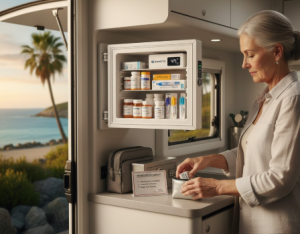
Storing Medication Safely While Travelling Australia: The Grey Nomad Guide Nobody Else Has Written
Real temperatures. Real pharmacy rules. The digital prescription system that changes everything for travellers. Written specifically for grey nomads, retirees and pensioners on the road.
1. This Is Not the Usual Medication Storage Advice
You already know the basics. Keep medications out of the heat. Do not store them in the car. Keep them in their original packaging. That advice is on every government pamphlet and every generic travel health website.
This guide covers what those pamphlets do not tell you. What temperature your caravan actually reaches in Australian summer heat — and which specific medications grey nomads commonly take that fail silently at those temperatures. Why your 12V compressor fridge is not a pharmacy fridge. What a Queensland pharmacist can now legally prescribe without a GP involved. How to get a script sent to your phone from any doctor in Australia while you are sitting in a camp chair in Longreach with no GP in sight. And what to do when the closest pharmacy is 200 kilometres away and you have just run out of your blood pressure tablets.
This guide is for grey nomads, retirees, and pensioners who travel with medications — which is most of you. It is practical, it is current, and it covers the systems and rules that changed in the last two years that most travelling Australians do not yet know about.
2. The Temperature Problem — Real Numbers for Australian Conditions
The standard advice is to store most medications at “room temperature” — defined as 15 to 25 degrees Celsius. In a caravan in outback Queensland in July, room temperature is not 25 degrees. It is 38, 42, or 45 degrees inside a van that has been closed up while you are out for the day.
A car or caravan parked in direct Australian sun with windows closed reaches 60 to 80 degrees Celsius inside within 30 to 60 minutes — regardless of the outside temperature. This is not an exaggeration. It has been measured repeatedly in Australian road safety research. The inside of your van in a Longreach summer is hotter than a commercial clothes dryer.
What Heat Does to Common Grey Nomad Medications
Most tablets and capsules degrade gradually above 25 degrees and degrade significantly above 40 degrees. The degradation is chemical — the active ingredient breaks down into inactive or sometimes harmful compounds. The problem is that degraded medication looks completely normal. A heat-damaged blood pressure tablet looks identical to a good one. You will not know it has failed until your blood pressure tells you.
The medications most commonly carried by grey nomads and most vulnerable to Australian heat are:
| Medication Type | Common Examples | Heat Risk | Safe Storage Temperature |
|---|---|---|---|
| Insulin (opened) | NovoRapid, Lantus, Humalog, Levemir | Very high — degrades above 25-30°C; freezing also destroys it | 2–8°C (unopened); below 25–30°C once opened |
| Insulin (unopened) | All types | High — must be refrigerated at 2–8°C | 2–8°C — fridge only |
| Blood pressure tablets | Perindopril, Amlodipine, Ramipril | Moderate to high — potency degrades above 25°C over time | Below 25°C, away from humidity |
| Thyroid medication | Thyroxine (Eutroxsig, Oroxine) | High — particularly sensitive to heat and humidity | Below 25°C, dry, away from light |
| Warfarin | Coumadin, Marevan | Moderate — heat accelerates degradation; dosing errors dangerous | Below 25°C, dry |
| Nitroglycerin spray/tablets | GTN spray, Anginine | Very high — loses potency quickly above 25°C | Below 25°C — keep in original container, away from light and heat |
| Eye drops | Latanoprost, Timolol, Xalatan | High — many require refrigeration; heat degrades rapidly | 2–8°C (most — check individual product) |
| Asthma inhalers | Ventolin, Seretide, Symbicort | Moderate — propellant affected by extreme heat; do not leave in direct sun | Below 30°C, away from direct sunlight |
| Metformin | Glucophage, Diaformin | Low to moderate — relatively stable; avoid extended high heat | Below 30°C |
| Cholesterol tablets | Atorvastatin, Rosuvastatin, Lipitor | Moderate — potency reduces above 25°C over time | Below 25°C, dry |
⚠️ The Silent Failure Warning: Heat-degraded medication looks, smells, and tastes identical to good medication. You cannot tell by looking at it. If your medication has been stored above its recommended temperature for an extended period — particularly in a closed caravan in Australian summer — assume it has degraded and replace it. Do not assume it is fine because it looks normal. This applies especially to insulin, nitroglycerin, thyroid medication, and blood pressure tablets.
The Cold Problem — Winter Nights in Your Van
Heat gets most of the attention. Cold gets almost none. But grey nomads travelling through Tasmania, the Snowy Mountains, the Southern Highlands, or inland New South Wales in winter face genuine cold storage risks overnight in an unheated van.
Insulin frozen even briefly is permanently destroyed. It looks completely normal after thawing. There is no visual sign of damage. Frozen insulin will appear to work — it will still inject correctly — but its activity is unpredictable and potentially dangerously reduced. If your insulin has frozen overnight in your van, replace it before using it.
Other medications damaged by freezing include most liquid medications, many eye drops, some liquid antibiotics, and some skin creams and gels. Check the storage instructions on each medication specifically — if it says “do not freeze” that instruction applies to your van on a cold night just as much as to your home freezer.
Practical solution for cold nights: Keep insulin and freeze-sensitive medications in an insulated lunch bag or small cooler bag — not with ice, just insulated — and bring it inside your sleeping area overnight. Body warmth in the sleeping area of a van is usually sufficient to prevent freezing even on cold nights.
3. The 12V Fridge Trap — What Grey Nomads Are Not Told
The advice for refrigerated medications is simple: keep them in the fridge. In a caravan, that means your 12V compressor fridge. What nobody tells grey nomads is that a 12V compressor fridge is not a pharmacy fridge — and the difference matters for medication safety.
How a 12V Fridge Differs From a Pharmacy Fridge
A pharmacy fridge maintains a stable temperature between 2 and 8 degrees Celsius. It has precise thermostat control, internal air circulation, and temperature monitoring. It is specifically designed for medication storage.
Your 12V compressor fridge fluctuates. How much it fluctuates depends on:
- How often you open the door — every opening raises the internal temperature
- How full the fridge is — a more full fridge holds temperature better
- Ambient temperature outside the fridge — a van at 40 degrees outside means the fridge works harder and fluctuates more
- Whether the fridge is in direct sunlight or shade
- The fridge’s proximity to the fridge’s own compressor heat — the area nearest the compressor runs warmer
In a well-maintained 12V fridge in moderate conditions, the temperature typically ranges between 2 and 8 degrees — which is adequate for most refrigerated medications. In hot Australian conditions with frequent door opening, the temperature can spike to 12 to 15 degrees temporarily after each door opening. For most medications this is acceptable. For insulin and some vaccines, repeated temperature spikes are concerning.
The Freezer Zone Problem
This is the most common medication error in caravans. The area directly adjacent to the freezer compartment — or the back wall of fridges without a separate freezer — runs significantly colder than the rest of the fridge. In many 12V fridges, this zone regularly drops below zero degrees.
If you store insulin, liquid eye drops, liquid antibiotics, or any medication labelled “do not freeze” at the back of your 12V fridge or near any freezer element — it may freeze without you knowing. You will take it out in the morning, it will look fine, and it may be completely ineffective or unpredictably active.
The practical fix: Store all refrigerated medications in a sealed bag or small container placed in the middle of the fridge — away from the back wall, away from the freezer compartment, and away from the door. Buy a cheap digital thermometer with a min/max memory function (under $20 at most hardware stores) and place it where your medications are stored. Check the min/max reading each morning. If it has gone below 2 degrees, your medications need to be assessed.
When Your 12V Fridge Fails
12V fridge failures happen on the road. A blown fuse, a failed compressor, a battery that ran flat overnight — any of these can leave your refrigerated medications unprotected for hours or overnight before you notice.
Have a plan before it happens. A small insulated cooler bag with a couple of ice packs from the nearest service station will maintain medication temperatures for 6 to 8 hours in most conditions. Opened insulin can be kept at room temperature below 25 to 30 degrees for 4 to 8 weeks depending on the type — check your specific insulin’s product information. The key is not to panic and to replace any medication that has been exposed to temperatures outside its range for an extended period.
4. The Three-Month Supply Conversation — Have It Before You Leave
This is the single most practical piece of advice in this entire guide and the one most grey nomads have never been told.
Under PBS rules, your GP can prescribe up to three months supply of most chronic medications at one time for patients who have difficulty accessing a pharmacy — including patients who travel or live remotely. Most grey nomads are still getting monthly prescriptions out of habit. One conversation with your GP before departure changes this.
Before you leave on any trip longer than four weeks, book an appointment with your GP specifically to discuss your medications for travel. Ask for:
- Three-month supplies of all stable chronic medications — blood pressure, cholesterol, thyroid, metformin, warfarin, and most other long-term tablets
- An extra supply of critical medications — particularly anything that would be dangerous to run out of suddenly, such as epilepsy medications, heart medications, and anti-rejection medications
- Electronic prescriptions for all medications — tokens sent to your phone or email that can be filled at any pharmacy in Australia
- Your Active Script List set up — explained in the next section
A GP who understands grey nomad travel will accommodate all of these requests. If yours does not, explain that you are travelling to remote areas without reliable pharmacy access. This is a legitimate clinical reason for extended supply and your GP has the authority to prescribe it.
Senior Tip — The Warfarin Exception: Warfarin (blood thinners) require regular INR blood testing to manage dosing safely. Grey nomads on warfarin need a specific plan for getting INR tests while travelling. Most regional hospitals and large medical centres can do a walk-in INR test. Ask your GP to write a standing pathology order for INR testing that you can use at any collection centre in Australia. Many pathology companies — including Sullivan Nicolaides and QML — have collection centres in most regional towns and some large caravan parks.
5. The Active Script List — The System That Changes Everything for Grey Nomads
The Active Script List (ASL) is one of the most useful developments for travelling Australians in the last five years — and one of the least known among the grey nomad community.
What It Is
The Active Script List is a national digital list of all your current electronic prescriptions. Once you register, your prescriptions are stored in a secure national system. When you walk into any participating pharmacy anywhere in Australia — in Cairns, in Broken Hill, in Kununurra — you give the pharmacist permission to access your list, and they can see and dispense all your current prescriptions without you needing to have a paper script or a token on your phone.
As of early 2025, over 85% of pharmacies across Australia are connected to the ASL system. That includes most regional and remote community pharmacies.
Why It Matters for Grey Nomads Specifically
Before the ASL, losing or forgetting a paper prescription was a real problem — particularly for repeat prescriptions. You needed to contact your home GP, have them fax or send a new script, and hope the remote pharmacy could receive it in time. The process could take days.
With the ASL, your current prescriptions follow you everywhere. Your home GP issues an electronic prescription. It goes onto your ASL. You drive from Brisbane to Cairns to Darwin. At any point along the way, you walk into a pharmacy, they access your ASL with your permission, and they dispense your medication. No phone calls. No faxes. No delays. No hunting for a local GP to reissue a script.
How to Set Up Your Active Script List
- Visit your regular pharmacy before your trip — not your GP; the pharmacy sets it up
- Bring your mobile phone and 100 points of ID — Medicare card, driver’s licence, or passport
- The pharmacy will set up the service for you in a few minutes
- You will be asked to consent to the service and agree to terms and conditions
- Once registered, all future electronic prescriptions from any prescriber are automatically added to your ASL
- You can also give a trusted travel partner access to your ASL — useful if you are incapacitated and cannot consent to access yourself
Important note on Schedule 8 medications: Controlled medications — including opioid pain medications such as oxycodone, morphine, and fentanyl — are handled differently in the ASL system. These medications have additional safeguards. They can appear on your ASL but dispensing is subject to state and territory controlled drug regulations. A pharmacist in a different state may need to verify your prescription through additional channels before dispensing a Schedule 8 medication. Discuss this specifically with your GP and home pharmacist before travelling if you are on any controlled medication.
6. Telehealth and Electronic Prescriptions — Getting a Script Anywhere in Australia
Medicare-funded telehealth GP consultations are now a permanent feature of the Australian health system — made permanent after the COVID-19 period demonstrated their value. This is not a temporary arrangement. It is how Australian primary healthcare now works, and it is extraordinarily useful for grey nomads who travel to areas with no local GP.
How It Works
You have Telstra coverage — even just enough for a phone call. You call your home GP or any telehealth GP service. The GP conducts a phone or video consultation. If it is clinically appropriate, they issue an electronic prescription — an eScript token sent to your phone by SMS or email as a QR code. You take that QR code to any pharmacy in Australia. The pharmacist scans it. Your medication is dispensed. The entire process — from the phone call to picking up your medication — can be completed in under two hours in a regional town.
Your home GP can do this from their surgery in Brisbane or Sydney while you are sitting in a camp chair in the outback. You do not need to physically attend a GP. You do not need to find a local doctor. You just need a phone signal.
Telehealth Services That Work Well for Grey Nomads
Your own home GP via telehealth is always the best option — they know your history. But when your home GP is unavailable, several national telehealth services operate on a walk-in basis with Australian-registered GPs:
- HotDoc: hotdoc.com.au — find telehealth appointments with GPs across Australia
- HealthEngine: healthengine.com.au — book telehealth GP appointments nationally
- 13SICK (National Home Doctor Service): 13 74 25 — after-hours GP service including telehealth in many regional areas
Important: Telehealth services cannot prescribe Schedule 8 controlled medications (opioids, stimulants) via online questionnaire alone. A genuine real-time phone or video consultation with a registered GP is required for any prescription, and Schedule 8 medications require additional safeguards. If you are on any controlled medication, discuss your travel prescription plan specifically with your prescribing GP before departure.
The eScript Token — How It Actually Works
An eScript is simply a digital version of a prescription. Your GP creates it in their clinical software. You receive a QR code via SMS or email. You show that QR code at any participating pharmacy. The pharmacist scans it, it unlocks your prescription details from the national secure system, and they dispense your medication. If you have repeats, the pharmacy sends you a new token for your next supply.
You can forward the token via text message to a travel partner if you are unwell and cannot collect the medication yourself. You can show it at any pharmacy in Australia — not just the one near your home. The token is electronic but it is a legally valid prescription in all Australian states and territories.
7. What Queensland Pharmacists Can Now Prescribe Without a GP
This is the biggest change to pharmacy access in Queensland’s history — and most grey nomads travelling through Queensland do not know it exists.
From 1 July 2025, trained Queensland pharmacists with Extended Practice Authority can prescribe for a range of acute common conditions and provide chronic disease management support — without requiring a GP referral or involvement. This is now permanent, not a pilot.
What Conditions Queensland Pharmacists Can Now Treat
Queensland pharmacists with Extended Practice Authority can assess and prescribe for conditions including:
- Gastro-oesophageal reflux (heartburn)
- Urinary tract infections (UTIs) — particularly common in female grey nomads travelling in the heat
- Ear infections (otitis media and otitis externa)
- Skin conditions including minor infections and rashes
- Allergic rhinitis (hayfever)
- Cold sores
- Musculoskeletal pain management (minor)
- Obesity management support (under chronic conditions program)
- Hormonal contraception
- Chronic conditions management support — including type 2 diabetes monitoring, hypertension support, and COPD monitoring — under structured protocols
Not every Queensland pharmacy offers this service — only pharmacists who have completed additional training and registered with Queensland Health as prescribers are authorised. Ask at the pharmacy counter whether they have a prescribing pharmacist available.
Practical use for grey nomads: You develop a UTI on a Thursday afternoon at a remote caravan park in North Queensland. The nearest GP is 100km away and does not have appointments. Previously, this was a painful 200km round trip or a wait until Monday. Now, the nearest Queensland pharmacy with a trained prescribing pharmacist can assess you and prescribe antibiotics immediately — at the pharmacy, with no GP involved. This is a genuine and significant change for grey nomads travelling in regional Queensland.
The State-by-State Picture — Where Else Pharmacists Can Prescribe
| State / Territory | Pharmacist Prescribing Status (2026) | Key Conditions |
|---|---|---|
| Queensland | Permanent — Extended Practice Authority from 1 July 2025 | UTIs, ear infections, skin conditions, reflux, chronic disease support, contraception and more |
| New South Wales | Expanded scope — recognises Queensland-trained pharmacists. UTIs, ear infections, minor skin conditions. | UTIs, contraceptive repeats, minor acute conditions |
| Victoria | Chemist Care Now program — 22+ conditions from November 2024 | UTIs, contraceptive repeats, minor skin conditions, reflux |
| South Australia | Community Pharmacy Expanded Scope — active | UTIs, minor acute conditions |
| Western Australia | UTI prescribing — active | UTIs — pharmacist prescribing for uncomplicated UTIs |
| Northern Territory | Pharmacist UTI services — active | UTIs |
| Tasmania | UTI prescribing — active | UTIs — antibiotics for uncomplicated UTIs |
| ACT | Expanded scope — UTIs and contraceptive repeats | UTIs, contraceptive repeats |
Ask at any pharmacy whether they have a prescribing pharmacist on duty. Not all pharmacies in each state participate — but the program is expanding rapidly and most regional and remote pharmacies in Queensland are actively participating because the need is greatest there.
8. Running Out of Medication in a Remote Area — The Actual Process
This section covers what to do in the specific situation of running out of a critical medication in a remote area with limited access to a GP. It is not theoretical — it happens to grey nomads regularly. Having the process clear before it happens makes an enormous difference.
Step 1: Try Your Home GP Via Telehealth First
Before anything else — call your home GP. Even if you are in Burketown or Birdsville, if you have Telstra coverage your GP can conduct a phone consultation and issue an electronic prescription immediately. The eScript token arrives on your phone within minutes of the consultation. You take it to the nearest pharmacy.
Step 2: Contact the Nearest Pharmacy Directly
Call ahead to the nearest pharmacy before driving to it. Ask specifically:
- Do you stock [your medication]?
- Do you have a prescribing pharmacist available today?
- Can you access my Active Script List if I provide consent?
- Can a doctor phone through an owing prescription to you?
A pharmacist can dispense medication on the basis of a phone call from your GP — an “owing prescription” — even without an eScript token in hand. Your GP calls the pharmacy, gives the prescription details verbally, and the pharmacist dispenses the medication. Your GP must then send the formal prescription within a short period. This is a legal and established process throughout Australia.
Step 3: PBS Continued Dispensing — What It Covers
If you genuinely cannot contact your prescriber and the medication is essential for an ongoing chronic condition, most Australian pharmacists can supply one month’s PBS supply of eligible medications under the national Continued Dispensing arrangements — without a prescription.
The conditions are:
- You have previously been prescribed this medication
- You were last supplied it within the past three months
- Your treatment is considered stable
- Your prescriber cannot be contacted
- The medication is on the list of eligible continued dispensing medicines
The eligible medications under continued dispensing cover most common chronic disease medications — blood pressure, cholesterol, diabetes, asthma, COPD, heart conditions, stroke prevention, arthritis, glaucoma, and mental health medications. This is one month’s PBS supply at the normal PBS price — it will not cost you more than your usual prescription fee.
What is not covered under Continued Dispensing: Schedule 8 controlled medications — opioids, stimulants, and certain other controlled drugs — are not available under standard Continued Dispensing. For these medications, you must contact your prescriber or attend a medical service. If you travel with Schedule 8 medications, plan your prescription supply carefully before departure and carry documentation of your prescription.
Step 4: State Emergency Supply — Three Days Without Prescription
As a separate arrangement from PBS Continued Dispensing, most Australian states and territories allow pharmacists to supply up to three days supply of most prescription medications in a genuine emergency — even without PBS subsidy. You pay full private price for this supply, but for most medications the cost is manageable for three days.
Schedule 8 controlled medications are generally excluded from state emergency supply provisions as well — the rules vary by state. NSW specifically excludes Schedule 8 from pharmacist emergency supply.
Three days is enough to drive to a larger town with a GP or hospital, get a proper consultation, and have your ongoing prescription managed correctly.
9. The NDSS — Essential Information for Diabetic Grey Nomads
A very high proportion of grey nomads are managing type 2 diabetes. The National Diabetes Services Scheme (NDSS) is a program that many diabetic grey nomads either do not know about or have not used fully.
What the NDSS provides: Subsidised access to diabetes consumables — blood glucose test strips, insulin syringes, pen needles, CGM (Continuous Glucose Monitor) sensors and transmitters, and insulin pump consumables — at any NDSS access point in Australia. An NDSS access point is most community pharmacies.
Why it matters for travelling grey nomads: Before the NDSS, buying test strips or pen needles at a remote pharmacy full price could be expensive. As an NDSS registrant, you pay subsidised prices at any participating pharmacy anywhere in Australia — including regional and remote pharmacies.
How to use it travelling: Register with the NDSS before you leave — registration is free at ndss.com.au or through your diabetes educator or GP. Carry your NDSS registration card or number. At any pharmacy in Australia, present your NDSS number to access subsidised consumables. You do not need a prescription for consumables — just your NDSS registration.
CGM sensors on the road: If you use a CGM device, check your sensor expiry dates before departure and carry adequate supply for your trip. CGM sensors are available through the NDSS at pharmacies but remote pharmacies may not stock them — call ahead for less common items.
10. DVA Gold Card Holders — What Is Different for You
A significant proportion of the grey nomad community are Department of Veterans’ Affairs (DVA) Gold Card holders. Your medication access while travelling has some specific differences worth knowing.
DVA Gold Card holders access medications under the Repatriation Pharmaceutical Benefits Scheme (RPBS) — which is in many ways more comprehensive than the standard PBS. The RPBS formulary includes all PBS-listed medications plus additional items specific to veterans’ health needs. Your co-payment is also different — Gold Card holders pay a concessional rate or nothing for RPBS medications.
When travelling, DVA-covered medications can be dispensed at any PBS-approved pharmacy in Australia using your Gold Card. The pharmacy claims reimbursement from DVA. You pay your standard concessional co-payment.
The potential issue: Some remote community pharmacies in very remote areas may not have all RPBS-listed items in stock, and the reimbursement claim process for DVA occasionally takes slightly longer than standard PBS claiming. In practice, most pharmacies handle DVA claims without issue — but if you encounter a problem, the DVA pharmacy line is 1800 552 580.
DVA-specific telehealth: DVA also funds telehealth GP consultations under the DVA Medical Benefit Scheme for Gold Card holders. Your DVA GP consultations by telehealth are covered in the same way as face-to-face consultations. This means your telehealth GP visit while travelling in remote Australia should be bulk-billed or covered through your DVA entitlements — confirm current arrangements with DVA on 1800 555 254.
11. Medication and Driving — What Your GP Should Have Told You
This section covers information that grey nomads are often not given clearly — and that can have real legal consequences on the road.
Drug-driving legislation in all Australian states and territories covers not just illicit drugs but also prescribed medications that impair driving. The relevant question is not whether your medication is legally prescribed — it is whether it impairs your ability to drive safely. These are two different questions.
The following types of medications — many of which are commonly prescribed to grey nomads — can impair driving and are relevant to Australian drug-driving law:
- Opioid pain medications (oxycodone, morphine, codeine in higher doses, tramadol) — all have sedating effects that can affect driving. Roadside drug testing does not test for prescription opioids in most states, but if you are involved in an accident, blood testing may reveal these medications and their presence will be relevant to any legal proceeding.
- Benzodiazepines (diazepam, temazepam, lorazepam) — sedating medications that significantly impair reaction time and judgement. Legally prescribed but legal prescription does not mean legal to drive while impaired by them.
- Antihistamines (older types — promethazine, phenergan) — significantly sedating. Not safe to drive within several hours of taking them.
- Some blood pressure medications — can cause dizziness and fatigue, particularly when first starting them or when the dose is changed.
- Gabapentin and pregabalin — increasingly prescribed for nerve pain in older Australians. Both are sedating and both are now monitored in SafeScript in Victoria. They can impair driving and are relevant to drug-driving law.
The rule is: if your medication causes drowsiness, dizziness, blurred vision, or slowed reaction time — do not drive while impaired. This is both a safety and a legal requirement. If you are unsure whether your medications affect your driving, ask your GP specifically before your trip.
12. Practical Checklist — Medications for Grey Nomad Travel
Six Weeks Before Departure — See Your GP
- ☐ Book a pre-trip medication review appointment — tell GP you are going grey nomading
- ☐ Request three-month supplies of all stable chronic medications
- ☐ Request electronic prescriptions (eScripts) for all medications — not paper
- ☐ Ask GP to set up or update your My Health Record
- ☐ Request a standing pathology order for INR testing if you are on warfarin
- ☐ Discuss Schedule 8 medications — get documentation and plan supply carefully
- ☐ Ask GP whether any of your medications affect driving
- ☐ Register with NDSS if diabetic and not already registered (ndss.com.au)
- ☐ Confirm DVA telehealth cover if you hold a DVA Gold Card (1800 555 254)
Before Departure — Visit Your Pharmacist
- ☐ Set up Active Script List at your regular pharmacy (bring mobile and 100 points ID)
- ☐ Confirm all current prescriptions are loaded on your ASL
- ☐ Ask pharmacist to check your medication storage temperatures for travel conditions
- ☐ Buy a digital min/max thermometer for your fridge medication zone (under $20)
- ☐ Buy an insulated medication bag for refrigerated medications
- ☐ Stock sufficient supply — minimum 3 months for long trips
- ☐ Photograph all medication labels — store photos in cloud, not only on phone
- ☐ Save your pharmacist’s phone number in your mobile contacts
Medication Storage in Your Van
- ☐ Never store medications in the closed van in direct sun — temperatures reach 60-80°C
- ☐ Store non-refrigerated medications in a cool, dark location in the van — not the glovebox
- ☐ Store refrigerated medications in the middle of the 12V fridge — away from back wall and freezer zone
- ☐ Check min/max fridge thermometer each morning — replace if below 0°C or above 8°C repeatedly
- ☐ Keep insulin and freeze-sensitive medications in an insulated bag in sleeping area on cold nights
- ☐ If fridge fails — insulated cooler bag with ice packs buys 6-8 hours
- ☐ Do not use medications that have been stored outside recommended temperature range — replace them
If You Run Out or Lose Medication on the Road
- ☐ Step 1: Call your home GP for a telehealth consultation and eScript
- ☐ Step 2: Call the nearest pharmacy — ask if they have a prescribing pharmacist (QLD especially)
- ☐ Step 3: Ask pharmacist about Continued Dispensing if you cannot reach your GP
- ☐ Step 4: Three-day emergency supply available at pharmacist’s discretion (state legislation)
- ☐ Never drive to a distant pharmacy without calling ahead to confirm they stock your medication
Key Contact Numbers
- ☐ Your home GP — save mobile number for direct contact
- ☐ Your home pharmacist — save direct number
- ☐ 13SICK after-hours GP: 13 74 25
- ☐ DVA pharmacy enquiries: 1800 552 580
- ☐ DVA general enquiries: 1800 555 254
- ☐ PBS enquiry line: 132 290
- ☐ Healthdirect (health advice line): 1800 022 222
- ☐ Emergency (all states): 000
Frequently Asked Questions — Medication Storage While Travelling Australia
Can I get a prescription filled at any pharmacy in Australia?
Yes — any PBS-approved pharmacy in Australia can fill a valid prescription. With an Active Script List or an eScript token on your phone, there is no need for paper prescriptions or to use your home pharmacy. Walk into any pharmacy, present your eScript or give consent to access your ASL, and your medication can be dispensed.
What can Queensland pharmacists prescribe without a GP?
From 1 July 2025, Queensland pharmacists with Extended Practice Authority can permanently prescribe for a range of conditions including UTIs, ear infections, skin conditions, gastro-oesophageal reflux, and more. They also provide chronic disease management support for diabetes, hypertension, and COPD under structured protocols. Not all pharmacies have a trained prescribing pharmacist — ask at the counter.
What happens if my 12V fridge fails and my insulin is unrefrigerated?
Most opened insulin can be stored at room temperature below 25–30 degrees Celsius for 4 to 8 weeks depending on the type and brand. If your fridge fails, keep insulin in the coolest part of the van, in an insulated bag, away from direct heat. Unopened insulin must be refrigerated — use an insulated cooler bag with ice packs as an emergency measure. If insulin has frozen, replace it — frozen insulin is permanently damaged even after thawing and looks completely normal. Always check the product information for your specific insulin type.
Can a pharmacist give me medication without a prescription in a remote area?
Yes — in two ways. Under PBS Continued Dispensing, pharmacists can supply one month of eligible chronic disease medications without a prescription if you cannot reach your GP and have been on the medication for at least three months. Under state emergency supply provisions, three days of most prescription medications can be supplied in a genuine emergency. Schedule 8 controlled medications are generally excluded from both arrangements. You pay standard PBS pricing for Continued Dispensing and private price for emergency supply.
How do I set up an Active Script List?
Visit your regular pharmacy before your trip — not your GP. Bring your mobile phone and 100 points of identification (Medicare card, driver’s licence, or passport). The pharmacist sets it up for you in a few minutes. Once registered, all future electronic prescriptions are automatically added to your ASL and can be dispensed at any of the 85% of Australian pharmacies connected to the system.
Is telehealth bulk billed for pensioners and seniors?
Medicare-funded telehealth GP consultations are available to all Australians with a Medicare card. Whether the consultation is bulk billed depends on the individual GP or service — just as face-to-face consultations may or may not be bulk billed. Many telehealth services do bulk bill concession card holders. DVA Gold Card holders have their telehealth consultations covered under the DVA Medical Benefit Scheme. Contact your GP practice or telehealth service to confirm billing before the consultation.
What medications must I not store near the freezer in my 12V fridge?
Insulin — of any type. Most liquid eye drops including Xalatan, Latanoprost, and Timolol. Liquid antibiotics. Most liquid medications generally. Any medication labelled “do not freeze” on the packaging. Store all of these in the middle section of the fridge, away from the back wall and away from any freezer compartment or cooling element. Check with your pharmacist about your specific medications if uncertain.
Article verified: February 2026. Pharmacist prescribing information sourced from Queensland Health Extended Practice Authority documentation (July 2025), Pharmaceutical Society of Australia, and state health department websites. PBS Continued Dispensing information sourced from pbs.gov.au. Active Script List information sourced from Australian Digital Health Agency (digitalhealth.gov.au) and Healthdirect. Medication storage temperature information sourced from product information documents and pharmaceutical references. This article is for general information only and does not constitute medical advice. Always consult your GP or pharmacist about your specific medications before travelling.

As an affiliate, I earn from qualifying purchases at no extra cost to you.
As an affiliate, I earn from qualifying purchases at no extra cost to you.