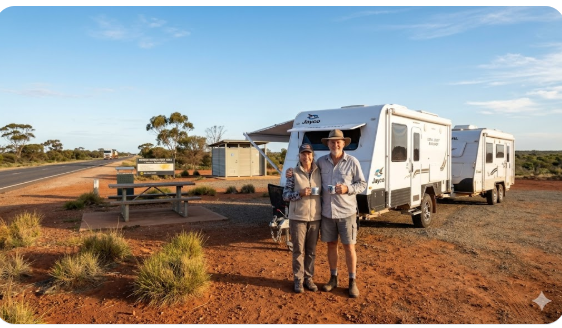
Rest Areas Far North of Perth — Geraldton to Port Hedland (North West Coastal Highway) Senior Grey Nomad Guide 2026
Rest areas far north of Perth — complete senior grey nomad guide to safe overnight stops between Geraldton and Port Hedland on North West Coastal Highway 2026. GPS coordinates, dump points, water sources, and critical medical distances for every stop.
The 1,200 km stretch from Geraldton to Port Hedland on the North West Coastal Highway is one of Australia’s most isolated sealed roads. In 2026, senior grey nomads travelling this route face extreme heat, limited services, and distances between facilities that can exceed 200 km. This guide provides verified GPS coordinates, dump point locations, water sources, medical proximity, and honest assessments of every official rest area between Geraldton and Port Hedland — written specifically for travellers aged 60–80 managing caravans, motorhomes, and the realities of remote outback travel.
Table of Contents
- Why Grey Nomads Drive This Far North — And Why Rest Area Planning Is Critical
- The Myth of “Just Pull Over Anywhere” — Why This Route Demands Pre-Planned Stops
- Your Main Rest Area Options: Official vs Roadhouse vs Free Camp
- Complete Rest Area Table — Geraldton to Port Hedland
- Heat Management on the North West Coastal Highway
- What the Roadhouse Websites Don’t Tell You
- Van Life Savings Spots: Free and Low-Cost Stops North of Perth
- Dump Point Strategy — Before, On-Site, and After
- Free Water Locations — Where to Top Up Tanks
- Bullara Station Stay: The Coastal Alternative for Grey Nomads
- Full Facilities Comparison — Rest Areas vs Roadhouses vs Station Stays
- Rates: All Options
- The Karijini Day Trip Plan for Seniors
- Senior Checklist: North West Coastal Highway 2026
- What to Do Between Geraldton and Port Hedland
- GPS Coordinates and Postcodes: Save Every Stop
- Frequently Asked Questions — Rest Areas Far North of Perth
- Quick-Reference Card + Booking
1. Why Grey Nomads Drive This Far North — And Why Rest Area Planning Is Critical
The North West Coastal Highway between Geraldton and Port Hedland is the main sealed route to the Pilbara, Karijini National Park, Ningaloo Reef, and the Kimberley beyond. For grey nomads completing the full lap of Australia in 2026, this section is unavoidable — and it demands more careful planning than almost any other sealed highway in the country.
Unlike the Eyre Highway (which has regular roadhouses every 200 km) or the Stuart Highway (which has towns with full facilities), the North West Coastal Highway has long stretches where the only services are a single roadhouse with fuel, a toilet block, and expensive packaged food. The free rest areas in between are basic — most have nothing more than a cleared gravel pad, a toilet drop box, and sometimes a picnic shelter. Water is rare. Shade is rarer. Phone signal disappears for hundreds of kilometres at a time.
For senior travellers managing CPAP machines, medication that requires refrigeration, mobility limitations, or simply the need for a decent toilet at night, the decision of where to stop for the night becomes a medical and safety issue — not just a convenience preference. This guide gives you the verified information you need to make that decision safely.
2. The Myth of “Just Pull Over Anywhere” — Why This Route Demands Pre-Planned Stops
Online forums and Facebook groups often describe the North West Coastal Highway as “easy” because it’s sealed, flat, and relatively straight. Senior travellers are sometimes told they can “just pull over anywhere” for the night. This advice is dangerously misleading — and in 2026, it has led to multiple emergency callouts involving grey nomads who became stranded, dehydrated, or injured attempting to free-camp on unmarked tracks off the highway.
Here are the five specific problems with the “just pull over” approach on this route:
1. Most roadside pull-offs are soft sand or bulldust. What looks like a firm shoulder from the road turns into deep, fine sand the moment you leave the sealed surface. Caravans and heavy motorhomes sink. Attempting to reverse out digs you in deeper. In 40°C heat with no phone signal, this becomes a life-threatening situation within hours.
2. There are no trees for shade between Minilya and Nanutarra — a 290 km stretch. If you stop on an unmarked pull-off during the day to rest, you are parking in full sun with no relief. Awnings provide minimal protection when the air temperature exceeds 45°C. Seniors with heat-sensitive medications or pre-existing cardiovascular conditions are at serious risk of heat stroke.
3. Telstra phone coverage disappears for up to 250 km at a time. If you have a medical emergency, a mechanical breakdown, or get bogged, you cannot call for help. The RFDS (Royal Flying Doctor Service) operates in this region, but they need GPS coordinates to find you — and if you’ve pulled off at an unmarked location without saving your position, even a satellite communicator can’t help them locate you quickly.
4. Road trains travel this highway 24 hours a day at high speed. Parking on narrow shoulders or partially on the road at night is extremely dangerous. Several grey nomad fatalities have occurred on this highway when vehicles parked too close to the road were struck by overtaking road trains in darkness.
5. Pastoral stations own the land on both sides of the highway. Pulling off onto station tracks without permission is trespassing. In 2026, some stations now patrol and issue fines. Others have locked gates within 1–2 km of the highway specifically to prevent unauthorised camping.
3. Your Main Rest Area Options: Official vs Roadhouse vs Free Camp
Between Geraldton and Port Hedland, you have three types of overnight stops. Each has trade-offs that matter significantly for seniors. The table below compares them honestly.
| Feature | Official Rest Areas (Free) | Roadhouse Unpowered Sites ($25–$35) | Station Stays (e.g. Bullara) ($40–$50) |
|---|---|---|---|
| Booking Required | No — first in, first served | No (but check availability by phone in peak season) | Yes — essential during school holidays |
| Power (240V) | ❌ None | ⚠️ Powered sites available at most roadhouses (+$15–$20), but limited number | ✅ Yes (at Bullara and similar station stays) |
| Toilets | ✅ Pit toilets or composting drop boxes — no flush, no lighting, no TP | ✅ Flush toilets, lit at night, TP supplied | ✅ Flush toilets, some with grab rails |
| Water (Potable) | ❌ None (Nerren Nerren and Chapman Valley have non-potable tanks) | ✅ Yes — tank fill $5–$10 | ✅ Yes (included in site fee) |
| Dump Point | ⚠️ Some have dump points (Galena Bridge, Nerren Nerren, Minilya) — not all | ✅ Yes (usually free if you’re a paying guest, $10–$15 if not) | ✅ Yes |
| Shade | ❌ None north of Minilya River. Galena Bridge has some trees. | ⚠️ Limited — a few shaded sites, most in full sun | ✅ Yes (Bullara has trees and shelters) |
| Dogs Allowed | ✅ Yes (on lead) | ⚠️ Check when booking — some roadhouses say no | ⚠️ Bullara allows dogs (on lead, $5/night extra) |
| Food Available | ❌ None | ✅ Counter meals, pies, sandwiches (expensive but convenient) | ⚠️ Bullara has a small shop — limited stock |
| Phone Signal | ❌ None at most rest areas | ✅ Telstra at Overlander, Nanutarra. Patchy elsewhere. | ⚠️ Bullara has no mobile signal — satellite phone or PLB essential |
| Nearest Hospital | Carnarvon Hospital (150–300 km away depending on rest area) | Carnarvon or Exmouth hospitals (100–200 km) — roadhouse staff can call RFDS | Exmouth Hospital 145 km, RFDS via satellite phone |
| ← Senior Recommendation | Only if fully self-contained with lithium battery, full tanks, and you’re comfortable with pit toilets at night | ← Best for most grey nomads — flush toilets, water, dump point, meal option | Best for those wanting coastal scenery and a rest day — but requires advance booking |
4. Complete Rest Area Table — Geraldton to Port Hedland (North West Coastal Highway) 2026
This table lists every official rest area, roadhouse stop, and town between Geraldton and Port Hedland on the North West Coastal Highway. GPS coordinates are verified as of March 2026. All coordinates use decimal degrees format (negative latitude first) for direct copy-paste into navigation apps and the Van Life Savings Spots app.
| # | Site Name | Type | Full Address + Postcode | GPS Coordinates | Water | Dump Point | Senior Notes |
|---|---|---|---|---|---|---|---|
| 1 | Geraldton (Francis St) | Free (24hr limit) | Francis Street, Geraldton WA 6530 | -28.7761, 114.6030 | ✅ Yes | ✅ Yes | Self-contained RVs only. Walk to shops. Hospital 2 km. Last full services before heading north. |
| 2 | Chapman Valley | Free | North West Coastal Highway, Chapman Valley WA 6532 | -28.5487, 114.6317 | ⚠️ Tank (non-potable) | ✅ Yes | Quiet alternative 30 km north of Geraldton. Pit toilets. Gravel surface. Tank water for washing only — not drinking. |
| 6 | Galena Bridge (Murchison River) | Free (24hr limit) | North West Coastal Highway, Murchison WA 6630 | -27.7886, 114.6145 | ❌ No | ✅ Yes | Popular spot — some tree shade near river. Pit toilets. Gets crowded in peak season. Arrive before 3 PM for best sites. |
| 7 | Nerren Nerren | Free (24hr limit) | North West Coastal Highway, Nerren Nerren WA 6630 | -27.2119, 114.6122 | ⚠️ Tank (non-potable) | ✅ Yes | Large gravel area. Flush toilets (basic). Tank water for washing only. No shade. 24-hour limit strictly enforced in 2026. |
| 10 | Overlander Roadhouse | Roadhouse Stop | North West Coastal Highway, Overlander WA 6701 | -26.4129, 114.1187 | ✅ Yes ($8 tank fill) | ✅ Yes (free for guests, $15 if not staying) | Gateway to Shark Bay turn-off. Unpowered sites $30, powered $45. Flush toilets, fuel, counter meals. Telstra signal. Open 6 AM–9 PM. |
| 14 | Carnarvon (Town) | Town | Robinson Street, Carnarvon WA 6701 | -24.8808, 113.6579 | ✅ Yes (at caravan parks) | ✅ Yes (public dump point Robinson St) | Last major town before Exmouth (370 km north). Hospital, Coles, pharmacy. Check Carnarvon Gateway Caravan Park for RV sites. Book ahead in peak season. |
| 15 | Minilya River | Free (24hr limit) | North West Coastal Highway, Minilya WA 6701 | -23.5887, 113.9159 | ❌ No | ✅ Yes | Large gravel area. Last rest stop before Nanutarra (290 km north). Pit toilets. No shade. Gets very hot. This is your last dump point for 290 km. |
| 20 | Nanutarra Roadhouse | Roadhouse Stop | Nanutarra-Munjina Road, Nanutarra WA 6710 | -22.2975, 115.0345 | ✅ Yes ($10 tank fill) | ✅ Yes (free for guests, $15 if not staying) | Junction for Karijini turn-off. Unpowered sites $35, powered $50. Fuel, counter meals. Essential fuel stop. Telstra signal. Open 24 hours. |
| 23 | Robe River | Free (24hr limit) | North West Coastal Highway, Robe River WA 6714 | -21.8947, 115.5122 | ❌ No | ❌ No | Riverside gravel parking area. Pit toilets. No dump point. No water. Scenic but very basic. Only use if you have full tanks and don’t need to dump. |
| 24 | Fortescue River | Free (24hr limit) | North West Coastal Highway, Fortescue WA 6716 | -21.5240, 116.0153 | ❌ No | ❌ No | Gravel area. Pit toilets. Last free rest area before Port Hedland (140 km north). No facilities beyond toilets. Full sun. Use only as overnight transit stop. |
5. Heat Management on the North West Coastal Highway — What It Means for Seniors in 2026
Between November and March, daytime temperatures on the North West Coastal Highway regularly exceed 42°C. In the Pilbara section (Nanutarra to Port Hedland), 45–48°C is common. For senior grey nomads, this is not just uncomfortable — it is medically dangerous. Heat stroke, dehydration, and cardiovascular stress are the leading causes of RFDS callouts on this route.
The rest areas between Minilya River and Nanutarra have zero shade. You are parking on gravel in full sun. If you arrive at 2 PM and the air temperature is 45°C, the inside of your caravan will reach 55–60°C within 30 minutes — even with windows open and a fan running. A 12V fan pulls power from your battery, which then cannot recharge without driving or running a generator. Running a generator during the heat of the day in full sun is itself a heat-stroke risk for the operator.
Here is the senior-safe heat management strategy for this route in 2026:
1. Drive early and stop early. Depart at sunrise (5–6 AM). Drive until 11 AM–12 PM. Stop at a roadhouse or shaded rest area before the peak heat (2–4 PM). Do not attempt to drive through the heat of the day — road train turbulence, glare, and fatigue combined with heat exhaustion significantly increase accident risk.
2. Use roadhouses for midday stops. Overlander and Nanutarra roadhouses have air-conditioned dining areas. You can buy a meal and sit inside for 2–3 hours during peak heat. This is not freeloading — it is heat-stroke prevention. Roadhouse staff understand this and expect grey nomads to use the facility this way.
3. Carry a minimum 40 litres of drinking water per person. Tank water is for washing and cooking. Drinking water must be bottled and stored separately. In 45°C heat, a senior needs 4–5 litres of water per day just to maintain hydration. Dehydration onset is rapid — within 2–3 hours without water in extreme heat.
4. Keep medications in a portable insulated bag with ice packs. Many senior medications (insulin, some blood pressure medications, emergency inhalers) lose efficacy above 30°C. If your caravan reaches 55°C, those medications are compromised. A cheap insulated lunch bag with reusable ice packs (frozen overnight at roadhouses) solves this.
5. Know the signs of heat stroke in yourself and your travel partner. Confusion, nausea, rapid heartbeat, cessation of sweating, and dizziness are all emergency signs. If any of these occur, stop immediately, move to shade (even if it’s just under your vehicle), pour water over clothing, and call 000 if you have signal or activate your PLB if you don’t. Heat stroke kills seniors within 30–60 minutes if untreated.
6. What the Roadhouse Websites Don’t Tell You About Staying Overnight
Roadhouses along the North West Coastal Highway advertise “caravan sites” and “camping areas” on their websites, but the reality is often different from what grey nomads expect. Here are the insider details you won’t find online — written specifically for senior travellers who need to know before they arrive.
1. “Unpowered sites” often means a gravel patch behind the fuel pumps. At both Overlander and Nanutarra, the unpowered camping area is not a defined caravan park with marked sites. It’s a large gravel area where you park wherever there’s space. In peak season (June–September), this area fills with road train drivers, mine workers, and other grey nomads. It can be noisy all night. Generators run until 9–10 PM. Road trains idle. If you’re a light sleeper, bring earplugs.
2. Toilet blocks are shared with roadhouse customers. The same toilets used by caravan park guests are used by fuel customers, truckies, and tour groups. During busy periods, toilets can be messy. There is no separate “guest only” facility. If you have mobility issues and need grab rails, check when you arrive — not all roadhouse toilet blocks have them installed.
3. Showers are coin-operated and water is limited. Most roadhouse showers cost $2–$5 in coins for a 3–5 minute timed shower. Water pressure is often low. If you need a longer shower due to mobility or hygiene needs, you’ll need multiple coin loads. Bring $1 and $2 coins — roadhouses often run out of change.
4. Powered sites are limited and fill by mid-afternoon in peak season. Overlander Roadhouse has only 8 powered sites. Nanutarra has 12. During school holidays and winter peak (June–August), these fill by 2–3 PM. If you need power for CPAP or medical equipment, phone ahead in the morning and ask them to hold a powered site — some roadhouses will do this for medical reasons, but you must ask specifically and explain why.
5. Solo women travellers should park near the roadhouse building, not the far edge of the camping area. The camping areas at roadhouses are large and poorly lit at night. While serious incidents are rare, solo women have reported feeling unsafe when parked in dark corners far from the main building. Park within sight of the roadhouse entrance and the toilet block. This also makes it easier to access facilities at night.
COPY PROMPT ➔ ASK AI ➔ SAVE TO FORM ➔ ADD SPOT PIN ➔ GET DIRECTIONS
📍 Interactive map — find free camps, rest areas and overnight stops. Enable location for best results.
7. Van Life Savings Spots: Free and Low-Cost Camping Near the North West Coastal Highway 2026
The Van Life Savings Spots app is the single most useful tool for finding and navigating to free camps, rest areas, and low-cost stops on this route. Unlike crowdsourced apps where information becomes outdated, Van Life Savings Spots uses AI to cross-reference official shire records, Main Roads WA data, and verified grey nomad reports to give you current, accurate information before you arrive.
Example queries you can ask the Van Life Savings Spots app for this route:
- “Free rest areas with dump points between Geraldton and Carnarvon”
- “Roadhouse unpowered sites with flush toilets on North West Coastal Highway”
- “Shaded free camps within 50 km of Overlander Roadhouse”
- “Nearest hospital to Minilya River rest area”
- “Free water refill locations between Carnarvon and Nanutarra”
The app returns GPS coordinates, current rules (including 24-hour limits), facility lists, and distances to medical facilities. You can save all this information offline before leaving Geraldton, so it remains accessible even when you have no phone signal for 200+ km at a time.
| Site Name | Cost | Full Address + Postcode | GPS Coordinates | Distance from Highway | Senior Verdict |
|---|---|---|---|---|---|
| Chapman Valley Rest Area | Free | North West Coastal Highway, Chapman Valley WA 6532 | -28.5487, 114.6317 | Roadside (0 km detour) | ✅ Good first-night stop 30 km north of Geraldton. Dump point available. Tank water non-potable. Pit toilets basic but clean. |
| Galena Bridge (Murchison River) | Free | North West Coastal Highway, Murchison WA 6630 | -27.7886, 114.6145 | Roadside (0 km detour) | ✅ Popular for good reason — some tree shade near river. Dump point. Fills early in peak season. Arrive before 3 PM. |
| Nerren Nerren Rest Area | Free | North West Coastal Highway, Nerren Nerren WA 6630 | -27.2119, 114.6122 | Roadside (0 km detour) | ⚠️ Large area, dump point available, but no shade. Gets extremely hot. 24-hour limit strictly enforced. Flush toilets (basic). |
| Minilya River Rest Area | Free | North West Coastal Highway, Minilya WA 6701 | -23.5887, 113.9159 | Roadside (0 km detour) | ⚠️ Last free dump point for 290 km north. No water. No shade. Essential overnight stop if you’re not paying for roadhouse. Pit toilets. |
| Robe River Rest Area | Free | North West Coastal Highway, Robe River WA 6714 | -21.8947, 115.5122 | Roadside (0 km detour) | ⚠️ Scenic riverside location but no dump point, no water. Only use if you have full tanks and don’t need to dump. Pit toilets only. |
| Fortescue River Rest Area | Free | North West Coastal Highway, Fortescue WA 6716 | -21.5240, 116.0153 | Roadside (0 km detour) | ⚠️ Last free rest area before Port Hedland (140 km). No facilities beyond pit toilets. Full sun. Transit stop only. |
7b. Dump Point Strategy — Before, On-Site, and After Every Major Stop
Dump points are spaced unevenly on the North West Coastal Highway. The longest gap without a dump point is 290 km (Minilya River to Nanutarra). For senior grey nomads managing a 60–80 litre grey water tank, this means you must plan your dumps strategically or pay for roadhouse dump access.
Here is the dump point strategy table for this route:
| Your Current Location | 🗑️ Dump Point BEFORE (Southbound) | 🗑️ Dump Point ON-SITE | 🗑️ Dump Point AFTER (Northbound) |
|---|---|---|---|
| Geraldton | — | Francis Street, Geraldton WA 6530 GPS: -28.7761, 114.6030 |
Chapman Valley (30 km north) GPS: -28.5482, 114.6328 |
| Chapman Valley | Geraldton (30 km south) GPS: -28.7751, 114.6139 |
Chapman Valley rest area GPS: -28.5487, 114.6317 |
Galena Bridge (120 km north) GPS: -27.7886, 114.6145 |
| Galena Bridge | Chapman Valley (120 km south) GPS: -28.5487, 114.6317 |
Galena Bridge rest area GPS: -27.7886, 114.6145 |
Nerren Nerren (65 km north) GPS: -27.2119, 114.6122 |
| Nerren Nerren | Galena Bridge (65 km south) GPS: -27.7886, 114.6145 |
Nerren Nerren rest area GPS: -27.2119, 114.6122 |
Overlander Roadhouse (110 km north, $15) GPS: -26.4129, 114.1187 |
| Overlander Roadhouse | Nerren Nerren (110 km south) GPS: -27.2119, 114.6122 |
Overlander Roadhouse (free for guests, $15 if not) GPS: -26.4129, 114.1187 |
Carnarvon town (75 km north) GPS: -24.8808, 113.6579 |
| Carnarvon | Overlander Roadhouse (75 km south, $15) GPS: -26.4129, 114.1187 |
Robinson Street public dump point, Carnarvon GPS: -24.8808, 113.6579 |
Minilya River (180 km north) GPS: -23.5887, 113.9159 |
| Minilya River | Carnarvon (180 km south) GPS: -24.8808, 113.6579 |
Minilya River rest area GPS: -23.5887, 113.9159 |
Nanutarra Roadhouse (290 km north, $15) GPS: -22.2975, 115.0345 |
| Nanutarra Roadhouse | Minilya River (290 km south) GPS: -23.5887, 113.9159 |
Nanutarra Roadhouse (free for guests, $15 if not) GPS: -22.2975, 115.0345 |
Port Hedland (370 km north) — no dump points in between |
7c. Free Water Locations — Where to Top Up Tanks Between Geraldton and Port Hedland
Potable water is even rarer than dump points on this route. Most rest areas have no water at all. The few that do (Chapman Valley, Nerren Nerren) have tank water that is explicitly labelled “non-potable” — it’s collected rainwater suitable for washing dishes or flushing toilets, but not safe for drinking without boiling and filtering.
For drinking water, you have three options: carry bottled water purchased in Geraldton, refill at roadhouses (paid), or refill at town facilities (free but limited locations). The table below lists every reliable water source on the route.
| Water Source | Type | Full Address + Postcode | GPS Coordinates | Cost | Senior Notes |
|---|---|---|---|---|---|
| 💧 Geraldton Visitor Centre | Potable (free) | 246 Marine Terrace, Geraldton WA 6530 | -28.7782, 114.6144 | Free | Last reliable free potable water before heading north. Fill all tanks and bottles here. Visitor centre open 9 AM–4 PM Mon–Sat. |
| 💧 Chapman Valley Rest Area | Non-potable (free) | North West Coastal Highway, Chapman Valley WA 6532 | -28.5487, 114.6317 | Free | Rainwater tank — suitable for washing only. Do not drink without boiling and filtering. Tank runs dry in summer. |
| 💧 Nerren Nerren Rest Area | Non-potable (free) | North West Coastal Highway, Nerren Nerren WA 6630 | -27.2119, 114.6122 | Free | Rainwater tank — suitable for washing only. Do not drink without boiling and filtering. Tank often empty May–October. |
| 💧 Overlander Roadhouse | Potable (paid) | North West Coastal Highway, Overlander WA 6701 | -26.4129, 114.1187 | $8 tank fill | Bore water — drinkable but high mineral content. Some seniors report stomach upset. Consider buying bottled water instead if sensitive. |
| 💧 Carnarvon (Town Tap) | Potable (free) | Robinson Street, Carnarvon WA 6701 | -24.8808, 113.6579 | Free | Town scheme water — potable. Public tap at dump point location. Fill tanks and bottles here before heading north to Exmouth or Karijini. |
| 💧 Nanutarra Roadhouse | Potable (paid) | Nanutarra-Munjina Road, Nanutarra WA 6710 | -22.2975, 115.0345 | $10 tank fill | Bore water — drinkable but high mineral content. Last water before Port Hedland (370 km) or before Karijini turn-off (80 km). |
8. Bullara Station Stay: The Coastal Alternative for Grey Nomads
If you’re looking for a coastal alternative to the inland highway route between Carnarvon and Nanutarra, Bullara Station offers powered sites, flush toilets, and access to pristine coastal scenery 50 km west of the highway. This is not a quick overnight stop — it’s a 2–3 night destination for seniors who want a rest day with beach access, wildlife, and a break from highway driving.
Full Contact Details:
Bullara Station
Bullara Station Road (50 km west of North West Coastal Highway), Bullara WA 6701
GPS: -23.6283, 113.7641
Phone: 08 9942 5924
Email: [email protected]
Website: www.bullara.com.au
What Makes Bullara Different for Seniors:
1. It’s a working cattle station with tourism accommodation. The station has been family-owned since the 1880s. The current owners offer powered caravan sites, unpowered sites, and self-contained accommodation units. The atmosphere is quiet, remote, and genuinely off-the-tourist-trail — you’ll share the site with maybe 5–10 other vans, not 50.
2. Coastal access to Ningaloo Reef’s southern edge. Bullara sits on the coast at the southern boundary of Ningaloo Marine Park. You can drive to sandy beaches, snorkel over coral (reef-safe sunscreen essential), and fish from the shore. This is not the busy Coral Bay tourist section — this is remote, empty coastline.
3. Powered sites with trees. Unlike roadhouses, Bullara has shaded powered sites under established trees. In summer heat, this makes a significant comfort difference. Sites are gravel but level. There’s room for large rigs — some sites can take 25-foot vans with tow vehicles.
4. No phone signal — satellite phone or PLB essential. Bullara has zero mobile coverage (Telstra or Optus). The station has a satellite phone for emergencies, but if you have a medical issue at night or on a weekend, you’re relying on your own PLB or the station owners’ emergency protocols. This is genuine remote travel.
5. Booking essential — no walk-ins. Bullara operates on an advance booking system. You cannot arrive unannounced and expect a site. Phone or email at least 1 week ahead (1 month ahead in school holidays). They close periodically for station work — always confirm they’re open before making the 50 km detour off the highway.
9. Full Facilities Comparison — Rest Areas vs Roadhouses vs Station Stays
This three-column comparison table gives you an honest, facility-by-facility assessment of what you actually get at each type of stop. Every row answers a specific senior concern.
| Facility / Feature | Official Rest Areas (Free) | Roadhouse Sites (Overlander, Nanutarra) | Bullara Station Stay |
|---|---|---|---|
| Power (240V mains) | ❌ None | ✅ Yes (powered sites +$15–$20) | ✅ Yes (included in site fee) |
| Toilets | ⚠️ Pit toilets or drop boxes — no flush, no TP, no lighting, no grab rails | ✅ Flush toilets, lit, TP supplied, shared with public | ✅ Flush toilets, guest-only, some grab rails |
| Showers | ❌ None | ✅ Yes (coin-operated, $2–$5 per shower) | ✅ Yes (included in site fee) |
| Pool / Shade | ❌ No pool. Some tree shade at Galena Bridge only. | ❌ No pool. Limited shade at most roadhouses. | ❌ No pool. ✅ Tree shade on most powered sites. |
| Water (Potable) | ❌ None (Chapman Valley and Nerren Nerren have non-potable tank water) | ✅ Yes — tank fill $8–$10 (bore water, high mineral content) | ✅ Yes (tank fill included in site fee) |
| Dump Point | ⚠️ Some (Galena Bridge, Nerren Nerren, Minilya) — not all | ✅ Yes (free for guests, $10–$15 if not staying) | ✅ Yes (included in site fee) |
| Dogs Allowed | ✅ Yes (on lead) | ⚠️ Check when booking — policies vary | ✅ Yes (on lead, $5/night extra) |
| Dining / Food | ❌ None | ✅ Counter meals, pies, sandwiches (expensive but convenient) | ⚠️ Small station shop — very limited stock, no meals |
| Wi-Fi | ❌ None | ⚠️ Limited guest Wi-Fi at Overlander (slow, patchy) | ❌ None |
| Phone Signal | ❌ None at most rest areas | ✅ Telstra at Overlander and Nanutarra (patchy elsewhere) | ❌ None — satellite phone or PLB essential |
| Medical Proximity | Carnarvon Hospital 100–300 km away depending on rest area | Carnarvon or Exmouth hospitals 100–200 km — roadhouse staff can call RFDS | Exmouth Hospital 145 km — RFDS via satellite phone, 60–90 min response |
| Stargazing | ✅ Excellent (zero light pollution) | ⚠️ Good (some light from roadhouse buildings) | ✅ Excellent (minimal station lighting) |
| ← Senior Overall Rating | ⚠️ Only if fully self-contained, comfortable with pit toilets, and you don’t need power | ✅ Best for most grey nomads — flush toilets, water, dump point, power, meal option | ✅ Best for coastal rest days — but requires advance booking and PLB for safety |
10. Rates: All Options (2026 Pricing)
Rates below are verified as of March 2026. Roadhouse rates can change seasonally — always phone ahead to confirm current pricing, especially during school holidays when some roadhouses increase rates.
| Accommodation Type | Nightly Rate (2 Adults) | What’s Included | Booking Contact |
|---|---|---|---|
| Official Rest Areas | ← Senior Recommended for budget travellers Free |
Pit toilets, dump point (at some sites), 24-hour parking limit | No booking required — first in, first served |
| Overlander Roadhouse — Unpowered Site | $30 per night | Gravel site, shared flush toilets, coin showers, dump point (free for guests) | 08 9942 5920 |
| Overlander Roadhouse — Powered Site | ← Senior Recommended for comfort $45 per night |
240V power, gravel site, shared flush toilets, coin showers, dump point, water fill ($8 extra) | 08 9942 5920 |
| Nanutarra Roadhouse — Unpowered Site | $35 per night | Gravel site, shared flush toilets, coin showers, dump point (free for guests) | 08 9943 6988 |
| Nanutarra Roadhouse — Powered Site | $50 per night | 240V power, gravel site, shared flush toilets, coin showers, dump point, water fill ($10 extra) | 08 9943 6988 |
| Bullara Station — Unpowered Site | $40 per night | Gravel site, guest flush toilets, showers (included), dump point, tank fill (included) | 08 9942 5924 — booking essential |
| Bullara Station — Powered Site | ← Senior Recommended for coastal rest days $50 per night |
240V power, tree shade, guest flush toilets, showers (included), dump point, tank fill (included), coastal access | 08 9942 5924 — booking essential 1+ week ahead |
| Dog Fee (where allowed) | +$5 per night | On-lead only. Confirm dog policy when booking. | — |
11. The Karijini Day Trip Plan for Seniors (From Nanutarra Base)
If you’re visiting Karijini National Park, Nanutarra Roadhouse is the closest overnight base on the highway (80 km from the park entry). Many grey nomads use Nanutarra as their base and day-trip into Karijini rather than camping inside the park — which requires a national park camping permit and involves rough unsealed access roads unsuitable for large caravans.
Here is a realistic senior-safe Karijini day trip itinerary from Nanutarra Roadhouse:
6:00 AM — Depart Nanutarra Roadhouse. Fill fuel tank before leaving (diesel $2.50+/L in 2026 — expensive but essential). Drive 80 km sealed road to Karijini Visitor Centre. Road is good quality sealed but watch for wildlife (kangaroos, emus) at dawn.
GPS: Karijini Visitor Centre: -22.4628, 118.5017
7:30 AM — Arrive Karijini Visitor Centre. Use flush toilets here (cleanest in the park). Check park alerts for gorge closures due to heat or flooding. Buy bottled water if needed. Visitor centre has air conditioning — good for midday return stop.
GPS: -22.4628, 118.5017
8:00 AM — Drive to Dales Gorge (40 km from visitor centre). This is the most accessible gorge for seniors. Sealed car park, short (200m) wheelchair-accessible path to Circular Pool lookout. If you’re mobile, the descent to Fortescue Falls is 200 stairs with handrails — return climb is strenuous in heat. Do this before 10 AM or skip it.
GPS: Dales Gorge Car Park: -22.4847, 118.4683
10:00 AM — Return to Karijini Visitor Centre. Spend the peak heat (10 AM–2 PM) inside the air-conditioned visitor centre. Have lunch (bring your own — no cafe on-site). Refill water bottles. Rest in air conditioning. This prevents heat stroke and allows you to do a second gorge in the afternoon when temperature drops.
GPS: -22.4628, 118.5017
2:00 PM — Drive to Oxer Lookout (60 km from visitor centre). This is a vehicle-accessible lookout — you do not need to hike. Park, walk 50m on flat sealed path to lookout viewing platform. Spectacular views of four gorges meeting. Toilet facilities at car park (pit toilets, basic but usable).
GPS: Oxer Lookout: -22.5417, 118.5833
3:30 PM — Depart Karijini, return to Nanutarra. Aim to be back at Nanutarra Roadhouse by 5:30–6:00 PM before dark. Outback roads are dangerous at dusk due to wildlife. Kangaroo strikes can total a vehicle and leave you stranded 80 km from help.
12. Senior Checklist: North West Coastal Highway 2026
Use this checklist before departing Geraldton for the north. Every item addresses a specific safety or medical concern for remote outback travel between Geraldton and Port Hedland in 2026.
| Item | Why It Matters for the North West Coastal Highway | ✓ |
|---|---|---|
| Travel insurance with medical evacuation cover | RFDS air ambulance to Perth from Carnarvon costs $15,000+. Medicare does not cover air ambulance. Travel insurance specifically covering remote medical evacuation is essential. Verify your policy covers WA remote areas before departure. | ☐ |
| PLB registered with AMSA | No phone signal for 200+ km stretches. A registered Personal Locator Beacon is the only reliable emergency signal between Carnarvon and Nanutarra. Free registration at beacons.amsa.gov.au. Test before departure. | ☐ |
| 3-week minimum prescription medication supply | Carnarvon pharmacy has limited stock. Port Hedland and Exmouth pharmacies restock weekly but can run out of specialty medications. Buy all prescriptions in Perth or Geraldton before heading north. | ☐ |
| Medicare card + medication list + insurance policy in waterproof pouch in vehicle | Keep accessible — not packed at bottom of luggage. A printed medication list saves critical time in emergency. Include drug names, dosages, prescribing GP contact, and known allergies. | ☐ |
| 40+ litres bottled drinking water (separate from tank water) | Tank water is for washing. Roadhouse bore water has high mineral content and can cause stomach upset. In 45°C heat a senior needs 4–5L drinking water per day. Purchase in Geraldton or Carnarvon and store separately. | ☐ |
| SPF 50+ sunscreen + wide-brim hat + long sleeves | UV index 12+ is common. Skin cancer risk is extreme. Even 15 minutes in full sun causes burns for fair-skinned seniors. Apply sunscreen before leaving vehicle. Reapply every 2 hours if outside. | ☐ |
| Offline maps downloaded (Google Maps offline + Van Life Savings Spots app) | Download maps of entire route from Geraldton to Port Hedland before leaving Wi-Fi in Geraldton. Save GPS coordinates for every rest area, dump point, water source, and hospital in Van Life Savings Spots app. | ☐ |
| CPAP lithium battery (if using CPAP at unpowered sites) | Free rest areas have no power. Roadhouse unpowered sites have no power. A medical-grade lithium CPAP battery gives 2–3 nights autonomy. Essential if you cannot safely sleep without CPAP. | ☐ |
| Emergency numbers saved offline AND printed in glovebox | 000 (emergency — works even without signal if any carrier tower in range). RFDS: 1800 625 800. Carnarvon Hospital: 08 9941 0300. Print these and keep in glovebox — phone batteries die. | ☐ |
| 🗑️ Dump point GPS — before stop (Minilya River GPS: -23.5887, 113.9159) | Last free dump point before 290 km gap to Nanutarra. Save GPS before leaving Geraldton Wi-Fi. Missing this dump point costs you $15 at Nanutarra or risks overflowing tanks. | ☐ |
| 🗑️ Dump point GPS — after stop (Nanutarra Roadhouse GPS: -22.2975, 115.0345) | Next dump point after Minilya River. Save GPS. Allows you to plan tank capacity and avoid emergency overflow. | ☐ |
| 💧 Water top-up location GPS (Carnarvon town tap GPS: -24.8808, 113.6579) | Last free potable water before Nanutarra (290 km north). Fill all tanks here. Save GPS to Van Life Savings Spots app. | ☐ |
| Dog water bowl, lead, tie-out, and waste bags (if travelling with dog) | Dogs overheat faster than humans. Carry minimum 5L dog water separately. Karijini National Park bans dogs — do not attempt to take dogs into any national park. Fines $500+. | ☐ |
| Insulated medication bag with reusable ice packs | Caravan interiors reach 55–60°C in summer. Insulin, some blood pressure medications, and emergency inhalers lose efficacy above 30°C. Store medications in portable insulated bag. Freeze ice packs overnight at roadhouses. | ☐ |
| Full fuel tank + 20L jerry can spare diesel/petrol | Longest fuel gap is Overlander to Nanutarra (280 km). Most caravans and motorhomes can do this on one tank, but a 20L spare eliminates risk. Roadhouse fuel is $2.50+/L — expensive but essential. | ☐ |
13. What to Do Between Geraldton and Port Hedland — Senior Day Plan Activities
The North West Coastal Highway is primarily a transit route, but there are several worthwhile stops for grey nomads who want to break up long driving days with short activities. Every activity below includes full address, GPS, and senior-specific notes.
| Activity | Full Address + Postcode | GPS Coordinates | Senior Notes |
|---|---|---|---|
| Kalbarri National Park (Murchison Gorge) | Red Bluff Road, Kalbarri WA 6536 (60 km detour west from highway) | -27.7133, 114.4500 | Vehicle-accessible lookouts at Nature’s Window and Z-Bend. Short sealed paths (50–100m) to viewing platforms. Wheelchair-accessible. Park entry $15/vehicle/day. Flush toilets at car parks. Open sunrise to sunset. |
| Shark Bay World Heritage Discovery Centre | 53 Knight Terrace, Denham WA 6537 (130 km detour west from Overlander turn-off) | -25.9275, 113.5358 | Air-conditioned indoor museum. Wheelchair-accessible. Entry $15 adult. Open 9 AM–4 PM daily. Flush toilets, cafe. Ideal midday heat-escape activity. Allow 1–2 hours. |
| Carnarvon Heritage Precinct | 6 Mahony Avenue, Carnarvon WA 6701 | -24.8794, 113.6619 | Historical buildings, OTC Dish (satellite tracking station), museum. Self-guided walk (flat, paved). Free entry. Shaded seating areas. Flush toilets. Open daylight hours. Allow 1 hour. |
| Carnarvon Space Museum (OTC Satellite Station) | Mahony Avenue, Carnarvon WA 6701 | -24.8775, 113.6628 | Indoor air-conditioned museum. Wheelchair-accessible. Gold coin donation entry. Open 10 AM–2 PM Mon–Fri. Flush toilets. Ideal for afternoon heat refuge. |
| Karijini National Park (Dales Gorge + Oxer Lookout) | Banjima Drive, Karijini WA 6751 (80 km detour east from Nanutarra) | -22.4628, 118.5017 (Visitor Centre) | Vehicle-accessible lookouts. Visitor Centre air-conditioned (use as midday refuge). Park entry $15/vehicle/day. Pit toilets at most lookouts. See Section 11 for full senior day-trip plan. Full-day activity from Nanutarra base. |
| Cossack Historic Town | Cossack Road, Roebourne WA 6718 (200 km detour from highway via Port Hedland) | -20.6858, 117.1875 | Restored pearling town. Self-guided walk (flat, some gravel paths). Free entry. Minimal shade — visit early morning only. Pit toilets. Coastal scenery. Allow 1–2 hours. Unsealed road final 15 km (suitable for 2WD). |
14. GPS Coordinates and Postcodes — Save Every Stop Before Leaving Wi-Fi
This is the master GPS table for the entire North West Coastal Highway route. Every location mentioned in this guide is listed here with full address and copy-paste GPS coordinates. Save these to the Van Life Savings Spots app before leaving Wi-Fi coverage in Geraldton. This information may save your life if you have a medical or mechanical emergency with no phone signal.
| Stop / Location | Full Address + Suburb + Postcode | GPS Coordinates (Copy to App) |
|---|---|---|
| Geraldton RV Park (Francis St) | Francis Street, Geraldton WA 6530 | -28.7761, 114.6030 |
| 🗑️ Geraldton Dump Point | Francis Street, Geraldton WA 6530 | -28.7761, 114.6030 |
| 💧 Geraldton Visitor Centre (Water) | 246 Marine Terrace, Geraldton WA 6530 | -28.7782, 114.6144 |
| 🏥 Geraldton Hospital | Shenton Street, Geraldton WA 6530 Phone: 08 9956 0200 |
-28.7694, 114.6097 |
| Chapman Valley Rest Area | North West Coastal Highway, Chapman Valley WA 6532 | -28.5487, 114.6317 |
| 🗑️ Chapman Valley Dump Point | North West Coastal Highway, Chapman Valley WA 6532 | -28.5487, 114.6317 |
| Galena Bridge (Murchison River) Rest Area | North West Coastal Highway, Murchison WA 6630 | -27.7886, 114.6145 |
| 🗑️ Galena Bridge Dump Point | North West Coastal Highway, Murchison WA 6630 | -27.7886, 114.6145 |
| Nerren Nerren Rest Area | North West Coastal Highway, Nerren Nerren WA 6630 | -27.2119, 114.6122 |
| 🗑️ Nerren Nerren Dump Point | North West Coastal Highway, Nerren Nerren WA 6630 | -27.2119, 114.6122 |
| Overlander Roadhouse | North West Coastal Highway, Overlander WA 6701 Phone: 08 9942 5920 |
-26.4129, 114.1187 |
| 🗑️ Overlander Roadhouse Dump Point | North West Coastal Highway, Overlander WA 6701 | -26.4129, 114.1187 |
| 💧 Overlander Roadhouse Water | North West Coastal Highway, Overlander WA 6701 ($8 tank fill) | -26.4129, 114.1187 |
| Carnarvon Town Centre | Robinson Street, Carnarvon WA 6701 | -24.8808, 113.6579 |
| 🗑️ Carnarvon Public Dump Point | Robinson Street, Carnarvon WA 6701 | -24.8808, 113.6579 |
| 💧 Carnarvon Town Water Tap (Free Potable) | Robinson Street, Carnarvon WA 6701 | -24.8808, 113.6579 |
| 🏥 Carnarvon Hospital | Robinson Street, Carnarvon WA 6701 Phone: 08 9941 0300 |
-24.8800, 113.6567 |
| Minilya River Rest Area | North West Coastal Highway, Minilya WA 6701 | -23.5887, 113.9159 |
| 🗑️ Minilya River Dump Point | North West Coastal Highway, Minilya WA 6701 | -23.5887, 113.9159 |
| Bullara Station | Bullara Station Road, Bullara WA 6701 Phone: 08 9942 5924 |
-23.6283, 113.7641 |
| Nanutarra Roadhouse | Nanutarra-Munjina Road, Nanutarra WA 6710 Phone: 08 9943 6988 |
-22.2975, 115.0345 |
| 🗑️ Nanutarra Roadhouse Dump Point | Nanutarra-Munjina Road, Nanutarra WA 6710 | -22.2975, 115.0345 |
| 💧 Nanutarra Roadhouse Water | Nanutarra-Munjina Road, Nanutarra WA 6710 ($10 tank fill) | -22.2975, 115.0345 |
| Karijini Visitor Centre | Banjima Drive, Karijini WA 6751 | -22.4628, 118.5017 |
| 🏥 Exmouth Hospital (Nearest to Bullara) | Lyons Street, Exmouth WA 6707 Phone: 08 9949 2377 |
-21.9353, 114.1286 |
| Robe River Rest Area | North West Coastal Highway, Robe River WA 6714 | -21.8947, 115.5122 |
| Fortescue River Rest Area | North West Coastal Highway, Fortescue WA 6716 | -21.5240, 116.0153 |
| 🏥 Port Hedland Hospital | Athol Street, Port Hedland WA 6721 Phone: 08 9158 2222 |
-20.3161, 118.6064 |
15. Frequently Asked Questions — Rest Areas Far North of Perth for Grey Nomads 2026
Q1: Are the rest areas between Geraldton and Port Hedland safe for solo senior women travelling alone?
The official Main Roads WA rest areas (Galena Bridge, Nerren Nerren, Minilya River) are generally safe — they’re well-used by grey nomads and road train drivers. However, they are remote, poorly lit at night, and have no phone signal. If you’re a solo woman traveller, choose roadhouse sites (Overlander, Nanutarra) over free rest areas — you’ll be near other people, have lit facilities, and staff can call for help if needed. Never park in dark corners away from the main camping area. Always park where you can see the roadhouse entrance and toilet block.
Q2: Can I use a generator at free rest areas on the North West Coastal Highway?
Most rest areas allow generators but have unofficial “quiet hours” 8 PM–7 AM. Other grey nomads will complain — and sometimes confront you — if you run a generator after 8 PM or before 7 AM. At roadhouses (Overlander, Nanutarra), generator use is allowed until 9 PM for guests. If you’re CPAP-dependent and need overnight power, either pay for a roadhouse powered site ($45–$50) or invest in a lithium CPAP battery for use at free sites.
Q3: What happens if I have a medical emergency between Carnarvon and Nanutarra where there’s no phone signal?
Activate your Personal Locator Beacon (PLB). This sends a distress signal to the Australian Maritime Safety Authority (AMSA) via satellite, which then coordinates rescue via the Royal Flying Doctor Service (RFDS) or local emergency services. Response time is typically 60–90 minutes from activation to RFDS arrival. If you don’t have a PLB, your only option is to flag down a passing vehicle and ask them to drive to the nearest roadhouse to call for help — which could add hours to response time. This is why a registered PLB is non-negotiable for this route.
Q4: How far apart are dump points on the North West Coastal Highway and what do I do if I miss one?
The longest gap between dump points is 290 km (Minilya River to Nanutarra). If you miss the Minilya River dump point and your tanks are full, your options are: (1) pay $15 to dump at Nanutarra Roadhouse, (2) dump illegally (which is a $500+ fine and creates a health hazard), or (3) backtrack 290 km. The smart move is to dump at Minilya River even if your tanks are only half full — it’s your last free dump for 290 km and prevents this dilemma.
Q5: Can I drink the water from rest area tanks at Chapman Valley and Nerren Nerren?
No. Both rest areas have rainwater tanks explicitly labelled “non-potable” — meaning not safe for drinking. Use this water for washing dishes, flushing toilets, or showering only. For drinking water, either fill tanks in Geraldton or Carnarvon (town scheme water, potable), or purchase bottled water. Drinking untreated rainwater tank water can cause gastro illness, which is dangerous when you’re 200 km from medical help.
Q6: Is Bullara Station worth the 50 km detour off the highway for grey nomads?
Yes — if you want a 2–3 night coastal rest break with beach access, powered sites, and tree shade. No — if you’re just looking for a quick overnight transit stop. Bullara is a destination, not a convenience stop. You need to book ahead (at least 1 week, 1 month in school holidays), you need a PLB or satellite phone (zero mobile signal), and you need to be comfortable with genuine remoteness (nearest hospital 145 km away). It’s beautiful and quiet, but it’s not for seniors who need immediate access to medical facilities.
Q7: Do I need a national parks pass for rest areas on the North West Coastal Highway?
No. The rest areas themselves (Galena Bridge, Nerren Nerren, Minilya River, Robe River, Fortescue River) are on Main Roads WA land, not national park land. You do not need a parks pass to use them. However, if you detour to Kalbarri National Park or Karijini National Park, you need a WA National Parks Pass ($15/vehicle/day or $46/vehicle/month). Purchase online at parks.dpaw.wa.gov.au before arrival or buy at park visitor centres (cash or card).
Q8: Are dogs allowed at rest areas and roadhouses on the North West Coastal Highway?
Rest areas: Yes (on-lead). Roadhouses: Check when booking — Overlander and Nanutarra both allow dogs on-lead in camping areas, but policies can change. Bullara Station allows dogs on-lead for $5/night extra. National parks: No — dogs are banned from all WA national parks including Kalbarri and Karijini. You cannot leave dogs in vehicles in national park car parks (temperatures inside vehicles reach lethal levels within 30 minutes). Plan dog-friendly vs dog-free days carefully — use the Van Life Savings Spots app to filter for pet-friendly overnight options.
16. Quick-Reference Card + Booking Resources
Screenshot this table and save it to your phone before leaving Wi-Fi coverage. Print a copy for your glovebox.
| Quick Reference | Details |
|---|---|
| Route | Geraldton to Port Hedland via North West Coastal Highway |
| Total Distance | 1,635 km |
| Recommended Travel Time | 5–7 days for seniors |
| Best Months | May to September 2026 |
| Emergency Number | 000 (mobile) or 112 (satellite/emergency) |
| RFDS HF Radio | Selcall 0199 or VHF 121.5 MHz |
| Hospital (South) | Geraldton Health Campus — 08 9956 1000 — GPS: -28.7794, 114.6147 |
| Hospital (Mid-Route) | Carnarvon Hospital — 08 9941 0555 — GPS: -24.8853, 113.6592 |
| Hospital (North) | Hedland Health Campus — 08 9173 1500 — GPS: -20.4063, 118.5941 |
| WA Parks Pass | parks.dpaw.wa.gov.au |
| PLB Registration | beacons.amsa.gov.au (free) |
| Start Dump Point | Geraldton Francis St — GPS: -28.7742, 114.6089 |
| End Dump Point | Port Hedland — GPS: -20.3108, 118.6097 |
| Start Water Fill | Geraldton Francis St — GPS: -28.7742, 114.6089 |
| Mid-Route Water Fill | Carnarvon Visitor Centre — GPS: -24.8842, 113.6594 |
Booking Resources for This Route
| Resource | Contact/Website | Notes |
|---|---|---|
| Overlander Roadhouse | 08 9942 9916 | Fuel, food, overnight parking. Call ahead for hours. |
| Nanutarra Roadhouse | 08 9943 5030 | Critical junction. Fuel, supplies, water. Verify hours before arrival. |
| Carnarvon Visitor Centre | 08 9941 1146 | Town info, RV parking locations, dump point directions. |
| Port Hedland Visitor Centre | 08 9173 1711 | Caravan park bookings, town info, dump point locations. |
| Main Roads WA (Road Conditions) | travelmap.mainroads.wa.gov.au | Check before departure and each morning. Road closures common after rain. |
Disclaimer: Information about rest areas far north of Perth on the North West Coastal Highway is accurate as of January 2026. Rest area facilities, roadhouse hours, and regulations can change without notice. Always verify current conditions with Main Roads WA, local visitor centres, and on-ground signage. GPS coordinates are provided as navigation aids — confirm your position with physical landmarks. This guide is not a substitute for proper travel preparation, current maps, and appropriate travel insurance. The author accepts no liability for changes to facilities, road conditions, or services described in this guide.
Popular rest areas fill quickly during peak grey nomad season (May–August). If your preferred stop is full, search remaining accommodation options below.
Accommodation and flight search powered by Expedia. Booking through this search supports this website at no extra cost to you. As an affiliate, I earn from qualifying purchases at no extra cost to you.

As an affiliate, I earn from qualifying purchases at no extra cost to you.
As an affiliate, I earn from qualifying purchases at no extra cost to you.