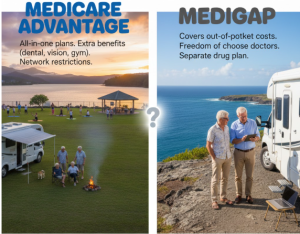
Medicare Advantage vs. Medigap for Full-Time RV Retirees Which One Actually Works on the Road
If you’re retired and living full-time in an RV or van, choosing between Medicare Advantage and Medigap isn’t just a financial decision — it’s a lifestyle decision. The wrong plan can leave you scrambling for covered care in the middle of Utah, or paying unexpected out-of-network bills in a small Montana town.
This guide gives you a straight answer on which plan type actually works for nomadic retirees — and how to choose the right one for your situation on the road.
| ⚡ QUICK ANSWER |
| For most full-time RV travelers, Original Medicare + Medigap offers the broadest nationwide coverage with the fewest surprises. Medicare Advantage PPO plans can work — but only if chosen carefully. Here’s exactly how to decide. |
Why This Decision Hits Different When You Live on the Road
Most Medicare guidance is written for people who stay in one place — one city, one set of doctors, one hospital system. When you’re a full-time RV traveler, that model breaks down fast. You need healthcare that works in every state you pass through, every urgent care you might walk into on a Tuesday in a town you’ve never heard of.
The two main paths after enrolling in Original Medicare (Parts A & B) are:
- Medicare Advantage (Part C) — a private plan that replaces Original Medicare
- Medigap (Medicare Supplement) — a policy that works alongside Original Medicare to cover the gaps
| 🚐 RV Traveler Reality CheckA Medicare Advantage HMO based in Florida will not cover your routine care when you’re parked in Oregon for the summer. You’d be paying out-of-pocket — or driving back. |
Medicare Advantage: What RV Travelers Need to Know
Medicare Advantage plans are offered by private insurers and must cover at least the same services as Original Medicare. Many add dental, vision, and fitness benefits. But the catch for nomadic retirees: most are built around local networks.
- HMO plans — Locked to in-network providers. Out-of-network is emergencies only. Risky for full-time travelers.
- PPO plans — Allow out-of-network care at a higher cost. Some have national networks that work better on the road.
Medigap: Why Most Full-Time Nomads Prefer It
Medigap works alongside Original Medicare to cover copays, coinsurance, and deductibles. The single biggest advantage for RV travelers: Medigap is accepted anywhere Medicare is accepted — nearly every hospital and provider across the entire country.
- Plan G — Covers almost everything except the Part B deductible. Most popular among new enrollees.
- Plan N — Lower premium with small copays. Good middle ground for healthy travelers.
- Plan F — Most comprehensive, but only for those eligible before January 1, 2020.
What You’ll Actually Pay Per Month
| Plan Type | Typical Monthly Premium | What’s Included | Out-of-Pocket Risk on the Road |
|---|---|---|---|
| Medicare Advantage PPO | $0–$50/month | Part D drugs + often dental & vision | Medium–High. Copays and out-of-network charges can surprise you |
| Original Medicare Part B | ~$185/month | Doctor and outpatient care | High without supplement — 20% coinsurance with no cap |
| Medigap Plan G | $100–$200/month | Covers most gaps in Original Medicare | Very Low. Predictable costs almost anywhere in the country |
| Medigap Plan N | $80–$160/month | Covers most gaps with small copays | Low. Small copays at visits but widely accepted nationwide |
| Part D (Rx) — standalone | $20–$60/month | Prescription drug coverage | Low if plan covers your medications. Use national chains to refill anywhere. |
Full Side-by-Side Comparison for RV Retirees
| Factor | Medicare Advantage PPO | Original Medicare + Medigap |
|---|---|---|
| Nationwide Coverage | Varies — depends on plan network. Out-of-area care costs more. | ✅ Accepted almost everywhere Medicare is accepted |
| Monthly Premium | Often $0–$50. Lower upfront cost. | $285+ combined (Part B + Medigap). Higher monthly, fewer surprises. |
| Out-of-Pocket Costs | Copays + coinsurance + annual max. Can add up unexpectedly on the road. | Very predictable. Most care is largely covered wherever you park. |
| Prescription Drugs | Usually built-in (Part D included). Convenient but limited to plan formulary. | Separate Part D plan required. Adds a step but gives more flexibility. |
| Dental & Vision | Basic coverage often included. A genuine extra benefit. | Not included — purchase separately. Budget extra for this. |
| Specialist Access | May need referral or network approval. Check before appointments. | ✅ Any Medicare provider, no referral needed, no network to check. |
| Telehealth | Often expanded beyond standard Medicare coverage. | Covered at standard Medicare rates. Usually sufficient for road use. |
| Plan Flexibility | Moderate. Tied to service area and network. | ✅ High. Follows you to any state, any Medicare provider. |
| Best For | Travelers with a strong home base who travel seasonally. | Full-time nomads traveling multiple states year-round. |
Which Plan Is Right for You?
| ✅ Choose Original Medicare + Medigap if… | ⚠️ Consider Medicare Advantage PPO if… |
|---|---|
| You travel full-time across multiple states | You have a strong home base (4–6+ months/year) |
| You have no consistent home base | You are relatively healthy with few specialist needs |
| You have chronic conditions or regular specialist needs | You want dental and vision included in one plan |
| You want maximum cost predictability on the road | You’ve verified the plan has a truly national PPO network |
| You’d rather pay more monthly than risk big unexpected bills | You can absorb potential out-of-network costs when they arise |
| 💬 Pro TipTalk to an independent Medicare insurance broker — not someone who only sells one company’s products. They compare plans across your domicile state and travel patterns at no cost to you. |
Planning Your Route Around Healthcare Access
One underrated strategy for nomadic retirees is building healthcare checkpoints into your travel calendar — identifying cities where you’ll access care and making those stops natural, not emergency detours. Tools like RV LIFE Trip Wizard make it easy to plan routes and build in stops near towns with hospitals and medical facilities.
Affiliate disclosure: As an RV LIFE affiliate, I earn a small commission from qualifying purchases at no extra cost to you.
Frequently Asked Questions
| Question | Answer |
|---|---|
| Can I switch from Advantage to Medigap later? | Yes, but insurers can ask health questions and deny coverage outside your initial enrollment window. Many nomads start with Medigap to lock in coverage while healthy. |
| What if I need a specialist in a new state? | With Medigap, any Medicare-accepting specialist takes your coverage — no referrals. With Advantage, confirm in-network status first or expect higher costs. |
| Does my domicile state affect my options? | Yes. It determines plan availability and Medigap premiums. South Dakota, Texas, and Florida are most popular among full-time RV travelers. |
| Are emergencies covered in all states? | Yes — both plans cover emergency care nationwide. Where they differ is in follow-up costs and out-of-network billing afterward. |
| What about dental and vision on the road? | Original Medicare and Medigap don’t cover routine dental or vision. Advantage often includes basic coverage here. Medigap users should budget separately. |
The Bottom Line
For most full-time RV retirees traveling broadly across multiple states, Original Medicare paired with Medigap Plan G or N offers the most freedom, least friction, and most predictable cost structure. Medicare Advantage can work but demands more due diligence — especially around network breadth.
Getting this right gives you the confidence to park wherever the road takes you — without wondering whether your coverage came along for the ride.
| ☕ Did this save you hours of Medicare research? |
| This site runs on coffee and a love of the open road. If this guide helped you make a clearer decision, a coffee keeps articles like this coming. |

As an affiliate, I earn from qualifying purchases at no extra cost to you.
As an affiliate, I earn from qualifying purchases at no extra cost to you.