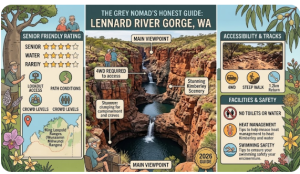
Lennard River Gorge, Kimberley WA: What Grey Nomads Should Know Before Driving the Gibb River Road
Written for Australian senior travellers aged 60–80 on the Gibb River Road — the complete practical guide that tells you whether you can actually do this, where to stay, what the crocodile situation really is, and where the nearest hospital is before you drive eight kilometres down a 4WD-only track in remote Kimberley country.
📋 Table of Contents
- The Gibb River Road and Why Grey Nomads Drive to Lennard River Gorge
- The Honest Senior Assessment — Can You Actually Reach the Viewpoint?
- Your Two Options: Visit the Gorge vs Scenic Flight Alternative
- Lennard River Gorge: What You Are Actually Visiting
- The Viewing Platform Experience: What You See When You Arrive
- What the Tourism Websites Don’t Tell You About Lennard River Gorge
- Van Life Savings Spots: Where to Base Camp Near Lennard River Gorge
- Dulundi (Silent Grove) Campground: The Best Senior Base Camp
- Full Facilities Comparison: Silent Grove vs Windjana Gorge vs Mount Hart
- What Everything Costs
- The Gibb River Road Senior Day Plan from Silent Grove
- Senior Checklist: Lennard River Gorge and the Gibb River Road
- Other Attractions Near Lennard River Gorge for Senior Grey Nomads
- GPS Coordinates and Postcodes: Save Every Stop
- Frequently Asked Questions — Lennard River Gorge for Grey Nomads
- Quick-Reference Card — Lennard River Gorge
1. The Gibb River Road and Why Grey Nomads Drive to Lennard River Gorge
The Gibb River Road is the road every grey nomad in Australia eventually drives. Six hundred and seventy kilometres of corrugated, spectacular, humbling Kimberley outback running from Derby in the west to the junction of the Great Northern Highway near Wyndham and Kununurra in the east — through ancient sandstone ranges, cattle stations the size of small countries, waterfall gorges that look like nothing else on Earth, and more stars at night than you thought existed. It is the trip that people come back from changed. It is genuinely one of the great journeys available to a human being in the twenty-first century.
Lennard River Gorge is one of the least-visited gorges on the entire Gibb River Road. While Bell Gorge draws the crowds — tour buses, day-trippers from Broome, social media posts — Lennard sits 8 kilometres down a rough 4WD-only access track off the Gibb River Road, approximately 190 kilometres from Derby, visited by a fraction of the people who pass the turnoff sign. Those who make the effort describe it as one of the most dramatic gorge experiences in the Kimberley: a narrow, deep chasm carved by the Lennard River through the 560-million-year-old Wunaamin Miliwundi Ranges, with a spectacular multi-strand waterfall that plunges into a pool far below and walls that tower up around you so completely that the sky above becomes a thin strip of blue.
It is also honest about what it asks of you. This is not a paved boardwalk attraction. Reaching the viewing platform involves a 3km return walk — along a creek through pandanus palms and freshwater mangroves, across rocks in the creek bed, and then steeply up a sandstone escarpment — in Kimberley heat, with no water on-site, no rescue services on call, and the nearest hospital three hours back down the Gibb River Road. This guide is the one that tells you the full truth about that, and then helps you decide whether to go — and exactly how to do it safely if you do. For the big picture on driving the Kimberley, see our guide to grey nomad routes around Australia.
2. The Honest Senior Assessment — Can You Actually Reach the Viewpoint?
Every other Lennard River Gorge article online gives you a glossy description of what the gorge looks like. This one starts with the question that matters most to a senior grey nomad: can you physically reach the viewing platform, and is it safe to try?
The honest answer is: it depends, and nobody should attempt it without reading what follows. This is not a question of fitness versus laziness. It is a question of genuine risk management in genuine remote country.
- The 8km access track is genuinely rough 4WD country. The access road off the Gibb River Road into Lennard River Gorge is 8 kilometres of rough corrugated gravel that takes a minimum of 30 minutes to negotiate one way — more after rain. This is not a “high clearance 2WD” track. This is real 4WD terrain. If you are driving a standard caravan and tow vehicle combination, you leave the van at your base camp (Silent Grove or Windjana Gorge) and take only your unladen 4WD tow vehicle in. If you are in a motorhome, do not attempt this road unless your vehicle is a genuine 4WD with high clearance. The track has deteriorated significantly from what it was ten years ago — sources confirm that the final section before the carpark was once accessible but is now only passable on foot.
- The walk involves a steep rocky ascent — walking poles are not optional. The 3km return walk from the carpark begins gently enough, following a creek line through pandanus palms and freshwater mangrove in a genuinely beautiful, shaded corridor. The trail then cuts away from the creek and tracks steeply up over the winamu (sandstone) range. This section involves uneven rocky surfaces, loose stones, and significant gradient. For seniors with arthritic knees, hip replacements, or any issue with balance on uneven terrain, this section requires serious consideration. Walking poles are highly recommended — two poles, not one. Non-slip footwear with ankle support is essential.
- There is no water on-site — and the Kimberley heat is extreme. Lennard River Gorge has toilets at the day-use area but no drinking water. The Kimberley dry season brings daily temperatures of 28–38°C with intense UV radiation. The sandstone ascent section has no shade. Carry a minimum of 2 litres of water per person for the walk — more in the heat of the day. Never begin the walk after 11am in the dry season unless you have arrived very early and conditions are cooler than average.
- There is no phone signal and no rescue on-site. Mobile coverage in the Gibb River Road corridor is effectively nil. A registered PLB (Personal Locator Beacon) is not a suggested option — it is the single piece of equipment that separates a bad situation from a fatal one in remote Kimberley country. If a senior falls on the sandstone section or suffers a medical episode at the gorge, the nearest assistance is the rangers at Silent Grove Campground, who are not on-call at the gorge itself. The nearest hospital is Derby Health Service, approximately 190km back along the Gibb River Road — a minimum of 3 hours’ drive on rough corrugated roads.
- The trail can be overgrown in speargrass and you can get off-route. The path tracks through sections of mangulu (speargrass) that can obscure the trail and make navigation confusing, particularly on the lower creek section. Do not bring your dog — 1080 baiting is active in the surrounding Kimberley landscape and dogs are banned from all national parks and conservation areas in this region. Tell someone at your base camp where you are going and when you expect to be back before you leave.
3. Your Two Options: Visit the Gorge vs Scenic Flight Alternative
| Factor | Drive In and Walk to Viewpoint | Scenic Flight from Derby or Broome |
|---|---|---|
| Vehicle required | ✅ Genuine 4WD with high clearance — essential | ✅ Any vehicle — fly from Derby or Broome airport |
| Physical demand | ⚠️ Moderate to high — steep rocky ascent, 3km return, no shade on top | ✅ Seated — suitable for all mobility levels |
| Gorge perspective | ✅ Standing on the edge — visceral, immediate, extraordinary | ✅ Aerial view of the full gorge system — different but spectacular |
| Crocodile risk | ⚠️ Freshwater crocs present in the creek section. No swimming — viewing only. | ✅ No ground-level crocodile contact |
| Cost | ✅ Free entry to Miluwindi Conservation Park. Fuel costs only. | ⚠️ $300–$600+ per person depending on tour length and operator |
| Access track | ⚠️ 8km rough 4WD only — 30+ minutes each way minimum | ✅ No Gibb River Road access needed at all |
| Wet season access | ❌ Road closed November to April — impassable | ✅ Wet season flights available — waterfall at maximum volume |
| Emergency proximity | ⚠️ No phone signal. PLB required. 190km to Derby Hospital. | ✅ Returns to Derby or Broome with full medical infrastructure |
| Dogs | ❌ Dogs banned — conservation park. 1080 baiting in area. | ❌ Dogs cannot board aircraft |
| Senior recommendation | ✅ For fit, mobile seniors who meet the conditions in Section 2 | ✅ For seniors with limited mobility or who arrive in wet season |
4. Lennard River Gorge: What You Are Actually Visiting
Lennard River Gorge sits within Miluwindi Conservation Park in WA’s Kimberley — the country of the Bunuba people, whose connection to this land through law and culture stretches back through Ngarranggani (creation time). The park was formerly the King Leopold Ranges Conservation Park, renamed in 2020 to acknowledge its Aboriginal heritage. The ranges themselves are now known as the Wunaamin Miliwundi Ranges — combining the Wilinggin word ‘Wunaamin’ and the Bunuba word ‘Miliwundi’ — a name that specifically honours both groups of traditional owners whose country the ranges span.
The Lennard River itself is 180 kilometres long. Named by explorer Alexander Forrest in 1879, it rises below the Wunaamin Miliwundi Ranges and flows westward through the Lennard River Gorge and Windjana Gorge before merging with the Meda River. The gorge is formed where the river slices through the ancient sandstone of the ranges — creating a narrow, deeply incised chasm with walls that rise dramatically above the water and create the acoustic and visual drama that visitors describe as overwhelming. Three separate waterfall streams fall from the gorge rim into the pool below, particularly early in the dry season when water levels are still high after the wet.
The conservation park is free to enter. There are toilets at the day-use area near the carpark. There is no camping, no power, no water, and no accommodation of any kind at the gorge itself. The park is open to the public from approximately the end of April until late November — access roads are impassable during the wet season and DBCA closes the park formally. Visiting outside the sanctioned season is not possible and not safe.
Conservation Park: Miluwindi Conservation Park (formerly King Leopold Ranges Conservation Park)
Address: Lennard River Gorge, Gibb River Road, King Leopold Ranges WA 6728
Access turnoff GPS: -17.0792, 125.1843 — this is the Gibb River Road turnoff to the 8km access track. Save to your navigation app before you leave the Gibb River Road — phone signal is nil in this area.
Carpark / Day-Use Area GPS: -17.1795, 125.1943 — approximately 8km down the access track from the Gibb River Road turnoff. Verify these coordinates on a current Hema map before departure.
Entry: Free — Miluwindi Conservation Park has no entry fee
Facilities: Toilets at day-use area. No water. No power. No camping. No shade structure.
Season: Open approximately end of April to late November. Exact dates vary by year — check at alerts.dbca.wa.gov.au before departure.
Derby Visitor Centre (nearest info point): 2 Clarendon Street, Derby WA 6728. Ph: 08 9191 0353. Visit before heading out on the Gibb River Road to confirm current road and park conditions.
The best time to visit Lennard River Gorge for the waterfall at maximum volume is early dry season — May and June — when water levels in the Lennard River are still elevated from the wet season and the falls are flowing strongly. By late August and September, water levels drop and the falls may reduce to a trickle or stop entirely. If the waterfall is your primary reason for the drive, time your visit as early in the dry season as road conditions permit. For the broader journey, see our full guide to living in retirement on the road through remote Australia.
5. The Viewing Platform Experience: What You See When You Arrive
The walk from the carpark follows the Lennard River creek line through a riparian corridor that is genuinely beautiful — one of the most striking landscapes on the entire Gibb River Road. The creek is hedged with native grasses and dominated by thickets of yarrara (pandanus palm), their rust-coloured roots arching into the water. Continuing along the bank, light filters through the malaa (freshwater mangrove) and biriwiri (bendee) trees. The sound of birds foraging in the reeds and the clarity of the water make this section alone worth the 30-minute walk on a cool early morning.
After crossing the creek — which involves rock hopping at low water, or wading boot-deep at higher levels early in the season — the path cuts steeply up over the winamu (sandstone) range. The gradient here is significant and the surface is rocky and loose in sections. Walking poles earn their keep on this ascent. The upside is immediate once you crest the ridge: you are suddenly standing in a different world — open sandstone country, bunches of speargrass, extraordinary geological formations — and the noise of the gorge below begins.
The viewing platform at the gorge rim is the destination. And the description that people who have stood there give consistently is a variation of: “I was not prepared for how deep it goes.” The Lennard River has carved a narrow, dramatically deep chasm into the sandstone — the walls are close together and very tall, creating an almost enclosed space below you while you stand on the open rim above. When the waterfall is running, three separate streams of white water fall from the gorge walls into the dark pool at the bottom, the sound reverberating up from below. Birds — including large raptors — can be seen soaring up out of the gorge on thermal currents, rising from far below to eye level and then above in a matter of seconds.
No swimming is permitted at Lennard River Gorge. DBCA’s official guidance is explicit: no swimming, no wading below the gorge. The creek crossing at the start of the walk is the only water contact permitted, and that should be treated with crocodile caution (see Section 6). The gorge pool itself is inaccessible by design — the viewing platform is a lookout, not a swimming access point.
6. What the Tourism Websites Don’t Tell You About Lennard River Gorge
The WA Tourism website gives you beautiful language and no practical information. Here is what you actually need to know before you drive 8 kilometres down a rough track in remote Kimberley country.
1. The road into the gorge has changed significantly from older accounts online. Many blogs and articles about Lennard River Gorge were written 5–10 years ago when the access track was in better condition and vehicles could drive closer to the gorge rim. The current situation, confirmed by DBCA and recent travellers, is that the final section before the carpark has deteriorated substantially — what is now described is an 8km rough access track to a carpark, from which you walk 3km return to the viewing platform. If your information source is older than 2022, treat it with caution and verify current conditions at the Derby Visitor Centre before departure.
2. Crocodile species present — and the distinction matters enormously. DBCA confirms that freshwater crocodiles inhabit waterways in the Wunaamin Miliwundi Ranges, including the Lennard River creek system. Freshwater crocodiles are smaller than saltwater crocodiles and are not typically considered dangerous predators of humans in normal circumstances — but they will bite defensively if approached or cornered. Do not attempt to interact with, approach, or photograph crocodiles at close range. DBCA also notes that saltwater crocodiles are not known to occur in this area but acknowledges that increasing crocodile populations and wet season flood events may enable movement of saltwater crocodiles into new waterways. The official guidance — and the correct one — is: if you see a crocodile of any species, stay well clear, do not approach the water at that point, and report sightings to the nearest Parks and Wildlife office.
3. The gorge is dangerous if you leave the designated path. The viewing platform is the safe endpoint. Multiple sources describe the gorge as hazardous to anyone who attempts to climb below the rim, scramble down to the pool, or explore beyond the designated path. Do not do any of these things. The rock surfaces are loose and the drops are serious. Emergency rescue from inside Lennard River Gorge requires RFDS aerial evacuation — which must be initiated by your registered PLB. There is no other emergency option.
4. No camping at the gorge — and “getting away with it” is not a safe option. Some older blogs mention that bush camping at Lennard River Gorge is “not officially permitted but you can get away with it.” This information is outdated, irresponsible, and actively dangerous for senior travellers. There is no water on-site, no phone signal, no ranger presence at the gorge overnight, no toilet facility for overnight use, and crocodiles in the creek. The correct camping bases for visiting Lennard River Gorge are Silent Grove Campground (see Section 8) or Windjana Gorge National Park campground — both are detailed fully below.
5. No dogs — anywhere in the conservation park. Miluwindi Conservation Park, all DBCA-managed lands along the Gibb River Road, and all national parks in the Kimberley ban dogs entirely. This is not just about wildlife protection — 1080 poison baiting for feral predators is active throughout the Kimberley and is lethal to domestic dogs. Do not bring your dog on any Gibb River Road gorge day trip. Leave your dog at your base camp — Silent Grove rangers can advise on safe temporary arrangements — or do not bring dogs on the Gibb River Road at all. The risk is genuinely fatal.
7. Van Life Savings Spots: Where to Base Camp Near Lennard River Gorge
There is no camping at Lennard River Gorge itself. The three practical base camps for senior grey nomads visiting the gorge are detailed below. Save all of these to your van life savings spots app and download all offline maps before leaving Derby — there is essentially no phone coverage on the Gibb River Road or at any of these campgrounds.
| Base Camp | Distance to Lennard Gorge | Address + GPS | Senior Verdict |
|---|---|---|---|
| Dulundi (Silent Grove) Campground ← Senior Recommended | ~24km to Lennard Gorge Gibb Rd turnoff. ~1hr total to gorge carpark. | Wunaamin Conservation Park, Bell Gorge Road, via Gibb River Road WA 6728. GPS: -17.0722, 125.2536 | Best senior base camp in the area. Solar hot showers, flush toilets, fire pits, ranger on-site. No power. No dogs. No drinking water (bring all your own). 4WD access only. Pre-book at exploreparks.dbca.wa.gov.au. Rates: $20 adult/night ($15 concession). Closest managed camp to Lennard River Gorge. Also the base for Bell Gorge visits — two gorges from one camp. |
| Bandilngan (Windjana Gorge) NP Campsite | ~65km to Lennard Gorge turnoff from Windjana. ~2hrs to gorge carpark. | Windjana Gorge National Park, Gibb River Road WA 6728. GPS: -17.4244, 124.9458 | Good senior camp. Flush toilets, hot showers, water on-site. No power. No dogs. Access road more manageable than Silent Grove. Also the base for Windjana Gorge (freshwater crocs in pools — viewing walk highly accessible) and Tunnel Creek. Better facilities than Silent Grove but further from Lennard and Bell Gorges. Pre-book via exploreparks.dbca.wa.gov.au. |
| Mount Hart Wilderness Lodge | ~70km to Lennard Gorge from Mount Hart. Remote. | Mount Hart Station, Gibb River Road WA 6728. GPS: -16.8095, 124.9189. Ph: 08 9191 1838 | Premium option — private station with powered sites, homestead accommodation, meals available. The only powered camp option within the Wunaamin Miliwundi Ranges area. Much more expensive but appropriate for seniors needing power for CPAP or who want a guided gorge experience. Book directly: mounthart.com.au |
8. Dulundi (Silent Grove) Campground: The Best Senior Base Camp
Dulundi (Silent Grove) Campground is the official DBCA campground in Wunaamin Conservation Park, situated approximately 19–30 kilometres from the Gibb River Road along Bell Gorge Road. It is the closest managed campground to both Lennard River Gorge and Bell Gorge, making it the natural multi-night base for senior grey nomads who want to visit both gorges without moving their camp. The campground reviews are genuinely positive for a bush camp of this type — rangers are helpful and safety-conscious, the solar-powered hot showers are well-maintained, and the flush toilets put it well above the standard of a basic DBCA bush camp.
From Silent Grove, Lennard River Gorge is approximately 24km back east along Bell Gorge Road to the Gibb River Road, then the 8km access track south into the gorge — allow around one hour for the drive. Dalmanyi (Bell Gorge) is approximately 11km west of Silent Grove — allow 20 minutes for the drive and then the Bell Gorge walk (which is shorter and more accessible than Lennard — see Section 13 for the Bell Gorge senior assessment). Two of the most spectacular gorges in the Kimberley from one base camp, with hot showers and fire pits in between.
The critical constraints for senior travellers at Silent Grove are important to understand before booking:
No drinking water is provided. The campground facilities include toilets and showers but you must bring all drinking water from Derby. A senior grey nomad spending 3–4 nights at Silent Grove should bring a minimum of 12 litres of drinking water per person — more in hot conditions. Fill your tanks and every container before leaving Derby.
No powered sites — CPAP users need a battery solution. Silent Grove has no mains power. If you use a CPAP machine, you must have a sufficiently large lithium battery backup to cover all nights at the campground. Given the heat and humidity of the early Kimberley dry season, your battery’s stated capacity may not reflect its real-world performance in high ambient temperatures. Test your battery’s actual runtime before the trip, not after you are 200km from the nearest power source.
Access road is 4WD only — off-road caravan required. The Bell Gorge Road from the Gibb River Road to Silent Grove is corrugated and suitable only for 4WD vehicles. Standard on-road caravans are specifically not recommended for this road — only off-road caravans or trailers with appropriate suspension should be towed to Silent Grove. If you have a standard on-road van, leave it at a safe camp at Derby or Windjana Gorge and take only your 4WD tow vehicle in.
9. Full Facilities Comparison: Silent Grove vs Windjana Gorge vs Mount Hart
| Facility | Dulundi (Silent Grove) | Bandilngan (Windjana Gorge) | Mount Hart Wilderness Lodge |
|---|---|---|---|
| 240V mains power | ❌ No — battery/solar only | ❌ No — battery/solar only | ✅ Yes — powered sites available |
| Hot showers | ✅ Solar hot water — well-rated | ✅ Yes | ✅ Yes — full facilities |
| Flush toilets | ✅ Yes | ✅ Yes | ✅ Yes |
| Drinking water on-site | ❌ None — bring all water from Derby | ✅ Yes — water available | ✅ Yes |
| Fire pits | ✅ Yes — fire rings (seasonal restrictions) | ✅ Yes — fire rings | ✅ Yes |
| Generator use | ⚠️ 7am–8pm at designated sites only | ⚠️ Restricted hours — confirm when booking | ✅ Less restrictive — confirm when booking |
| Pets | ❌ Banned — conservation park / 1080 baiting | ❌ Banned — national park | ❌ Banned — verify when booking |
| Ranger on-site | ✅ Rangers on-site mid-April to mid-October | ✅ Rangers on-site | ✅ Station staff on-site year-round |
| Meals / food available on-site | ❌ Self-catering only. Bring all food from Derby. | ❌ Self-catering only | ✅ Meals and homestead dining available |
| 4WD access required | ✅ Yes — 4WD essential | ⚠️ 4WD recommended, some sections manageable in high-clearance 2WD | ✅ Yes — 4WD essential for full access |
| Off-road caravan access | ⚠️ Off-road campers and trailers only. Standard on-road caravans: not recommended. | ⚠️ Off-road trailers only | ✅ Better access road — call ahead with rig details |
| Distance to Lennard River Gorge | ✅ ~1 hour — closest managed camp | ⚠️ ~2 hours | ⚠️ ~1.5 hours (different direction) |
| Phone / satellite coverage | ❌ None. PLB and satellite communicator essential. | ❌ None at campground | ⚠️ Station satellite phone — no personal mobile coverage |
| Medical proximity | ⚠️ Derby Hospital ~240km. RFDS aerial evacuation for emergencies. | ⚠️ Derby Hospital ~145km. Closer but still remote. | ⚠️ Deep ranges — RFDS evacuation for emergencies. |
| Senior overall rating | ✅ ★★★★ Best base for Lennard + Bell Gorges | ✅ ★★★★ Good — better facilities, more accessible | ✅ ★★★★ Best for CPAP users and comfort seekers |
10. What Everything Costs
Fees are indicative based on current DBCA published rates and subject to change. Always verify at exploreparks.dbca.wa.gov.au before booking. Park entry fees and camping fees are separate items.
| Item | Cost | Notes |
|---|---|---|
| Lennard River Gorge day visit | FREE | Entry to Miluwindi Conservation Park is free. No vehicle or person entry fee applies. |
| Dulundi (Silent Grove) Campground — adult per night | $20/adult, $15/concession | Plus vehicle/park entry fee for Wunaamin Conservation Park. Must pre-book at exploreparks.dbca.wa.gov.au. Concession rate applies with eligible card. |
| Wunaamin Conservation Park vehicle entry fee | ~$15–$17 per vehicle | Paid at Silent Grove. WA Parks Pass (annual) offers better value for travellers spending multiple nights in WA national and conservation parks — calculate at exploreparks.dbca.wa.gov.au. |
| Bandilngan (Windjana Gorge) Campsite — adult per night | ~$15–$20/adult | Plus park entry fee. Pre-book online. Includes use of showers, toilets, and water. Fire rings at designated sites. |
| Mount Hart Wilderness Lodge — camping | From ~$45/person/night | Powered sites available. Homestead meals extra. The only powered accommodation option within the ranges. Book at mounthart.com.au or ph 08 9191 1838. |
| Scenic flight over gorge country (Derby) | $300–$600+/person | Contact Derby Visitor Centre on 08 9191 0353 for current operators. Wet season flights (Nov–Apr) often offer the most dramatic waterfall views. Excellent alternative for seniors with mobility limitations. |
| Derby to Silent Grove fuel estimate (one way) | ~$40–$60 in a typical 4WD | Based on current fuel prices and approximately 250km from Derby to Silent Grove return. Fill tank in Derby — no fuel between Derby and Imintji Store (~200km along the Gibb). Carry a full jerry can. |
To book Dulundi (Silent Grove) Campground: Visit exploreparks.dbca.wa.gov.au and book up to 180 days ahead. Peak season (June–August) fills weeks in advance — set a calendar reminder when you start planning your Gibb River Road trip and book the day bookings open.
11. The Gibb River Road Senior Day Plan from Silent Grove
This is the two-day plan for senior grey nomads based at Silent Grove who want to visit both Lennard River Gorge and Bell Gorge on separate days, starting each day by 7am to beat the heat.
Day One — Lennard River Gorge
5:30am — Wake, eat, water up. Prepare 2 litres of water per person for the walk, fill hydration packs or water bottles before leaving camp. Apply SPF 50+ sunscreen, ankle-support footwear, walking poles. Tell the ranger or a neighbouring camper where you are going and your expected return time.
6:00am — Depart Silent Grove for the Gibb River Road. Drive east ~24km on Bell Gorge Road back to the Gibb River Road. This road is corrugated — allow 30 minutes minimum.
6:30am — Turn right (east) on Gibb River Road. Drive approximately 12km east to the Lennard River Gorge access track turnoff. The turnoff is on the south side (right) of the Gibb River Road. GPS for the turnoff: –17.0792, 125.1843. There should be a DBCA sign.
7:00am — Turn onto the 8km Lennard River Gorge access track. Drive slowly and deliberately. Low range 4WD recommended. Do not rush this track — tyre damage is common at speed. Allow 30–40 minutes for the 8km. Arrive at the carpark/day-use area GPS: -17.1795, 125.1943.
7:40am — Begin the 3km return walk. Follow the creek south through the pandanus corridor. Scan the creek before crossing. Cross on rocks. Ascend the sandstone range — take your time, stop frequently, use both walking poles on the incline. Reach the viewing platform approximately 45–60 minutes from the carpark. Stand there as long as you want. Return the same way.
10:00am — Begin descent and return to carpark. The descent on the sandstone requires equal care to the ascent — loose rocks are equally dangerous going down as up. Do not rush. Return to carpark by approximately 11:00am.
11:00am — Drive back to Silent Grove. Allow 1 hour for the drive. Arrive by noon. Rest through the hottest part of the day — this is critical. Drink water continuously. Do not attempt any physical activity between noon and 4pm in the Kimberley dry season.
Day Two — Dalmanyi (Bell Gorge)
6:30am — Depart Silent Grove west. Bell Gorge is approximately 11km west of Silent Grove on Bell Gorge Road. Allow 20 minutes for the corrugated drive. GPS for Bell Gorge carpark: -17.0163, 125.2015.
Bell Gorge is the more accessible of the two gorges. The walk is approximately 1–1.5km to the viewing area, the gradient is less severe than Lennard, and there is a swimming area at the top of the falls (subject to crocodile survey clearance — check signage on arrival every time without exception). The gorge itself is a classic Kimberley tiered waterfall with a large pool — one of the most photographed landscapes in WA. Earlier in the dry season, swimming here is a genuinely magnificent experience. Arrive early — by June, tour groups from Derby and Broome arrive from 9am onwards and the atmosphere changes.
12. Senior Checklist: Lennard River Gorge and the Gibb River Road
| Item | Why It Is Non-Negotiable in the Kimberley | ✓ |
|---|---|---|
| Registered PLB — on your person during the walk | There is no phone signal anywhere near Lennard River Gorge. The only way to summon emergency assistance is via a registered PLB activating an RFDS response. Register at beacons.amsa.gov.au. Carry it in a belt pouch or vest pocket — not in a bag. This is the single most important item on this list. | ☐ |
| Satellite communicator (Garmin inReach or similar) | A PLB sends an emergency signal only. A satellite communicator lets you send and receive messages via satellite, track your position, and communicate with emergency services before activating a full RFDS response. For senior grey nomads doing the Gibb River Road, this is the upgrade that experienced remote travellers strongly recommend. | ☐ |
| Travel insurance with RFDS and remote evacuation cover | RFDS aerial evacuation from the Kimberley gorge country costs thousands of dollars without appropriate insurance. Check your travel insurance policy explicitly states remote WA coverage and includes RFDS evacuation. Many standard travel policies do not. Read the policy document — not just the marketing summary. | ☐ |
| Minimum 2 litres of water per person for each walk | There is no water at Lennard River Gorge. The Kimberley dry season brings temperatures of 28–38°C with very high UV. The sandstone section of the walk has no shade. Dehydration in the Kimberley progresses to heat exhaustion within 1–2 hours in seniors without adequate hydration. Carry more water than you think you need. | ☐ |
| Water for Silent Grove — all drinking water from Derby | Silent Grove has no drinking water. A senior couple spending 3 nights needs a minimum of 25 litres of drinking water. Fill every tank and container before leaving Derby. Do not rely on any source between Derby and Imintji Store. | ☐ |
| Fuel full from Derby — carry a full jerry can | There is no fuel between Derby and the Imintji Store approximately 200km east along the Gibb River Road. Fill your tank in Derby. Carry a full 20-litre jerry can. The 8km Lennard Gorge access track and the corrugated roads use significantly more fuel than sealed highway driving — the difference between your expected and actual fuel consumption can be 30–50% greater on corrugated roads. | ☐ |
| Walking poles (two — not one) | The sandstone ascent at Lennard River Gorge has loose rocks and significant gradient. Two walking poles significantly reduce the load on knees and hips on both the ascent and descent, and provide essential fall-prevention on the uneven surface. This is not optional for seniors — do not attempt the walk without poles. | ☐ |
| Non-slip ankle-support footwear | Thongs, sandals, trail runners without ankle support, and flat-soled shoes are all inappropriate for the Lennard River Gorge walk. You need enclosed footwear with genuine ankle support and a rubber sole with grip on wet rock surfaces. A twisted ankle or a fall on the sandstone section in remote country with no phone signal is a serious medical event. | ☐ |
| SPF 50+ sunscreen applied before leaving camp | The Kimberley UV Index reaches 10–13 (Extreme) during the dry season, including the early morning hours. The sandstone ascent section is fully exposed. Wide-brimmed hat plus long sleeves for the exposed section. Reapply on arrival at the carpark before starting the walk. | ☐ |
| Sign-out with ranger or campsite neighbour before walking | Tell the Silent Grove ranger (or your campsite neighbour) where you are going, your vehicle description, how many people, your start time, and your expected return time. This is the lowest-tech but most effective search-and-rescue trigger in remote Australia. A search is initiated much faster when someone knows you were overdue. | ☐ |
| Medication list in waterproof pouch in tow vehicle | In the event of RFDS evacuation, the medication list is the first piece of clinical information the crew needs. Keep a printed copy accessible in your tow vehicle glovebox — not in a bag or van drawer. Include all medications, doses, and any known allergies. | ☐ |
| Hema Kimberley map (paper backup) | Download offline GPS maps before leaving Derby. Additionally, carry a current Hema Kimberley hard-copy map. Electronic devices fail — screens crack, batteries die, displays wash out in direct sunlight. A paper map never runs out of charge and gives you a backup navigation tool and a communication reference when you need to describe your position to emergency services. | ☐ |
13. Other Attractions Near Lennard River Gorge for Senior Grey Nomads
The Gibb River Road corridor around Lennard River Gorge offers several other senior-accessible attractions. For more on planning the full circuit, see van life savings spots for verified GPS stops across the Kimberley.
| Attraction | Address + GPS | Senior Notes |
|---|---|---|
| Dalmanyi (Bell Gorge) | Bell Gorge Road, Wunaamin Conservation Park WA 6728. ~11km west of Silent Grove. GPS: -17.0163, 125.2015 | ~1.5km return walk, less steep than Lennard — more accessible. Swimming at upper pool (check crocodile signage on arrival every time). The most beautiful swimming gorge in the west Kimberley when conditions allow. Depart camp by 6:30am. No dogs. Free entry if paid at Silent Grove. |
| Bandilngan (Windjana Gorge) and Dimalurru (Tunnel Creek) | Windjana Gorge NP, Gibb River Road WA 6728. ~65km west of Silent Grove. GPS: -17.4244, 124.9458 | Windjana Gorge walk is flat and accessible — 7km return along the Lennard River gorge floor with freshwater crocodiles visible in the dry season pools. Best crocodile viewing in the Kimberley for seniors — flat ground, no climbing, extraordinary experience. Tunnel Creek nearby — a 750m walk through a naturally lit limestone cave (torch required, seasonal water crossing, freshwater crocs in the dark water — guided by a torch). Both can be done in one day from Windjana Gorge camp. |
| Galvans Gorge (day stop — accessible) | Gibb River Road, Mt Barnett Station WA 6728. East of Lennard on the Gibb. GPS: -16.7821, 125.8239 | 1km easy walk from roadside carpark. Small waterfall, deep green pool, rock ledges and ferns. Swimming possible (check signage). Most accessible gorge on the entire Gibb River Road. No climbing, flat walk, manageable for almost all senior travellers. Free entry. Small but genuinely beautiful. |
| Derby — Boab Prison Tree, Pier, Mud Flats | Derby WA 6728. ~190km west of Lennard Gorge. GPS: -17.3524, 123.6701 | Derby is the gateway town to the Gibb River Road — stay at least two nights before and after the gorge country. Hospital, pharmacy, supermarket, fuel, laundry. The Derby Wharf jetty at sunset is one of WA’s great views. The Boab Prison Tree is an extraordinary 1,500-year-old hollow boab. Flat ground throughout — fully senior accessible. |
| Imintji Community Store (fuel, supplies — on the Gibb) | Gibb River Road, Imintji WA 6728. ~200km east of Derby on the Gibb. GPS: -17.2185, 125.2285 | The first fuel and basic supplies east of Derby on the Gibb River Road. Call ahead to confirm current opening hours and fuel availability before departure — store hours are variable: 08 9191 1899. Essential refuelling point if heading east from the gorge country. |
14. GPS Coordinates and Postcodes: Save Every Stop
Save all of these coordinates before leaving Derby. You will have no phone signal on the Gibb River Road or at any of these locations. All coordinates should be cross-referenced against a current Hema Kimberley map before departure — the Gibb River Road changes condition seasonally and GPS coordinates for access tracks should be treated as guides rather than precise endpoints. For broader WA route planning, see our guide to free camping in Western Australia.
| Stop | Full Address + Postcode | GPS (copy to app) |
|---|---|---|
| Lennard River Gorge Gibb Rd Turnoff | Gibb River Road, Miluwindi Conservation Park WA 6728 | -17.0792, 125.1843 |
| Lennard River Gorge Carpark / Day-Use Area | Lennard River Gorge, Miluwindi Conservation Park WA 6728 (8km south of Gibb River Road) | -17.1795, 125.1943 |
| Dulundi (Silent Grove) Campground | Wunaamin Conservation Park, Bell Gorge Road, via Gibb River Road WA 6728 | -17.0722, 125.2536 |
| Dalmanyi (Bell Gorge) Carpark | Bell Gorge Road, Wunaamin Conservation Park WA 6728 | -17.0163, 125.2015 |
| Bandilngan (Windjana Gorge) NP Campsite | Windjana Gorge National Park, Gibb River Road WA 6728 | -17.4244, 124.9458 |
| Dimalurru (Tunnel Creek) National Park | Tunnel Creek Road, Kimberley WA 6728 | -17.6111, 125.0906 |
| Galvans Gorge (easy walk — day stop) | Gibb River Road, Mt Barnett Station WA 6728 | -16.7821, 125.8239 |
| Imintji Community Store (fuel, supplies) | Gibb River Road, Imintji WA 6728. Ph: 08 9191 1899 | -17.2185, 125.2285 |
| Derby (gateway town — fuel, water, food, pharmacy) | 2 Clarendon Street, Derby WA 6728. Visitor Centre: 08 9191 0353 | -17.3055, 123.6358 |
| Mount Hart Wilderness Lodge (powered camp) | Mount Hart Station, Gibb River Road WA 6728. Ph: 08 9191 1838 | -16.8095, 124.9189 |
| 🏥 Derby Health Service — EMERGENCY (24hrs) | Clarendon Street, Derby WA 6728. Ph: 08 9193 3333 (24-hour emergency). ~190km west of Lennard Gorge on Gibb River Road. 3+ hours minimum drive on rough roads. | -17.3060, 123.6335 |
| 🏥 Broome Regional Medical Centre (larger facility) | Robinson Street, Broome WA 6725. Ph: 08 9194 3333 (24 hours). ~300km+ from Lennard Gorge. | -17.9621, 122.2415 |
| 🚁 RFDS Western Operations (Broome base) | RFDS Western Operations, Broome Airport, Broome WA 6725. Emergency: Activate PLB first, then call 000 if any signal. RFDS is the emergency response for the remote Kimberley. | -17.9461, 122.2355 |
| 🚨 Emergency (ambulance, fire, police) | Call 000. In the absence of phone signal, activate registered PLB. Healthdirect nurse line (free, 24hrs): 1800 022 222 — requires phone signal. Derby Police: 08 9193 0555 | PLB activation is the primary remote emergency tool |
15. Frequently Asked Questions — Lennard River Gorge for Grey Nomads
Can I drive my caravan to Lennard River Gorge?
No — not directly. The 8km access road to the Lennard River Gorge carpark is strictly 4WD only and is rough corrugated gravel. You cannot and should not tow a caravan down this track. The correct approach is to leave your caravan at your base camp — Silent Grove Campground (off-road caravans only on the Bell Gorge Road access track) or Windjana Gorge National Park campsite — and drive to Lennard River Gorge in your unladen 4WD tow vehicle only. If you are in a 4WD motorhome with high clearance, the access track may be manageable — but assess the track conditions carefully on arrival and do not commit to the full 8km if you have any doubt about your vehicle’s capability.
Is there swimming at Lennard River Gorge?
No. DBCA’s official guidance for Lennard River Gorge states explicitly: no swimming. The gorge pool at the base of the waterfall is inaccessible from the viewing platform, and the creek crossing near the start of the walk should be treated as a crocodile zone — cross quickly on rocks and do not linger at the water’s edge. Freshwater crocodiles are confirmed as present in the Lennard River system. For swimming in the gorge country area, the upper pool at Bell Gorge (subject to daily crocodile safety clearance — check signage every visit) and Galvans Gorge pool are the recommended options.
When is the best time of year to visit Lennard River Gorge?
May and June — early dry season — are the best months for senior grey nomads visiting Lennard River Gorge. The waterfall is at maximum volume from wet season water still in the river system, temperatures are warm but not extreme (typically 25–32°C), and the access track is usually open after the wet season closure. By July and August, the waterfall often reduces significantly as the river drops. By September and October, some years see the falls effectively dry. If the waterfall is your primary reason for the trip, go as early in the dry season as road conditions permit. The park is closed from approximately November to late April — check current status at alerts.dbca.wa.gov.au before departure.
How difficult is the walk to the viewing platform for seniors?
The walk is moderate to challenging for senior travellers. The total distance is 3km return from the carpark. The first section along the creek is relatively gentle and shaded — but involves rock hopping across the creek that requires balance and stability. The second section involves a steep ascent up the sandstone range with loose rock surfaces, significant gradient, and no shade. Walking poles (two) and ankle-support footwear are essential. The walk should only be attempted by seniors who are regularly walking 5+ kilometres on varied terrain, have no significant knee or hip issues, and can start the walk before 8am to avoid peak heat. Full assessment criteria are in Section 2 of this guide.
Are there crocodiles at Lennard River Gorge?
Yes. DBCA confirms that freshwater crocodiles inhabit the Lennard River waterways within the Wunaamin Miliwundi Ranges, including the creek system at Lennard River Gorge. Freshwater crocodiles are generally smaller and less dangerous than saltwater crocodiles, but they will bite defensively. No swimming is permitted at the gorge. At the creek crossing during the walk, scan the water visually for 60 seconds before crossing, cross quickly on rocks, and do not linger at the water’s edge. DBCA also notes that saltwater crocodiles, while not historically found in this area, may be present given increasing populations and wet season flood movement. Treat all water crossings in the Kimberley as potential saltwater crocodile habitat unless specifically confirmed otherwise by a current DBCA ranger assessment.
What is the nearest hospital to Lennard River Gorge?
Derby Health Service at Clarendon Street, Derby WA 6728 — phone 08 9193 3333, GPS: -17.3063, 123.6334 — is the nearest hospital with a 24-hour emergency department. It is approximately 190km west of Lennard River Gorge by road on the Gibb River Road — a minimum of 3 hours’ drive. For any serious medical emergency at the gorge, activate your registered PLB immediately to initiate an RFDS aerial response. Do not attempt to drive a seriously injured person out on the Gibb River Road when aerial evacuation is available. Broome Regional Medical Centre — phone 08 9194 3333 — is a larger facility approximately 300km from the gorge. Both phone numbers and GPS should be written on paper in your vehicle glovebox before departure.
Can I visit Lennard River Gorge if I have limited mobility?
If you cannot walk 3km on rough terrain including a steep rocky ascent, the gorge viewpoint is not safely accessible for you on foot. The alternatives are: (1) a scenic flight over the gorge country from Derby or Broome, which provides a spectacular aerial perspective and is suitable for all mobility levels; (2) driving the 8km access track and spending time at the day-use area with the toilets and immediate surroundings, which gives you a genuine remote Kimberley environment experience even without reaching the viewing platform; or (3) visiting the more accessible alternatives — Galvans Gorge (1km flat walk from the Gibb River Road carpark) or Windjana Gorge (flat 7km return walk along the gorge floor). None of these are consolation prizes — they are extraordinary experiences in their own right.
Is Lennard River Gorge Worth Visiting?
Yes — Lennard River Gorge is worth visiting if you are already travelling the Gibb River Road in the Kimberley. The gorge is famous for its dramatic twin waterfalls and deep sandstone canyon, but it is not an easy roadside stop. Reaching the viewing platform requires a steep and rocky walking track, which can be challenging for some senior travellers. Most grey nomads base themselves at nearby Silent Grove Campground and visit as a day trip.
For many travelers, Lennard River Gorge is one of the most spectacular waterfalls in the Kimberley, but it is best suited to visitors who are comfortable with rough tracks or who are exploring the wider Kimberley region rather than making a dedicated trip.
16. Quick-Reference Card — Lennard River Gorge
| Location | Miluwindi Conservation Park, Gibb River Road, King Leopold Ranges WA 6728 |
| Traditional Owners | Bunuba people of the Miluwindi Conservation Park country |
| Gibb River Road Turnoff GPS | -17.0792, 125.1843 |
| Carpark GPS | -17.1795, 125.1943 (8km from Gibb River Road) |
| Entry Cost | FREE — Miluwindi Conservation Park has no entry fee |
| Season | ~End of April to late November (closed wet season — check alerts.dbca.wa.gov.au) |
| Best Time to Visit | May–June for maximum waterfall volume. September–October: falls may be dry. |
| Access Road | 8km rough 4WD only — 30+ minutes each way. DO NOT tow caravan. |
| Walk | 3km return. Creek crossing + steep sandstone ascent to viewing platform. Moderate-Challenging. |
| Facilities at Gorge | Toilets only. No water. No power. No camping. No shade. |
| Swimming | ❌ NOT PERMITTED — DBCA official. Freshwater crocs present. |
| Pets | ❌ Banned — 1080 baiting active. All Kimberley national and conservation parks. |
| Phone Signal | ❌ None. PLB and satellite communicator essential before departure. |
| Best Senior Base Camp | Dulundi (Silent Grove) — $20 adult/night ($15 concession). Pre-book at exploreparks.dbca.wa.gov.au |
| Powered Option (CPAP) | Mount Hart Wilderness Lodge — ph 08 9191 1838 — only powered option in the ranges |
| Distance from Derby | ~190km east on the Gibb River Road (~3 hours minimum) |
| Nearest 24hr Hospital (Derby) | Derby Health Service — Clarendon Street, Derby WA 6728 — Ph: 08 9193 3333 |
| Nearest Larger Hospital (Broome) | Broome Regional Medical Centre — Robinson Street, Broome WA 6725 — Ph: 08 9194 3333 |
| Remote Emergency Protocol | Activate registered PLB → RFDS aerial evacuation. Call 000 if signal exists. Do not drive a seriously injured person out on the Gibb River Road when RFDS is available. |
| Derby Visitor Centre (pre-departure check) | 2 Clarendon Street, Derby WA 6728 — Ph: 08 9191 0353 — Visit before heading out on the Gibb River Road every time to confirm current road and park conditions. |
Gorge Turnoff GPS: -17.0792, 125.1843 (Gibb River Road) — save before leaving Derby
Carpark GPS: -17.1795, 125.1943 — 8km down 4WD access track
Entry: FREE — Miluwindi Conservation Park
Best base camp: Dulundi (Silent Grove) — book at exploreparks.dbca.wa.gov.au
Powered camp (CPAP): Mount Hart Wilderness Lodge — 08 9191 1838 — mounthart.com.au
Derby Visitor Centre (confirm road conditions before departure): 08 9191 0353
Derby Health Service (24hr emergency — 190km west): 08 9193 3333 — GPS: -17.3063, 123.6334
Broome Regional Medical Centre (24hr emergency — 300km+ west): 08 9194 3333
Emergency: 000 | PLB activation for remote emergencies
→ Save all Kimberley GPS stops to your van life savings spots app before leaving Derby Wi-Fi
Before you head out on the Gibb River Road, review our guide on keeping your rig secure when you leave it at a base camp while day-tripping into the gorge country.
Disclaimer: Lennard River Gorge information was verified to the best of our ability as of March 2026 using DBCA’s Explore Parks WA, WA Country Health Service, and verified travel sources. Road conditions, park access dates, campground fees, and facility availability change without notice — always verify at alerts.dbca.wa.gov.au and with the Derby Visitor Centre before departure. GPS coordinates are provided as guides — cross-reference with a current Hema Kimberley map. Medical and hospital information is based on publicly available WA Country Health Service data — always call 000 and activate your PLB in a remote emergency. This article was written for retiretovanlife.com and is intended for senior travellers. It is not a substitute for professional medical, safety, or emergency management advice. The Bunuba people are recognised as the traditional owners of Miluwindi Conservation Park country. We pay respect to Elders past, present and emerging.
Derby is the essential gateway town for the Gibb River Road — stock up on water, fuel and supplies, get a good night’s rest in town, and debrief after the gorge country. Search current Derby accommodation below.
Accommodation and flight search powered by Expedia. Booking through this search supports this website at no extra cost to you. As an affiliate, I earn from qualifying purchases at no extra cost to you.

As an affiliate, I earn from qualifying purchases at no extra cost to you.
As an affiliate, I earn from qualifying purchases at no extra cost to you.