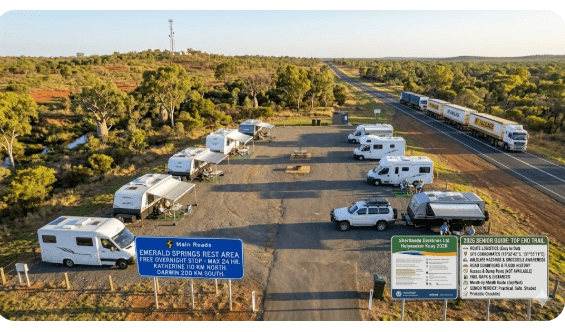
Emerald Springs Rest Area — Free Camping Senior Grey Nomad Guide 2026
Last updated: July 2025 | Region: Stuart Highway, Northern Territory | Status: Free — Open 24/7
If you have been driving the Stuart Highway between Darwin and Katherine and your eyelids are starting to droop, Emerald Springs Rest Area is one of those quiet pull-offs that can save your day — and possibly your life. Sitting roughly 110 kilometres south of Katherine and about 200 kilometres south-east of Darwin, this small but well-positioned rest area gives seniors travelling in caravans, motorhomes, campervans and converted vans a free, no-fuss overnight stop right beside the highway.
For grey nomads heading north towards Katherine and the Kimberley, or south towards Pine Creek, Adelaide River and Darwin, Emerald Springs fills an awkward gap in the fuel-and-rest chain. It is not fancy. There is no powered site, no dump point, no Wi-Fi, and the phone signal ranges from patchy to non-existent depending on your carrier. But it is flat, it is free, it is legal for overnight stays up to 24 hours, and it gives you a shaded place to stop, stretch, brew a cuppa and sleep safely before tackling the next leg.
This guide is written specifically for retired and semi-retired Australians doing the big lap or exploring the Top End in 2026. Every section — from road conditions and flood history to crocodile awareness and the nearest dump point — is designed to answer the questions that matter when you are 60-plus, towing a van, and a long way from the nearest mechanic or hospital.
Table of Contents
- Why Grey Nomads Stop at Emerald Springs Rest Area
- Free Camping — Looks Easy, But Know the Limits for Seniors
- Your Two Main Options Side by Side
- Quick Facts and Key Details 2026
- How to Get to Emerald Springs Rest Area — Directions from Key Locations
- Road Conditions, Flooding and Unsealed Sections
- Heat, Crocodiles and Remoteness — What It Really Means for Seniors
- Wildlife at Emerald Springs — Birds, Reptiles and What to Watch For
- What Emerald Springs Doesn’t Tell You Online
- Best Time to Visit Emerald Springs Rest Area — Month-by-Month Breakdown
- Free and Low-Cost Camping Near Emerald Springs
- Dump Points Near Emerald Springs
- Free Water Sources Near Emerald Springs
- Fuel Stops Along the Stuart Highway Near Emerald Springs
- Nearest Paid Caravan Parks — The Alternative
- Full Facilities Comparison Table
- Rates — All Options Near Emerald Springs 2026
- The Emerald Springs Day Plan for Seniors
- Senior Checklist — Emerald Springs and Stuart Highway
- What to Do Near Emerald Springs — Senior Activity Guide
- GPS Coordinates and Postcodes — Save Every Stop
- Stargazing at Emerald Springs Rest Area
- Phone Signal and Emergency Communications
- Campfires and Cooking at Emerald Springs
- Pets at Emerald Springs Rest Area
- Accessibility for Seniors with Mobility Limitations
- Rest Area Etiquette and Waste Management
- Emergency Scenarios — What to Do
- Packing List for the Stuart Highway
- History of Emerald Springs
- Permits and Park Fees
- Reviews — What Real Grey Nomads Say About Emerald Springs
- Rest Area Comparisons — Emerald Springs vs Nearby Stops
- People Also Ask — Emerald Springs Rest Area
- Frequently Asked Questions
- Quick-Reference Card
- Related Free Camping Guides on the Stuart Highway
- Interactive Map — Find Free Camps and Rest Areas
- Disclaimer
Why Grey Nomads Stop at Emerald Springs Rest Area
The Stuart Highway between Darwin and Katherine is one of Australia’s iconic north-south corridors, but it is also deceptive. The distances between towns look manageable on a map — 300 km from Darwin to Katherine — yet the heat, the road trains, the wildlife, and the sheer monotony of driving through savanna woodland conspire to exhaust older drivers faster than they expect.
Emerald Springs Rest Area sits right in the sweet spot. For seniors driving south from Katherine, it appears roughly an hour into the trip — early enough that you haven’t committed to a full run to Pine Creek or Adelaide River, late enough that you may have already been on the road for several hours if you started from somewhere further north like Timber Creek or Victoria River. For those heading north from Darwin, it’s about two hours down the highway, which is often the point where a retiree towing a van starts to feel the strain.
The reasons grey nomads choose this stop include:
- Fatigue management. The NT Government positions rest areas at intervals specifically to reduce fatigue-related crashes. This is one of them.
- Zero cost. No fees, no bookings, no check-in. Pull in, park, stay up to 24 hours.
- Toilet available. A basic pit toilet means you do not need to be fully self-contained to stop legally.
- Shade. Several bays have tree cover — critical when ambient temperatures regularly exceed 35°C during the dry season and 40°C+ during the build-up.
- Gap filler. The roadhouse that once operated at Emerald Springs has been intermittently closed in recent years. Even when it operates, many travellers prefer the free rest area to paying for a site.
- Quiet overnight. While the highway carries road trains 24/7, the rest area is set back enough from the road that most travellers report acceptable noise levels for sleeping.
Free Camping — Looks Easy, But Know the Limits for Seniors
Free camping at NT rest areas is governed by the Northern Territory Traffic Act and local signage. The general rule is straightforward: you may stop and rest, including overnight, for up to 24 hours. There is no requirement to be self-contained at Emerald Springs because a toilet is provided. However, “free” does not mean “no rules.”
• 24-hour maximum stay — do not overstay or you give councils ammunition to close rest areas to campers.
• No grey water dumping on the ground. Use your grey water tank or carry a portable container.
• No generators after 9 pm. Many rest areas are now adding signage about generator hours. Be considerate.
• Take all rubbish. Bins may be provided but they overflow quickly during peak season.
• Fire restrictions apply year-round in the NT — check before lighting anything.
For seniors who need powered sites, showers, or dump points, Emerald Springs Rest Area is not the answer. It is a transit stop, not a destination camp. Think of it as the free, safe, legal place to break a long drive — not a place to set up for three nights.
Your Two Main Options Side by Side
| Feature | Emerald Springs Rest Area (Free) | Nearest Caravan Park (Paid) |
|---|---|---|
| Cost per night | $0 | $35–$55 (unpowered) / $45–$70 (powered) |
| Toilets | Pit toilet — BYO paper | Flushing toilets |
| Showers | No | Yes — hot water |
| Power | No | Yes — 15A |
| Dump point | No | Yes |
| Water | No potable water | Town water — drinkable |
| Booking | Not required | Recommended in dry season |
| Max stay | 24 hours | No limit (pay per night) |
| Best for | One-night transit stop | Multi-night base with full facilities |
Quick Facts and Key Details 2026
| Detail | Information |
|---|---|
| Rest area name | Emerald Springs Rest Area |
| Location | Stuart Highway, approx. 110 km south of Katherine, NT |
| GPS Coordinates | -14.5622, 132.1647 (approx.) |
| Postcode | 0852 |
| Road type | Sealed — Stuart Highway (National Highway 1) |
| Cost | Free |
| Maximum stay | 24 hours |
| Toilets | Yes — pit toilet |
| Water | No potable water — carry your own |
| Dump point | No — nearest at Pine Creek or Katherine |
| Showers | No |
| Power | No — solar and battery only |
| Phone signal | Telstra — weak/intermittent. Optus/Vodafone — unlikely. |
| Public WiFi | None at rest area. Nearest at Katherine library or Katherine Visitor Centre. |
| Pets allowed | Yes — on leash |
| Fires | Check NT fire bans — generally no open fires at rest areas |
| Suitable for | Caravans, motorhomes, campervans, cars with rooftop tents |
| Managed by | NT Department of Infrastructure, Planning and Logistics |
How to Get to Emerald Springs Rest Area — Directions from Key Locations
From Katherine (Heading South)
Leave Katherine heading south on the Stuart Highway. Continue for approximately 110 km. The rest area is on the western (right-hand) side of the highway. Watch for the standard brown NT rest area sign. There is a deceleration lane — use it, especially if you are towing a caravan and road trains are running behind you.
Drive time: Approximately 1 hour 10 minutes at 110 km/h (caravan speed closer to 1 hour 20 minutes at 100 km/h).
From Darwin (Heading South-East)
Take the Stuart Highway south-east from Darwin through Palmerston, Noonamah, Adelaide River, and Hayes Creek. Continue past Pine Creek. Total distance is approximately 200 km. The rest area appears on the left-hand (eastern) side of the highway if travelling from this direction. Note: depending on exactly which side of the highway the rest area pull-in is located, you may need to watch for the entry carefully.
Drive time: Approximately 2 hours 15 minutes without a caravan; 2 hours 30–45 minutes towing.
From Pine Creek (Heading South)
Pine Creek is approximately 60 km north of Emerald Springs on the Stuart Highway. A straightforward, sealed drive. Pine Creek is a good place to fuel up and fill water before arriving at Emerald Springs.
Drive time: Approximately 35–40 minutes.
From Hayes Creek (Heading North)
Hayes Creek is approximately 60–70 km south of Emerald Springs. If you have stopped at Hayes Creek Rest Area, Emerald Springs is your next natural break heading north.
Drive time: Approximately 40 minutes.
Pre-download offline maps on your phone or tablet before leaving Katherine or Darwin. Google Maps and the Hema Maps app both allow offline area downloads. In this part of the NT, you cannot rely on data connectivity for turn-by-turn navigation.
Road Conditions, Flooding and Unsealed Sections
Stuart Highway Surface
The Stuart Highway is fully sealed and well-maintained between Darwin and Katherine. The section past Emerald Springs is two lanes (one each direction) with occasional overtaking lanes. Road surface quality is generally good, though minor potholes and edge deterioration can appear after the wet season.
Does the Road Flood?
Yes. The Stuart Highway in the Top End is subject to seasonal flooding during the wet season (November to April). Low-lying sections between Adelaide River and Pine Creek — the stretch that includes Emerald Springs — can flood during heavy monsoonal rains or tropical cyclone events. Floodways are marked with depth indicators.
• Never attempt to cross a flooded road. “If it’s flooded, forget it” is not just a slogan in the NT — it’s survival advice.
• The Stuart Highway can be closed for hours or even days during major flood events. Carry at least 3 days of water and food at all times.
• Real-time road conditions: check the NT Government road report website at roadreport.nt.gov.au or call 1800 246 199 before departing.
• During the wet season, most grey nomads avoid this route entirely. The dry season (May to October) is the standard travel window.
Rest Area Access
The pull-in to Emerald Springs Rest Area from the Stuart Highway is sealed. You do not need to drive on any unsealed road to reach the rest area itself. The internal surface is a mix of sealed and compacted gravel — suitable for all caravans and motorhomes in dry conditions.
Road Trains
Triple and quad road trains operate on the Stuart Highway 24 hours a day. When pulling out of Emerald Springs Rest Area back onto the highway, allow a very long gap before merging. Road trains cannot stop quickly and the air blast as they pass at speed can destabilise a caravan. If you are towing, accelerate fully in the deceleration/acceleration lane before merging.
Heat, Crocodiles and Remoteness — What It Really Means for Seniors
Heat
Even in the dry season (the “ideal” travel window), daytime temperatures at Emerald Springs routinely hit 32–36°C. During the build-up (October–November), temperatures push past 40°C with extreme humidity. For seniors — particularly those on blood pressure medication, diuretics or heart medication — this heat is a genuine medical risk.
- Drink at least 3–4 litres of water per person per day.
- Park in shade wherever possible. Arrive early to claim a shaded bay.
- Use reflective windscreen shades, awnings and roof-mounted fans or air conditioning (if you have solar/battery capacity).
- Avoid physical activity between 10 am and 3 pm.
- Know the signs of heat stroke: confusion, cessation of sweating, rapid pulse, nausea.
Crocodiles
Emerald Springs Rest Area is set back from any significant waterway, so the direct risk of crocodile encounter at the rest area itself is low. However, you are in the Top End. Any creek, river, dam, billabong, drainage ditch or even roadside puddle in this region may harbour freshwater crocodiles (Crocodylus johnsonii) or the far more dangerous saltwater crocodile (Crocodylus porosus).
• Do not swim in any body of water unless it is a clearly signed, managed swimming area (and even then, heed all signage).
• Do not approach the water’s edge at creeks or rivers — saltwater crocs are ambush predators that can launch from the water with explosive speed.
• Keep pets away from water.
• If you see a crocodile, do not approach it. Report sightings to NT Parks and Wildlife.
Remoteness
The nearest hospital is in Katherine (approximately 110 km north). The nearest 24-hour emergency department is also Katherine. Ambulance response times in this region can exceed one hour. For seniors with chronic health conditions, this remoteness means:
- Carry a comprehensive first-aid kit including your prescription medications (minimum 2-week supply beyond your expected trip length).
- A satellite communicator (such as a Garmin inReach or SPOT device) is strongly recommended as a backup to mobile phones.
- Know the location of the nearest Royal Flying Doctor Service (RFDS) strip — Katherine has RFDS facilities.
- Travel with another vehicle whenever possible. Solo grey nomads should inform someone of their itinerary daily.
Wildlife at Emerald Springs — Birds, Reptiles and What to Watch For
The savanna woodland around Emerald Springs supports a rich mix of Top End wildlife. For birdwatchers, this section of the Stuart Highway is productive:
- Birds: Red-tailed Black-Cockatoos, Sulphur-crested Cockatoos, Rainbow Bee-eaters, Blue-winged Kookaburras, Brown Falcons, Wedge-tailed Eagles (often seen on roadkill), Brolgas (near wetlands), and various honeyeaters. Dawn and dusk are the best viewing times.
- Reptiles: Frilled-neck Lizards are common on roadsides in the early wet season. Goannas (sand monitors and Mertens’ water monitors) patrol rest areas looking for scraps. Several species of python occur in the area. King Brown (Mulga) snakes and Western Brown snakes are present — watch where you step, particularly at night and around woodpiles or long grass.
- Mammals: Wallabies, wallaroos and dingoes. Wallabies are a significant collision risk at dawn and dusk — avoid driving during these hours if possible.
- Insects: Mosquitoes are present year-round and intense during the wet. Use DEET-based repellent. March flies are aggressive during the build-up. Bring insect repellent and consider fly nets for your awning area.
Set up a camp chair under the awning at dawn with a pair of binoculars and a cup of tea. The bird activity at Top End rest areas during the first hour of light is remarkable. Download the free Merlin Bird ID app (with Australian pack offline) before you leave Katherine — it can identify birds by their calls.
What Emerald Springs Doesn’t Tell You Online
Most free camping apps and directories list Emerald Springs with minimal detail — often just a GPS pin and the word “toilet.” Here is what the listings don’t tell you:
- Bay availability: During peak dry season (June–August), this rest area fills by mid-afternoon. By 4 pm, you may find yourself jockeying for space. If you plan to overnight here, arrive by 2–3 pm.
- Toilet condition: The pit toilet is serviced periodically, but between services it can be in poor condition. BYO toilet paper, hand sanitiser, and a portable toilet as backup. Some travellers report the toilet being locked or out of order at times.
- Noise: Road trains run all night. If you are a light sleeper, park as far from the highway as the rest area allows and use earplugs.
- No rubbish collection guarantee: Bins may be present but may be full. Pack out everything.
- Emerald Springs Roadhouse status: The roadhouse (also known as Emerald Springs Roadhouse or Emerald Springs Resort) has a history of changing ownership and intermittent closures. As of early 2025, confirm its operating status before relying on it for fuel, food or accommodation. Phone ahead if possible, but phone signal may be needed to do so — a catch-22 situation. Check recent WikiCamps or iOverlander reports.
- Water: There is no tap water at the rest area. Fill up in Katherine or Pine Creek.
Best Time to Visit Emerald Springs Rest Area — Month-by-Month Breakdown
| Month | Avg High °C | Wet/Dry | Verdict for Seniors |
|---|---|---|---|
| January | 34 | Wet — heavy rain, flooding | ❌ Avoid — road closures likely |
| February | 34 | Wet — peak rainfall | ❌ Avoid |
| March | 34 | Wet — tail end of monsoon | ❌ Avoid — roads still unreliable |
| April | 34 | Transition — storms easing | ⚠️ Possible — check road reports daily |
| May | 33 | Dry season begins | ✅ Good — warm days, cool nights |
| June | 31 | Dry — best period starts | ✅ Excellent — peak grey nomad season |
| July | 31 | Dry — coolest month | ✅ Excellent — arrive early, rest area fills fast |
| August | 32 | Dry — last reliable month | ✅ Very good — still busy |
| September | 34 | Build-up begins — humidity rising | ⚠️ OK for experienced travellers — very hot |
| October | 36 | Build-up — storms starting | ⚠️ Marginal — extreme heat and humidity |
| November | 36 | Wet season onset | ❌ Avoid — storms, flooding risk |
| December | 35 | Wet — monsoon active | ❌ Avoid |
Free and Low-Cost Camping Near Emerald Springs
If Emerald Springs Rest Area is full when you arrive, or if you want to compare alternatives in the region, here are options along the Stuart Highway corridor:
| Camp / Rest Area | Distance from Emerald Springs | Direction | Cost | Toilets |
|---|---|---|---|---|
| Hayes Creek Rest Area | ~60–70 km | South | Free | Yes |
| Pine Creek Rest Area | ~60 km | North | Free | Yes |
| King River Rest Area | ~80 km | North (near Katherine) | Free | Yes |
| Adelaide River Show Ground | ~100 km | South | Low cost ($10–$15) | Yes |
| Timber Creek Rest Area | ~390 km | West (via Victoria Hwy) | Free | Yes |
Dump Points Near Emerald Springs
There is no dump point at Emerald Springs Rest Area. The nearest options:
| Location | Distance | Direction | Cost | Notes |
|---|---|---|---|---|
| Pine Creek — town dump point | ~60 km | North | Free | Located near the town caravan park area. Confirm current access locally. |
| Katherine — various | ~110 km | North | Free (some) / small fee at caravan parks | Multiple dump points in Katherine including at caravan parks and the Katherine visitor area. |
| Adelaide River | ~100 km | South | Free | Town dump point — confirm access at the local information point. |
Never dump grey or black water on the ground at any NT rest area. It is illegal, it attracts wildlife, and it gives authorities justification to close rest areas to overnight camping. Use a cassette toilet or portable waste tank and empty it at a designated dump point.
Free Water Sources Near Emerald Springs
There is no potable water at Emerald Springs Rest Area. The nearest reliable free water fill-up points:
- Pine Creek (~60 km north) — town water tap available at the Pine Creek community area. Drinkable town water.
- Katherine (~110 km north) — multiple water fill points including at caravan parks (some free to passers-through), Katherine Visitor Centre, and service stations.
- Adelaide River (~100 km south) — town water available.
Carry a minimum of 4 litres per person per day, plus a reserve buffer of at least 20 litres in your main tank beyond what you expect to use between fill-ups. In Top End heat, you will drink and use far more water than you expect.
Fuel Stops Along the Stuart Highway Near Emerald Springs
Fuel planning is critical on the Stuart Highway. Here are the stations closest to Emerald Springs, travelling in each direction:
Heading North (Towards Katherine)
| Fuel Stop | Distance from Emerald Springs | Fuel Types | Notes |
|---|---|---|---|
| Pine Creek | ~60 km | ULP, Diesel | Reliable. Small town — limited hours on some pumps. |
| Katherine | ~110 km | ULP, Diesel, Premium | Major town — multiple service stations, 24-hour options. |
Heading South (Towards Darwin)
| Fuel Stop | Distance from Emerald Springs | Fuel Types | Notes |
|---|---|---|---|
| Hayes Creek Roadhouse | ~60–70 km | ULP, Diesel | Confirm operating status — some highway roadhouses have limited hours or seasonal closures. |
| Adelaide River | ~100 km | ULP, Diesel | Small town — Adelaide River Inn or general store. |
| Darwin | ~200 km | All types | Major city — no issues. |
Heading West (Towards Timber Creek / WA)
If you are turning off the Stuart Highway at Katherine and heading west on the Victoria Highway towards the Kimberley:
| Fuel Stop | Distance from Katherine | Notes |
|---|---|---|
| Timber Creek | ~285 km | ULP, Diesel. Essential fuel stop before Kununurra. |
| Victoria River Roadhouse | ~195 km | ULP, Diesel. Confirm operating status. |
Heading East
There is no major eastbound highway directly from Emerald Springs. The Stuart Highway runs roughly north-south in this section. To head east, you would typically continue north to Katherine and then take the Stuart Highway south-east towards Mataranka, or the Roper Highway east — both of which have very limited fuel availability. Plan carefully.
Never pass a fuel stop in the NT with less than half a tank. Fill up at every opportunity. Fuel prices are higher in remote areas — expect $2.20–$2.60+/litre for diesel in 2026. Budget accordingly.
Nearest Paid Caravan Parks — The Alternative
If you need powered sites, showers, laundry or a pool, the nearest reliable caravan parks are:
- Pine Creek Caravan Park — approximately 60 km north. Powered and unpowered sites, showers, toilets, dump point. Small, quiet park popular with grey nomads.
- Katherine caravan parks — approximately 110 km north. Multiple options including Katherine Low Level Caravan Park (if operating — check flood status), Riverview Tourist Village, and Knotts Crossing Resort. Full facilities including pools, laundry, camp kitchens.
- Adelaide River Showgrounds — approximately 100 km south. Basic, low-cost camping with toilets and showers.
If the former Emerald Springs Roadhouse is operational, it may offer camping sites — confirm directly before arrival.
Full Facilities Comparison Table
| Facility | Emerald Springs RA | Pine Creek CP | Katherine CP |
|---|---|---|---|
| Cost/night | $0 | $30–$45 | $38–$70 |
| Toilets | Pit | Flush | Flush |
| Showers | ✗ | ✓ | ✓ |
| Power | ✗ | ✓ | ✓ |
| Dump point | ✗ | ✓ | ✓ |
| Water | ✗ | ✓ | ✓ |
| Laundry | ✗ | ✓ | ✓ |
| Pool | ✗ | Some | ✓ |
| Phone signal | Weak Telstra | Telstra OK | All carriers |
Rates — All Options Near Emerald Springs 2026
| Option | Unpowered | Powered | Notes |
|---|---|---|---|
| Emerald Springs Rest Area | $0 | N/A | 24-hour limit, pit toilet only |
| Pine Creek Caravan Park | $30–$35 | $38–$45 | Approx. prices — confirm on arrival |
| Katherine caravan parks | $35–$45 | $45–$70 | Multiple parks — prices vary by peak/off-peak |
| Adelaide River Showgrounds | $10–$15 | Limited power available | Basic — honesty box system |
The Emerald Springs Day Plan for Seniors
Emerald Springs Rest Area works best as a well-planned transit stop within a longer Stuart Highway itinerary. Here is a suggested day plan:
| Time | Activity |
|---|---|
| 2:00 – 3:00 pm | Arrive and claim a shaded bay. Level the van. Chock wheels. |
| 3:00 – 4:00 pm | Set up awning, camp chairs. Brew tea or coffee. Check van systems (water level, battery, fridge). |
| 4:00 – 5:30 pm | Gentle walk around the rest area. Birdwatching. Stretch and hydrate. |
| 5:30 – 6:30 pm | Cook dinner (gas stove or van kitchen). Watch the sunset — Top End sunsets are spectacular. |
| 6:30 – 8:00 pm | Stargazing (see section below). Read. Chat with fellow travellers. |
| 8:00 – 9:00 pm | Secure camp. Lock van. Final toilet visit. Earplugs in if needed. |
| 5:30 – 6:00 am | Wake at dawn. Morning birdwatching. Breakfast. |
| 6:30 – 7:30 am | Pack up. Clean site (leave no trace). Depart while it’s still cool. |
Senior Checklist — Emerald Springs and Stuart Highway
☐ Fuel tank above half — filled at last opportunity
☐ Water tank full — minimum 4L per person per day + 20L reserve
☐ Grey water tank capacity checked — no dumping at rest area
☐ Cassette toilet empty or portable waste container loaded
☐ Offline maps downloaded (Google Maps / Hema)
☐ Satellite communicator charged (Garmin inReach / SPOT)
☐ First-aid kit stocked — including prescription medications
☐ Toilet paper, hand sanitiser, wet wipes packed
☐ Insect repellent (DEET-based) accessible
☐ Earplugs for sleeping near highway
☐ Torch / headlamp (for night toilet visits — watch for snakes)
☐ Sun protection — hat, sunscreen SPF 50+, long sleeves
☐ Emergency contact details written down (not just on phone)
☐ Road conditions checked at roadreport.nt.gov.au
☐ Fire ban status checked at Bushfires NT
☐ Levelling blocks and wheel chocks ready
☐ Awning secured against wind gusts
☐ Pet lead, water bowl, tick prevention current
☐ Camera / binoculars for wildlife
☐ Cash — some roadhouses and small towns are cash-only or have unreliable EFTPOS
What to Do Near Emerald Springs — Senior Activity Guide
Emerald Springs Rest Area is primarily a transit stop, but the broader region between Pine Creek and Katherine offers excellent activities for seniors:
- Pine Creek (~60 km north): Historic gold mining town. Visit the Pine Creek Railway Station museum, the old bakery, and heritage buildings. A peaceful town to walk around for an hour.
- Edith Falls / Leliyn (~75 km north-west via Katherine): A beautiful, croc-free (monitored) swimming hole in Nitmiluk National Park. Accessible walk to the lower pool. One of the safest swimming spots in the Top End.
- Katherine Gorge / Nitmiluk (~120 km north): Boat cruises through the gorge system — a must-do for grey nomads. Book ahead during dry season. The flat-water cruise is suitable for all mobility levels.
- Cutta Cutta Caves (~90 km north): Guided tours through tropical limestone caves. Moderately accessible — some steps and uneven surfaces. Book at the Katherine Visitor Centre.
- Adelaide River War Cemetery (~100 km south): A beautifully maintained WWII cemetery. Deeply moving and fully wheelchair accessible. Free entry.
- Douglas Hot Springs (~120 km south-west): Natural thermal springs in a bush setting. Basic camping available. Check access road conditions — some unsealed sections.
GPS Coordinates and Postcodes — Save Every Stop
| Location | Latitude | Longitude | Postcode | Source |
|---|---|---|---|---|
| Emerald Springs Rest Area | -14.5622 | 132.1647 | 0852 | Public mapping / WikiCamps |
| Pine Creek | -13.8240 | 131.8330 | 0847 | Public mapping |
| Katherine | -14.4524 | 132.2714 | 0850 | Public mapping |
| Adelaide River | -13.2367 | 131.1064 | 0846 | Public mapping |
| Hayes Creek | -13.7797 | 131.7717 | 0822 | Public mapping |
| Victoria River Roadhouse | -15.6094 | 131.1150 | 0852 | Public mapping |
Copy these GPS coordinates into your Hema Maps, Google Maps (saved places), or your Garmin unit before you leave town. Pre-loaded waypoints mean you never miss a turn-off, even without phone signal.
Stargazing at Emerald Springs Rest Area
The Stuart Highway between Pine Creek and Katherine has virtually zero light pollution. On a clear dry-season night at Emerald Springs, the Milky Way is not a faint smudge — it is a blazing river of light stretching overhead from horizon to horizon.
For seniors with even a casual interest in astronomy, this is a rare opportunity. Bring:
- A reclining camp chair — your neck will thank you.
- Binoculars (even 10×50 general-purpose ones reveal thousands more stars and the Magellanic Clouds).
- The free “Stellarium” or “Sky Guide” app pre-downloaded on your tablet for constellation identification.
- A red-light torch to preserve night vision.
The Southern Cross, Scorpius, Sagittarius and the galactic centre are all prominent during the dry season. Satellite passes (including the ISS) are often visible — the Heavens Above app provides pass times.
Phone Signal and Emergency Communications
Telstra: Weak to intermittent coverage at Emerald Springs. An external antenna (such as a Cel-Fi Go or a roof-mounted antenna on your van) will significantly improve your chances of getting a usable signal. SMS may work when voice calls fail.
Optus: Very unlikely to have coverage at this location. Optus coverage in the Top End is limited to major towns.
Vodafone/TPG: No coverage.
Satellite communicators: Strongly recommended for all grey nomads travelling the Stuart Highway. A Garmin inReach Mini 2, ZOLEO or SPOT device allows two-way messaging and SOS activation via satellite, independent of mobile coverage. Cost is approximately $15–$50/month for a basic plan.
Emergency calls: 000 calls may route through any available carrier tower, not just your provider. However, in areas with no tower coverage at all, 000 calls will not connect. This is where a satellite SOS button becomes your lifeline.
Nearest public WiFi: Katherine Library or Katherine Visitor Centre (approximately 110 km north). No public WiFi exists at Emerald Springs or within practical driving distance.
Campfires and Cooking at Emerald Springs
Open ground fires are generally not permitted at NT roadside rest areas unless a designated fire ring is provided. Even where fire rings exist, seasonal total fire bans override local allowances. During the dry season (May–October), the fire danger across the Top End is typically rated HIGH to SEVERE, with total fire bans common from August onwards.
• Check firebans.nt.gov.au before any fire or even gas cooking in open areas.
• A gas stove inside your van or under an awning is generally permitted, but use common sense in extreme heat and wind.
• A portable gas BBQ on a stand (raised off the ground) is acceptable when no fire ban is in effect.
• Never leave any flame unattended.
• Carry a fire extinguisher and a fire blanket in your van at all times — this is not just for campfires, but for vehicle and cooking fires.
Pets at Emerald Springs Rest Area
Pets are welcome at Emerald Springs Rest Area. Keep your dog on a leash at all times — for their safety (snakes, goannas, cane toads) and for the comfort of other travellers. Specific concerns for pets in this area:
- Cane toads: Abundant across the Top End. Cane toad toxin is lethal to dogs. Supervise pets closely, especially at night when toads are most active. If your dog mouths a cane toad, rinse their mouth with water (wipe outwards, do not hose inwards) and seek veterinary help immediately — the nearest vet is in Katherine.
- Snakes: Keep dogs on lead and away from long grass, woodpiles and rock edges.
- Heat: Dogs suffer heat stroke faster than humans. Ensure shade, constant water, and never leave a pet in a closed vehicle — even for minutes.
- Ticks: Paralysis ticks are less common in the dry inland areas than on the coast, but still present. Ensure tick prevention is current.
Accessibility for Seniors with Mobility Limitations
Emerald Springs Rest Area is a basic roadside stop, not a purpose-built accessible facility. Key considerations:
- Ground surface: Mix of sealed and compacted gravel. Wheelchair users or those using walking frames may find the gravel sections challenging, especially after rain.
- Toilet: The pit toilet is unlikely to be wheelchair accessible or compliant with disability access standards. If you require an accessible toilet, use your van’s onboard toilet or plan stops at towns with accessible public amenities (Katherine, Pine Creek).
- Picnic tables: Standard fixed-bench style — not wheelchair-friendly.
- Level parking: Most bays are reasonably flat, but use levelling blocks for your van.
Seniors with limited mobility should always have their own onboard toilet, a portable step for van entry/exit, grab rails fitted to their caravan/motorhome, and a good-quality walking stick or frame. Remote rest areas across the NT are not built to DDA standards.
Rest Area Etiquette and Waste Management
Free rest areas survive because travellers treat them with respect. Follow these principles:
- Leave no trace. Pack out everything you bring in. If the bins are full, take your rubbish to the next town.
- No grey water dumping. Use your grey water tank. If it’s full, drive to a dump point — do not pour water on the ground.
- Generator hours. Generators off by 9 pm and not before 7 am. Better yet, invest in solar and lithium batteries so you never need a generator.
- Space. Don’t park right next to another van if there’s room to spread out. Give everyone privacy.
- Noise. Keep voices, music and TV volume low after dark.
- Pets. Clean up after your dog. Always.
- Toilet. If the public toilet is unserviceable, use your own. Do not defecate in the bush — it attracts flies, spreads disease, and is revolting for the next traveller.
Emergency Scenarios — What to Do
| Scenario | Action |
|---|---|
| Medical emergency (heart attack, stroke, severe injury) | Activate satellite SOS. Attempt 000 call. Flag down passing vehicles. Nearest hospital: Katherine (~110 km north). RFDS can be dispatched. |
| Snake bite | Apply pressure immobilisation bandage. Do NOT wash, cut or suck the bite. Keep patient still and calm. Call 000 or activate SOS. Note time of bite. |
| Vehicle breakdown | Pull well off the highway. Display hazard triangle/lights. Stay with vehicle (shade, water). Call AANT roadside assist (NT equivalent). Satellite message if no phone signal. |
| Bush fire approaching | Do not attempt to outrun a fire on foot. Get in your vehicle and drive away from the fire front. If trapped, park in a clearing, close all windows/vents, cover with woollen blankets, stay low, engine running for air con. |
| Heat stroke | Move person to shade. Remove excess clothing. Cool with wet cloths, fan, or tepid water. Give sips of water if conscious. Call 000 or SOS. |
| Lost or stranded | Stay with your vehicle. It is easier to find a vehicle than a person. Use satellite communicator. Conserve water. Signal with mirror or fire (if safe). |
Packing List for the Stuart Highway
Water: Minimum 40L in main tank + 20L in jerry cans
Fuel: Full tank + 20L jerry can (diesel or ULP as applicable)
Food: 3–5 days non-perishable supply beyond expected needs
First aid: Comprehensive kit + prescription meds + pressure bandages
Communication: Telstra SIM + satellite communicator + EPIRB
Navigation: Offline maps + paper road atlas (Hema NT map recommended)
Insect: DEET repellent + mosquito coils + fly nets
Sun: SPF 50+ sunscreen + wide-brim hat + long-sleeve shirts
Tools: Basic tool kit + tyre repair kit + air compressor + jumper leads
Spares: Fan belts + radiator hoses + fuses + spare tyre (van + tow vehicle)
Lighting: Torch + headlamp + spare batteries
Comfort: Earplugs + eye mask + camp chairs + awning
Fire safety: Fire extinguisher + fire blanket + gas stove (no open fires)
Pet: Lead + water bowl + tick/flea treatment + cane toad awareness
History of Emerald Springs
The name “Emerald Springs” refers to natural spring-fed pools in the area, known to the local Jawoyn Aboriginal people long before European exploration. The springs were named by early European surveyors and telegraph line workers during the construction of the Overland Telegraph Line in the 1870s — the same infrastructure project that gave birth to many place names along the Stuart Highway corridor.
The area later became a small wayside stop servicing travellers on the Stuart Highway. The Emerald Springs Roadhouse operated for many years as a fuel stop, basic accommodation provider and restaurant. Its fortunes have fluctuated with changing ownership and the economics of running a remote roadhouse in the Top End. As of 2025, travellers should not rely on the roadhouse being open without confirming in advance.
The rest area itself was established by the NT Government as part of the network of roadside rest stops designed to combat driver fatigue on the territory’s long, straight highways. It continues to serve this critical safety function.
Permits and Park Fees
Emerald Springs Rest Area: No permit required. No fee. No booking.
Nearby national parks: If you plan to visit Nitmiluk (Katherine Gorge) or other NT national parks, a Parks Pass may be required. The NT Parks Pass (available online or at visitor centres) provides access to multiple parks. Single-park entry fees also apply. Check nt.gov.au/parks for current fees.
Aboriginal land: Some areas near the Stuart Highway are Aboriginal land. If you plan to travel off the main highway onto unsealed tracks or access roads, check whether a permit is required from the relevant land council (Northern Land Council or Central Land Council).
Reviews — What Real Grey Nomads Say About Emerald Springs
Compiled from WikiCamps, iOverlander, and grey nomad forums (paraphrased):
“We pulled in about 3 pm heading south from Katherine. Flat, shaded, quiet enough to sleep despite the odd road train. Toilet was basic but functional. Exactly what you need when you’re too tired to push on to the next town.” — Retired couple, 2024
“Arrived at 5 pm in July and it was nearly full. Managed to squeeze in but had to park close to another van. Toilet paper had run out. Still, it’s free and it’s legal — can’t complain too much.” — Solo motorhomer, 2024
“The best part of Emerald Springs was lying on my swag at 8 pm and seeing more stars than I’ve seen anywhere in 70 years of life. Worth stopping just for the night sky.” — Grey nomad, 2023
“Toilet was in rough shape. Bins overflowing. Some people had clearly dumped grey water on the ground. Rest area is only as good as the people who use it — and some people are pigs.” — Caravan couple, 2024
Rest Area Comparisons — Emerald Springs vs Nearby Stops
| Feature | Emerald Springs RA | Hayes Creek RA | King River RA |
|---|---|---|---|
| Cost | Free | Free | Free |
| Toilets | Pit | Pit | Pit |
| Shade | Good | Moderate | Good |
| Space for large rigs | Moderate | Moderate | Good |
| Highway noise | Moderate | Moderate | Low–Moderate |
| Stargazing quality | Excellent | Excellent | Excellent |
| Nearest fuel | ~60 km | On-site (if open) | ~20 km (Katherine) |
People Also Ask — Emerald Springs Rest Area
Is Emerald Springs Rest Area safe for a woman travelling alone?
As safe as any remote rest area. Many solo female grey nomads use NT rest areas without incident. Practical tips: park near other travellers (but not crowding them), lock your vehicle, keep valuables out of sight, and have a satellite communicator accessible. Trust your instincts — if something feels wrong, drive to the next stop.
Can I stay more than one night at Emerald Springs Rest Area?
The standard limit is 24 hours. Overstaying risks fines and — more importantly — contributes to the political pressure to close rest areas to overnight camping. Respect the limit.
Is the Emerald Springs Roadhouse open in 2026?
The Emerald Springs Roadhouse has a history of intermittent closures and ownership changes. We cannot confirm its status for 2026. Check WikiCamps reviews, iOverlander, or call ahead (if you have signal) before relying on it for fuel, food or accommodation. Do not plan your fuel stop around this roadhouse without confirmation.
Are there showers at Emerald Springs Rest Area?
No. The nearest showers are at caravan parks in Pine Creek (~60 km north) or Katherine (~110 km north). Some grey nomads use a portable camping shower (solar bag or 12V pump shower) at the rest area — use a shower mat to catch water and do not let soapy water run onto the ground.
What is the speed limit on the Stuart Highway near Emerald Springs?
The open speed limit on the Stuart Highway outside of town zones is 130 km/h. However, most grey nomads towing caravans travel at 100 km/h or less. Speed advisory signs at curves and rest area entries should be followed. Slow down well before turning into any rest area.
Frequently Asked Questions
Q: Is Emerald Springs Rest Area free to camp at in 2026?
A: Yes. It is a free NT Government rest area. No fees, no bookings. Overnight stays up to 24 hours are permitted.
Q: Does Emerald Springs Rest Area have toilets?
A: Yes — a basic pit toilet. Carry your own toilet paper and hand sanitiser.
Q: Is it suitable for large caravans?
A: Yes, for rigs up to approximately 20 metres. Space is limited during peak season — arrive early.
Q: Is there phone signal?
A: Telstra — weak to intermittent. Optus and Vodafone — no. Use a satellite communicator as backup.
Q: Are there crocodiles nearby?
A: No significant waterway at the rest area, but you are in croc country. Never swim in any unfamiliar water body in the Top End.
Q: Where is the nearest fuel?
A: Pine Creek (~60 km north) or Hayes Creek (~60–70 km south). Katherine (~110 km north) is the nearest major fuel hub.
Q: Can I have a campfire?
A: Generally no. Check fire bans before lighting any flame. Use a gas stove.
Q: How far is Katherine?
A: Approximately 110 km north — about 1 hour 10 minutes drive.
Quick-Reference Card
GPS: -14.5622, 132.1647
Postcode: 0852
Cost: Free
Stay limit: 24 hours
Toilets: Pit — BYO paper
Water: None — carry your own
Dump point: None — nearest Pine Creek or Katherine
Fuel: Pine Creek ~60 km N / Hayes Creek ~60 km S / Katherine ~110 km N
Phone: Telstra weak — carry satellite communicator
Hospital: Katherine ~110 km N
Emergency: 000 (if signal) or satellite SOS
Road report: roadreport.nt.gov.au / 1800 246 199
Fire bans: firebans.nt.gov.au
Best months: May–August
Related Free Camping Guides on the Stuart and Victoria Highways
Planning your full route? These guides cover other free camps and rest areas along the Stuart Highway and connecting routes:
- Hayes Creek Rest Area — Stuart Highway, south of Emerald Springs
- King River Rest Area — Stuart Highway, near Katherine
- Timber Creek Rest Area — Victoria Highway, heading west to WA
- House Creek Rest Area
- Robinson River Rest Area
- Mount Welcome Rest Area
- Duncan Road Rest Area
- Mathison Rest Area
- Kununurra Highway Rest Area
- Boab Rest Area
- Stanley Rest Area
- Ellendale Rest Area
- Sherlock River Rest Area
- Whim Creek Rest Area
- Balla Balla Rest Area
- Beasley River Rest Area
COPY PROMPT ➔ ASK AI ➔ SAVE TO FORM ➔ ADD SPOT PIN ➔ GET DIRECTIONS
📍 Interactive map — find free camps, rest areas and overnight stops across Australia. Enable location for best results.
Disclaimer
This article is provided for informational purposes only and was accurate to the best of our knowledge at the time of writing (July 2025). Conditions at rest areas, road closures, fuel availability, roadhouse operating status, fees, regulations and facilities can change at any time without notice.
Always verify current conditions before travelling by checking:
• NT road conditions: roadreport.nt.gov.au or 1800 246 199
• Fire bans: firebans.nt.gov.au
• Parks and permits: nt.gov.au/parks
• Fuel and roadhouse status: WikiCamps, iOverlander, or direct phone contact
Retire To Van Life is not responsible for any loss, injury, damage or inconvenience resulting from the use of information in this article. Travel in remote Australia at your own risk. Always carry adequate water, fuel, food, communication equipment and first-aid supplies. Inform someone of your travel plans and expected arrival times.
GPS coordinates are approximate and sourced from publicly available mapping data. Verify all coordinates with current mapping tools before navigation.
Free campsites and powered sites fill fast during school holidays and peak season. If your preferred site is already gone, search remaining accommodation options below to explore the region.
Accommodation and flight search powered by Expedia. Booking through this search supports this website at no extra cost to you. As an affiliate, I earn from qualifying purchases at no extra cost to you.

As an affiliate, I earn from qualifying purchases at no extra cost to you.
As an affiliate, I earn from qualifying purchases at no extra cost to you.