Camping Near Crocs in Queensland: What No One Tells Seniors About Staying Safe at Night
Camping Near Crocs in Queensland: Senior Safety Guide The nighttime danger nobody writes about for older campers. Written specifically for grey nomads, retirees and pensioners travelling through croc country in…
Camping Near Crocs in Queensland: Senior Safety Guide
The nighttime danger nobody writes about for older campers. Written specifically for grey nomads, retirees and pensioners travelling through croc country in Far North Queensland.
Every year, tens of thousands of Australian seniors do exactly what they’ve dreamed about their entire working lives: they hitch up the van, load the caravan, roll out the swag, and head north. Far North Queensland is extraordinary — the Daintree, Cape York, the Gulf Savannah, the wild tidal estuaries of the Wet Tropics. There is nowhere quite like it on earth.
But woven through every creek crossing, every mangrove fringe, every grassy bank along every tidal waterway in that region is one of the oldest and most effective predators on the planet. The saltwater crocodile. Crocodylus porosus. A creature that has outlasted every mass extinction for 200 million years and is exceptionally good at doing one thing: getting close to you without you knowing.
Here’s the problem. The safety advice most people receive is written for a demographic that doesn’t need it most. Young, fit, daylight-active bushwalkers. But the group most commonly camping in croc country — grey nomads and senior travellers — has a very different risk profile. And nobody is writing about that gap. Until now.
“The most dangerous moment for a senior camper in croc country isn’t fishing or swimming. It’s the 3am walk to the camp toilet in the dark.”
“The most dangerous moment for a senior camper in croc country isn’t fishing or swimming. It’s the 3am walk to the camp toilet in the dark.”
1. This Is Not the Usual Croc Safety Advice
You already know the basics camping near crocodiles in Queensland, but not seniors vanlifers. Stay away from the water’s edge. Don’t clean fish near the waterline. Be careful at dawn and dusk. Watch for slide marks in the mud. That advice is on every Queensland Parks sign and every generic travel safety website.
This guide covers what those signs do not tell you. How far a saltwater crocodile actually travels from water at night — and why the “5 metre rule” has nothing to do with camping safety. Why your 3am walk to the camp toilet is the single most dangerous moment for a senior camper in croc country. What the difference is between a campground with active croc management and one that just has a warning sign nailed to a post. What to do if you or your travel partner is injured and the nearest hospital is six hours away. And the specific gear investments that change your risk profile from lucky to genuinely safe.
This guide is for grey nomads, retirees, and pensioners who travel through croc country — in a van, a caravan, a trailer camper, or a tent. It is practical, it is current, and it covers the risks that are specific to older travellers that every other safety resource ignores entirely.
2. Why the Standard Croc Advice Doesn’t Work for Seniors
Walk into any Queensland National Parks visitor centre from Townsville northwards and you’ll receive a laminated card or brochure. It’ll remind you to stay 5 metres from the water’s edge. Don’t clean fish near the waterline. Be especially careful at dawn and dusk. Watch for slide marks in the mud. Sensible advice — as far as it goes.
But here’s what the brochure doesn’t say, and what every senior planning a night in croc country needs to understand:
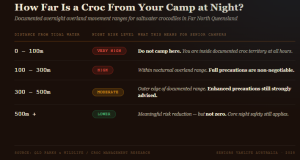
Saltwater crocodiles travel up to 500 metres from the waterline at night. Documented overland movements of between 200–500 metres are well recorded in Far North Queensland. A campsite that is entirely dry and looks completely safe in the afternoon can be within a croc’s nocturnal range by midnight.
Crocs are most active between dusk and dawn. This is their primary hunting window. It is also the window when most senior campers are outside their vehicle — walking to the camp toilet, sitting by a low campfire, or letting the dog out for a late-night wander.
Crocodile movement on land is nearly silent. On grass or compacted earth, a large saltwater crocodile moves with surprisingly little noise. There is no crashing through undergrowth. There is no warning growl. If you are relying on hearing something to alert you, you may not get that alert. For older Australians — where hearing loss affects more than 70% of people over 70, according to Hearing Australia — this risk is meaningfully higher.
Seniors get up at night more often. Nocturia — the need to urinate one or more times overnight — affects the majority of people over 60. This means multiple trips in the dark, often in unfamiliar terrain near a waterway. This is the scenario that represents the greatest real-world risk for older campers, and it is never discussed in standard safety literature.
Slower movement matters. In the unlikely event of an encounter, the ability to move quickly matters. Mobility limitations common in older adults — arthritis, knee or hip replacements, balance issues — are real factors that compound risk in a way the standard brochure cannot account for.
⚠️ This is not about scaring you out of going. Millions of trips are completed safely through croc country every year. It is about replacing luck with knowledge — and writing that knowledge down in a way that actually applies to how seniors travel.
3. How Far From Water Is Actually Safe? The Numbers Nobody Publishes
The “5 metre rule” you see on warning signs is a daytime proximity guideline near the water’s edge. It is not a camping distance recommendation. There is an important difference, and the distinction has never been more relevant than it is for someone setting up an overnight camp.
Queensland Parks and Wildlife researchers and crocodile management specialists have documented saltwater crocodiles making overland movements during the night that range from 200 metres to well over 500 metres from the nearest waterway. In tidal creek systems — which thread through enormous portions of the Cape York and Gulf Savannah landscapes — this figure is compounded by tidal movement pushing crocs further into terrestrial habitat at high tide.
Distance from Tidal Water
Risk Level
Notes for Senior Campers
0–100m
Very High
Do not camp. No exceptions. This is documented croc territory at all hours.
100–300m
High
Still within documented nocturnal overland range. If you must camp here, the precautions in this guide are non-negotiable.
300–500m
Moderate
Approaching the outer edge of documented nocturnal range. Enhanced precautions still strongly advised for seniors.
500m+
Lower (not zero)
Meaningful risk reduction. Still advisable to follow core night safety practices.
✅ A note on freshwater crocs: Freshwater crocodiles (Crocodylus johnstoni) are found in freshwater systems above the tidal zone throughout Queensland. They are significantly less dangerous to humans than saltwater crocs — attacks are rare and typically defensive rather than predatory. However, freshwater crocs can and do bite, and their presence is still worth noting, particularly if you’re swimming or wading.
4. The Night Risk Nobody Talks About: Your 3am Bathroom Trip
Let’s be direct about this because it is the single biggest unaddressed risk factor for senior campers in croc country, and it is almost never discussed.
Most campgrounds near waterways in Far North Queensland — including some very popular and well-maintained ones — have a camp toilet block or long-drop that is a short walk from where you park or pitch your tent. That walk might be 20 metres. It might be 50 metres. In the daylight, it’s nothing. At 3am, in croc country, in the dark, it is a different proposition entirely.
Crocodiles have been documented entering campground perimeters at night. Not in huge numbers, not every night — but it happens, and it happens in areas that are well-signed and well-managed. The risk is real and documented. And the people most likely to be making that walk — multiple times per night, in the dark, often without fully waking up — are older campers.
What to Do Instead
This is where van and caravan travellers have a genuine advantage over tent campers. If you are sleeping in a vehicle, the most important thing you can do is arrange your situation so that you never need to leave the vehicle at night unless you absolutely choose to.
A portable camp toilet inside your van or caravan is not a luxury in croc country — it is a safety device. The Thetford Porta Potti and similar products are compact, odour-controlled, and eliminate the need for any nighttime walk in high-risk areas. For senior travellers, this is one of the most practical investments you can make for Far North Queensland travel.
If you must walk to a facility at night, use a headlamp — not a handheld torch. You need both hands free. Sweep the beam low and wide, not just ahead of you. Crocs are low to the ground. You are looking for eyeshine (reddish reflection at ground level) and for any dark elongated shape on the ground that wasn’t there before.
Make noise as you walk. Stomp your feet. Use a walking stick or hiking pole to tap the ground ahead of you. A crocodile that knows you are coming and has time to move will almost always choose to move. The encounters that go wrong are almost universally ones where the animal was surprised at close range.
Never walk to the toilet alone at night if you can avoid it. A travel partner who stays awake and alert — even just watching from the caravan door with a torch — adds a meaningful layer of safety.
If your mobility means you move slowly, take extra precautions. The more time you spend outdoors at night in croc country, the higher the cumulative risk. Minimising that time with a portable toilet or a well-positioned vehicle is genuinely protective.
✅ Van and caravan setup tip:When choosing where to park for the night near water, position your vehicle so the door faces away from the waterway, not toward it. This means that if you do step out at night, you step away from the higher-risk direction first, giving you more visual clearance before you are exposed.
5. Your Campsite Setup: What Actually Matters
Here’s another gap in the standard advice: it tells you where not to go, but almost nothing about how to set up your camp to reduce risk once you’re there.
Tents vs Vans vs Caravans: The Honest Comparison
A tent provides essentially no physical barrier against a large saltwater crocodile. This is simply true, and it is worth sitting with that fact honestly. A van with a closed door is a solid physical barrier. A caravan with a closed annexe and closed door is also a solid barrier (though the annexe area itself is not protected).
If you are a senior tent camper in croc country, this is one of the strongest arguments for either upgrading to a campervan or trailer camper with a solid sleeping area, or for being extremely careful about campsite selection — choosing sites that are well clear of the risk distances outlined above and maintaining especially disciplined nighttime practices.
Campfire Placement and Lighting
There is some informal evidence from experienced Far North Queensland guides and rangers that a maintained campfire acts as a deterrent to croc approach — fire and the smell of smoke are associated with avoidance behaviour in many large predators. However, this should not be treated as reliable protection. A campfire that burns down unattended in the night provides little deterrent value.
More practically: ensure your campsite has good artificial lighting if you are going to be outside after dark. A well-lit area gives you far more chance of detecting an approaching animal than a dark one. Solar-powered campsite lights are widely available and are a genuinely useful investment for remote senior travel in Far North Queensland.
Where Exactly to Pitch or Park
Never set up directly on a flat grassy bank sloping toward water. This is a croc highway.
If the campsite is near a creek, choose the highest ground available, even if it’s only slightly elevated. Crocs are powerful swimmers but they are not climbers.
Avoid camping near obvious croc signs: slide marks in mud or sand, drag marks, churned-up areas near the water’s edge, or the musky smell sometimes associated with large crocs.
If the campsite has warning signs, read them carefully. “Crocodiles inhabit these waters” is different from “Crocodile activity reported at this site.” The latter means recent, specific incidents and should be treated with much greater caution.
6. Croc-Managed Campgrounds vs. Just-Signed Campgrounds: A Critical Distinction
One of the most important things senior travellers in croc country can understand — and one that almost no travel guide or safety brochure addresses — is the difference between a campground that has active crocodile management and one that simply has a warning sign at the gate.
Active management typically includes: regular ranger patrols, documented removal of problem animals, updated visitor logs of recent sightings, and staff on-site who can answer specific questions about recent croc activity at that location. Some Queensland National Parks campgrounds near high-use waterways do maintain this level of management.
But many campgrounds — particularly free camps, station stays, and remote bush camps — have no ongoing croc management at all. The warning sign was installed once, possibly years ago, and nothing else has changed. There is nobody checking whether a large croc has taken up residence in the adjacent waterhole over the past wet season.
✅ Before you set up camp: Ask the campground host, station owner, or ranger directly: “Have there been any croc sightings here in the last few weeks?” This is a specific, practical question. A vague “oh yes, there are crocs around” is very different from “yes, a 3-metre saltie was seen at the boat ramp three days ago.” The specific answer tells you the actual current risk.
If you are travelling through croc country and staying in free camps without hosts, check the Queensland Government’s Crocodile Management reporting page before you go. Reports of problem animals and recent sightings near specific waterways are sometimes available through local council and Queensland Parks channels.
7. Hearing Loss, Reduced Night Vision, and Slower Reactions: The Honest Conversation
This section is the one that most travel guides and safety resources skip entirely — because it requires being direct about the realities of ageing in a way that can feel uncomfortable. But the people who need this information deserve to have it presented honestly and without condescension.
Three physical changes that are common in people over 65 — and that meaningfully affect croc risk — are hearing loss, reduced night vision, and slower reaction time.
Hearing loss affects approximately 48% of Australians aged 60–69 and rises to over 70% in those over 70 (Hearing Australia, 2023). As noted earlier, a crocodile approaching on grass is not loud. You should not rely on hearing it. This means visual vigilance and environmental precautions (lighting, noise-making, not going out alone) are more important for older campers than for younger ones.
Reduced night vision is a normal age-related change. The pupil becomes less responsive, and the eye’s ability to adapt to low light diminishes. This means what looks like adequate light to a 40-year-old may be genuinely inadequate for a 70-year-old. Use brighter, wider-beam lighting than you think you need. A headlamp rated at 200+ lumens with a wide flood beam is far more appropriate than a small convenience torch.
Slower reaction time and reduced mobility are self-evident considerations. The practical implication is simple: the best strategy is to minimise the situations where a fast reaction might be needed. This means the precautionary measures in this guide — portable toilets, vehicle positioning, strong lighting, avoiding solo nighttime walks — are not optional extras for senior travellers. They are the core safety strategy.
8. After an Encounter: What Every Senior Camper Needs to Know
Almost nothing is written about what happens after a crocodile attack — practically, medically, and logistically. For senior travellers in remote Far North Queensland, this information could be life-saving.
Medical Reality: Distance from Help
A saltwater crocodile bite causes massive, catastrophic soft tissue damage. The death roll — the animal’s instinctive response when it has prey — creates tearing injuries unlike almost any other trauma. Survival depends heavily on speed of medical treatment. And in Far North Queensland, that treatment can be a very long way away.
From many popular remote camping areas on Cape York, the nearest major hospital (Cairns Base Hospital) can be 6–12+ hours by road, and much of that road is unsealed and subject to seasonal closure. This is not a reason to avoid going. It is a reason to plan specifically for the possibility of a serious medical emergency.
The Royal Flying Doctor Service and Emergency Protocols
The Royal Flying Doctor Service (RFDS) is the emergency medical response backbone for remote Australia. For senior travellers in Far North Queensland, an RFDS membership is not optional — it is essential. Basic membership covers aeromedical evacuation costs that could otherwise run to tens of thousands of dollars. Ensure your membership is current before you leave, and ensure you know your RFDS membership number and how to activate a response.
A Personal Locator Beacon (PLB) registered with the Australian Maritime Safety Authority (AMSA) is equally essential for remote travel. In the event of a serious injury where you cannot get to a phone or where mobile coverage is absent (which covers most of Cape York), a PLB is how help finds you. Every vehicle in a serious remote travel party should carry one.
First Aid Specific to Crocodile Bites
Control bleeding with direct pressure. Crocodile wounds are typically large and bleed heavily. Pack wound dressings capable of managing significant haemorrhage. Israeli bandages (combat trauma dressings) are compact, widely available, and appropriate for this purpose.
Do not attempt to remove the animal if it has locked its jaws. This is extremely dangerous. Striking the animal on the snout or eyes is the documented method of encouraging release.
Get the injured person away from the water immediately and elevate injured limbs if possible.
Call 000 or activate your PLB. State your exact GPS coordinates. If you do not have a GPS device, describe your location in as much detail as possible including the campsite name, waterway, and the nearest mapped landmark.
⚠️ Senior-specific consideration: Shock and blood loss affect older people faster and more severely than younger adults. An injury that a younger person might manage for several hours before deteriorating critically may become life-threatening more quickly in an older person. Speed of response and quality of first aid in the first 30 minutes is critically important.
9. The Gear That Senior Croc-Country Campers Should Not Travel Without
Beyond the standard camping kit, there are specific items that meaningfully reduce risk for senior campers in Far North Queensland. This is a practical, no-nonsense list:
Portable camp toilet (Thetford, Dometic, or equivalent) — eliminates the need for nighttime walks to facilities
High-lumen headlamp (200+ lumens, wide flood mode) — essential for safe nighttime navigation around a campsite
Solar LED campsite perimeter lights — passive, battery-free illumination of your immediate camp area overnight
Registered Personal Locator Beacon (PLB) — non-negotiable for any remote travel in Queensland
Current RFDS membership — essential for any traveller spending extended time in remote Far North Queensland
Hiking pole or walking stick — doubles as a ground-tapping alert tool during nighttime walks and a balance aid on uneven terrain
Trauma dressing/haemostatic bandage — part of any serious remote first aid kit
Satellite communicator (Garmin inReach or equivalent) — two-way communication where mobile coverage doesn’t exist, which is most of Cape York
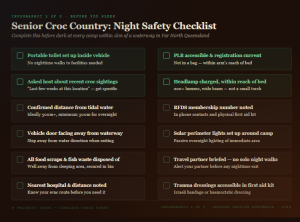
10. Senior Croc Country Night Safety: The Complete Checklist
☐ Confirmed distance from nearest tidal waterway — ideally 500m+, minimum 300m for overnight camp
☐ Asked campground host or ranger about specific recent croc sightings at this location
☐ Portable camp toilet set up inside vehicle — no nighttime walks to facilities required
☐ High-lumen headlamp charged and within reach of the bed
☐ Solar perimeter lights set up around immediate campsite area
☐ Vehicle door positioned facing away from waterway
☐ Campfire positioned between the camp and the water direction (if applicable)
☐ All food scraps and fish cleaning residue disposed of well away from camp
☐ Travel partner briefed on nighttime exit protocol — no solo night walks without alerting partner
☐ PLB accessible and activated registration confirmed current
☐ RFDS membership number noted in phone and first aid kit
☐ Nearest hospital and its distance from current location noted
☐ Satellite communicator charged and tested
☐ Trauma dressings accessible in first aid kit
11. The Bottom Line: Go. But Go Prepared.
Far North Queensland is one of the most extraordinary places on earth to spend time as a senior traveller. The freedom of vanlife and caravan travel through croc country — waking up to a sunrise over the Gulf, watching a brahminy kite circle above a tidal creek at golden hour, sitting around a fire listening to the night sounds of the Cape — is an experience that stays with you for the rest of your life.
The crocodile is part of that landscape, not a reason to avoid it. The people who get into serious trouble in croc country are almost always the ones who either didn’t know the risks, or knew them and got casual. Knowledge and discipline together are what keep you safe.
For senior campers specifically, that means taking the nighttime risk seriously in a way the standard brochure never bothers to explain. It means investing in the gear that removes the need for high-risk nighttime behaviour. It means asking the specific questions rather than the vague ones. And it means having a clear, current emergency plan before you need it.
The croc has been here for 200 million years. With the right preparation, so will you.
✅ Continue reading: Next in this series — Which QLD campgrounds have active croc management vs. just a warning sign: a practical guide for grey nomads and senior travellers.
Information sourced from Queensland Parks and Wildlife, RFDS, Hearing Australia, and experienced Far North QLD rangers. This article is for general information only. Always follow current Queensland Government advice regarding crocodile safety.