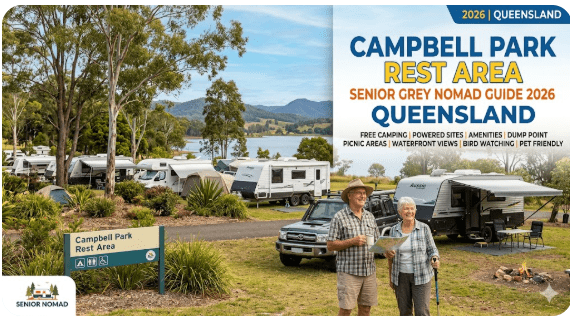
Cambell Park Rest Area Senior Grey Nomad Guide 2026
Planning a stop at Cambell Park Rest Area in Queensland? This comprehensive 2026 guide covers everything senior travellers, grey nomads, and caravan owners need to know before arriving—including overnight stay rules, facilities, road access, fuel planning, and practical safety considerations.
Whether you’re towing a caravan, driving a motorhome, or travelling in a campervan, this guide will help you decide if Cambell Park Rest Area suits your needs and how to plan your stop safely.
If you’re travelling through central and western Queensland, you may also find these rest area guides helpful: Roma Rest Area is a popular stop along the Warrego Highway, and Injune Rest Area offers another option further north.
⚠️ Important Note: Cambell Park Rest Area is a lesser-documented Queensland rest stop. Some details in this guide are based on general rest area standards and traveller reports. Always check current signage on arrival and verify overnight rules with local authorities or updated traveller apps before settling in for the night.
📋 Table of Contents
- 1. Why Grey Nomads Stop at Cambell Park Rest Area
- 2. Quick Facts and Key Details 2026
- 3. Can You Stay Overnight at Cambell Park Rest Area?
- 4. How to Get to Cambell Park Rest Area
- 5. Road Conditions, Flooding and Unsealed Sections
- 6. Vehicle Suitability — Caravan, Motorhome, Campervan, 2WD, 4WD, Big Rig
- 7. Fuel Planning — North, South, East and West
- 8. Free Camping and Overnight Options Nearby
- 9. Caravan Parks or Paid Alternatives Nearby
- 10. Dump Points Near Cambell Park Rest Area
- 11. Water Availability Near Cambell Park Rest Area
- 12. Nearby Public WiFi Options
- 13. Facilities at the Rest Area
- 14. Full Facilities Comparison Table
- 15. Best Time to Visit — Month-by-Month Guide
- 16. Heat, Weather and Seasonal Travel Risks for Seniors
- 17. Wildlife and What to Watch For
- 18. Phone Signal and Emergency Communications
- 19. Campfires, Cooking Rules and Food Purchase Options
- 20. Pets at Cambell Park Rest Area
- 21. Accessibility for Seniors with Mobility Limitations
- 22. Camping Etiquette and Waste Management
- 23. Emergency Scenarios — What to Do
- 24. Packing List for This Part of Queensland
- 25. What to Do Near Cambell Park Rest Area
- 26. Stargazing at Cambell Park Rest Area
- 27. Reviews — What Real Travellers Commonly Say
- 28. People Also Ask
- 29. Frequently Asked Questions
- 30. Quick-Reference Card
- 31. Interactive Free Camp Finder Map
- 32. Final Verdict
- 33. Disclaimer
Why Grey Nomads Stop at Cambell Park Rest Area
Cambell Park Rest Area serves as a practical stopping point for travellers moving through regional Queensland. For grey nomads and senior caravan travellers, rest areas like this one offer essential benefits that support safe, comfortable travel:
- Driver fatigue management: Queensland roads can be long and monotonous. Stopping to rest, stretch, and recover before continuing is essential for senior drivers.
- Cost-effective travel: Rest areas provide a free alternative to paid camping, helping travellers stretch their travel budget across longer trips.
- Convenient break point: Located along a main travel route, Cambell Park Rest Area offers a logical place to break a journey without significant detours.
- Flexibility: For self-contained travellers, rest areas provide the freedom to travel at their own pace without advance bookings.
💡 Senior Travel Tip: Even if you don’t plan to stay overnight, stopping at rest areas every 2 hours helps manage fatigue—especially important for travellers over 60. A 15-minute walk and a cup of tea can make a significant difference to alertness.
Quick Facts and Key Details 2026
Below is a summary of key information about Cambell Park Rest Area. Please note that some details may require verification on arrival, as this rest area has limited official documentation available.
| Detail | Information |
|---|---|
| Rest Area Name | Cambell Park Rest Area |
| State | Queensland |
| Cost | Free (verify on arrival) |
| Overnight Stays | Check signage on arrival—rules vary by rest area type |
| Time Limit | Verify locally—typically 20 hours if overnight allowed |
| Toilets | Verify on arrival |
| Water | Unlikely—bring your own supply |
| Bins | Verify on arrival—practice carry-in, carry-out |
| Suitable for Caravans | Generally yes—verify turning space |
| Mobile Reception | Variable—check coverage maps for your provider |
| Coordinates | Not verified—use GPS navigation or traveller apps |
| Coordinate Source | Coordinates not independently verified for this guide |
⚠️ Verification Required: Details for Cambell Park Rest Area are not comprehensively documented in official sources at the time of writing. We recommend using WikiCamps Australia, Camps Australia Wide, or similar apps to cross-check facilities and overnight rules before arrival.
Can You Stay Overnight at Cambell Park Rest Area?
Whether overnight stays are permitted at Cambell Park Rest Area depends on its official classification and local signage. Queensland rest areas fall into different categories:
Queensland Rest Area Categories
- Driver Reviver or Short-Stop Areas: Designed for brief rest breaks only. Overnight camping is typically not permitted.
- Major Rest Areas (Type A): Often allow overnight stays up to 20 hours. Usually have toilets and sometimes picnic facilities.
- Minor Rest Areas (Type B): May allow short overnight stays for driver fatigue purposes but with limited facilities.
- Truck Rest Areas: Primarily for heavy vehicles. Caravans and motorhomes may be able to use them, but priority goes to trucks.
- The Springsure Rest Area is another option in the Central Highlands region.
For travellers heading toward the Capricorn region, the Rolleston Rest Area provides a convenient stopping point.
💡 What to Check on Arrival: Look for signage at the rest area entrance that specifies:
• Whether overnight stays are allowed
• Maximum stay duration (commonly 20 hours)
• Whether the area is for all vehicles or heavy vehicles only
• Any camping restrictions or generator rules
Self-Contained Requirements
Many Queensland rest areas that permit overnight stays expect travellers to be self-contained. This means your vehicle should have:
- Onboard toilet facilities
- Grey water containment (not discharging onto the ground)
- Sufficient water storage
- Waste management systems
⚠️ Important: Overnight rules can change. Local councils may update restrictions, especially during events, bushfire seasons, or if misuse occurs. Always check current signage and consider calling ahead to the local council or visitor information centre if planning to rely on this stop.
How to Get to Cambell Park Rest Area
Cambell Park Rest Area is located in Queensland. Due to limited official documentation, specific turn-by-turn directions are not available for this guide. We recommend the following approach:
Finding the Rest Area
- Use GPS Navigation: Enter “Cambell Park Rest Area Queensland” into your GPS or mapping app. Google Maps, Apple Maps, and GPS units often have rest areas marked.
- WikiCamps Australia: This popular app used by grey nomads includes user-verified locations and coordinates for rest areas across Queensland.
- Camps Australia Wide: The printed book and digital app provide detailed rest area information.
- Highway Signage: Rest areas on Queensland highways are typically signposted with advance warning signs indicating distance.
General Directions by Approach
| Approaching From | Guidance |
|---|---|
| North | Watch for rest area signage along main highways. Use GPS for specific location. |
| South | Follow highway markers and rest area signs. Confirm location via traveller app. |
| East | If approaching from coastal areas, allow extra travel time and fuel planning. |
| West | Plan fuel carefully—western Queensland has longer distances between towns. |
💡 Navigation Tip for Seniors: Before leaving home, download offline maps for the region. Mobile coverage can be patchy in regional Queensland, and offline maps ensure you can still navigate even without signal.
Road Conditions, Flooding and Unsealed Sections
Road conditions in regional Queensland can vary significantly depending on the season, recent weather, and the specific location of the rest area. Here’s what grey nomads should consider:
Sealed vs Unsealed Access
Most rest areas along Queensland’s main highways are accessed via sealed roads. However, some rest areas require short unsealed access tracks. Before arrival:
- Check traveller apps for recent reports on access road conditions
- Look for comments about gravel, corrugations, or potholes
- Consider your vehicle and van’s ground clearance
Flood Risk and Wet Weather
Queensland experiences significant wet seasons, typically from November through March. During and after heavy rain:
- Floodways: Many Queensland roads cross floodways that can become impassable after rain.
- Road closures: Check Queensland Traffic (qldtraffic.qld.gov.au) for current road conditions before travel.
- Rest area access: Even if the main highway is open, rest area access tracks may be boggy or flooded.
- Recovery time: Allow 24-48 hours after rain before attempting unsealed sections.
⚠️ Flood Safety: Never attempt to cross flooded roads or enter rest areas through standing water. “If it’s flooded, forget it.” Wait for waters to recede and roads to be confirmed safe. Seniors towing caravans should be especially cautious, as recovery from bog situations is difficult.
Road Condition Resources
| Resource | What It Provides |
|---|---|
| Queensland Traffic | Real-time road closures, incidents, and conditions (qldtraffic.qld.gov.au) |
| BOM Weather | Weather forecasts and rainfall radar (bom.gov.au) |
| WikiCamps Reviews | Recent traveller comments on access conditions |
| Local Council | Contact for specific rest area accessibility queries |
Vehicle Suitability — Caravan, Motorhome, Campervan, 2WD, 4WD, Big Rig
Understanding whether Cambell Park Rest Area suits your vehicle setup is essential for safe travel planning. Here’s general guidance based on typical Queensland rest area characteristics:
| Vehicle Type | Suitability | Notes |
|---|---|---|
| 2WD Car | Generally suitable | Most highway rest areas accessible in dry conditions |
| 4WD | Suitable | Greater flexibility in varying conditions |
| Campervan | Generally suitable | Easy manoeuvrability in most rest areas |
| Motorhome (under 8m) | Generally suitable | Check turning circle requirements |
| Motorhome (over 8m) | Verify space | Some rest areas have limited turning space for large vehicles |
| Caravan (single axle) | Generally suitable | Standard rest areas accommodate single-axle vans |
| Caravan (tandem axle) | Generally suitable | Verify entry/exit angles and surface conditions |
| Big Rig / 5th Wheeler | Verify before arrival | Large rigs may need extra manoeuvring space—check recent reviews |
💡 Senior Manoeuvring Tip: If you’re not confident reversing in tight spaces, arrive at rest areas during daylight when you can assess the layout. It’s okay to drive through and check the area before committing to a spot. Many grey nomads prefer pull-through bays that don’t require reversing.
Surface Considerations
Rest area surfaces vary. You may encounter:
- Sealed/bitumen: Ideal for all vehicles, easy levelling
- Gravel: Generally fine in dry conditions, can become soft after rain
- Dirt/grass: May be unsuitable after rain or for heavy vehicles
Fuel Planning — North, South, East and West
Fuel planning is critical for grey nomads travelling in regional Queensland. Without knowing the exact location of Cambell Park Rest Area, we cannot provide specific fuel distances. However, here are essential fuel planning principles for Queensland outback travel:
General Queensland Fuel Planning Guidelines
- Never pass a fuel station with less than half a tank when travelling in regional areas.
- Carry jerry cans with additional fuel for remote sections (stored safely and legally).
- Know your vehicle’s range when towing—fuel consumption increases significantly with a caravan.
- Plan fuel stops in advance using apps like Fuel Map Australia or the RACQ app.
- Check opening hours—some outback fuel stations close early or have limited weekend hours.
⚠️ Fuel Warning: In western Queensland, distances between fuel stops can exceed 200km. Some stations have limited diesel availability or may be closed unexpectedly. Always confirm fuel availability at your next planned stop before departing.
How to Find Fuel Near Any Queensland Rest Area
| Resource | How It Helps |
|---|---|
| Fuel Map Australia | Shows fuel prices and locations across Australia |
| RACQ App | Fuel finder with real-time pricing for Queensland |
| Google Maps | Search “fuel near me” or along your planned route |
| WikiCamps | Users often note nearby fuel availability in rest area reviews |
💡 Senior Fuel Tip: When planning each day’s travel, identify fuel stops as waypoints in your GPS. This helps prevent the stress of watching fuel gauge drop in unfamiliar territory. Many grey nomads fill up whenever they see a station, regardless of tank level.
Free Camping and Overnight Options Nearby
If Cambell Park Rest Area doesn’t suit your needs—or if you want to explore alternatives—Queensland offers various free camping and low-cost overnight options. Without specific coordinates for Cambell Park Rest Area, we cannot list nearby options with distances. However, here are the types of alternatives to look for:
Types of Free/Low-Cost Overnight Stops in Queensland
- Council Rest Areas: Many Queensland councils provide designated rest areas allowing overnight stays.
- State Forest Camps: Queensland state forests often have free or low-cost camping areas with basic facilities.
- National Park Camping: Requires booking through Queensland Parks (parks.des.qld.gov.au) but often affordable.
- Showgrounds: Many regional showgrounds offer camping for a small fee, especially outside event periods.
- Recreation Reserves: Local reserves sometimes permit camping—check with councils.
- Station Stays: Some pastoral properties offer camping for a fee, often with unique outback experiences.
Queensland offers various free camping and low-cost overnight options. If you’re planning a longer route through southwest Queensland, our Charleville to Goondiwindi Grey Nomad Guide covers rest areas and stops along that corridor.
How to Find Free Camps Near Any Location
| Resource | Details |
|---|---|
| WikiCamps Australia | Comprehensive app with user reviews, photos, and facility details |
| Camps Australia Wide | Book and app with extensive free camp listings |
| CamperMate | Free app with camping and rest area information |
| Visitor Information Centres | Staff can advise on local free and paid camping options |
💡 Backup Planning: Always have 2-3 alternative stops identified before you need them. Arrive at your preferred stop with enough daylight and fuel to reach an alternative if the first choice is full, closed, or unsuitable.
Caravan Parks or Paid Alternatives Nearby
Sometimes a caravan park is the better choice, especially for seniors who want reliable facilities, power, hot showers, and the security of a managed environment. Without specific location details for Cambell Park Rest Area, we recommend searching for caravan parks in nearby towns using these resources:
When to Choose a Caravan Park Instead
- You need to charge batteries or run air conditioning after a hot day of travel.
- You want a hot shower—rest areas rarely have shower facilities.
- You need to do laundry after several days on the road.
- The weather is extreme—parks provide shade structures and sometimes camp kitchens.
- You want reliable WiFi and phone charging facilities.
- You’re feeling unwell and want to be closer to assistance.
- The rest area is full or noisy—have a caravan park as backup.
How to Find Caravan Parks in the Region
| Resource | Details |
|---|---|
| BIG4 Holiday Parks | Chain parks with consistent standards (big4.com.au) |
| Discovery Parks | Widespread network across Queensland |
| Top Parks | Quality independent parks |
| WikiCamps | Lists both free camps and paid parks with reviews |
| Google Maps | Search “caravan park near [town name]” |
💡 Booking Tip for Seniors: During peak travel season (April–October), book powered sites 1-2 days ahead in popular areas. Many parks offer senior discounts or extended stay rates—ask when booking.
Dump Points Near Cambell Park Rest Area
For self-contained travellers, knowing where to empty grey and black water is essential. Rest areas rarely have dump point facilities, so you’ll need to plan for nearby towns or caravan parks.
Finding Dump Points in Queensland
Without the specific location of Cambell Park Rest Area, we cannot list exact dump points. Use these resources to find the nearest facilities:
| Resource | Details |
|---|---|
| Dump Point Finder (CMCA) | Campervan and Motorhome Club of Australia maintains a dump point database |
| WikiCamps | Filter for dump points in your search area |
| Visitor Information Centres | Staff can direct you to local facilities |
| Local Caravan Parks | Many allow non-guests to use dump points for a small fee |
Dump Point Etiquette
- Only use designated dump points—never empty waste into drains, nature, or standard toilets.
- Rinse the area after use.
- Use appropriate chemicals in your cassette toilet.
- If a dump point is for potable water, do not contaminate it with waste equipment.
⚠️ Important: Never empty waste at rest areas unless there is a clearly signed dump point facility. Illegal dumping causes rest areas to be closed and damages the environment.
Water Availability Near Cambell Park Rest Area
Most Queensland rest areas do not have potable water available. Grey nomads should always travel with sufficient water supplies and know where to refill.
Water Planning Guidelines
- Carry at least 20 litres per person for drinking and cooking, plus water for your vehicle’s tanks.
- Refill tanks at every opportunity—don’t wait until you’re low.
- Know your tank capacity and consumption rates.
- Caravan parks usually offer water for guests—some allow non-guests to fill for a fee.
- Town visitor information centres often know where public water taps are available.
Where to Find Water
| Location Type | Notes |
|---|---|
| Caravan Parks | Reliable water—ask if non-guests can fill tanks |
| Showgrounds | Many have public taps available |
| Visitor Information Centres | Can direct you to water fill points |
| Public Parks with BBQs | Sometimes have drinking taps |
| Service Stations | Ask politely—many will allow water fills with fuel purchase |
💡 Senior Hydration Tip: In hot weather, seniors need to drink water regularly even when not feeling thirsty. Keep a water bottle within easy reach in the vehicle and set reminders if needed. Dehydration can cause confusion and fatigue—dangerous when driving.
Nearby Public WiFi Options
Rest areas in regional Queensland typically do not have WiFi. However, grey nomads can often find free public WiFi in nearby towns:
Common Public WiFi Locations
- Libraries: Most Queensland public libraries offer free WiFi during opening hours.
- Visitor Information Centres: Many have WiFi for visitors.
- McDonalds: Free WiFi with purchase in most locations.
- Caravan Parks: Usually have WiFi for guests—quality varies.
- Some town centres: Some Queensland councils provide free WiFi in main streets or parks.
💡 Connectivity Tip: If you need regular internet access, consider a mobile WiFi device (pocket WiFi) with a data plan. This provides connectivity wherever there’s mobile signal, which is more reliable than searching for public WiFi.
Facilities at Cambell Park Rest Area
Facility information for Cambell Park Rest Area requires verification on arrival, as detailed documentation is not publicly available. Here’s what Queensland rest areas typically offer:
Typical Rest Area Facilities
| Facility | Commonly Available | Notes |
|---|---|---|
| Toilets | Many major rest areas | Usually drop toilet or basic amenities |
| Showers | Rarely | Rest areas typically don’t have showers |
| Potable Water | Rarely | Bring your own water supply |
| Bins | Some | Practice carry-in, carry-out regardless |
| Picnic Tables | Many | Usually shaded or under shelters |
| Shade | Variable | Some have shelters or trees; some are exposed |
| Power | No | Rest areas don’t have power hookups |
| Dump Point | Rarely | Find dump points in nearby towns |
| BBQ | Some | Some rest areas have gas or electric BBQs |
⚠️ Verify Before Relying: Facilities at rest areas can change or fall into disrepair. Always have backup plans—especially for toilet needs. Self-contained travellers have significant advantages at basic rest areas.
Full Facilities Comparison: Rest Area vs Caravan Park
This comparison helps grey nomads decide when a rest area stop is sufficient versus when a caravan park makes more sense:
| Feature | Typical Rest Area | Caravan Park |
|---|---|---|
| Cost | Free | $30–$55/night |
| Power | No | Yes (powered sites) |
| Hot Showers | No | Yes |
| Toilets | Sometimes (basic) | Yes (clean amenities) |
| Potable Water | Rarely | Yes |
| Dump Point | Rarely | Yes |
| Laundry | No | Yes |
| WiFi | No | Usually (varies) |
| Security | None | Managed/gated |
| Noise Level | Variable (road noise) | Usually quieter |
| Camp Kitchen | Rarely | Often |
| Booking Required | No | Recommended in peak |
| Best For | Quick overnight, self-contained | Extended stays, recharging |
💡 Grey Nomad Strategy: Many experienced travellers alternate between free rest areas and paid caravan parks. Use rest areas for simple overnight stops when you’re self-contained and fresh, then book into a caravan park every 3-4 days to recharge batteries, do laundry, have hot showers, and catch up on emails.
Best Time to Visit — Month-by-Month Guide
Timing your visit to regional Queensland rest areas makes a significant difference to comfort and safety. Here’s a general month-by-month guide for Queensland outback and regional travel:
| Month | Conditions | Senior Suitability |
|---|---|---|
| January | Hot, wet season, flood risk, storms | ⚠️ Not recommended |
| February | Hot, wet season continues, humidity high | ⚠️ Not recommended |
| March | Wet season easing, still hot, possible road closures | ⚠️ Caution |
| April | Cooling down, dry season starting, roads reopening | ✅ Good |
| May | Mild days, cool nights, dry conditions | ✅ Excellent |
| June | Cool and dry, peak grey nomad season begins | ✅ Excellent |
| July | Cool days, cold nights, dry and clear | ✅ Excellent |
| August | Warming slightly, still dry, busy travel period | ✅ Excellent |
| September | Warming up, still good conditions, wildflowers | ✅ Good |
| October | Getting hot, storm season approaching | ✅ Fair |
| November | Hot, storms beginning, humidity rising | ⚠️ Caution |
| December | Hot, wet season, storms, flood risk increasing | ⚠️ Not recommended |
💡 Best Travel Window: For most grey nomads, the ideal Queensland outback travel window is May through September. This period offers comfortable temperatures, minimal rain, and reliable road conditions. June through August is peak season—expect more company at popular stops.
Heat, Weather and Seasonal Travel Risks for Seniors
Queensland’s climate presents specific challenges for senior travellers. Understanding these risks helps you plan safer, more comfortable trips.
Heat-Related Risks
Seniors are more vulnerable to heat-related illness due to changes in how the body regulates temperature with age. Key risks include:
- Heat exhaustion: Symptoms include heavy sweating, weakness, cold/pale/clammy skin, nausea, and dizziness.
- Heat stroke: A medical emergency. Symptoms include high body temperature, hot/red/dry skin, rapid pulse, confusion, and unconsciousness.
- Dehydration: Can cause confusion, fatigue, and dizziness—dangerous when driving.
⚠️ Heat Safety Rules for Seniors:
• Avoid travelling during the hottest part of the day (11am–3pm) in summer
• Drink water regularly, even when not thirsty
• Never leave the vehicle without water, hat, and sun protection
• If your vehicle breaks down in heat, stay with it and seek shade
• Know the signs of heat illness in yourself and your travel companion
Storm and Flood Risks
Queensland’s wet season (November–March) brings:
- Sudden storms: Can be severe with lightning, heavy rain, and strong winds.
- Flash flooding: Floodways can become impassable within hours of rain.
- Road closures: May strand travellers for days in some areas.
- Isolation: Communications may be affected during severe weather.
💡 Weather Monitoring Tips:
• Check Bureau of Meteorology forecasts daily (bom.gov.au)
• Monitor Queensland Traffic for road conditions
• Have a battery-powered radio for emergency broadcasts
• Sign up for emergency alerts on your mobile if travelling in storm-prone areas
Wildlife and What to Watch For
Queensland’s wildlife is one of the attractions of outback travel, but it also presents hazards that grey nomads should be aware of:
Road Hazards
- Kangaroos: Most active at dawn and dusk. Can cause serious vehicle damage and injury. Reduce speed during these times.
- Cattle and livestock: Open range areas mean animals may be on roads. Watch for cattle grid signs.
- Emus: Can run into traffic unpredictably.
- Wedge-tailed eagles: Often feeding on roadkill and slow to take off. Don’t swerve—brake firmly if safe.
⚠️ Dawn and Dusk Driving: Avoid driving during the hour after sunrise and hour before sunset when possible. If you must drive during these times, reduce speed significantly and stay extra alert. Many grey nomads plan their travel to arrive at rest areas by mid-afternoon.
Wildlife at Rest Areas
- Snakes: Watch where you step, especially in grass or around logs. Most snakes will avoid humans if given the chance.
- Spiders: Check toilet seats, shoes left outside, and under picnic tables.
- Ants: Check the ground before setting up chairs. Bull ants and fire ants can deliver painful bites.
- Mosquitoes: More prevalent after rain. Use repellent, especially at dusk.
- Birds: Crows and kookaburras may try to steal food—keep food secured.
💡 Wildlife Safety Tips:
• Use a torch when walking at night
• Shake out shoes before putting them on
• Don’t leave food scraps around your camp
• Store food securely to avoid attracting animals
• If you encounter a snake, back away slowly—don’t try to kill or move it
Phone Signal and Emergency Communications
Mobile phone coverage in regional Queensland is patchy. Grey nomads should plan for limited or no signal at many rest areas.
Network Coverage Overview
| Provider | Regional Coverage | Notes |
|---|---|---|
| Telstra | Best regional coverage | Recommended for outback travel |
| Optus | Good in towns, limited between | Check coverage maps before travel |
| Vodafone | Limited regional coverage | Consider secondary Telstra SIM |
Communication Backup Options
- Satellite phone: Provides coverage anywhere but expensive. Consider renting for remote trips.
- Personal Locator Beacon (PLB): Emergency-only device that sends distress signal to rescue services. Recommended for remote travel.
- Satellite messenger (e.g., Garmin inReach): Allows two-way messaging and emergency alerts via satellite.
- UHF radio: Useful for communicating with other travellers and in emergencies. Channel 40 is the road channel.
- External antenna: A vehicle-mounted antenna can significantly improve mobile reception.
⚠️ Emergency Calls: Even with no regular signal, emergency calls (000) may connect through any available network. However, don’t rely on this in very remote areas. A PLB or satellite device is essential safety equipment for outback travel.
💡 Communication Tips for Seniors:
• Download offline maps before leaving coverage areas
• Tell someone your travel plan and expected check-in times
• Learn how to use your PLB or satellite device before you need it
• Keep devices charged—carry a portable power bank
• When you do get signal, send a location update to family
Campfires, Cooking Rules and Food Purchase Options
Campfire Rules
Campfire rules at Queensland rest areas vary and are subject to fire bans:
- Check signage: Most rest areas display current fire restrictions.
- Fire bans: During total fire bans, no open flames are permitted—including campfires and some camp stoves.
- Fire rings: If fires are allowed, use designated fire rings only.
- Fuel stoves: Gas camp stoves are usually permitted even during fire bans, but check current restrictions.
⚠️ Fire Safety: Queensland has severe fire danger periods. Check the Rural Fire Service Queensland website or app for current fire danger ratings and restrictions in your travel area. Penalties for breaching fire bans are severe.
Cooking at Rest Areas
Most grey nomads cook using:
- Gas camp stoves: Portable and efficient—the standard for caravan and motorhome travel.
- Built-in van kitchens: Most caravans and motorhomes have gas cooktops.
- Electric cookers: If you have solar/battery capacity or are at a powered site.
- BBQs: Some rest areas have electric or gas BBQs available.
Food Purchase Options
Rest areas don’t have food for sale. Plan your food supplies around nearby towns:
- Supermarkets: Available in larger towns. Stock up when you pass through.
- General stores: Small towns often have basic supplies at higher prices.
- Roadhouses: Usually have basic groceries, takeaway food, and sometimes hot meals.
- Bakeries and cafes: Found in most Queensland towns—great for lunch stops.
💡 Food Planning Tip: Carry enough non-perishable food for at least 3-4 days beyond your planned needs. Road closures, breakdowns, or changes in plans can extend your time between towns. Include items that don’t require refrigeration as backup.
Pets at Cambell Park Rest Area
Many grey nomads travel with dogs or other pets. Here’s general guidance for travelling with pets in Queensland:
Rest Area Pet Rules
- General roadside rest areas: Pets are usually allowed but must be kept on lead and under control.
- Check signage: Some rest areas near national parks or conservation areas may have restrictions.
- Clean up: Always clean up after your pet—carry bags and dispose of waste properly.
Pet Safety in Hot Conditions
⚠️ Critical Pet Safety:
• Never leave pets in vehicles—even with windows down, temperatures can become fatal within minutes
• Walk dogs only in the cool of early morning or evening
• Check ground temperature before walks—hot bitumen and sand burn paw pads
• Ensure pets always have access to fresh water and shade
• Watch for signs of heat stress: excessive panting, drooling, lethargy, or collapse
Travelling with Pets Checklist
- Vaccination records and microchip details
- Regular medications
- Portable water and food bowls
- Lead and secure tie-out system
- Bedding and familiar items
- Pet-safe insect repellent
- First aid supplies for pets
- Contact details for vets along your route
Accessibility for Seniors with Mobility Limitations
Rest areas vary significantly in accessibility. Without specific details about Cambell Park Rest Area, here’s general guidance for seniors with mobility considerations:
Common Accessibility Challenges at Rest Areas
- Uneven ground: Many rest areas have gravel, grass, or uneven surfaces that can be difficult with walkers or wheelchairs.
- Toilet access: Not all rest area toilets are accessible. Some have steps or narrow doorways.
- Distance from parking: Facilities may be some distance from where you park.
- Table seating: Picnic tables may not accommodate wheelchairs or mobility devices.
Planning for Accessibility
- Check WikiCamps: User reviews often mention accessibility features or challenges.
- Self-contained advantage: Having your own toilet in your van means you’re not dependent on rest area facilities.
- Arrive early: Better chance of parking close to facilities and on level ground.
- Scout first: If possible, walk the area before committing to ensure it meets your needs.
💡 Accessibility Equipment: Consider carrying portable ramps, a lightweight camp chair that’s easy to get in and out of, a walking stick for uneven terrain, and a torch for nighttime toilet trips. A portable toilet for the van provides independence from potentially inaccessible facilities.
Camping Etiquette and Waste Management
Good behaviour at rest areas ensures they remain open for future travellers. Poor etiquette leads to closures. Follow these guidelines:
Rest Area Etiquette Rules
- Leave no trace: Take all rubbish with you. Leave the area cleaner than you found it.
- Respect quiet hours: Keep noise to a minimum, especially after 9pm and before 7am.
- Generator use: If generators are permitted, limit use to reasonable daylight hours. Many travellers prefer generator-free camps.
- Parking consideration: Don’t take up more space than you need. Leave room for others.
- Be friendly: A wave or hello builds community. Grey nomads look out for each other.
- Observe time limits: Don’t overstay posted limits. This isn’t a long-term camp.
Waste Management
⚠️ Critical Waste Rules:
• Grey water: Do not empty grey water onto the ground. Contain it in tanks or portable containers until you reach a dump point.
• Black water: Empty only at designated dump points—never anywhere else.
• Rubbish: If bins are provided, don’t overfill them. If no bins, carry all waste with you.
• Food scraps: Don’t leave food out—it attracts wildlife and pests.
💡 Being a Good Camping Citizen: The grey nomad community largely self-regulates. Your good behaviour helps keep rest areas open. If you see someone acting irresponsibly, a friendly word is often more effective than confrontation. Report serious issues to local councils.
Emergency Scenarios — What to Do
Being prepared for emergencies is essential for safe outback travel. Here’s how to handle common emergency scenarios:
Vehicle Breakdown
- Move off the road if possible. Turn on hazard lights.
- Stay with your vehicle—it provides shade, shelter, and is easier for rescuers to spot.
- Conserve water and stay in shade.
- If you have phone signal, call your roadside assistance provider.
- If no signal, wait for another traveller or use your PLB/satellite device.
- Make your vehicle visible—raise the bonnet, put out a distress triangle if you have one.
Medical Emergency
- Call 000 if you have signal. Provide your location as accurately as possible.
- If no signal, activate your PLB or satellite emergency device.
- Administer first aid within your training level.
- If possible, drive towards the nearest town or help.
- Flag down other travellers for assistance.
Fire Emergency
- If bushfire approaches, leave early if you have a clear evacuation route.
- If trapped, seek refuge in a clear area away from vegetation.
- Stay in your vehicle as a last resort—it provides protection from radiant heat.
- Cover up with woolen blankets, drink water, and stay low.
- Check emergency alerts on your phone or radio.
Snake Bite
- Keep the victim calm and still. Movement spreads venom faster.
- Apply a pressure immobilisation bandage (firm bandage from the bite site up the limb).
- Do not wash the bite area—venom can be used to identify the snake.
- Do not cut the wound or try to suck out venom.
- Get to medical help as soon as possible. Call 000.
💡 Emergency Preparedness: Complete a first aid course before extended travel. Carry a comprehensive first aid kit and know how to use everything in it. Keep emergency contacts, medical information, and your travel itinerary in an easily accessible location.
Packing List for This Part of Queensland
Travelling through regional Queensland requires thoughtful preparation. This packing list covers essentials for grey nomads stopping at rest areas like Cambell Park Rest Area:
Water and Hydration
- Minimum 20 litres drinking water per person
- Water containers for tank refills
- Water purification tablets (backup)
- Reusable water bottles for each traveller
- Electrolyte sachets for hot weather
Vehicle and Mechanical
- Spare tyre(s) in good condition—check pressure
- Jack and wheel brace suitable for your vehicle
- Jumper leads or jump starter pack
- Basic tool kit
- Tyre repair kit and compressor
- Extra engine oil and coolant
- Spare fuses and globes
- Tow rope or snatch strap
- Jerry can with extra fuel (stored safely)
- Duct tape and cable ties
Safety and Emergency
- Comprehensive first aid kit
- Personal medications (extra supply)
- Personal Locator Beacon (PLB) or satellite messenger
- Fire extinguisher (vehicle-rated)
- Reflective triangle or warning device
- Torch and spare batteries (or rechargeable)
- Headlamp for hands-free use
- UHF radio
- Emergency contact list (printed)
- Copies of important documents
Sun and Heat Protection
- Wide-brimmed hats
- Sunscreen SPF 50+ (check expiry date)
- Sunglasses with UV protection
- Lightweight long-sleeved shirts
- Shade shelter or tarp
- Portable fan (battery or 12V)
- Cooling towels
- Insulated water bottle to keep drinks cool
Cold Weather Gear (Winter Nights)
- Warm sleeping bags or extra blankets
- Thermal underwear
- Warm jacket and beanie
- Hot water bottle
- Thermos for hot drinks
Camping Comfort
- Camp chairs (easy to get in and out of)
- Folding table
- Ground mat or outdoor rug
- Insect repellent
- Fly net for hat
- Citronella candles or coils
- Good quality earplugs (for road noise)
- Eye mask for sleeping
Food and Cooking
- Non-perishable food supplies (3-4 days extra)
- Camp stove and fuel
- Cooking utensils and pots
- Plates, cups, cutlery
- Washing up supplies
- Rubbish bags (carry-in, carry-out)
- Insulated cooler bag for day use
- Long-life milk and shelf-stable foods
Navigation and Communication
- GPS with current maps
- Paper maps as backup
- Phone with offline maps downloaded
- Phone charger and car charger
- Portable power bank
- WikiCamps or similar app (downloaded)
📥 Download: Senior Rest Area Stop Checklist
We’ve created a printable checklist specifically for grey nomads planning rest area stops in Queensland. Use it to ensure you’re prepared before each trip.
[Printable PDF checklist — check our Resources page or request via email]
What to Do Near Cambell Park Rest Area — Senior Activity Guide
While the specific location of Cambell Park Rest Area limits our ability to recommend exact attractions, Queensland’s regional areas offer plenty for grey nomads to explore. Here are activity types commonly available in Queensland’s outback and regional areas:
Town Exploration
- Visitor Information Centres: Excellent starting point for local knowledge, brochures, and recommendations.
- Heritage walks: Many Queensland towns have self-guided walking trails highlighting historic buildings.
- Local museums: Often volunteer-run with fascinating regional history and pioneer stories.
- Art galleries: Regional galleries showcase local artists and Indigenous art.
- Markets: Weekend markets in larger towns offer local produce and crafts.
Nature and Wildlife
- Birdwatching: Queensland has exceptional bird diversity—bring binoculars.
- National parks: Many have accessible walking tracks suitable for seniors.
- Scenic drives: Tourist drives through the region showcase landscapes.
- Wildlife spotting: Kangaroos, emus, and bird life are commonly seen at dawn and dusk.
- Botanical gardens: Many towns have lovely gardens for a peaceful stroll.
Senior-Friendly Activities
- Morning coffee: Find the local bakery or cafe—often the heart of a small town.
- Library visits: Air-conditioned, WiFi access, and comfortable seating.
- Photography: Outback landscapes, sunsets, and wildlife offer endless opportunities.
- Swimming pools: Many towns have public pools—great for cooling off.
- Golf courses: Regional golf clubs often welcome visitors at reasonable rates.
- Fishing: Rivers and dams may offer fishing opportunities (check permit requirements).
💡 Activity Planning Tip: Ask at the visitor information centre for a “what’s on” guide. Many regional towns have weekly events like markets, community breakfasts, or RSL meals that welcome travellers. This is a great way to meet locals and other grey nomads.
Stargazing at Cambell Park Rest Area
One of the greatest rewards of outback rest area camping is access to dark skies. Away from city lights, Queensland’s night sky is spectacular.
What You Can See
- The Milky Way: Visible as a bright band stretching across the sky, stunning in dark locations.
- Southern Cross: The iconic constellation, used for navigation and featured on the Australian flag.
- Magellanic Clouds: Two small galaxies visible as fuzzy patches near the southern horizon.
- Planets: Venus, Mars, Jupiter, and Saturn are often visible depending on time of year.
- Shooting stars: Common on clear nights, especially during meteor shower periods.
- Satellites: Watch for moving points of light crossing the sky—often visible in the hours after sunset.
Stargazing Tips for Seniors
- Allow eyes to adjust: It takes 20-30 minutes for your eyes to fully adapt to darkness. Avoid looking at phone screens during this time.
- Red torch: Use a red light torch to preserve night vision while moving around.
- Comfortable seating: A reclining camp chair or blanket on the ground makes extended viewing comfortable.
- Warm clothing: Even in Queensland, desert nights can be cold. Rug up for extended stargazing.
- Star apps: Apps like Sky Map or Star Walk help identify what you’re looking at.
- Binoculars: Even basic binoculars reveal far more stars and detail than the naked eye.
💡 Best Stargazing Conditions: The best viewing is during new moon phases when the sky is darkest. Check a moon calendar before your trip. Clear, dry winter nights (May–August) typically offer the best viewing conditions in Queensland.
Reviews — What Real Travellers Commonly Say
At the time of writing, verified traveller reviews specifically for Cambell Park Rest Area are limited in publicly available sources. However, based on common feedback patterns for Queensland rest areas, here’s what travellers typically comment on:
Common Positive Comments (Queensland Rest Areas Generally)
- “Great free stop for a quick overnight”
- “Appreciated having toilets available”
- “Quiet enough for a good night’s sleep”
- “Easy to access with a caravan”
- “Good shade from trees”
- “Nice spot to break up a long drive”
Common Concerns (Queensland Rest Areas Generally)
- “Road noise from highway through the night”
- “Toilets could use more frequent cleaning”
- “No water available—come prepared”
- “Limited shade in some areas”
- “Flies can be intense during the day”
- “Gets crowded during peak season”
⚠️ Check Current Reviews: For the most up-to-date feedback on Cambell Park Rest Area, we recommend checking WikiCamps Australia, Google Reviews, or Camps Australia Wide app. User reviews provide recent information on conditions, facilities, and any changes.
💡 Contribute Your Review: If you stay at Cambell Park Rest Area, consider leaving a review on WikiCamps or Google. Your feedback helps other grey nomads make informed decisions and keeps the community updated on current conditions.
People Also Ask
Here are common questions travellers search for when planning stops at Queensland rest areas:
Is it legal to sleep overnight at rest areas in Queensland?
Queensland permits overnight stays at many designated rest areas, typically for up to 20 hours. However, not all rest areas allow camping. Look for signage on arrival that indicates whether overnight stays are permitted. Some rest areas are for short breaks only. When in doubt, check traveller apps like WikiCamps for verified information.
Nearby Rest Areas Worth Considering:
If you’re travelling through central and western Queensland, you may also find these rest area guides helpful: Roma Rest Area is a popular stop along the Warrego Highway.
Are Queensland rest areas free to use?
Yes, Queensland government rest areas are free to use. They are provided as a road safety initiative to help drivers manage fatigue. There are no fees for stopping or staying overnight where it’s permitted. However, facilities are basic—you won’t find powered sites, showers, or other caravan park amenities.
What facilities are typically available at Queensland rest areas?
Facilities vary significantly between rest areas. Major rest areas often have toilets (usually drop toilets or basic amenities), picnic tables, and sometimes shelters or BBQs. Most do not have potable water, showers, power, or dump points. Always arrive self-sufficient with your own water, food, and toilet facilities if possible.
Can I take my caravan to Queensland rest areas?
Most Queensland rest areas accommodate caravans and motorhomes. However, space may be limited, and very large rigs might have difficulty manoeuvring in smaller rest areas. Check recent traveller reviews on WikiCamps for specific information about whether a rest area suits your vehicle size. Some rest areas near towns may have restrictions on recreational vehicles to prioritise truck parking.
How do I find rest areas along my Queensland route?
The best resources are WikiCamps Australia (app), Camps Australia Wide (book and app), and CamperMate (app). These show rest area locations, facilities, and user reviews. Queensland rest areas are also signposted on highways with advance warning signs. Some GPS units include rest area information, though this may not always be current.
Are Queensland rest areas safe for seniors travelling alone?
Queensland rest areas are generally safe, but travellers should take common-sense precautions. Park where you feel comfortable, near other travellers if that adds reassurance. Lock your vehicle at night. Avoid rest areas that feel isolated if you’re uncomfortable. Many grey nomads travel solo and report feeling safe at well-used rest areas. Trust your instincts—if a location doesn’t feel right, move on to an alternative.
Frequently Asked Questions
Can you stay overnight at Cambell Park Rest Area?
Overnight stay rules at Cambell Park Rest Area should be verified on arrival by checking signage. Many Queensland rest areas permit overnight stays for fatigue management purposes, typically up to 20 hours. However, rules vary by location and can change. Check WikiCamps or similar apps for the most current user reports.
Are there toilets at Cambell Park Rest Area?
Toilet facilities at Cambell Park Rest Area require verification on arrival. Many Queensland rest areas have basic toilet facilities (often drop toilets), but not all do. Self-contained travellers with onboard toilets have greater flexibility and don’t need to rely on rest area facilities.
Is Cambell Park Rest Area suitable for caravans?
Most Queensland highway rest areas accommodate standard caravans. For specific information about Cambell Park Rest Area’s suitability for your rig size, check recent reviews on WikiCamps or Camps Australia Wide. These apps often include details about access, turning space, and surface conditions from travellers who have recently visited.
Is there mobile phone reception at Cambell Park Rest Area?
Mobile reception at regional Queensland rest areas varies significantly. Telstra generally offers the best coverage in outback areas. Check coverage maps for your provider before travel. Even in areas with nominal coverage, signal strength at specific rest areas can vary. Consider carrying backup communication such as a UHF radio or satellite device for remote travel.
Is water available at Cambell Park Rest Area?
Potable water is rarely available at Queensland rest areas. Always travel with sufficient water supplies and refill your tanks whenever you have the opportunity in towns. Carry a minimum of 20 litres of drinking water per person, plus vehicle tank reserves.
Where is the nearest dump point to Cambell Park Rest Area?
Without specific location details for Cambell Park Rest Area, we recommend using WikiCamps or the CMCA dump point finder to locate nearby facilities. Dump points are typically found in towns at caravan parks, showgrounds, or council-provided facilities. Never empty waste at rest areas unless a designated dump point is clearly signed.
Is Cambell Park Rest Area free?
Queensland government rest areas are free to use. There are no fees for day use or overnight stays (where permitted). These facilities are provided as a road safety measure to help drivers rest and manage fatigue.
What should I do if the rest area is full?
Always have backup stops identified before you need them. If Cambell Park Rest Area is full, options include continuing to the next rest area, stopping at a nearby caravan park, or checking WikiCamps for alternative free camps in the area. During peak grey nomad season (May–September), popular rest areas can fill up by mid-afternoon.
Is it safe for senior travellers at Cambell Park Rest Area?
Queensland rest areas are generally safe, and thousands of grey nomads use them every year without incident. Take standard precautions: park where you feel comfortable, lock your vehicle, avoid travelling when fatigued, and carry emergency communication devices. Trust your instincts—if a location doesn’t feel right, move on to an alternative stop.
Quick-Reference Card
Print or save this quick-reference summary for easy access during your trip:
📋 CAMBELL PARK REST AREA — QUICK REFERENCE
| Location | Queensland (verify exact location via GPS/apps) |
| Cost | Free |
| Overnight Stays | Check signage on arrival |
| Time Limit | Typically 20 hours if overnight allowed |
| Toilets | Verify on arrival |
| Water | Bring your own |
| Power | No |
| Dump Point | No — find nearest town facility |
| Mobile Signal | Variable — Telstra best coverage |
| Suitable Vehicles | Most caravans/motorhomes — verify for big rigs |
| Best Season | May–September (dry season) |
| Emergency | 000 (where signal available) / PLB for remote |
⚠️ Before You Arrive — Check:
- Road conditions (Queensland Traffic)
- Weather forecast (BOM)
- Fire restrictions
- Current reviews (WikiCamps)
- Fuel availability at your next planned stop
- Backup stop options if rest area is full
Interactive Free Camp Finder Map
Use our interactive map tool to find free camps, rest areas, and overnight stops near Cambell Park Rest Area and throughout your Queensland journey:
COPY PROMPT ➔ ASK AI ➔ SAVE TO FORM ➔ ADD SPOT PIN ➔ GET DIRECTIONS
📍 Interactive map — find free camps, rest areas and overnight stops. Enable location for best results.
💡 How to Use: Enable location services on your device for the most relevant results. You can search by area, filter by facilities, and get directions to any listed stop. The map includes user-contributed information and is regularly updated.
Final Verdict
Cambell Park Rest Area offers grey nomads a potential stopping point along their Queensland journey. As with many regional rest areas, it serves an important purpose for driver fatigue management and provides a free alternative to paid camping.
Who Should Consider Stopping
- Self-contained travellers who have their own toilet, water, and waste management systems.
- Budget-conscious grey nomads looking to balance paid caravan parks with free stops.
- Travellers needing a fatigue break before continuing their journey.
- Experienced outback travellers comfortable with basic or no facilities.
Who Might Prefer Alternatives
- Seniors with mobility challenges who need guaranteed accessible facilities.
- Travellers without self-contained setups who rely on campground amenities.
- Those seeking powered sites for air conditioning or battery charging.
- Anyone uncomfortable with basic or unknown conditions.
✅ Our Recommendation
Cambell Park Rest Area can be a practical stop for well-prepared grey nomads, but we strongly recommend verifying current conditions using WikiCamps or similar apps before planning your stay. Arrive with full water tanks, empty waste tanks, and backup options identified. As always, check signage on arrival for current overnight rules and respect any posted restrictions.
Safe travels, and enjoy the journey!
Disclaimer
The information in this guide has been compiled from publicly available sources and general knowledge of Queensland rest areas. While we strive for accuracy, conditions at rest areas can change without notice.
Important considerations:
- Overnight stay rules, facilities, and access conditions may change at any time.
- Always check current signage at any rest area before settling in.
- Road conditions can change rapidly, especially after rain.
- Verify critical information (fuel availability, dump points, water) before relying on it.
- This guide is not a substitute for up-to-date traveller apps, official road condition reports, or local advice.
We recommend using WikiCamps Australia, Queensland Traffic, and Bureau of Meteorology resources in conjunction with this guide.
Travel at your own risk. The authors and publishers of this guide accept no liability for any loss, injury, or inconvenience resulting from the use of this information.
Free campsites and powered sites fill fast during school holidays and peak season. If your preferred site is already gone, search remaining accommodation options below to explore the region.
Accommodation and flight search powered by Expedia. Booking through this search supports this website at no extra cost to you. As an affiliate, I earn from qualifying purchases at no extra cost to you.

As an affiliate, I earn from qualifying purchases at no extra cost to you.
Exclusive Offer: Get 5% OFF all StarterStopper immobiliser products with promo code: RTV5
Visit StarterStopper.com to see our data-backed security solutions
As an affiliate, I earn from qualifying purchases at no extra cost to you.