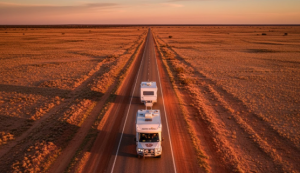
There comes a moment — usually somewhere between your last day of work and the first morning you wake up with nowhere to be — when the idea of driving around Australia stops being a fantasy and starts being a plan.
For grey nomads over 55, that plan has a name: The Big Lap.
Australia’s Highway 1 circles the entire continent for more than 14,500 kilometres, making it one of the longest national highway loops in the world. But the Big Lap is not just one route. It is dozens of possible journeys shaped by your time, your budget, your health, and what you actually want to see. Some grey nomads take three months. Some take three years. Most wish they had taken longer.
This is your complete guide to the best routes, the key stops, the right timing, and everything else you need to drive around Australia as a grey nomad — comfortably, confidently, and without missing the places that matter most.
Why the Big Lap Is Perfect for Over-55s
The Big Lap has become a rite of passage for Australian retirees, and for good reason. Once the kids are grown, the mortgage is paid down, and the alarm clock no longer rules your mornings, you finally have what the Big Lap demands above all else: time.
Unlike younger travellers who might rush the circuit in six weeks, grey nomads take it slow. They stop when something looks interesting. They stay an extra week if they fall in love with a place. They sit around campfires swapping stories with other nomads doing exactly the same thing.
The good news for over-55s is that Highway 1 is almost entirely sealed bitumen, which means you do not need a 4WD for the main route. A well-set-up van, motorhome, or caravan towed by a reliable vehicle will carry you comfortably all the way around. The unsealed tracks — the Gibb River Road, Cape York, the Tanami — are optional adventures for those who want them.
How Long Does It Take to Drive Around Australia?
This is the question every new grey nomad asks, and the honest answer is: longer than you think.
The absolute minimum is around six weeks if you are purely clocking kilometres without stopping. But that is not a holiday — that is a commute. For grey nomads who want to genuinely experience the country, here is a realistic guide based on how much time you have.
Three Months — The Rush
If you only have three months, you will need to be selective. You can cover the main highlights of each state, but you will not have time to linger. It is manageable but most three-month nomads return home feeling they left too soon.
Six Months — The Sweet Spot for First-Timers
Six months allows you to see the headline attractions in every state and territory without feeling constantly rushed. You will average around 200 to 250 kilometres on driving days and still have plenty of rest days built in. This is the length most first-time Big Lappers recommend.
Twelve Months — The Dream
A full year is what experienced grey nomads recommend most often. You can follow the seasons perfectly, take detours into the outback and Cape York, spend a few weeks in Tasmania, and genuinely slow down. Most twelve-month nomads say the year flew by and they wished they had kept going.
Open-Ended — The True Grey Nomad Way
The happiest nomads on the road are often those with no fixed end date. Some work casual harvest jobs along the way, others house-sit or rely on savings. Many are still on the road three or four years after they first left the driveway. If you can, build in the flexibility to extend. You will almost certainly want to.
Clockwise or Anticlockwise? The Great Big Lap Debate
Every grey nomad has an opinion on this question, and it comes up around every campfire from Broome to Bundaberg. The practical truth is that both directions work — but the seasons should drive your decision more than anything else.
The golden rule is simple. You want to be in the tropical north — Queensland’s far north, the Northern Territory, and the Kimberley in WA — during the dry season, which runs from May to October. You want to be in the southern states during their warmer months, from roughly September through February.
Why Most Grey Nomads Choose Anticlockwise
Heading south first before turning west is the most popular choice for east coast grey nomads, and there is good logic behind it. Anticlockwise travellers departing in autumn — say, April or May — hit the Great Ocean Road in pleasant weather, cross the Nullarbor before summer heat sets in, reach Perth in winter which is mild and beautiful, move north through WA in spring, arrive in Darwin for the early dry season, and loop back down the east coast in time for summer. The seasons align almost perfectly.
When Clockwise Makes More Sense
Heading north first works well if you are departing in winter and want to chase warmth immediately. Head straight up to Queensland, across the top to Darwin, down through WA, across the Nullarbor, and back up the east coast. The main challenge is timing the Nullarbor crossing to avoid the brutal summer heat of December through February. If you are starting from Queensland or northern New South Wales, a clockwise departure in late October or November can work very well.
The Complete Grey Nomad Big Lap Itinerary
The itinerary below follows an anticlockwise route starting from Sydney. Adjust your starting point and timing to suit where you live. Distances and timeframes are guides only — the freedom to change your mind at any moment is the whole point.
Stage One — Sydney to Melbourne
Allow 2 to 3 weeks
Skip the freeway and take the coastal Princes Highway through the NSW South Coast. It is one of the most underrated drives in the country, winding through Royal National Park, Kiama, Batemans Bay, Narooma, and Merimbula before crossing into Victoria.
Jervis Bay deserves a stop for some of the whitest sand you will ever walk on. Narooma is beautiful for its estuary inlet and the nearby Montague Island seal colony. Eden, near the Victorian border, is one of the best spots in Australia for whale watching between September and November. Give yourself more time on the NSW South Coast than you think you need — it has a way of slowing you down, and that is a very good thing.
Melbourne itself deserves at least a week. The Queen Victoria Market, the Dandenong Ranges, the Mornington Peninsula hot springs, and the Yarra Valley wine region are all within easy reach of the city.
Stage Two — The Great Ocean Road
Allow 2 to 3 weeks
This is one of the world’s great coastal drives, and the grey nomads who rush it always say they wish they had taken more time. The Twelve Apostles are the famous showpiece, but the drive itself — twisting along clifftops, dipping through rainforest townships, passing lighthouses and surf beaches — is the real experience.
Lorne is a charming stop with waterfalls close by. Cape Otway Lighthouse almost guarantees koala sightings in the trees above the road. Port Campbell and the Twelve Apostles are best visited at sunrise before the tour buses arrive. Warrnambool is worth knowing about for its winter whale nursery, where southern right whales come to calve in the bay. From Warrnambool, most grey nomads cut across to South Australia through the Grampians — dramatic sandstone ranges that are spectacular in spring wildflower season.
Stage Three — South Australia
Allow 3 to 4 weeks
South Australia rewards slow travellers more than almost any other state. The Barossa Valley and Clare Valley wine regions are a natural first stop. Kangaroo Island — reached by ferry from Cape Jervis — deserves three to five days at minimum. The wildlife is extraordinary: sea lions, fur seals, koalas, and the Remarkable Rocks are all genuinely worth the crossing.
The Flinders Ranges in the state’s north offer ancient geology, stunning gorges, and outstanding birdlife. Coober Pedy, the underground opal mining town, is unlike anywhere else you will visit in your life. The Nullarbor crossing completes this leg. Fill the tank at every roadhouse, carry extra water, and enjoy the extraordinary emptiness. The Bunda Cliffs, where the plain drops straight into the Southern Ocean, are one of the great unsung sights of the entire lap.
Stage Four — Western Australia, the South West
Allow 3 to 4 weeks
Western Australia is so large it would be the world’s fourth biggest country if it were a nation. Most grey nomads spend more time here than anywhere else and still feel they have only scratched the surface.
Esperance and Cape Le Grand National Park deliver Lucky Bay — a beach where kangaroos lie on the sand beside the water, one of the most photographed scenes in Australia and one that genuinely lives up to its reputation. Albany is a historic port city with whale watching and access to the ancient karri and tingle forests nearby. The Valley of the Giants near Denmark offers a canopy walkway through 400-year-old tingle trees that puts even the most seasoned traveller back in their place. Margaret River deserves a dedicated stop for its surf, world-class wineries, and spectacular cave system. Perth and Fremantle round out the south-west, and a ferry to Rottnest Island for quokka encounters is worth the day trip.
Stage Five — Western Australia, the North West
Allow 4 to 6 weeks
If you ask grey nomads which part of the Big Lap surprised them most, the north-west of Western Australia wins more often than anywhere else. It is remote, spectacular, and unlike anywhere else in the world.
Kalbarri National Park’s gorge country and new skywalk are extraordinary. Monkey Mia’s wild dolphin feeding — where dolphins come to shore each morning — is one of those experiences that stays with you long after the trip is finished. Ningaloo Reef near Exmouth offers snorkelling that many experienced divers argue betters the Great Barrier Reef, without the crowds. Whale shark season runs from March to July and sits on most grey nomads’ bucket lists.
Karijini National Park is one of the great hidden gems of Australia — deep gorges, clear waterholes, and ancient rock formations that make you feel you are standing on another planet. Allow three to four days minimum. Broome and Cable Beach are iconic for good reason, and the Staircase to the Moon over Roebuck Bay is the kind of natural spectacle that never gets old. The Kimberley is where grey nomads most often say they wished they had built in more time. If there is anywhere on the Big Lap to slow down and stay longer than planned, it is here.
Stage Six — The Northern Territory
Allow 3 to 4 weeks
The Northern Territory demands time and delivers it back to you in full.
Katherine and Nitmiluk Gorge are a superb introduction to the Territory, with boat cruises through the gorge system that are peaceful and stunning. Darwin deserves four to five days — the Mindil Beach Sunset Markets, the Second World War history, and access to Kakadu are all worth your time. Kakadu National Park is one of the world’s great wilderness areas. The Ubirr rock art, the Yellow Water Billabong cruise at dawn, and Jim Jim Falls in the dry season are experiences that have no equivalent elsewhere in Australia.
The Red Centre side trip via the Stuart Highway is the most popular detour on the entire Big Lap, and it earns that status. Uluru at sunrise, the Valley of the Winds walk at Kata Tjuta, and the rim walk at Kings Canyon collectively represent some of the most profound landscape experiences Australia offers. Do not rush this leg.
Stage Seven — Queensland
Allow 6 to 8 weeks
Queensland is vast and varied. For most grey nomads, the journey from Cairns south down the coast is the main event — and it delivers.
Cairns is the base for Great Barrier Reef day trips and the Daintree Rainforest, the oldest tropical rainforest on Earth. The Whitsundays are worth a sailing day trip from Airlie Beach. Eungella National Park near Mackay is the best place in Queensland to spot wild platypus — go at dawn or dusk to the creek at Broken River.
Mon Repos Conservation Park near Bundaberg is one of the most important loggerhead turtle nesting sites in the Pacific. Between November and March, rangers lead guided tours to watch turtles nest or hatchlings make their way to the sea. Book well ahead — this experience sells out fast and is genuinely unforgettable.
Fraser Island, now known as K’gari, is a World Heritage-listed sand island with freshwater lakes, coloured sand cliffs, and dingoes that roam the beach freely. A 4WD is essential for independent travel on the island, but tours are available for those without one. From Noosa south through Brisbane and the Gold Coast hinterland, you are heading back toward New South Wales — and the completion of your loop.
Essential Tips for Grey Nomads Doing the Big Lap
Follow the Seasons Without Compromise
Being in Darwin during the wet season — November through April — is uncomfortable and limits what you can do and see considerably. Crossing the Nullarbor in the height of summer is genuinely punishing. The seasonal rule is the single most important planning decision you will make, so treat it seriously from the start.
Book the Popular Spots Well in Advance
Broome, Exmouth, Monkey Mia, Airlie Beach, and Noosa fill their caravan parks months ahead during peak grey nomad season from May to September. Call ahead or book online well before you arrive. Turning up in the Kimberley during peak season and expecting a site is a gamble you will almost certainly lose.
Get the Right Apps Before You Leave
WikiCamps Australia is the most widely used app among grey nomads for finding free campsites, rest stops, and affordable caravan parks. It costs a small one-off fee and is worth it many times over. Campermate is a solid free alternative. Both apps allow you to read reviews from other travellers, which is far more useful than any tourism brochure.
Plan Your Fuel Stops on Remote Stretches
In outback WA, the Northern Territory, and parts of Queensland, fuel stops can be 200 to 400 kilometres apart. Always fill up when you can. Carry a jerry can with extra fuel on remote stretches and check current road conditions before heading off the main highway. The cost of a tow truck in a remote area makes the price of a jerry can look very reasonable indeed.
Think About Healthcare Access Before You Go
Remote Australia is beautiful, but it is also a long way from a hospital. Download the Emergency+ app, which uses GPS to give your exact location to emergency services. Many grey nomads with ongoing health conditions time their stays in larger centres like Darwin, Alice Springs, Broome, and Cairns to coincide with specialist appointments. Always carry enough medication to last several weeks beyond your planned time away from a pharmacy.
Give the Kimberley More Time Than You Think You Need
Of all the places grey nomads say they wish they had lingered longer, the Kimberley comes up more than anywhere else. If there is one stretch of the Big Lap where flexibility in your itinerary matters most, it is here. Build in extra weeks and use them.
Frequently Asked Questions
How Much Does the Big Lap Cost for Two People?
Costs vary enormously based on your accommodation style and daily spending. As a rough guide, two people can expect to spend between $2,000 and $3,000 per month on a mix of free camping and caravan parks, self-catering most meals, and taking in paid attractions occasionally. Those who stay in powered sites most nights and eat out regularly will spend more. Those who free camp as a default and cook everything themselves can travel comfortably for less.
Do You Need a 4WD for the Big Lap?
No. Highway 1 is entirely sealed and accessible in any vehicle. But a 4WD opens up side trips to the Gibb River Road, Cape York, Fraser Island, and parts of Kakadu that are otherwise out of reach. Many grey nomads tow a caravan with a 4WD specifically for this flexibility.
Is the Big Lap Safe for Solo Grey Nomads?
Absolutely. The community of nomads on the road is warm, welcoming, and genuinely looks out for one another. Solo travellers rarely feel isolated if they stay at caravan parks and popular free camps where other nomads gather. Let someone at home know your general itinerary, check in regularly, and consider a satellite communicator such as a Garmin inReach for remote stretches.
Final Word
The Big Lap is not just a road trip. For most grey nomads who do it, it is the adventure of a lifetime — a chance to see the country they have called home for fifty or sixty years with completely fresh eyes.
The red dirt of the Kimberley at sunset. The eerie silence of the Nullarbor under a full moon. Dolphins at Monkey Mia. Turtles at Mon Repos. The Milky Way over Uluru. Kangaroos stretched out on the white sand at Lucky Bay.
These are not things you will see from a resort balcony or a cruise ship deck. They are the rewards for those willing to load up the van, point it down the highway, and find out what Australia has been quietly keeping for those patient enough to go looking.
The road is waiting. And it is better than you imagined.

As an affiliate, I earn from qualifying purchases at no extra cost to you.
As an affiliate, I earn from qualifying purchases at no extra cost to you.