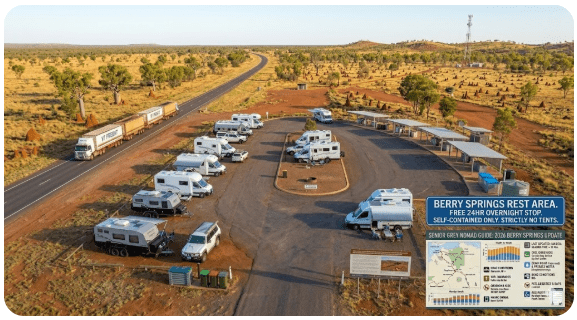
Berry Springs Rest Area Free Camping Senior Grey Nomad Guide 2026
Berry Springs Rest Area sits just a few kilometres south of Darwin in the lush rural zone of Berry Springs, Northern Territory. For grey nomads heading into — or out of — the Top End, it is one of the most convenient free overnight stops within striking distance of a capital city. You get shade shelters, toilets, and a sealed road in and out, all without paying a cent. And Berry Springs Nature Park, with its famous spring-fed swimming holes, is only a short drive away.
This guide covers everything a senior traveller needs to know before pulling in: facilities, road conditions in every direction, fuel distances, crocodile awareness, heat management, wildlife, nearby attractions, dump points, water, phone signal, accessibility, pets, campfire rules, packing lists, and month-by-month weather. It is written specifically for older Australians travelling in caravans, motorhomes, campervans, or converted vans — the people who need accurate detail, not vague suggestions.
All information is current as at early 2026. Conditions in the Top End can change quickly — always cross-check fuel availability and road conditions before you travel.
📑 Table of Contents
- Why Grey Nomads Stop at Berry Springs Rest Area
- Free Camping — Looks Easy, But Know the Limits for Seniors
- Your Two Main Options Side by Side
- Quick Facts and Key Details 2026
- How to Get to Berry Springs Rest Area — Directions from Every Approach
- Road Conditions, Flooding and Surface Types
- Heat, Crocodiles and Remoteness — What It Really Means for Seniors
- Wildlife at Berry Springs — Birds, Reptiles and What to Watch For
- What Berry Springs Rest Area Doesn’t Tell You Online
- Best Time to Visit — Month-by-Month Breakdown
- Free and Low-Cost Camping Near Berry Springs
- Dump Points Near Berry Springs
- Free Water Sources Near Berry Springs
- Fuel Stops — North, South, East and West of Berry Springs
- Berry Springs Caravan Park — The Paid Alternative
- Full Facilities Comparison Table
- Rates — All Options Near Berry Springs 2026
- The Berry Springs Day Plan for Seniors
- Senior Checklist — Berry Springs and Surrounds
- What to Do Near Berry Springs — Senior Activity Guide
- GPS Coordinates and Postcodes — Save Every Stop
- Stargazing at Berry Springs Rest Area
- History of Berry Springs and the Surrounding Area
- Free Camping Etiquette — Leave No Trace
- Waste Management and Grey Water
- Emergency Scenarios and What to Do
- Packing List for Berry Springs Rest Area
- Rest Area Comparison — Berry Springs vs Nearby Alternatives
- Campfires and Cooking at Berry Springs
- Pets at Berry Springs Rest Area
- Accessibility for Seniors with Mobility Limitations
- Phone Signal and Emergency Communications
- Permits and Park Fees
- Reviews — What Real Grey Nomads Say About Berry Springs Rest Area
- People Also Ask — Berry Springs Rest Area
- Frequently Asked Questions
- Quick-Reference Card
- Related Free Camping Guides on NT Highways
- Final Verdict
- Disclaimer
COPY PROMPT ➔ ASK AI ➔ SAVE TO FORM ➔ ADD SPOT PIN ➔ GET DIRECTIONS
📍 Interactive map — find free camps, rest areas and overnight stops. Enable location for best results.
1. Why Grey Nomads Stop at Berry Springs Rest Area
Berry Springs Rest Area is one of the closest free overnight options to Darwin. Sitting roughly 56 km south of the Darwin CBD (and only about 35 km from Palmerston), it lets you camp for free while still being close enough to run errands, see a doctor, stock up at a major supermarket, or visit Top End attractions without a long drive.
For grey nomads arriving from the south — whether you have driven up the Stuart Highway from Katherine or Alice Springs — Berry Springs is the logical place to pull over and decompress before tackling Darwin traffic. For those heading south, it is your last free rest area before the long stretches between rest stops along the Stuart Highway begin to widen.
The nearby Berry Springs Nature Park is a massive draw. Its spring-fed pools are among the few places in the Top End where you can safely swim in fresh, clear water (the pools are regularly monitored for crocodiles). For seniors who have been driving through red dust for days, a swim in those pools is close to heaven.
Other reasons grey nomads choose this spot:
- Free — no fees, no bookings. NT rest areas are maintained by the government and open to all.
- Sealed road access — no corrugated dirt tracks to rattle your caravan.
- Toilets and shade shelters — basic but functional.
- Flat, level ground — important for caravans and for seniors who need stable footing.
- Close to fuel and supplies — the Coolalinga/Humpty Doo commercial area is about 25–30 km east, and Berry Springs itself has a small general store.
- Wildlife — the surrounding bush is alive with birds, wallabies, and monitor lizards.
- Night sky — far enough from Darwin’s lights that the Milky Way is clearly visible on clear Dry Season nights.
2. Free Camping — Looks Easy, But Know the Limits for Seniors
Free camping at NT rest areas is legal and encouraged for traveller safety, but there are limits that every grey nomad should know:
- Maximum stay: 72 hours (3 nights) at any one rest area. This is a Territory-wide regulation. Rangers and local council officers do patrol, particularly in high-season.
- Self-contained expectation: There is no dump point, no potable water, and no power at the rest area. You need your own water, waste management, and power (solar, battery, or generator).
- Generator use: No specific ban exists at this rest area, but keep generators to reasonable daytime hours. Excessive noise complaints can prompt council action.
- No booking system: It is first-come, first-served. During peak Dry Season (June–August) it can fill up, particularly on Friday and Saturday nights when Darwin locals also use the area for day trips.
- No campfires: Open fires are prohibited at most NT rest areas. Use your own gas stove or camp kitchen setup inside your vehicle.
3. Your Two Main Options Side by Side
| Feature | Berry Springs Rest Area (Free) | Berry Springs Caravan Park (Paid) |
|---|---|---|
| Cost | Free | From approx. $35–$50/night (powered site) |
| Toilets | Yes — pit/vault style | Yes — flush, hot showers |
| Showers | No | Yes — hot water |
| Power | No — BYO solar/battery | Yes — 15A powered sites |
| Water | No — BYO | Yes — potable tap water |
| Dump point | No | Yes |
| Pets | Yes (on lead) | Check with park |
| Max stay | 72 hours | No fixed limit |
| Best for | Self-contained rigs, budget travellers, one–two night stops | Extended stays, non-self-contained vehicles, those wanting hot showers and laundry |
4. Quick Facts and Key Details 2026
| Detail | Information |
|---|---|
| Name | Berry Springs Rest Area |
| Location | Cox Peninsula Road, Berry Springs, NT 0838 |
| GPS Coordinates | -12.6994, 130.9958 (approximate — publicly sourced) |
| Postcode | 0838 |
| Cost | Free — no booking required |
| Max stay | 72 hours |
| Road surface | Sealed (Cox Peninsula Road) — gravel within rest area |
| Suitable for | Caravans, motorhomes, campervans, swags, tents |
| Toilets | Yes — basic (pit/vault) |
| Drinking water | No — BYO |
| Dump point | No — nearest at Coolalinga ~30 km |
| Phone signal | Telstra 4G (moderate), Optus (patchy), Vodafone (unreliable) |
| Nearest town | Berry Springs (~3 km), Coolalinga (~30 km), Darwin CBD (~56 km) |
| Public WiFi | Not at rest area. Nearest free WiFi at Palmerston Library (~35 km) or Darwin CBD (~56 km) |
| Pets | Allowed — on lead at all times |
| Campfires | No open fires — gas stoves only |
5. How to Get to Berry Springs Rest Area — Directions from Every Approach
From Darwin (North — ~56 km, ~45 minutes)
- Head south from Darwin CBD on the Stuart Highway.
- Continue through Palmerston and past Noonamah.
- Turn right (west) onto the Cox Peninsula Road at the clearly signed intersection approximately 45 km south of Darwin CBD.
- Follow Cox Peninsula Road for approximately 10–12 km. Berry Springs Rest Area is on your left (south side of the road).
- The entire route is sealed. Suitable for all vehicles including full-length caravans.
From Katherine (South — ~345 km, ~3.5 hours)
- Drive north on the Stuart Highway from Katherine.
- Pass through Pine Creek, Adelaide River, and Noonamah.
- Turn left (west) onto Cox Peninsula Road.
- Follow Cox Peninsula Road approximately 10–12 km to the rest area.
- Fully sealed road the entire way. Fuel available at Adelaide River, Noonamah, and Coolalinga.
From the West (Cox Peninsula Road continuation)
If you have been exploring the Cox Peninsula (towards Wagait Beach or Mandorah), Berry Springs Rest Area is on Cox Peninsula Road heading east. The road is sealed for much of this route, but sections closer to the coast can be rough or flood-affected during the Wet Season. Allow extra time and check NT road reports.
From the East (Arnhem Highway direction)
If approaching from Kakadu or the Arnhem Highway, rejoin the Stuart Highway at the Arnhem Highway junction (near Humpty Doo) and head south briefly before turning west onto Cox Peninsula Road. This entire route is sealed.
6. Road Conditions, Flooding and Surface Types
Cox Peninsula Road
Surface: Sealed two-lane road with marked centre line. Generally well-maintained.
Width: Adequate for caravans and motorhomes. Some sections lack sealed shoulders, so take care when passing road trains.
Flooding: The road itself is elevated and sealed, and rarely floods. However, low-lying creek crossings between the Stuart Highway junction and Berry Springs may experience water over the road during intense monsoonal downpours (December–March). These events are usually brief (hours, not days), but check roadreport.nt.gov.au before travelling in the Wet Season.
Stuart Highway (north–south)
Surface: Fully sealed dual carriageway for much of the Darwin–Palmerston section, then sealed two-lane highway south of Noonamah.
Flooding: The Stuart Highway is the Territory’s main arterial road and is maintained to a high standard. Flooding is extremely rare on the highway itself, though feeder roads and access tracks to properties may be cut during the Wet.
Speed limit: 130 km/h on open highway sections (not applicable to vehicles towing over a certain length — check NT road rules).
Road trains: Common south of Noonamah. Give them room.
Within the Rest Area
Surface: Compacted gravel/laterite. Level and firm in the Dry Season. Can become soft and slippery after rain in the Wet Season. Not a bog risk for caravans in the Dry, but exercise caution after rain.
Turning room: Adequate for standard caravans (up to about 7–8 metres). Very large fifth-wheelers or combinations over 20 metres total should scout the turning area before committing.
7. Heat, Crocodiles and Remoteness — What It Really Means for Seniors
Heat and Humidity
Berry Springs sits at latitude 12.7°S — firmly in the tropics. Even in the Dry Season, daily maximums regularly reach 32–34°C. In the Build-Up (October–November), temperatures can exceed 38°C with humidity above 70%, creating dangerous heat-stress conditions for seniors.
What this means for your rig: If you rely on a rooftop air conditioner, you will need to run your generator or have a very substantial lithium battery bank and solar array to keep it going through the afternoon heat. Absorption-style caravan fridges can struggle when ambient temperatures exceed 38°C — consider a compressor fridge or supplementary cooling.
Hydration: Drink a minimum of 3 litres of water per day. Seniors on blood pressure medication, diuretics, or heart medication are at elevated risk of heat-related illness. Carry oral rehydration sachets and monitor for signs of heat exhaustion: confusion, rapid pulse, headache, nausea.
Crocodiles
There is no gentle way to say this: saltwater crocodiles live in every waterway in the Berry Springs region. They inhabit creeks, dams, drainage channels, and storm-water pools. They are present year-round, though they are more active and more likely to be encountered away from their usual territory during the Wet Season when floodwaters spread them across the landscape.
The Berry Springs Nature Park swimming area is actively managed — rangers set traps and survey the pools, and the spring-fed water makes crocodile presence less likely (though not impossible). Every other waterway in the area is unmanaged and should be treated as if a crocodile is present.
- Do not walk near creek edges, even at the rest area.
- Do not let pets drink from natural water sources.
- Do not fish from creek banks without extreme caution.
- Never camp within 50 metres of a waterway.
Remoteness
Berry Springs Rest Area is not truly remote — it is within an hour of Darwin, and help (ambulance, police, fire) is relatively accessible. The nearest hospital is Royal Darwin Hospital (about 55 km away, ~40 minutes drive). The nearest medical clinic is in Palmerston (~35 km, ~25 minutes). However, in an emergency during the Wet Season, flood-affected roads could delay response times. Carry a first-aid kit, have a charged phone, and know that Triple Zero (000) works on any Australian mobile network with signal.
8. Wildlife at Berry Springs — Birds, Reptiles and What to Watch For
The Berry Springs area is a biodiversity hotspot. The combination of monsoon vine forest, open woodland, and freshwater springs creates habitat for an extraordinary range of species. For grey nomads who enjoy birdwatching or nature photography, this is one of the best locations within easy reach of Darwin.
Birds
- Rainbow Bee-eaters — common in open woodland around the rest area, particularly May–October.
- Blue-winged Kookaburras — you will hear them at dawn.
- Red-tailed Black Cockatoos — often seen in flocks feeding in eucalyptus trees.
- Great Bowerbirds — look for their bowers on the ground near the bush edge.
- Orange-footed Scrubfowl — these large mound-builders are common and noisy.
- Azure Kingfishers — at Berry Springs Nature Park near the pools.
- Jabiru (Black-necked Stork) — occasional visitor to wetland areas nearby.
- Whistling Kites and Brahminy Kites — raptors are common overhead.
Reptiles
- Saltwater crocodiles — in surrounding waterways (see Section 7).
- Freshwater crocodiles — present in Berry Springs Nature Park pools (generally not aggressive to humans but do not approach or feed them).
- Monitor lizards (goannas) — large sand monitors are common around picnic areas and rest areas. They will investigate food smells. Secure all rubbish.
- Frill-necked lizards — occasionally seen on road edges and tree trunks.
- Snakes — king brown (mulga) snakes, western brown snakes, and death adders are all present in the area. Watch where you step, especially at dusk and dawn. Do not walk through long grass.
Mammals and Insects
- Agile wallabies — often seen grazing near the road edges at dawn and dusk. Significant collision risk for drivers.
- Flying foxes — large fruit bat colonies roost in nearby monsoon forest.
- Mosquitoes — ever-present in the Top End. Use repellent containing DEET or picaridin. Ross River virus and Murray Valley encephalitis are transmitted by mosquitoes in this region.
- March flies (horse flies) — painful bite. Common near water, particularly in the Wet Season and Build-Up.
- Sandflies — present in some areas, especially near estuarine mud flats further west.
✅ Never swim in unmanaged waterways
✅ Camp at least 50 m from any water
✅ Do not clean fish at the water’s edge
✅ Keep pets on a lead and away from water
✅ Store food securely — goannas and dingoes are opportunistic
✅ Be especially cautious in the Wet Season when floodwater moves crocs into unexpected areas
9. What Berry Springs Rest Area Doesn’t Tell You Online
Most online listings for Berry Springs Rest Area are a bare-bones pin on a map with “free camping, toilets, tables.” Here is what they leave out:
- The toilets can be unpleasant in the Wet Season — high temperatures and humidity accelerate decomposition in pit-style toilets. Carry your own toilet paper (it frequently runs out) and hand sanitiser.
- Shade is limited to the shelters — if those are occupied, there is minimal natural shade for parking a large rig. The eucalyptus woodland is not dense enough to shade a caravan in the midday sun. Arrive early in the Dry Season (before 2 pm) to secure a shaded spot.
- Road noise — the rest area is right beside Cox Peninsula Road. While traffic is not heavy at night, you will hear early-morning vehicles from about 5:30 am as local workers commute.
- No rubbish bins in some seasons — bins may be removed or not serviced during quieter months. Always carry your own bin bags and pack out what you pack in.
- The rest area is also used by day-trippers — particularly on weekends, families and locals use the picnic shelters during the day, so it is not exclusively a camping area.
- No security — as with any free camp, there is no security presence. Keep valuables locked away and out of sight.
- Water runoff after rain — the gravel pads can channel water during downpours. Park on the highest ground available.
10. Best Time to Visit — Month-by-Month Breakdown
| Month | Season | Temp (°C) | Rain | Camping Rating |
|---|---|---|---|---|
| January | Wet | 25–34 | Very high (400+ mm) | ⛔ Not recommended |
| February | Wet | 25–34 | Very high (350+ mm) | ⛔ Not recommended |
| March | Wet | 25–34 | High (300+ mm) | ⛔ Not recommended |
| April | Late Wet / Early Dry | 24–34 | Moderate (100 mm) | ⚠️ Possible — check roads |
| May | Dry | 22–33 | Low (20 mm) | ✅ Excellent |
| June | Dry | 20–31 | Minimal (2 mm) | ✅ Best month |
| July | Dry | 19–31 | Minimal (1 mm) | ✅ Best month |
| August | Dry | 20–32 | Minimal (2 mm) | ✅ Excellent (peak season — busy) |
| September | Dry / Build-Up | 23–34 | Low (15 mm) | ✅ Good — getting warmer |
| October | Build-Up | 25–35 | Moderate (70 mm) | ⚠️ Hot and humid — for experienced travellers only |
| November | Build-Up / Early Wet | 25–34 | High (140 mm) | ⛔ Not recommended |
| December | Wet | 25–34 | Very high (250 mm) | ⛔ Not recommended |
11. Free and Low-Cost Camping Near Berry Springs
| Camp / Rest Area | Distance | Cost | Notes |
|---|---|---|---|
| Berry Springs Rest Area | — | Free | This guide’s subject. Toilets, shelters, no water |
| Noonamah Rest Area | ~25 km east | Free | Stuart Highway. Toilets, tables. Road train noise. |
| Adelaide River Show Ground | ~90 km south | Low cost / donation | Toilets, water, power. Good for longer stays. |
| Robin Falls Rest Area | ~110 km south | Free | Short walk to waterfall. Toilets. Popular Dry Season stop. |
| Howard Springs Nature Park | ~25 km north-east | Free day use / no overnight | Swimming, BBQs. No camping permitted. |
12. Dump Points Near Berry Springs
| Location | Distance from Berry Springs RA | Cost | Notes |
|---|---|---|---|
| Coolalinga area (various service stations / caravan dealers) | ~30 km | Free / gold coin | Check locally — availability may vary by business |
| Palmerston — various caravan parks | ~35 km | Fee varies ($5–$10) | Phone ahead to confirm access for non-guests |
| Darwin — Hidden Valley area | ~56 km | Fee varies | Several caravan parks with dump points |
| Adelaide River township | ~90 km south | Free (public) | Public dump point near the showground. Confirm current status. |
13. Free Water Sources Near Berry Springs
There is no potable water at Berry Springs Rest Area. You must carry all drinking and cooking water with you. Here are your nearest fill-up options:
- Berry Springs township: The Berry Springs Tavern or general store may allow water fill-ups — ask politely. (~3 km)
- Coolalinga: Service stations with water taps. (~30 km east)
- Noonamah: Some service stations. (~25 km east)
- Palmerston: Council water taps, service stations, and caravan parks. (~35 km)
- Darwin: Multiple options. (~56 km)
14. Fuel Stops — North, South, East and West of Berry Springs
Fuel planning is critical for any Top End trip. While Berry Springs is close to Darwin, fuel is consistently more expensive in the NT than in southern states. Top up whenever you can.
Going North (towards Darwin)
| Station / Town | Distance from Berry Springs RA | Fuel Types |
|---|---|---|
| Coolalinga (multiple stations) | ~30 km | ULP, Diesel, E10 |
| Palmerston (multiple stations) | ~35 km | ULP, Diesel, Premium, E10, LPG |
| Darwin CBD / Stuart Park | ~56 km | All fuel types |
Going South (towards Katherine)
| Station / Town | Distance from Berry Springs RA | Fuel Types |
|---|---|---|
| Noonamah | ~25 km (via Cox Peninsula Rd to Stuart Hwy) | ULP, Diesel |
| Adelaide River | ~90 km | ULP, Diesel |
| Pine Creek | ~200 km | ULP, Diesel |
| Katherine | ~345 km | All fuel types, multiple stations |
Going East (towards Kakadu / Arnhem Highway)
| Station / Town | Distance from Berry Springs RA | Fuel Types |
|---|---|---|
| Humpty Doo | ~28 km | ULP, Diesel |
| Bark Hut Inn (Arnhem Hwy) | ~85 km | ULP, Diesel |
| Jabiru (Kakadu) | ~210 km | ULP, Diesel |
Going West (Cox Peninsula Road towards Wagait Beach / Mandorah)
There are no fuel stations west of Berry Springs on Cox Peninsula Road. If you plan to explore the Cox Peninsula, fill up at Berry Springs or Coolalinga before heading west. The round trip to Mandorah and back is approximately 120 km from the rest area.
15. Berry Springs Caravan Park — The Paid Alternative
If you want powered sites, hot showers, laundry, and a dump point, Berry Springs has a small caravan park located on the Cox Peninsula Road, just a few kilometres from the rest area. It is a simple, no-frills park but offers the essentials that the rest area lacks.
- Powered sites: Yes — 15A
- Unpowered sites: Yes
- Amenities: Hot showers, flush toilets, laundry, camp kitchen (basic)
- Dump point: Yes
- Potable water: Yes
- Pets: Check with management — policies may vary
- Rates (2026 guide prices): Approximately $35–$50 per night for a powered site for two adults. Unpowered from approximately $25–$35. These are approximate only — contact the park directly for current pricing.
- Booking: Recommended in the Dry Season (June–August), especially for longer stays.
16. Full Facilities Comparison Table
| Facility | Berry Springs RA | Berry Springs Caravan Park | Noonamah RA |
|---|---|---|---|
| Toilets | ✅ Pit | ✅ Flush | ✅ Pit |
| Showers | ❌ | ✅ Hot | ❌ |
| Power | ❌ | ✅ 15A | ❌ |
| Drinking water | ❌ | ✅ | ❌ |
| Dump point | ❌ | ✅ | ❌ |
| Shade shelters | ✅ | ✅ | ✅ |
| Picnic tables | ✅ | ✅ | ✅ |
| Cost | Free | $35–$50/night | Free |
17. Rates — All Options Near Berry Springs 2026
| Option | Nightly Rate (approx.) | Weekly Rate (approx.) |
|---|---|---|
| Berry Springs Rest Area | Free | Free (max 72 hrs) |
| Berry Springs Caravan Park — unpowered | $25–$35 | $150–$220 |
| Berry Springs Caravan Park — powered | $35–$50 | $210–$300 |
| Darwin caravan parks (average) | $45–$65 | $280–$400 |
All rates are approximate guide prices for 2026 and may change. Contact venues directly for current pricing.
18. The Berry Springs Day Plan for Seniors
Here is a relaxed day plan designed specifically for older travellers based at Berry Springs Rest Area during the Dry Season:
| Time | Activity |
|---|---|
| 6:00 am | Wake with the birds. Coffee under the shelter. Temperature is pleasant — low 20s. |
| 7:00 am | Light breakfast. Watch for rainbow bee-eaters and kookaburras. |
| 8:30 am | Drive 3 km to Berry Springs Nature Park. Arrive early for the best swimming — pools are calmest before 10 am. |
| 10:30 am | Walk the monsoon vine forest trail (flat, easy, shaded — ~1 km loop). |
| 11:30 am | Visit Territory Wildlife Park (10 km away) — allow 2–3 hours. Excellent for seniors. Mostly shaded paths, shuttle train available. |
| 2:00 pm | Return to rest area. Rest during the hottest part of the day. Read, nap, rehydrate. |
| 4:30 pm | Afternoon tea. Set up chairs. Watch the afternoon light change. |
| 5:30 pm | Cook dinner (gas stove). Sunset around 6:30 pm in the Dry Season. |
| 7:00 pm | Stargazing. The Milky Way is spectacular on clear nights. |
| 8:30 pm | Early night. You will wake early in the tropics — embrace it. |
19. Senior Checklist — Berry Springs and Surrounds
📋 Downloadable Senior Checklist — Berry Springs Rest Area
Print this or save it to your phone before you head to the Top End.
- ☐ Full water tanks (minimum 80 litres for 2 people, 3 days)
- ☐ Solar/battery system charged and tested
- ☐ Portable waste tank (cassette or dump tank)
- ☐ Insect repellent (DEET or picaridin based)
- ☐ Fly net / head net
- ☐ Sunscreen SPF 50+
- ☐ Wide-brim hat
- ☐ Oral rehydration sachets
- ☐ Prescription medications (at least 2 weeks’ supply ahead)
- ☐ First-aid kit with snake bandage
- ☐ Torch / headlamp (for night toilet trips)
- ☐ Enclosed shoes (snake protection)
- ☐ Toilet paper and hand sanitiser (rest area may run out)
- ☐ Rubbish bags (pack out everything)
- ☐ Gas stove and fuel (no campfires)
- ☐ NT road conditions report checked: roadreport.nt.gov.au
- ☐ Telstra-network phone or booster antenna
- ☐ Emergency contacts saved in phone
- ☐ Berry Springs Nature Park entry (free) — swimwear and towel packed
20. What to Do Near Berry Springs — Senior Activity Guide
Berry Springs Nature Park (3 km)
The star attraction. Crystal-clear, spring-fed swimming pools surrounded by monsoon vine forest. The pools are managed for crocodile safety (rangers monitor regularly). There is a flat walking trail through the monsoon forest — suitable for most seniors. Free entry. Toilets, picnic areas, and BBQs on-site. Opens at 8 am, closes at 6:30 pm (Dry Season hours — check current times).
Territory Wildlife Park (10 km)
A world-class wildlife park showcasing Top End species. Features include an aquarium (with sawfish, barramundi, and freshwater crocodiles), walk-through aviaries, a nocturnal house, and open-range exhibits. A shuttle train runs around the park — excellent for seniors with mobility issues. Entry fee applies (approximately $30–$37 adults, concession rates may apply — check current pricing). Allow 2–4 hours.
WWII Heritage
During World War II, Berry Springs served as a rest and recreation area for military personnel. Remnants of old structures and foundations can still be seen near the nature park. Interpretive signage explains the wartime history. A gentle, sobering walk through history.
Tumbling Waters (20 km)
A seasonal waterfall and swimming hole in the Wet Season and early Dry Season. Access road can be rough (check conditions). The walk is moderately steep — assess your mobility before attempting.
Darwin Day Trip (56 km)
Darwin offers museums (Museum and Art Gallery of the NT — free entry), the Waterfront Precinct, Mindil Beach Sunset Markets (Thursday and Sunday evenings, Dry Season), Crocosaurus Cove, and excellent Asian-inspired dining. A full day trip from Berry Springs is easily achievable.
Litchfield National Park (50–70 km)
Florence Falls, Wangi Falls, and Buley Rockhole are all within an easy day trip from Berry Springs. Sealed road access to all major sites. Some walks involve stairs — check individual trail difficulty before committing. Entry is free (no park fees for Litchfield in 2026).
21. GPS Coordinates and Postcodes — Save Every Stop
| Location | Latitude | Longitude | Postcode | Source |
|---|---|---|---|---|
| Berry Springs Rest Area | -12.6994 | 130.9958 | 0838 | Publicly available mapping data |
| Berry Springs Nature Park | -12.7012 | 130.9734 | 0838 | NT Parks & Wildlife / public mapping |
| Territory Wildlife Park | -12.7106 | 130.9496 | 0838 | Public mapping |
| Coolalinga (fuel/shops) | -12.5209 | 131.0483 | 0839 | Public mapping |
| Noonamah Rest Area | -12.6342 | 131.0672 | 0837 | Public mapping |
22. Stargazing at Berry Springs Rest Area
Berry Springs Rest Area is approximately 56 km from Darwin’s light pollution, which means the night sky — particularly in the Dry Season — is significantly better than anything you would see from a Darwin suburban caravan park. On moonless nights in June, July, and August, the Milky Way stretches across the entire sky from horizon to horizon.
Because Berry Springs is at latitude 12.7°S, you can see constellations that are difficult or impossible to view from southern Australia. The Southern Cross sits high, and northern-hemisphere constellations like Orion are visible in the early Dry Season evenings. For seniors who enjoy astronomy, bring a set of binoculars (even 10x50s will reveal star clusters, nebulae, and the moons of Jupiter).
23. History of Berry Springs and the Surrounding Area
The Berry Springs area has a deep and layered history. The Larrakia people are the Traditional Owners of the Darwin region, and the land around Berry Springs has been used by Indigenous Australians for thousands of years. The freshwater springs were a significant resource.
European settlement in the area came relatively late. The springs were named after Captain Berry, an early colonial figure. During World War II, Berry Springs became an important military rest and recreation area. Troops stationed in and around Darwin used the springs for swimming and relaxation between operations. Remnants of the wartime infrastructure — including concrete foundations and old access tracks — can still be found near Berry Springs Nature Park and are interpreted with signage.
In the post-war decades, Berry Springs developed as a small rural community. The nature park was formally established by the NT government to protect the spring-fed ecosystem and provide public recreation. The Territory Wildlife Park opened in 1989 and has become one of the NT’s most popular tourist attractions.
Cyclone Tracy devastated Darwin in December 1974. While Berry Springs is south of Darwin’s core and suffered less damage, the community contributed to the recovery effort. The event remains part of the collective memory of every Top End community.
24. Free Camping Etiquette — Leave No Trace
- Take all rubbish with you. If bins are full or removed, pack out everything — food scraps, cans, bottles, toilet paper wrappers, everything.
- Do not dump grey water on the ground. Use a portable grey water tank and empty at a designated dump point.
- Keep noise to a minimum after 9 pm. Many grey nomads rise early and retire early. Respect this.
- Do not monopolise shade shelters. These are shared facilities. Set up your camp at your vehicle and use shelters for meals or socialising.
- Leave the site cleaner than you found it. Pick up any rubbish left by others — this is how we keep free camping available for everyone.
- Respect the 72-hour limit. Overstaying invites council enforcement and risks the rest area being closed to overnighters.
- Be friendly but not intrusive. A wave and a “G’day” go a long way. Not everyone wants extended conversation.
25. Waste Management and Grey Water
There is no dump point at Berry Springs Rest Area. You must manage all waste responsibly:
- Black water (toilet waste): Use your onboard cassette toilet or portable toilet. Empty at the nearest dump point (see Section 12).
- Grey water (sink and shower waste): Collect in a portable grey water tank. Do not pour on the ground — this attracts insects, creates odour, and is environmentally damaging in the tropical environment.
- Solid waste: Bag and take to the nearest town bin. If the rest area bins are available and not full, you may use them for small amounts of general household waste — but do not dump large quantities.
- Recycling: The NT has a 10c container deposit scheme. Keep cans and bottles separate and redeem them at a collection point in Palmerston or Darwin.
26. Emergency Scenarios and What to Do
| Emergency | Action |
|---|---|
| Snake bite | Apply pressure immobilisation bandage. Do NOT wash the bite (venom ID). Call 000. Drive to Royal Darwin Hospital (~55 km). |
| Crocodile encounter | Back away slowly. Do not run towards water. Call 000 if anyone is injured. Report sighting to NT Parks & Wildlife: 08 8999 4555. |
| Heat stroke / heat exhaustion | Move person to shade. Cool with wet cloths. Give small sips of water if conscious. Call 000 immediately if confusion, loss of consciousness, or high body temperature occurs. |
| Vehicle breakdown | Stay with your vehicle. Use phone signal to call your roadside assistance provider (AANT in NT). Berry Springs has Telstra coverage — call should be possible. |
| Medical emergency (heart, stroke, fall) | Call 000. Nearest hospital: Royal Darwin Hospital. Nearest clinic: Palmerston. Request ambulance — they can reach Berry Springs in approximately 30–40 minutes in normal conditions. |
| Cyclone / severe storm warning | Do NOT shelter in a tent or annexe. Move to a solid structure — Berry Springs Tavern or drive to Palmerston/Darwin. Monitor BOM warnings and ABC local radio. |
🚨 Triple Zero: 000 (ambulance, police, fire)
📞 NT Police non-emergency: 131 444
🐊 NT Parks & Wildlife (croc reports): 08 8999 4555
🚗 AANT Roadside Assistance: 13 11 11
27. Packing List for Berry Springs Rest Area
🎒 Essential Packing List — Top End Free Camping
Water & Food:
- Full water tanks (minimum 80 litres for 2 people, 3 days)
- Additional bottled water as backup
- Non-perishable food for 3+ days
- Gas stove and spare fuel canisters
- Esky with ice or 12V fridge/freezer
Health & Safety:
- First-aid kit (include snake bandage, burn gel, antiseptic)
- Prescription medications — at least 2 weeks’ supply
- Oral rehydration sachets
- Sunscreen SPF 50+ and lip balm with SPF
- Insect repellent (DEET or picaridin — tropical strength)
- Fly/mosquito net for head
- Antihistamine cream (insect bites)
Comfort & Utility:
- Shade awning or tarp (if rest area shelters are full)
- Camp chairs with armrests (easier for seniors to stand up from)
- Torch/headlamp with fresh batteries
- Enclosed shoes for night walks and snake country
- Toilet paper and hand sanitiser
- Rubbish bags (heavy duty)
- Portable grey water tank
- Solar panel and battery monitor
Entertainment:
- Binoculars (birdwatching and stargazing)
- Bird field guide — Simpson & Day or Pizzey & Knight
- Camera
- Books, cards, crosswords
28. Rest Area Comparison — Berry Springs vs Nearby Alternatives
| Feature | Berry Springs RA | Noonamah RA | Robin Falls RA |
|---|---|---|---|
| Distance to Darwin | 56 km | 38 km | ~170 km |
| Toilets | ✅ | ✅ | ✅ |
| Natural attraction nearby | Berry Springs NP (3 km) | None immediate | Robin Falls (1 km walk) |
| Road noise | Moderate | High (Stuart Hwy + road trains) | Low |
| Shade | Shelters + some trees | Shelters | Good natural shade |
| Phone signal | Telstra 4G (mod.) | Telstra 4G (good) | Telstra (patchy) |
| Best for seniors | ⭐⭐⭐⭐ | ⭐⭐⭐ | ⭐⭐⭐⭐ |
29. Campfires and Cooking at Berry Springs
Open fires are not permitted at Berry Springs Rest Area. The NT has strict fire regulations, particularly during the Dry Season when the landscape is tinder-dry and bushfires are a serious risk. Fire bans are common from May through October.
What you can use:
- Gas stoves (butane or propane) — the most practical option.
- Self-contained gas BBQs — bring your own, set up at your vehicle or at a picnic table.
- 12V electric cookers or microwave (if your battery system supports it).
What you cannot do:
- Light any ground fire or wood fire.
- Use a fire pit or fire ring (none are provided).
- Burn rubbish.
30. Pets at Berry Springs Rest Area
Pets are allowed at Berry Springs Rest Area. Keep the following in mind:
- On lead at all times. This is for your pet’s safety as much as the wildlife’s. Goannas, snakes, and cane toads are all threats to dogs.
- Cane toads: These are extremely common in the Top End, especially after rain. They are fatally toxic to dogs. If your dog mouths or licks a cane toad, rinse its mouth immediately with running water (angled so the water runs out, not down the throat) and get to a vet urgently. The nearest emergency vet is in Darwin (~56 km).
- Paralysis ticks: Present in the Top End. Check your dog daily — especially around the head, neck, and between the toes.
- Heat: Dogs suffer from heat stress faster than humans. Provide shade, constant access to fresh water, and never leave a dog in a vehicle.
- Berry Springs Nature Park: Pets are NOT allowed inside the nature park. Leave your pet secure and cool in your rig while you visit.
31. Accessibility for Seniors with Mobility Limitations
Berry Springs Rest Area is relatively accessible for a free camp:
- Ground surface: Compacted gravel — reasonably firm and level in the Dry Season. Wheelchair users and those with walkers should find it manageable on the main pads, though softer areas near the bush edge could be difficult.
- Toilets: Pit-style toilets are basic. They may not meet full disability access standards (step up, narrow door). Check your individual needs before relying on them.
- Picnic tables: Standard design with bench seating — not wheelchair-accessible.
- Berry Springs Nature Park: The main pool area is accessible via a sealed path and there is a wheelchair-accessible viewing platform. However, the pools themselves are accessed via steps or slippery rocks.
- Territory Wildlife Park: Excellent accessibility. Sealed paths, shuttle train, and facilities designed for wheelchair and mobility-aid users.
32. Phone Signal and Emergency Communications
- Telstra: 4G coverage — moderate. You should be able to make calls, send texts, and get basic internet. Signal may drop inside vehicles with metal roofs — step outside or use an external antenna/booster.
- Optus: 4G/3G — patchy. May work for calls but data can be unreliable. Not recommended as your sole communications device in the Top End.
- Vodafone: Very unreliable at Berry Springs. Not recommended.
- Satellite communicators: Devices like the Garmin inReach or Zoleo work everywhere and are highly recommended for any NT travel, even in areas with mobile coverage. They provide an emergency SOS function independent of mobile networks.
- 000 calls: Triple Zero calls will connect on any network with signal — your phone will use whichever carrier is available, even if you are not subscribed to it.
33. Permits and Park Fees
- Berry Springs Rest Area: No permit required. Free access.
- Berry Springs Nature Park: Free entry. No permit required.
- Territory Wildlife Park: Entry fee applies (approximately $30–$37 adults, concession available — check current pricing).
- Litchfield National Park: Free entry. No park pass required (as of 2026). Some commercial campgrounds within the park charge fees.
- Kakadu National Park: Requires a park pass (approximately $40 per adult for a 7-day pass in 2026 — check current pricing at parksaustralia.gov.au/kakadu).
34. Reviews — What Real Grey Nomads Say About Berry Springs Rest Area
Based on reviews from community forums, WikiCamps, and grey nomad travel groups (paraphrased, not direct quotes):
⭐⭐⭐⭐ “Great base for exploring the Top End”
“We stayed here for two nights in July. Quiet, clean enough, and the Nature Park swimming pools were the highlight of our trip. No water or dump point, but we were fully self-contained so no drama. Recommend arriving by mid-afternoon to get a shady spot.” — Grey nomad couple, QLD
⭐⭐⭐ “Basic but functional”
“Toilets were a bit rough (pit style — bring your own paper). Road noise from early morning commuters. But it’s free, it’s close to Darwin, and the birds were lovely in the morning. Wouldn’t stay more than one night.” — Solo traveller, VIC
⭐⭐⭐⭐⭐ “Perfect for us”
“We’re fully self-contained in our Jayco motorhome with solar, water, and a cassette toilet. Berry Springs Rest Area was ideal — flat ground, shade shelter, and 3 km to the most beautiful swimming pools in the NT. We did day trips to Litchfield, Territory Wildlife Park, and Darwin all from this base. Saved a fortune compared to a caravan park.” — Retired couple, SA
35. People Also Ask — Berry Springs Rest Area
Can you swim at Berry Springs?
Yes — at Berry Springs Nature Park, 3 km from the rest area. The spring-fed pools are managed for crocodile safety and are generally safe to swim in during the Dry Season. Swimming is not recommended during the Wet Season when water levels rise and crocodile monitoring is more difficult. Do NOT swim in any unmanaged waterway in the area.
Is Berry Springs Nature Park free?
Yes. Entry to Berry Springs Nature Park is free. There are no parking fees. Toilets and BBQs are available at no charge.
How far is Berry Springs from Darwin?
Berry Springs Rest Area is approximately 56 km south of Darwin CBD, or about 35 km from Palmerston. The drive takes approximately 45 minutes via the Stuart Highway and Cox Peninsula Road.
Is there a supermarket near Berry Springs?
The nearest major supermarket is at Coolalinga Central (~30 km east), which has a Woolworths and other retail stores. Berry Springs has a small general store for basic supplies.
Can I get LPG refilled near Berry Springs?
LPG is available at some service stations in Palmerston (~35 km) and Darwin. Check availability at Coolalinga as well. Phone ahead to confirm — not all stations fill all bottle sizes.
36. Frequently Asked Questions
Q: Is Berry Springs Rest Area free to camp at in 2026?
A: Yes. It is a free, NT Government-maintained roadside rest area. No fee and no booking required. Maximum 72-hour stay.
Q: Can I take a caravan or motorhome to Berry Springs Rest Area?
A: Yes. Sealed road access. Level gravel pads can accommodate caravans, motorhomes, and campervans. Very large rigs (over 20 m combined) should check turning room.
Q: Are there crocodiles near Berry Springs Rest Area?
A: Yes. The entire Top End is crocodile habitat. Do not approach any waterway near the rest area. Berry Springs Nature Park has managed swimming pools, but surrounding creeks are unmanaged.
Q: Is there phone signal at Berry Springs Rest Area?
A: Telstra provides moderate 4G coverage. Optus is patchy. Vodafone is unreliable. A Telstra device or booster antenna is recommended.
Q: Does the road to Berry Springs Rest Area flood?
A: Cox Peninsula Road is sealed and generally passable year-round. However, during the Wet Season (November–April), localised flooding can occur. Always check roadreport.nt.gov.au.
Q: Where is the nearest dump point?
A: Coolalinga (~30 km east) and various caravan parks in the Palmerston–Darwin area (~35–60 km).
Q: What is the best time to visit Berry Springs Rest Area?
A: May to September (Dry Season) — warm days, cool nights, minimal rain, low humidity. June and July are ideal.
37. Quick-Reference Card
🗂️ Berry Springs Rest Area — At a Glance
| 📍 GPS: | -12.6994, 130.9958 |
| 📮 Postcode: | 0838 |
| 💰 Cost: | Free |
| ⏱️ Max stay: | 72 hours |
| 🚽 Toilets: | Yes (pit) |
| 💧 Water: | No — BYO |
| ⛽ Nearest fuel: | Coolalinga ~30 km / Noonamah ~25 km |
| 🏥 Nearest hospital: | Royal Darwin Hospital ~55 km |
| 📶 Phone: | Telstra 4G (moderate) |
| 🐕 Pets: | Yes (on lead) |
| 🔥 Fires: | No — gas stoves only |
| 🛣️ Road: | Sealed (Cox Peninsula Road) |
| 🌟 Best months: | May–September |
38. Related Free Camping Guides on NT Highways
Planning a longer Top End trip? These guides cover free camping spots along the major NT routes:
- King River Rest Area — Free Camping Grey Nomad Guide 2026
- Victoria River Roadhouse — Free Camping Grey Nomad Guide 2026
- Robin Falls Rest Area — Free Camping Grey Nomad Guide 2026
- Adelaide River — Free Camping Grey Nomad Guide 2026
- Noonamah Rest Area — Free Camping Grey Nomad Guide 2026
39. Final Verdict
Berry Springs Rest Area is not a luxury camp. It is a simple, free roadside stop with pit toilets, a few shelters, and gravel ground. That is exactly what many grey nomads want: a place to pull over, sleep safely, and base themselves while exploring one of the most beautiful parts of northern Australia.
The real value of Berry Springs Rest Area is its location. Three kilometres from spring-fed swimming pools. Ten kilometres from a world-class wildlife park. An hour from Darwin’s shops, hospitals, and restaurants. And all of it accessible via sealed roads that any caravan can handle.
If you are a self-contained grey nomad travelling the Top End during the Dry Season, Berry Springs Rest Area deserves a spot on your itinerary. Fill your water tanks before you arrive, bring insect repellent, and set your alarm for dawn — the birds at Berry Springs are worth getting up for.
Rating for seniors: ⭐⭐⭐⭐ out of 5 — Excellent location, good access, basic facilities, no water or dump point prevents a perfect score. Ideal for self-contained rigs staying 1–3 nights.
40. Disclaimer
Disclaimer: This guide is provided for informational purposes only and is current as at early 2026. Conditions, facilities, regulations, fees, road conditions, and availability can change without notice. GPS coordinates are approximate and sourced from publicly available data — always verify on arrival. The author and publisher accept no liability for any loss, injury, or damage arising from the use of this information. Always check current road conditions at roadreport.nt.gov.au, confirm facility availability locally, and exercise your own judgement regarding safety — particularly regarding crocodiles, heat, and remote travel. This article may contain affiliate links. If you purchase through these links, we may earn a small commission at no additional cost to you.
Free campsites and powered sites fill fast during school holidays and peak season. If your preferred site is already gone, search remaining accommodation options below to explore the region.
Accommodation and flight search powered by Expedia. Booking through this search supports this website at no extra cost to you. As an affiliate, I earn from qualifying purchases at no extra cost to you.

As an affiliate, I earn from qualifying purchases at no extra cost to you.
As an affiliate, I earn from qualifying purchases at no extra cost to you.